

The Outbound Call Center Guide That Skips the Vendor Pitch
Two thousand calls yesterday. Forty-seven conversations. Three meetings booked. Your cost per meeting is creeping toward $200, and the CFO wants to know why the "phone team" needs a bigger budget. Meanwhile, companies that invest in cold calling grow 42% faster than those that don't. The outbound call center channel isn't dead - but most operations are bleeding money in places nobody's looking.
Here's the thing: most guides on this topic are written by dialer companies selling you their product. They'll tell you everything about their software and nothing about the operational fundamentals that actually determine whether your program makes money. We've spent years watching outbound teams succeed and fail, and the pattern is always the same - it comes down to data quality, compliance discipline, and agent retention. The real work happens before the call.
What Is an Outbound Call Center?
An outbound call center is any operation where agents initiate calls to prospects, customers, or leads rather than waiting for the phone to ring. The goal is almost always to generate revenue, gather information, or re-engage lapsed accounts.
Today's outbound centers run on cloud infrastructure and remote agents, not rows of cubicles. They're increasingly omnichannel, meaning agents follow up a call with a text or email in the same workflow. The core distinction from inbound is intent: your team is reaching out to people who haven't asked to hear from you, or who interacted once and need a nudge.
The use cases are broader than most people realize:
- Sales prospecting and lead generation - the obvious one
- Appointment setting - common in healthcare, financial services, home services
- Collections - high-volume, heavily regulated
- Customer surveys and market research
- Proactive support and retention - reaching out before a customer churns, or win-back calls for lapsed accounts
- Fundraising - nonprofits and political campaigns
- Reminders and confirmations - appointments, renewals, deliveries
Proactive outbound engagement can increase revenue by at least 30% when done well. The problem is that "done well" requires more operational discipline than most teams expect.
Inbound vs. Outbound: The Operational DNA Is Different
Blended centers handle both, but the underlying mechanics diverge sharply.
| Dimension | Inbound | Outbound |
|---|---|---|
| Goal | Resolve issues | Generate revenue |
| Key metric | FCR, CSAT | Connect rate, conversion |
| Tech stack | ACD, IVR, ticketing | Dialer, CRM, data tools |
| Staffing model | Forecast-driven | Campaign-driven |
| Cost driver | Call volume spikes | Data quality + dials |
Inbound agents react to demand. Outbound agents create it. That means your cost structure shifts from workforce management - staffing to handle volume - to data and dialing efficiency, where you're maximizing the value of every hour an agent is on the phone.
Most mid-market companies run blended operations, but the outbound side consistently gets less operational rigor. That's where the waste hides.
What It Actually Costs
Costs vary wildly depending on whether you build in-house, outsource, or run a hybrid model.
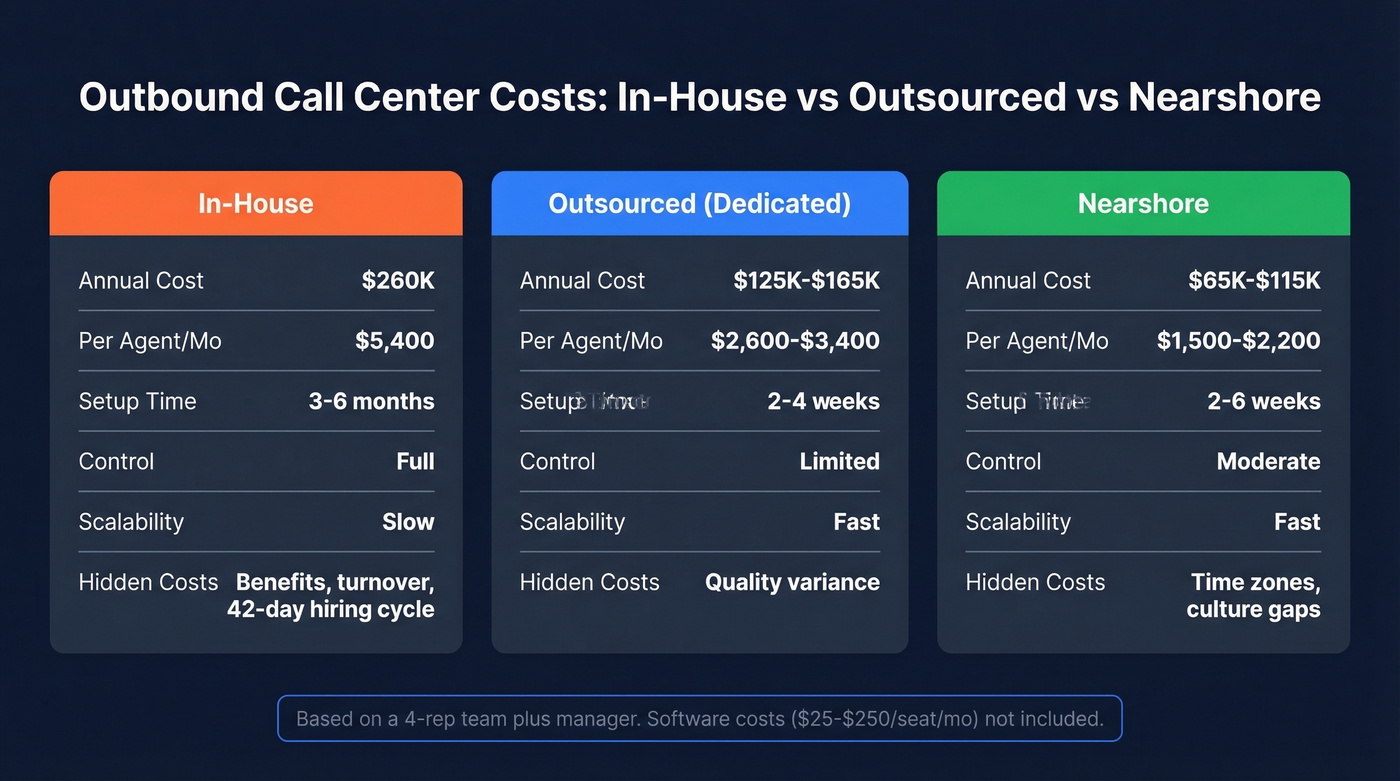
| Factor | In-House | Outsourced (Dedicated) | Nearshore |
|---|---|---|---|
| Annual cost | ~$260K (4 reps + mgr) | $125K-$165K (4 agents) | $65K-$115K |
| Per agent/mo | ~$5,400 fully loaded | $2,600-$3,400 | $1,500-$2,200 |
| Setup time | 3-6 months | 2-4 weeks | 2-6 weeks |
| Control level | Full | Limited | Moderate |
| Scalability | Slow | Fast | Fast |
| Hidden costs | Benefits, turnover | Quality variance | Time zones, culture |
An in-house team of four reps plus a manager runs roughly $260K per year when you factor in salaries, benefits, training, and support staff. That doesn't include software, phone infrastructure, or the opportunity cost of a 42-day hiring cycle followed by 30-90 days of onboarding before a rep is productive.
Outsourced agents bill $10-$50 per hour depending on location and expertise. Nearshore teams in Latin America and Eastern Europe cut that by 30-50%.
Software adds another layer. SMB dialers run $25-$150 per user per month. Enterprise CCaaS platforms like Five9 or Genesys start at $150/seat/month and climb fast once you add analytics, workforce management, and AI coaching modules.
The hybrid model - in-house team for high-value accounts, outsourced for volume campaigns - delivers the best cost-to-quality ratio for companies doing more than 5,000 dials per month. If your average deal size is under $10K and you're running fewer than 3,000 dials monthly, an outsourced calling service is almost always the smarter play.
KPIs That Actually Matter
Most outbound teams track too many metrics and act on too few. Here are the ones that drive decisions, with benchmark ranges you can use to set targets.
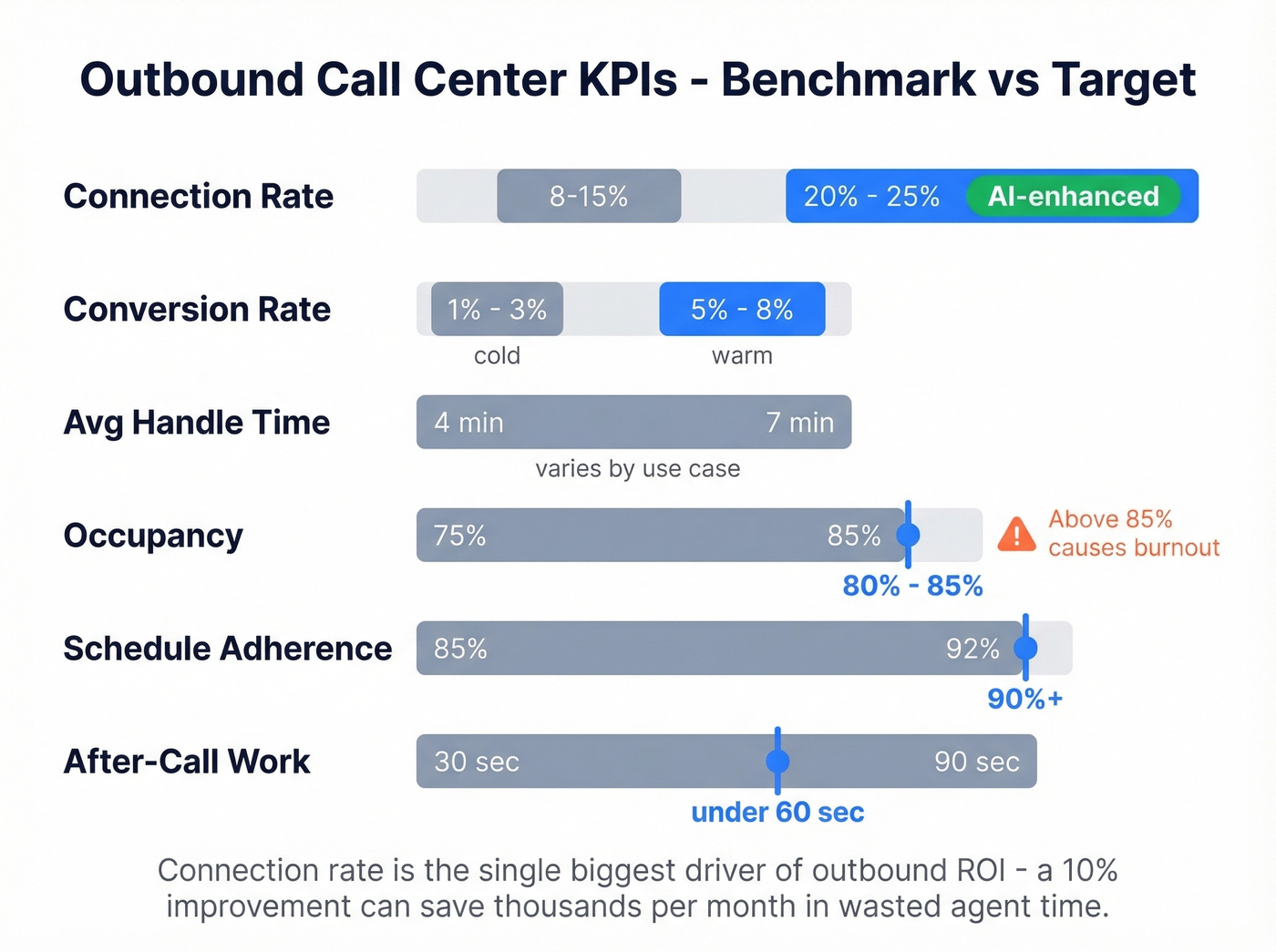
| KPI | Benchmark | Good Target | Formula |
|---|---|---|---|
| Connection rate | 8-15% | 20-25% (AI-enhanced) | Connects / dials x 100 |
| Conversion rate | 1-3% cold | 5-8% warm | Outcomes / connects x 100 |
| AHT (voice) | 4-7 min | Varies by use case | Talk + hold + ACW |
| Occupancy | 75-85% | 80-85% | Handle time / logged time |
| Schedule adherence | 85-92% | 90%+ | Actual / scheduled time |
| ACW | 30-90 sec | Under 60 sec | Post-call wrap time |
| CSAT | 80-90% | 85%+ | Satisfied / surveyed x 100 |
Connection rate is the metric that separates good operations from bad ones. Traditional campaigns average 8-15%. Teams using AI-enhanced dialing and verified data push that to 20-25%. The gap between those two numbers represents thousands of dollars in wasted agent time every month.
Conversion rate is trickier to benchmark because it depends entirely on what you're selling and to whom. Cold outbound to net-new prospects converts in the low single digits. Warm outbound - following up on inbound leads, re-engaging past customers - runs 5-8% or higher. Don't let anyone tell you "2% is good" without asking "2% of what?"
Occupancy above 85% sounds efficient but usually means agents are burning out. Below 75% means you're overstaffed or your dialer isn't feeding calls fast enough. The sweet spot is 80-85% for sustained campaigns.
Calls per day by role:
| Role | Typical Dials/Day | Target Connects |
|---|---|---|
| SDR (power dialer) | 80-150 | 12-20 |
| Collections (predictive) | 200-400 | 30-60 |
| Appointment setting | 60-100 | 8-15 |
Raw dial counts mean nothing without context. A hundred dials with 15 connects beats 300 dials with 10 every single time.
Outbound Call Center Software
The dialer is the engine, but picking the wrong type for your use case is one of the most common and expensive mistakes we see.
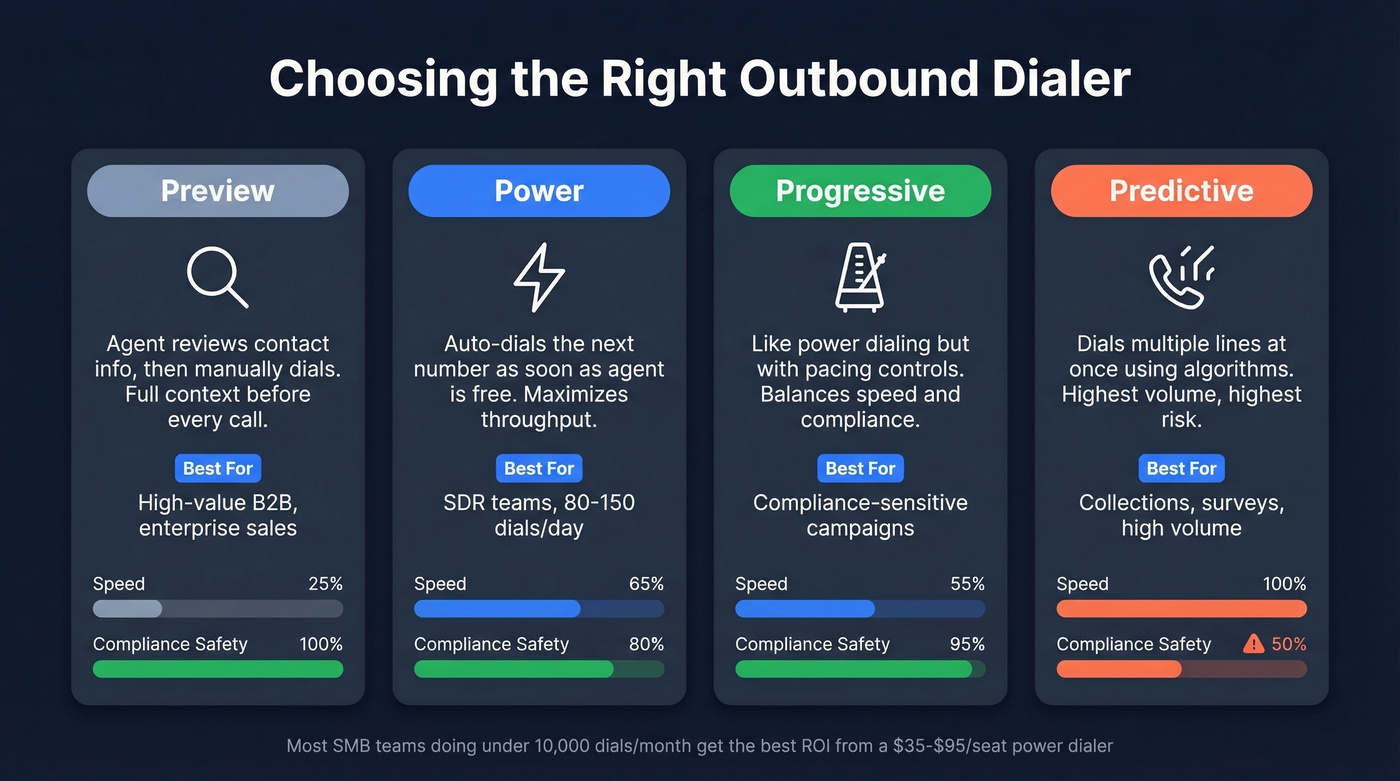
| Dialer Type | How It Works | Best For |
|---|---|---|
| Preview | Agent sees info, dials manually | High-value B2B sales |
| Power | Auto-dials next number when free | SDR teams, appointment setting |
| Progressive | Like power, with pacing controls | Compliance-sensitive campaigns |
| Predictive | Dials multiple lines simultaneously | High-volume collections, surveys |
Preview dialers give agents time to research before calling - essential for enterprise sales where you're calling a VP who'll hang up if you mispronounce their company name. Power dialers maximize throughput for SDR teams doing 80-150 dials per day. Predictive dialers are the fastest but carry compliance risk because they create abandoned calls when the algorithm misfires.
Most dialer vendors gate the good stuff behind higher tiers. CloudTalk includes 500 outbound minutes per user on Starter but locks power dialing to a higher plan. Kixie puts AI features and spam reduction tools on its top tier at roughly $95/mo. JustCall reserves predictive dialing for Pro plans.
For most SMB teams doing under 10,000 dials per month, a $35-$95/seat power dialer integrated with a lightweight CRM beats an enterprise CCaaS platform every time. Nextiva starts around $15/mo for basic calling. CloudTalk runs $25+ per user. Enterprise platforms like Five9 range from $150-$250 per seat per month.
AI coaching is worth watching. Real-time prompts, sentiment analysis, and automated call scoring are showing up to 14% productivity gains in early deployments. The tech isn't magic yet, but it's past the gimmick stage - especially for teams with newer reps who benefit from live disposition guidance.
CRM integration isn't optional. If your dialer doesn't sync with Salesforce or HubSpot automatically, your agents will spend 20% of their day on data entry instead of talking to prospects.
If you're building a modern outbound stack, start with a clear view of your SDR tools and how they connect to your CRM.

Connection rate is the metric that separates profitable call centers from money pits. Prospeo's 125M+ verified mobile numbers deliver a 30% pickup rate - triple the industry average. Stop burning agent hours dialing dead numbers at $5,400/month per rep.
Fix your connect rate before you hire another agent.
Compliance Rules You Can't Ignore
Let's be honest: compliance is the part of outbound that nobody wants to think about until the first cease-and-desist letter arrives. Under the current TCPA rules, you're looking at $500-$1,500 per violation, and plaintiff attorneys specialize in turning a single mishandled opt-out into a class action.
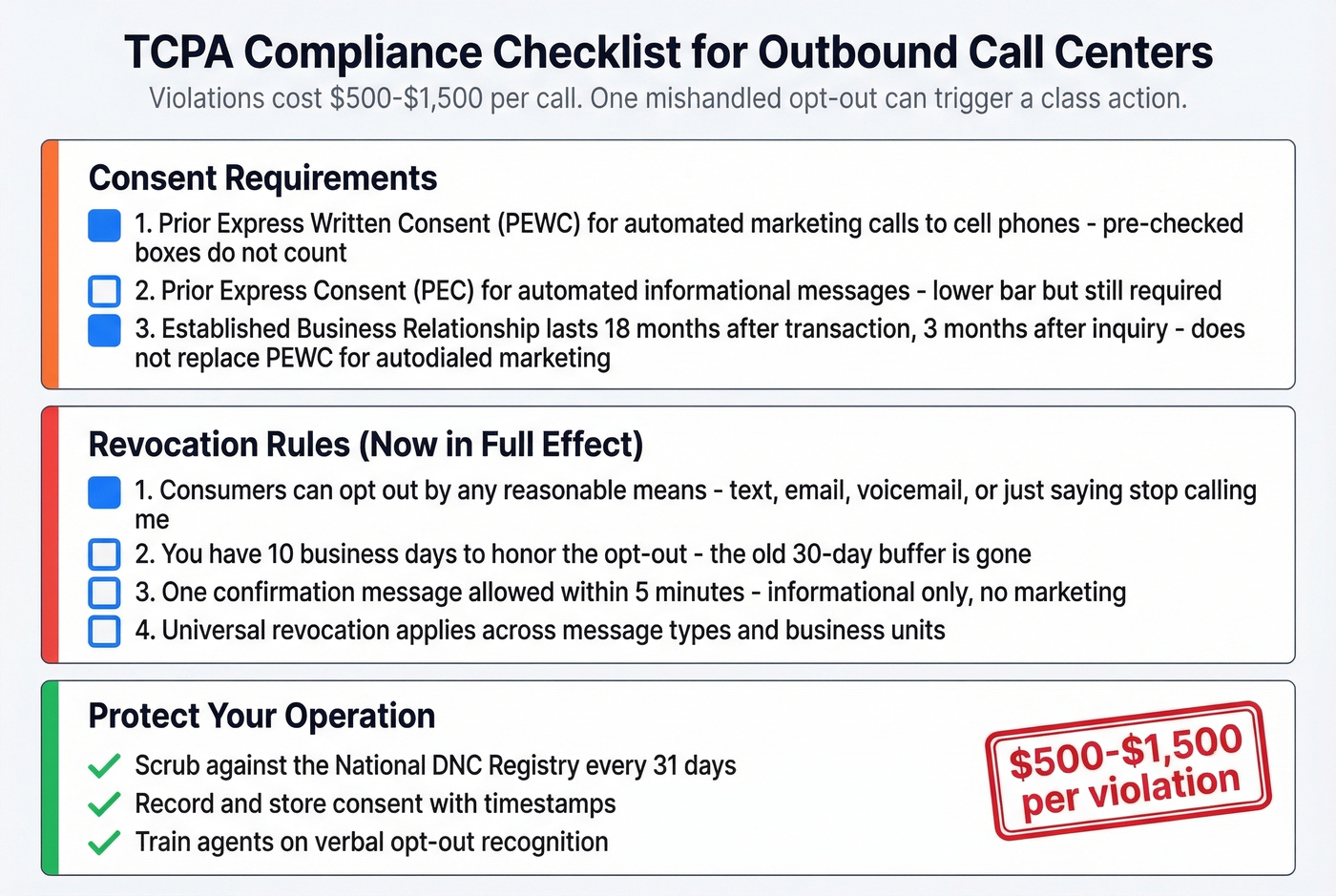
This isn't hypothetical. The April 2025 TCPA revocation changes are now in full effect, and they made opt-outs much easier for consumers - and much easier for businesses to mishandle.
Consent requirements:
- Prior Express Written Consent (PEWC) is required for automated or prerecorded marketing calls to cell phones. Pre-checked boxes don't count - the consumer must take affirmative action.
- Prior Express Consent (PEC) covers automated informational messages. Lower bar, but still required.
- Established Business Relationships help with DNC exemptions for live calls, but EBR doesn't substitute for PEWC on autodialed marketing calls. EBR lasts 18 months after a transaction, 3 months after an inquiry.
The revocation rules now in full effect:
- Consumers can revoke consent by any reasonable means - text, email, voicemail, even saying "stop calling me" mid-conversation.
- Your team has 10 business days to honor the opt-out. The old 30-day buffer is gone.
- You're allowed one confirmation message within 5 minutes of the revocation. No marketing content - informational only.
- The "universal revocation" expansion broadened how an opt-out applies across message types and business units.
Operational non-negotiables:
- Federal calling window: 8 a.m. to 9 p.m. in the recipient's time zone. Not yours.
- Scrub against the National DNC Registry every 31 days. Fines for illegal DNC calls run up to $50,120 per call.
- If you're using AI for outbound calls, disclose it at the start of the conversation before any sales content.
- State laws stack on top of federal rules. Connecticut alone carries penalties of up to $20,000 per violation.
Build the logging, the opt-out workflows, and the scrub cadence into your systems now - not after the first letter arrives.
Why Your Numbers Get Flagged as Spam
Roughly 4.5 billion robocalls hit US phones in a single month in 2024. Carriers responded with aggressive spam-detection algorithms, and legitimate outbound operations are getting caught in the crossfire. An estimated 25% of business numbers are at risk of being mislabeled as spam or blocked entirely.
The behaviors that trigger spam flags are predictable: high-volume repetitive dialing from the same number, ignoring DNC requests, calling outside standard hours, and using recycled numbers that carry a previous owner's bad reputation.
Mitigation isn't complicated, but it requires discipline:
- Space your calls. Rapid-fire dialing from the same number is the fastest way to get flagged. Rotate through a pool of registered numbers.
- Scrub DNC lists religiously. Every 31 days minimum. Calling someone on the DNC list doesn't just risk fines - it triggers carrier-level flags.
- Register numbers and update CNAM. Unregistered caller IDs are treated as suspicious by default. STIR/SHAKEN attestation helps carriers verify your identity.
- Rest recycled numbers. Give them roughly 6 months to shed inherited reputation issues.
- Invest in branded caller ID. The ROI is real: one insurance platform saw a 36% increase in long call duration and a 30% increase in policies sold within 30 days. Another company saw a 20-30% increase in call success rates just from correcting mislabeled numbers.
The Data Quality Problem
Here's the chain that kills outbound operations: bad data leads to wasted dials, which trigger spam flags, which burn phone numbers, which lower answer rates, which frustrate agents, which drive turnover, which raise costs. Every link traces back to the same root cause.
A predictive dialer on top of bad data is just a faster way to burn your phone numbers.
The industry-average data refresh cycle is six weeks. In that time, people change jobs, get new phone numbers, and switch email addresses. Your "verified" list decays by the day, and every dead number your agents dial is a wasted touch that inches your caller ID closer to a spam label.

This is where we've seen Prospeo make the biggest difference for outbound teams. Its database covers 300M+ professional profiles with 143M+ verified emails at 98% accuracy and 125M+ verified mobile numbers that deliver a 30% pickup rate. The difference-maker is the 7-day data refresh cycle - while most providers update every 4-6 weeks, Prospeo's records stay current. Meritt, an outbound-heavy sales org, saw their bounce rate drop from 35% to under 4% after switching. When your data is clean before it hits the dialer, every downstream metric improves: fewer wasted dials, fewer spam flags, higher connect rates, lower agent burnout.
If you're evaluating providers, compare options across sales prospecting databases and B2B company data before you commit.
How to Improve Answer Rates
We've seen outbound teams go from a 1-2% contact rate to 8-12% with 100-120 connects per shift - not by changing their script, but by fixing what happens before the first dial.
Data freshness is the single biggest lever. If your contact list was pulled three weeks ago, a meaningful percentage of those numbers are already stale. Snyk's 50-person sales team ran into exactly this problem - bounce rates of 35-40% were destroying their outbound efficiency. After switching to weekly-refreshed data, bounces dropped to under 5% and AE-sourced pipeline jumped 180%.
Beyond data, here's what actually moves answer rates:
Speed matters more than you think. HBR research shows you're 7x more likely to qualify a lead if you contact them within an hour of their first interaction. Time-zone optimization is the low-hanging fruit version of this - call prospects between 10-11 a.m. and 3-4 p.m. in their local time, and you can lift connect rates 15-20%.
Local presence dialing is table stakes in 2026. Matching your outbound caller ID to the prospect's area code increases the odds they'll pick up. If your dialer doesn't support this, switch dialers.
Test scripts on connects, not dials. Most teams A/B test scripts based on meetings booked. Test based on whether the prospect stays on the line past 30 seconds - that's the real signal for script quality.
Warm-up sequences change the math. An email or a relevant touchpoint before the call gives the prospect context. 82% of buyers accept meetings from salespeople who reach out with something relevant. The call shouldn't be the first touch - it should be the third or fourth.
If you need a starting point for the pre-call touches, use these sales follow-up templates and tighten your sales prospecting techniques.
The teams that obsess over dialing volume are solving the wrong problem. Volume without accuracy is just noise.
Common Challenges and Fixes
Agent turnover is expensive and constant. The average cost to hire and train a new outbound agent is $1,750, and annual turnover runs 30-45%. For a 20-seat operation, that's $25K-$35K per year just in replacement costs - and that doesn't account for the productivity dip while new hires ramp up, the institutional knowledge that walks out the door, or the morale hit on the agents who stay. Preventative programs like regular 1:1 check-ins, clear career paths, and realistic quota expectations can drive a 78% drop in performance-related attrition. Most managers skip these because they seem like "soft" initiatives. They're the highest-ROI investment in an outbound operation.
Rejection fatigue is real. Reddit threads from outbound agents paint a brutal picture: 350-400 calls per day in debt collection environments, with single-digit answer rates and frequent hostility from the people who do pick up. One common thread is agents describing the frustration of finally getting someone to answer only to realize the number belongs to someone who left the company months ago. The fix isn't motivational posters - it's better data so agents reach real people, better scripts so conversations go somewhere, and realistic daily targets that prioritize connects over raw dials.
Compliance complexity compounds. Federal rules, state rules, TCPA revocation changes, AI disclosure requirements, DNC scrub cadences - it adds up fast. The teams that handle this well build compliance into their tech stack through automated DNC scrubbing, consent logging, and time-zone-aware dialing rules rather than relying on agent training alone.
Tech stack bloat wastes money. The consensus on r/CRMSoftware is that tools like HubSpot feel like overkill for small outbound teams - too many features, too much navigation friction for fast-paced dialing workflows. If your agents are spending more time clicking through CRM screens than talking to prospects, you've over-engineered the stack. Skip the all-in-one platform. A focused dialer plus a lightweight CRM beats it every time.
If you're rethinking your CRM layer, start with a shortlist of contact management software or review a few examples of a CRM to match your workflow.
Bad data is the hidden cost nobody budgets for. Every wrong number costs you agent time, dialer minutes, and momentum. Prospeo refreshes 300M+ contacts every 7 days - not every 6 weeks - so your outbound team dials numbers that actually ring. At $0.01 per email and 10 credits per verified mobile, it costs less than one wasted hour of agent time.
Clean data costs pennies. Dirty data costs your pipeline.
FAQ
Is outbound calling still effective in 2026?
Yes. Companies using cold calling grow 42% faster than those that don't, and 82% of buyers accept meetings from relevant outreach. Most teams that "fail" at outbound are actually failing at data quality or compliance, not the channel itself.
How many calls should an agent make per day?
SDRs with power dialers typically handle 80-150 dials per day; collections agents using predictive dialers push 200-400. The metric that matters is connects per shift - 100 dials with 15 connects beats 300 dials with 10.
What's the difference between a power dialer and a predictive dialer?
Power dialers call one number at a time when the agent is ready, giving them pacing control. Predictive dialers call multiple numbers simultaneously using algorithms to predict agent availability - faster throughput, but higher risk of abandoned calls and compliance issues.
How much does outsourcing cost?
US-based outsourced agents run $10-$50 per hour or $2,600-$3,400 per agent per month for dedicated reps. Nearshore teams in Latin America or Eastern Europe cost 30-50% less. Factor in a 2-4 week ramp period before agents hit full productivity.
How do I keep calls from being flagged as spam?
Rotate across multiple registered numbers, scrub DNC lists every 31 days, update CNAM records, rest recycled numbers for 6 months, and invest in branded caller ID - which lifts answer rates 20-36%. Using freshly verified contact data also reduces wasted dials to dead numbers, which is a primary trigger for carrier spam algorithms.