

Outbound Sales Agent: Salary, Skills, Scripts & the Complete 2026 Playbook
Four hundred emails. Thirty to fifty customer calls. Follow-ups stacking on top of internal fires. That's how one outbound sales agent on r/sales described their daily reality - right before admitting they needed a vacation. The thread's title? "How in the world are you guys doing 100 outbound calls?" Most companies set their reps up to fail by measuring activity instead of outcomes, handing them bad data, and calling it a "numbers game." It doesn't have to work that way.
The 30-Second Version
If you're considering an outbound sales agent role or just started one, here's the quick take. Median total comp is $91K/year. You need 3-4 core tools: a data provider, a sequencer, a dialer, and a CRM. Expect 80-100+ touches per day across channels. The agents who succeed prioritize data quality and follow-up discipline over raw call volume. The rest of this guide gives you the numbers, scripts, and stack to execute.
What Does an Outbound Sales Agent Do?
An outbound sales agent is anyone whose job starts with seller-initiated contact. You're not waiting for inbound leads to fill your calendar - you're cold calling, cold emailing, and reaching out on social to people who haven't raised their hand. That's the fundamental split. Inbound reps work leads that come through marketing. Outbound reps go find their own.
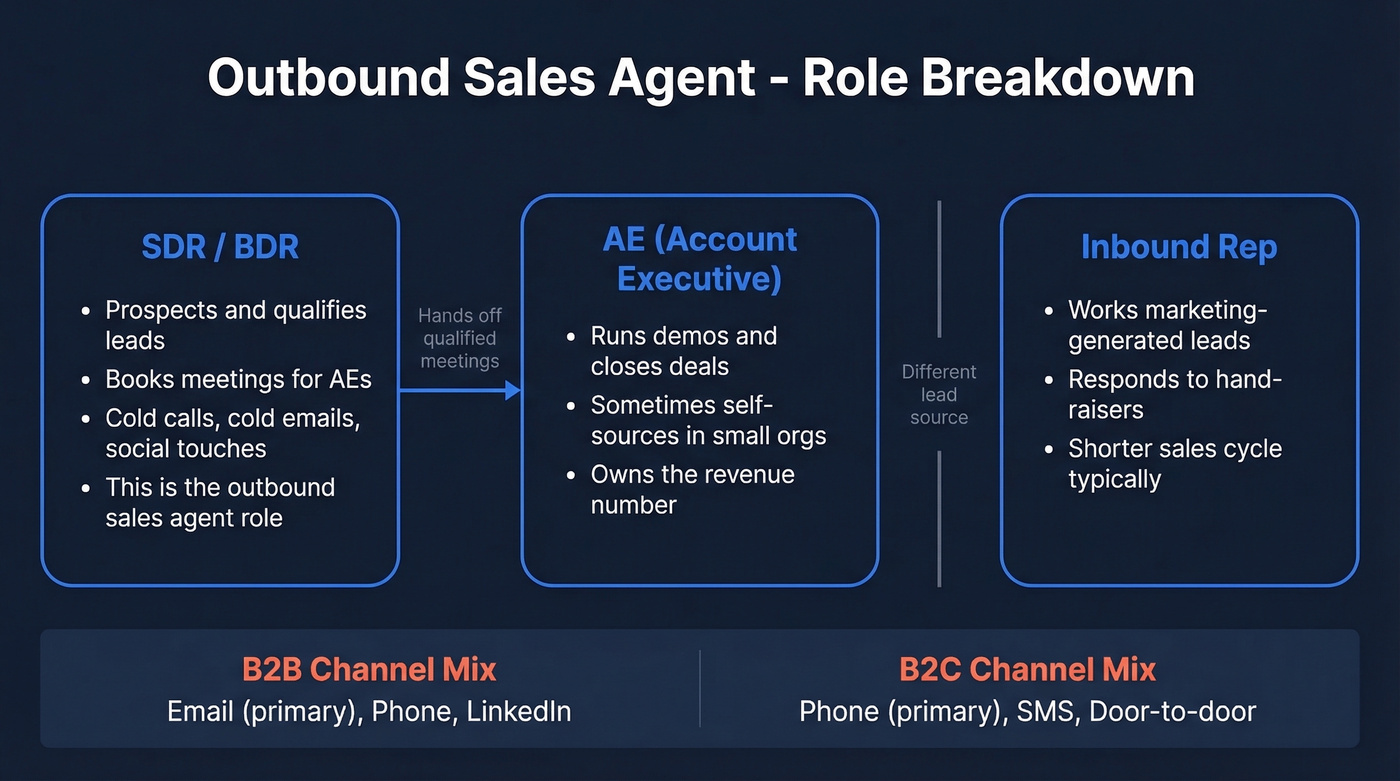
In B2B, the channel mix skews heavily toward email and phone, with social touches layered in. B2C outbound leans more on phone and often SMS. Here's how the titles break down: an SDR (Sales Development Representative) focuses on prospecting and qualifying - they book meetings for account executives. A BDR (Business Development Representative) often does the same thing, though some companies use BDR for outbound-only and SDR for inbound. An AE (Account Executive) runs demos and closes deals, sometimes doing their own prospecting in smaller orgs.
The "outbound sales agent" title typically maps closest to the SDR/BDR function - the person doing the hard work of opening conversations from scratch.
Salary and Compensation
Let's talk money. According to Glassdoor, the median total pay for an outbound sales representative in the US is $91K/year, with a typical range of $71K-$121K. That breaks down into a base salary of $43K-$68K and additional pay (commissions, bonuses) of $28K-$53K.
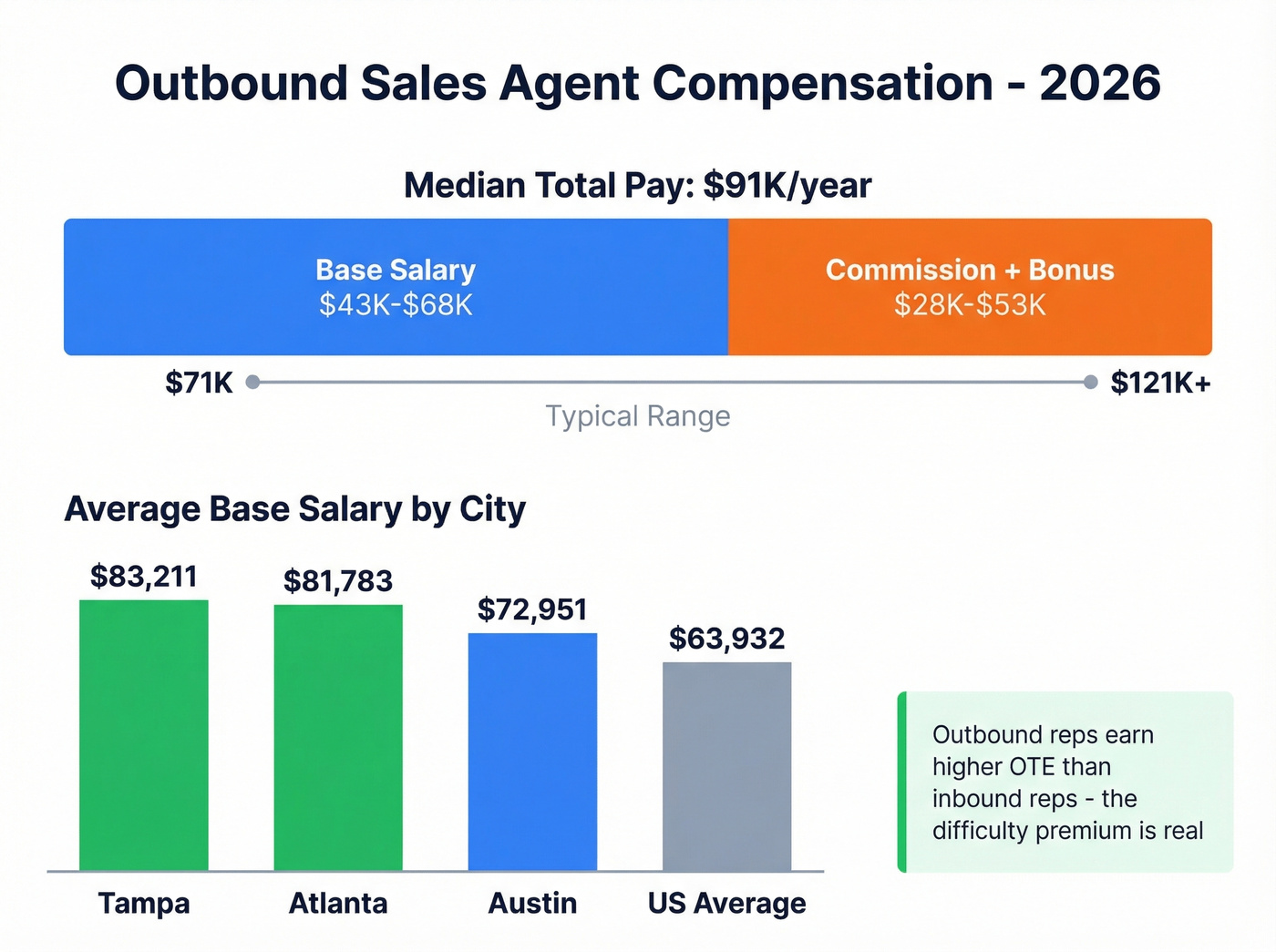
Indeed's data pegs the average base salary at $63,932/year, which aligns with Glassdoor's base range. Geography matters:
| City | Avg Base Salary |
|---|---|
| Tampa | $83,211 |
| Atlanta | $81,783 |
| Austin | $72,951 |
| US Average | $63,932 |
The commission structure makes or breaks outbound comp. Most roles use an OTE (On-Target Earnings) model where base salary represents 50-60% of total comp and commissions fill the rest. Some companies offer uncapped commissions - that's where top performers push well past $121K. Others cap commissions or use tiered accelerators that kick in after you hit 100% of quota.
Here's the thing: outbound reps typically earn higher OTE than inbound reps because the role is harder. You're creating demand, not capturing it. That difficulty premium is real, but so is the reality that roughly 40-50% of SDRs consistently hit quota in any given quarter.
Core Responsibilities and Skills
The day-to-day breaks down into six core activities:
- Prospecting - identifying and researching potential buyers who fit your ICP
- Qualifying - determining whether a prospect has the budget, authority, need, and timing (BANT) to buy, or running MEDDICC for complex enterprise deals
- Outreach - executing multichannel cadences across email, phone, and social
- Presenting - delivering your value prop clearly in 30 seconds on a cold call or in 3 sentences in an email
- Following up - working a cadence through 8-12 touchpoints without dropping off
- CRM reporting - logging every activity so your manager and you can see what's working
Communication is table stakes. You need to write concise emails and hold a conversation on the phone without reading from a script like a robot. Resilience matters because you'll hear "no" (or nothing at all) 95%+ of the time. Time management is critical when you're juggling 80-100 touches per day across multiple channels.
Two skills get underrated: product knowledge and data literacy. Knowing your product deeply enough to handle objections on the fly turns a cold call into a booked meeting. And understanding your data - which lists are clean, which segments convert, which signals indicate buying intent - separates reps who grind from reps who produce. One more: avoid jargon. Prospects tune out the moment you start rattling off acronyms and buzzwords they don't use in their own meetings.
The Outbound Sales Process
1. Define your ICP. Before you touch a single lead, get crystal clear on who you're targeting. Industry, company size, job titles, tech stack, funding stage - the tighter your ICP, the higher your conversion rates.
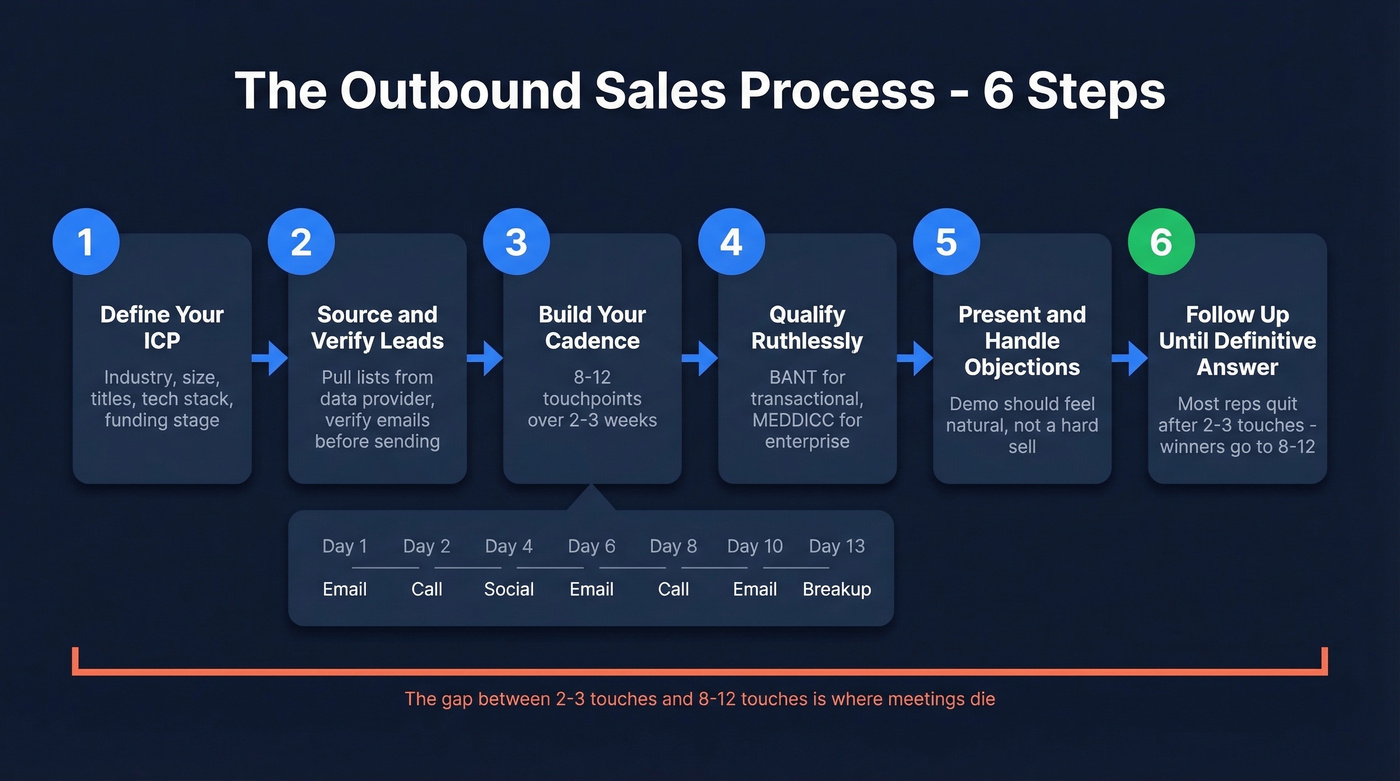
2. Source your leads. Pull lists from your data provider using filters that match your ICP. Data quality is the force multiplier nobody talks about enough. Verify your list before sending - high bounce rates wreck deliverability fast.
3. Build your cadence. The average prospect needs 8-12 touchpoints before they engage. A solid multichannel cadence over 2-3 weeks:
- Day 1: Personalized email (pain-point hook, not a pitch)
- Day 2: Phone call + voicemail
- Day 4: Social touch (comment or connection request)
- Day 6: Follow-up email (new angle, reference the first)
- Day 8: Phone call (different time of day)
- Day 10: Email #3 (case study or social proof)
- Day 13: Final breakup email
4. Qualify ruthlessly. For transactional deals, BANT works fine - does the prospect have Budget, Authority, Need, and Timing? Three out of four usually means qualified. For complex enterprise sales, MEDDICC gives you a more rigorous framework covering Metrics, Economic Buyer, Decision Criteria, Decision Process, Identify Pain, Champion, and Competition.
5. Present and handle objections. If you've qualified well, the demo or pitch should feel like a natural next step, not a hard sell.
6. Follow up until you get a definitive answer. Most reps give up after 2-3 touches. The data says you need 8-12. That gap is where meetings die.

Bad data is why most outbound agents burn out grinding 100+ touches a day with nothing to show for it. Prospeo's 300M+ profiles are refreshed every 7 days - not every 6 weeks - so your cold emails actually reach real inboxes. 98% email accuracy, 125M+ verified mobile numbers, and 30+ ICP filters mean fewer wasted dials and more booked meetings.
Stop grinding on stale lists. Start every cadence with data that connects.
KPIs Every Outbound Rep Should Track
You can't improve what you don't measure. Here are the benchmarks that matter:
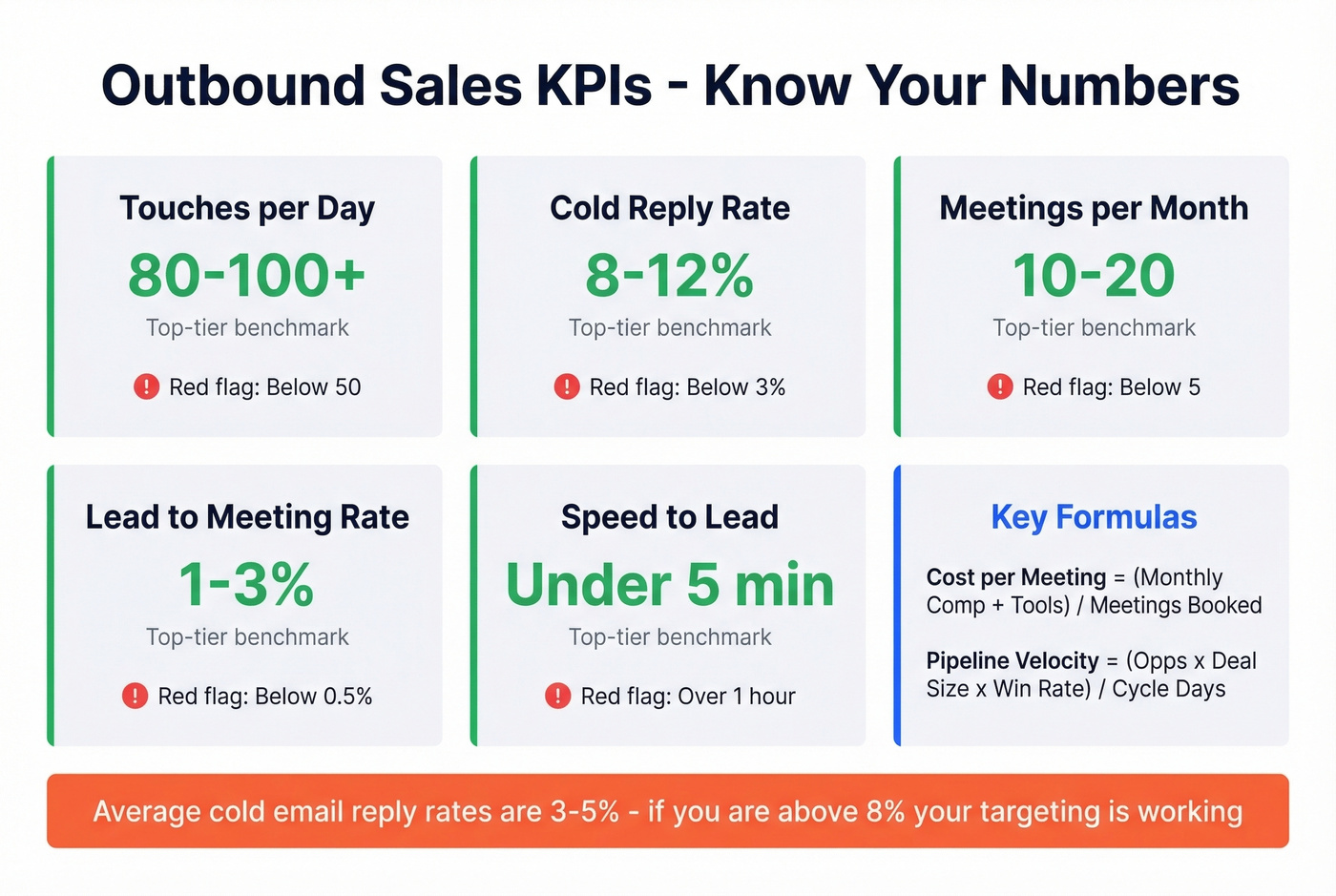
| Metric | Top-Tier Benchmark | Red Flag |
|---|---|---|
| Touches/day | 80-100+ | Below 50 |
| Cold reply rate | 8-12% | Below 3% |
| Meetings/month | 10-20 | Below 5 |
| Lead-to-meeting | 1-3% | Below 0.5% |
| Speed-to-lead | Under 5 min | Over 1 hour |
Note that 8-12% reply rates represent top-tier performance, not average. Average cold email reply rates hover around 3-5%. If you're above 8%, your targeting and messaging are working.
When touches per day drop below 50, it's usually a process or tooling problem - not a motivation problem. When reply rates dip below 3%, your targeting or messaging is broken. A lead-to-meeting rate under 0.5% almost always means you're spraying and praying instead of working a tight ICP.
Two formulas worth memorizing:
Cost per meeting = (monthly comp + tool costs) / meetings booked. If your loaded SDR cost is $20K/month and you book 12 meetings, that's $1,667 per meeting. Track this monthly - it's the single best indicator of outbound efficiency.
Pipeline velocity = (qualified opportunities x avg deal size x win rate) / sales cycle length in days. This tells you how much revenue your pipeline generates per day and reveals whether you have a volume problem, a conversion problem, or a speed problem.
Speed-to-lead is the sleeper metric. Responding to an inbound signal within 5 minutes dramatically increases your odds of booking a meeting. Wait over an hour and you've essentially lost the lead. We've seen teams cut their speed-to-lead from 45 minutes to under 3 minutes just by setting up real-time alerts from their intent data provider.
Scripts and Templates That Work
Buyers' average attention span for a cold outreach message is measured in seconds, not minutes. Scripts aren't about reading word-for-word - they're frameworks that keep you from fumbling the first 10 seconds.
Cold Call Opener (Micro-Yes)
"Hi [Name], this is [Your Name] with [Company]. I know I'm calling out of the blue - do you have 30 seconds so I can tell you why, and then you can decide if we should keep talking?"
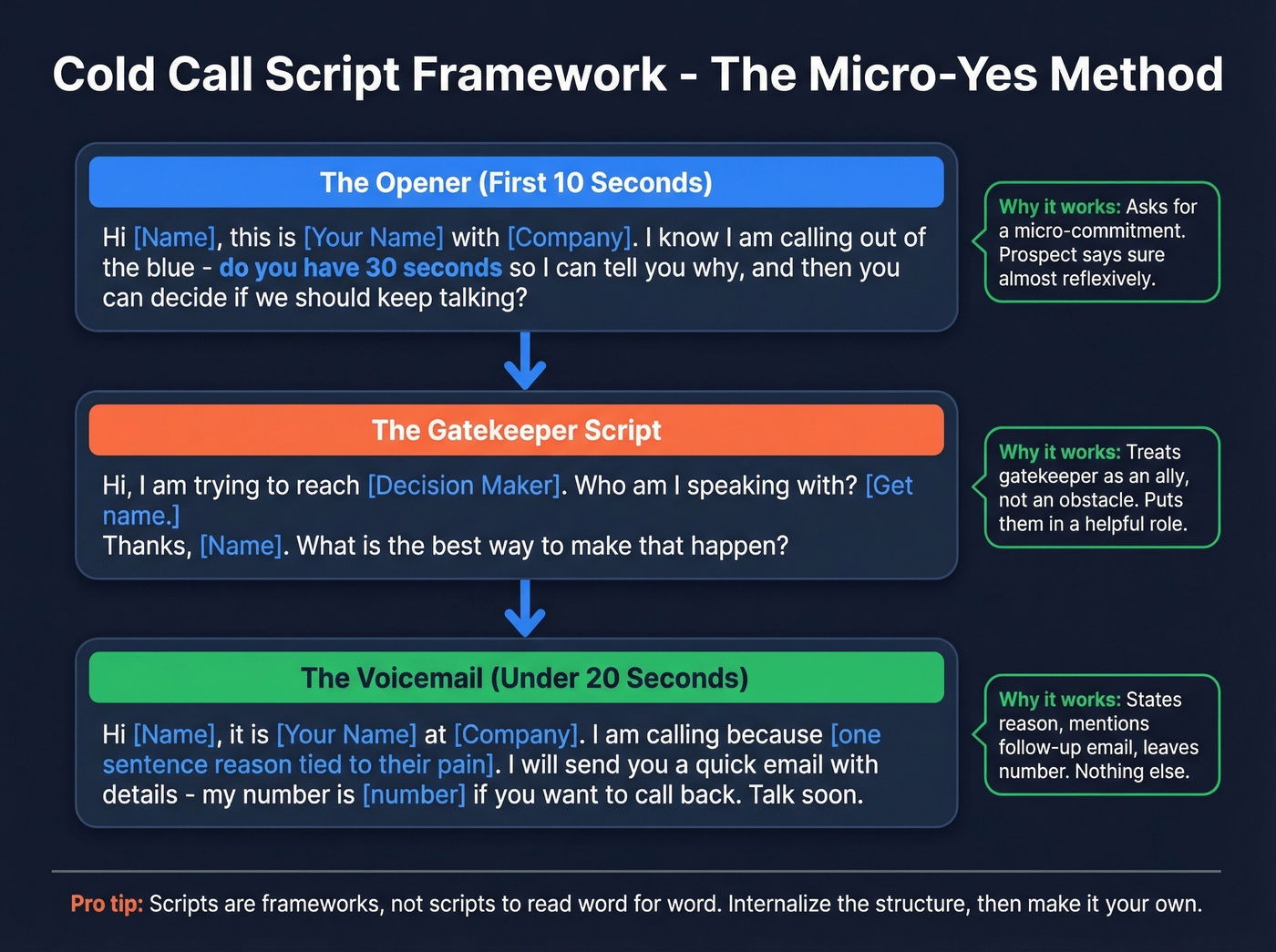
This opener, adapted from Pipedrive's cold calling playbook, works because it asks for a micro-commitment. The prospect says "sure" almost reflexively, and now you've got permission to deliver your hook.
Gatekeeper Script
"Hi, I'm trying to reach [Decision Maker]. Who am I speaking with? [Get name.] Thanks, [Name]. What's the best way to make that happen?"
Asking the gatekeeper's name and treating them as an ally - not an obstacle - changes the dynamic entirely. "What's the best way to make that happen?" puts them in a helpful role instead of a blocking one.
Voicemail Template
"Hi [Name], it's [Your Name] at [Company]. I'm calling because [one-sentence reason tied to their pain]. I'll send you a quick email with details - my number is [number] if you want to call back. Talk soon."
Keep voicemails under 20 seconds. State the reason, mention the follow-up email, leave your number. That's it.
Cold Email Template
Subject: [Pain point] at [Company]
Hi [Name],
[Company] is scaling [specific initiative] - which usually means [specific pain point your product solves].
We helped [similar company] cut [metric] by [result] in [timeframe]. Happy to share how.
Worth a 15-minute call this week?
[Your Name]
Keep cold emails under 100 words. Lead with their problem, not your product. End with a low-friction CTA. Personalization and timing are the two biggest success drivers in 2026 - generic templates get filtered; relevant, well-timed messages get replies.
Building Your Outbound Tech Stack
The average SDR team uses 12-15 tools daily. That's insane. You need 3-4 tools, maybe 5. Everything else is overhead that slows you down and drains budget.
| Category | Typical Cost | Examples |
|---|---|---|
| Data/Prospecting | $50-$500/user/mo | Prospeo, Apollo (Free-$79/mo), ZoomInfo |
| Sales Engagement | $25-$150/user/mo | Instantly, Smartlead, Outreach, SalesLoft |
| Dialer | $50-$200/user/mo | Orum, Trellus, PhoneBurner |
| CRM | $25-$300/user/mo | Salesforce, HubSpot |
| Scheduling | $10-$30/user/mo | Calendly |
| Conversation Intel | $100-$200/user/mo | Gong, Grain |
Total stack cost runs $2,000-$5,000 per SDR per month for a fully loaded setup. But you don't need to start there.
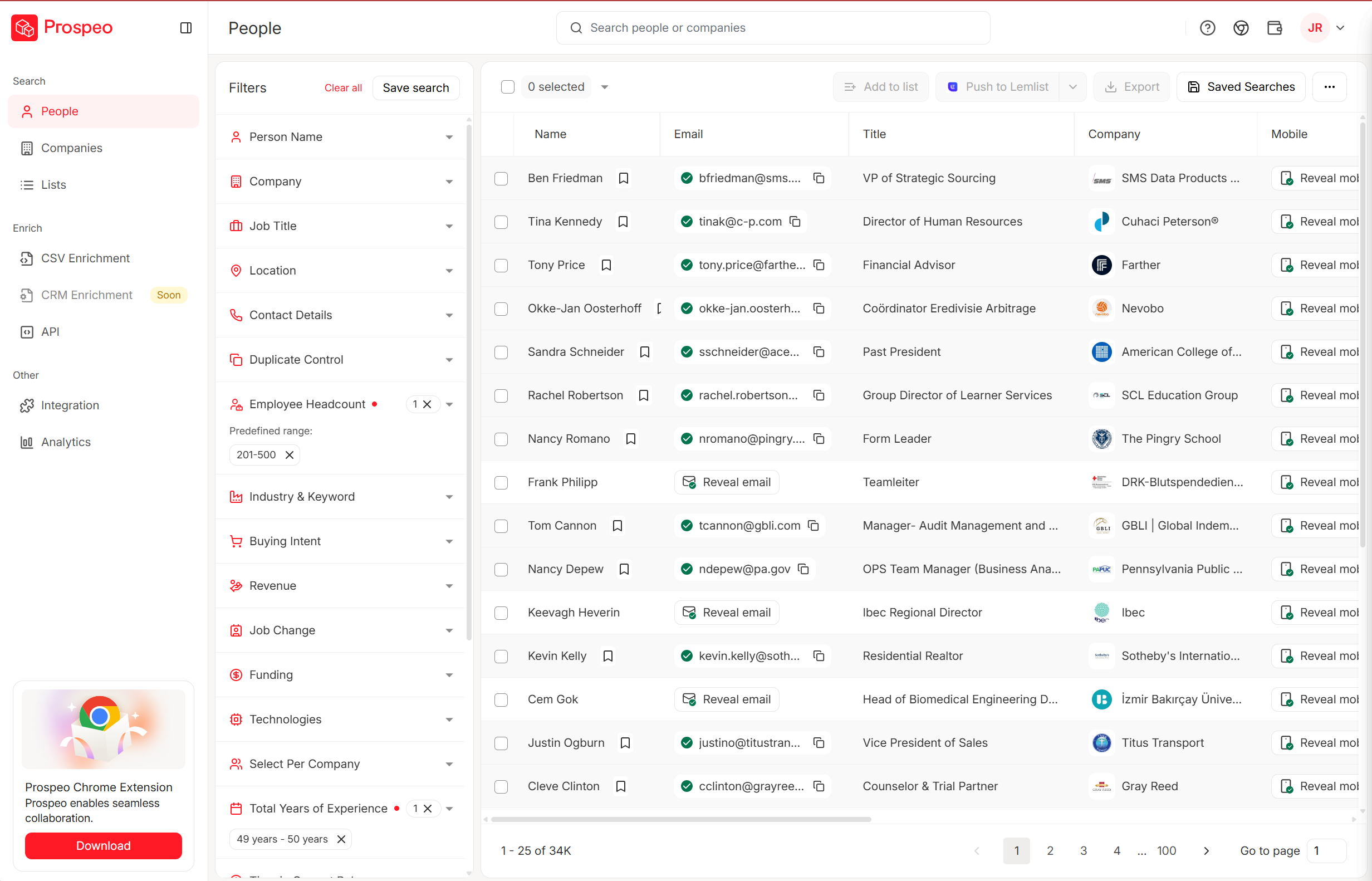
The starter stack that actually works: your data provider for verified contacts, Instantly or Smartlead for sequencing, HubSpot (free CRM) for tracking. You're looking at under $200/month total and you can run a legitimate outbound operation.
Look, the data provider is the most important tool in your stack. Bad emails burn your domain reputation. Disconnected phone numbers waste entire call blocks. Everything downstream - your sequences, your cadences, your conversion rates - depends on starting with clean data. We've watched teams spend $150/month on a sequencer and $0 on data verification, then wonder why their reply rates are in the gutter.
Prospeo runs a 5-step verification process with catch-all handling, spam-trap removal, and honeypot filtering, delivers 98% email accuracy, and refreshes all records on a 7-day cycle versus the 6-week industry average. At roughly $0.01 per lead, it's a fraction of what ZoomInfo charges - ZoomInfo starts at $14,995/year and most teams pay $20-50K/year once they add modules. Native integrations with Instantly, Smartlead, Lemlist, HubSpot, Salesforce, Clay, Zapier, and Make mean your data flows straight into your sequencer without CSV exports.
If you're evaluating tools, start with a shortlist of SDR tools and a clear view of data enrichment services so you know what should live where in your stack.
AI vs Human Outbound Agents
One Reddit operator broke down their AI-heavy outbound stack versus a traditional SDR hire, and the numbers got a lot of attention:
| Factor | Human SDR | AI-Heavy Stack |
|---|---|---|
| Monthly cost | $18-22K (loaded) | ~$1,800 |
| Prospects contacted | 1,000-2,000 | ~20,000 |
| Meetings booked | 8-15 | ~14 |
| Cost per meeting | $1,200-$2,750 | ~$130 |
| Ramp time | 3-6 months | Days |
| Closing ability | High | None |
The economics are compelling on paper. An AI stack using tools like Clay ($134-$720/mo), Instantly ($37-$286/mo), Unify ($1,740/mo+), and enrichment APIs can contact 10x more prospects at a tenth of the cost.
But AI can't close. It can't read the room on a discovery call, improvise when a prospect throws a curveball objection, or build the kind of relationship that turns a $50K deal into a $500K expansion. Where AI genuinely helps outbound reps right now: account research, first-draft personalization, speed-to-lead on intent signals, and campaign analysis. Where it breaks: closing, creative strategy, edge-case judgment, and handling angry or confused prospects.
For teams where the average deal size is under $10K, a well-built AI-assisted workflow will outperform a junior SDR on cost-per-meeting every time. Above that threshold, the human relationship becomes the moat. The sweet spot for most teams is AI doing the research and first drafts while a human reviews, sends, and takes every live conversation.
AI won't replace the outbound sales agent in 2026. But an agent who uses AI will absolutely replace one who doesn't. If you're building that workflow, borrow patterns from AI cold email outreach and best AI for automating sales follow-ups.
Common Mistakes That Kill Results
Talking too much. The best outbound calls have the prospect talking 60%+ of the time. If you're monologuing about features for 3 minutes, you've already lost.
Failing to qualify before demoing. Giving a full demo to someone who doesn't have budget or authority is the most expensive mistake in outbound. Qualify first, demo second. Always. (If you want a tighter structure, use a discovery questions framework.)
Pitching the wrong stakeholder. You can have the best pitch in the world, but if you're delivering it to someone who can't sign a check or influence the decision, you're wasting both your time and theirs.
Shotgun targeting. Blasting 10,000 generic emails to an unfiltered list isn't outbound sales - it's spam. Tight ICP targeting with personalized messaging outperforms mass blasts every single time, and the consensus on r/sales backs this up repeatedly.
Inconsistent follow-up. Remember the 8-12 touchpoint benchmark. Most reps quit after touch 3. The meeting was waiting at touch 8. Use proven sales follow-up templates and a repeatable sequence management process.
Bad data - the invisible killer. This one doesn't show up in your CRM reports but destroys everything. Bounced emails burn your sender domain reputation. Disconnected numbers waste entire call blocks. Before you send a single email, verify your list. Meritt saw their bounce rate drop from 35% to under 4% after switching data providers - that's the difference between a dead domain and a healthy pipeline. (If you're troubleshooting, start with email bounce rate benchmarks and an email deliverability guide that fixes root causes.)
The "100-calls-a-day target is a management crutch" opinion isn't popular with sales leaders, but I'll say it anyway. Activity metrics without quality metrics produce burnout, not pipeline. Track conversations and meetings booked, not dials.
Compliance Rules for 2026
Skip this section at your own risk. TCPA litigation surged roughly 95% in 2025, with class actions spiking 285% in September alone. If you're making outbound calls or sending texts, the rules have shifted dramatically.
The FCC classified AI-generated voices as "artificial or prerecorded" in February 2024, which means using AI voice agents for cold calls requires prior express written consent. No exceptions. The consent revocation rules that took effect in April 2025 mean consumers can revoke consent by any reasonable method - including just texting "STOP." Some cross-channel revocation effects are delayed until April 2026, but don't wait to comply.
State-level "mini-TCPAs" add another layer:
| State | Effective Date | Key Rule |
|---|---|---|
| Texas (SB 140) | Sep 1, 2025 | Expanded solicitation def incl. texts |
| Virginia (SB 1339) | Jan 1, 2026 | Honor text opt-outs for 10 years |
| Connecticut (SB 1058) | 2025 | Calls 9am-8pm local; $20K/violation |
| Maine (LD 2234) | 2025 | Must check Reassigned Numbers DB |
Maintain clean opt-out lists, respect calling windows, never use AI voice without explicit written consent, and check the Reassigned Numbers Database before dialing. Penalties run up to $20,000 per violation in some states. One sloppy campaign can cost more than your entire annual tech stack budget.
You just read that reps need 8-12 touchpoints to book a meeting. That cadence collapses when 35% of your emails bounce and your direct dials ring dead lines. Prospeo delivers 98% verified emails and mobile numbers with a 30% pickup rate - the same data that helped Snyk's 50 AEs generate 200+ new opportunities per month.
Your cadence is only as good as the data behind it. Fix that first.
FAQ
Is being an outbound sales agent hard?
Yes - expect 80-100+ touches per day, frequent rejection, and constant quota pressure. The reps who thrive build systems (cadences, scripts, verified data) instead of relying on raw volume. Resilience and time management matter more than natural charisma.
How many calls should an outbound rep make per day?
High-performing teams target 80-100+ touches across all channels, with pure cold call targets ranging from 50-100 dials. Multichannel cadences blending calls, emails, and social touches consistently outperform phone-only approaches by 2-3x on meetings booked.
What's the difference between outbound and inbound sales?
Outbound means the seller initiates contact - cold calls, cold emails, social outreach. Inbound means the buyer comes to you through demo requests or content leads. Outbound reps typically earn 15-25% higher OTE because the role demands proactive pipeline creation.
Do I need a degree for outbound sales?
No. Most outbound roles prioritize communication skills, resilience, and coachability over formal education. Many top-performing SDRs have no college degree - hiring managers care about your ability to hold a conversation and follow a process.