

Pabbly vs Apollo.io: They're Not Competitors (Here's What You Actually Need)
Comparing Pabbly vs Apollo.io is like comparing a conveyor belt to a warehouse. One moves things between places; the other stores and serves up the things you need. They solve fundamentally different problems - yet the internet is full of integration tutorials pretending they're interchangeable.
Let's clear this up.
30-Second Verdict
- Need to automate tasks between apps? Pabbly Connect.
- Need B2B leads and outreach sequences? Apollo.io.
What Each Tool Actually Does
Pabbly Connect - Workflow Automation
Pabbly Connect is a workflow automation platform with 2,000+ integrations, used by 14,099+ businesses. Think Zapier, but often cheaper. You use it to connect apps - push a new CRM contact into Slack, trigger an email sequence when a form gets submitted, sync invoices to your accounting tool.
If you're building a full outbound stack, it helps to map where automation fits into your sales funnel automation layer.
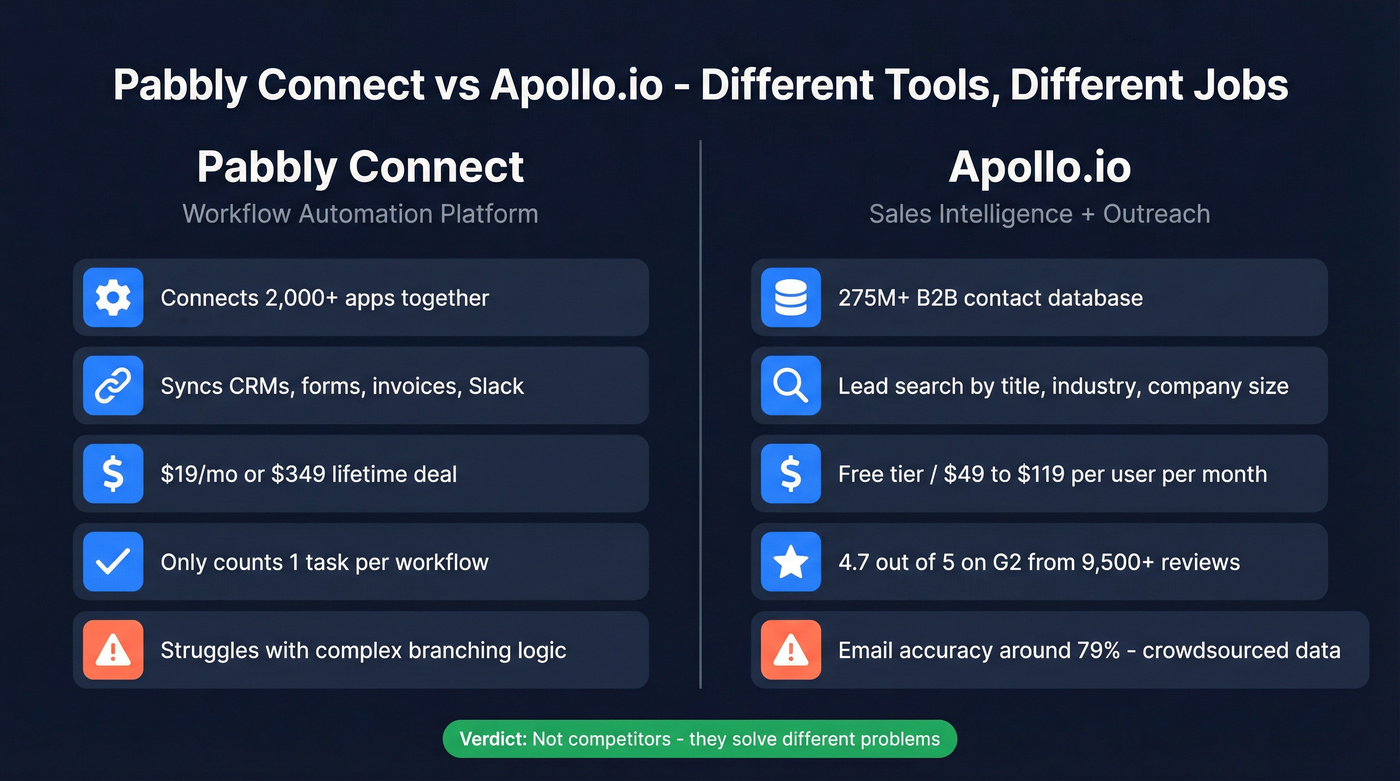
The pricing is the headline: $19/mo on subscription, or a $349 one-time lifetime deal. That lifetime deal is a no-brainer for small teams paying $50+/mo on Zapier. Pabbly's task-counting model also works in your favor - triggers and internal steps are free, so the same workflow that costs 2 tasks on Zapier and 3 on Make costs just 1 on Pabbly.
The tradeoff? Pabbly struggles with complex branching, heavy data manipulation, and error recovery at scale. If your workflows are simple (and most are), it's great. Multi-step conditional logic will hit walls fast.
If you're trying to operationalize this for reps, pairing automation with clear sales activities is usually what makes it stick.
Apollo.io - Sales Intelligence + Outreach
Apollo is a B2B contact database and outreach platform rolled into one. It carries a 4.7/5 rating on G2 from 9,512 reviews and earned #13 Best Sales Software in G2's 2026 Best Software Awards. With 60% of B2B software teams now using AI across their sales processes, Apollo has leaned hard into AI-powered features - and it shows in the product.
If you're evaluating data sources broadly, compare Apollo against other sales prospecting databases before committing.
The credit system is where things get tricky. Apollo's free tier gives you 10,000 email credits/mo but only 5 mobile credits. Paid plans run from $49/user/mo (Basic) through $79/user/mo (Professional) to $119/user/mo (Organization), with the Organization tier requiring a 3-user minimum. Exporting leads and viewing mobile numbers eat credits fast - users report overage costs of $0.03-$0.10 per credit.
Here's the thing: Apollo's data is partially crowdsourced. Users update records, which means accuracy varies wildly outside the US. The consensus on r/sales is that Apollo is a "jack of all trades, master of none." Teams running high-volume outbound frequently report bounce rates that damage sender reputation.
If you're building a repeatable outbound motion, these sales prospecting techniques help reduce spray-and-pray list building.
Side-by-Side Comparison
| Pabbly Connect | Apollo.io | Prospeo | |
|---|---|---|---|
| Category | Workflow automation | Sales intelligence + outreach | B2B data + verification |
| Starting price | $19/mo or $349 lifetime | Free / $49/user/mo | Free (75 emails/mo) / ~$0.01/email |
| Best for | Automating tasks between apps | Finding leads + sequences | Verified emails + direct dials |
| Integrations | 2,000+ apps | CRM + email tool integrations | Salesforce, HubSpot, Smartlead, Instantly, Zapier, Make, n8n |
| Key limitation | Complex workflows | Inconsistent data accuracy | Not an outreach tool |
Since these tools occupy different categories, there's no single "winner." Pick based on your actual problem: Pabbly for plumbing, Apollo for prospecting, Prospeo for making sure the data is accurate before you hit send.
If you're also enriching records after capture, consider dedicated data enrichment services as a separate layer.

Pabbly automates your workflows. Apollo finds your leads. But neither verifies the data. Teams running Apollo exports through Prospeo cut bounce rates from 35% to under 4%. At $0.01/email with 98% accuracy, it's the missing layer.
Stop sending to dead emails. Verify 75 leads free, right now.
When You Need One, the Other, or Both
Pabbly Connect is the right call when you're wiring apps together - syncing your CRM to email tools, pushing form submissions into Slack, routing data between platforms your team already uses. It's plumbing, not prospecting.
If you're still choosing the system of record, start with these examples of a CRM to sanity-check what you actually need.
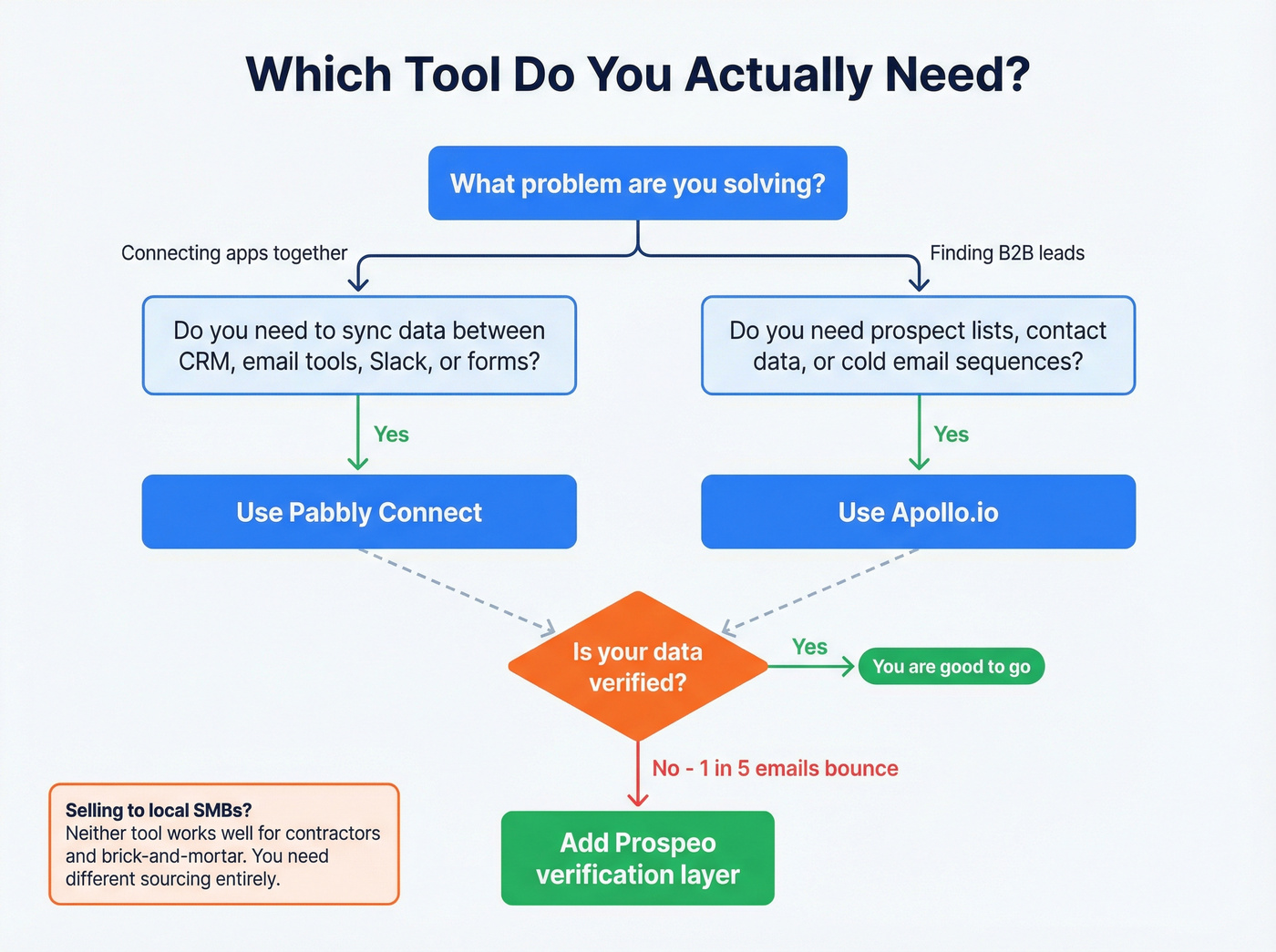
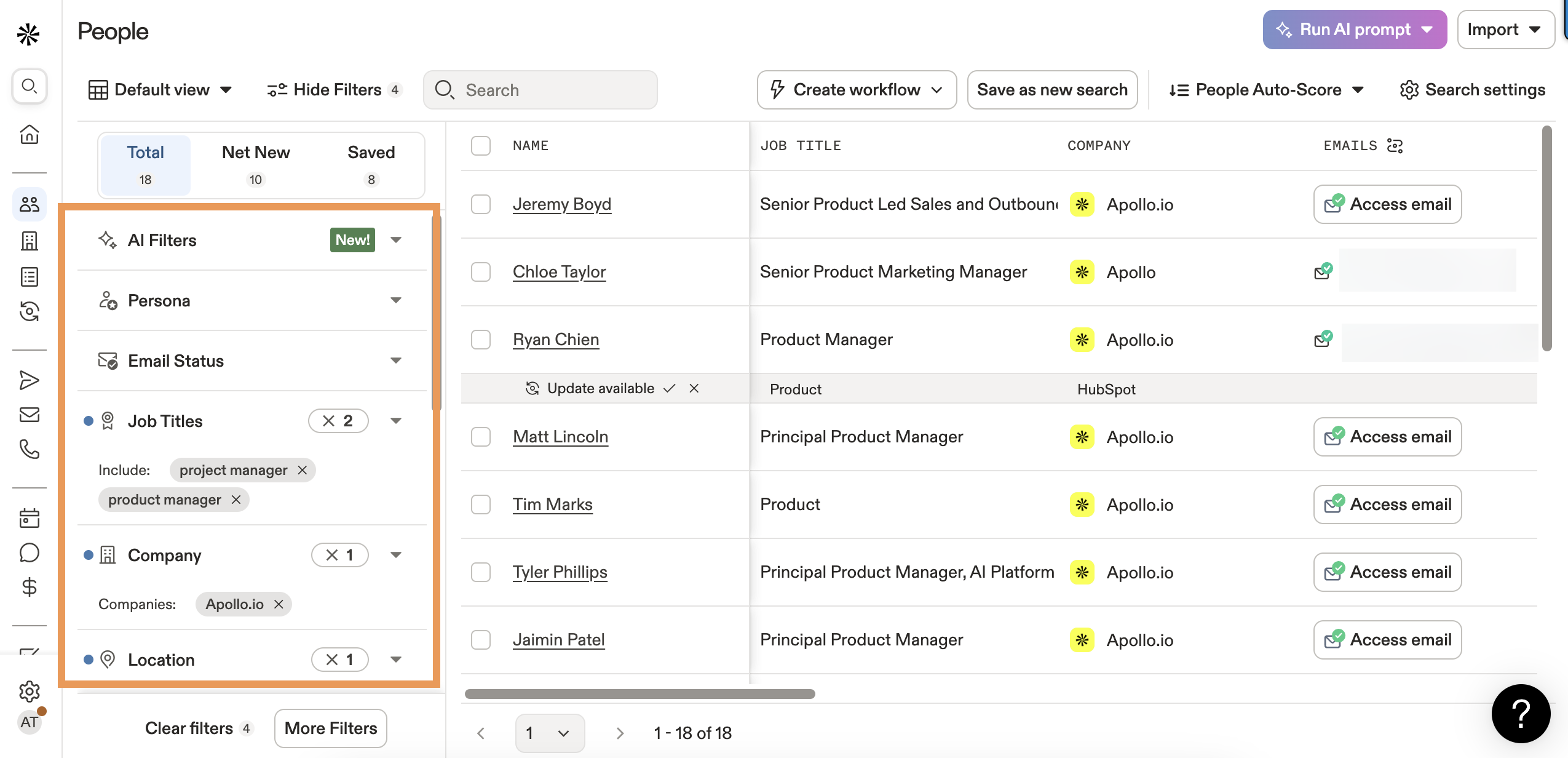
Apollo is the right call when you're building prospect lists from scratch, running cold email sequences, or need a searchable B2B database with filters for industry, title, and company size.
If you're looking for more options at the top of the funnel, these free lead generation tools can complement Apollo-style sourcing.
Use both when you're sourcing leads in Apollo but need to route that data into tools Apollo doesn't natively connect with. One caveat: Apollo can receive data from Pabbly as an action step, but Apollo can't serve as the trigger in a Pabbly workflow because Apollo hasn't introduced a webhook module in its API documentation yet. Data flows one direction only.
Hot take: Neither tool works if you're selling to local SMB owners - contractors, trades, brick-and-mortar. Apollo gives you generic info@ addresses and front desk numbers for these segments. Pabbly can't help you find data that doesn't exist in your stack. You'll need entirely different sourcing for local outbound.

The Verification Gap Neither Tool Fills
Neither Pabbly nor Apollo solves the accuracy problem. Pabbly doesn't touch contact data at all. Apollo's email accuracy sits around 79% - and one bad send can torch your domain.
If you're seeing deliverability issues, start by understanding email bounce rate benchmarks and what actually causes spikes.
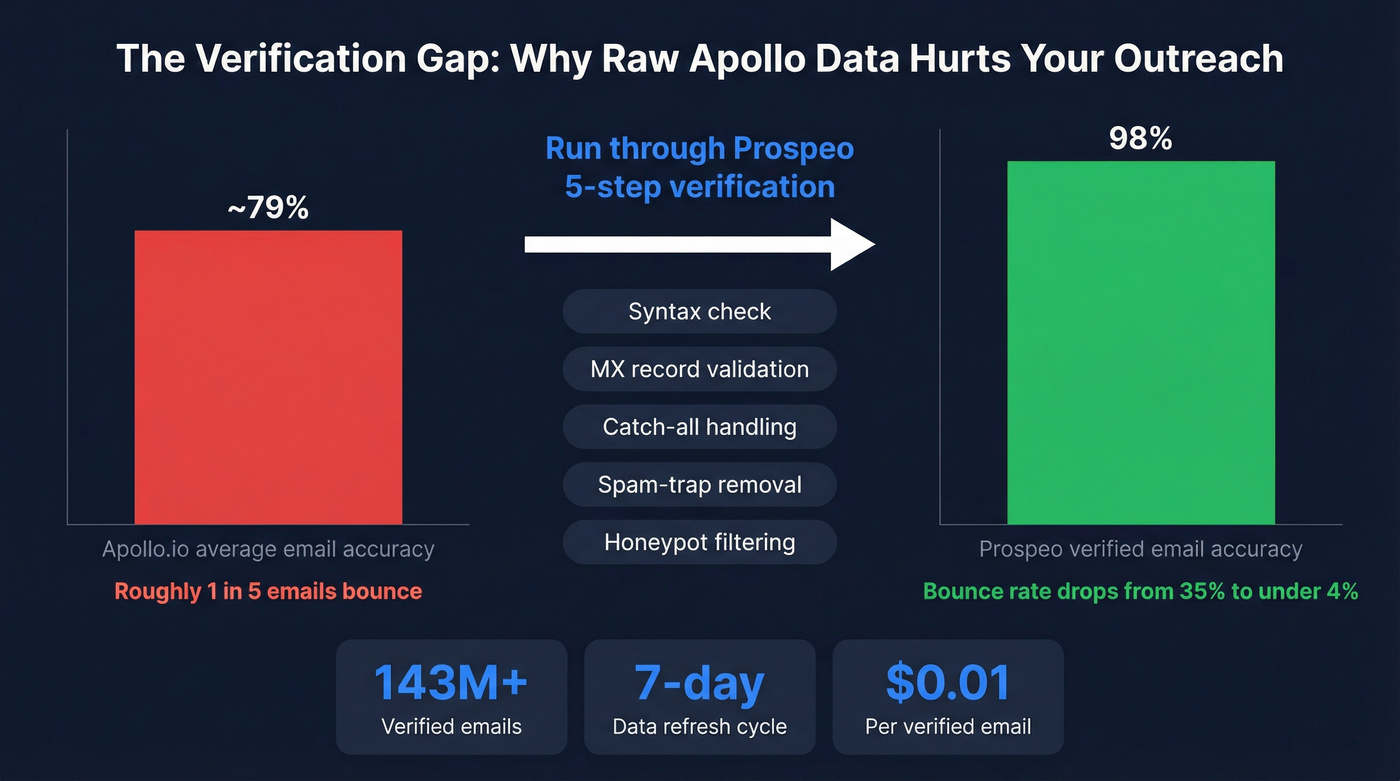
We've seen this play out firsthand. Teams like Meritt cut bounce rates from 35% to under 4% after running Apollo exports through Prospeo's verification. With 98% email accuracy across 143M+ verified emails, 125M+ verified mobile numbers with a 30% pickup rate, and a 7-day data refresh cycle versus the industry average of 6 weeks, it's the verification layer that sits between Apollo's data and your outreach tool. The 5-step verification process - including catch-all handling, spam-trap removal, and honeypot filtering - runs on proprietary infrastructure, not third-party email providers. The free tier gives you 75 verified emails/month, enough to test before committing.
If you're cleaning lists proactively, a dedicated guide to spam trap removal can prevent long-term reputation damage.
Apollo's crowdsourced data means 1 in 5 emails bounce. Prospeo's 5-step verification - catch-all handling, spam-trap removal, honeypot filtering - runs on proprietary infrastructure refreshed every 7 days. No third-party guesswork.
Your sender reputation is worth more than a few saved minutes.
Quick Alternatives Worth Knowing
For automation: Zapier remains the easiest option if budget isn't a concern. Make offers more power for complex workflows. n8n is the move if you want self-hosted, open-source automation - a common migration path for teams that outgrow Pabbly's branching limits.
If you're scaling outbound, it also helps to standardize sequence management so automation doesn't create chaos.
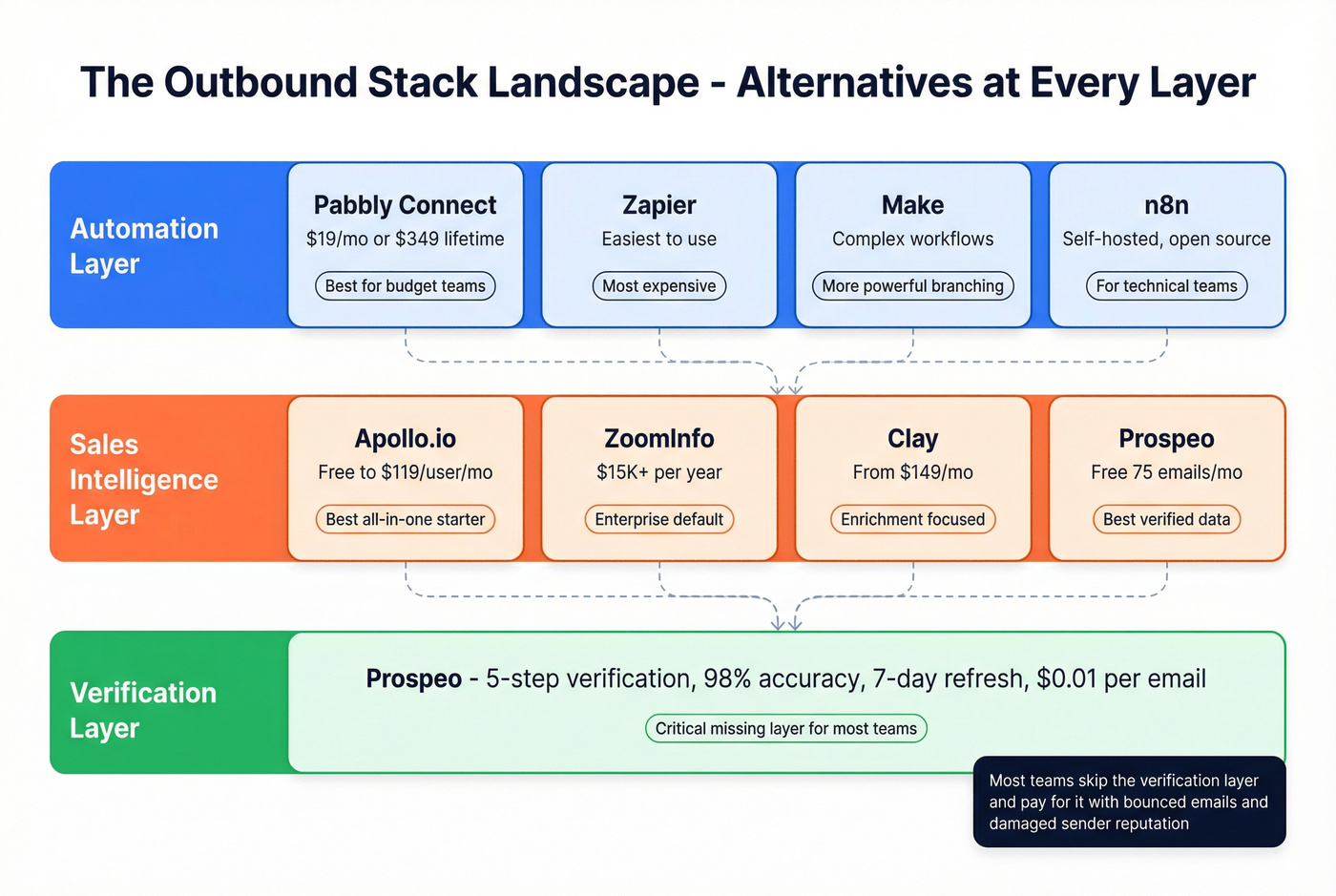
For sales intelligence: ZoomInfo is the enterprise default ($15K+/year). Clay is the enrichment-focused option that typically starts around $149/mo and scales with usage. For teams that want enterprise-grade data without enterprise pricing, self-serve platforms with transparent credit-based models have become the go-to - skip the annual contracts and "talk to sales" gates entirely.
If you're doing heavy list building, this breakdown of Clay list building can help you estimate real costs.
FAQ
Can Pabbly Connect replace Apollo.io?
No. They serve completely different functions. Pabbly automates workflows between apps; Apollo provides B2B contact data and outreach sequences. You'd use both together (Apollo for leads, Pabbly to route data), but one can't substitute for the other.
Is Apollo.io's data accurate enough for cold outreach?
Apollo's email accuracy averages around 79%, which means roughly 1 in 5 emails will bounce. Reddit threads on r/sales consistently mention sender reputation damage on high-volume campaigns. The most reliable setup is verifying Apollo exports through a dedicated verification tool before hitting send.
Does Pabbly Connect integrate with Apollo.io?
Yes, but only in one direction. Apollo can receive data from Pabbly as an action step, but Apollo can't serve as a trigger in Pabbly workflows because Apollo hasn't introduced a webhook module in its API documentation yet.
Is this even a fair comparison?
Not really - and that's the point. Pabbly is an automation platform; Apollo is a sales intelligence tool. They occupy different layers of your outbound stack. The real question is which layer you're missing, and whether you need both working together with a verification step in between.