

Personal Selling Disadvantages: 10 Data-Backed Problems in 2026
61% of B2B buyers prefer a rep-free buying experience. That's not a prediction - it's a Gartner survey of 632 buyers. Meanwhile, most articles about personal selling disadvantages read like they were written in 2005: "it's expensive," "it takes time," "it's hard to scale." No numbers. No context. No acknowledgment that buyers have fundamentally changed how they purchase.
Personal selling isn't dying. It's being misapplied. The real problem isn't the method - it's deploying $120K-$190K/year field reps against deals that don't warrant it, while 83% of buyers have already defined their purchase requirements before your rep gets a meeting.
10 Drawbacks of Personal Selling
1. It's Absurdly Expensive
A fully loaded field sales rep costs $120K-$190K per year in compensation alone. Add $20K-$40K in travel, hotels, meals, and entertainment, and you're looking at $140K-$230K before that rep closes a single deal. An inside rep doing the same job remotely runs $60K-$80K.
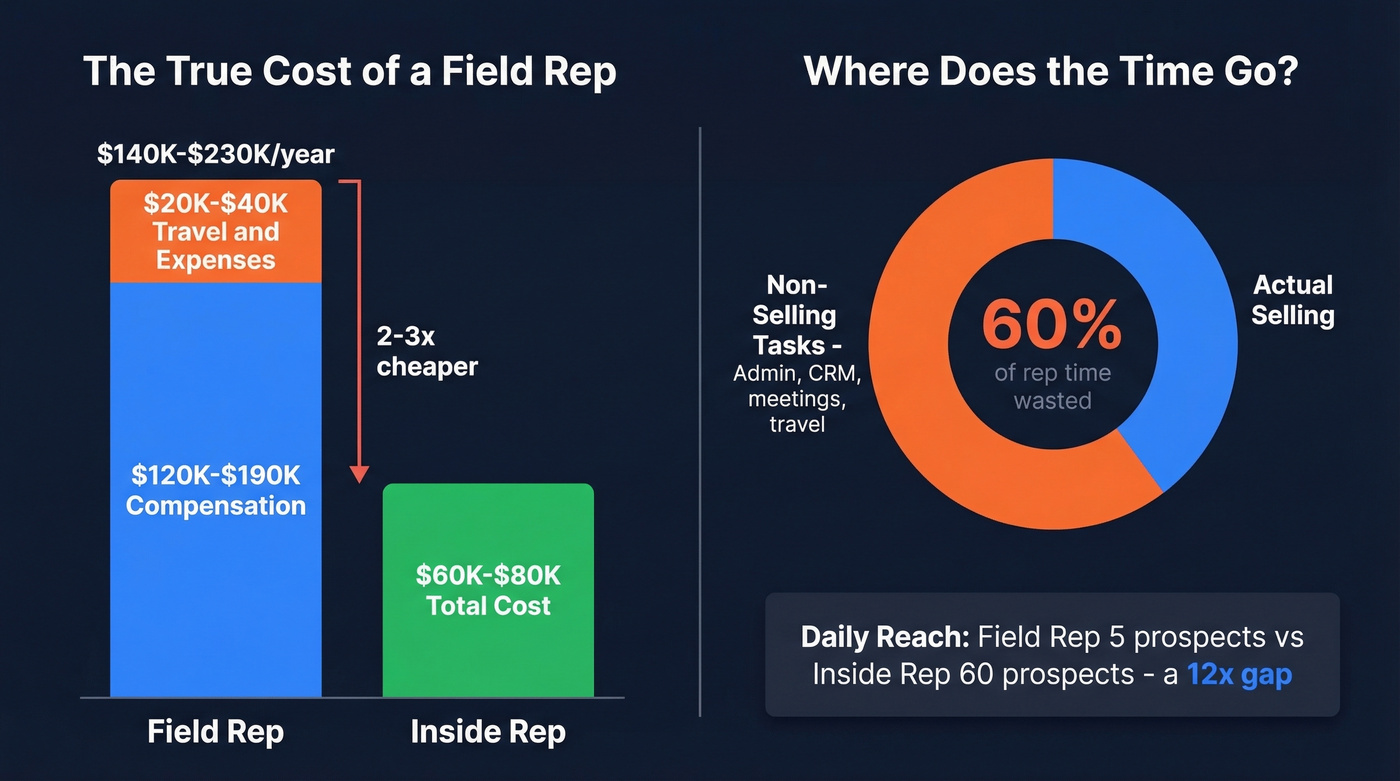
The volume gap is even more damning. A field rep reaches roughly 5 prospects per day. An inside rep touches 60. That's a 12x reach differential at half the cost. Some estimates put the cost ratio of personal selling vs. advertising at 100:1 to 1,000:1 for customer acquisition - the gap is real, and it's widening every year as digital channels get cheaper while rep compensation keeps climbing.
Here's the number that should make every VP of Sales uncomfortable: reps spend 60% of their time on non-selling tasks - admin, CRM updates, internal meetings, travel logistics. Your $180K field rep flew to Chicago for a meeting that got cancelled, spent the afternoon updating Salesforce in a hotel lobby, and logged zero revenue-generating activity. That's not an edge case. That's a Tuesday.
2. It Doesn't Scale
Personal selling is inherently one-to-one. Every additional prospect requires proportionally more rep time, more territory coverage, more management overhead. There's no leverage point.
For high-margin enterprise deals, that's fine - the math works. But if your average deal sits in the four-figure range, personal selling is destroying your unit economics. A rep who costs $150K/year and closes 50 deals at $8K each generates $400K in revenue. After cost of goods, that rep is barely break-even. Scale that team to 20 reps and you've scaled the problem, not the solution.
36% of B2B companies have already cut sales development headcount. They've done the math.
3. Buyers Don't Want to Talk to You
This is the disadvantage nobody in sales leadership wants to confront. 61% of B2B buyers prefer a rep-free buying experience. 73% actively avoid suppliers who send irrelevant outreach. And 83% of buyers mostly or fully define their purchase requirements before ever speaking with a salesperson.
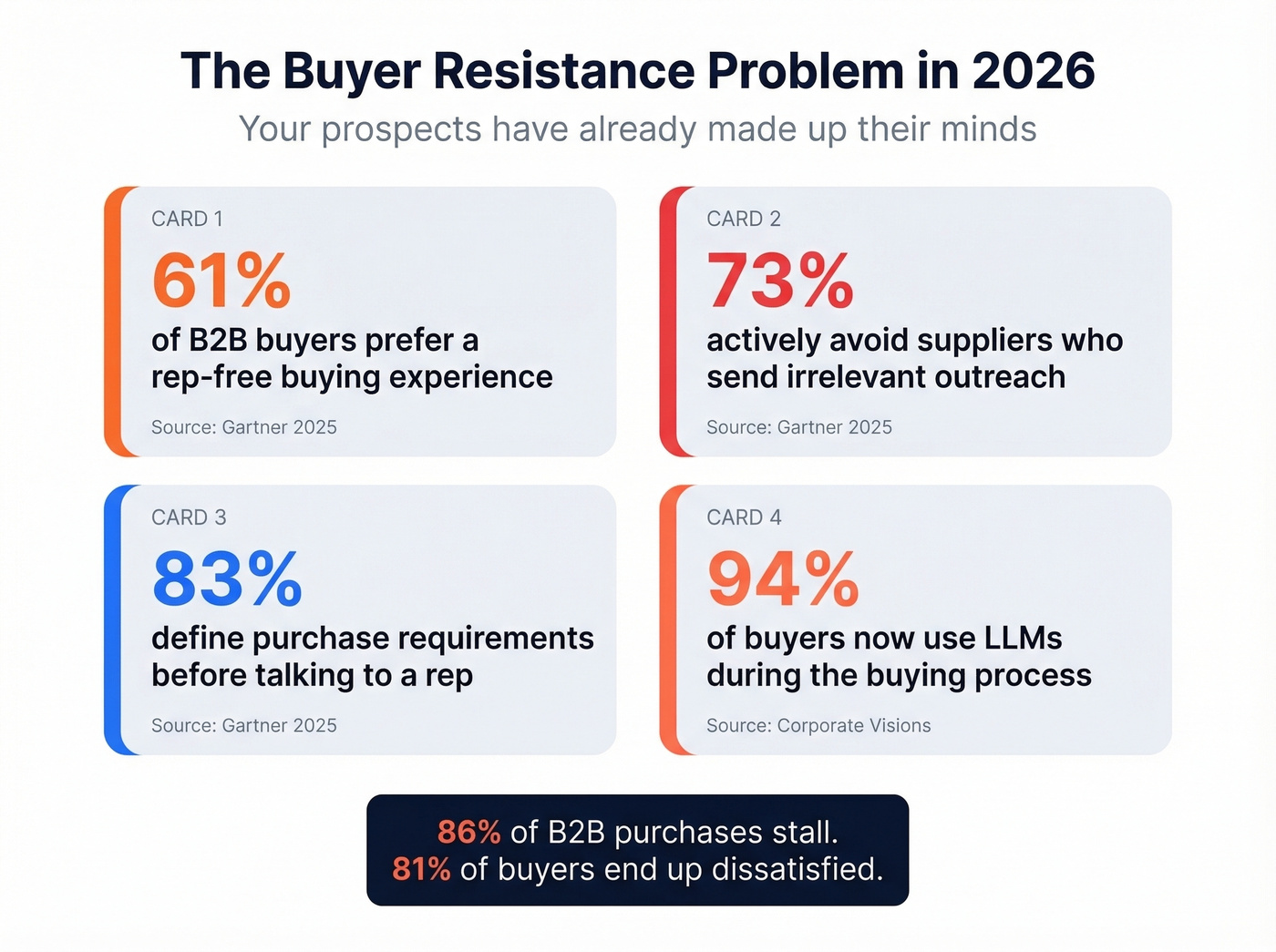
It gets worse. 86% of B2B purchases stall, and 81% of buyers end up dissatisfied with the provider they ultimately choose. The old model - where a rep controlled information flow - is gone. 94% of buyers now use LLMs during the buying process. They're researching your product, your competitors, and your pricing with AI before your SDR even sends the first email. The rep who can't add value beyond what ChatGPT already told them is dead weight.
4. Your Message Changes With Every Rep
69% of B2B buyers report inconsistencies between what a company's website says and what the seller tells them. That's not a minor gap. It's a trust killer.
Gong's research shows top-closing reps talk 43% of the time on calls, while average performers talk 65%. Only 5% of B2B buyers say salespeople exceed their expectations. When your message depends on individual rep skill, your brand experience becomes a lottery. Commission structures make this worse - reps prioritize high-return prospects and neglect segments that don't maximize their payout, regardless of what your strategy says.
5. Turnover Resets Your Pipeline
Your top rep just gave two weeks' notice. She's taking her relationships, her institutional knowledge, and her pipeline with her. The accounts she was working go cold while you spend 3-6 months ramping a replacement.
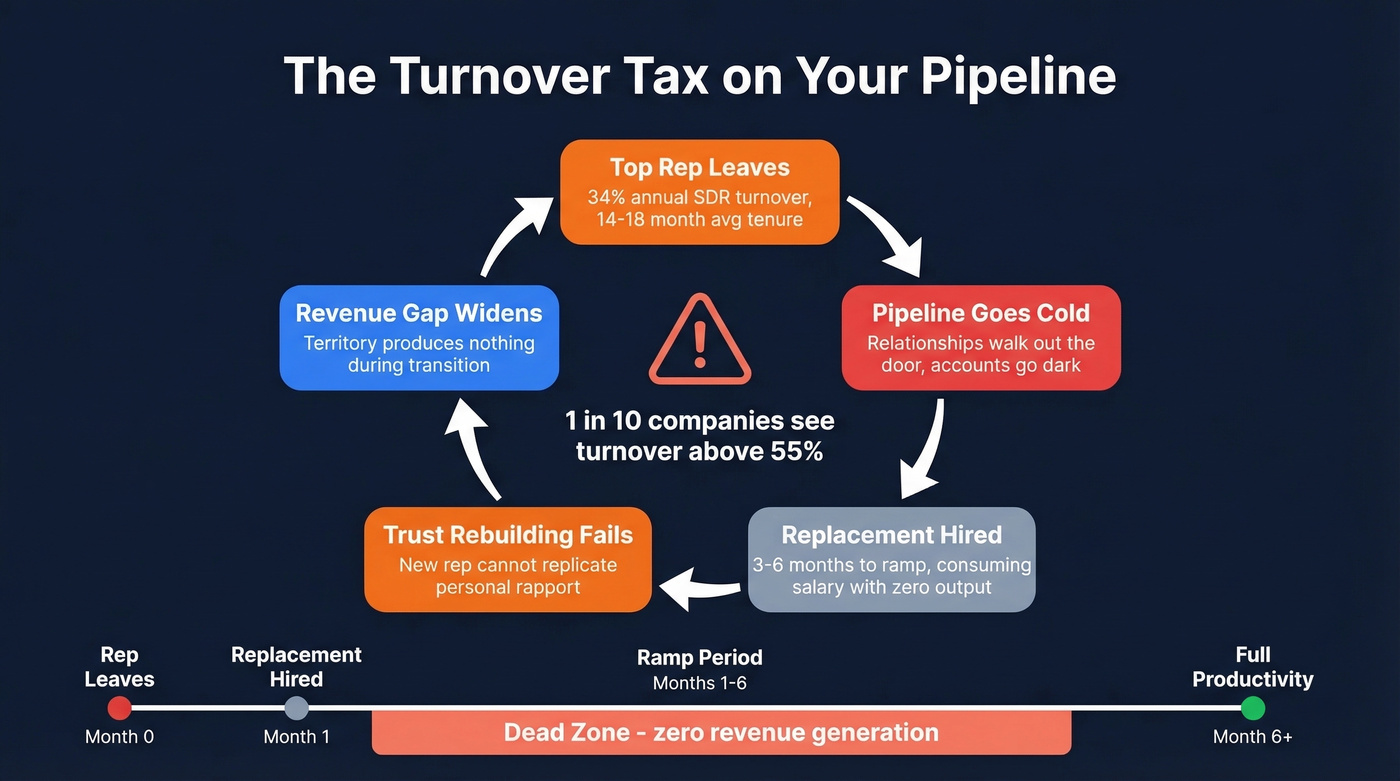
This isn't rare. SDR/BDR turnover runs 34%, with average tenure of just 14-18 months. More than 1 in 10 companies see turnover exceeding 55%. Every departure means lost pipeline, lost relationships, and a territory that produces nothing during the ramp period. I've watched teams where a single departure triggered a cascade of churn because the replacement couldn't rebuild trust fast enough. Customer loyalty in personal selling attaches to the individual rep, not the company - so when the rep leaves, the relationship walks out the door too.
6. Bad Data Multiplies Every Problem
It takes 18+ dials to connect with one prospect. If your phone numbers are outdated, that number balloons. At $150K/year in rep cost, every dead-end call burns real money.
Talk to any SDR who's been grinding for 14 months - the burnout isn't from hearing "no." It's from dialing disconnected numbers and emailing people who changed jobs six months ago. Bad emails bounce, wrong numbers waste rep time, and outdated titles mean your carefully crafted outreach lands on someone who left the company. Real-time verification tools like Prospeo eliminate that waste before your rep opens the dialer - 98% email accuracy and a 30% mobile pickup rate mean fewer dead-end calls and more conversations with actual decision-makers.
7. Ethical and Reputational Risks
Personal selling creates ethical exposure that digital channels simply don't. Reps operate with less supervision, carry expense accounts, and make promises in conversations that aren't recorded. The failure modes are well-documented: dishonest product claims, slandering competitors, expense padding, inflating sales data, and outright bribery.
The most famous example: Wells Fargo employees created millions of fraudulent accounts without customer consent, resulting in a $185M CFPB fine. That's an extreme case, but the underlying dynamic - individual reps under quota pressure making bad decisions - plays out at smaller scales constantly. The Foreign Corrupt Practices Act exists specifically because personal selling in international markets creates bribery risk that other channels don't. Channel stuffing, overpromising, and creative expense reporting are endemic to field sales cultures that reward results without scrutinizing methods.
8. Geographic and Time Constraints
Field sales is physically bounded. A rep in Dallas can't take a meeting in Boston on the same day. Territory models create artificial boundaries that don't match how buyers actually purchase, and time zones turn a "quick follow-up call" into a scheduling nightmare when your rep covers accounts across three regions.
Let's be honest: the point of first contact has shifted from 69% to 61% of the buyer's journey. Buyers are engaging earlier, which means your field rep's expensive in-person visit is competing with a decision that's already mostly made.
9. Training Eats Your Budget Twice
New reps take 3-6 months to reach full productivity - longer for complex enterprise sales. During that ramp, they're consuming salary, management time, and enablement resources while producing little.
Multiply that by 34% annual turnover and you're perpetually carrying a chunk of your team that's still learning. In our experience, the ramp problem is worse than the turnover number suggests because the best reps - the ones who ramp fastest - are also the ones most likely to get poached. You invest six figures in developing someone, they hit quota for two quarters, and then a competitor offers them 20% more OTE. Rinse, repeat.
10. Dependency on Individual Relationships
When the relationship lives with the rep instead of the company, you've built a fragile revenue model. Key accounts become hostage to individual tenure.
Personalization matters - McKinsey's research shows it can lift revenue 10-15%. But when personalization is entirely dependent on one human's memory and rapport, it's a liability, not a strategy. The fix isn't less personalization; it's building institutional knowledge systems so the relationship survives any single departure.
Personal Selling vs. Digital Channels
The cost and reach gaps are stark when you put channels side by side.
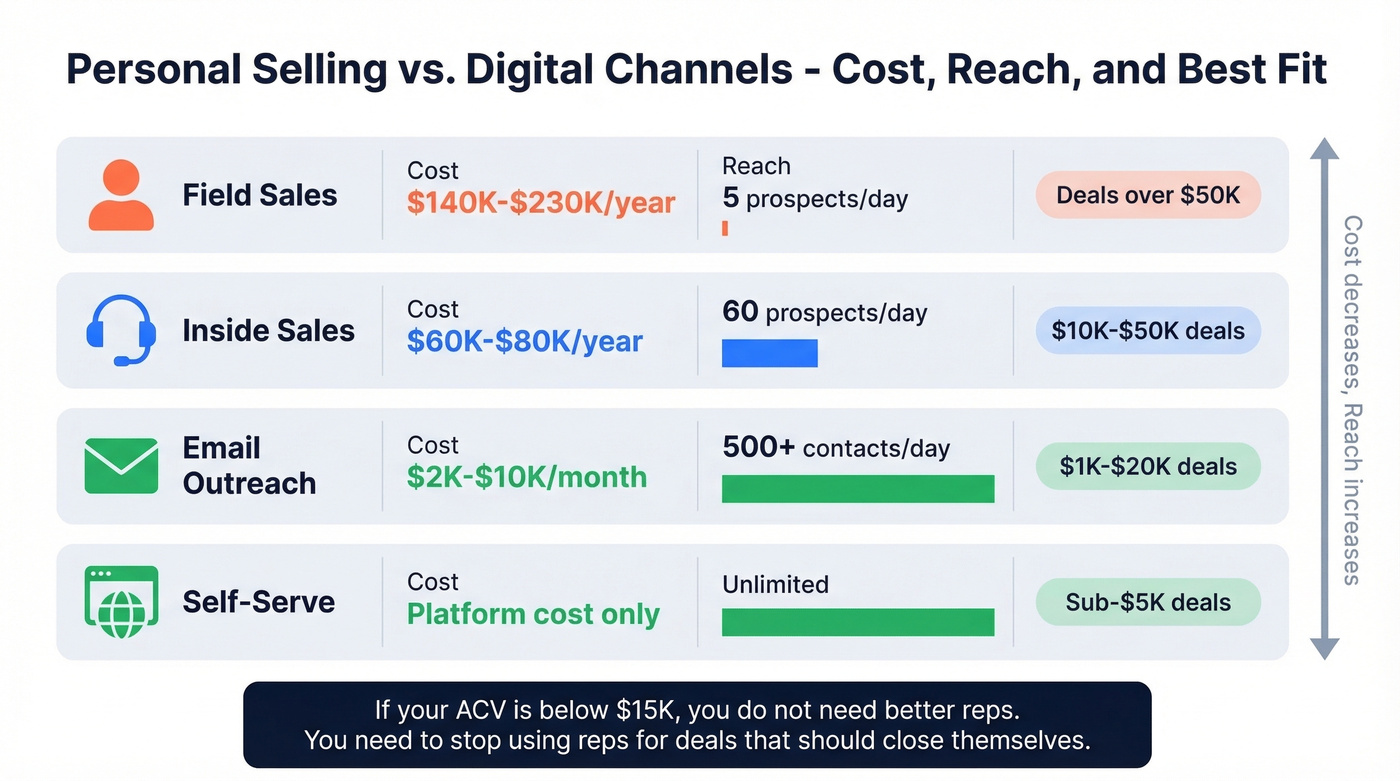
| Channel | Annual Cost | Daily Reach | Personalization | Best Fit |
|---|---|---|---|---|
| Field Sales | $140K-$230K/rep | ~5 prospects | Very high | Deals >$50K |
| Inside Sales | $60K-$80K/rep | ~60 prospects | High | $10K-$50K deals |
| Email Outreach | $2K-$10K/mo | 500+ contacts | Medium | $1K-$20K deals |
| Self-Serve | Platform cost only | Unlimited | None | Sub-$5K deals |
The pattern is clear: personal selling wins on depth but loses on everything else. For teams selling sub-$10K deals, inside sales or automated outreach delivers better unit economics by an order of magnitude.
Here's the thing: most B2B companies don't have a "personal selling problem" - they have a deal-size problem. If your ACV sits below $15K, you don't need better reps. You need to stop using reps for deals that should close themselves.

Bad data is the silent multiplier behind every personal selling disadvantage. Dead-end dials, bounced emails, and outdated titles burn rep time that already costs $150K+/year. Prospeo's 98% email accuracy and 30% mobile pickup rate mean your reps spend time selling - not chasing ghosts.
Stop paying $180K reps to dial disconnected numbers.
When Personal Selling Still Works
Skip this section if you're selling low-ACV products. Personal selling earns its place only when:
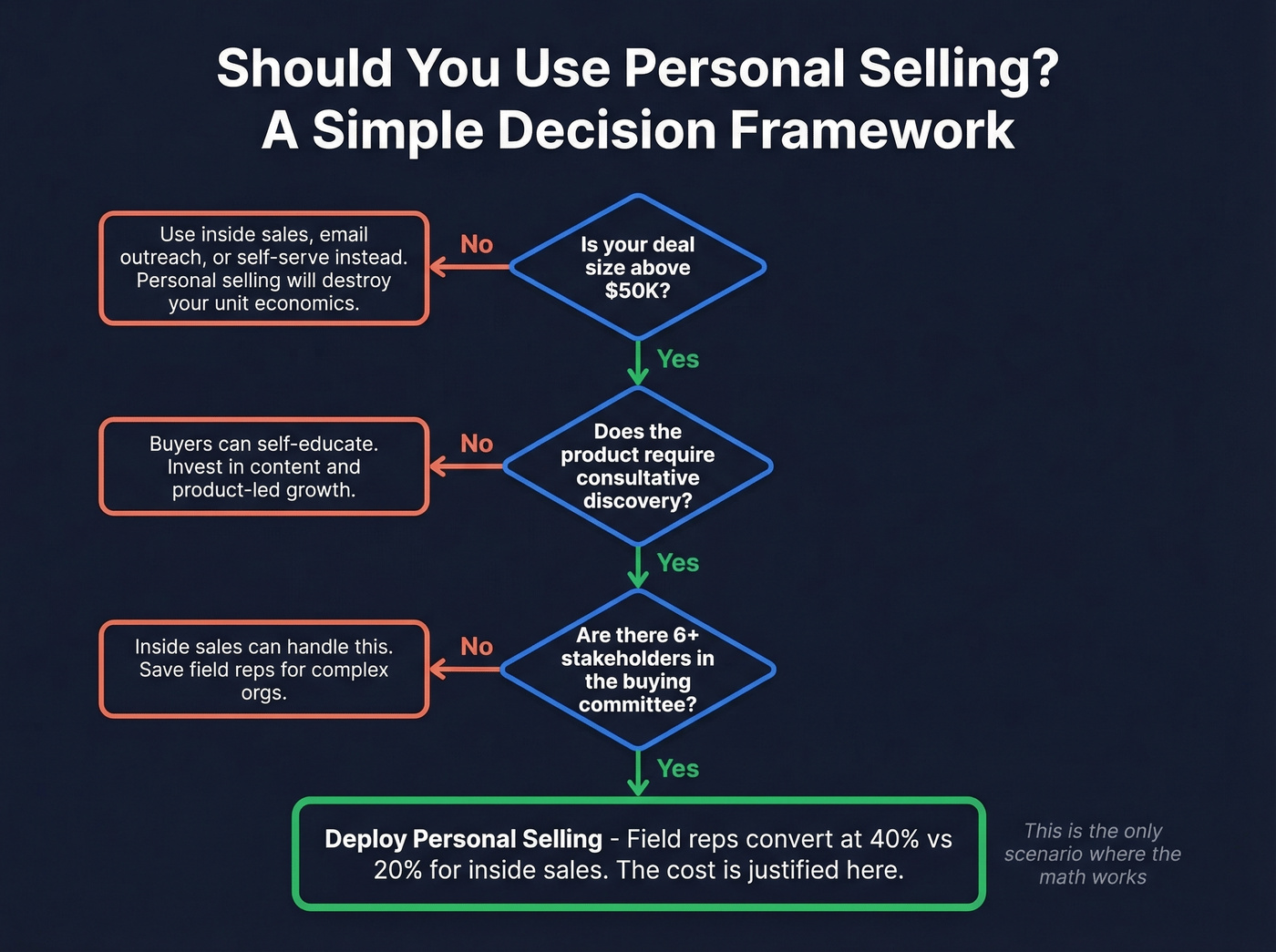
- Deal size exceeds $50K. The cost-per-touch math only works at enterprise price points.
- The product requires consultative discovery. If buyers can't self-educate, they need a human guide.
- Buying committees have 6+ stakeholders. Multi-threading complex organizations is still a human skill.
Field reps convert qualified leads at roughly 40% vs. 20% for inside sales. That's a real advantage - but only when the deal justifies the cost. If you're deploying field reps against mid-market accounts with $15K average deals, you're subsidizing an expensive habit, not running an efficient sales motion.
How to Mitigate the Worst of It
You don't have to abandon personal selling. You have to stop letting its weaknesses compound unchecked.
Verify contact data before outreach. Before your $150K/year rep picks up the phone, verify the number is real. Prospeo checks emails and mobile numbers in real time at roughly $0.01 per email verified - the ROI is absurd compared to wasted rep hours. Its 7-day data refresh cycle means you're not calling someone who changed roles last quarter. (If you want a broader stack view, start with data enrichment services and lead enrichment.)
Layer channels by deal size. Reserve personal selling for deals above $50K. Route mid-market to inside sales. Push low-ACV segments to self-serve and automated sequences. The consensus on sales prospecting techniques is that most teams wait too long to make this shift because leadership romanticizes the field sales model they grew up in.
Standardize talk tracks and enablement. Address the 69% inconsistency problem between your website and your reps. Record calls, build playbooks, and coach to the talk tracks - 43% talk time, not 65%.
Track leading indicators. Meetings booked, pipeline created, and conversion rates by stage tell you more than closed revenue alone. By the time you see a revenue miss, the problem started months ago. If you need a tighter measurement system, use pipeline health and funnel metrics as your baseline.
Personal selling doesn't scale - but the data powering it can. Prospeo refreshes 300M+ profiles every 7 days, so your reps reach real decision-makers at current companies with current titles. At $0.01 per email, you eliminate the data tax that makes personal selling uneconomical.
Make every rep conversation count with contacts verified this week.
FAQ
What's the biggest disadvantage of personal selling?
Cost. A fully loaded field sales rep runs $120K-$190K per year and reaches roughly 5 prospects per day. Factor in that 60% of their time goes to non-selling tasks, and the effective cost per meaningful interaction is among the highest of any channel. For deals under $50K, the unit economics rarely justify it.
Is personal selling still effective in 2026?
For high-value, complex B2B deals - yes. But 61% of buyers now prefer a rep-free experience, and 83% define requirements before ever speaking with a salesperson. It works when deal size justifies the cost and the product demands consultative guidance. For everything else, digital and self-serve channels outperform on both reach and ROI.
How can you reduce the cost of personal selling?
Verify contact data before outreach so reps don't waste calls on bad numbers - tools like Prospeo deliver 98% email accuracy at ~$0.01 per lead. Combine personal selling with inside sales and digital channels for lower-value segments. Invest in enablement to shrink the skill gap between your best and worst reps.
What are the personal selling pros and cons?
The pros are real: high personalization, stronger relationship building, and 40% close rates on qualified leads versus 20% for inside sales. The cons - cost, scalability limits, message inconsistency, turnover risk, and buyer resistance - are equally real and increasingly hard to ignore. Match the channel to the deal size so the pros outweigh the cons on every opportunity.