

Personal Selling in B2B: What Top Reps Actually Do (and What Every Guide Gets Wrong)
A rep on r/sales shared his playbook last year - $1.3M cash comp, $40-50M in revenue generated, several hundred deals annually. His top tactic? Remembering that a client's kid had a soccer tournament and asking about it three weeks later. Not MEDDIC. Not a fancy sequence. A text message about a 9-year-old's penalty kick.
That's personal selling in B2B distilled to its essence. And here's the macro trend backing it up: Gartner predicts that by 2030, 75% of B2B buyers will prefer sales experiences that prioritize human interaction over AI - a full reversal from the "rep-free buying" hype of the early 2020s. AI is flooding every inbox, but buyers are swinging back toward humans for the conversations that matter. Gartner also flags an "uncanny valley" effect: as deal stakes rise, AI that mimics human interaction creates discomfort rather than trust.
Personalized one-to-one selling often converts in the 20-40% range on qualified, high-intent opportunities, versus 1-5% for mass outreach. But 63% of buyers don't want a rep in the discovery phase - timing matters more than effort. This guide covers when to deploy it, which frameworks to use, and what a seven-figure earner actually does differently from the reps who read the same playbooks and still miss quota.
Why High-Touch Selling Dominates B2B
The economics aren't even close. One-to-one B2B selling costs more per contact, but the return dwarfs everything else in the channel mix.
| Metric | Personal Selling | Mass Marketing |
|---|---|---|
| Cost per contact | $50-$200 | $0.10-$5 |
| Conversion rate | 20-40% | 1-5% |
| Customer lifetime value | +18% higher spend | Baseline |
| Referral generation | 3.2x more referrals | Baseline |
| Scalability | Low (high-touch) | High (automated) |
| Best for | Complex B2B, enterprise | Awareness, top-of-funnel |
An analysis of 1,200 B2B sales cycles found that personalized demos closed at 2.8x the rate of generic presentations. Customers acquired through direct rep engagement spend 18% more over their lifetime and generate 3.2x more referrals. For context, B2B email campaigns average a 2.4% conversion rate - the 20-40% close rate on qualified opportunities is a different league entirely. That referral multiplier alone can justify the cost differential for any deal over five figures.
B2B eCommerce transactions are projected to hit $36.16 trillion in 2026, and a significant share of total B2B revenue still flows through channels where a human relationship is the deciding factor. The question isn't whether this approach works. It's whether you're deploying it at the right moment.
When to Deploy It (and When to Hold Back)
Most guides treat personal selling as an always-on strategy. That's wrong.
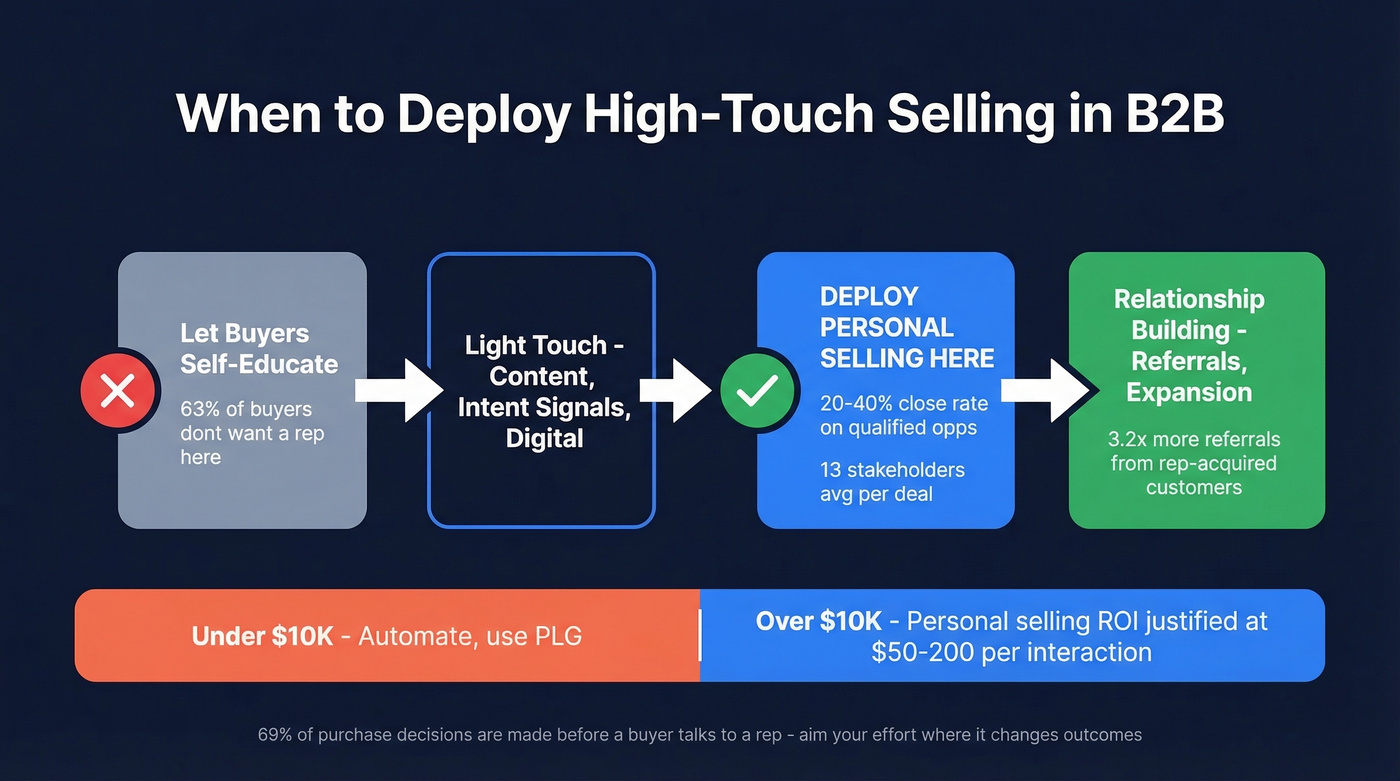
A Forrester Consulting survey found that 63% of buyers don't want to interact with a salesperson during the Discovery phase. They want to research on their own, read peer reviews, and build internal alignment before anyone pitches them. A 6sense study of 2,509 B2B buyers found that 69% of purchase decisions are effectively made before a buyer talks to a rep, and 81% already have a preferred vendor at first contact.
So where does direct rep engagement actually change the outcome? Mid-to-late funnel. Once a buyer has self-educated and narrowed their shortlist, a skilled rep creates separation. The early stages belong to content, digital touchpoints, and intent signals. The close belongs to humans.
Here's the thing: if your average deal size sits below $10K, you probably don't need a high-touch motion at all. Automate the top of funnel, invest in product-led growth, and save the one-to-one effort for deals where the economics justify $50-$200 per interaction. Personal selling in B2B is the highest-ROI channel - but only when you aim it at the right deals.
74% of marketers report sales cycles are getting longer, which means the window for rep-led selling isn't shrinking - it's stretching. The hybrid model wins: AI and digital for early-stage research, humans for customization, negotiation, and trust-building.
The Selling Process (Modernized for 2026)
The traditional seven-step process still holds up structurally. Every step looks different than it did five years ago, though.
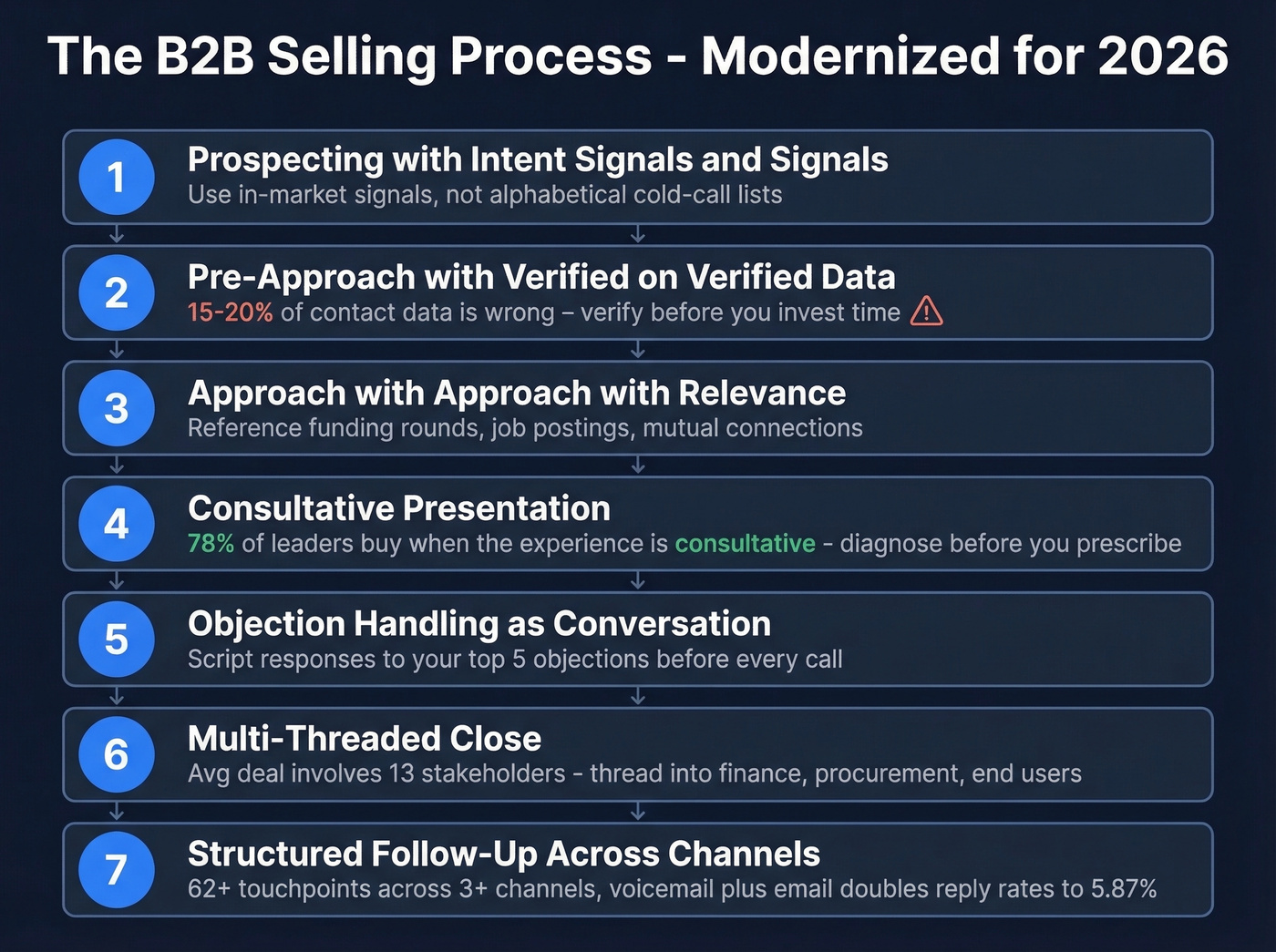
Prospecting with intent signals. Don't cold-call a list alphabetically. Use intent signals to identify accounts actively researching your category. The spray-and-pray era is over.
Pre-approach with verified contact data. Before you invest 45 minutes preparing a personalized pitch, verify that the prospect's email and phone number actually work. If 15-20% of your contact data is wrong, you're burning thousands before a conversation even starts. Prospeo's 98% email accuracy and 7-day data refresh cycle exist specifically for this step - so high-touch effort doesn't get wasted on disconnected numbers.
Approach with relevance. Your first touchpoint should reference something specific - a recent funding round, a job posting that signals a pain point, a mutual connection. Generic "just checking in" messages get deleted. (If you need examples, start with personalized outreach.)
Consultative presentation. Diagnose before you prescribe. 78% of sales leaders say they're more likely to buy when the sales experience is consultative - they're not asking for a product demo, they're asking you to understand their problem first.
Objection handling as conversation. Prepare for the five most common objections before every call. We've seen reps who script objection responses close at meaningfully higher rates than those who wing it. If this is a weak spot, use a system to reduce sales objection rate.
Multi-threaded close. The average B2B deal now involves 13 stakeholders. If you're only talking to one champion, you're exposed. Thread into finance, procurement, and the end users who'll actually adopt your product.
Structured follow-up across channels. Deals require 62+ touchpoints across 3+ channels, with sales cycles often exceeding six months. One underused tactic: leaving a voicemail alongside your email. Gong data shows this doubles reply rates from 2.73% to 5.87%. Use a repeatable sales meeting follow-up email process so nothing slips.
Five Frameworks That Work
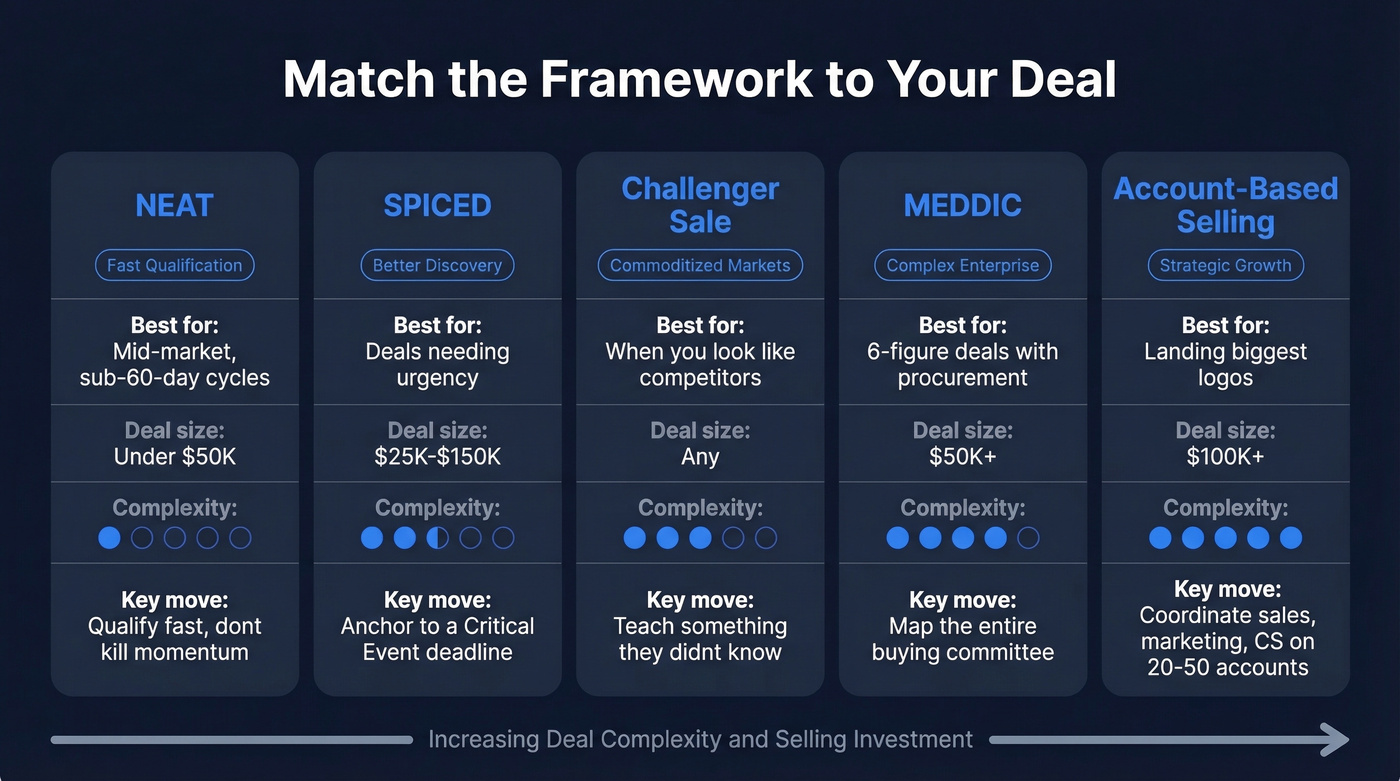
Frameworks prevent one-to-one outreach from becoming random acts of selling. Match the framework to your deal complexity.
MEDDIC: For Complex Enterprise Deals
Metrics, Economic Buyer, Decision Criteria, Decision Process, Identify Pain, Champion. MEDDIC forces you to map the entire buying committee and their evaluation criteria before you invest serious selling time. If your average deal is six figures and involves procurement, this is your default. (For a deeper breakdown, see MEDDIC sales qualification.)
Skip it if your deal size is under $50K - the overhead isn't worth it.
Challenger Sale: For Commoditized Markets
When your product looks identical to three competitors, stop selling features. The Challenger approach wins by reframing how the buyer thinks about the problem. Teach them something they didn't know, tailor your message to their specific context, and take control of the conversation. You're selling a perspective, not a spec sheet.
SPICED: For Better Discovery
Situation, Pain, Impact, Critical Event, Decision. SPICED prevents reps from jumping to the pitch too early. It forces you to quantify the cost of inaction before you ever show a slide. The "Critical Event" step is what makes it distinct - it anchors the deal to a real deadline, not a vague "sometime this quarter."
NEAT: For Fast Qualification
Need, Economic impact, Access to authority, Timeline. Your sales cycle is under 60 days and you need to qualify fast - NEAT was built for this. It's lighter than MEDDIC and works well for mid-market deals where a 90-minute discovery call would kill momentum. Start here, graduate to MEDDIC when deal complexity demands it.
Account-Based Selling: For Strategic Growth
ABS flips the funnel. Instead of generating hundreds of leads, you pick 20-50 strategic accounts and go deep. Coordinate marketing, sales, and customer success around the same target list. This is high-touch selling at the organizational level, and it's where the biggest logos come from. If you're building this motion, follow account-based selling best practices.

You just read that 15-20% of contact data is wrong - meaning reps burn hours crafting personalized pitches for prospects they'll never reach. Prospeo's 98% email accuracy and 7-day data refresh cycle ensure your high-touch effort connects with real buyers, not dead inboxes.
Stop wasting $200 interactions on bad data. Verify before you personalize.
What Top B2B Reps Actually Do
Let's talk about what separates the top 1% from everyone else. The Reddit thread from that $1.3M earner is the most honest practitioner playbook I've read in years.
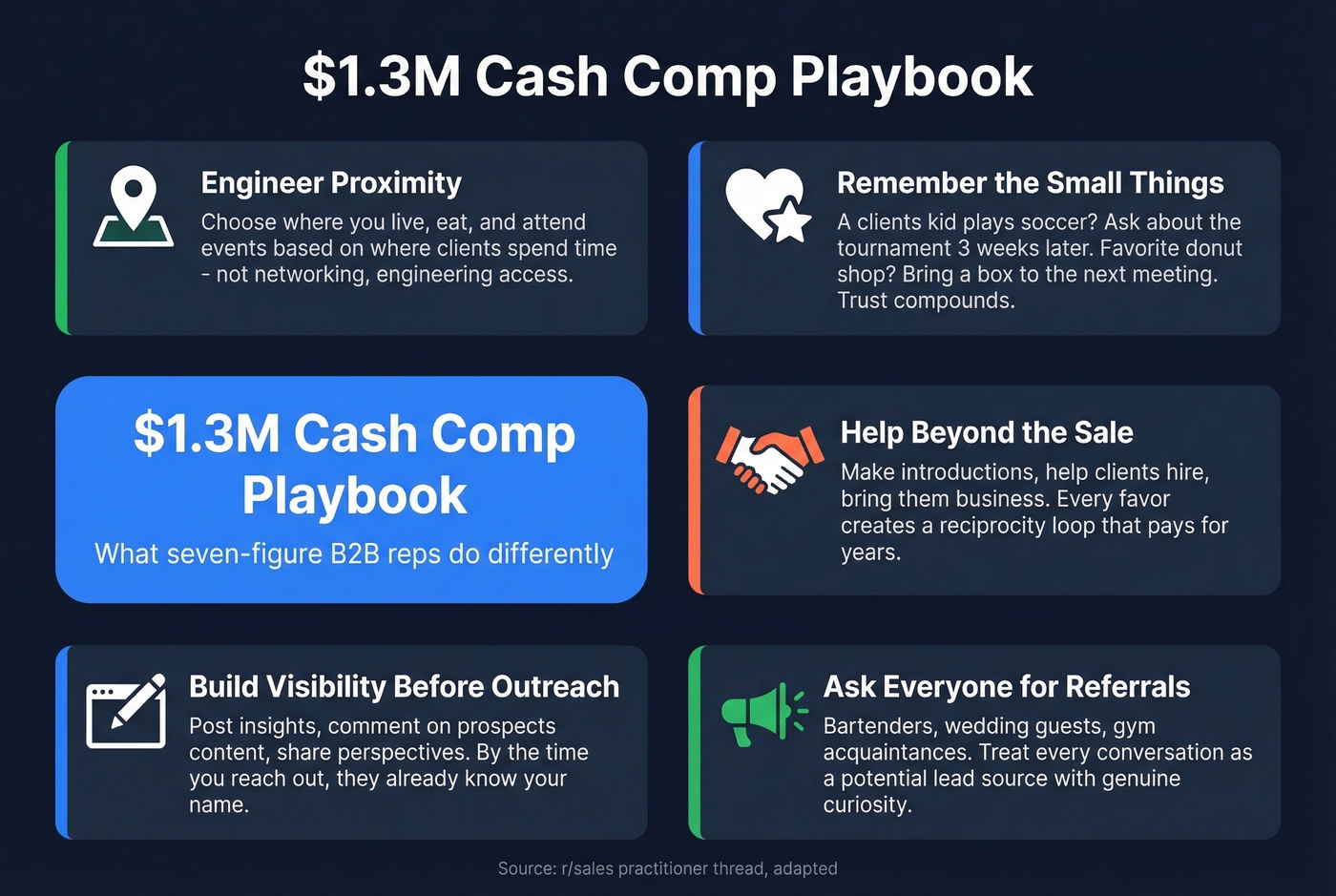
They build their lives around clients. This rep optimizes where he lives, where he eats, and which events he attends based on where clients and prospects spend time. He's not "networking" - he's engineering proximity. Conferences, after-hours events, even neighborhood choices are deliberate.
They remember the small things. A client mentioned they love a specific donut shop? He shows up to the next meeting with a box. A prospect's kid plays travel soccer? He asks about the tournament results three weeks later. These aren't tactics - they're habits that compound into trust. At its core, this is person-to-person sales, one human genuinely caring about another, and no automation tool can replicate it.
They help beyond the sale. The best reps help clients hire, make introductions to other vendors, and even bring them business. Every favor creates a reciprocity loop that pays dividends for years. They also ask for advice, not just orders - "What would you do in my position?" disarms the natural defensiveness buyers feel and shifts the dynamic from adversarial to collaborative.
They ask everyone for referrals. Bartenders, people at weddings, acquaintances at the gym. The consensus on r/sales is that the best prospectors treat every conversation as a potential lead source - not in a sleazy way, but because they're genuinely curious about what people do.
They build visibility before outreach. The best reps in 2026 don't cold-call into a vacuum. They post insights on social platforms, comment on prospects' content, and share industry perspectives that establish credibility before the first email lands. By the time they reach out, the prospect already recognizes their name. This isn't "social selling" as a buzzword - it's building the trust layer that makes direct engagement land harder when you deploy it.
Here are three unconventional tactics from another Reddit thread worth stealing:
- The calendar invite hack. If a prospect ghosts after you've invested real time, send a calendar invite anyway - optional, five minutes - with a $10-$20 coffee voucher attached. It forces visibility without being aggressive.
- Multithread while you wait. Arrive early for meetings and use the time to connect with the prospect's colleagues. Offer to share meeting notes afterward. You've just expanded your footprint without asking permission.
- Call when the proposal reopens. If you can track document views, call the moment a prospect opens your proposal again. If it's been shared internally, call that person too.
The Tech Stack You Need
You don't need eight tools. 42% of reps feel overwhelmed by tool complexity, and in our experience, the teams that close the most with a high-touch motion run the leanest stacks. Three categories matter.
The principle: use automation for data and scheduling - never for the conversation itself.

CRM: HubSpot or Salesforce. Your system of record. HubSpot starts free for small teams; Salesforce runs roughly $25-$330/user/month depending on the edition. Pick one, use it religiously, and don't overthink it. (If you're evaluating options, see examples of a CRM.)
Conversation intelligence: Gong. Records and analyzes your calls so you can coach reps on talk-to-listen ratios, objection handling, and competitive mentions. Expect roughly $100-$200/user/month. Worth it if you have five or more reps.
Skip the rest until you've maxed out these three. The rep making $1.3M isn't closing deals because of his tech stack - he's closing because he remembered the donuts.
Multi-threading into 13 stakeholders requires verified emails and direct dials for every contact on the buying committee. Prospeo gives you 125M+ verified mobiles with a 30% pickup rate and 30+ filters to find the exact decision-makers worth your one-to-one effort.
Thread into every stakeholder with contacts that actually pick up.
Seven Mistakes That Kill Deals
Talking more than listening. Aim for roughly a 40/60 split. If you're above 50% talk time, you're pitching, not selling.
Leading with price instead of value. Quantify the cost of the prospect's current problem before you ever mention your number.
Failing to qualify. Use NEAT or BANT in the first call. No budget, no authority, no timeline? Move on.
Arguing with objections. Acknowledge the concern, ask a clarifying question, then reframe. "I hear you - can you help me understand what's driving that concern?"
Skipping objection prep. Before every meeting, write down the three most likely objections and your response to each. We've watched reps walk into six-figure calls without doing this. It doesn't end well.
Presenting to the wrong stakeholder. Ask "Who else would need to weigh in on this decision?" in every discovery call. Map the committee early.
Using inaccessible jargon. If your prospect isn't technical, neither is your pitch. Match their language, not your product docs.
These aren't exotic mistakes. They're the basics that experienced reps still get wrong under pressure.
Case Studies with Hard Numbers
Unity + Clari. Unity implemented Clari's revenue platform and saw win rates jump 29.9%, slipped deals drop 30.2%, and average deal size increase 209%. Their ops team saved four hours per week - time that went back into actual selling.
Grammarly + Salesforce Einstein. Grammarly deployed Einstein's AI lead scoring to prioritize which accounts got personal attention from reps. The result: an 80% increase in conversion rates. The AI didn't replace the reps - it told them where to focus.
SaaS company, personalized video outreach. A mid-market SaaS team switched from templated emails to personalized video messages for their top 100 accounts. Response rates jumped from 8% to 34%, generating 34 meetings in 90 days and $2.1M in additional pipeline.
The pattern across all three: personal selling in B2B scales when you use data and technology to decide where to invest human effort, then let the humans do what they do best. (If you want a tighter system for this, build around data-driven selling.)
FAQ
Is personal selling dead in the age of AI?
No. Gartner predicts 75% of B2B buyers will prefer human interaction over AI by 2030. AI handles research and early-stage information gathering brilliantly, while humans handle trust, negotiation, and the nuance of complex deals. As AI gets more pervasive, the human touch becomes the differentiator, not the default.
Why are B2B sales based on personal selling?
B2B deals involve high stakes, long cycles, and multiple decision-makers - conditions where trust and tailored communication outperform any automated channel. When a purchase affects an entire organization's operations and budget, buyers need a human who understands their specific context and can navigate internal politics in real time.
What's the difference between personal selling and consultative selling?
Personal selling is the broader category - any one-to-one sales interaction where a rep engages a prospect directly. Consultative selling is a style within it that emphasizes diagnosing the buyer's problem before prescribing a solution. All consultative selling is personal selling, but not all personal selling is consultative.
How do I make sure I'm reaching the right person?
Verify contact data before every high-touch outreach. Bad data at a 15-20% error rate wastes $50-$200 per interaction on unreachable prospects. Use a verified data provider with high accuracy rates and frequent refresh cycles, then confirm direct dials and email validity before investing 30 minutes on a personalized message.
Which framework should I use?
MEDDIC for six-figure enterprise deals with complex buying committees. Challenger for commoditized markets where differentiation is hard. NEAT for fast qualification when cycles are under 60 days. Match the framework to your deal complexity and cycle length - there's no universal answer.