

Phone Prospecting Tips: Scripts, Benchmarks, and the 3-Minute Call That Books Meetings
It's 9 AM. You've got 200 dials ahead of you, a CRM full of numbers you don't trust, and a quota that doesn't care about your connect rate. Most phone prospecting tips out there tell you to "be confident" and "do your research" without giving you the actual words to say or the numbers to expect.
Here's what should change your mindset before you pick up the phone: 82% of buyers accept meetings with sellers who proactively reach out. That's from a RAIN Group study of 488 buyers and 489 sellers. The problem isn't that prospects won't talk to you - it's that you're not reaching them with the right numbers, at the right time, with the right words. Once you understand the power of the phone call in sales, you stop treating dials as a chore and start treating them as your highest-leverage activity.
The quick version:
- Your connect rate is a data problem before it's a skills problem - verify numbers before you dial.
- Structure every call in 3 minutes: opener, value prop, meeting ask. Never pitch product.
- 80% of calls hit voicemail - have a researched VM script ready or you're wasting those dials.
The Math Behind Cold Calling
At a 5% connect rate - realistic for most B2B SDR teams - 200 dials per day gets you 10 live conversations. Convert one and you've booked a meeting. That's the baseline, and it lines up with what practitioners report on r/sales: SDRs describe doing 180-200 dials per day with a 5-8% connect rate as their reality.
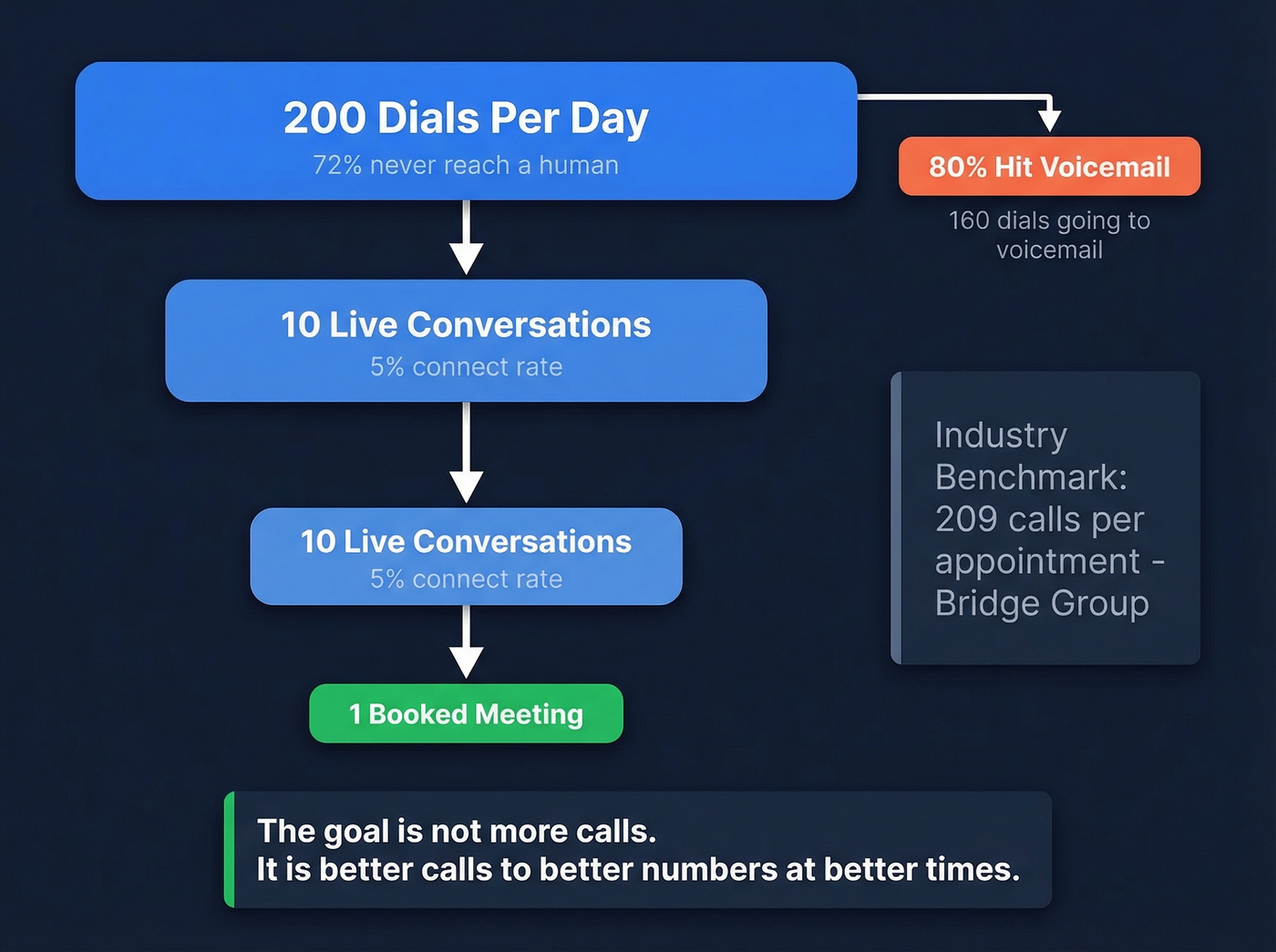
Industry data paints a consistent picture. The Bridge Group pegs it at 209 calls per appointment. 72% of calls never reach a human. 80% hit voicemail. So out of every 200 dials, you're having maybe 10 real conversations - the rest is ringing, voicemail, and gatekeepers.
The takeaway isn't "make more calls." It's make better calls to better numbers at better times.
Before You Dial: Data and Timing
B2B contact data decays at roughly 2.1% per month - that's 22.5% annually. Reps lose 27.3% of their selling time to bad data. If you're dialing from a list that hasn't been refreshed in weeks, you're burning a quarter of your call block on disconnected numbers and wrong contacts.
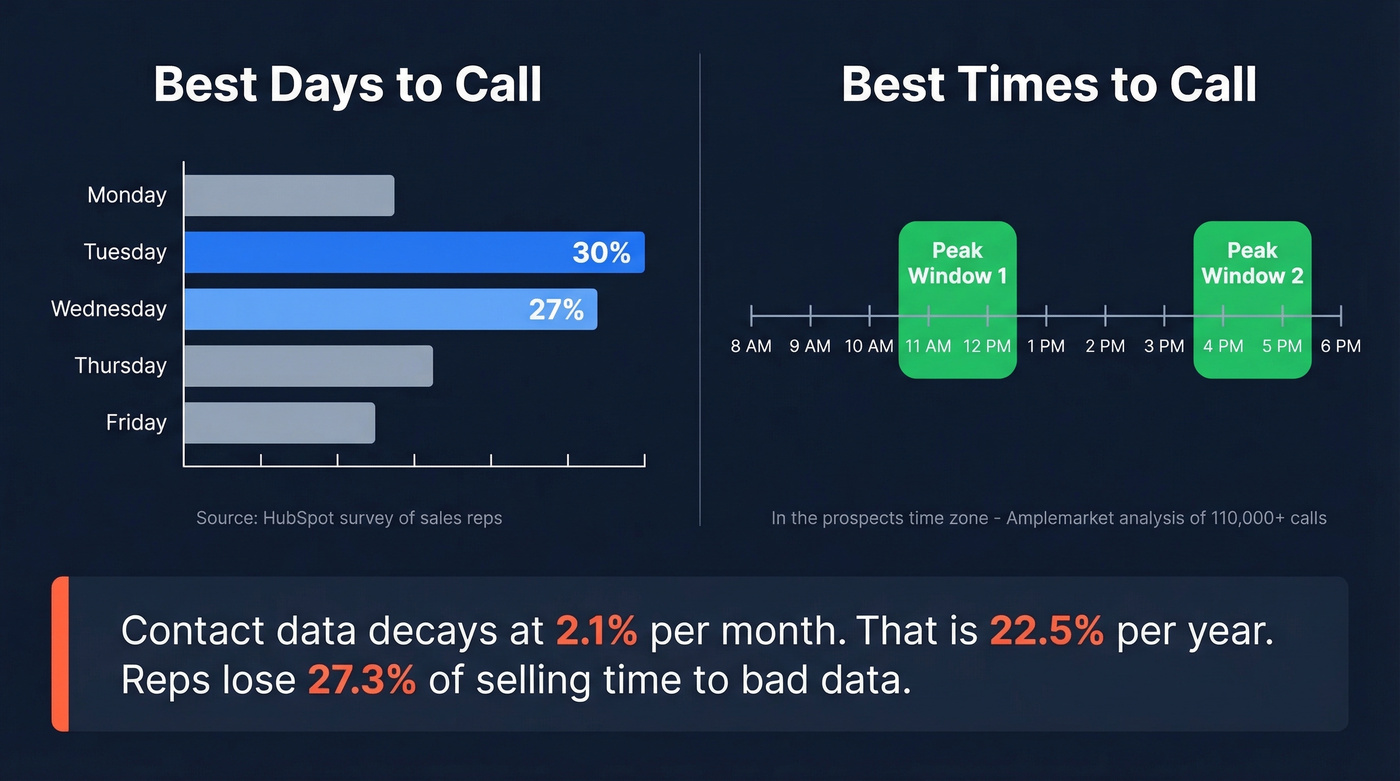
Timing matters too. Tuesday is the best day to call, with 30% of reps agreeing according to HubSpot, and Wednesday close behind at 27%. Best windows are 11 AM-12 PM and 4-5 PM in the prospect's time zone. An Amplemarket analysis of 110,000+ B2B cold calls confirmed the mid-week, late-morning pattern across industries.
Your dials are only as good as your data. We've seen teams lift connect rates dramatically just by switching from quarterly to weekly list refreshes. Prospeo's Mobile Finder gives you access to 125M+ verified mobile numbers with a 30% pickup rate - versus the 11-12.5% you'll typically see from Apollo or ZoomInfo - and numbers refresh every 7 days. Layer in intent data to prioritize prospects actively researching your category, and you're not just dialing verified numbers. You're dialing people who are already in-market.
The 3-Minute Call Structure
Forget long discovery calls on a cold dial. The goal is three minutes: get in, deliver value, book the meeting. This framework draws from Sandler-style pattern-interrupt sequencing and Hyperbound's 3-minute model.
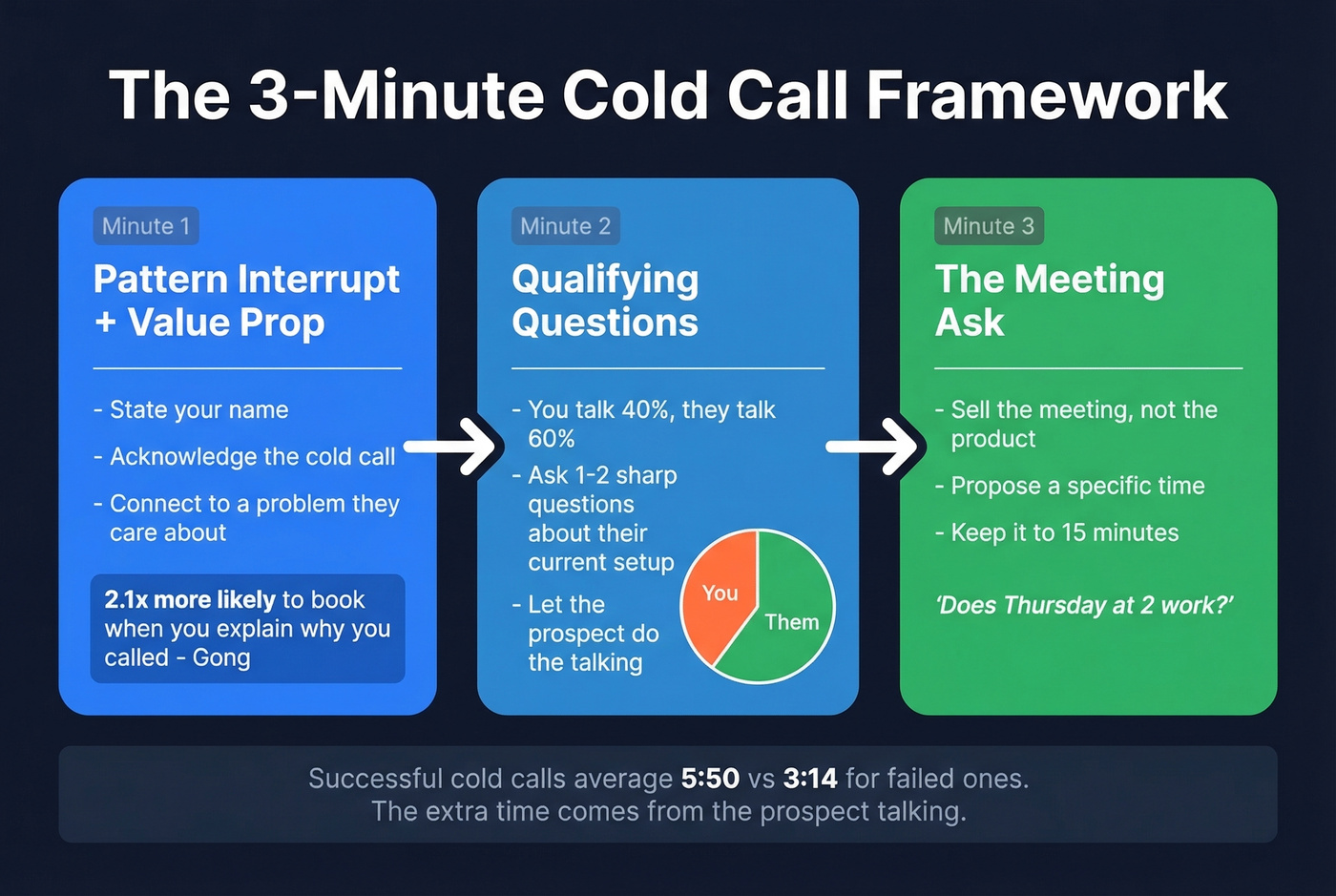
Minute 1 - Pattern interrupt + value prop. Break the autopilot. State your name, acknowledge the cold call, and immediately connect to a problem they care about. Gong's data shows that explaining why you're calling makes you 2.1x more likely to book a meeting.
Minute 2 - Qualifying questions. Flip the ratio. Aim for a 40/60 talk-to-listen split - you talk 40%, they talk 60%. Ask one or two sharp questions about their current setup. Successful cold calls average 5:50 in duration versus 3:14 for failed ones, and the extra time comes from the prospect talking, not you. (If you want a tighter qualification framework, borrow a few from discovery questions.)
Minute 3 - The meeting ask. Don't pitch your product. Sell the meeting. "Based on what you just shared, I think a 15-minute deep dive would be worth your time. Does Thursday at 2 work?" (For more meeting language, see email wording to schedule a meeting.)
Pattern interrupt, value, questions, ask. Three minutes, one booked meeting.

Bad numbers kill your connect rate before your opener even matters. Prospeo's Mobile Finder gives you 125M+ verified mobile numbers refreshed every 7 days - with a 30% pickup rate versus 11-12% from Apollo or ZoomInfo. At $0.01 per lead, you stop burning dials on disconnected lines and start reaching real buyers.
Turn those 200 daily dials into conversations that actually book meetings.
Opening Lines That Work
The first 10 seconds determine whether you get three minutes or a dial tone.
"Hi, this is Sam. I know you weren't expecting my call." Pause.
The Sandler pattern interrupt. The pause is critical - it forces them to respond rather than reflexively hanging up.
"I'll be honest, this is a cold call. You can hang up now, or give me 30 seconds to explain why I called."
Radical honesty disarms. This one comes from Nomi's playbook, and it works because it gives the prospect control - which paradoxically makes them more likely to listen.
"I'll be brief - in three minutes I can share how we help [specific outcome]. Does that sound fair?"
The permission opener from Zendesk's script library. Works best when you fill in a concrete, relevant outcome rather than a generic pitch. (If you need a punchier outcome line, steal from these sample elevator pitches.)
All three share one thing: none of them ask "Is this a good time?" Gong's data shows that phrase drops your meeting chances by 40%. Kill it from your vocabulary.
Handling the Top 5 Objections
Objections aren't rejections - they're requests for more information delivered impatiently. Use a simple three-step framework: Listen, Clarify, Respond with value. Don't argue. Don't steamroll. Ask a question. (For more scripts, see cold call rejection.)
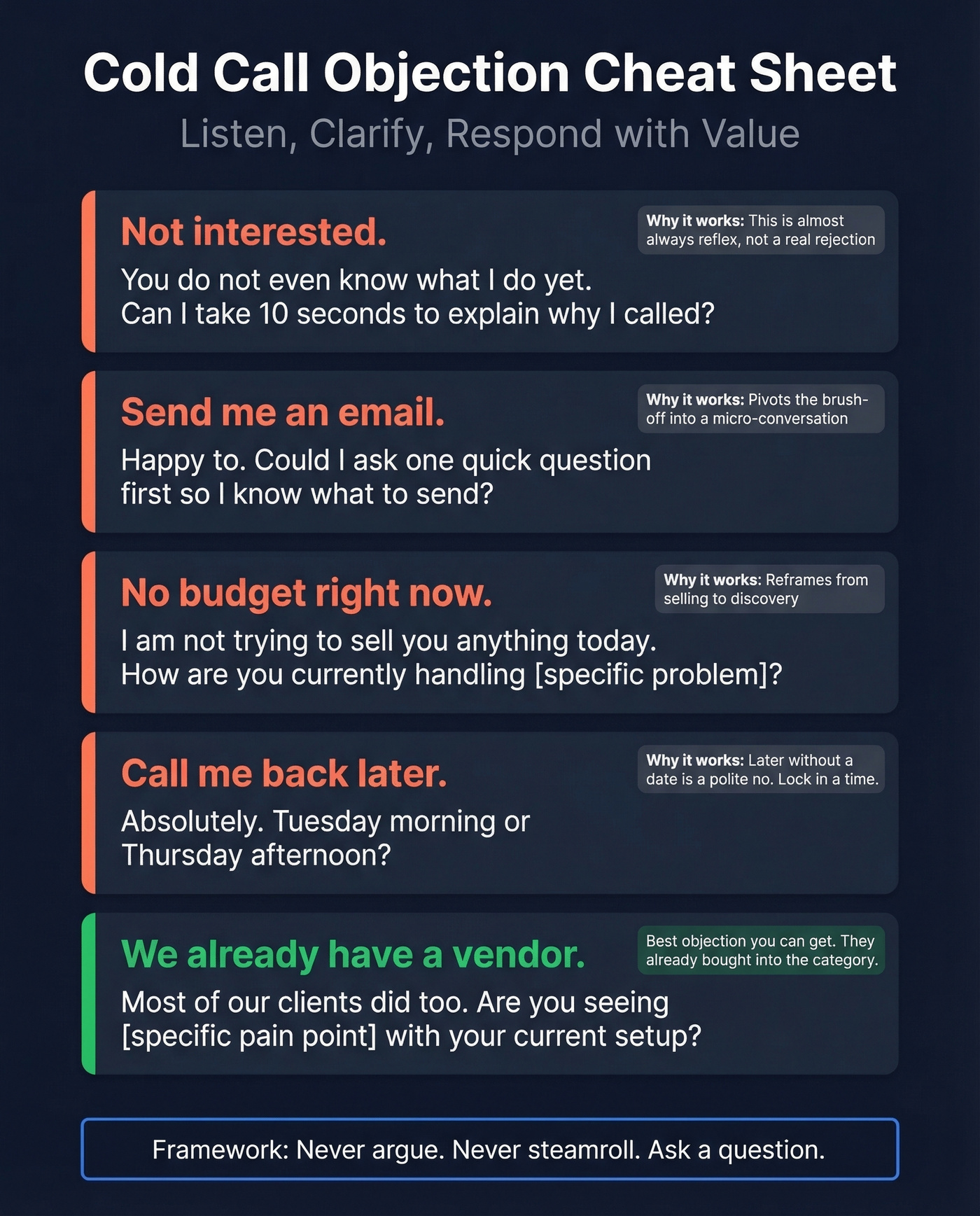
"Not interested." "That makes sense - you don't even know what I do yet. Can I take 10 seconds to explain why I called?"
This works because "not interested" is almost always reflexive. They're not rejecting your offer; they're rejecting the interruption. The average B2B buying group has grown from 6 to 12 stakeholders, so "not interested" often means "I can't decide alone" - your job is to give them ammunition for the internal conversation.
"Send me an email." "Happy to - but emails can only go so far. Could I ask one quick question first so I know what to send?"
This pivots the brush-off into a micro-conversation. If they answer one question, you're in a dialogue.
"No budget right now." "Totally fair. I'm not trying to sell you anything today - just wanted to understand how you're currently handling [specific problem]. Is that something you're actively thinking about?"
Reframe from selling to discovery. Budget objections almost always mean "I don't see the value yet."
"Call me back later." "Absolutely. When's a good time - Tuesday morning or Thursday afternoon?"
Lock in a specific time. "Later" without a date is a polite no.
"We already have a vendor for that." "That's great - most of our clients did too. Quick question: are you seeing [specific pain point] with your current setup?"
Here's the thing: "We already have a vendor" is the best objection you can get. It means they've already bought into the category - you just need to show them a gap. That's infinitely easier than selling a prospect who doesn't think they have a problem at all.
Voicemail Strategy That Gets Callbacks
80% of your calls hit voicemail. That's not a failure - it's a channel. Here's a script that one SDR on r/sales reported generating 15 callbacks from 25-35 voicemails per week, with 3-5 of those converting into booked meetings:
"Hey [Name], this is [You] with [Company], calling in regards to your oversight of the [X] team. If you could give me a call back at your nearest convenience at [number]."
No pitch, no feature dump, no "I'd love to connect." The key variable is research - the "oversight of the [X] team" phrase signals you know who they are and what they do. Generic voicemails get deleted; researched ones get callbacks.
When they call back, here's the move most reps miss: open with a confused reset. "Hey, sorry - I'm a bit lost, remind me what you oversee at [Company] again?" This flips the dynamic entirely. The prospect starts explaining their role and responsibilities, which puts you in discovery mode without ever having to pitch. In our experience, callbacks handled this way convert significantly better than callbacks where the rep launches straight into a pitch, because the prospect is doing the talking from the first sentence.
Mistakes That Kill Your Connect Rate
Asking "Is this a good time?" Gong's data shows it drops meeting rates by 40%. Use an assumptive opener instead.
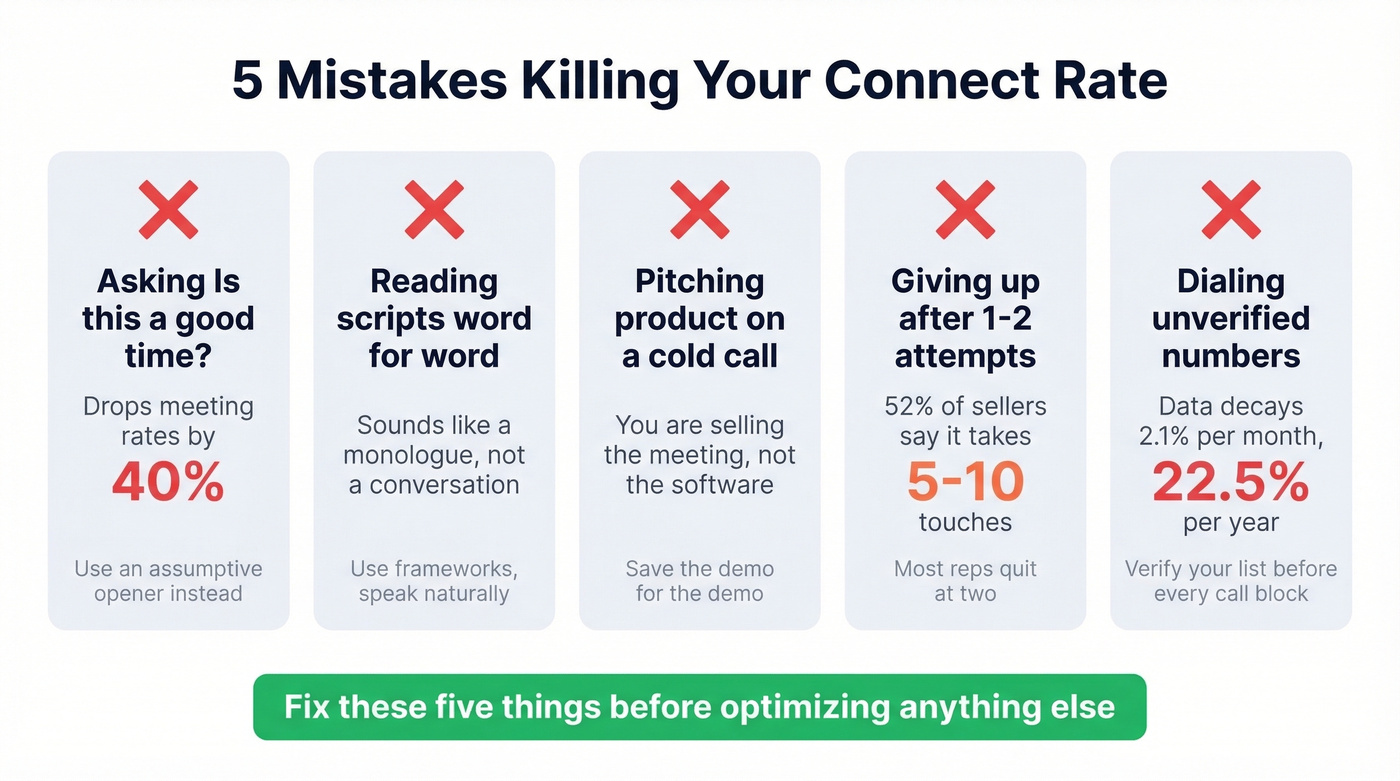
Reading scripts verbatim. Frameworks beat scripts. Know your structure, then speak naturally within it. The best cold callers sound like they're having a conversation, not performing a monologue. (If you need a full workflow, build a repeatable cold calling system.)
Pitching product on a cold call. You're selling the meeting, not the software. Save the demo for the demo. I've listened to hundreds of recorded cold calls, and the single biggest pattern among failed ones is the rep launching into features before the prospect has said a single word about their problems. (Use these software demo tips once you’ve earned the meeting.)
Giving up after 1-2 attempts. 52% of sellers say it takes 5-10 touches to connect with a new prospect. Most reps quit at two. Persistence isn't annoying - quitting early is just leaving meetings on the table. (Pair calls with sales follow-up templates so every touch has a purpose.)
Dialing unverified numbers. This is the silent killer. If you're not verifying your list before each call block, you're spending time on dead air instead of conversations. Skip this step and nothing else in this article matters. (If your list is messy, start with data enrichment services.)
Phone prospecting is a numbers game - but only when the numbers are real. Prospeo combines 125M+ verified mobiles with intent data tracking 15,000 topics, so you're not just dialing verified contacts. You're calling prospects actively researching your category, at the exact moment they're ready to talk.
Stop cold calling. Start warm-dialing prospects who are already in-market.
FAQ
How many cold calls should I make per day?
150-200 dials is standard for B2B SDRs. At a 5-8% connect rate, that's 8-16 live conversations and roughly one booked meeting per day. Track connects, not just dials - volume without verified numbers is wasted effort.
What's the best time to make prospecting calls?
Tuesday and Wednesday between 11 AM-12 PM and 4-5 PM in the prospect's time zone. This is confirmed across multiple studies, including Amplemarket's 110,000-call analysis. Avoid Monday mornings and Friday afternoons.
How do I improve my cold call connect rate?
Start with verified mobile numbers - bad data wastes up to 27.3% of selling time. Then optimize your call timing and use a pattern-interrupt opener to keep prospects on the line. Let's be honest: most connect rate problems are data problems disguised as skills problems.
What phone prospecting tips work immediately?
Use a pattern-interrupt opener, explain why you're calling within 10 seconds, never ask "Is this a good time?", aim for a 40/60 talk-to-listen ratio, sell the meeting instead of the product, leave researched voicemails, lock objections into specific callback times, verify numbers before dialing, and batch calls into focused 90-minute blocks. These don't require months of training - just discipline and repetition.