

Pipeline Generation: The 2026 Playbook (With Benchmarks)
Sales cycles are 32% longer than they were in 2021. Only 16% of B2B reps hit quota last year. And 79% of marketing leads never convert into a single dollar of revenue.
If your pipeline feels fuller but your revenue feels flat, you're experiencing pipeline inflation - and you're far from alone. We've watched teams pour money into top-of-funnel activity only to wonder why closed-won numbers barely budge. This playbook breaks down pipeline generation from benchmarks to tech stack so you can find and fix what's leaking.
The Short Version
This isn't about more leads. It's about better signals, cleaner data, and faster follow-up. Most teams leak pipeline at the MQL-to-SQL handoff (15% conversion), through bad contact data (bounce rates can hit 35-40% when you're sequencing unverified emails), and by measuring vanity metrics instead of velocity. Fix those three leaks and you'll generate more pipeline with fewer resources.
What Is Pipeline Generation?
Pipeline generation is the process of creating qualified, revenue-attached sales opportunities - not just leads, not just awareness, but deals your reps can actually work. It sits downstream of demand generation (which creates awareness) and lead generation (which captures contact information). This is where interest converts into money.
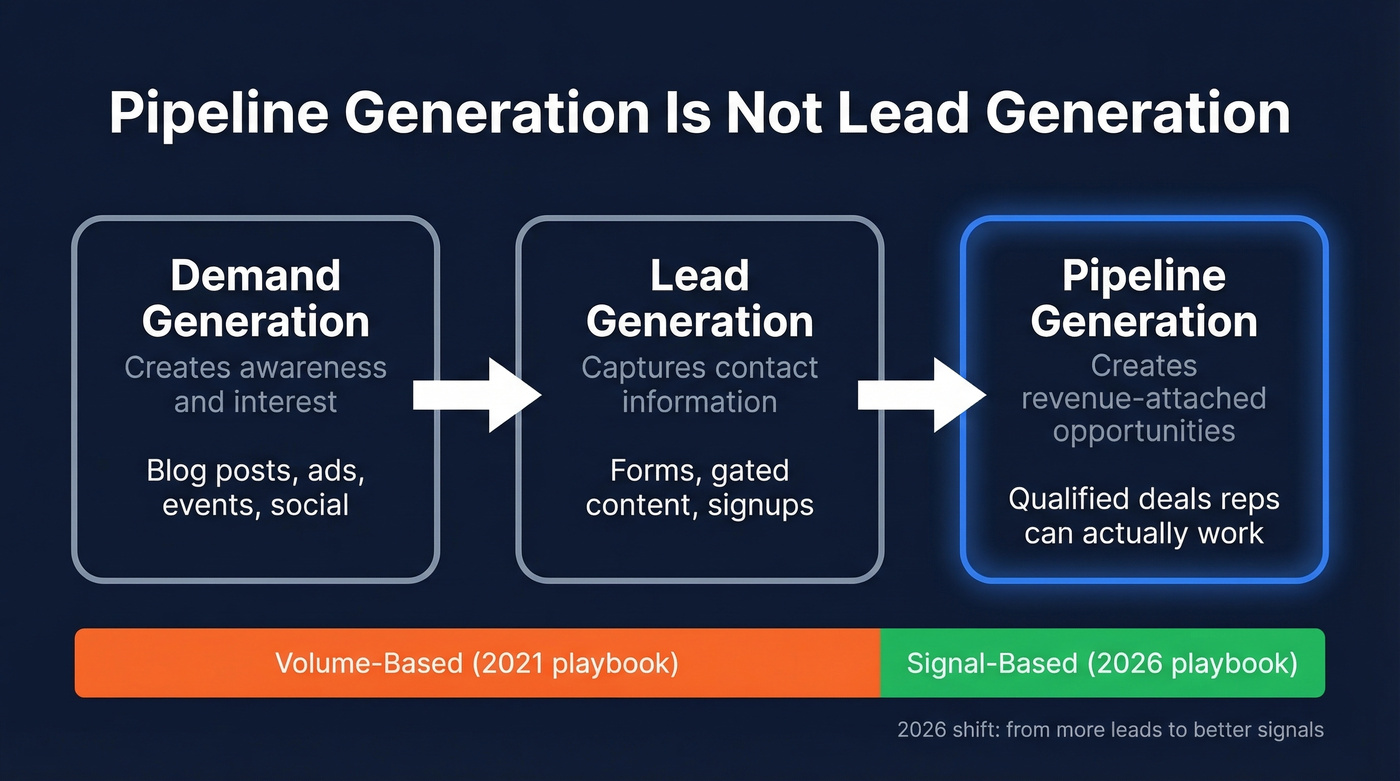
A useful distinction: your pipeline tracks active deals and their stages. Your funnel tracks conversion rates through those stages. Related, but not interchangeable. The term gets confused with lead generation constantly, but the difference matters - generating pipeline means filling and advancing real opportunities in front of reps, not just inflating the top of the funnel.
The shift happening right now is from volume-based to signal-based motions. Volume-based outreach creates more noise than revenue. The teams winning in 2026 aren't sending more - they're targeting accounts showing intent, reaching verified contacts, and moving fast on timing.
Stage-by-Stage Conversion Benchmarks
Benchmarks matter because "more pipeline" is meaningless without context.
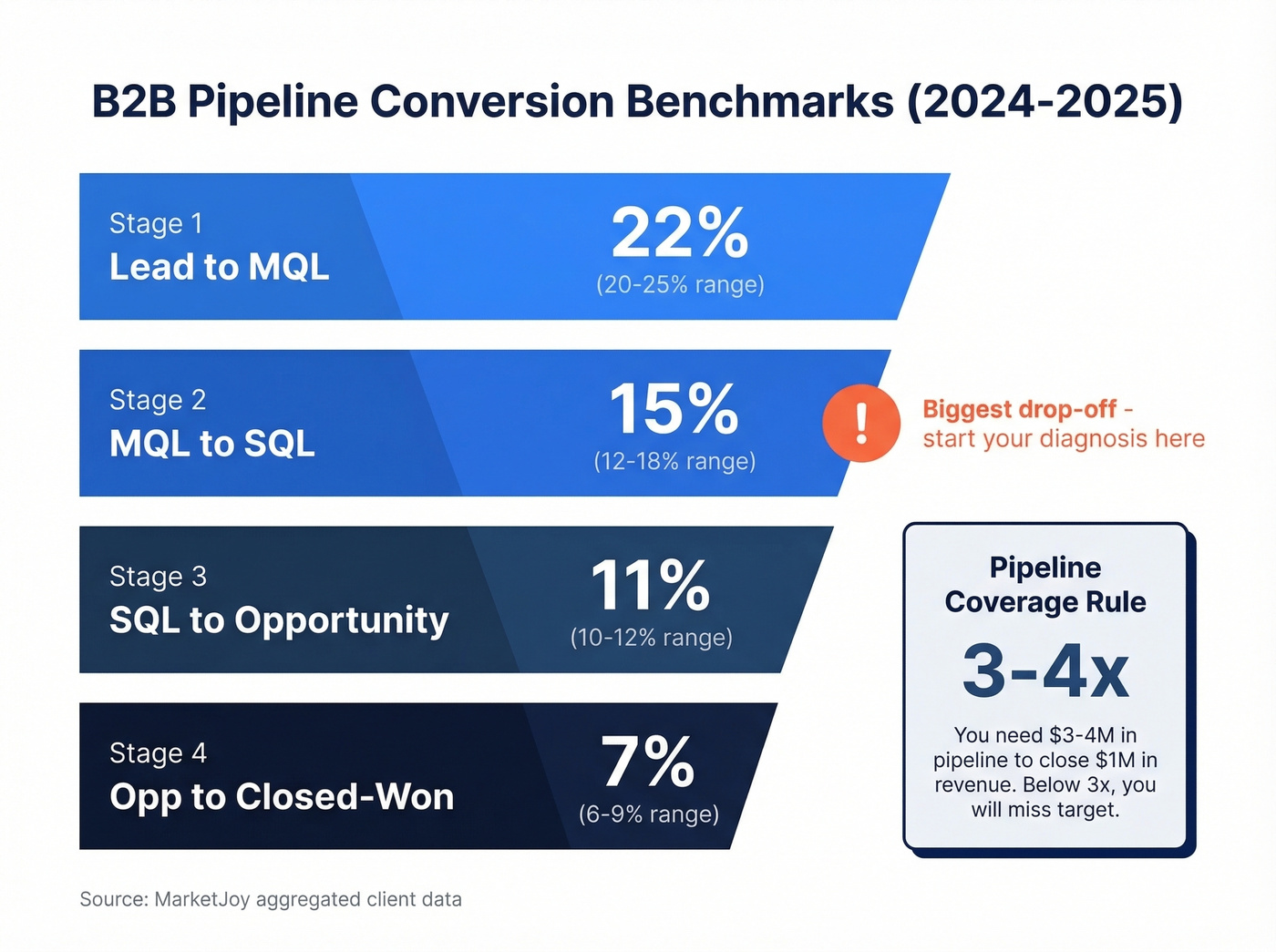
These numbers come from MarketJoy's aggregated client data across 2024-2025:
| Stage | Benchmark | Typical Range |
|---|---|---|
| Lead to MQL | 22% | 20-25% |
| MQL to SQL | 15% | 12-18% |
| SQL to Opportunity | 11% | 10-12% |
| Opp to Closed-Won | 7% | 6-9% |
The biggest drop-off happens at MQL to SQL. That's where misaligned definitions, bad contact data, and slow follow-up silently destroy pipeline. If you're losing more than 85% of MQLs before they become SQLs, start your diagnosis there.
For context, the median B2B conversion rate across all industries sits at 2.9%, with most falling in the 2.0-5.0% range. Most B2B teams run 3-4x pipeline coverage: you need $3-4M in pipeline to reliably close $1M in revenue. Below 3x, you will miss target.
Benchmarks by Industry
Not all funnels convert the same. First Page Sage's benchmark report shows dramatic variation:
| Industry | Lead to MQL | MQL to SQL | SQL to Opp | SQL to Closed |
|---|---|---|---|---|
| B2B SaaS | 39% | 38% | 42% | 37% |
| Cybersecurity | 24% | 40% | 43% | 46% |
B2B SaaS has higher early-stage conversion but lower close rates than cybersecurity, which converts fewer leads initially but closes at a much higher rate. The takeaway: don't benchmark yourself against "B2B averages." Find your industry's norms and measure against those.
The 50-Day Rule and Pipeline Velocity
Here's a stat that should change how you manage deals: opportunities closed within 50 days have a 47% win rate. After 50 days, that drops to 20% or lower. Time kills deals.
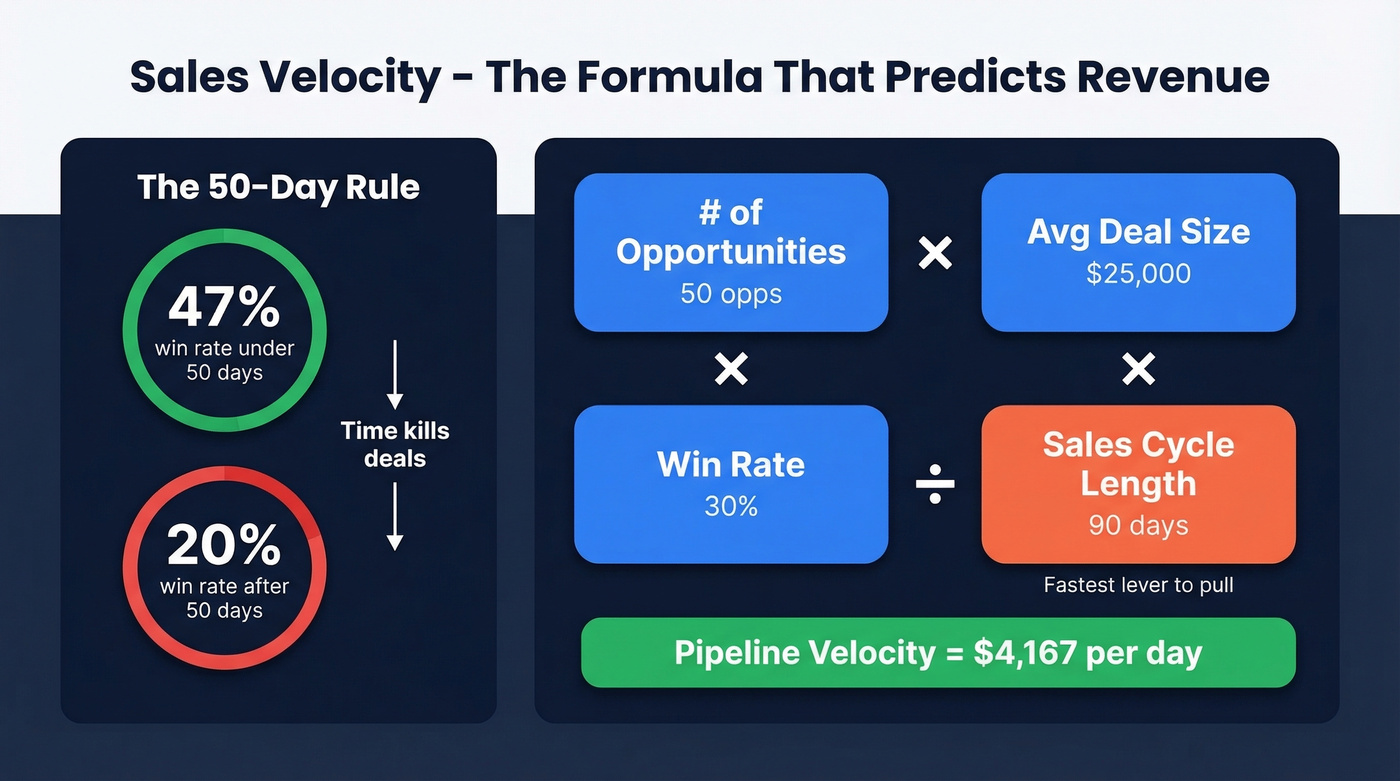
Sales Velocity = (# Opportunities x Avg Deal Size x Win Rate) / Sales Cycle Length
A worked example: 50 opportunities x $25,000 average deal x 30% win rate / 90-day cycle = $4,167/day in pipeline velocity. Want to double that number? You've got four levers. Most teams obsess over opportunity volume when shortening cycle length delivers faster results with less effort.
Here's the thing: if your average deal closes under $10K, you don't need a $60K intent platform or a 50-person SDR team. You need verified data, a tight ICP, and a rep who can close in 30 days. Complexity should scale with deal size, not with ambition.
Track 3-5 metrics tied to revenue goals. Not 15. Velocity, stage conversion rates, and pipeline coverage predict revenue. Everything else is decoration.

The article says it: bounce rates of 35-40% silently destroy pipeline and nuke domain reputation. Prospeo's 5-step email verification delivers 98% accuracy - teams like Snyk cut bounces from 35% to under 5% and grew AE-sourced pipeline 180%. At $0.01 per verified email, bad data stops being a pipeline killer.
Stop leaking pipeline to unverified contacts. Start with 75 free emails.
5 Pipeline Killers (And Fixes)
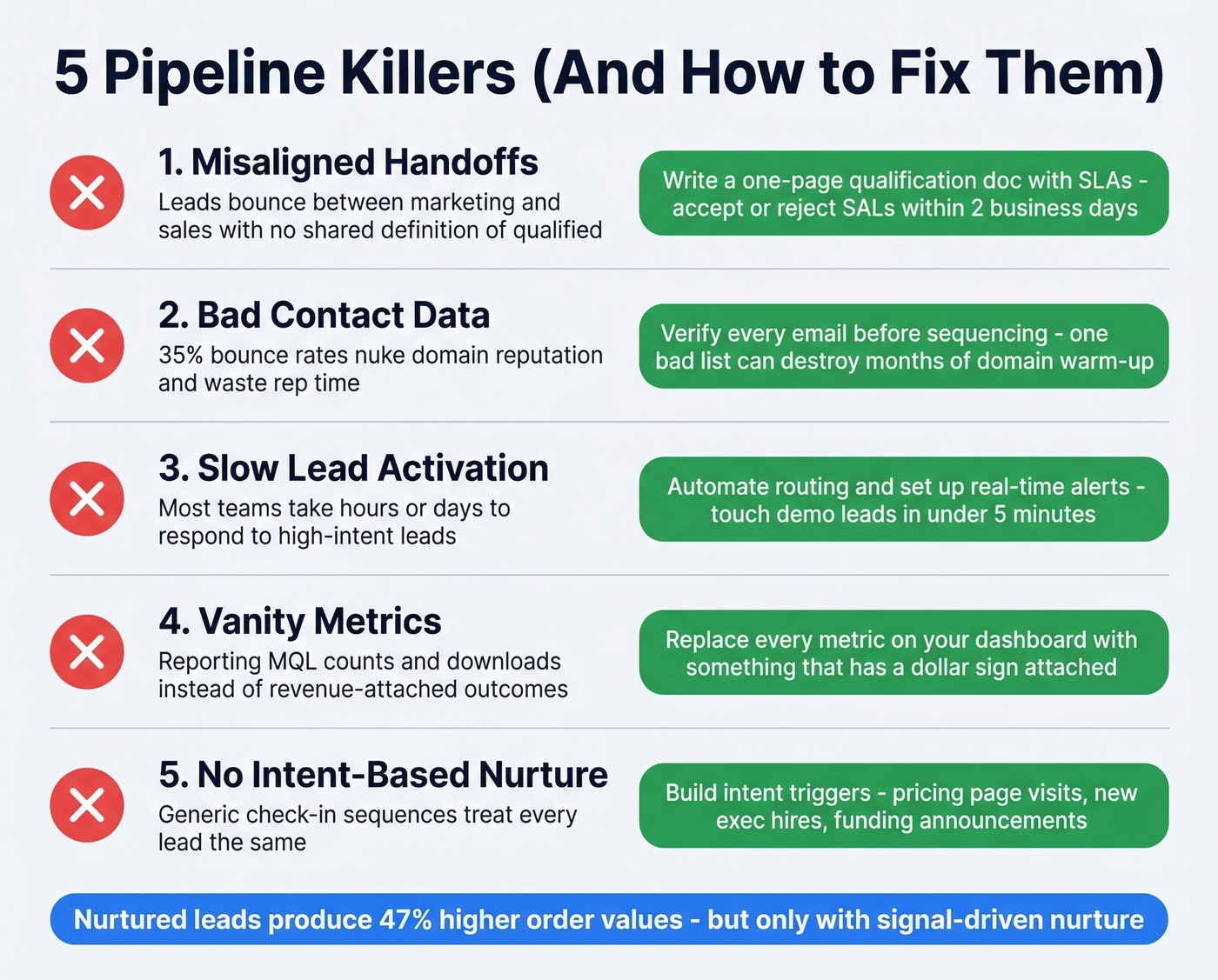
Most pipeline problems aren't strategic. They're operational.
1. Misaligned Handoffs
The symptom: leads bouncing between marketing and sales, reps complaining about "bad leads," marketing complaining about follow-up speed. The root cause is almost always a missing shared definition of "qualified."
Fix it by writing a one-page qualification criteria doc that both teams sign off on. Include explicit SLAs - marketing delivers X leads per week meeting Y criteria, sales follows up within Z hours. Directive's framework recommends accepting or rejecting SALs within 2 business days.
2. Bad Contact Data
Your sequences look great, your messaging is sharp, your targeting is dialed - and 35% of your emails bounce. Bad data doesn't just waste rep time. It tanks your domain reputation, which tanks deliverability on every future send. We've seen teams nuke months of domain warm-up with a single unverified list.
3. Slow Lead Activation
Contacting leads within 24 hours increases conversion by 5x. But the real benchmark is tighter - Directive recommends touching demo and pricing leads in under 5 minutes. Most teams take hours or days because of manual routing, missing CRM fields, or reps who don't check their queues.
Automate the routing. Set up real-time alerts when target accounts show intent. The competitor who responds first usually wins.
4. Vanity Metrics Over Outcomes
Page views, downloads, webinar registrations - none of these are pipeline. Let's be honest: we've all sat in pipeline reviews where someone presents a slide full of MQL counts while the CRO stares at a revenue gap. The fix is a measurement reframe. Marketing reports pipeline contribution by source and segment, not MQL volume. SDRs track speed-to-lead and conversion velocity by offer. RevOps tracks CAC and payback period. Replace every vanity metric on your dashboard with something that has a dollar sign attached.
5. No Intent-Based Nurture
Generic "just checking in" sequences aren't nurture. They're noise. Nurtured leads produce 47% higher order values than non-nurtured ones - but only when the nurture is signal-driven.
The signals that matter most in 2026: new exec appointments (new executives spend 70% of their budget within the first 100 days at a new job), pricing page visits, competitor tool evaluations, and funding announcements. A prospect who visited your pricing page three times this week gets a different follow-up than one who downloaded a whitepaper six months ago. Build intent-based triggers into your sequences, and stop treating every lead the same.
How AI Impacts Pipeline Generation in 2026
AI adoption has hit 89% among revenue organizations. But adoption and impact are different things.
The upside is real. Bain's research shows early adopters seeing 30%+ improvement in win rates. Sellers currently spend only about 25% of their time actually selling - AI can reclaim a meaningful chunk of the rest. Outreach reports that 45% of teams now run a hybrid AI-SDR model, blending automated outreach with human follow-up.
AI won't save bad processes. The biggest blockers Bain identified aren't technical - they're fragmented GTM data, piecemeal automation layered on broken workflows, and change management failures. If your CRM data is dirty, your qualification criteria are vague, and your handoffs are manual, adding AI just automates the mess faster.
The teams getting real results use AI for three specific things: prioritizing accounts based on intent signals, personalizing outreach at scale without sounding robotic, and shortening research time so reps spend more hours in actual conversations.
The Right Tech Stack
The lead generation software market is projected to grow from $7.4B to $16.2B by 2034. There's no shortage of tools. The challenge is picking the right three or four layers and not overbuying.
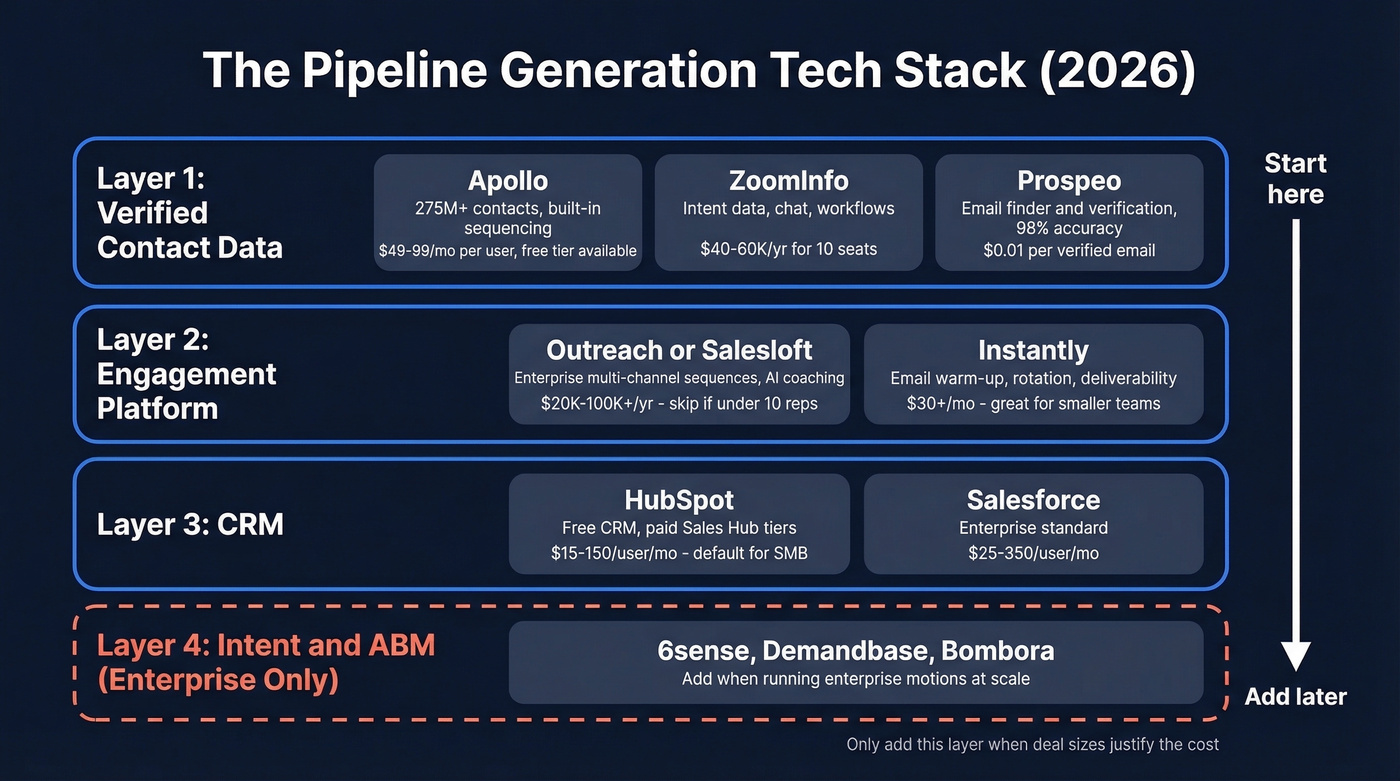
Start with three layers: verified contact data, an engagement platform, and a CRM. Add intent and ABM tools when you're running enterprise motions at scale.
Data and Enrichment
Apollo covers 275M+ contacts and bundles a solid sequencing tool, making it a strong all-in-one option for SMB teams. Free tier available, paid plans from $49-99/mo per user. Convenient if you want prospecting and outreach in one place.
ZoomInfo offers a broad feature set - intent data, chat, workflow automation, and more. But a 10-seat contract with modules can run $40-60K/year. Worth it for large orgs; overkill for everyone else.
Clay ($149+/mo) is a workflow orchestration layer that pulls data from multiple providers and enriches it through automated sequences - the glue between your data sources, not a data source itself.
If you're comparing providers, start with data enrichment and lead enrichment basics so you know what to buy.
Engagement Platforms
Skip Outreach and Salesloft if your team is under 10 reps. Both are enterprise-grade sales engagement platforms with multi-channel sequences, AI-assisted coaching, and pipeline analytics. Outreach runs roughly $20K-$100K+/year; Salesloft is roughly $20K-$80K+/year. The feature sets have converged so much that the decision comes down to which UI your reps prefer and which integrates better with your CRM.
For teams that just need email sending without the enterprise overhead, Instantly starts at $30+/mo and handles warm-up, rotation, and deliverability well.
If you're building outbound sequences, use proven sales prospecting techniques and tighten your sequence management before adding more tools.
CRM
HubSpot offers a free CRM with paid Sales Hub tiers from $15-$150/user/mo. It's the default for SMBs and mid-market teams who want marketing and sales in one platform without a six-month implementation. Salesforce runs $25-$350/user/mo and remains the enterprise standard.
If you're still evaluating options, see examples of a CRM and the best contact management software for different team sizes.
Intent and ABM (Enterprise)
6sense ($60K+/year) uses AI to identify anonymous buying signals and predict which accounts are in-market. Demandbase ($24K+/year) offers a similar account-based platform with a more accessible entry point for mid-market teams exploring ABM.
To operationalize signals, build a simple system for identifying buying signals and intent based segmentation.
| Tool | Category | Starting Price | Best For |
|---|---|---|---|
| Prospeo | Data/Enrichment | Free; ~$0.01/email | Best email accuracy at any budget |
| Apollo | Data/Enrichment | Free-$99/mo/user | SMB all-in-one prospecting |
| ZoomInfo | Data/Enrichment | $15K+/yr | Enterprise with broad coverage |
| Clay | Enrichment/Workflow | $149+/mo | Multi-source data orchestration |
| Outreach | Engagement | ~$20K-$100K+/yr | Enterprise sales teams (20+ reps) |
| Salesloft | Engagement | ~$20K-$80K+/yr | Enterprise teams on Salesforce |
| Instantly | Email Sending | $30+/mo | High-volume cold email at low cost |
| HubSpot | CRM | Free; $15-$150/user/mo | SMB and mid-market default |
| Salesforce | CRM | $25-$350/user/mo | Enterprise with complex workflows |
| 6sense | Intent/ABM | $60K+/yr | Enterprise ABM with big deal sizes |
| Demandbase | Intent/ABM | $24K+/yr | Mid-market entering ABM |
Pipeline velocity has four levers - and data quality touches all of them. Prospeo gives you 30+ filters including buyer intent across 15,000 topics, 125M+ verified mobiles with 30% pickup rates, and a 7-day data refresh cycle so you're never sequencing stale contacts. Meritt tripled their pipeline from $100K to $300K/week.
Generate pipeline with signals, not spray-and-pray. Try Prospeo free.
Enterprise vs. SMB Motions
These are fundamentally different motions, and treating them the same is a common mistake.
Enterprise deals involve 13 decision-makers on average, run 6-18 months, and require multithreading across the buying group. You can't just email the VP and hope. You need contact-level ABM - SDR outreach coordinated with marketing air cover hitting multiple stakeholders simultaneously. The Influ2 playbook frames this well: align sales and marketing on specific contacts within buying groups, not just target accounts.
SMB cycles run 2-6 months with 1-3 decision-makers. Speed and efficiency matter more than coverage. A single rep with verified contact data, a good sequencer, and a tight ICP can build meaningful pipeline without an ABM platform. The stack is simpler, the motion is faster, and the margin for error on data quality is actually lower - because you don't have 50 AEs to absorb a 30% bounce rate.
One stat that applies to both: 58% of SDRs say competition is their biggest challenge. In enterprise, that means getting to the buying group before your competitor does. In SMB, it means responding faster and with better personalization. Either way, speed and signal quality beat volume.
FAQ
What's the difference between pipeline generation and demand generation?
Demand generation creates awareness and interest across your target market. Pipeline generation converts that interest into qualified, active sales opportunities with revenue attached. Demand gen fills the top of the funnel; pipeline gen turns attention into deals your reps can forecast against.
What's a good pipeline coverage ratio?
Most B2B companies target 3-4x coverage, meaning $3-4 in pipeline value for every $1 of quota. Below 3x, you'll consistently miss target. Enterprise teams with long cycles often aim for 4-5x to account for deal slippage and multi-quarter forecasting.
How do you calculate sales velocity?
Sales velocity = (number of opportunities x average deal size x win rate) / sales cycle length. The formula gives you four distinct levers - most teams default to increasing opportunities when shortening cycle length often delivers faster results.
Why do most MQLs never become pipeline?
The MQL-to-SQL stage has the biggest drop-off at roughly 15% conversion. The usual culprits: marketing and sales disagree on what "qualified" means, contact data is bad so reps can't reach the lead, and follow-up takes days instead of minutes. Fixing shared definitions and data quality resolves most of the gap.
What's a cost-effective data tool for pipeline generation?
Prospeo offers 98% verified emails and 125M+ mobile numbers starting free at roughly $0.01 per email - no contracts required. Apollo is a strong all-in-one alternative for SMB teams. ZoomInfo covers enterprise needs but starts at $15K+/year, making it overkill for teams under 20 reps.