

Pipeline Signals: What They Are, Why They Matter, and How to Use Them
Your SDR dashboard shows MQLs climbing quarter after quarter. Close rates? Down roughly 15%. The pipeline looks full, but it's inflated with contacts who downloaded a whitepaper six months ago and haven't thought about you since.
This is the pipeline inflation problem. MQLs are up 20-30% across B2B, but 79% of marketing leads never convert because they're missing a "why now" trigger. The fix isn't more leads - it's better pipeline signals.
What Are Sales Pipeline Signals?
Pipeline signals are behavioral evidence that a prospect is entering a buying window. Three signal types cover 80% of the value: conversion-proximity signals (pricing page visits, demo requests), job changes (champion tracking), and hiring surges (expansion signals). Teams using signal-based outreach see 18% reply rates vs. 3.4% for generic cold outreach.
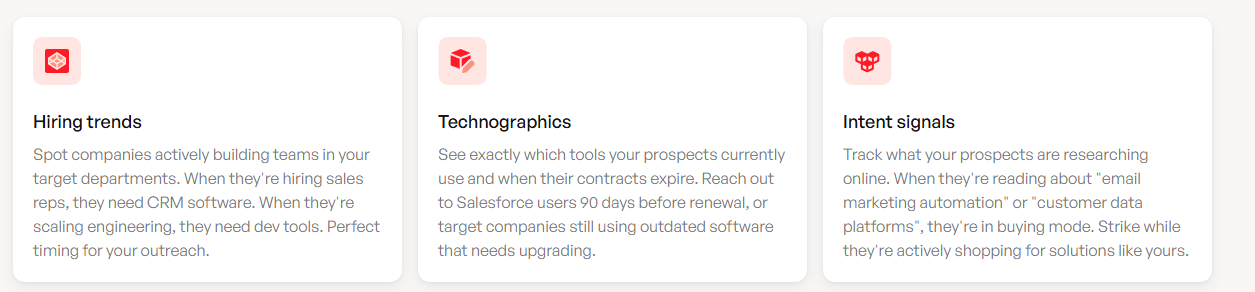
These aren't static firmographic lists. They're real-time indicators that a company or individual is actively researching, evaluating, or preparing to buy a solution in your category. They tell you when to reach out, not just who.
Here's the thing: up to 70% of the buyer journey happens in the dark funnel - channels you can't directly observe. Prospects read G2 reviews, compare pricing pages, and talk to peers long before they fill out your demo form. The intent data market has grown to roughly $4.5B at a 15.9% CAGR because every revenue team is trying to illuminate that invisible buying activity. A prospect visiting your pricing page three times in a week, a former champion changing jobs to a target account, a company posting five SDR roles - those are signals worth acting on.
Types of Buying Signals
First-Party, Second-Party, and Third-Party
| Source Type | What It Is | Examples | Accuracy | Reach |
|---|---|---|---|---|
| First-party | Your own data | Site visits, email opens, product usage | Highest | Narrow |
| Second-party | Partner's data | G2 Buyer Intent, TrustRadius, TechTarget | High | Moderate |
| Third-party | Aggregated co-ops | Bombora, 6sense, ZoomInfo, Demandbase | Variable | Broadest |
First-party signals are the most reliable but limited to people who already know you exist. Third-party signals cast a wider net but can carry 7-14 day delays through co-op data models - by the time you see the signal, a competitor may have already made contact.
The 4 Patterns That Predict Deals
Raw activity is vanity. Patterns are what predict deals.
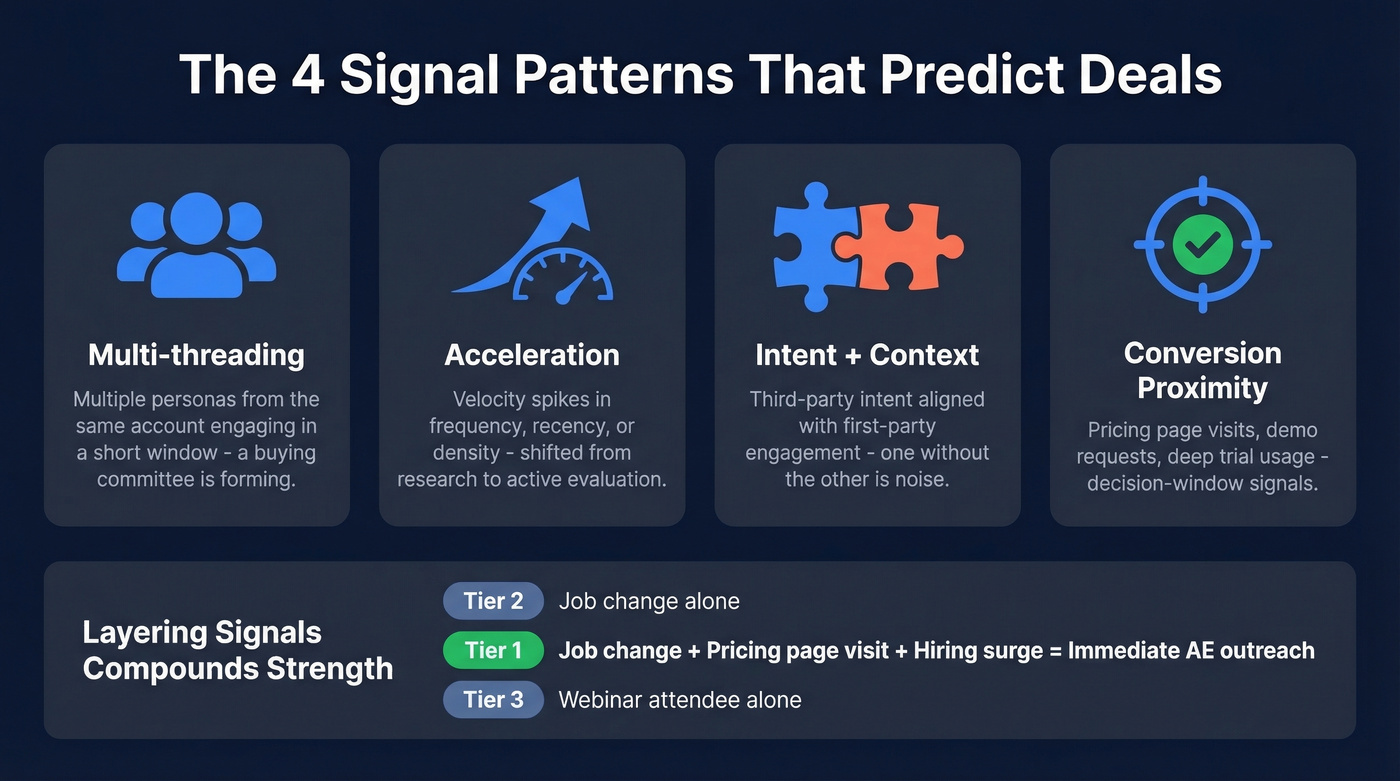
- Multi-threading - Multiple personas from the same account engaging in a short window. A buying committee is forming.
- Acceleration - Velocity spikes in frequency, recency, or density. The account shifted from passive research to active evaluation.
- Intent + context - Third-party intent becomes meaningful only when it aligns with first-party engagement. One without the other is noise.
- Conversion-proximity - Pricing page visits, demo requests, deep trial usage. These are decision-window signals.
Layering signals compounds predictive strength. A job change alone gets a Tier 2 response. A job change plus a pricing page visit plus a hiring surge? That's Tier 1 - immediate AE outreach. About 30% of people change jobs every year, which means nearly a third of your champion contacts are rotating out of their accounts annually. If you're not tracking those moves, you're bleeding pipeline.
Signal Response Playbook
Only about 3% of your TAM is buying at any given time. Signals help you find that 3% - but only if you act fast. The first seller to contact after a trigger event is 5x more likely to win, and being in front of buyers first increases closing probability by 74%. Yet 55% of companies take more than five days to respond to leads.
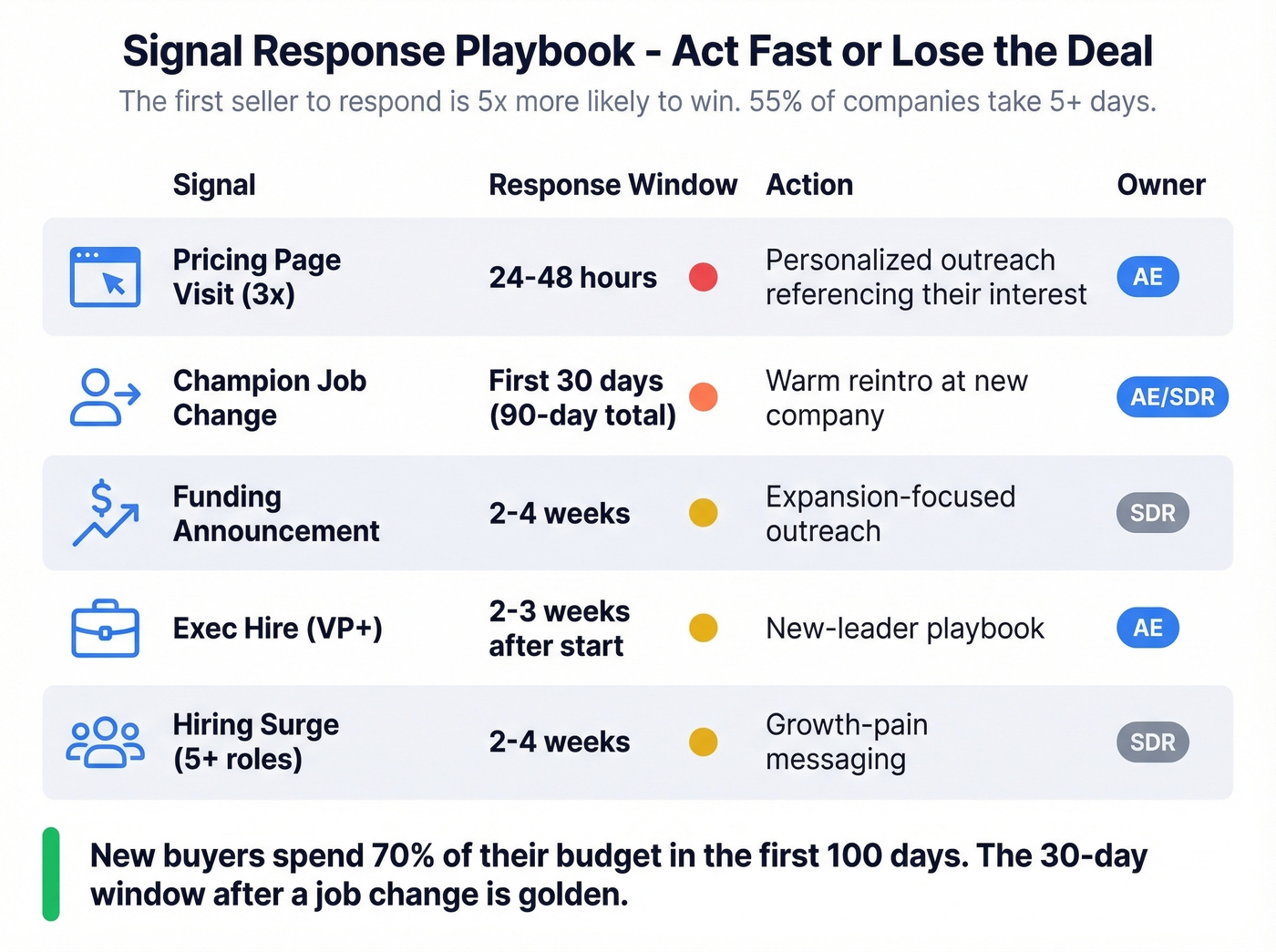
Speed isn't optional. It's the whole point.
| Signal | Response Window | Action | Owner |
|---|---|---|---|
| Pricing page visit (3x) | 24-48 hrs | Personalized outreach referencing interest | AE |
| Champion job change | First 30 days (90-day total window) | Warm reintro at new company | AE/SDR |
| Funding announcement | 2-4 weeks | Expansion-focused outreach | SDR |
| Exec hire (VP+) | 2-3 weeks after start | New-leader playbook | AE |
| Hiring surge (5+ roles) | 2-4 weeks | Growth-pain messaging | SDR |
New buyers spend 70% of their budget in the first 100 days. That first-30-day window after a champion changes jobs is genuinely golden - they're building their stack, they have budget authority, and they already trust your product. Miss that window and you're competing against inertia.
Let's be honest: if your average deal size is under $15k, you probably don't need a $50k+ intent platform. Track three signals manually - pricing page visits, champion job changes, hiring surges - and you'll outperform 80% of teams drowning in dashboards they never act on.

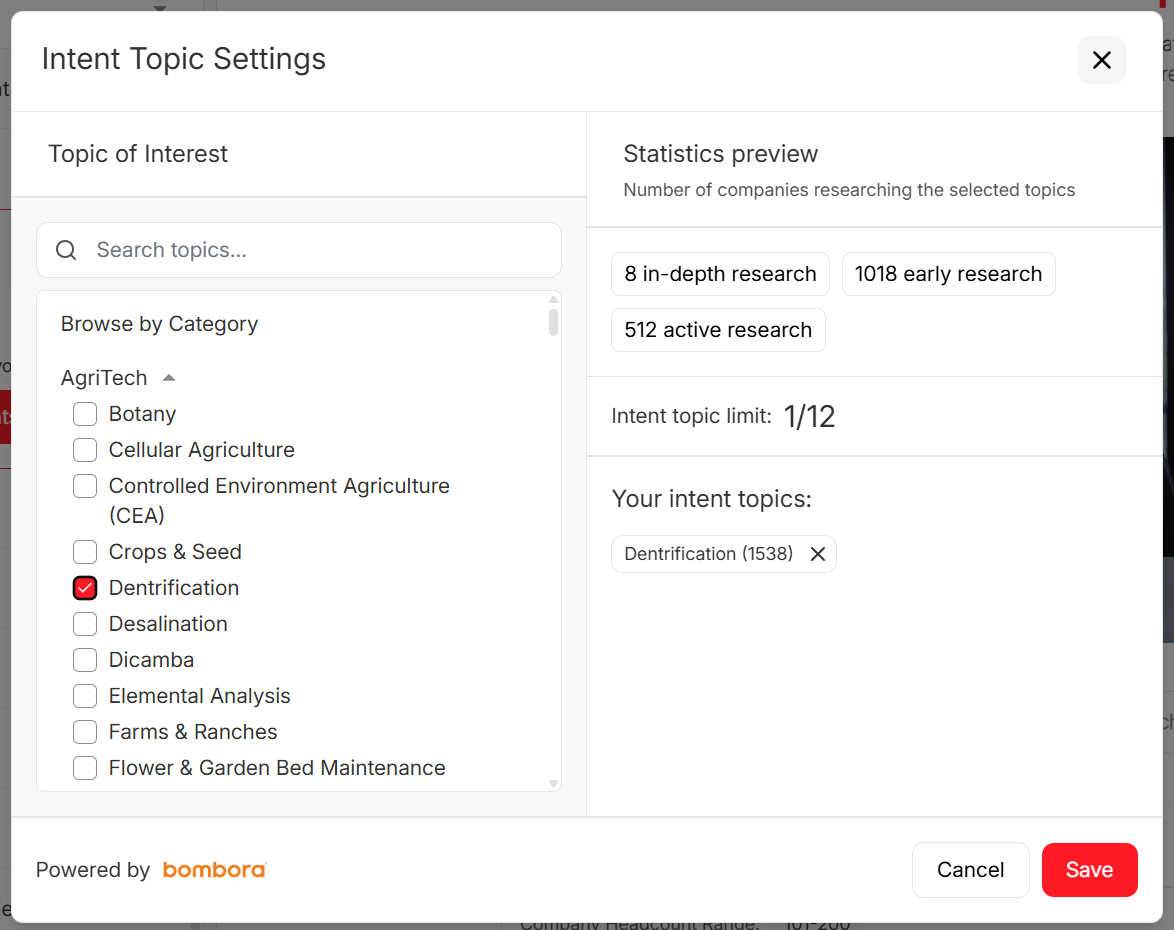
You just read that a champion job change plus a hiring surge is a Tier 1 signal. Prospeo tracks both - with intent data across 15,000 Bombora topics, job change filters, and headcount growth signals built into 30+ search filters. Every contact comes back with 98% verified emails and 125M+ direct dials so you can act within that 30-day golden window, not after it closes.
Stop watching signals expire while you hunt for accurate contact data.
How to Operationalize Signals
The gap between "we track signals" and "signals drive our pipeline" is operational routing. A practitioner on r/startups documented a system that mirrors what high-performing teams build: aggregate signals from multiple sources, then route by intent strength.
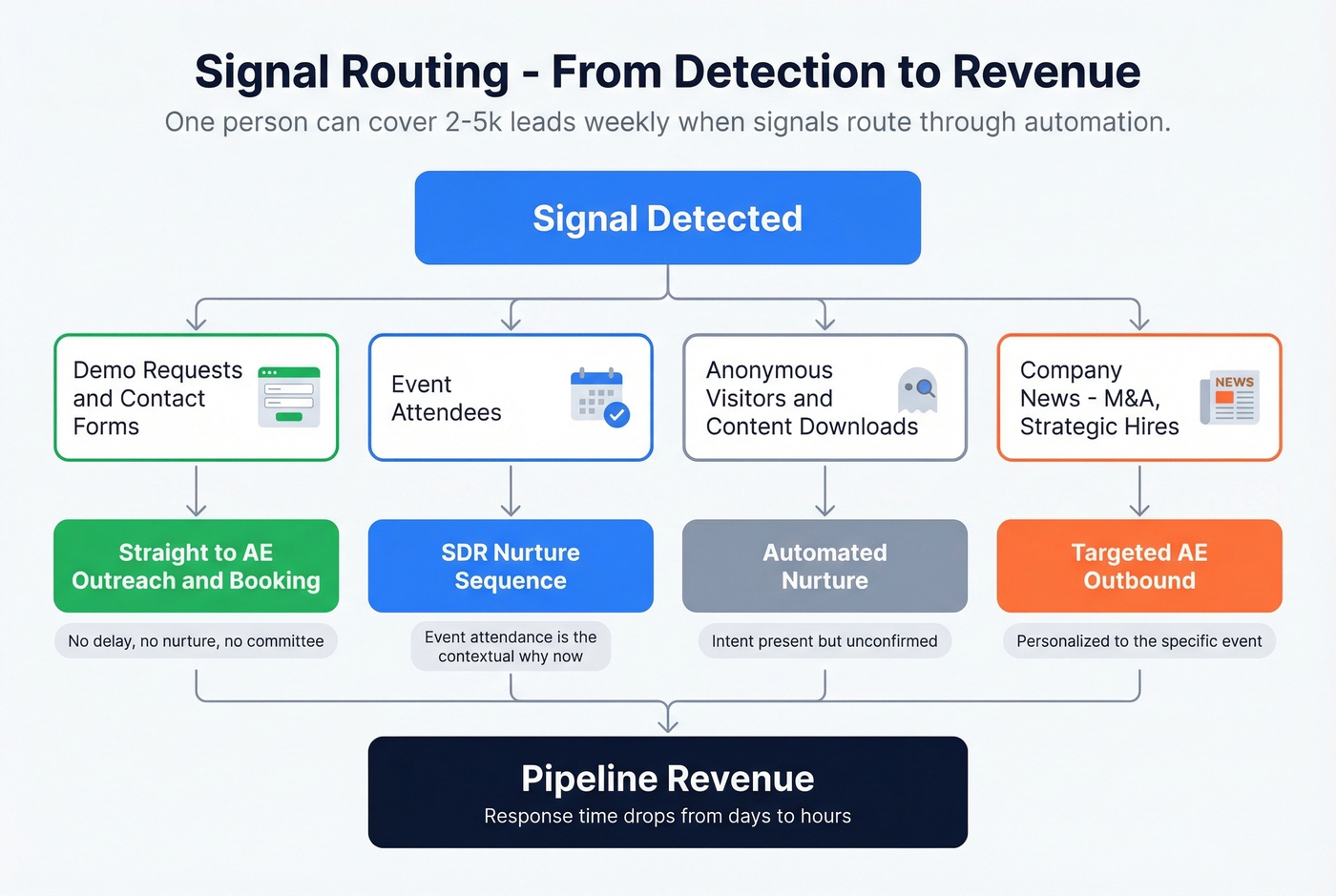
Demo requests and contact forms go straight to AE outreach and booking. No delay, no nurture sequence, no committee review. Event attendees get an SDR nurture sequence - the event attendance itself is a contextual "why now." Anonymous visitors and content downloads enter automated nurture because intent is present but unconfirmed. Company news like M&A or strategic hires triggers targeted AE outbound with personalized messaging tied to the specific event.
One person can cover 2-5k active leads weekly when signals are routed through automation instead of manual review. Response time drops from days to hours. That's the difference between a signal program that exists on a dashboard and one that actually generates revenue.
We've found that teams who start tracking at the first signal - not at opportunity creation - get dramatically better attribution and can optimize earlier in the journey.
Common Mistakes and Pipeline Risk Identification
Treating all signals as equal. Build a hierarchy. Tier 1: pricing page visits, demo requests, product research. Tier 2: repeat engagement, topic research. Tier 3: one-off browsing, generic content downloads. Route and staff accordingly.
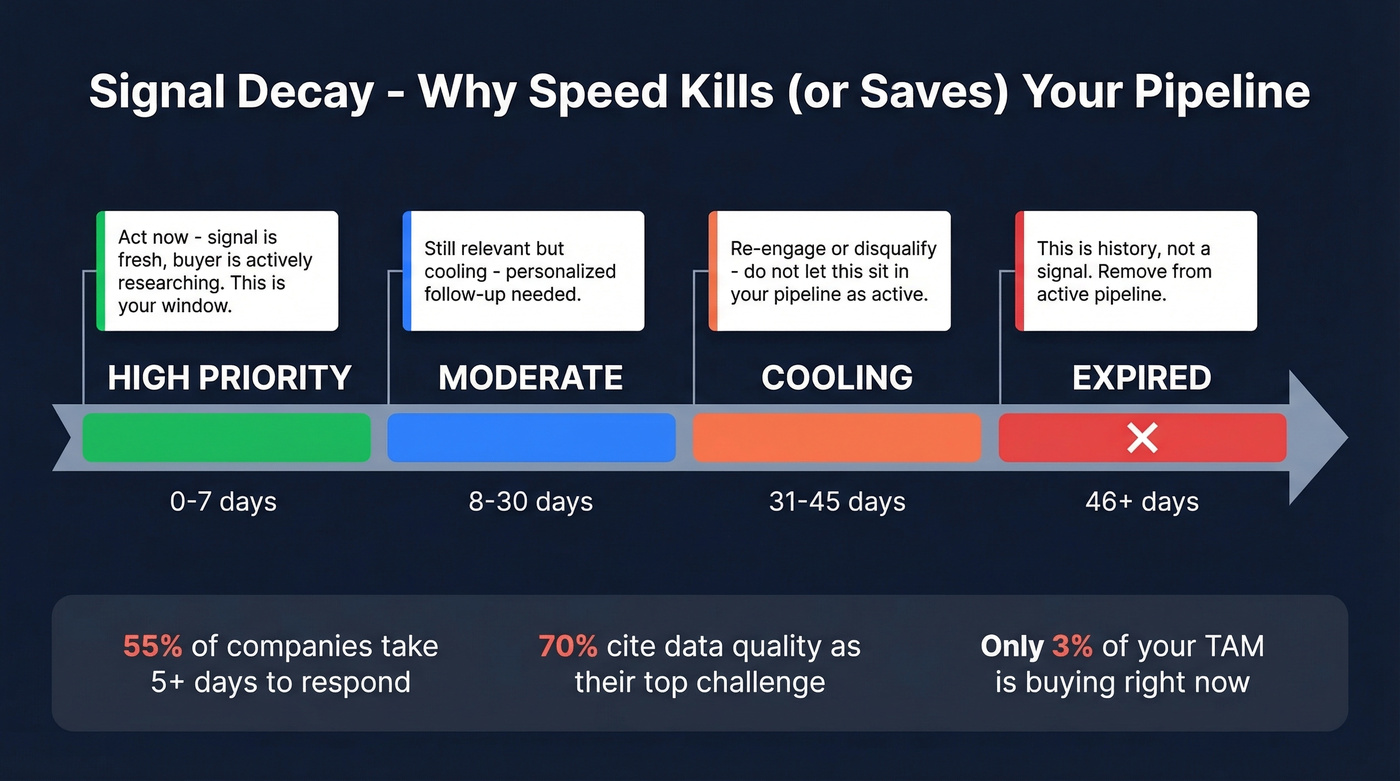
Ignoring signal decay. Signals have a shelf life. Zero to seven days is high priority, 8-30 days is moderate, 31-45 is cooling, and anything past 46 days is expired. An intent spike from six weeks ago isn't a signal - it's history. Effective pipeline risk identification means flagging deals where signals have gone cold so reps can re-engage or disqualify before the quarter ends. (If you want a structured way to score this, see deal health.)
Chasing database size over accuracy. Demandbase puts it well: 5,000-10,000 target accounts multiplied by 15-person buying committees equals roughly 150,000 contacts that actually matter. Whether your database has 100M or 500M records is irrelevant if those 150k are stale or wrong. 70% of teams cite data quality as their number one challenge with intent data.

Acting on signals with stale contact data. This one drives us crazy. Most B2B databases refresh every six weeks. By the time you act on a job-change signal, the email is from their old company. You need a provider with a weekly refresh cycle so the contact data matches the signal when it fires. This is the "last mile" problem that kills signal programs silently. (If you're auditing your data, start with data cleansing and CRM data cleansing services.)
No response protocol. Skip this if you already have documented routing rules, but most teams don't. If you haven't written down who responds, within what window, with what message, you're just building a more sophisticated way to ignore leads. A lightweight sales action plan is usually enough to start.
Tools for Signal-Based Selling
The signal stack has two layers: detection (who's in-market) and activation (reaching them with verified contact data).
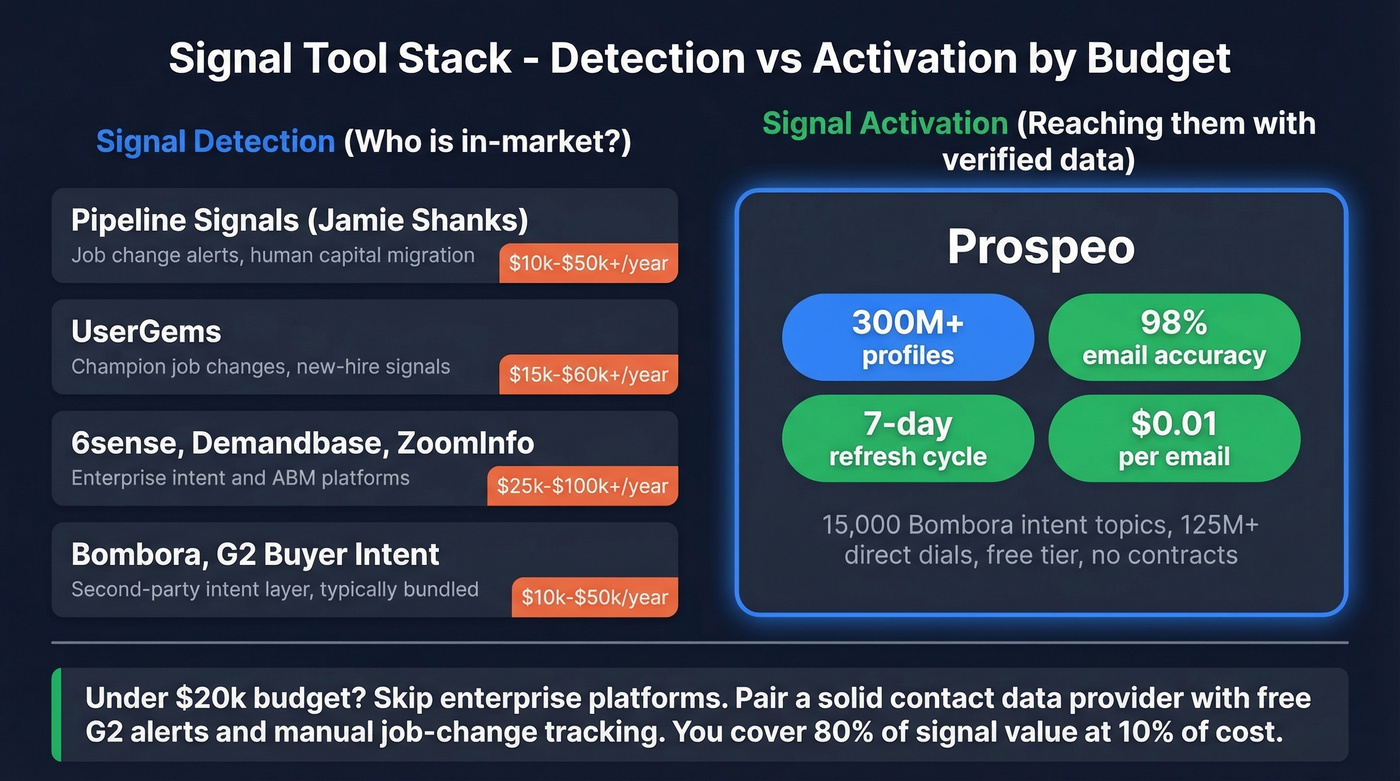
For contact data and activation, Prospeo covers 300M+ profiles with 98% email accuracy and intent data tracking 15,000 topics via Bombora. The 7-day refresh cycle keeps contact data current when signals fire, and at roughly $0.01 per email with a free tier and no contracts, it's a fraction of enterprise pricing. One of our customers, Meritt, saw their bounce rate drop from 35% to under 4% after switching - critical when every hour of signal freshness matters. (If you're comparing vendors, start with sales intelligence tools and B2B email data providers.)
For signal detection and champion tracking, the landscape breaks down by budget and use case. Pipeline Signals (Jamie Shanks' company) focuses on job-change alerts and human capital migration at $10k-$50k+/year. UserGems tracks champion job changes and new-hire signals at $15k-$60k+/year. Enterprise intent and ABM platforms like 6sense, Demandbase, and ZoomInfo run $25k-$100k+/year depending on modules. Bombora and G2 Buyer Intent sit in the second-party layer, typically bundled at $10k-$50k/year as add-ons.
For teams under $20k in annual tooling budget, skip the enterprise platforms entirely. Pair a solid contact data provider with free G2 alerts and manual job-change tracking. You'll cover 80% of the signal value at 10% of the cost.
The signal stack that works: intent platform detects the signal, verified contact data gets you to the buyer. One without the other is incomplete.
Your signal stack is only as good as the data behind it. 70% of teams say data quality is their biggest intent data challenge. Prospeo refreshes every record on a 7-day cycle - not the 6-week industry average - so when a pricing page visit or hiring surge fires, the emails and mobiles you reach out with are current. At $0.01 per email, acting fast on signals doesn't require a $50K platform budget.
Signals decay in days. Your contact data should refresh in days too.
FAQ
What's the difference between pipeline signals and intent data?
Intent data is one category of pipeline signal. The broader term also includes job changes, hiring surges, funding events, and first-party engagement - any behavioral evidence a prospect is entering a buying window. Intent data tells you what they're researching; other signals tell you why now.
How many signals should a team track?
Start with three: pricing page visits, champion job changes, and hiring surges. These cover roughly 80% of predictive value. Add intent topics and technographic changes only after you've operationalized the first three with documented routing and clear ownership.
How do you keep contact data fresh enough to act on signals?
Use a provider with a weekly data refresh cycle rather than the six-week industry average. Stale data is the silent killer of signal programs - you detect the perfect buying window, fire off outreach, and it bounces because the contact changed roles two months ago.
What's a good free option for getting started?
Prospeo offers a free tier with 75 email credits and 100 Chrome extension credits per month - enough to test signal-based workflows on your highest-priority accounts. Combine it with free G2 Buyer Intent alerts or manual job-change tracking on professional profiles to build a lightweight signal stack without enterprise spend.