

Best Pipeline Tracking Software in 2026 (8 Picks)
Your VP asked for a pipeline forecast last Friday and you spent three hours reconciling a spreadsheet that still didn't match what reps entered in the CRM. Sound familiar? A recurring thread on r/CRM is teams outgrowing HubSpot's free plan once contact limits and missing automation start to bite. Pipeline tracking software should fix this, but most tools just show where deals sit without telling reps what to do next. Meanwhile, sales reps spend only a third of their day actually selling - the rest gets eaten by admin, bad data, and tools that don't talk to each other.
Here are eight pipeline management tools worth evaluating, plus the data quality layer that keeps your forecast honest.
Our Picks
You need one CRM and one data source. Pick from these and move on.
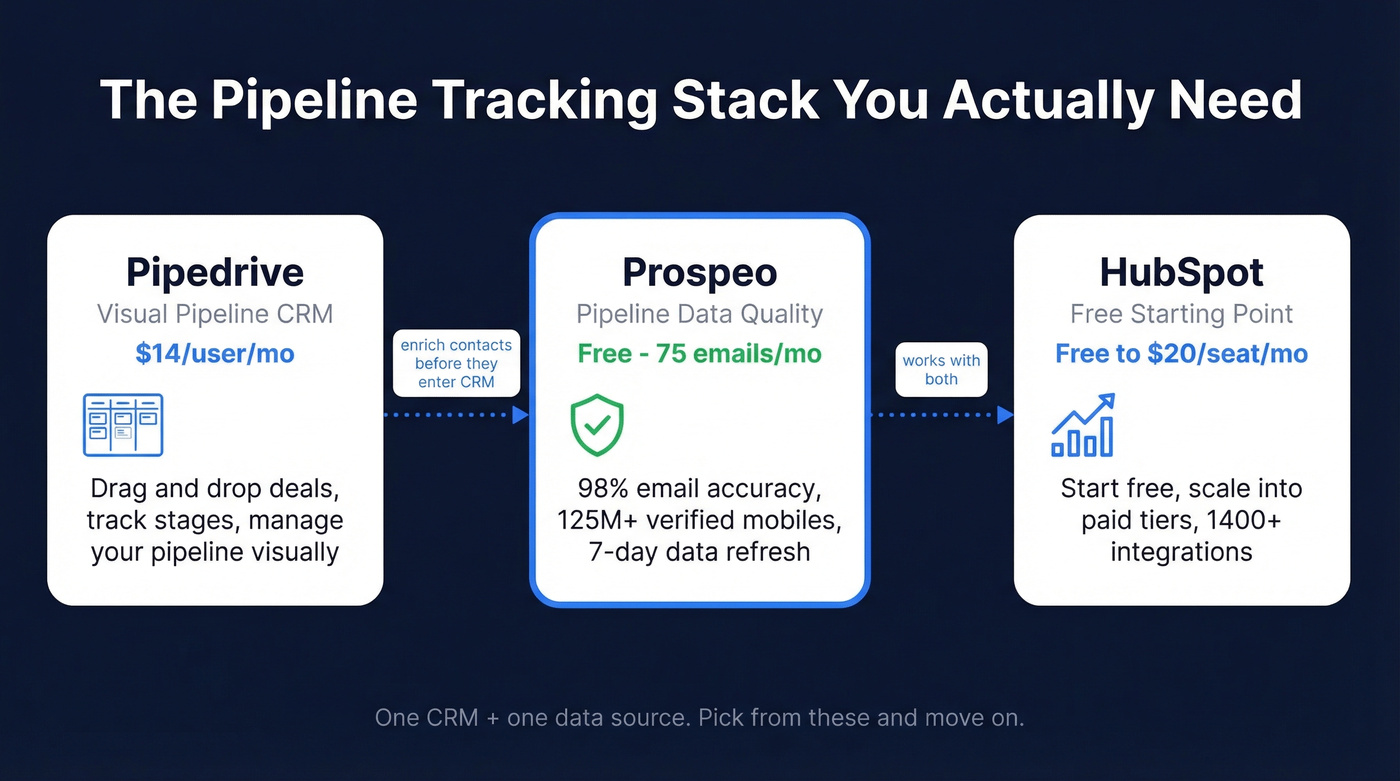
| Pick | Best For | Starting Price |
|---|---|---|
| Pipedrive | Visual pipeline for SMBs | $14/user/mo |
| Prospeo | Pipeline data quality | Free (75 emails/mo) |
| HubSpot | Free starting point | Free -> $20/seat/mo |
Pipedrive gives you one of the cleanest drag-and-drop pipeline views on the market. But your deal tracker is only as useful as the data inside it - Prospeo ensures contacts have verified emails and verified mobile numbers before they enter your CRM. When Snyk deployed it across 50 AEs, bounce rates dropped from 35% to under 5%. HubSpot lets you start free and grow into paid tiers. That's the stack.
Best Pipeline Tracking Tools
Pipedrive - Best Visual Pipeline for Small Teams
Use this if you're a team under 20 reps that wants deal tracking without a three-month implementation. Pipedrive's Kanban board is the best visual pipeline interface available - it's the reason the tool exists, and it shows.
Essential starts at $14/user/mo, scaling through Advanced ($29), Professional ($49), and Enterprise ($99). The catch: add-ons like LeadBooster and Prospector push real costs to $80-$160/user. Setup takes days, not weeks. With 500+ integrations, G2 4.3/5 (1,863 reviews), and Capterra 4.5/5 (2,970 reviews), it's the most reviewed pure-play pipeline tool in the SMB tier.

Skip this if you need deep reporting, marketing automation, or enterprise-grade permissions. Pipedrive is a pipeline tracker, not a platform. That's its strength and its ceiling.
Prospeo - Best for Pipeline Data Quality
Use this if your pipeline is full of contacts you can't actually reach. Here's the thing: your CRM tracks where deals are, but it can't tell you whether the email on that contact record still works or whether the phone number connects.
Prospeo's database covers 300M+ professional profiles with 98% email accuracy and 125M+ verified mobile numbers that hit a 30% pickup rate. Data refreshes every 7 days - the industry average is six weeks. When Snyk rolled this out to 50 AEs, bounce rates dropped from 35% to under 5% and AE-sourced pipeline jumped 180%. Native integrations with HubSpot, Salesforce, Salesloft, and Lemlist mean enrichment runs inside your existing workflow. Free tier gives you 75 verified emails per month. Paid plans run ~$0.01/email with no contracts.
If you're comparing vendors, start with a shortlist of data enrichment options and pick the one that fits your workflow.
Skip this if you need a CRM. Prospeo is the data layer that makes your CRM's pipeline accurate - pair it with any tool on this list.
HubSpot Sales Hub - Best Free Starting Point
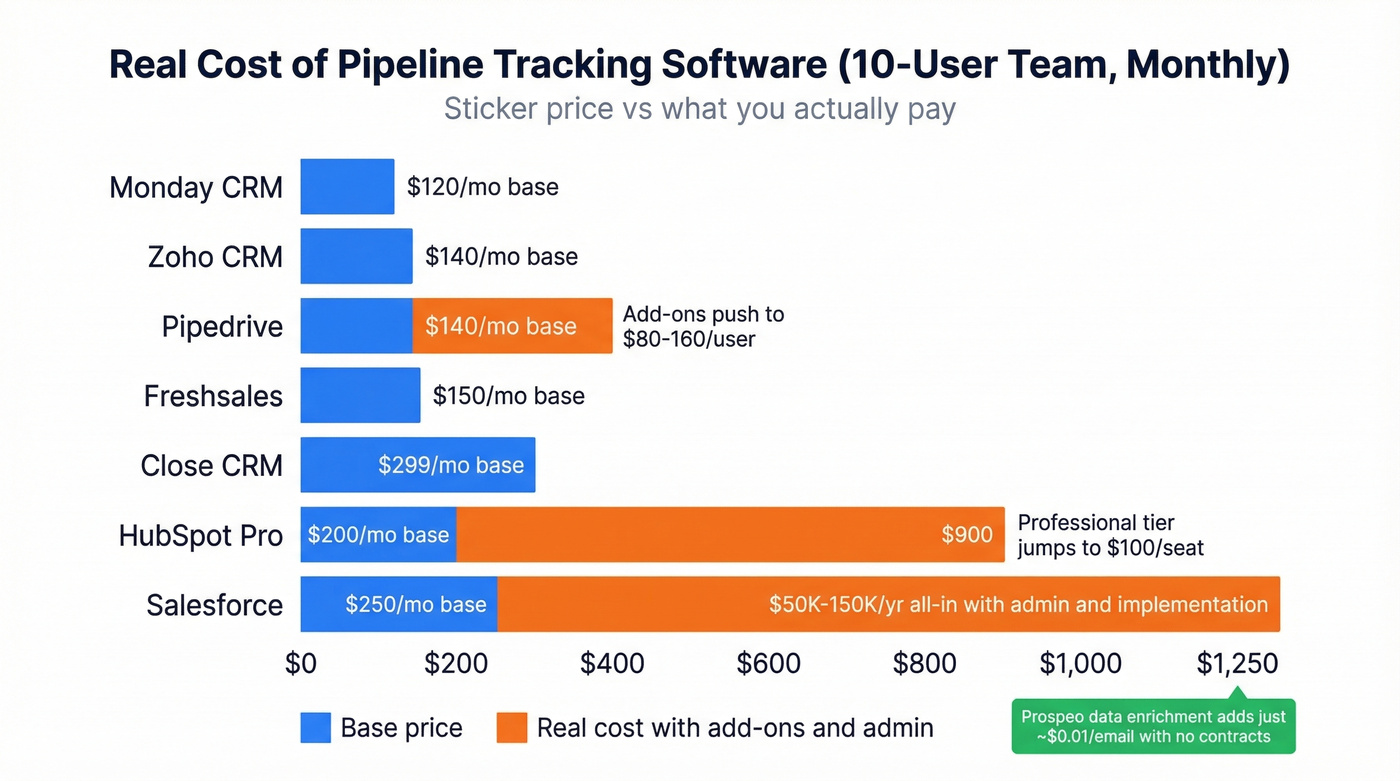
HubSpot's free CRM is genuinely useful - deal tracking, contact management, basic email integration. The growth path runs Free -> Starter ($20/seat/mo) -> Professional ($100/seat/mo) -> Enterprise ($150/seat/mo), plus a $3,500 onboarding fee at Enterprise. A 10-person team on Professional runs about $900/mo before add-ons. With 1,400+ integrations, it connects to nearly everything.
But it's a gateway drug. Genuinely useful until you need real automation, then you're writing a much bigger check. The jump from free to $100/seat for Professional is the #1 complaint we see on r/CRM - contact limits, no automation, and sticker shock.
If you want to sanity-check alternatives, compare a few examples of a CRM before you commit.
Salesforce - Powerful but Admin-Heavy
Salesforce is the most customizable CRM on the planet, and the most expensive to actually run. Starter at $25/user/mo, Enterprise at $175/user/mo. But the sticker price is misleading - real mid-market cost lands at $50K-$150K/year once you factor in admin headcount, implementation partners, and integrations. Implementation takes months, not weeks.
G2 4.3/5 across 20,174 reviews and 7,000+ apps on AppExchange. If you need multi-currency, audit trails, and data governance, nothing else comes close. But it's overkill for many teams evaluating simpler deal management solutions. If your average deal size is under $25K and you have fewer than 50 reps, you're paying for infrastructure you'll never use.
Before you buy, it’s worth mapping your sales operations metrics so you know what you actually need to report on.
Close CRM - Built for Outbound
Built-in calling, SMS, and email sequences live inside the CRM - no separate dialer add-on needed. That's a real differentiator when Salesloft charges $7,500/year just for the calling add-on on a 25-seat plan. Starts from $49/month. The pipeline view is clean and purpose-built for outbound-heavy teams running high-velocity sales motions.
Skip this if inbound is a big part of your motion. The ecosystem is smaller than HubSpot or Salesforce, and reporting is functional but not deep. For pure outbound teams, though, Close eliminates an entire layer of tool sprawl.
If outbound is your core motion, pair this with a repeatable set of sales prospecting techniques so the pipeline stays full.
Freshsales - Budget-Friendly with AI
Starts at $15/user/mo. Freddy AI handles lead scoring and deal insights without requiring enterprise pricing - a solid choice for teams that want pipeline management plus basic AI without paying HubSpot Professional rates. The lower tiers are limited enough that most teams outgrow them fast, and the integration ecosystem is thinner than Pipedrive or HubSpot.
If you’re leaning on scoring, make sure your lead scoring model is defined before you automate it.
Zoho CRM
From $14/user/mo with a free plan for up to 3 users. Best for teams already embedded in the Zoho ecosystem - the suite integration is tight. As a standalone pipeline tracker, it's capable but unremarkable.
Monday CRM
From $12/user/mo. If your team already lives in Monday for project management, adding deal tracking inside the same workspace makes sense. The visual board approach feels more like project management than sales ops, which is either a feature or a bug depending on your team.
Pricing Comparison
TCO matters more than sticker price. HubSpot Professional for 10 users runs ~$900/mo, and Salesforce mid-market deployments land at $50K-$150K/year all-in.
If forecasting is the real pain, you may be better served by dedicated sales forecasting solutions alongside your CRM.
| Tool | Starting Price | Free Tier | Best For |
|---|---|---|---|
| Pipedrive | $14/user/mo | 14-day trial | Visual pipeline (SMB) |
| HubSpot | Free/$20/seat | Yes | Free starting point |
| Salesforce | $25/user/mo | 30-day trial | Enterprise custom |
| Close | $49/mo | 14-day trial | Outbound teams |
| Freshsales | $15/user/mo | Yes | Budget AI scoring |
| Zoho CRM | $14/user/mo | Yes (3 users) | Zoho ecosystem |
| Monday CRM | $12/user/mo | 14-day trial | Work OS teams |

Pipeline tracking software shows where deals sit. But 35% bounce rates mean reps can't reach the contacts in those deals. Prospeo's 98% email accuracy and 7-day data refresh keep every record in your CRM current - so your pipeline reflects reality, not stale data.
Snyk dropped bounce rates from 35% to under 5% across 50 AEs. Your pipeline deserves the same.
Pipeline Benchmarks Worth Knowing
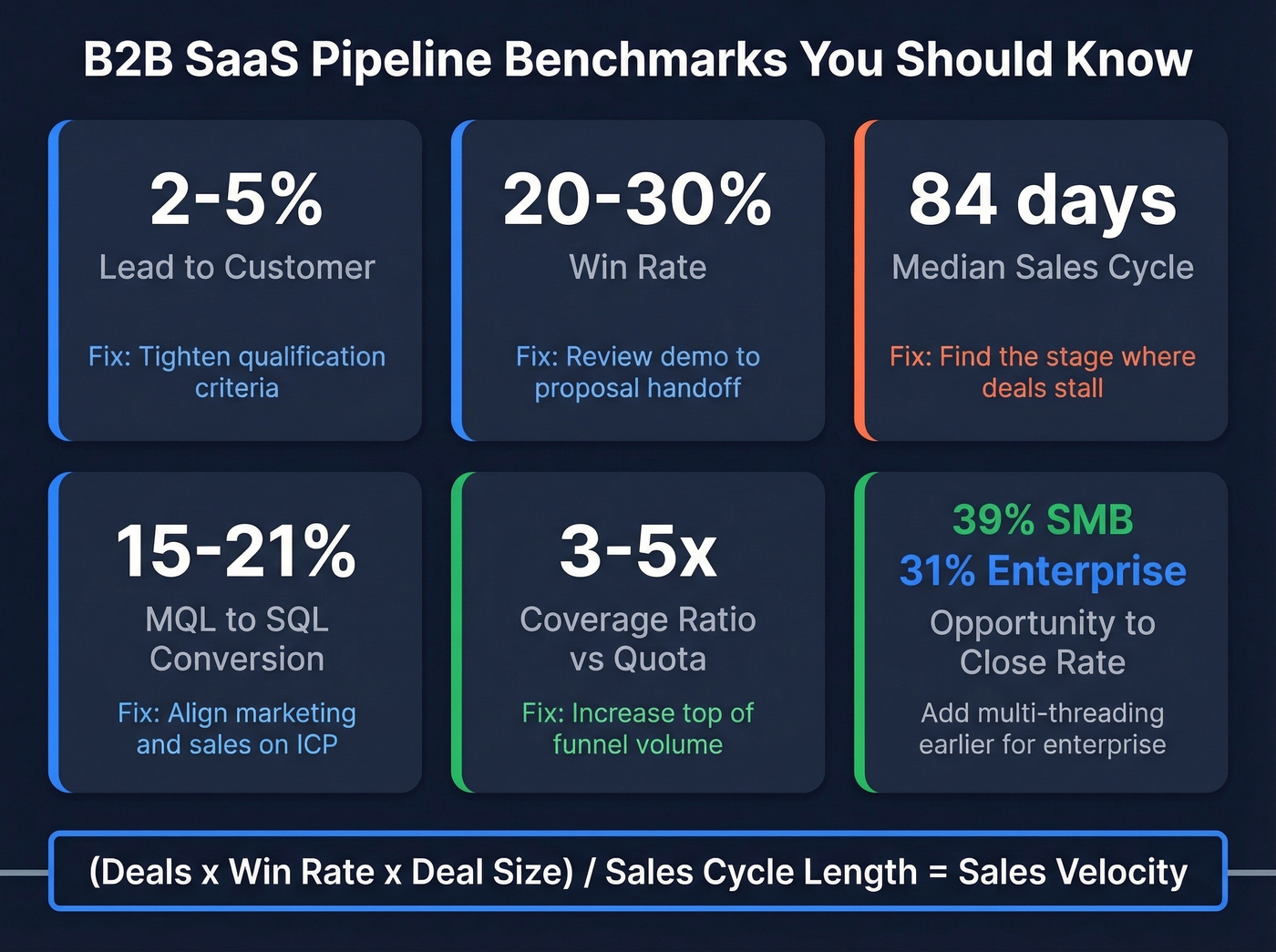
Before you pick a tool, know what you're measuring against. These B2B SaaS benchmarks give you a baseline.
For a deeper set of numbers, see our sales pipeline benchmarks.
| Metric | Benchmark | What to Do If You're Below |
|---|---|---|
| Lead-to-customer | 2-5% | Tighten qualification criteria |
| Win rate | 20-30% | Review demo-to-proposal handoff |
| Median sales cycle | 84 days | Identify the stage where deals stall |
| MQL -> SQL conversion | 15-21% | Align marketing and sales on ICP |
| Coverage ratio | 3-5x quota | Increase top-of-funnel volume |
| Opp -> Close (SMB) | 39% | Shorten time-in-stage limits |
| Opp -> Close (Enterprise) | 31% | Add multi-threading earlier |
The sales velocity formula is the single most useful equation in pipeline management: (Deals x Win Rate x Deal Size) / Sales Cycle Length. If your tool can't surface these numbers without a custom report, you've got the wrong tool.
Five Mistakes That Kill Your Forecast
Keeping stagnant deals. If a deal hasn't moved in 30 days, it's not a deal - it's a wish. Kill it or move it to nurture.
This is also where tracking pipeline health weekly pays off fast.
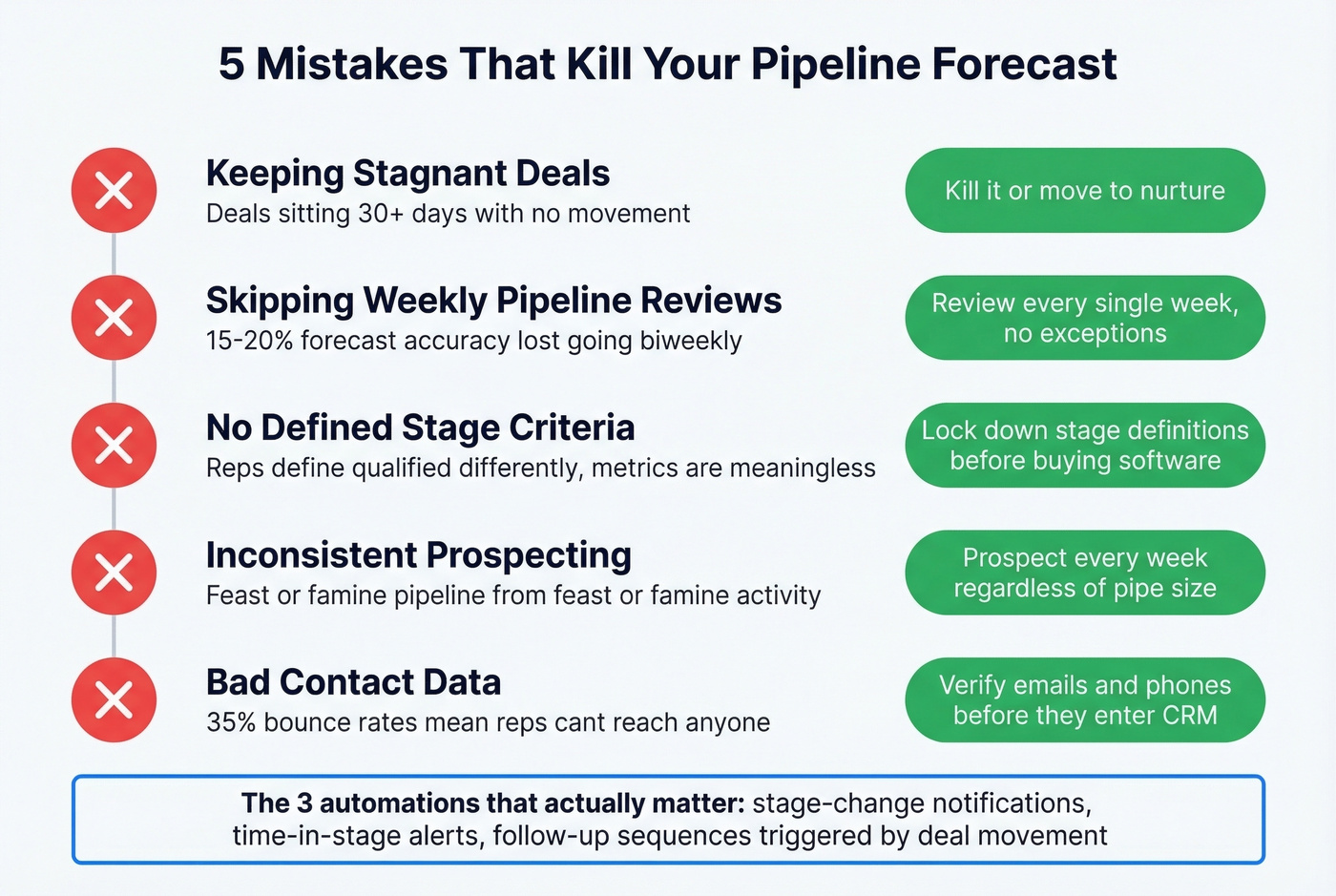
Skipping weekly pipeline reviews. Your pipeline decays between meetings. We've seen teams lose 15-20% of forecast accuracy just by going biweekly instead of weekly. Don't do that.
No defined stages. If reps define "qualified" differently, your conversion metrics are meaningless. Lock down stage definitions first, before you buy any software.
Inconsistent prospecting. Feast-or-famine prospecting creates feast-or-famine pipeline. The teams that hit quota prospect every week, regardless of how full the pipe looks.
If you need a system, start with a few high-leverage sales activities that happen every week.
Bad contact data. You can't close a deal if the email bounces and the phone is disconnected. This is the problem we built Prospeo to solve - 5-step verification, 98% email accuracy, and a 7-day refresh cycle keep your CRM from filling up with dead records.
If bounces are a recurring issue, benchmark against typical email bounce rate ranges and fix the source.
Let's be honest about automations, too. The three that actually matter: stage-change notifications so nothing slips, time-in-stage alerts that flag stalled deals automatically, and follow-up sequences triggered by deal movement. If your tool doesn't support at least the first two, you're doing pipeline reviews manually forever.
No pipeline tracker can fix bad contact data. Prospeo enriches your CRM with 300M+ verified profiles, 125M+ direct dials at 30% pickup, and native HubSpot and Salesforce integrations - starting free with 75 verified emails/month.
Stop tracking deals you can't actually close because the phone number is dead.
Which Tool Fits Your Team Size
| Team Size | What to Prioritize | Top Pick | Setup Time |
|---|---|---|---|
| Solo/SMB (<50) | Ease of use, no admin | Pipedrive | Days |
| Mid-market (50-1,000) | Source of truth, permissions | HubSpot Pro or Salesforce | Weeks |
| Enterprise (1,000+) | Governance, audit trails | Salesforce | Months |
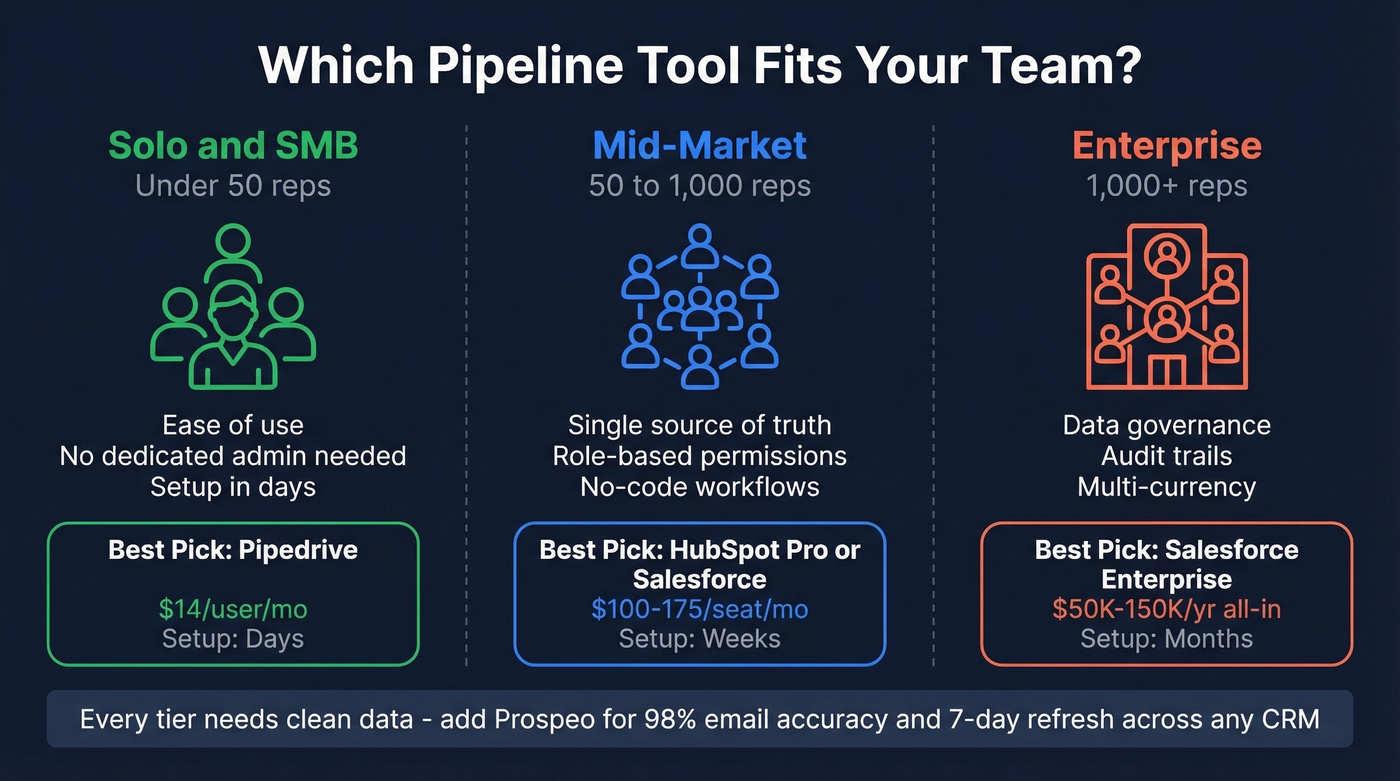
Small teams need setup in days, not months. Mid-market teams need the CRM to be the single source of truth with role-based permissions and no-code workflows. Enterprise needs data governance, multi-currency, and quarter-long implementations they can justify to procurement.
A solo operator on r/startups described managing 2-5K active leads weekly, scaling from 3,000 to 30,000+ mapped companies - that kind of growth breaks any tool without clean underlying data. In our experience, the CRM choice matters less than the data hygiene underneath it. Pick a tool that fits your team size, then make sure the contact records inside it are actually reachable.
FAQ
What is pipeline tracking software?
Software that visualizes sales deals across stages - from first touch to closed-won - so you can forecast revenue, spot bottlenecks, and automate follow-ups. Most CRMs include pipeline views, but dedicated tools like Pipedrive focus exclusively on stage-based deal management.
What's the best free option?
HubSpot's free CRM offers deal boards, contact management, and basic reporting at zero cost. For data quality, Prospeo's free tier includes 75 verified emails per month - useful for keeping contact records accurate without paying upfront.
How many pipeline stages should I have?
Five to seven for B2B SaaS. Fewer hides where deals stall. More creates friction and reps stop updating. Map stages to buyer actions (e.g., "demo completed," "proposal sent"), not internal milestones.
What metrics should I track weekly?
Coverage ratio (3-5x quota), stage conversion rates, deal velocity, and stagnant deal count. These four tell you if your pipeline is healthy or just big. Any tool that can't surface them natively needs a reporting upgrade.
Does a CRM replace a data provider?
No. Pipeline tools track deals through stages but don't verify whether contacts have working emails or phone numbers. You need a separate data layer - like an enrichment API with a 92% match rate - to keep contact records accurate.