

Pitch Deck Go-to-Market Strategy: Build the GTM Slide Investors Believe
Investors spend roughly two to three minutes on your entire deck, according to DocSend data cited by Ada Ventures. Your go-to-market slide gets seconds of that window before they decide you've done the work - or you're hand-waving.
Only 5%-10% of decks turn into meetings. That means your GTM slide isn't filler. It's one of the fastest rejection triggers in the whole PDF.
Here's the thing: investors don't fund channel lists. They fund repeatable motions. Founders treat the GTM slide like a wish list. Investors read it like a credibility test.
What a Go-to-Market Slide Actually Is
A GTM slide isn't a list of channels. It's a strategy slide that happens to mention channels.
The classic anti-pattern is the "bingo card of vagueness" - social, content, partnerships, events, PR. Looks busy, says nothing about how customers discover you, evaluate you, and buy. Your go-to-market slide should be a proof-of-work document. It shows one motion you've validated, plus the economics that make it believable.
Most founders miss the framing entirely. Your GTM slide should be the consequence of your market and competition slides. It answers: who you target first, why you win against alternatives, and why that channel is reachable for your specific ICP. If it doesn't connect to those earlier slides, investors notice the gap immediately.
GTM Slide Expectations by Stage
Stage changes what "good" looks like. A pre-seed GTM slide can be founder-led and scrappy. A Series A GTM slide gets interrogated like a machine.
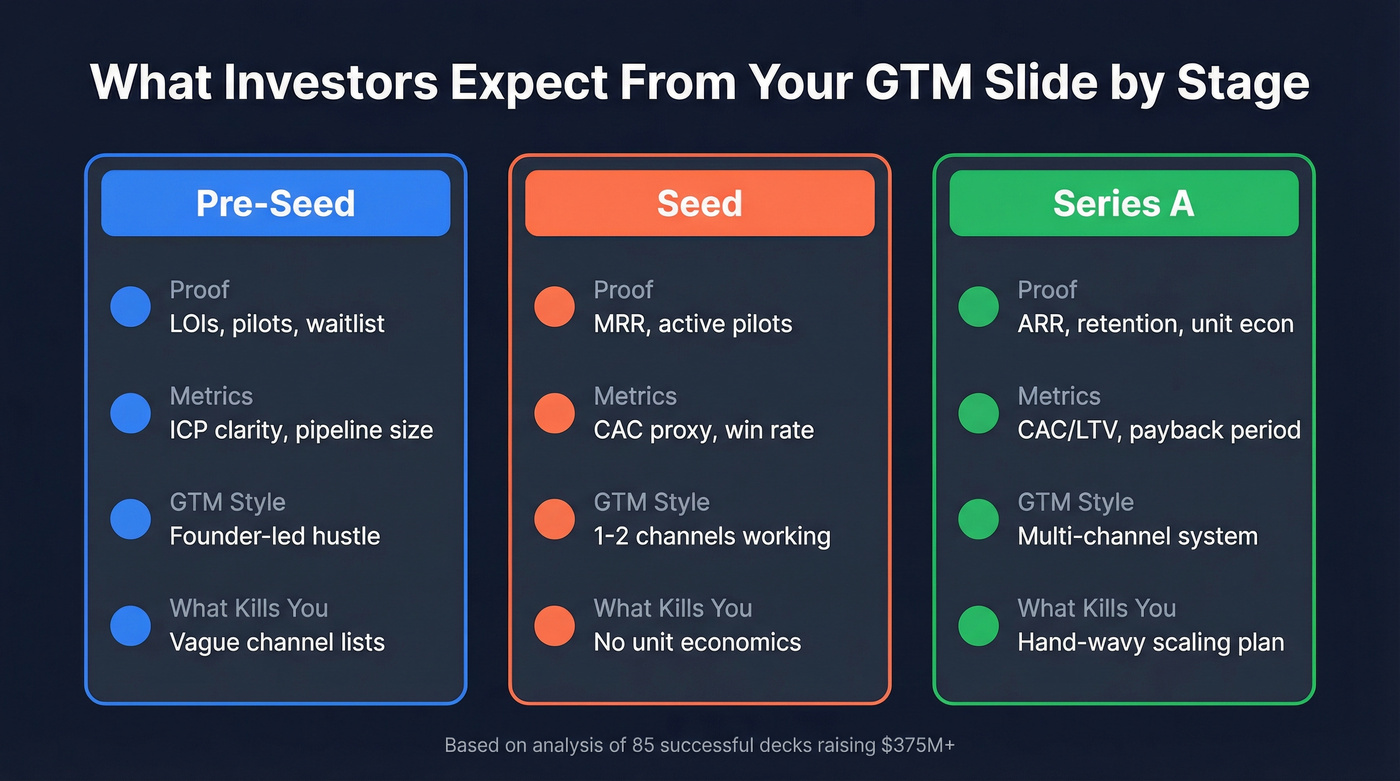
A useful lens comes from a dataset of 85 successful decks that raised $375M: you're not selling your company - you're selling the next de-risked step for that round.
Real pre-seed scenario: $70K revenue, 3 LOIs worth roughly $180K ARR in the first year, mostly from network intros. That's fine. The slide just has to show how that becomes repeatable. Don't invent precise CAC/LTV numbers you can't defend. Use proxies from small tests and be explicit about assumptions - overly hypothetical unit economics at pre-seed hurt more than they help.
| Pre-seed | Seed | Series A | |
|---|---|---|---|
| Common deck length | 10-14 slides | 12-16 slides | 14-18 slides |
| What "traction" means | LOIs, pilots, waitlist | MRR, pilots, engagement | ARR, retention, unit economics |
| GTM proof expected | Founder-led process | 1-2 channels working | Multi-channel system |
| Metrics investors scan | ICP clarity, pipeline | CAC proxy, win rate | CAC/LTV, payback, retention |
| What kills you | Vague channels | No unit economics | Hand-wavy scaling |
Pick Your GTM Motion
Stop trying to show every motion. Pick one, then make the slide match it.
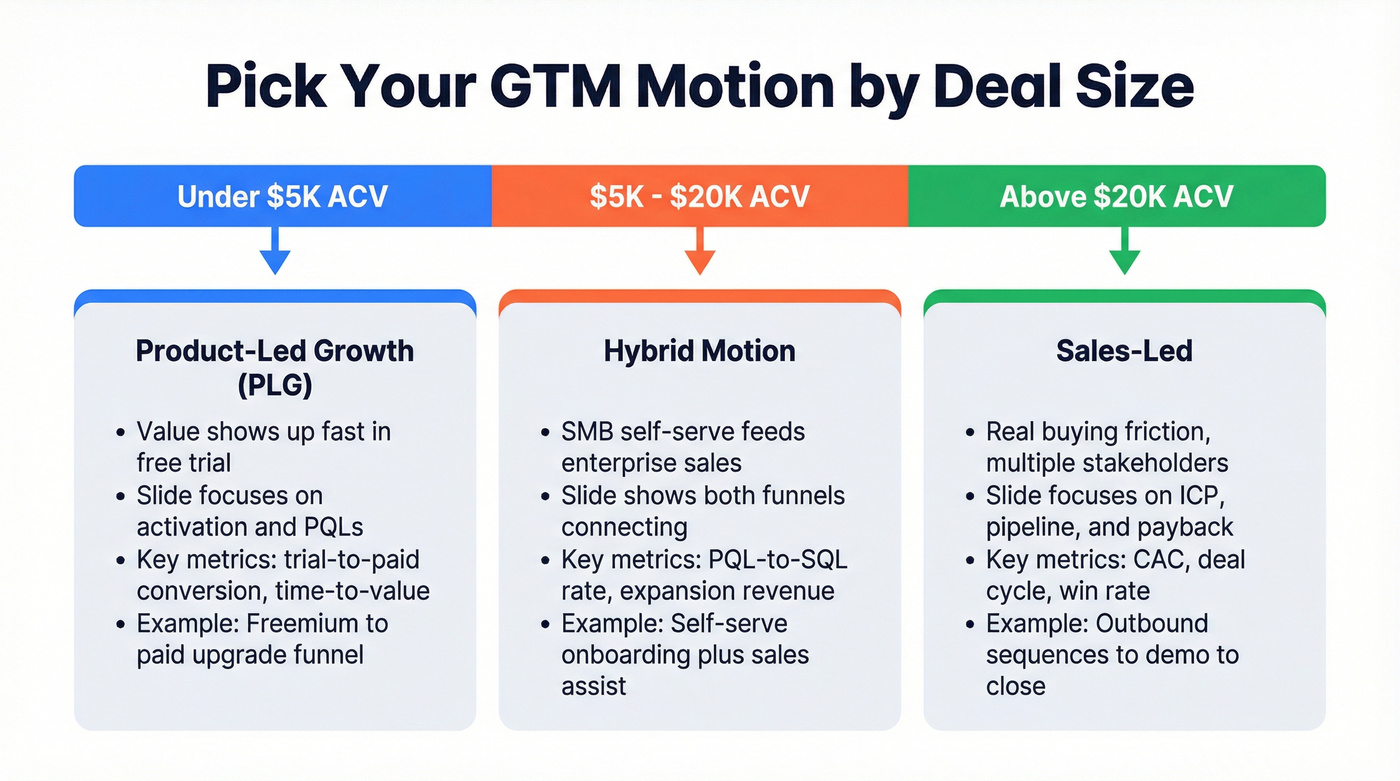
Rule of thumb by deal size: PLG when average deal size is under $5K and value shows up fast. Sales-led when it's above $20K and there's real buying friction. Hybrid in the $5K-$20K middle, or when SMB self-serve feeds enterprise sales.
This choice determines what the slide looks like. PLG slides lean on activation, PQLs, and conversion. Sales-led slides lean on ICP, list building, sequences, meetings, pipeline, and payback. If you're presenting a sales-led or outbound motion, credibility depends on real prospect data - which means you need verified contact information before you run your pilot, not after.
If you're building an outbound motion, borrow proven sales prospecting techniques and keep the workflow tight enough to measure.

Investors fund repeatable motions, not channel wish lists. If your GTM slide says 'outbound,' you need the pilot data to back it up. Prospeo gives you 300M+ profiles with 98% email accuracy and 30+ filters to build the exact ICP list your pitch deck describes - at $0.01 per email.
Run your outbound pilot with real data before you walk into the room.
Instead of X, Say Y
Every guide says "be specific." Almost none show what that looks like on the actual slide. Here's the rewrite pattern we use when cleaning up decks for founders.
| Generic (delete this) | Specific (use this) |
|---|---|
| "Channels: outbound, content, partnerships" | "Outbound to RevOps leaders: 1,200-account list -> 6.5% reply -> 1.1% meeting rate -> $410 CAC (pilot)" |
| "Partnerships" | "HubSpot App Marketplace integration + 20% rev-share; co-marketing webinar/month; 3 partner-sourced opps in pipeline" |
| "10K users" | "10K users, 23% MoM growth, $47 ARPU, 4.2% churn" |
| "Paid search" | "15 long-tail terms, <$2 CPC, 9.2% trial conversion, $50 CAC on $300 ACV" |
Tie this back to the pre-seed founder with $70K revenue and 3 LOIs: don't pretend you've scaled channels. Show the repeatable flow you used to get those LOIs, then show the first experiment proving you can source similar accounts without your personal network.
If you need a clean way to define and score that first segment, use an ICP template before you build lists.
Visualize the Process, Not Channels
Investors want to see a motion, not a menu. Draw it as a simple left-to-right flow with one metric under each step:
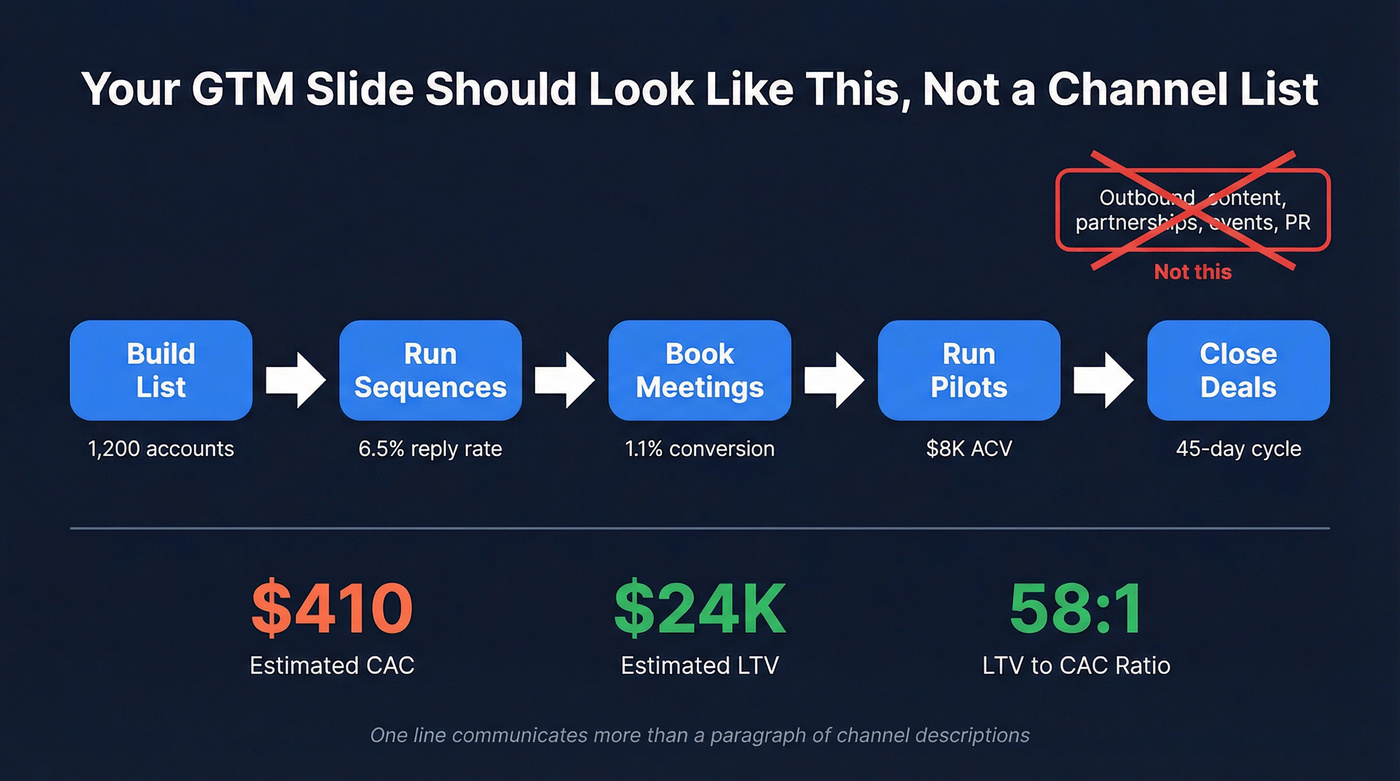
List (1,200 accounts) -> Sequence (6.5% reply) -> Meeting (1.1% convert) -> Pilot ($8K ACV) -> Close (45-day cycle)
That single line communicates more than a paragraph of channel descriptions. If your slide can't be read as a process with measurable steps, it's a brainstorm - not a go-to-market strategy worthy of a pitch deck.
If you're running sequences, keep a library of sales follow-up templates so your pilot is consistent enough to benchmark.
Metrics That Belong on the Slide
Your GTM slide needs economics, but not a finance lecture. Think "investor scan speed."
Include what you have, proxy the rest. CAC or a proxy like cost per meeting. LTV or gross margin plus retention assumptions. CAC/LTV targeting 3:1 for SaaS. CAC payback - top quartile SaaS hits 5-7 months. For e-commerce, 2:1-4:1 LTV:CAC is healthy; 4:1+ can signal you're underinvesting in growth.
Always include one leading indicator like dollar pipeline at proposal stage, and the result it produced - closes, ARR, payback. That pairing shows you understand your own funnel, not just the outcome. Best single-slide visualizations: a cohort retention curve or an MRR waterfall showing new, expansion, and churn.
If you want to sanity-check what “good” looks like, compare against current funnel metrics benchmarks.
Mistakes That Kill GTM Slides
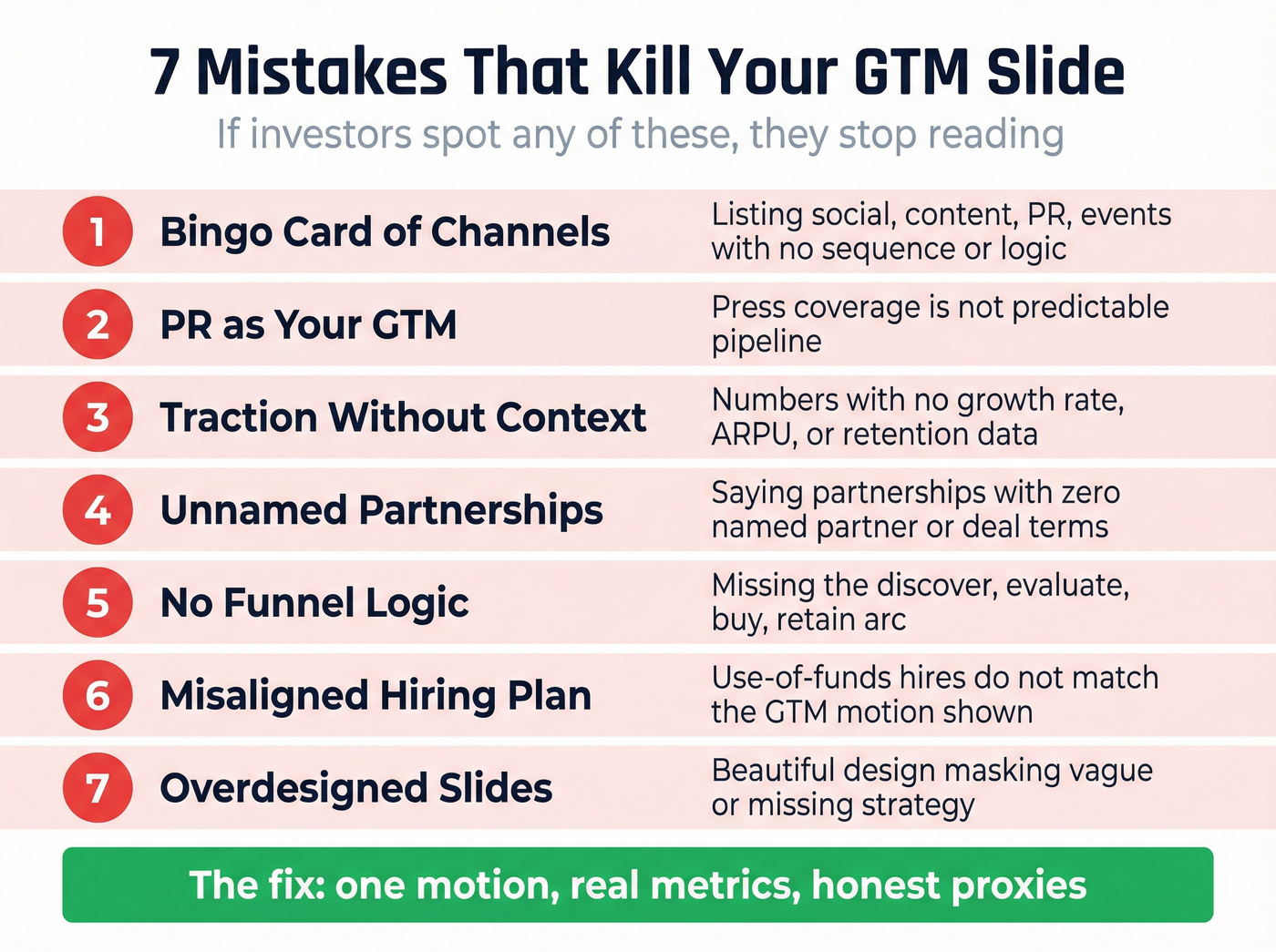
We've reviewed enough decks to see the same failure mode over and over: a beautiful GTM slide with zero math behind it. Reddit threads confirm this pattern - the consensus on r/Entrepreneur is that vague GTM slides are the number-one reason investors stop reading.
Let's be honest: if your average contract value sits below $10K and your GTM slide mentions "enterprise partnerships" as a primary channel, you've already lost the room. Match the motion to the deal size or don't bother.
The seven kills:
- Bingo card of channels with no motion or sequence
- PR-as-GTM - press isn't predictable pipeline
- Traction without context - numbers with no growth rate, ARPU, or retention
- "Partnerships" with zero named partner or deal structure
- No funnel logic - the discover-evaluate-buy-retain arc is missing
- Misaligned with use-of-funds - hiring plan doesn't match the motion
- Overdesigned slides masking vague strategy
Beyond strategy, formatting kills decks too. Send as PDF. Label every axis on every chart. If your GTM slide uses tiny fonts, it won't survive a projector or a phone screen. These sound trivial. They're not - we've watched investors close tabs over unreadable charts.
If your deck claims outbound, be ready to show how you’ll protect deliverability (or your pilot data will be noisy). A quick read on email deliverability helps you avoid the obvious landmines.
GTM Slide Checklist
Final pass before you send the PDF:
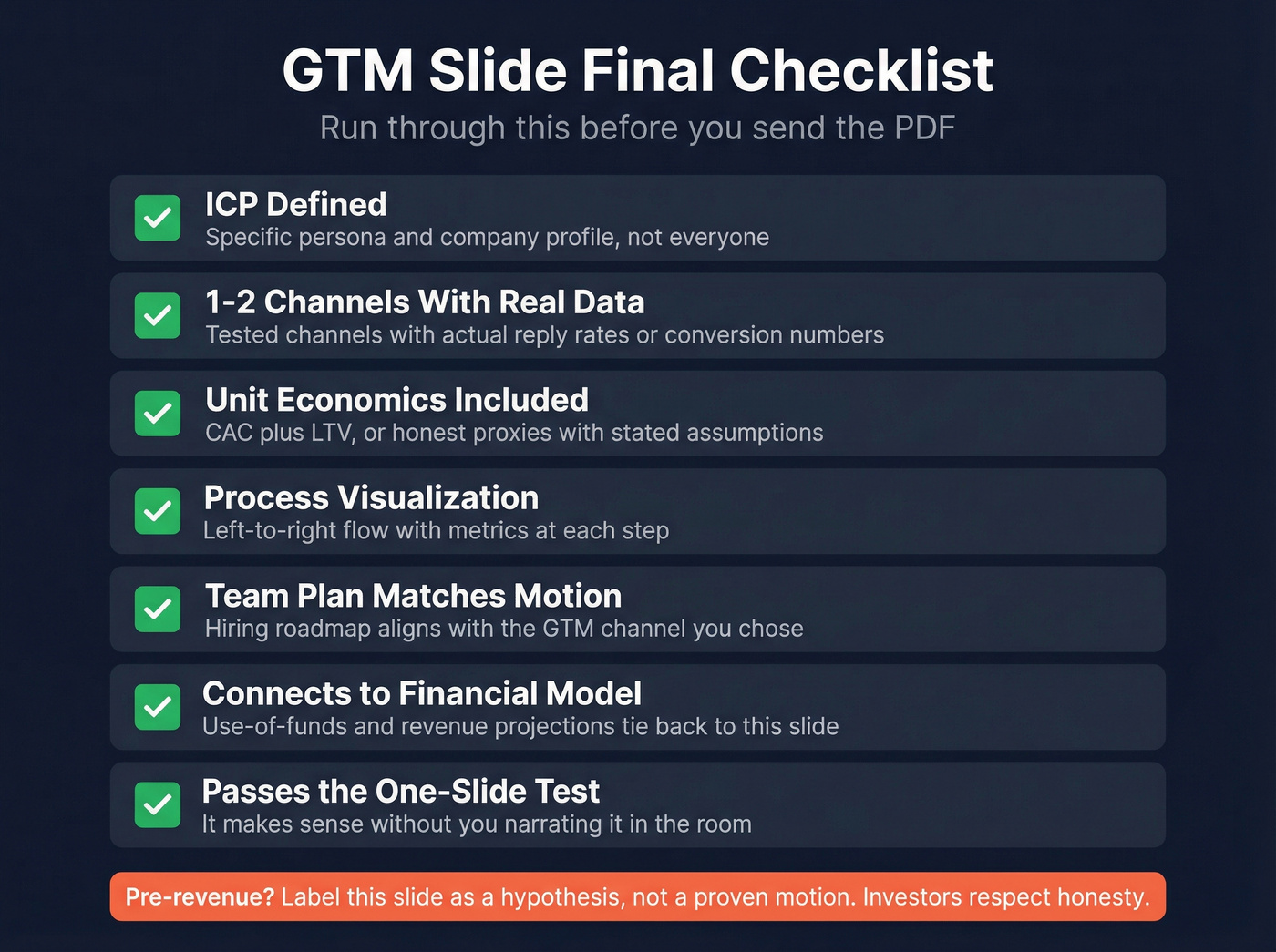
- ICP defined (who, not "everyone")
- 1-2 channels with real data
- Unit economics: CAC + LTV, or honest proxies
- Process visualization with metrics at each step
- Team plan matches GTM motion
- Connects to financial model and use-of-funds
- "One-slide test": it stands alone without narration
Skip this checklist if you're pre-revenue and pre-product - at that point, your GTM slide is really a hypothesis slide, and you should label it that way. Investors respect intellectual honesty far more than fabricated funnels.
A strong pitch deck go-to-market strategy isn't about showing investors everything you could do. It's about proving one motion works, then making the economics undeniable. Nail that, and the GTM slide stops being a rejection trigger - it becomes the reason they take the meeting.
If you’re building a sales-led motion, it also helps to align the slide with how you actually run B2B sales day to day.
That 'List → Sequence → Meeting → Close' flow on your GTM slide only works if the contacts are real. Prospeo's 7-day data refresh and 5-step verification mean your pilot numbers hold up under investor scrutiny - no bounced emails undermining your CAC math.
Turn your GTM slide from a brainstorm into a proven motion with verified data.
FAQ
How long should a GTM slide be?
One slide, one motion, one proof point. If it takes more than 15 seconds to scan, you've overloaded it. Use a single left-to-right flow with four or five steps and one metric per step - that's the format top-performing decks use in 2026.
What if I don't have CAC data yet?
Show proxy metrics from a small test - cost per conversation, LOI conversion rate, or paid experiment results. Even a 200-contact outbound pilot with reply and meeting rates gives investors something concrete. Rough numbers beat polished slides with no data behind them.
What tools help build outbound GTM data for the slide?
Prospeo lets you find and verify prospect emails before running campaigns so your CAC reflects real deliverability - 98% email accuracy across 143M+ contacts with a 7-day refresh cycle. Pair it with a sequencing tool like Instantly or Smartlead, and you can run a credible outbound pilot in under two weeks.
Should my GTM slide differ for each investor meeting?
Yes - tailor emphasis, not structure. For a SaaS-focused fund, highlight retention and payback period. For a generalist, spend more time on ICP clarity and market entry logic. Keep the core motion identical; adjust which metric you foreground based on what that investor cares about most.