

Point of Contact (POC): The Complete Guide for Sales and Support Teams
"Point of contacts" is grammatically wrong - and the fact that so many people write it that way tells you something about how casually most teams treat the concept behind it. The plural, the process, the practice: most organizations get all three wrong.
Let's fix that.
"Points of Contact" vs. "Point of Contacts"
The correct plural is points of contact. You pluralize the head noun - "point" - not the object of the preposition. Same rule that gives us "attorneys general" and "mothers-in-law."
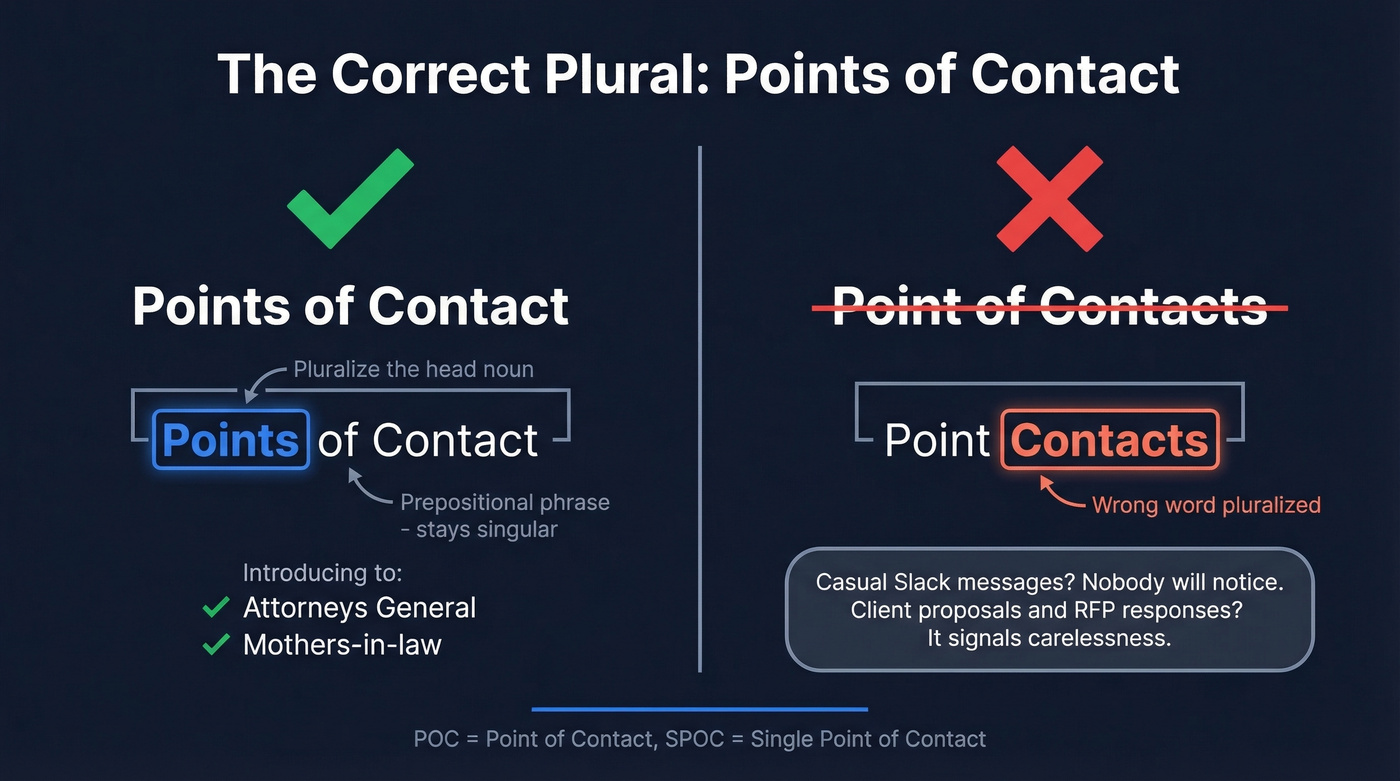
"Point of contacts" shows up in Slack messages and informal emails constantly. People treat "contacts" as the core word and pluralize it instinctively. But "contact" here describes the type of point. You're talking about multiple points, not multiple contacts. In casual conversation, nobody will correct you. In a proposal, an RFP response, or a client-facing document, getting this wrong signals carelessness.
Here's the short version:
- The correct plural is points of contact
- A POC is the person or team responsible for communication on a project, deal, or account
- In B2B sales, relying on a single POC is risky - map 3-5 stakeholders per account
What Is a Point of Contact?
A point of contact is the designated person - or sometimes a department - responsible for coordinating communication between two parties. In shorthand: POC. When a single person or team handles all inbound requests, that's a Single Point of Contact, or SPOC.
The concept shows up everywhere. In sales, your POC is the person you're building the deal through (especially in enterprise B2B sales). In customer support, it's the rep assigned to a ticket or account. In IT service management, the service desk acts as the organizational POC, routing requests to the right specialist. In project management, the POC keeps stakeholders aligned on deliverables. Government and military organizations use the term to designate communication liaisons.
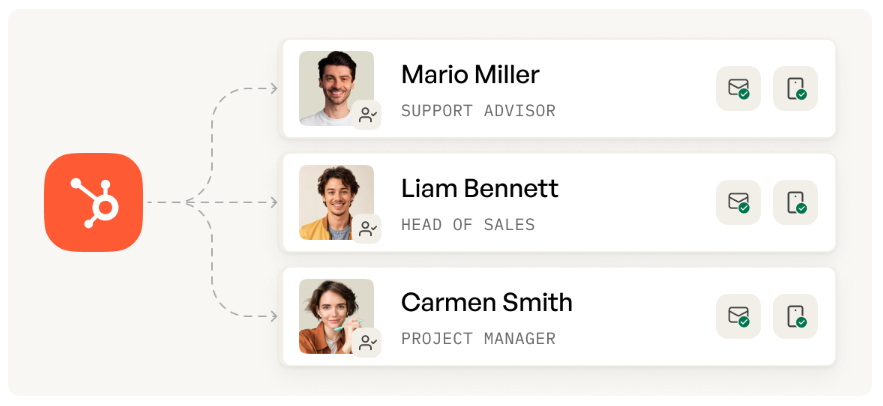
Don't confuse a POC with a "touchpoint" or an "account owner." A touchpoint is any interaction - an email, a call, a meeting. It's an event, not a person. An account owner is the internal rep who holds the relationship in your CRM (see examples of a CRM). A POC can be the account owner, but it can also be someone on the buyer's side, a project lead, or a support coordinator. Conflating these terms leads to unclear ownership, which leads to dropped balls.
Who Serves as a POC?
The answer depends on context:
| Role | Primary Focus | When They're the POC |
|---|---|---|
| Account Executive | Closing deals | Pre-sale, deal-focused |
| Account Manager | Revenue growth | Renewals + upsells |
| CSM | Retention | Post-sale adoption |
| Support Rep | Issue resolution | Ticket-based |
| Project Manager | Deliverables | Implementation phase |
| IT Service Desk | Request routing | SPOC model |
The CSM vs. Account Manager distinction trips people up constantly. A CSM focuses on the entire customer base, proactively delivering value and monitoring metrics like NPS. An AM focuses on select high-value clients and tends to be more reactive. Both frequently serve as the "main point of contact" - which is exactly why you need clarity on who owns what.
Why a Dedicated POC Matters
The business case comes down to numbers. 70% of customers expect any employee they interact with to have full context of their situation. Not partial context. Full context. And 83% expect to interact with someone immediately when they reach out.
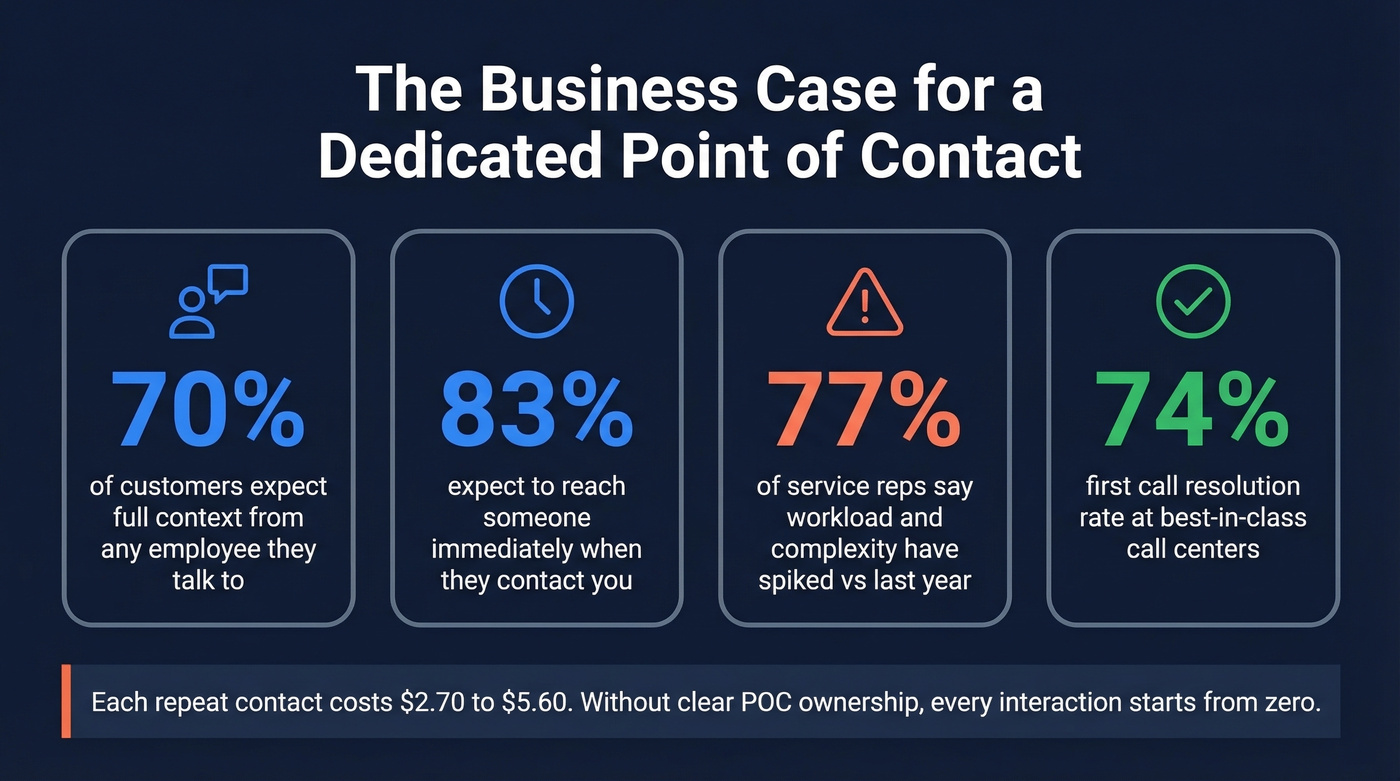
On the agent side, the picture is equally grim - workload and issue complexity have spiked for 77% of service reps compared to a year ago, and 56% report burnout. In our experience, this gap between customer expectations and team capacity is one of the biggest drivers of churn we see across accounts (more on churn analysis).
Without a clear POC and proper handoff protocols, every interaction starts from zero. Best-in-class call centers achieve a first call resolution rate of 74% or higher. Calls typically cost $2.70-$5.60 each, so repeat contacts get expensive fast. Multiply that across thousands of tickets per month, and you're looking at a six-figure line item that's entirely preventable with better POC ownership.

You just read why relying on a single POC kills deals. Prospeo gives you 300M+ professional profiles with 30+ filters - map every stakeholder in an account by job title, department, and seniority. 98% email accuracy means your multi-threading outreach actually lands.
Find every decision-maker in the account, not just one gatekeeper.
SPOC: When It Works and When It Doesn't
When SPOC Works
The SPOC model shines in service desk and coordination-heavy environments. Route all requests through one team so users don't need to figure out which department handles what. The SPOC routes to the right colleague behind the scenes.
The common critique is that a SPOC creates a bottleneck. The better mental model is "bottleneck to funnel." A well-run SPOC orchestrates requests, maintains consistent communication, and centralizes monitoring so you spot outages and trends earlier than any individual team could. The key enabler is shift-left empowerment: give your tier-1 team the access, training, and knowledge to resolve issues without escalation.
TOPdesk's framework highlights onboarding as a perfect use case - HR, facilities, and IT all coordinated through a single intake point instead of three separate email chains.
When SPOC Backfires
In enterprise B2B sales, a single point of contact can be catastrophic. There's a vivid thread on r/sales where a seller's champion insisted on being the only communication channel across departments. The champion forwarded the seller's presentation and delivered it themselves - then admitted to altering both pricing and deal content before presenting internally.
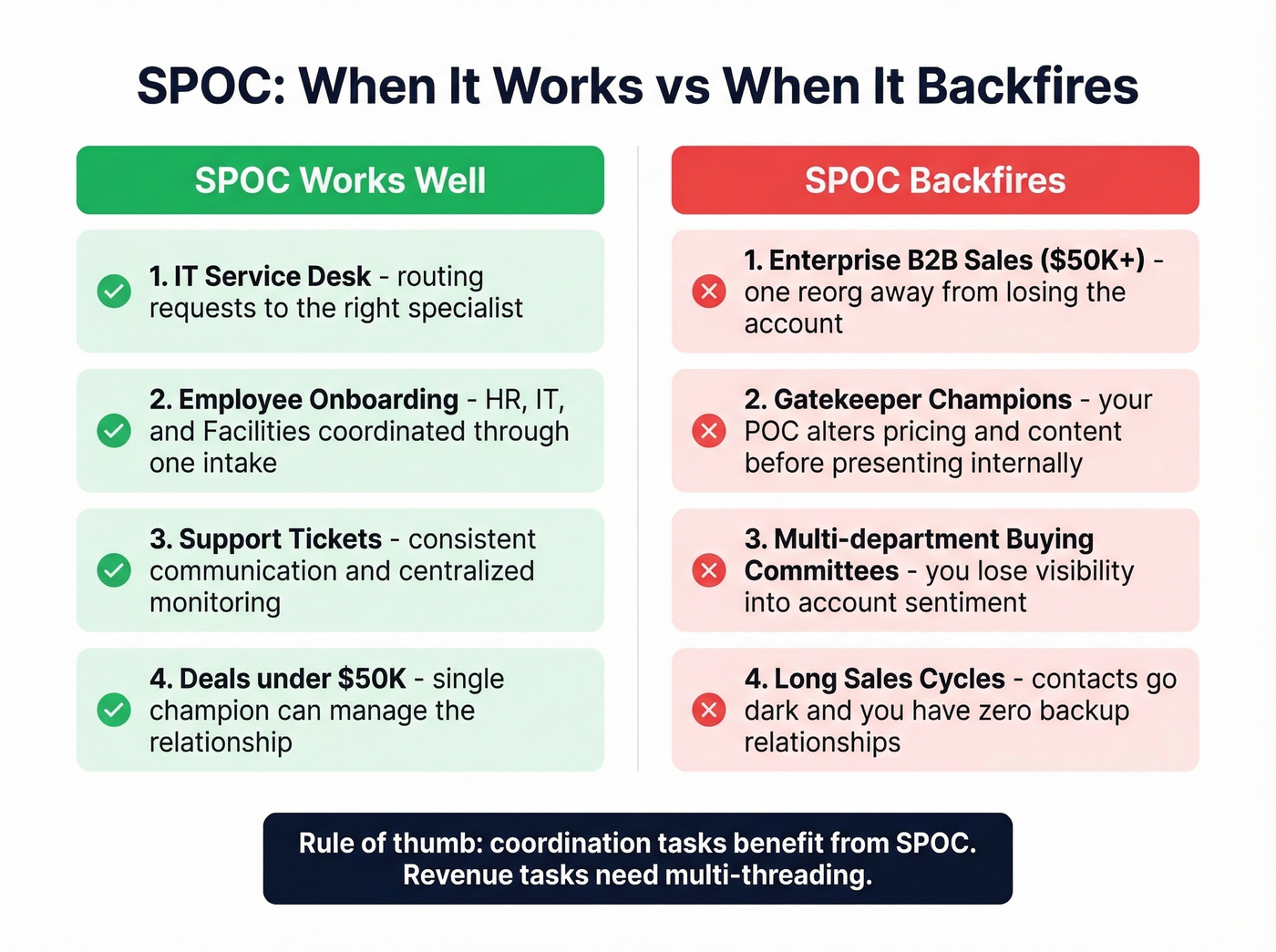
We've seen this pattern kill deals repeatedly. When your sole POC becomes a gatekeeper to leadership, you lose visibility into account sentiment. You can't read the room because you're not in the room.
Here's the thing: if your deal size is under $50K, a single champion might be fine. Above that, single-threading is organizational malpractice. You're one reorg away from losing the account.
How to Implement a SPOC
If the SPOC model fits your organization - particularly for internal service delivery - here's a practical seven-step rollout:
- Identify internal service providers - who handles what today?
- List top activities and requests - what are people actually asking for?
- Identify interdependencies and duplication - where are teams stepping on each other?
- Document employee journey maps - trace the request path from submission to resolution
- Set performance targets - define what "good" looks like
- Choose the SPOC department - pick the team with the broadest visibility
- Promote internally and iterate - adoption doesn't happen by announcement alone
The onboarding example makes this concrete. A new hire needs a laptop (IT), a badge (facilities), benefits enrollment (HR), and a desk assignment (office management). Without a SPOC, that's four separate request chains. With one, the new hire sends a single message and the SPOC coordinates the rest. Four email chains become one message.
Finding the Right POC in B2B Sales
Knowing what a POC is doesn't help if you can't find the right one.
Map Your Ideal Customer Profile
Start with firmographics: industry, employee count, revenue range, geography. Layer in technographics - what tools does the company use? A company running Salesforce and Outreach has different needs than one on HubSpot and Mailchimp. Combine firmographic and technographic filters with BANT qualification criteria to narrow your target list before you ever look at individual contacts (use an ideal customer profile template to standardize this).
Identify the Buying Committee
Gartner's widely cited stat holds up: complex B2B buying groups involve 6-10 decision-makers. Those buyers spend roughly 17% of their total buying time with any single supplier - you're competing for a sliver of attention across a committee you don't fully see.
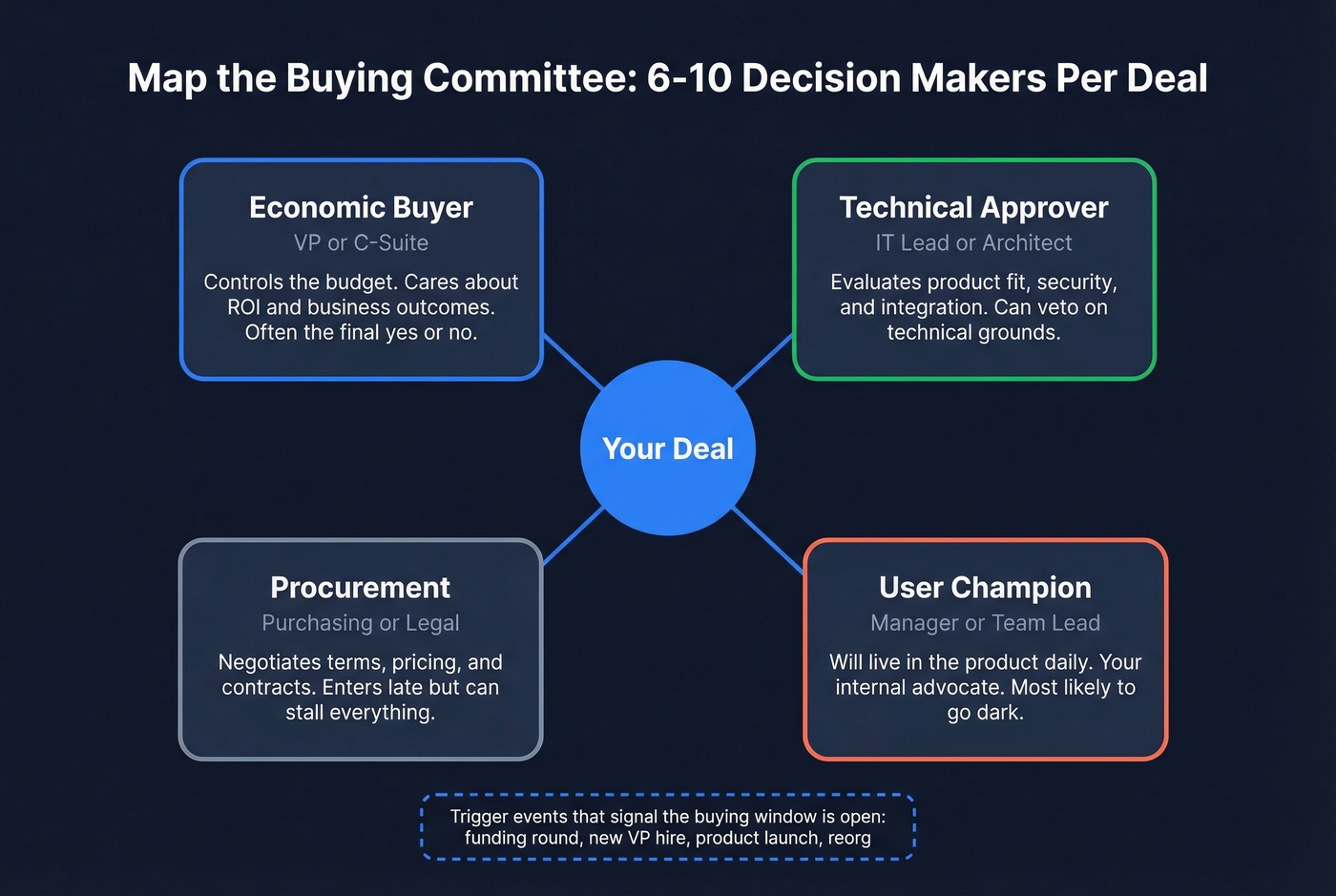
Segment by role: economic buyer (controls budget), technical approver (evaluates fit), user champion (will live in the product daily), and procurement (negotiates terms). Then watch for trigger events - a funding round, a new VP hire, a product launch - that signal the buying window is open and new stakeholders have entered the picture (see identifying buying signals).
Verify Contact Data Before Outreach
Between 30-70% of B2B contact data decays annually. People change jobs, get promoted, leave companies. Reps already spend only 34% of their time actually selling - the rest goes to admin, data cleanup, and chasing bad numbers (a classic sales pipeline challenges symptom).
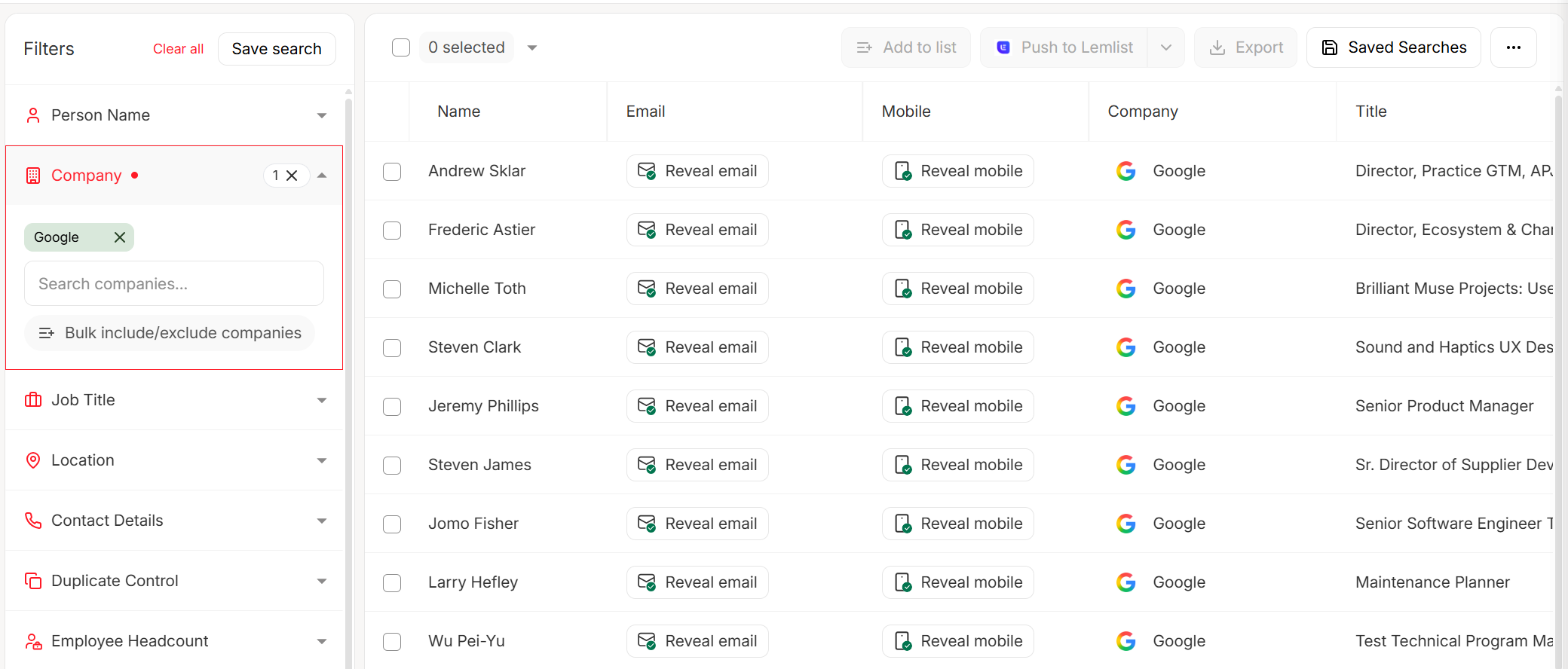
This is where a tool like Prospeo saves hours. Paste a company URL or upload a CSV, and it pulls verified emails and direct dials for key stakeholders on the account. The 7-day data refresh cycle matters here - most platforms refresh on a roughly 6-week cycle, which means you're often working with stale records by default.
Every repeat contact costs $2.70-$5.60. Every bounced email to a wrong POC wastes even more. Prospeo's 7-day data refresh cycle ensures the points of contact you're reaching are still in their roles - not last quarter's org chart. At $0.01 per verified email, accurate POC data costs less than a single wasted call.
Stop emailing people who left the company six weeks ago.
Multi-Threading: Why One POC Isn't Enough
Your champion just went dark on a $200K deal. No replies to emails. Calls go to voicemail. You have zero other contacts at the account.
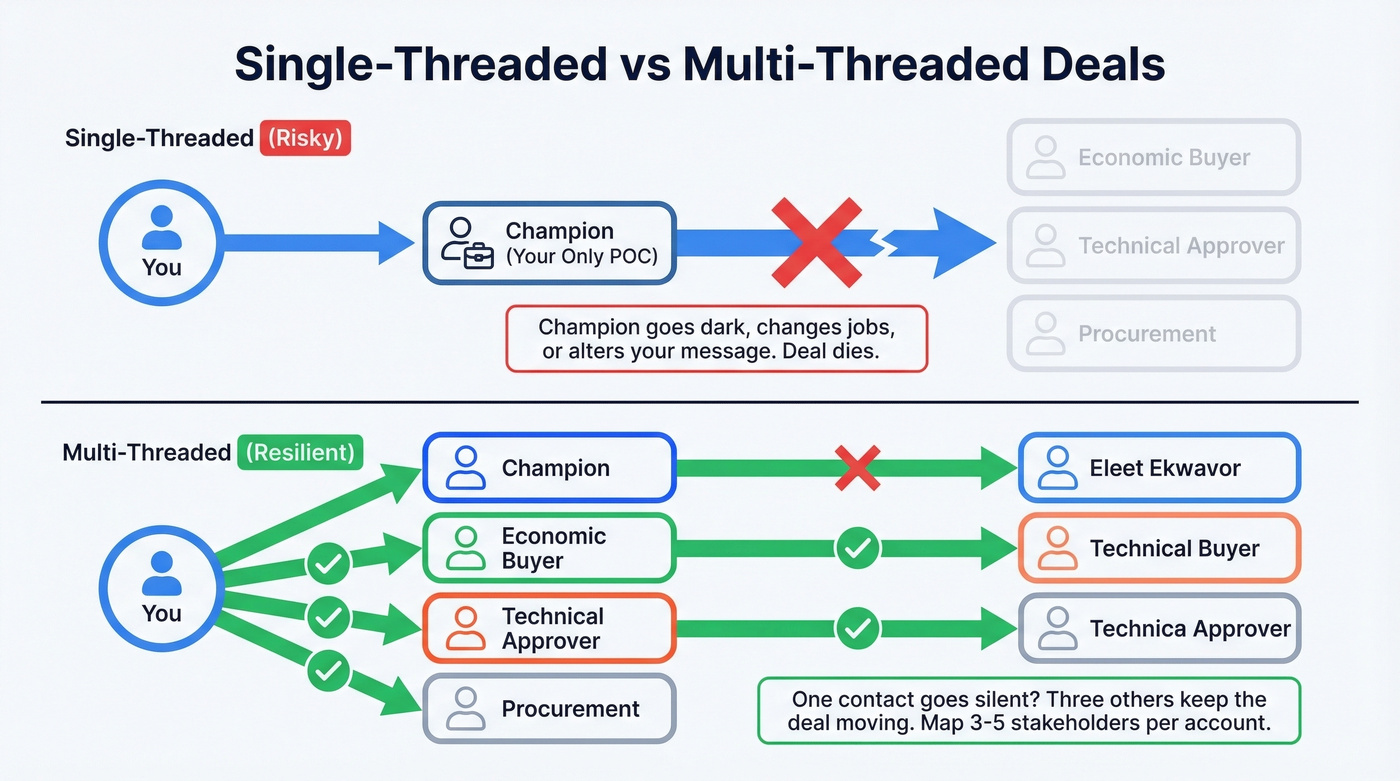
This isn't a hypothetical - it's the most common failure mode in enterprise sales, and it's entirely preventable.
The consensus on r/sales is clear: single-threading kills enterprise deals. The fix is straightforward. For every target account, map 3-5 contacts across the buying committee. Economic buyer, technical approver, user champion, procurement - at minimum. When one contact goes silent, you have three others who can keep the deal moving (a core part of account-based selling best practices).
The common failure patterns are predictable: templated sequences sent to a single title, delayed outreach after initial interest fades, and generic materials that don't speak to each stakeholder's specific concerns. When contacts go stale - and they will - you need a fast way to rebuild. Running your account list through an enrichment API that returns 50+ data points per matched contact at a 92% match rate turns a two-day research project into a 20-minute workflow (see data enrichment services).
POC Handoff Templates
Bad handoffs kill deals and erode trust. Here are three templates you can copy, customize, and use today (or use these handoff email templates if you want more variations).
Template 1: New POC Introduction
Subject: Introducing [New POC Name], Your New Point of Contact
Hi [Client Name], [New POC Name] is taking over as your primary point of contact starting [date]. They have full context on [specific project]. I'll be on copy for two weeks to ensure a smooth transition.
Template 2: AE to CSM Post-Sale Handoff
Subject: Welcome aboard - meet [CSM Name]
Hi [Client Name], now that we've signed, [CSM Name] will be your point of contact for onboarding and ongoing support. They're briefed on [specific goals]. Expect a kickoff scheduling email within 24 hours.
Template 3: Internal Specialist Connection
Subject: Connecting you with [Specialist Name] re: [Topic]
Hi [Stakeholder Name], you mentioned [specific need] on our last call. I'm looping in [Specialist Name], our expert on this. [Specialist Name], [Stakeholder Name] is [role, company, what they need].
Skip the handoff if the transition is temporary or the new contact doesn't have full context yet. A premature introduction with no real ownership behind it is worse than no introduction at all.
FAQ
Is it "points of contact" or "point of contacts"?
"Points of contact" is correct. You pluralize the head noun ("point"), not the object of the preposition. "Point of contacts" appears in casual usage but is grammatically incorrect in any formal or client-facing writing.
What does SPOC stand for?
Single Point of Contact - one person or team that handles all incoming requests so users don't need to identify the right department. It's most common in IT service management and internal operations.
Can a department be a POC?
Yes. In IT service management and customer support, the service desk frequently serves as the organizational POC, routing requests to the appropriate specialist behind the scenes rather than exposing internal structure to end users.
How many POCs should a B2B account have?
For enterprise accounts, map 3-5 contacts across the buying committee - economic buyer, technical approver, user champion, and procurement at minimum. One silent champion can stall a six-figure opportunity overnight.
How do I find verified contact info for a POC?
Use a B2B data platform to search by company, role, and seniority. Look for 98%+ email accuracy and a weekly refresh cycle - platforms that refresh every 6 weeks often serve stale records by default. Prospeo's free tier includes 75 email credits per month if you want to test this without commitment.