

Predictive Dialer for Cold Calling: What Actually Works in 2026
Your reps made 2,000 dials last week. They got 38 connects and booked 2 meetings. The knee-jerk reaction is to buy a predictive dialer for cold calling - something that dials more numbers per hour so the math works out. But dialing faster through garbage numbers just burns your caller ID reputation faster. The problem isn't your dialer. It's your data.
Cold calling connect rates have cratered. Reps on Reddit report 1-2% connect rates using Apollo-sourced lists. An SDR manager running a 12-person team posted that 6% is their current benchmark - down from 15-20% in 2021. This article won't rank 15 dialers. It'll show you why your data matters more than your dialer, and what to do about it.
What You Need (Quick Version)
- 20+ agents with validated lists? A predictive dialer makes sense. Look at Five9 or Convoso.
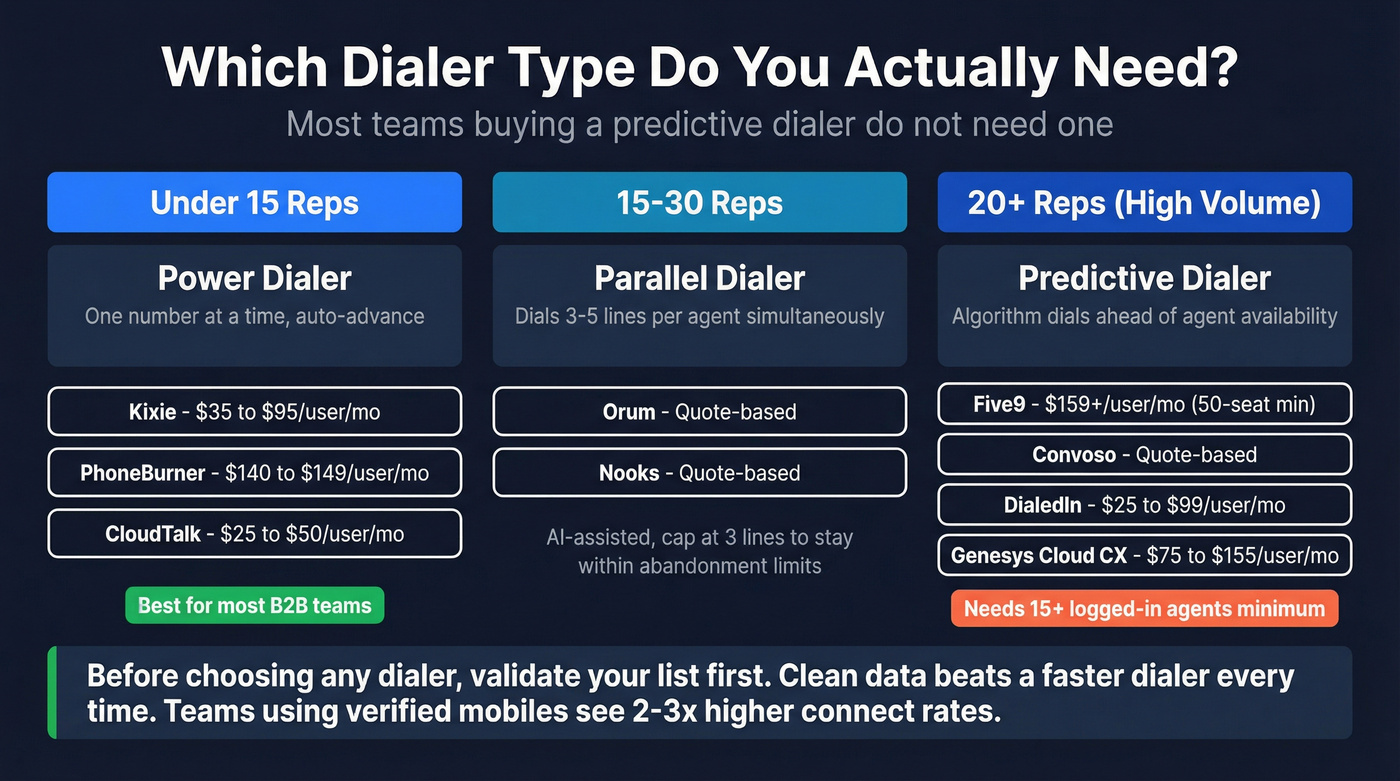
- Under 15 reps? Skip predictive entirely. A power dialer or parallel dialer gives you control without compliance headaches.
- Before you buy any dialer: Validate your phone list. Run your numbers through a verification tool like Prospeo's mobile finder to strip out dead lines and landlines before spending $25-$150+/agent/month on dialing software.
How Predictive Dialers Actually Work
A predictive dialer uses a pacing algorithm to dial multiple numbers simultaneously before any agent is free. It forecasts when your next rep will finish their current call and starts dialing ahead of time, routing the first live answer to that rep. Zero idle time between conversations - that's the pitch.
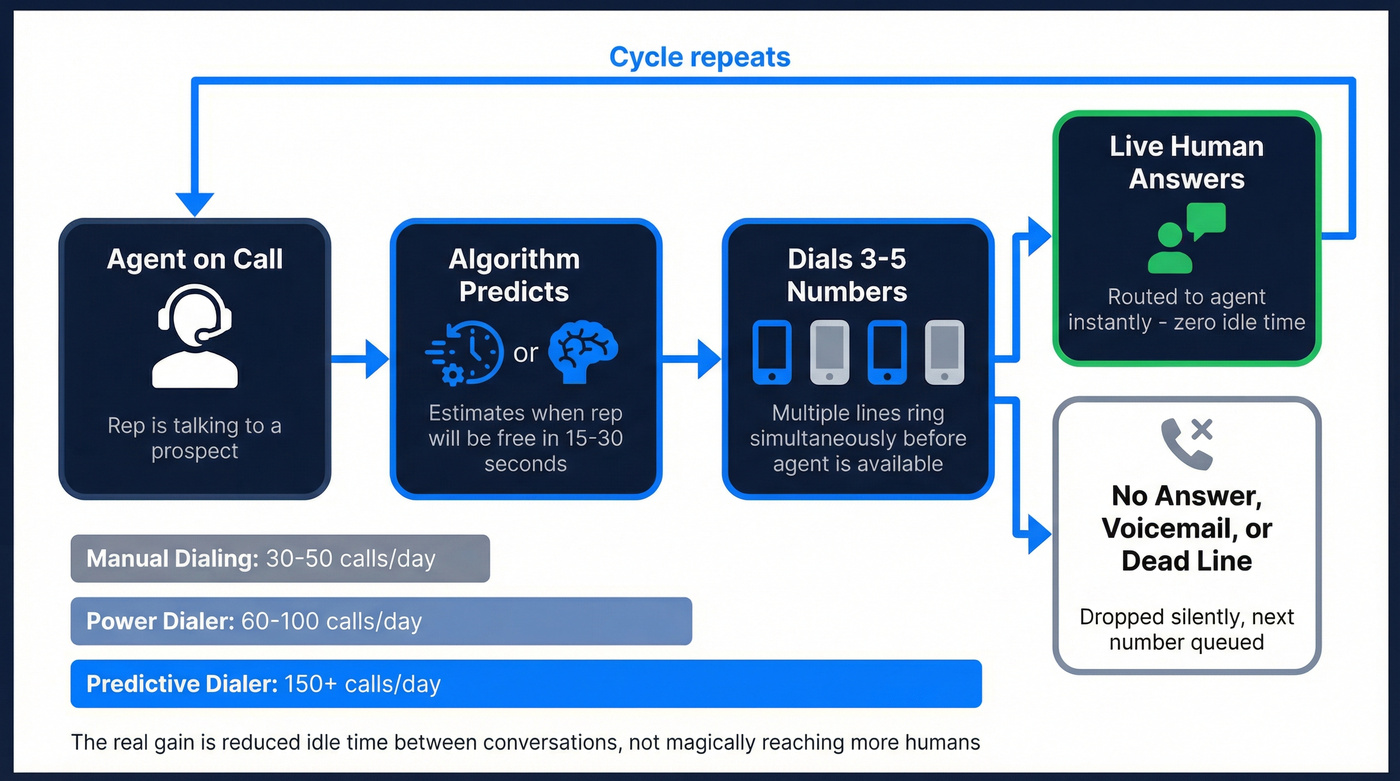
Manual dialing gets reps 30-50 calls per day. Power dialers push that to 60-100. Predictive dialers hit 150+ because they're always working ahead, and parallel dialers like Orum or Nooks can exceed 200 by dialing 3-5 lines per agent at once, though most teams cap at 3 lines to stay within abandonment limits.
Vendors love to claim "up to 400% improvement" in connection rates. That's marketing math. The real gain is reduced idle time, not magically reaching more humans.
Why Your Dialer Can't Fix Bad Data
The consensus on r/sales is clear: list quality is the bottleneck, not dialing speed. One practitioner reported that validating their list with a phone verification tool doubled their connect rate overnight. No dialer upgrade will do that.
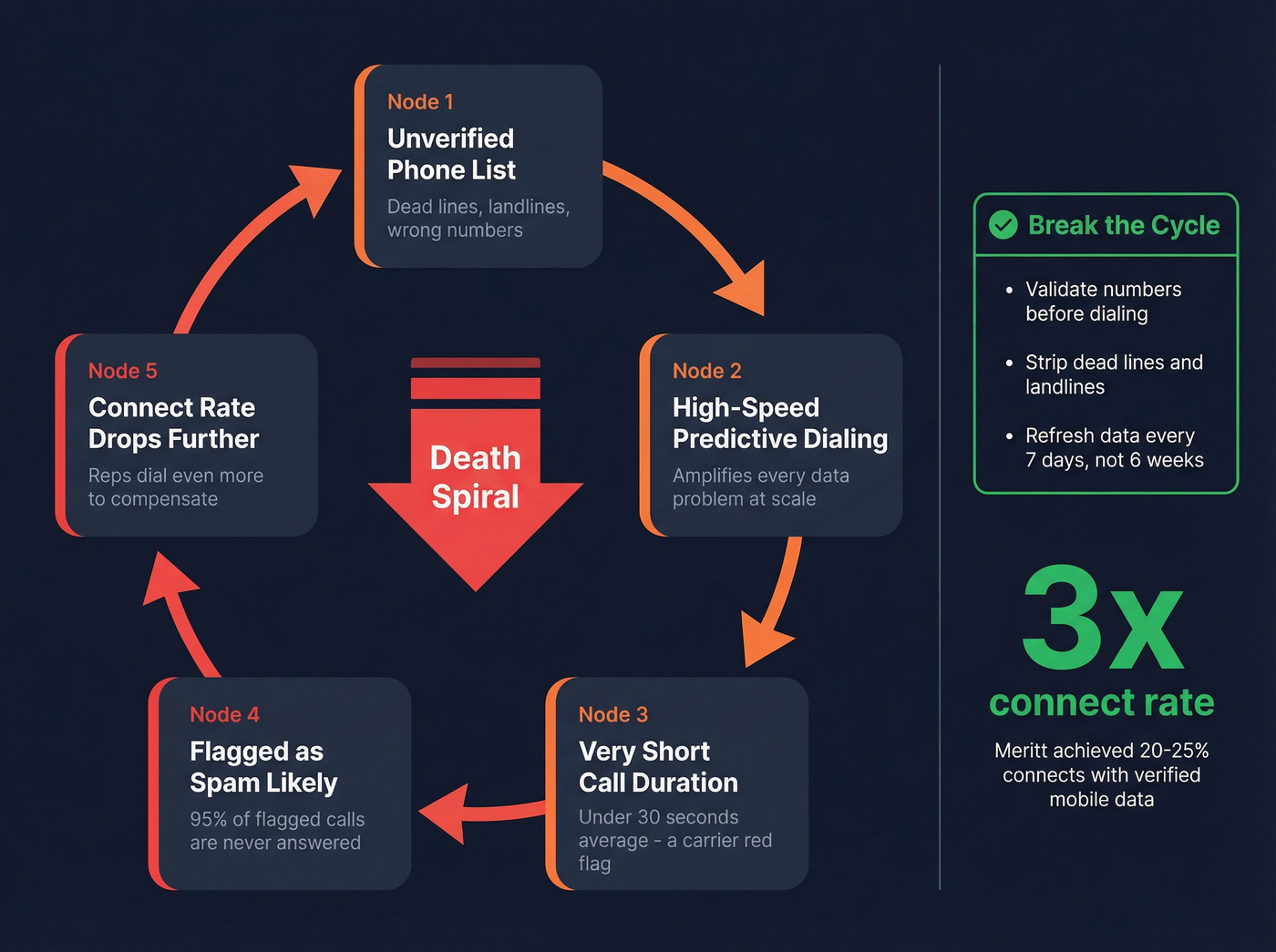
When you dial unverified numbers at predictive speeds, you amplify every problem. Very short average call duration - under 30 seconds - is a behavioral trigger that carrier analytics engines use to flag you as spam. Volume spikes from aggressive pacing compound the damage. Within days, your numbers get labeled "Spam Likely" and your connect rate drops further. It's a death spiral.
We've seen this play out with our own customers. Meritt, an outbound agency, 3x'd their connect rate to 20-25% after switching to verified mobile data refreshed every 7 days versus the 6-week industry average. That's the kind of lift no dialer algorithm can manufacture on its own.
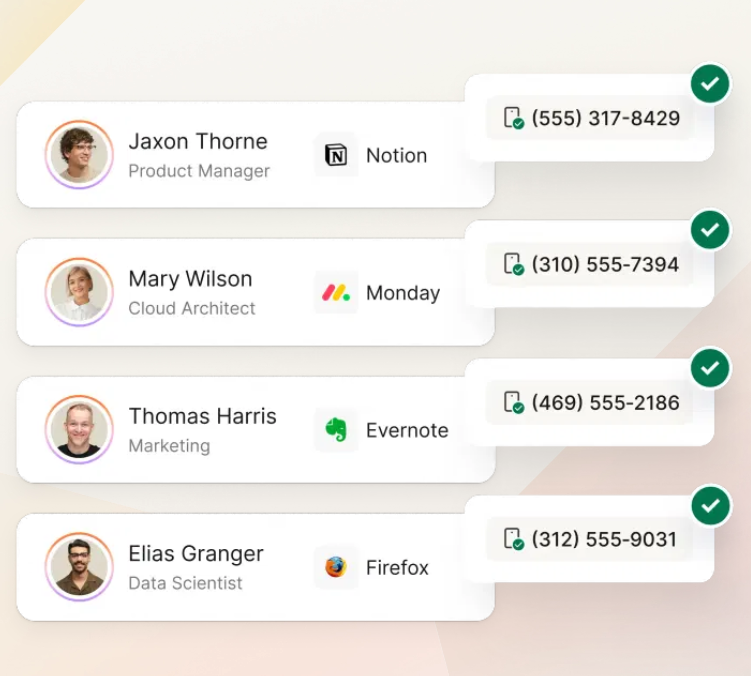

Meritt tripled their connect rate to 20-25% by feeding verified mobile numbers into their dialer - not by dialing faster. Prospeo's 125M+ verified mobiles are refreshed every 7 days, so your predictive dialer hits live numbers instead of burning your caller ID on dead lines.
Stop dialing dead numbers. Start with data that picks up.
Spam Labeling and Call Authentication
Every major US carrier runs its own analytics engine to decide whether your call shows up as "Spam Likely" before the phone even rings. AT&T uses Hiya, Verizon uses TNS, T-Mobile uses First Orion. They don't just check STIR/SHAKEN signatures - they analyze calling behavior in real time: volume spikes from a single number, average call duration under 30 seconds, and neighbor-spoofing patterns. More than 95% of calls labeled "Spam Likely" are never answered. Add Apple's "Silence Unknown Callers" feature and you've got a structural headwind no dialer overcomes.
As of 2026, 85% of voice traffic between Tier-1 carriers is signed and verified with STIR/SHAKEN, with 93% at A-level attestation. Smaller carriers sit at just 17.5% signed call traffic. Having proper attestation on your outbound numbers is table stakes now.
If you want the full picture on what’s actually moving the needle, start with answer rate benchmarks and how they tie back to list hygiene and carrier trust.
Compliance Rules You Can't Ignore
Predictive dialers are legal in the US, but they sit in a regulatory minefield. The FTC's [safe harbor conditions](https://www.federalregister.gov/documents/2004/11/17/04-25470/telemarketing-sales-rule) require:
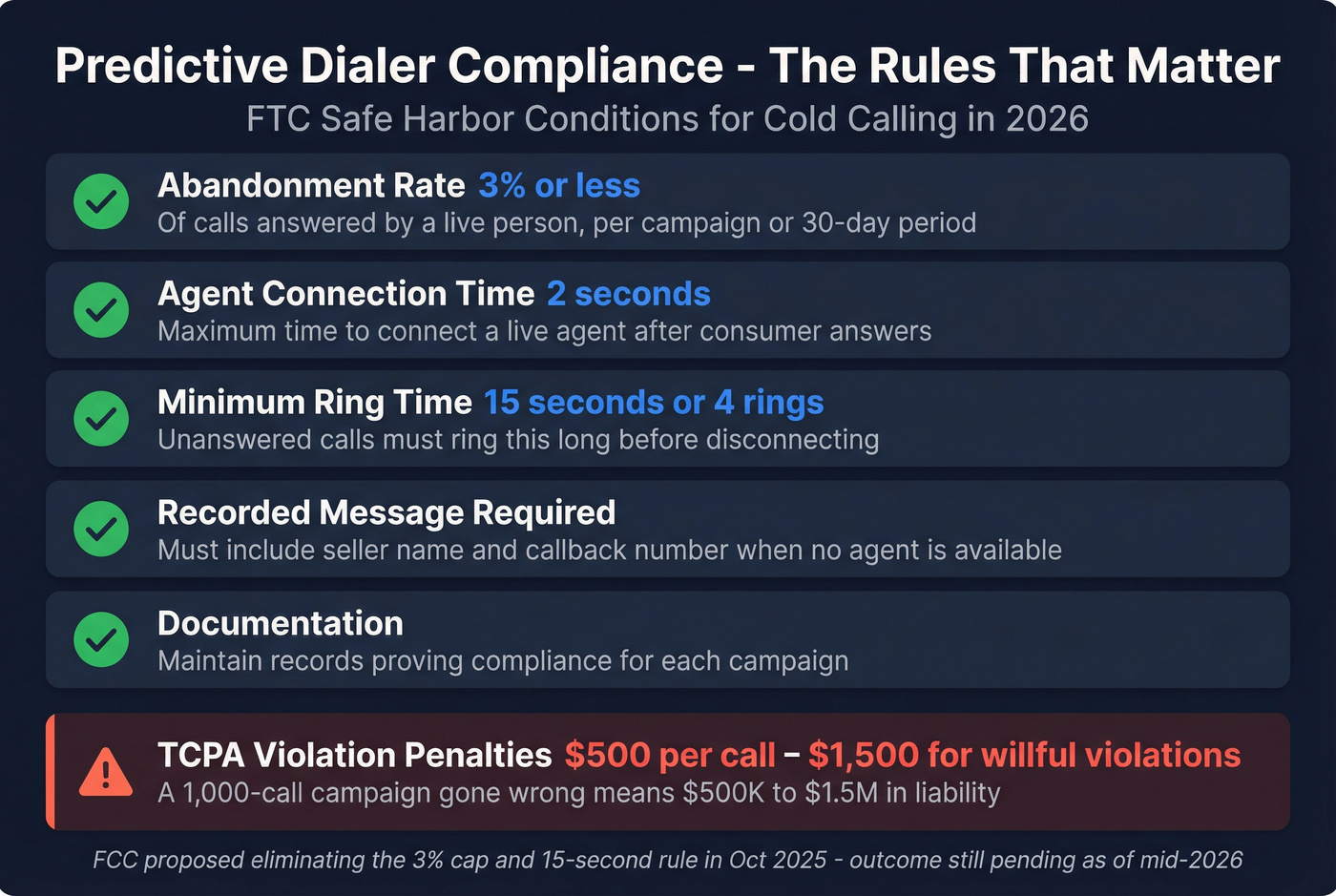
- Abandonment rate at or below 3% of calls answered by a live person, per campaign or 30-day period
- Live agent connects within 2 seconds of the consumer answering
- Unanswered calls ring at least 15 seconds or 4 rings
- Recorded message with seller's name and number when no agent is available
- Records documenting compliance
TCPA violations carry $500 per call, tripled to $1,500 for willful violations. A 1,000-call campaign gone sideways means $500K-$1.5M in liability. That's not a rounding error.
If you're building a process around this, use a TCPA compliance checklist and make sure your ops team understands the cold calling laws that apply to your regions.
Worth watching: the FCC proposed an FNPRM in October 2025 that would eliminate the 3% abandonment cap and the 15-second/4-ring rule entirely. As of mid-2026, the outcome is still pending. Don't assume the rules are loosening until it's finalized.
AMD: How to Evaluate It
Answering Machine Detection is the feature every predictive dialer vendor touts and none benchmark honestly. Vendor claims of "up to 98% accuracy" are meaningless without context. We've seen those numbers fall apart in production when call routing, carrier codecs, or regional voicemail greetings change.
Here's the thing: you need to run your own tests. Regal.ai's framework offers a practical approach - measure the ratio of calls connected to agents that have human-answered dispositions versus all calls connected. Run a QA sample of 200-500 calls per campaign. That's the only number you can trust, because vendor benchmarks are always run under ideal conditions that don't match your calling environment.
To pressure-test results, track your connect rate and compare it to your cold call connect rate by list source and campaign.
Top Cold Calling Dialers Compared
Let's be honest about most "top 10 predictive dialer" lists - half the tools are enterprise CCaaS platforms where the dialer is buried three menus deep, and the other half are power dialers with "predictive" in the marketing copy. Here's what's actually worth your time.
| Tool | Best For | Pricing | Notes |
|---|---|---|---|
| Five9 | High-volume teams | $159/concurrent user/mo+, 50-seat min | Enterprise gold standard. Negotiate on volume. |
| Convoso | Serious outbound ops | Quote-based | Best AMD and pacing controls in the category. |
| DialedIn | Budget teams | $25-$79/user/mo (annual) or $35-$99/user/mo (monthly) | Solid value. Less polished UI. |
| CloudTalk | Mid-market + Salesforce | ~$25-$50/user/mo (annual) | Dialer features on higher tiers; Salesforce integration on Expert plan. |
| Genesys Cloud CX | Enterprise CCaaS | $75-$155/user/mo | Full contact center platform. |
For teams under 15 reps, skip predictive entirely. You don't have enough agents for the pacing algorithm to work - Genesys recommends at least 15 logged-in agents as a minimum. Look at Kixie (~$35-95/user/mo) or PhoneBurner (~$140-149/user/mo) for power dialing, or Orum and Nooks for parallel dialing with AI assistance.
If you do want a tool-by-tool breakdown, use our separate guide on predictive dialer software (and for broader options, see best sales dialer).
Our take: most teams buying a predictive dialer don't actually need one. If your deal size is under $20k and you have fewer than 20 reps, a power dialer plus clean data will outperform predictive dialing fed with unverified lists every single time. The dialer is never the bottleneck. The list is.
If you’re rebuilding your outbound motion, start with a tighter outbound calling strategy and a repeatable cold calling system.
At $25-$150+/agent/month for dialing software, every call to a disconnected number is money wasted. Prospeo's mobile finder verifies numbers before they hit your dialer - 30% pickup rate versus the 11-12% industry average. Strip out landlines and dead lines at $0.10/number.
Fix your list before you fix your dialer. The ROI is immediate.
FAQ
What's the difference between a predictive dialer and a power dialer?
A predictive dialer dials multiple numbers ahead of agent availability, routing the first live answer to the next free rep. A power dialer dials one number at a time, auto-advancing through the list. Predictive needs 20+ agents to pace correctly; power dialers work for any team size.
Are predictive dialers legal in the US?
Yes, but heavily regulated under TCPA and FTC rules. You must keep abandonment under 3%, connect a live agent within 2 seconds, ring for at least 15 seconds, and scrub against DNC lists. Violations run $500-$1,500 per call.
How do I improve my cold calling connect rate before buying a dialer?
Validate your phone list - it's the highest-leverage move you can make. Teams using verified mobile data consistently report 2-3x higher connect rates than those dialing unverified lists. Start with a free verification tool to see the difference before committing to any dialing software.