

How to Write a Product Integration Partnership Email That Gets a Reply
A SaaS founder on r/SaaS pitched 15 companies for integration partnerships. Fourteen went nowhere. The one that worked shared the same customer base, solved a painful problem neither product could fix alone, and had a sales team actually incentivized to promote the integration. The product integration partnership email that started it took 20 minutes to write - but the research behind it took two weeks.
Most partnership email templates are built for co-marketing swaps, affiliate pitches, and link-building asks - not API integrations. A strong integration pitch needs a specific shared-customer pain point, a quantified benefit, and a low-commitment next step. Below: five templates, benchmarks from 16.5M analyzed emails, and the full lifecycle from pitch to launch.
Why Generic Partnership Emails Fail
Search for "partnership email template" and you'll find dozens of results offering variations of "Let's explore a partnership..." or "A win-win idea for {{TheirCompany}}." Fine for link swaps and content collabs. Useless for integration partnerships.
Most partnership email guides give you templates for affiliate deals and co-marketing swaps. They don't address API scoping, sandbox access, or technical discovery - the things that actually determine whether an integration partnership moves forward. Even Instantly's guide nails the diagnosis (partnership pitches die from "spray and pray" and "premature proposal") but the templates still feel like generic outreach.
Here's the thing: if your email doesn't reference the partner's product architecture, you're sending a marketing pitch, not an integration proposal. Partnership teams can smell the difference instantly.
Qualify Before You Write
That r/SaaS poster identified exactly four criteria that made the one successful partnership work:
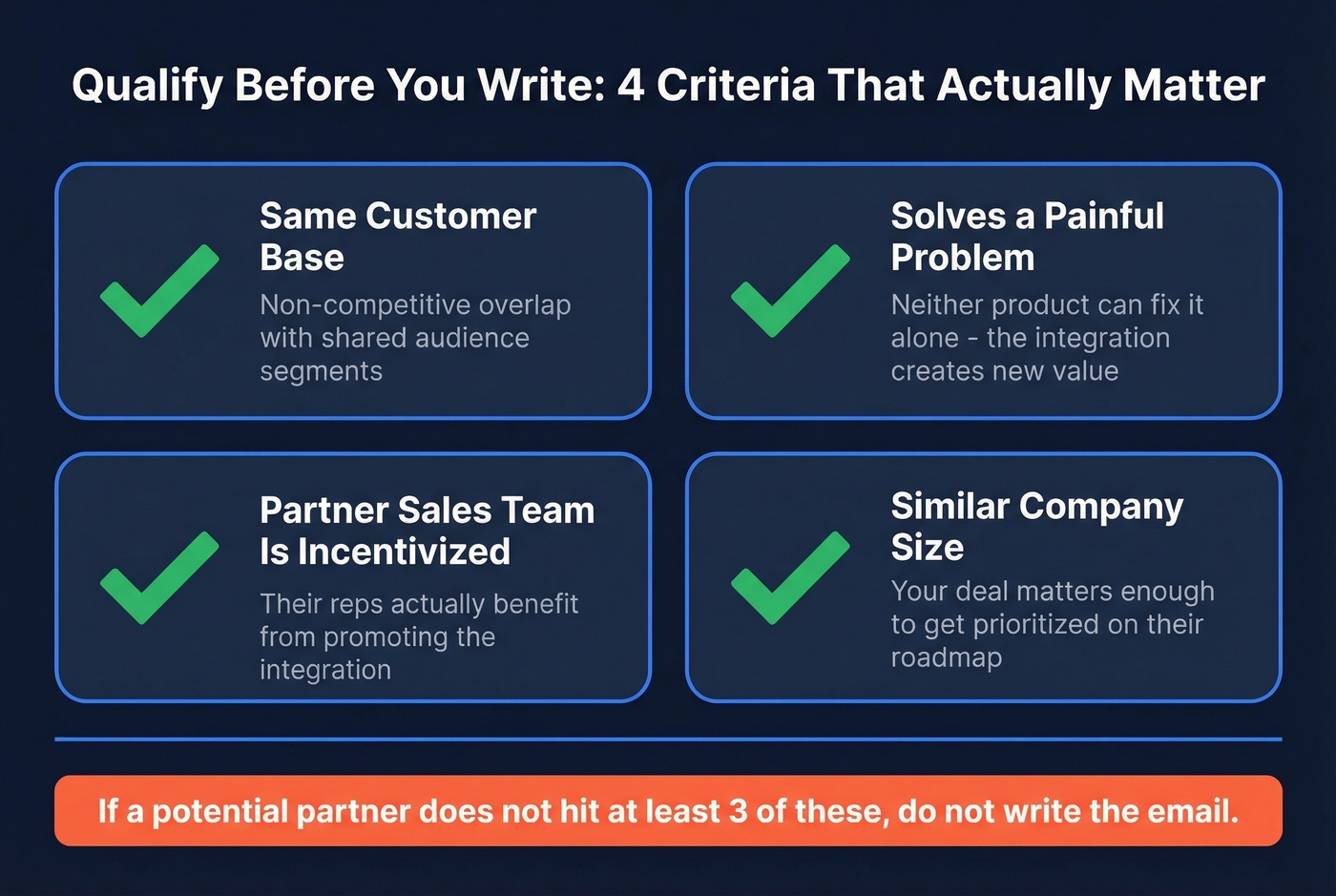
- Same customer base with non-competitive overlap
- Solved a painful problem the partner couldn't fix alone
- Partner sales team was incentivized to promote the integration
- Similar company size so your deal actually mattered to them
If a potential partner doesn't hit at least three of these, don't write the email. You'll spend weeks in scoping calls that go nowhere. 82% of B2B leaders plan to add partners this year, which means partnership teams are drowning in inbound pitches. Yours needs to be obviously worth their time.
Find the Right Contact
Sending your integration pitch to info@company.com is a black hole. You need the Head of Partnerships, VP Product, or a senior BD lead - someone with authority to greenlight a technical integration.
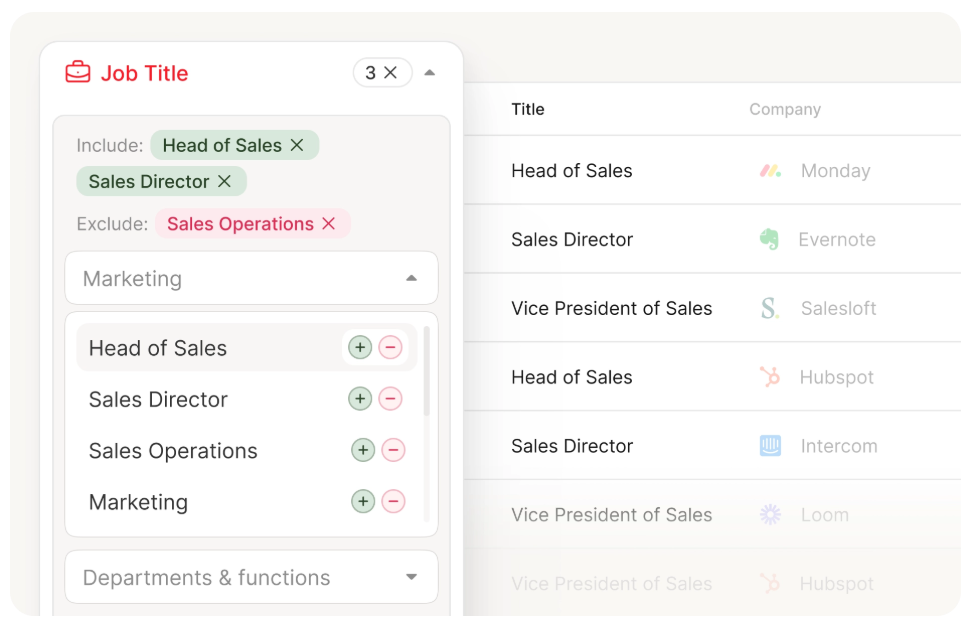
Prospeo makes this straightforward: filter by job title, department, and technographics across 300M+ professional profiles to surface the exact decision-maker. With 98% email accuracy, you're not wasting a carefully crafted pitch on a bounced address.
Anatomy of an Integration Pitch
Keep subject lines to 5-7 words. Be specific. "Quick idea for {{their product}} + {{your product}}" works. "Partnership opportunity" screams mass outreach.
If you want more options, pull from proven Email Subject Line Examples and adapt them to an integration context.
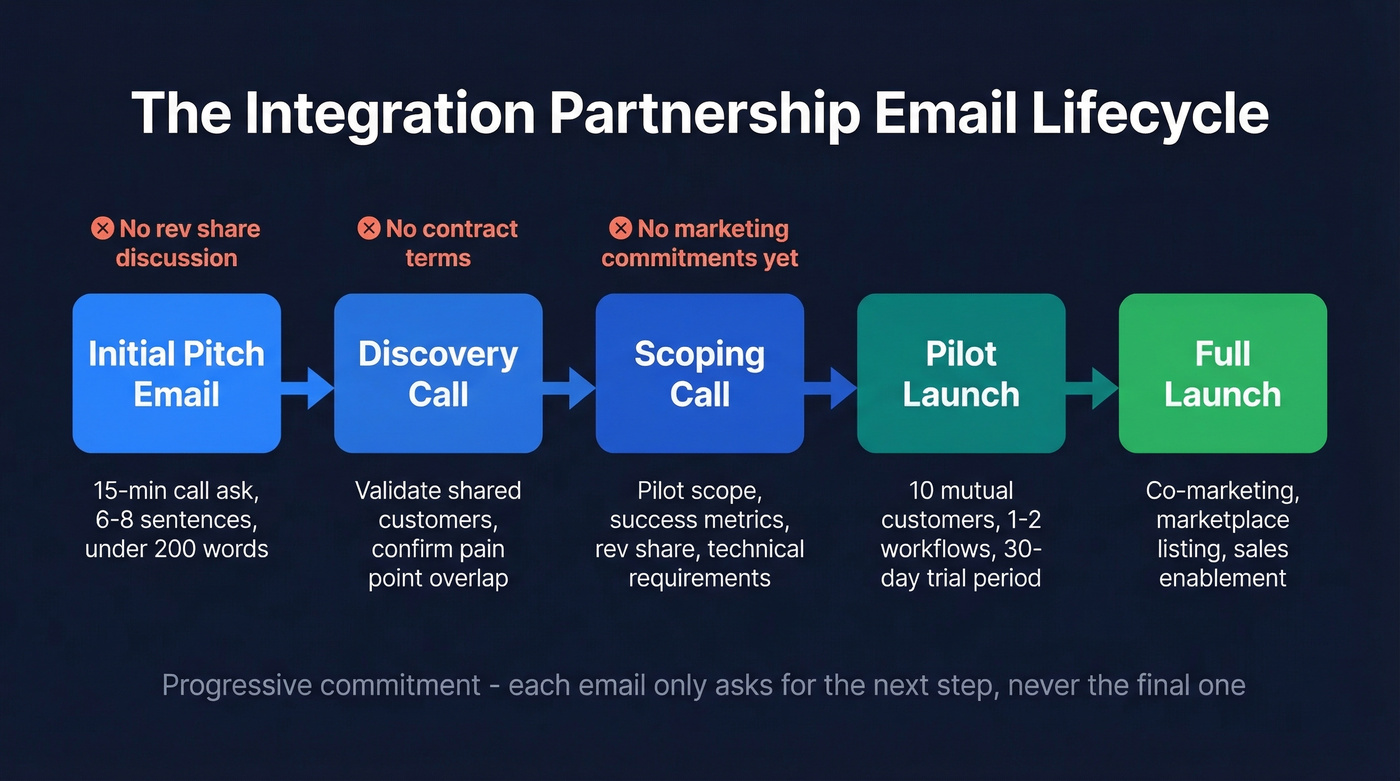
The sweet spot for email length is 6-8 sentences, under 200 words. That's enough to establish credibility, articulate the pain point, quantify the benefit, and propose a next step. The principle is progressive commitment - your first email asks for a 15-minute call, not a signed agreement. Revenue share, lead attribution, and marketing commitments belong in the scoping conversation, never the first touch.
If you're building a sequence (not a one-off), use a B2B cold email sequence structure so each step earns the next ask.

Your integration pitch is only as good as the inbox it lands in. Prospeo surfaces Heads of Partnerships, VPs of Product, and BD leads across 300M+ profiles - filtered by role, department, and technographics. With 98% email accuracy, your carefully researched partnership proposal actually reaches the decision-maker.
Stop losing integration deals to bounced emails and wrong contacts.
Five Templates for Integration Outreach
1. Initial Integration Pitch
Use this when you've identified a complementary product and a shared-customer pain point. The goal is a 15-minute call, nothing more.
Subject: Quick idea: {{YourProduct}} + {{TheirProduct}}
Hi {{FirstName}},
I lead partnerships at {{YourCompany}}. We share a lot of customers with {{TheirProduct}} - specifically {{segment, e.g., "mid-market SaaS teams running outbound"}}.
One thing we hear constantly: {{specific pain point, e.g., "they're manually exporting enriched contacts from our platform into yours"}}. A native integration would eliminate that friction and keep both products stickier - companies with 3-5 integrations see retention rates double or triple.
Would you have 15 minutes this week to explore whether this makes sense?
Best, {{YourName}}
2. Marketplace Listing Proposal
Subject: {{YourProduct}} listing on {{TheirMarketplace}}
Hi {{FirstName}},
We've built a {{brief description}} that {{TheirProduct}} customers already use alongside your platform. {{X}} mutual customers have asked about a native connection.
We'd like to apply for your integration marketplace. Our team can handle the build - we just need sandbox/API docs and a technical contact for scoping.
Happy to walk through our integration spec on a quick call. What works for you?
3. Data Enrichment Partnership Pitch
This template works when both products become more valuable together through a data or enrichment layer. Prospeo's own integration ecosystem - connecting to Salesforce, HubSpot, Clay, Zapier, Make, Lemlist, and Instantly - is a real-world example of how these partnerships create mutual value for shared customers.
If you're pitching this angle, it helps to frame it as data enrichment rather than a generic "data partnership."
Subject: Enrichment integration: {{YourProduct}} + {{TheirProduct}}
Hi {{FirstName}},
Our customers keep asking for {{TheirProduct}} data inside {{YourProduct}}. Right now they're exporting CSVs and manually importing - it's a workflow that breaks constantly.
A native integration would let mutual customers {{specific benefit, e.g., "enrich CRM records in real time without leaving your platform"}}. We've scoped similar integrations before - a typical first version is 4-8 weeks with a sandbox-first approach.
Worth a 15-minute call to see if the overlap is real?
4. Follow-Up After No Response
42% of replies come from follow-ups, yet 48% of reps never send a second message. Follow up - but know that spam complaints escalate from 0.5% on the first email to 1.6% by the fourth. Two follow-ups is the sweet spot.
If you need more variations, borrow from these sales follow-up templates and keep the integration-specific context.
Subject: Re: Quick idea: {{YourProduct}} + {{TheirProduct}}
Hi {{FirstName}},
Wanted to bump this - I know partnership inboxes get buried. Quick context: {{1-sentence value prop from original email}}.
If the timing isn't right, no worries. But if there's someone else on your team who handles integration partnerships, I'd appreciate the redirect.
5. Scoping Call Follow-Up
Once they've said yes to a call, shift to pilot framing. In our experience, the scoping call is where most partnerships actually die - teams overcook the contract and kill momentum before any code gets written. Keep it tight.
Subject: Scoping: {{YourProduct}} + {{TheirProduct}} pilot
Hi {{FirstName}},
Great connecting. Here's what I'm thinking for a pilot:
- Scope: Soft launch with 10 mutual customers on 1-2 core workflows
- Success metrics: activation rate, mutual customer retention, support ticket reduction
- Timeline: 4-8 weeks build, 30-day pilot period
- Exit clause: Either side can wind down after the pilot with 30 days' notice
For the scoping call, let's also cover rev share structure, lead attribution, co-marketing responsibilities, technical requirements (auth method, rate limits, sandbox access), and review cadence.
Does {{day/time}} work?
42% of partnership replies come from follow-ups - but only if your emails actually deliver. Prospeo's 5-step verification and 7-day data refresh mean you're reaching real people at real addresses, not stale contacts who left the company six months ago. At $0.01 per email, qualifying 50 potential integration partners costs less than a coffee.
Build your integration partner shortlist in minutes, not weeks.
Outreach Benchmarks
Let's set realistic expectations. Across 16.5M analyzed cold emails, the average reply rate is 5.8%. Partnership emails tend to run lower because the ask is more complex - one founder on r/buildinpublic reported 300 DMs, 2 responses, and zero closed deals. Quality over volume is the only play that works here.
If you're trying to improve outcomes, start with sales prospecting techniques that prioritize fit over list size.
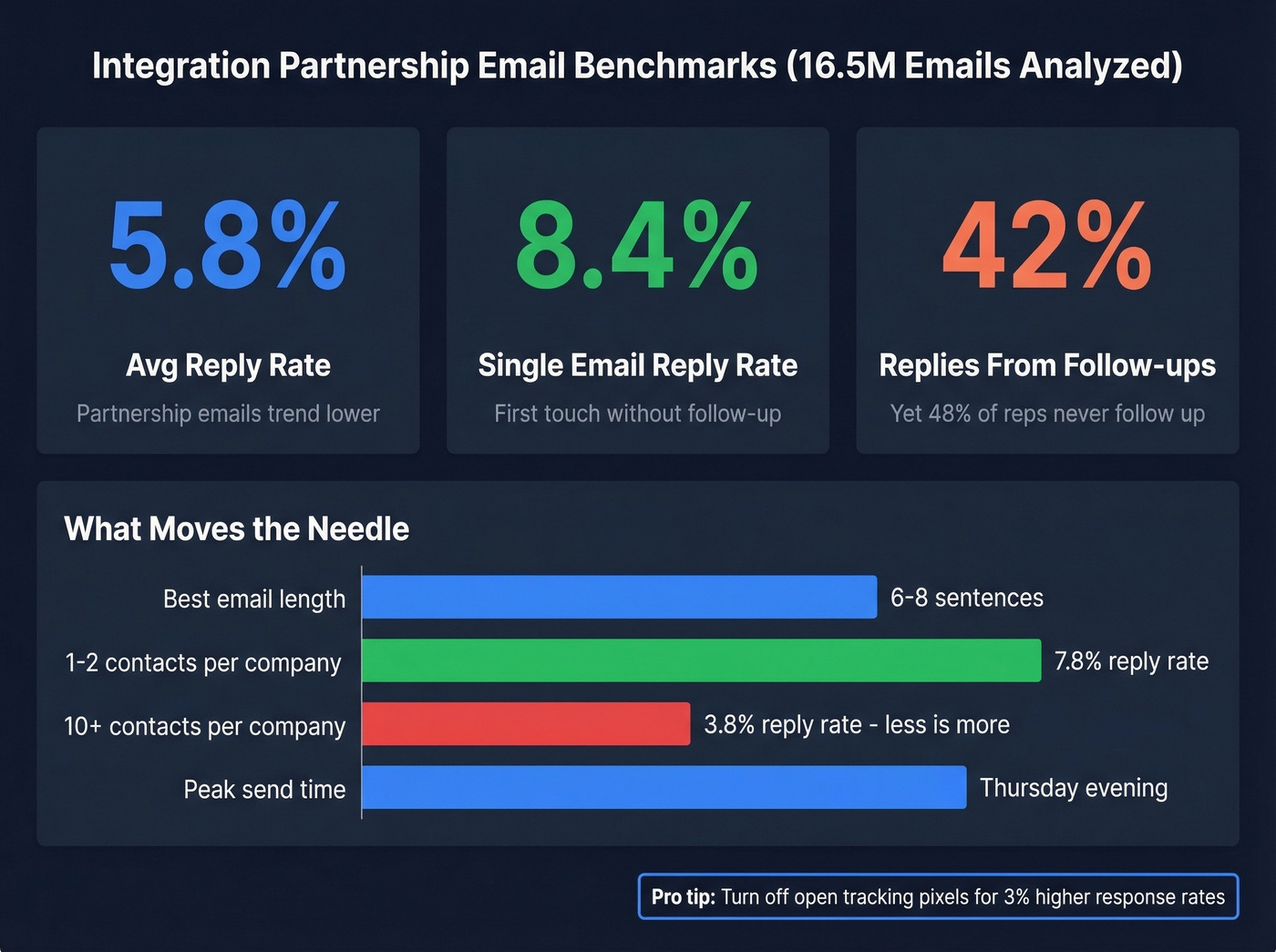
| Metric | Benchmark |
|---|---|
| Avg reply rate | 5.8% |
| Single-email reply | 8.4% |
| Best email length | 6-8 sentences |
| 1-2 contacts/company | 7.8% reply rate |
| 10+ contacts/company | 3.8% reply rate |
| Peak send time | Thursday evening |
| Replies from follow-ups | 42% |
| Reps who never follow up | 48% |
| Spam complaints by 4th email | 1.6% vs 0.5% on 1st |
One tactical note: turning off open tracking pixels produced 3% higher response rates in the same dataset. For partnership outreach where you're emailing 20-30 companies, ditch the pixel and focus on reply quality. (If you want the technical why, see email tracking pixels.)
After the Handshake - Launch Emails
Once the integration is built, you need launch comms that drive adoption. We've seen teams spend a quarter of engineering time on an integration that nobody hears about - the launch email matters more than the pitch email.
If you're planning the rollout, treat it like a lightweight go-to-market strategy, not a single announcement blast.
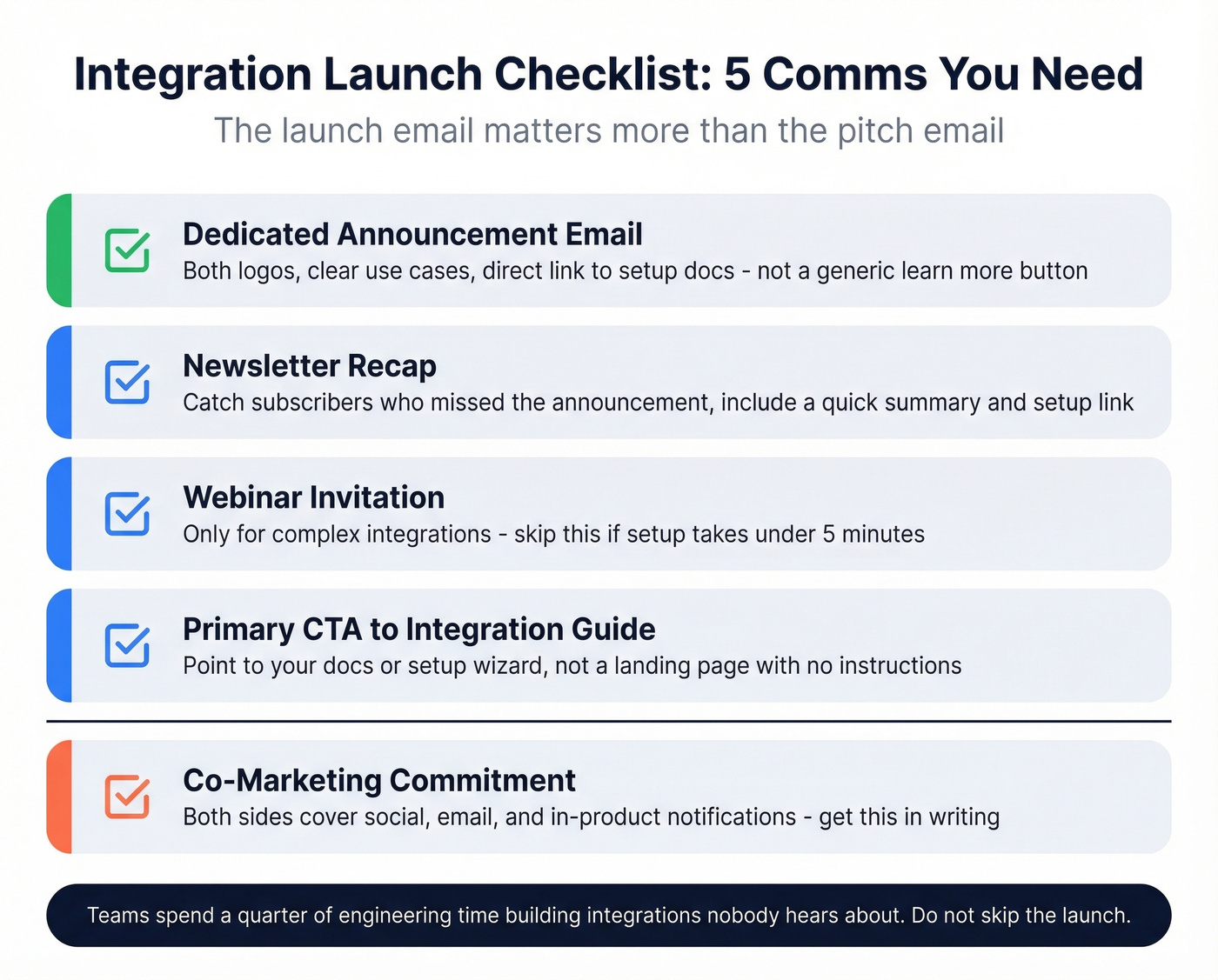
Based on Userlist's analysis of companies like Stripe, Clay, and Attio, here's what works. Stripe's Xero integration announcement used both logos, a visual walkthrough, and a direct link to setup docs - not a generic "learn more" button. That's the standard to hit.
Your launch checklist:
- A dedicated announcement email with both logos and clear use cases
- A newsletter recap for subscribers who missed it
- A webinar invitation for complex integrations
- A primary CTA pointing to your integration guide or docs
- A co-marketing commitment from both sides covering social, email, and in-product notifications
Skip the webinar if the integration is simple enough to set up in under five minutes - you'll just annoy people.
Mistakes That Kill Partnerships
Expecting the partner to do all the work. You built the integration - now you need to enable their sales team, create documentation, and drive initial adoption. They won't do it for you.
Undercooking your code. Per Monterro's analysis, shipping a buggy integration strains the relationship beyond repair. Get it right before launch.
Overcooking the contract. Overly punitive terms and complex rev-share structures kill partnerships before they start. Start with a simple pilot agreement and iterate.
Forgetting about each other post-launch. This is the #1 failure mode on Reddit: "They build the integration, forget about you, maybe 3 people use it." Schedule quarterly reviews and co-marketing sprints, or the integration dies quietly. If you're not willing to commit to that cadence, don't bother building the integration in the first place.
FAQ
How long from first email to live integration?
Expect 2-6 months end to end. First email to scoping call takes 2-4 weeks. Technical build runs 4-12 weeks. QA, security review, and launch adds another 2-4 weeks. A Zapier connector might ship in weeks; a native API integration takes months.
What reply rate should I expect?
Across 16.5M cold emails, the average reply rate is 5.8%. Partnership emails run lower - expect 2-6%. Emailing 1-2 contacts per company yields roughly double the reply rate of mass outreach (7.8% vs 3.8%).
Should I propose revenue share in the first email?
No. The first email asks for a 15-minute call, nothing more. Revenue share, lead attribution, and marketing commitments belong in the scoping conversation after both sides agree the integration makes technical and strategic sense.
How do I find the right person to email?
Target the Head of Partnerships, VP Product, or senior BD lead - never generic inboxes. Tools like Prospeo let you filter by role, department, and tech stack across 300M+ profiles to surface verified contacts at your target companies, so your pitch doesn't bounce.