

Product Pitch Examples You Can Steal and Send Today
40-60% of B2B deals don't die to a competitor. They die to indecision. The JOLT Effect research analyzed 2 million sales calls and confirmed it - buyers fear messing up more than they fear missing out. The best product pitch examples share one trait: they reduce risk, not hype features.
Every example below follows one rule: outcomes first, features second, risk reduction always.
What Is a Product Pitch?
A product pitch proves your product solves a specific problem worth paying for. A pitch deck is about belief; a sales deck is about commitment. Pitch decks open doors. Sales decks close them.
| Product Pitch | Sales Pitch | Investor Pitch | |
|---|---|---|---|
| Goal | Spark interest | Close the deal | Raise capital |
| Tone | Story-driven | Buyer-focused | Vision + traction |
| Timing | Early relationship | Late-stage negotiation | Fundraising rounds |
| Example | Airbnb: "Book rooms with locals" | ROI calculator + case study | TAM slide + projections |
Mixing these formats is where most teams go wrong. A sales-heavy deck shown too early feels transactional. A pitch-style deck used too late feels vague.
Why Most Pitches Fail
Investors spend an average of 3 minutes and 44 seconds on a pitch deck. Buyers spend less. If your pitch leads with a feature walkthrough instead of a clear problem and a credible outcome, you've already lost the window.
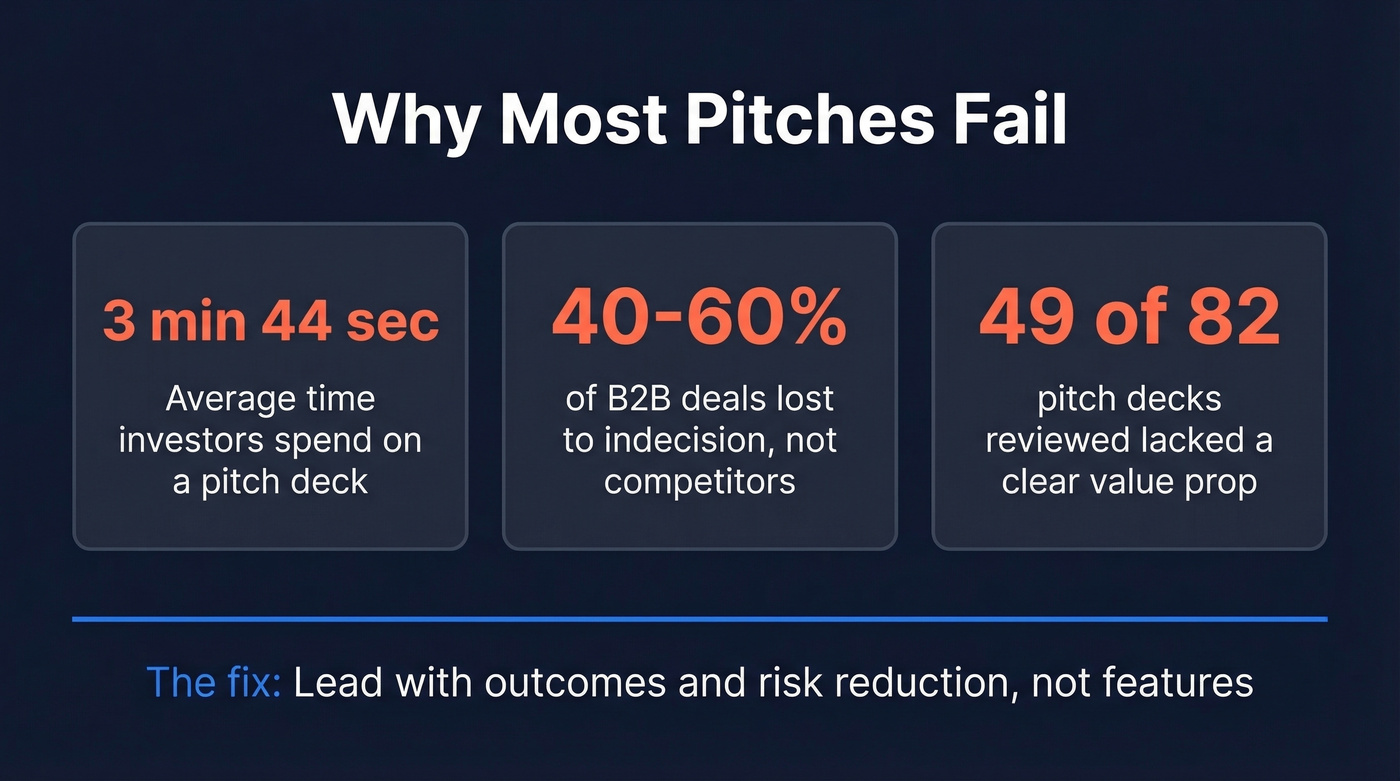
The reframe: stop pitching upside. Start reducing risk. Show the prospect that doing nothing is more dangerous than switching.
Product Pitch Examples by Channel
Elevator Pitch (21 + 60 Seconds)
The average NYC elevator ride is about 21 seconds. That's your constraint for the short version - and it doubles as a product selling speech you can use at conferences, networking events, or chance encounters.
21-second version: "We help mid-market HR teams cut hiring time from 60 days to 12 by automating reference checks and background screening. Our customers fill roles 3x faster than the industry average."
60-second version: "Most HR teams lose 3-4 weeks per hire on manual reference checks - phone tag, email chains, spreadsheets. We built an automated screening engine that completes full background checks in 48 hours. One customer went from 60-day average time-to-hire to 12 days. If your recruiters are spending more time chasing references than interviewing candidates, we should talk."
No product name. No feature list. Just problem, outcome, proof.
Cold Email Pitch (3 Frameworks)
Generic B2B cold emails average a 0.5% reply rate. Personalized campaigns hit 3.2%. The framework matters less than the specificity. Here's the same type of product pitched three ways.
If you want more patterns you can reuse, start with these email subject lines and build a simple B2B cold email sequence around the best performer.
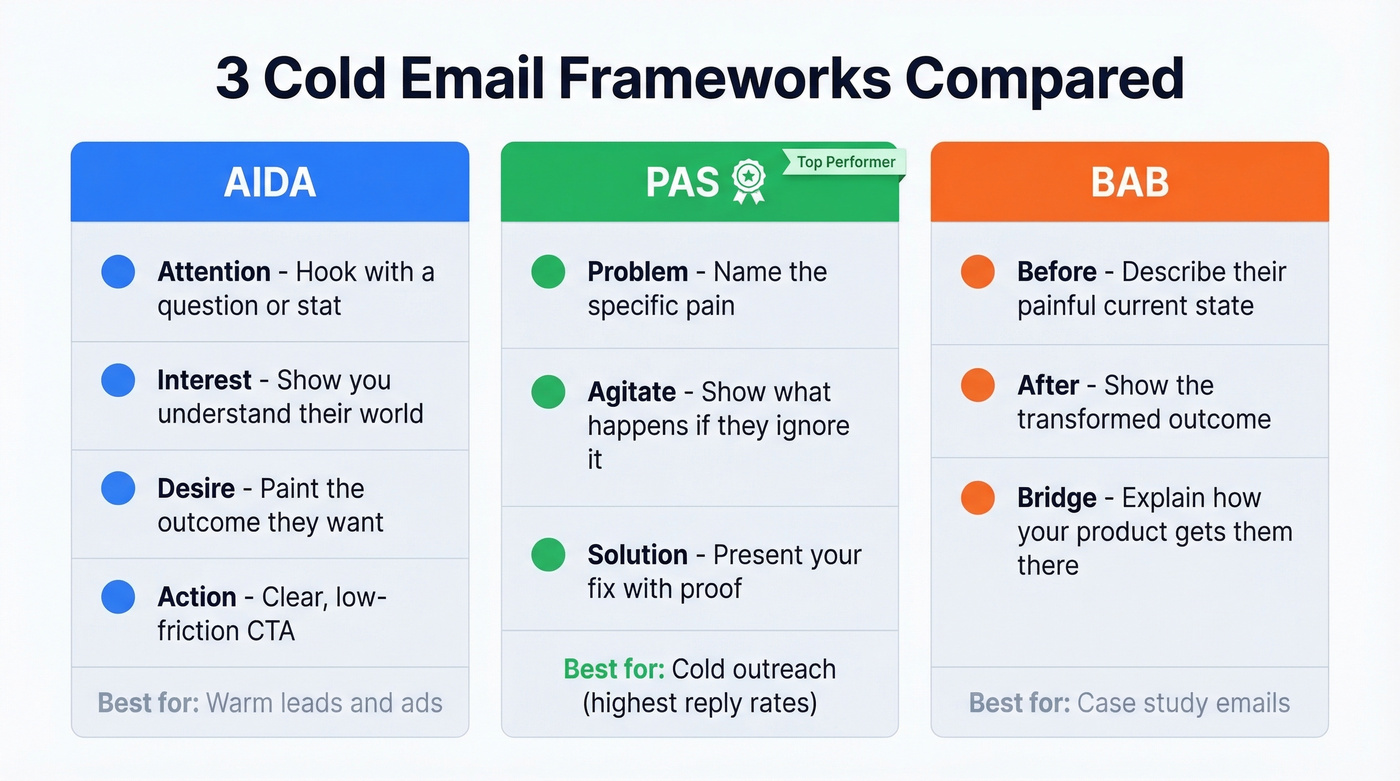
AIDA (Attention -> Interest -> Desire -> Action):
Subject: Your hiring pipeline has a bottleneck
Hi {{firstName}},
Quick question - how many days does it take your team to go from final interview to signed offer?
Most HR leaders we talk to say 45-60 days. That's not just slow - it's losing candidates to faster competitors.
Our automated screening platform cuts time-to-hire by 75%. One team went from 60-day cycles to 12 days.
Worth a 10-minute look? I can show you the workflow on your actual process - free.
PAS (Problem -> Agitate -> Solution):
Subject: 35% of your emails might be bouncing
Hi {{firstName}},
Bad contact data doesn't just waste rep time. It flags your domain with ESPs, which means even your good emails start landing in spam. The longer you send to unverified lists, the harder it gets to recover.
Prospeo runs a 5-step verification process that catches spam traps, honeypots, and catch-all domains before you hit send. 98% email accuracy, 7-day data refresh.
Can I verify a sample of your list for free? Takes 2 minutes.
BAB (Before -> After -> Bridge):
Subject: From 45 support tickets to 3
Hi {{firstName}},
Before: Your ops team spends 10 hours/week reconciling supply chain data across spreadsheets. Errors slip through. Shipments get delayed.
After: Every data point is validated automatically before it enters your system. Error rate drops from 12% to under 1%. Your team focuses on exceptions, not data entry.
Bridge: Our reconciliation engine processes 50,000 records/hour with 99.7% accuracy. One manufacturer cut supply chain errors by 94% in the first month.
Free pilot available - want me to run your data?
We've tested all three frameworks across hundreds of outbound campaigns. PAS consistently outperforms for cold outreach because it forces you to name the pain before offering the fix. If you learn one framework, make it PAS.
Cold Call Script (Before/After)
Here's a real cold call script from r/sales - a cybersecurity rep who described their pitch as "boring" and couldn't figure out why prospects kept hanging up:
If you're getting shut down early, fix your opener and objection handling with these cold call rejection scripts.
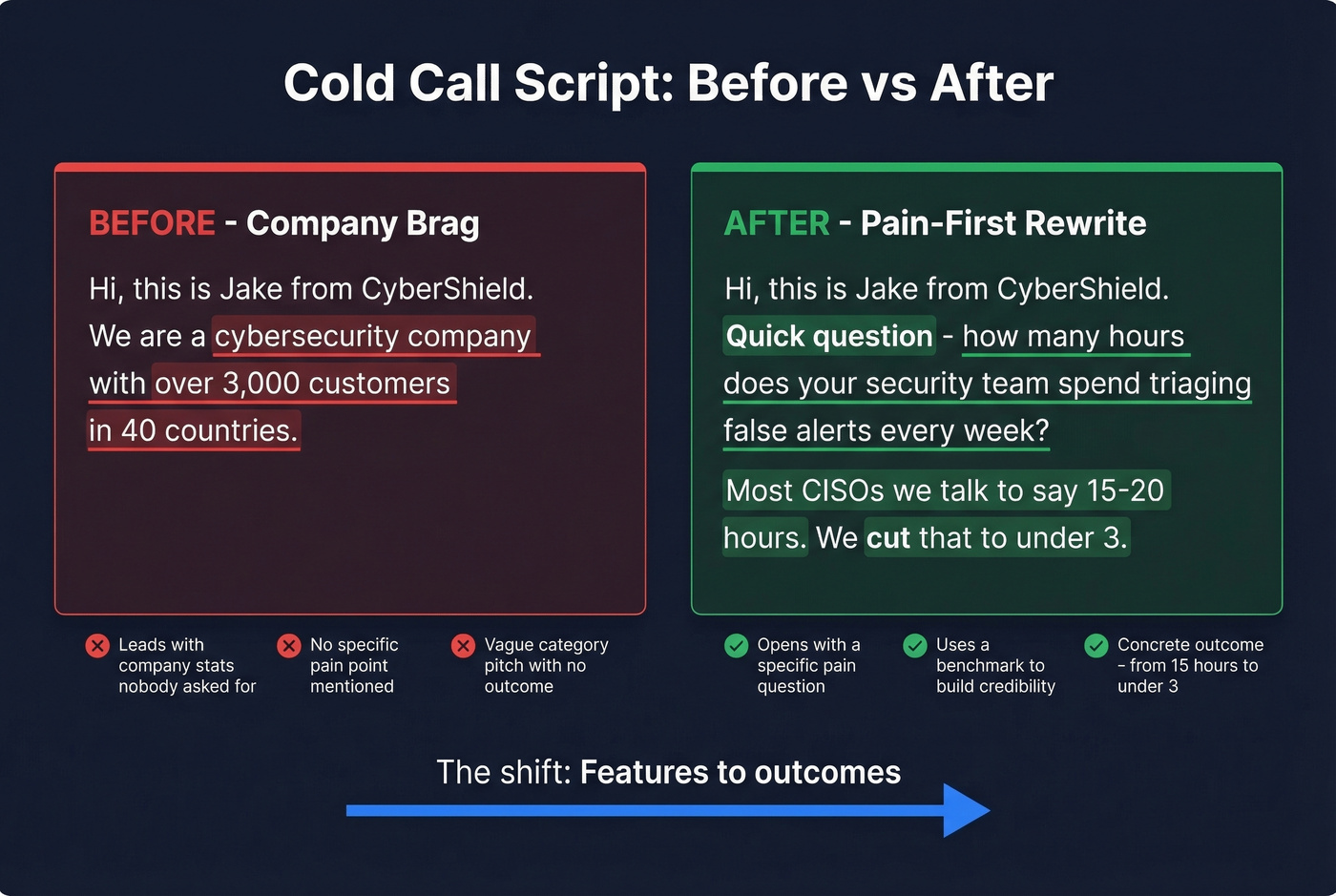
Before (original): "Hi, this is Jake from CyberShield. We're a cybersecurity company with over 3,000 customers in 40 countries. We help companies deal with the noise - too many tickets, too many alerts. With ransomware attacks up 800% in 2020, we wanted to see if you're evaluating your security stack."
After (rewrite): "Hi, this is Jake from CyberShield. Quick question - how many hours does your security team spend triaging false alerts every week? Most CISOs we talk to say 15-20 hours. We cut that to under 3 for companies like [similar company]. Worth a 10-minute conversation?"
The company brag ("3,000 customers in 40 countries") became a specific pain question. The vague category description became a concrete outcome. Aim for under two minutes on a cold call - you're earning the next conversation, not closing the deal.
Product Demo Opening
Most reps start demos with a 5-minute company overview. By the time they get to the product, the prospect has mentally checked out.
Demo opener script: "Thanks for joining. I know you've got 30 minutes, so let's skip the slides and go straight into the product. Based on our last conversation, you mentioned [specific pain point]. I'm going to show you exactly how we solve that in about 8 minutes, then we can dig into questions. Sound good?"
Let your product speak for itself. Always have a video backup - live demos break at the worst possible moment. (Use this product demo checklist to avoid the usual failure points.)
Pitch Deck (10-Slide Structure)
Guy Kawasaki's 10-20-30 rule still holds: 10 slides, 20 minutes max, 30-point minimum font. In practice, aim for 12 slides or fewer in an 8-minute window.
If you're building decks for late-stage buyers, borrow these sales deck storytelling patterns to keep it outcome-first.
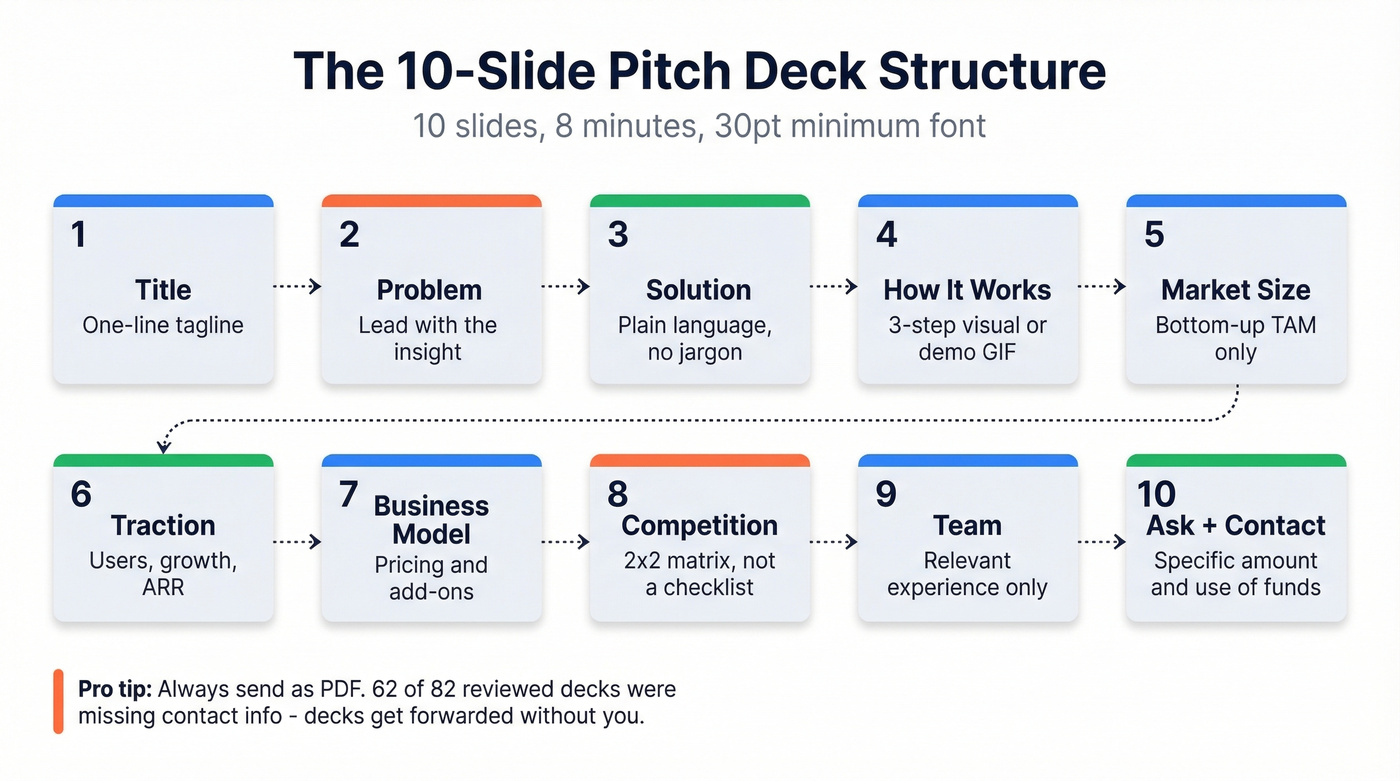
- Title - Company name + one-line tagline. "SaaSify: Eliminating manual errors in manufacturing supply chains."
- Problem - Lead with the insight. Example: "$50B+ lost annually to supply chain data errors."
- Solution - Plain language. No jargon, no buzzwords.
- How it works - 3-step visual. Screenshot or demo GIF.
- Market size - Bottom-up TAM. Don't say "we'll capture 1% of a $200B market."
- Traction - Contextualize: "5,000 users, 20% MoM growth, $1M ARR in 18 months."
- Business model - "$99/user/month + premium add-ons."
- Competition - 2x2 matrix. Never a feature checklist.
- Team - Relevant experience only.
- Ask + contact - Specific amount, specific use of funds. 62 out of 82 decks reviewed on r/Entrepreneur were missing contact info. Decks get forwarded. Make it easy.
Always send as PDF. Never Keynote. Avoid a live link that breaks mid-meeting.
Competitor Displacement Pitch
When your prospect already uses a competitor, don't compare features. Compare outcomes.
Subject: Cutting [Competitor] costs by 40%
Hi {{firstName}},
I noticed your team is using [Competitor]. Solid tool - but most teams we talk to are paying for modules they don't use and getting 15-20% bounce rates on the contact data.
We helped [similar company] cut their data costs by 40% while improving email deliverability from 82% to 97%. The migration took less than a day.
Open to a quick comparison? I can run a side-by-side on your actual data.
Acknowledge the competitor respectfully, then shift to an outcome gap they're probably already feeling. If you need a tighter process for this stage, map it to these steps to close a sale.

That PAS cold email template above? It only works if the email actually reaches the inbox. Bad data means bounces, domain flags, and wasted pitches. Prospeo's 5-step verification delivers 98% email accuracy with a 7-day refresh cycle - so your product pitch lands in front of real buyers, not dead addresses.
Stop crafting perfect pitches for email addresses that don't exist.
Pitch Frameworks Compared
| Framework | Structure | Best For | Example |
|---|---|---|---|
| AIDA | Attention -> Interest -> Desire -> Action | Cold emails, ads | "Know your bounce rate?" |
| PAS | Problem -> Agitate -> Solution | Cold emails, calls | "Bad data kills deliverability." |
| BAB | Before -> After -> Bridge | Case study emails | "Before: 35% bounce. After: under 4%." |
| SCR | Situation -> Complication -> Resolution | Presentations, decks | "500 emails/week. 150 bounce." |
SCR works best for live presentations where you can build narrative tension. It's the framework HubSpot's sales team recommends for in-person meetings because it mirrors how people naturally tell stories.
If you want a deeper breakdown of the funnel logic behind these frameworks, see the AIDA (Attention -> Interest -> Desire -> Action) model in full.
Common Pitch Mistakes (With Data)
A reviewer on r/Entrepreneur analyzed 82 pitch decks and the numbers are brutal:
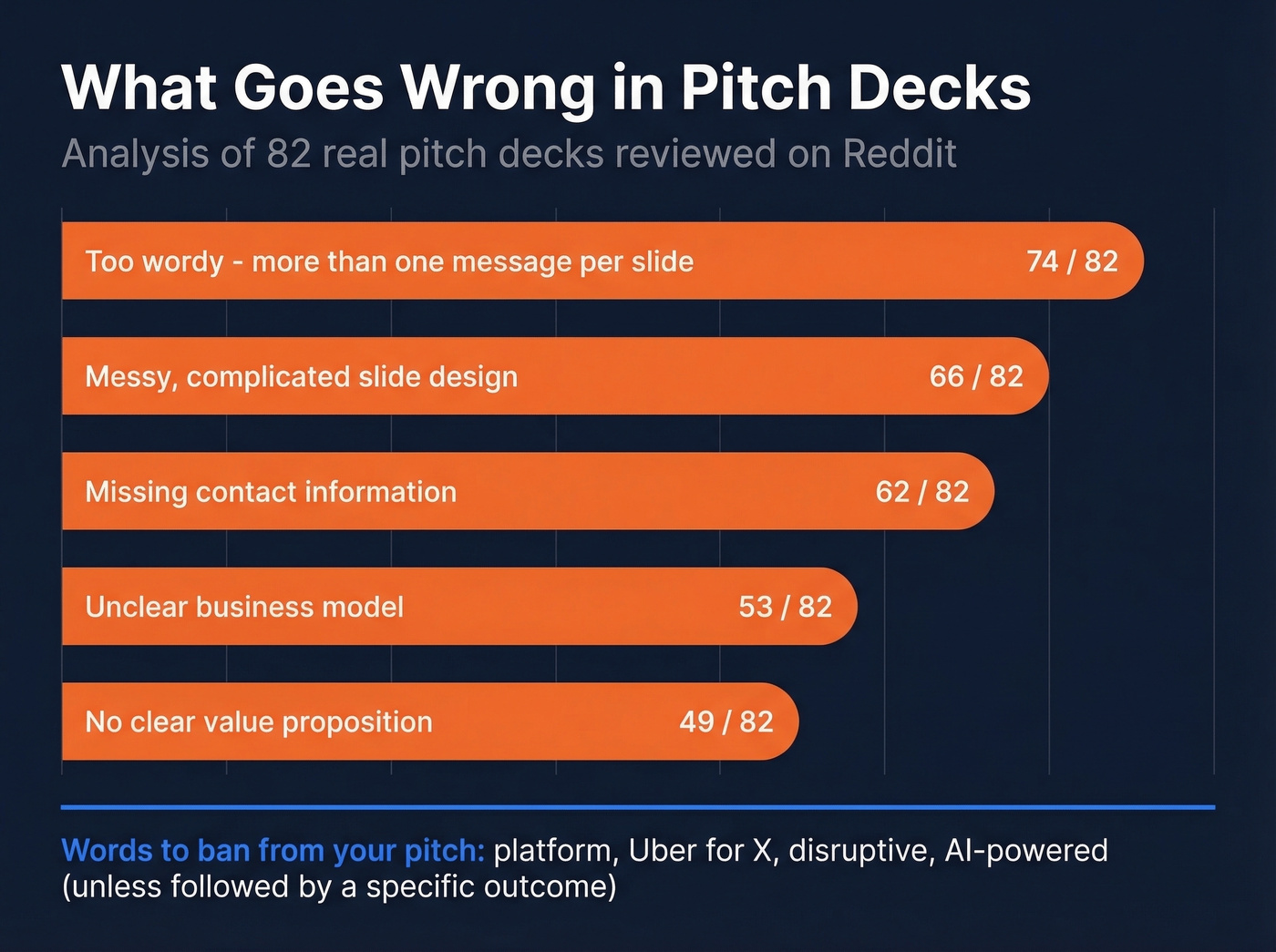
- 74 out of 82 were too wordy - one message per slide, period
- 62 out of 82 were missing contact info - your deck gets forwarded without you
- 66 out of 82 had messy, complicated slides
- 53 out of 82 had an unclear business model
- 49 out of 82 lacked a clear value prop - if you can't say it in one sentence, rewrite it
Words to ban from your pitch: "platform," "Uber for X," "disruptive," "AI-powered" (unless you immediately follow with a specific outcome). As one investor put it on Reddit: "Just tell me what the thing actually does."
In our experience reviewing hundreds of outbound campaigns and pitch decks, the #1 mistake isn't bad copy or ugly slides. It's pitching features instead of outcomes. "AI-powered matching algorithm" means nothing to a buyer. "Cuts hiring time from 60 days to 12" means everything. You'll likely need to deliver 50-200 pitches before closing a round, so make every one count.
Your Script Isn't the Problem
Here's the thing most sales content won't tell you: if your average deal size is under $10K, the ROI on perfecting your pitch script is near zero compared to fixing your targeting. You wrote the perfect PAS email, personalized the opening line, nailed the subject line. Then it bounced. Or it went to someone who left the company six months ago. Your domain reputation takes the hit, and next week's campaign performs worse.
This is why we built Prospeo with a 7-day data refresh cycle and 5-step verification that catches spam traps, honeypots, and catch-all domains before they torch your sender reputation. Before you obsess over the perfect pitch, verify the list. It takes two minutes and it's free to start.
If deliverability is the bottleneck, start with email deliverability fundamentals and track your email bounce rate by campaign.

A great cold call script is useless without a direct dial. Prospeo gives you 125M+ verified mobile numbers with a 30% pickup rate - 3x higher than ZoomInfo or Apollo. Pair these product pitch frameworks with contacts that actually pick up the phone.
Reach decision-makers directly at $0.01 per verified email.
Pre-Send Checklist
Run through this before you send or present anything:
- Problem stated in the first 30 seconds (or first two sentences)?
- Outcomes over features throughout?
- One message per slide (decks only)?
- Contact info included on the deck?
- Prospect data verified and up to date?
- CTA is specific and low-friction?
- No buzzwords ("platform," "disruptive")?
- Demo backup video ready (live presentations)?
- Traction metrics contextualized (growth rate, not just user count)?
- Sent as PDF, not Keynote or live link?
Skip this checklist at your own risk. We've seen teams spend weeks on a pitch deck only to send it from a domain that's already flagged.
FAQ
How long should a product pitch be?
Elevator pitch: 21-60 seconds. Cold email: under 125 words. Pitch deck: 10 slides in an 8-minute window. Cold call: under two minutes. Investors spend 3 minutes 44 seconds on average reviewing a deck - buyers spend less. Every extra slide or sentence works against you.
What's the difference between a product pitch and a sales pitch?
A product pitch proves the product solves a specific problem worth paying for - it sparks interest early in the relationship. A sales pitch closes the deal with pricing, ROI calculations, and contract terms. Mixing the two is one of the most common mistakes we see: a sales-heavy deck shown too early feels transactional, while a vague pitch deck used too late leaves buyers without the specifics they need to sign.
How do you pitch a product with no traction?
Lead with beta users, pre-orders, letters of intent, or pilot results. Contextualize small numbers: "200 users, 23% MoM growth, $47 ARPU" beats "200 users" every time. If you've got a working product, open with a live demo and let the results speak for themselves.
What makes a good product pitch example?
A strong example names a specific problem, quantifies the outcome, and includes a low-friction next step. Strip out every sentence that describes what the product is and replace it with what the product does for the buyer. If your pitch works with any competitor's name swapped in, it's not specific enough.
How do I make sure my pitch emails actually get delivered?
Use a verification tool before every send. A 35% bounce rate will wreck your domain reputation faster than any bad subject line. Free tiers from most email verification providers let you test a sample list before committing - there's no excuse for sending blind in 2026.