

Professional Email Closings That Actually Get Replies
You've spent 20 minutes crafting the perfect email. Then you stare at the cursor for another three minutes agonizing over whether to write "Best" or "Best regards." Meanwhile, the part of your email that actually drives replies - the sentence before the sign-off - gets zero thought.
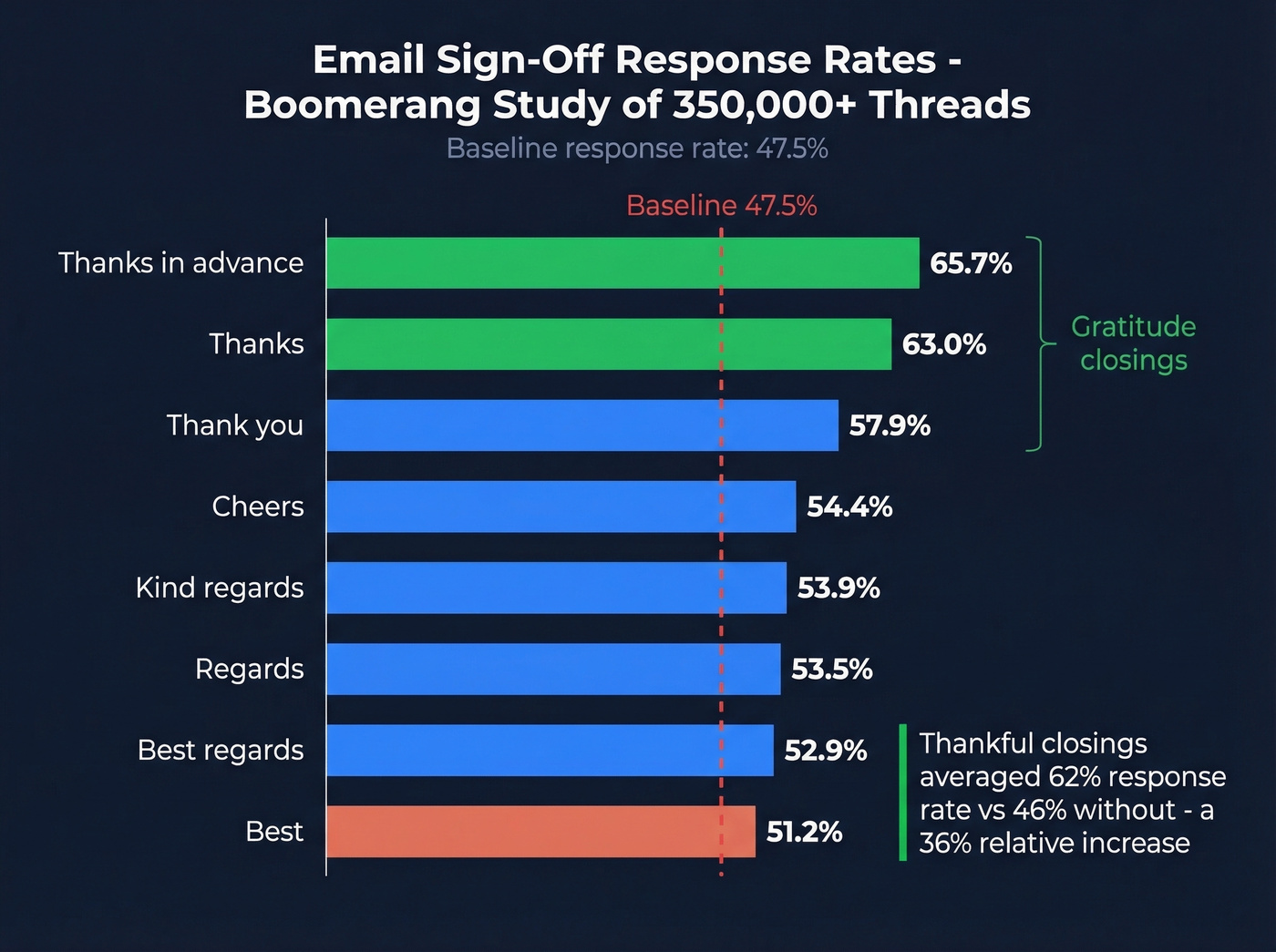
A Boomerang study of 350,000+ email threads found that "thanks in advance" pulls a 65.7% response rate against a 47.5% baseline. That's a 38% lift from two words. Your professional email closing isn't a formality. It's a performance lever.
The Short Version
- Safest all-purpose closing: "Best regards" - one of the safest professional defaults in most contexts.
- Highest-performing closing: "Thanks in advance" - 65.7% response rate in a 350K-thread study.
- The real lever: Your closing phrase (the CTA sentence before the sign-off) matters more than the sign-off word itself.
That last point is what most guides miss entirely.
The 3-Part Email Ending
Your email ending has three distinct parts, and each one does a different job:
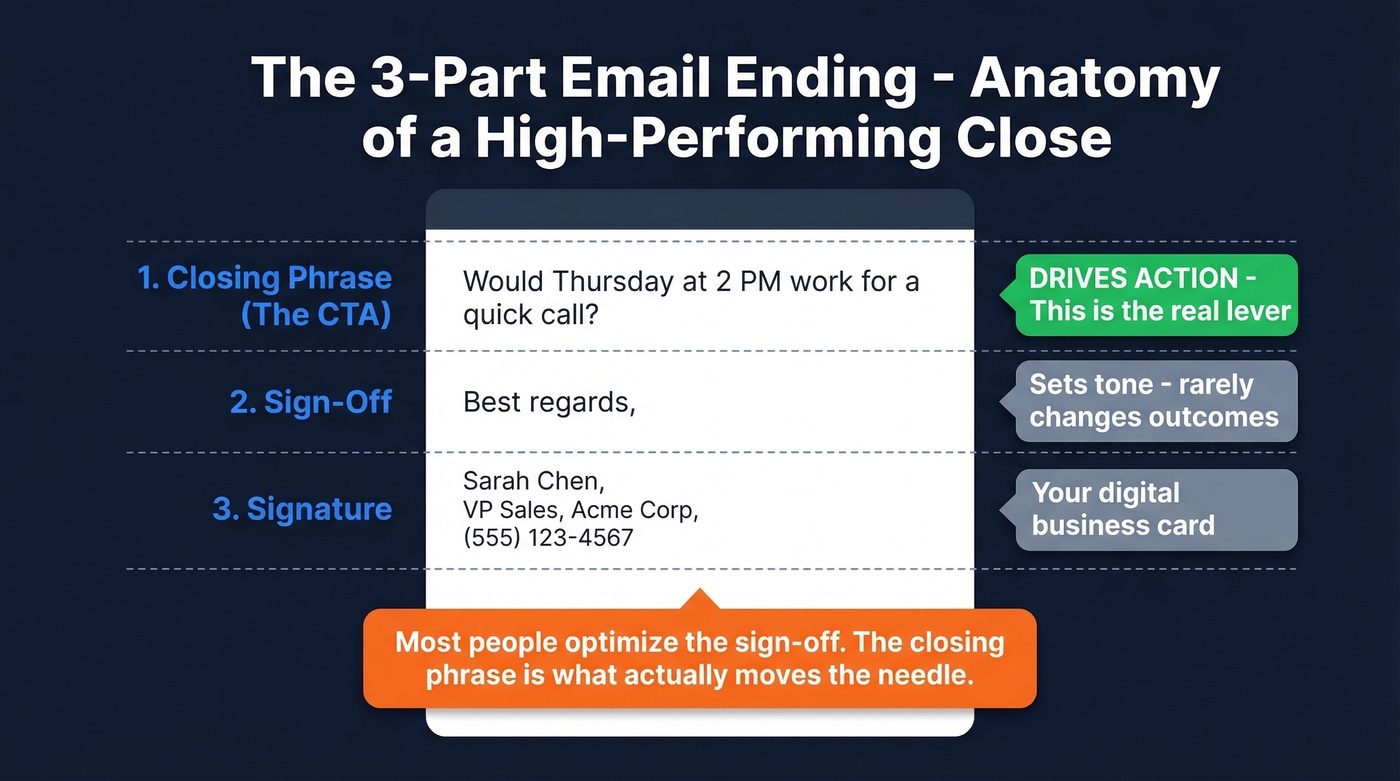
- Closing phrase - the CTA sentence that tells the reader what to do next. "Would Thursday at 2 PM work for a quick call?" This drives action. (If you want more examples, see email CTA patterns that convert.)
- Sign-off - the farewell word. "Best regards," "Thanks," "Cheers." Sets tone but rarely changes outcomes.
- Signature - your contact block. Name, title, phone, company.
Most people optimize the wrong part. They agonize over "Best" vs. "Best regards" while writing a closing phrase that's either missing entirely or so vague it gives the reader nothing to respond to - no question, no next step, no reason to hit reply. Your closing phrase is the most important component. The sign-off is just punctuation.
What the Data Says About Sign-Offs
The Boomerang study is one of the largest public analyses of email sign-off performance. They analyzed 350,000+ threads from mailing list archives across 20+ online communities using regex to extract closings, then measured response rates for every sign-off that appeared at least 1,000 times.
If you're building a repeatable system around this, it helps to treat the closing as part of your broader email copywriting process, not an afterthought.
| Sign-Off | Response Rate |
|---|---|
| Thanks in advance | 65.7% |
| Thanks | 63.0% |
| Thank you | 57.9% |
| Cheers | 54.4% |
| Kind regards | 53.9% |
| Regards | 53.5% |
| Best regards | 52.9% |
| Best | 51.2% |
The pattern is clear. Emails with any "thankful" closing averaged a 62% response rate versus 46% without one - a 36% relative increase just from expressing gratitude.
Here's the contrarian take: Grammarly and several style guides warn that "thanks in advance" is presumptuous. The data says it gets 38% more replies than the baseline. We'll go with the data. People respond to gratitude, even preemptive gratitude, because it creates a subtle social obligation. Is it a little manipulative? Maybe. Does it work? Absolutely.
And "Best" - the sign-off half the professional world defaults to - is the lowest-performing popular closing in the dataset at 51.2%. A Reddit poster in r/ExecutiveAssistants said they intentionally avoid "Best" and default to "thanks" instead. The numbers back that instinct.
Best Closings by Situation
Job Applications
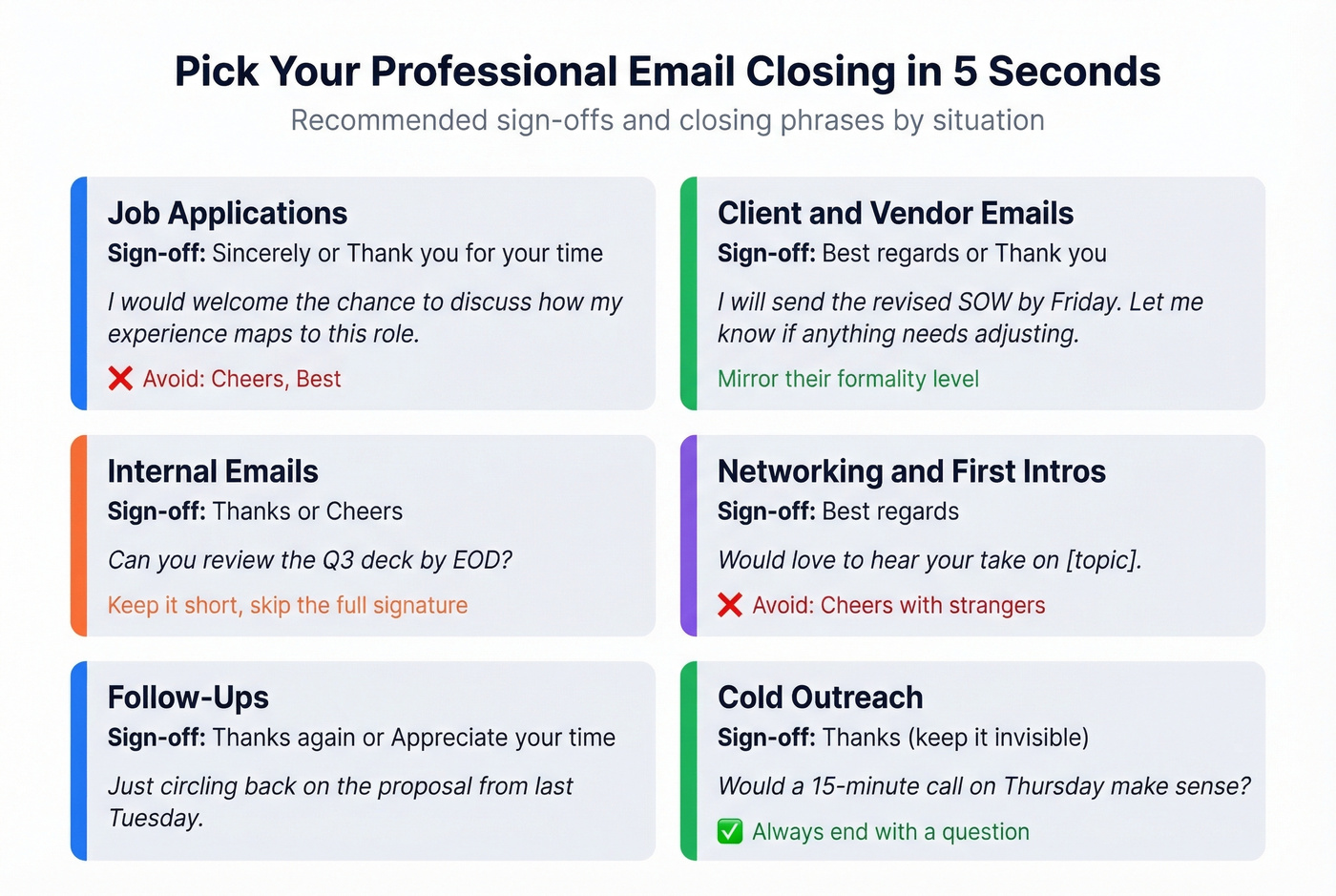
Use "Sincerely" or "Thank you for your time." Your closing phrase should restate interest without desperation: "I'd welcome the chance to discuss how my experience at [Company] maps to this role." Skip "Cheers" - hiring managers notice formality signals, and a casual sign-off on a cover email can quietly move you down the pile.
Client & Vendor Emails
"Best regards" or "Thank you." Clarify next steps: "I'll send the revised SOW by Friday. Let me know if anything needs adjusting." For long-standing relationships, match the formality they're using in their replies. The right closing for a business email depends on how established the relationship is - mirror your counterpart's tone.
Internal Emails
"Thanks" or "Cheers" if your office culture supports it. Nobody needs a three-line sign-off on a Slack-adjacent email about the Q3 deck.
"Best" is the khaki pants of email closings - not wrong, just the thing you default to when you haven't thought about it. The Boomerang dataset shows "Thanks" (63.0%) beat "Best" (51.2%) by about 12 percentage points, so the switch costs you nothing and gains you something.
Networking & First Introductions
Lead with a warm closing phrase: "Looking forward to connecting" or "Would love to hear your take on [topic]." Land on "Best regards." Avoid "Cheers" with someone you've never met - it can read as presumptuous familiarity.
Follow-Ups
"Thanks again" or "Appreciate your time." Gently restate the ask: "Just circling back on the proposal from last Tuesday - happy to jump on a quick call if that's easier." One clear ask, one grateful sign-off. That's it. If you need ready-to-send language, borrow from these sales follow-up templates.
Cold Outreach
End with a question, not a statement. "Would it make sense to chat for 15 minutes next week?" is a stronger closer than "Let me know if you're interested." Questions create a response loop. Statements let the reader nod and move on.
The sign-off itself? "Thanks" - keep it invisible. The question is doing all the work. (More frameworks in our AI cold email outreach playbook.)

A perfect closing phrase means nothing if your email bounces. Prospeo delivers 98% email accuracy with a 7-day refresh cycle, so your carefully crafted sign-off actually reaches the inbox. At $0.01 per email, bad data never wastes your best copy again.
Stop perfecting closings for emails that never arrive.
Sign-Offs to Avoid
Some closings actively hurt your credibility:
| Sign-Off | Why It Fails |
|---|---|
| Love, / xoxo | Too intimate for work |
| TTYL / TAFN | Reads as teenage texting |
| Later | Dismissive, signals low effort |
| Please do the needful | Cross-cultural misread; sounds odd outside South Asia |
| Sent from my iPhone | Signals you didn't care enough to edit |
The "please do the needful" example is instructive. It's a perfectly normal phrase in Indian English - polite, even. But an American or British recipient often reads it as oddly formal or associates it with scam emails. Cross-cultural closings trip people up more than any other part of the email.
How Closings Change by Country
A Korean-Australian study cited by the BBC found that 40% of Korean respondents perceived Australian emails as impolite, compared to just 28% the other way around. Email politeness isn't universal - it's cultural.
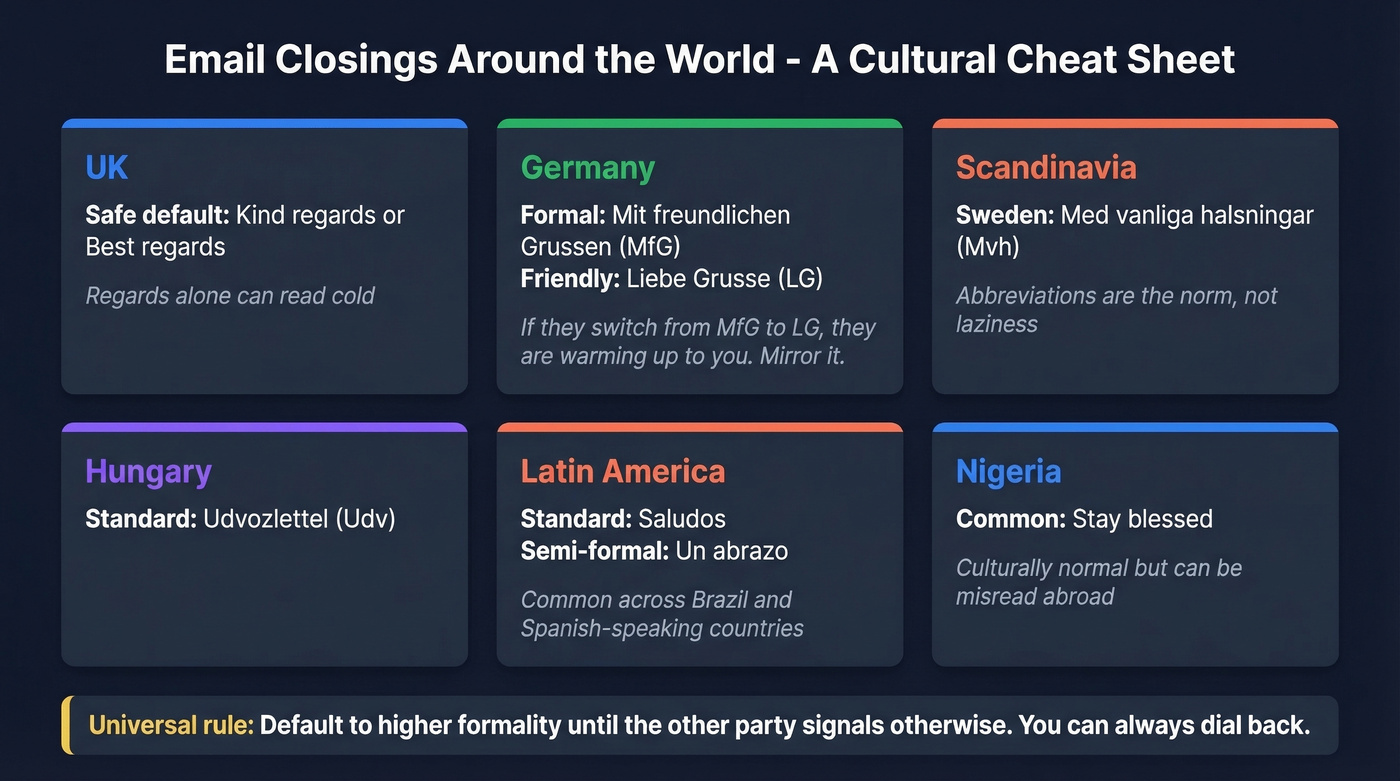
UK: "Kind regards" or "Best regards" is a safe default. "Regards" alone can read cold.
Scandinavia & Germany: Abbreviations dominate. Swedish emails close with "Med vanliga halsningar," typically abbreviated to "Mvh." German formal is "Mit freundlichen Grussen" or "MfG"; friendly is "Liebe Grusse" or "LG." If a German counterpart switches from "MfG" to "LG," that's them warming up to you. Mirror it.
Hungary: "Udvozlettel" (abbreviated "Udv") is the standard professional closing.
Latin America: "Saludos" is the standard "Regards" equivalent. "Un abrazo" is common in semi-formal contexts across Brazil and Spanish-speaking Latin America.
Nigeria: Religious closings like "Stay blessed" are culturally normal. The BBC reported a case where a Nigerian professional's closing - "I hope to read from you soon" - was misread by an American recipient as scam-like language, costing the sender a professional opportunity. The phrase was perfectly polite in Nigerian English.
The universal rule: default to higher formality until the other party signals otherwise. You can always dial back. Dialing up after a too-casual first impression is much harder.
Cold Email Closing Lines That Get Replies
Cold email is a different animal. Belkins analyzed 16.5 million cold emails across 93 industries from January through December 2024 and found the average reply rate dropped to 5.8% - down from 6.8% the year before. In that environment, every element of your email has to earn its keep. (For more benchmarks and mechanics, see our cold email marketing guide.)
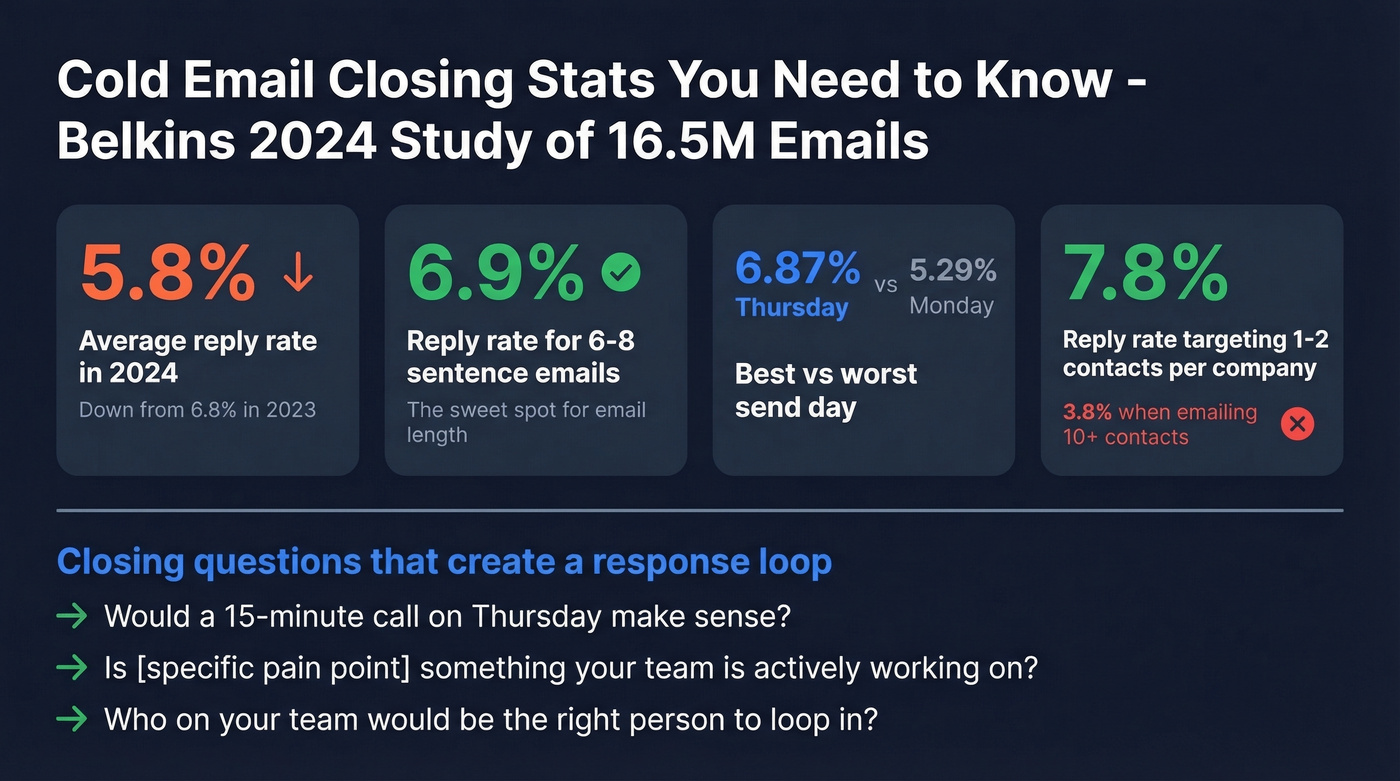
A few data points worth knowing: emails between 6 and 8 sentences hit a 6.9% reply rate, Thursday sends outperform Monday at 6.87% vs. 5.29%, and targeting 1-2 contacts per company yielded a 7.8% reply rate while emailing 10+ contacts at the same company dropped to 3.8%. Spray-and-pray doesn't just annoy people - it mathematically underperforms.
Let's be honest: if your average deal value is under $10K, you probably don't need a 12-touch sequence with custom video thumbnails. A tight 3-email sequence with a strong closing question will outperform most overengineered cadences. We've seen this pattern repeatedly in our own outbound - the teams that obsess over their closing question outperform the teams that obsess over sequence length.
For your closing specifically, end with a short, specific question:
- "Would a 15-minute call on Thursday make sense?"
- "Is [specific pain point] something your team's actively working on?"
- "Who on your team would be the right person to loop in?"
Each one gives the reader something concrete to respond to. A/B test your closings across campaigns - even small wording changes can shift reply rates by a few points.
Of course, none of this matters if your email bounces. The best closing in the world doesn't help if you're sending to dead addresses. Prospeo verifies emails in real time with 98% accuracy, and the free tier gives you 75 verifications per month with no credit card required. If you're troubleshooting deliverability end-to-end, start with an email deliverability guide.
Email Signature Best Practices
Your signature is your digital business card. Keep it clean, current, and compact.
HTML is the business standard, but plain-text recipients will see your carefully designed signature stripped of all formatting. Test both views. Mobile and dark mode matter just as much - if your signature looks great on desktop Chrome and broken on an iPhone in dark mode, half your recipients are seeing a mess.
Keep the signature shorter than the email body. Name, title, company, phone, one link. That's it. Skip the motivational quotes and oversized logos - they're distracting, not impressive. In ongoing threads, drop the full signature after your first email. Your first name or just the sign-off word is enough.
For enterprise senders: CASL, GDPR, and various national regulations require specific company details in commercial correspondence. If you're sending at scale, make sure your signature meets compliance requirements for every jurisdiction you're emailing into. (Related: how to manage email bounce rate and list hygiene.)
Cold outreach closings work when they reach real decision-makers. Prospeo's 300M+ verified profiles and 30+ search filters let you target the exact buyers who'll read your sign-off - and reply. Teams book 35% more meetings than Apollo users.
Write the perfect closing. Send it to the right person.
FAQ
What's the most professional email closing?
"Best regards" is the safest universal choice - appropriate across industries and contexts. For higher reply rates, "Thanks in advance" outperforms everything in the Boomerang dataset at 65.7% in a 350K-thread study. Use "Best regards" when you're unsure; use "Thanks in advance" when you're requesting something specific.
Is "Best" a good email sign-off?
It's not bad, but it's the lowest-performing popular closing in the Boomerang dataset at 51.2% - nearly 15 points below "Thanks in advance." "Thank you" or "Best regards" are stronger choices that take the same effort to type.
Should I use "Thanks in advance" in professional emails?
Yes. Despite some style guides calling it presumptuous, data shows it gets 38% more replies than the baseline. Use it when you're genuinely requesting something - it creates a subtle social obligation that prompts action.
How do I end a cold email?
End with a short, specific question - not a statement. "Would a 15-minute call Thursday work?" outperforms "Let me know if you're interested." Questions create a response loop. Pair with "Thanks" as the sign-off. Before sending, verify addresses with a tool like Prospeo so your carefully crafted closing actually reaches the inbox.
Do I need a sign-off in every email in a thread?
No. Include a full sign-off and signature in your first email. In ongoing threads, drop to just your first name or skip the sign-off entirely. Repeating your full signature in every reply clutters the thread and signals you're on autopilot.