

Prospect Definition: What It Really Means in Sales and Business
The word "prospect" has a dozen meanings - scenic views, geological surveys, baseball draft picks. But when your VP asks why 4,000 "prospects" produced 12 deals last quarter, only one definition matters.
The term comes from the Latin prospicere - "to look forward." By 1841, miners were using "prospecting" to describe searching for gold. The sense of "a person or thing considered promising" didn't appear until 1922, and even general dictionaries like Wiktionary now list "a potential client or customer" as a recognized meaning. That's the meaning every search result buries under three paragraphs about mountain vistas.
What Is a Prospect? (Quick Version)
A prospect is a qualified lead who matches your ideal customer profile and shows real buying intent. Not everyone in your CRM. Not everyone who downloaded your ebook. A prospect has been vetted - they fit what you sell, they have the authority and budget to buy, and they're showing signals that they will.
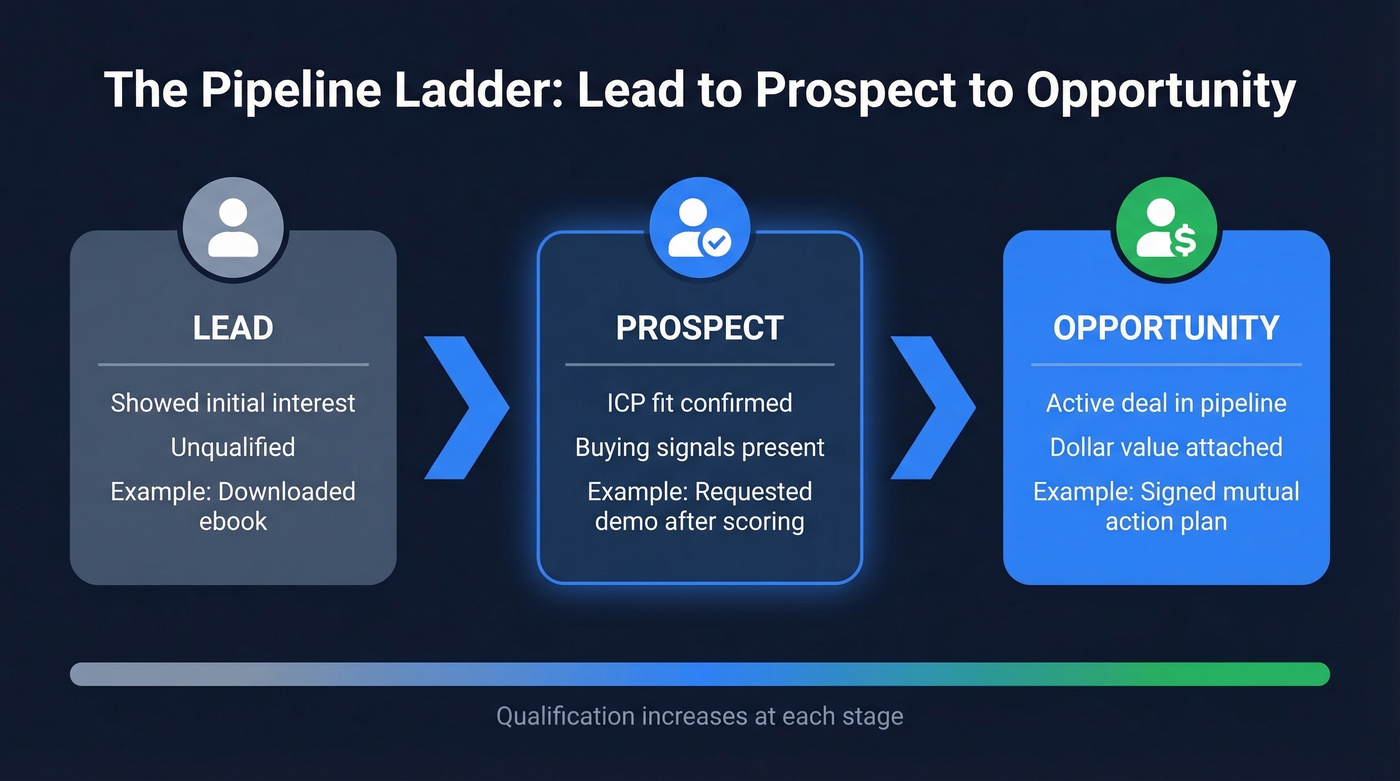
The pipeline ladder:
- Lead - Someone who's shown initial interest through a form fill, content download, or event signup. Unqualified.
- Prospect - A lead you've qualified: ICP fit confirmed, buying signals present, worth direct sales attention.
- Opportunity - A prospect with a deal in motion: dollar value attached, close date projected, next steps agreed.
Prospect Definition in Sales
The sales meaning of "prospect" isn't complicated, but teams butcher it constantly. A new SDR gets handed 10,000 contacts on day three and told to "go prospect." No criteria. No qualification gates. Just a list and a quota. On r/sales, this debate surfaces monthly - teams genuinely can't agree on when a lead becomes a prospect.
Salesforce's framework draws the line clearly: a lead has expressed interest, while a prospect has been qualified against your ICP. A lead is anyone who's entered your orbit. A prospect is a lead you've actively vetted - they match your target market, have budget and authority, and show buying intent. An opportunity is a prospect who's entered a formal sales process with a dollar value and timeline attached.
Adobe's framework adds useful nuance. Qualification happens at three levels: organization (does the company fit your market?), opportunity (do they actually need what you sell?), and stakeholder (are you talking to someone who can sign?). Most teams skip at least one of these levels. That's why their "prospect" counts are inflated and their close rates are terrible.
| Lead | Prospect | Opportunity | |
|---|---|---|---|
| Definition | Showed initial interest | Qualified: ICP fit + intent | Active deal in pipeline |
| Qualified? | No | Yes | Yes, with $ value |
| Example action | Downloaded ebook | Requested demo after scoring | Signed mutual action plan |
| CRM stage | Marketing Qualified | Sales Accepted | Pipeline (Stage 1+) |
How a Lead Becomes a Prospect
This is where pipeline hygiene lives or dies. The Fit-Interest-Intent checklist from TOPO's research is the simplest framework we've seen for gating leads into qualified status:
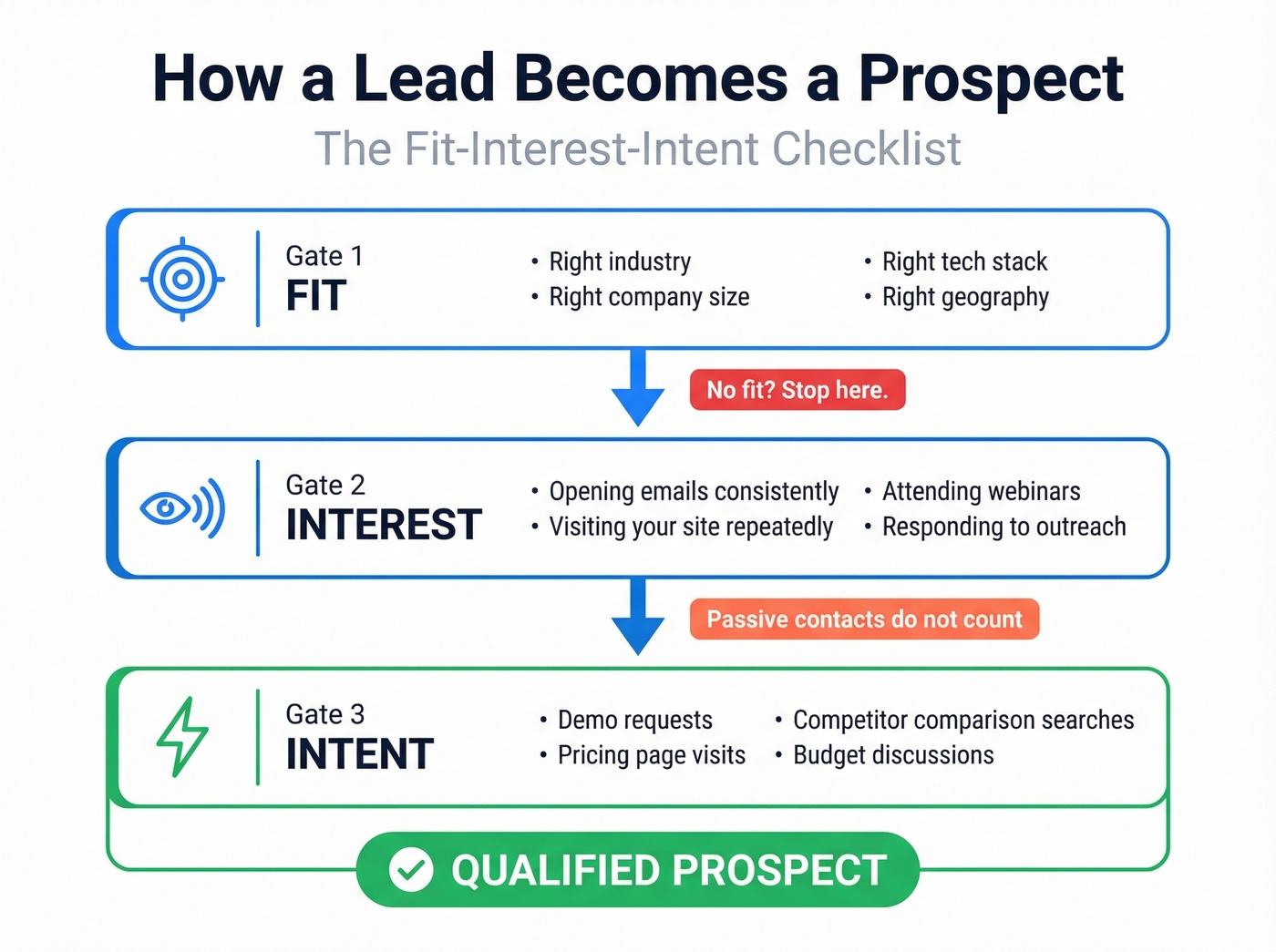
- Fit - Does this person's company match your ICP? Right industry, right size, right tech stack, right geography. If the answer is no, stop here.
- Interest - Are they actively engaging? Opening emails, visiting your site repeatedly, attending your webinar, responding to outreach. Passive list members don't count.
- Intent - Are they showing buying signals? Demo requests, pricing page visits, competitor comparison searches, budget discussions. Interest without intent is just curiosity.
BANT Still Works
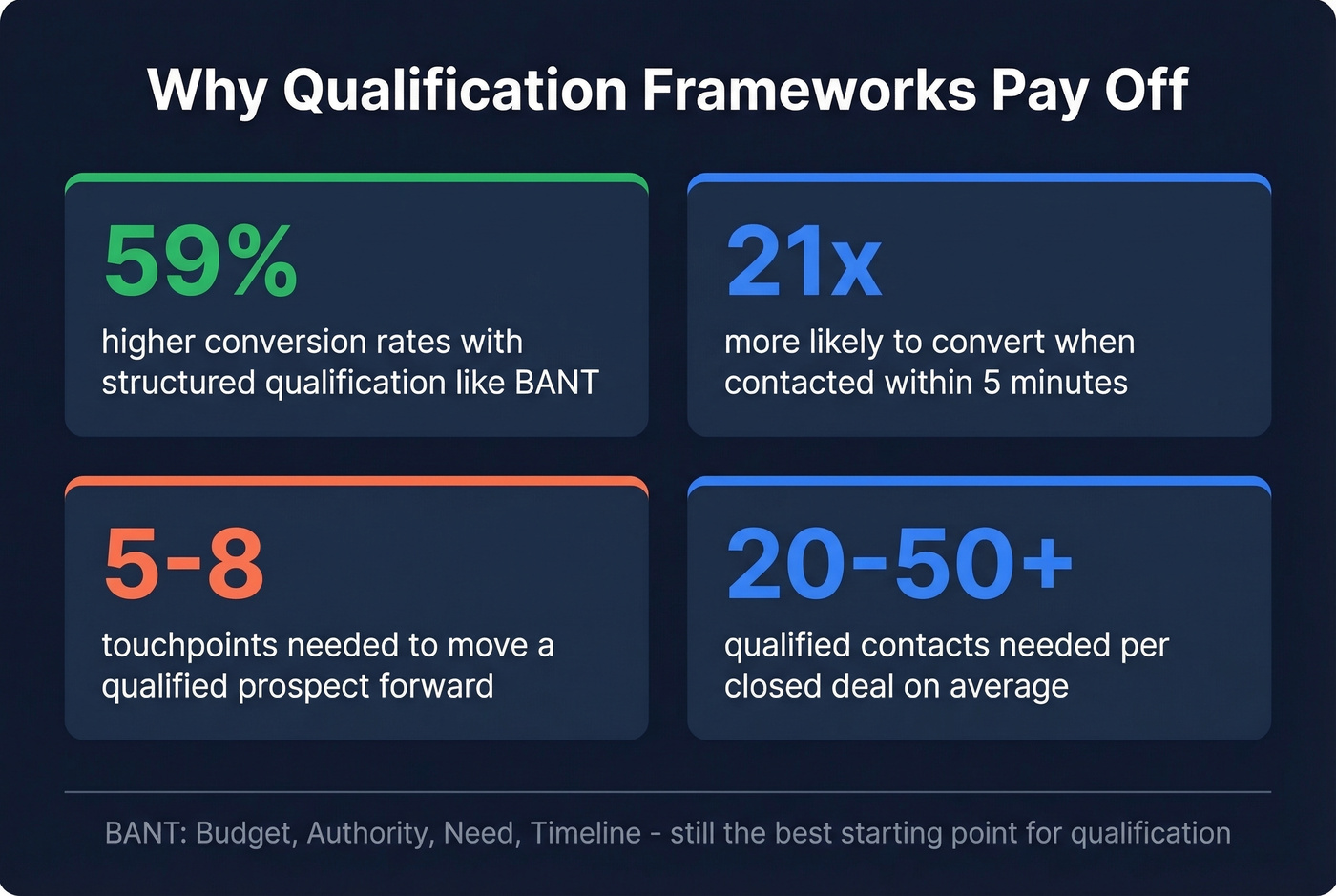
IBM built the BANT framework decades ago, and despite years of people trying to replace it, BANT remains the best starting point for qualification. Budget, Authority, Need, Timeline - four questions that separate real prospects from friendly time-wasters.
The modern version layers in behavioral signals. Budget intent doesn't just mean someone told you their number - it means they're visiting your pricing page repeatedly, downloading ROI calculators, or requesting quotes. Authority means mapping the buying committee: economic buyer, technical evaluator, end users, and influencers. In B2B, you're rarely selling to one person. Six to ten stakeholders is common, and if you're only talking to one of them, you don't have a prospect - you have a fan.
The numbers back this up. Teams that implement BANT-style qualification see conversion rate increases up to 59%. Speed matters too - contacting a lead within five minutes makes them 21x more likely to convert. Every hour you wait, the buyer cools. And in B2B, expect 5-8 touchpoints to move a qualified prospect forward. You also need volume: roughly 20-50+ qualified contacts per closed deal depending on your deal size and sales cycle length. That ratio alone should tell you why qualification gates matter so much.
The Prospect-to-Opportunity Gate
A prospect becomes an opportunity when four things are true: you've confirmed the problem, identified a champion inside the account, know the budget and timeline, and have a meeting scheduled. If any of those are missing, it's still a prospect. Don't inflate your pipeline by promoting it early.

Qualification frameworks only work when your data is real. Prospeo gives you 30+ filters - buyer intent, technographics, funding, headcount growth - so every contact you promote from lead to prospect actually fits your ICP. 98% email accuracy means your outreach lands.
Qualify prospects with real data, not guesswork.
What Is Sales Prospecting?
Sales prospecting used to be list-based and heavy on blind dialing. That model isn't enough anymore. 96% of prospects research companies before engaging with a rep, and 71% prefer doing that research independently. By the time someone talks to your SDR, they've already formed opinions.
Modern prospecting is the intelligence layer before outreach. It has four pillars: signal detection (who's showing buying behavior right now?), dynamic lead prioritization (which accounts should reps focus on today?), buying committee mapping (who are the six to ten people involved in this decision?), and just-in-time data enrichment - sometimes called data waterfalling - where you verify and layer contact info at the moment of outreach, not months in advance.
Look, most reps aren't doing any of this at scale. 66.7% of sales reps reach out to 250 prospects or fewer per year. That's roughly one new contact per business day. And 25% of sales pros say simply getting direct access to decision-makers is their top challenge. The bottleneck isn't effort - it's data.
Not all buying signals carry equal weight, either. Hard signals - new funding rounds, executive hires, M&A activity - indicate active buying. Soft signals - content engagement spikes, job postings for relevant roles, event attendance - suggest emerging need. The best prospecting workflows score both types and prioritize accordingly.
If you want a deeper playbook, see our sales prospecting techniques guide.
How to Find and Verify Prospects
Understanding what a prospect means is only half the equation - you also need to actually reach them. Here's the workflow that works:
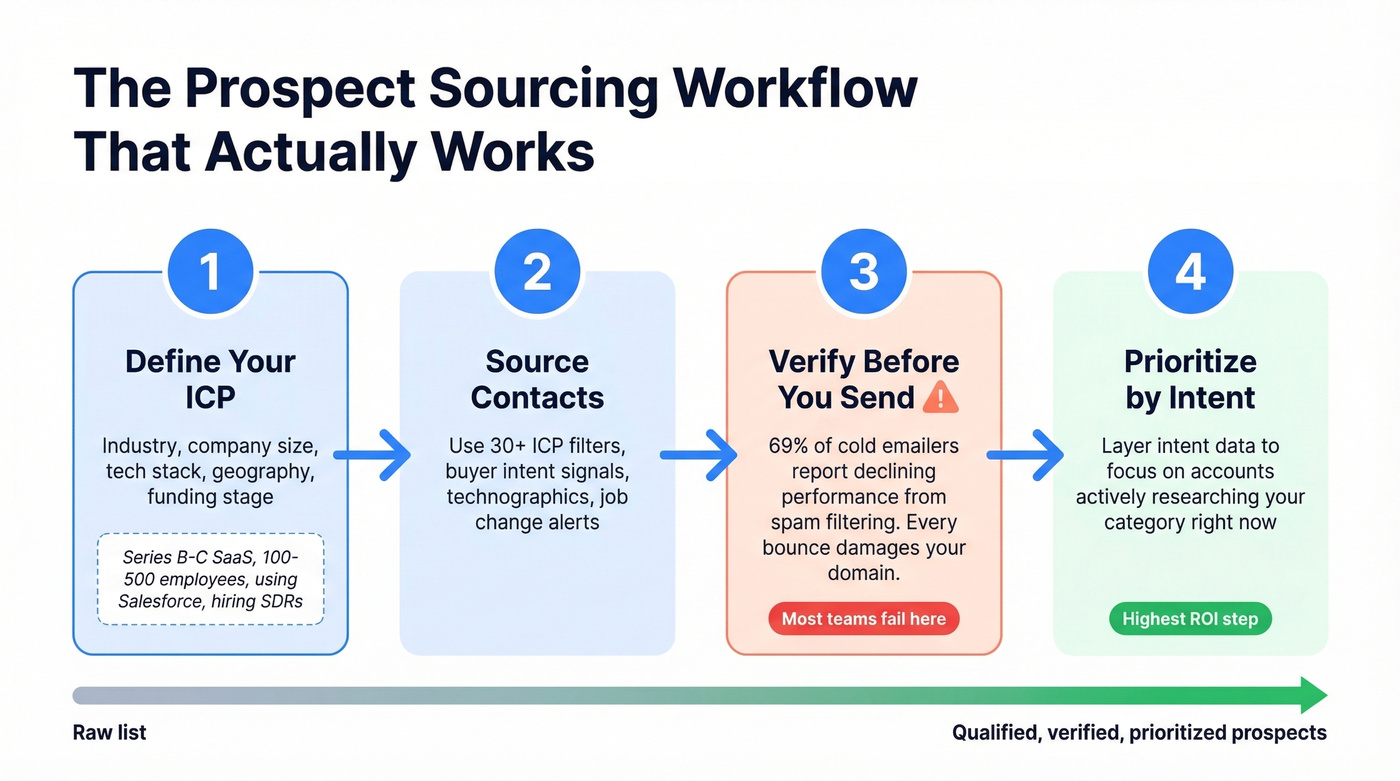
Step 1: Define your ICP. Industry, company size, tech stack, geography, funding stage. Be specific. "Mid-market SaaS companies" isn't an ICP - "Series B-C SaaS companies with 100-500 employees using Salesforce and hiring SDRs" is.
Step 2: Source contacts. Use a sales prospecting database with filters that match your ICP criteria. You need more than name and title - you need buyer intent signals, technographic data, and job change alerts. This is how you move from a generic contact list to a pool of potential prospects worth pursuing.
Step 3: Verify before you send. This step is where most teams bleed. 69% of cold email senders report declining performance due to spam filtering. Bad data accelerates that problem. Every bounced email damages your domain reputation, and domain reputation is brutally hard to rebuild (see our email deliverability guide).
Step 4: Prioritize by intent. Not every verified contact deserves outreach today. Layer in intent data to focus on accounts actively researching your category (more on identifying buying signals).
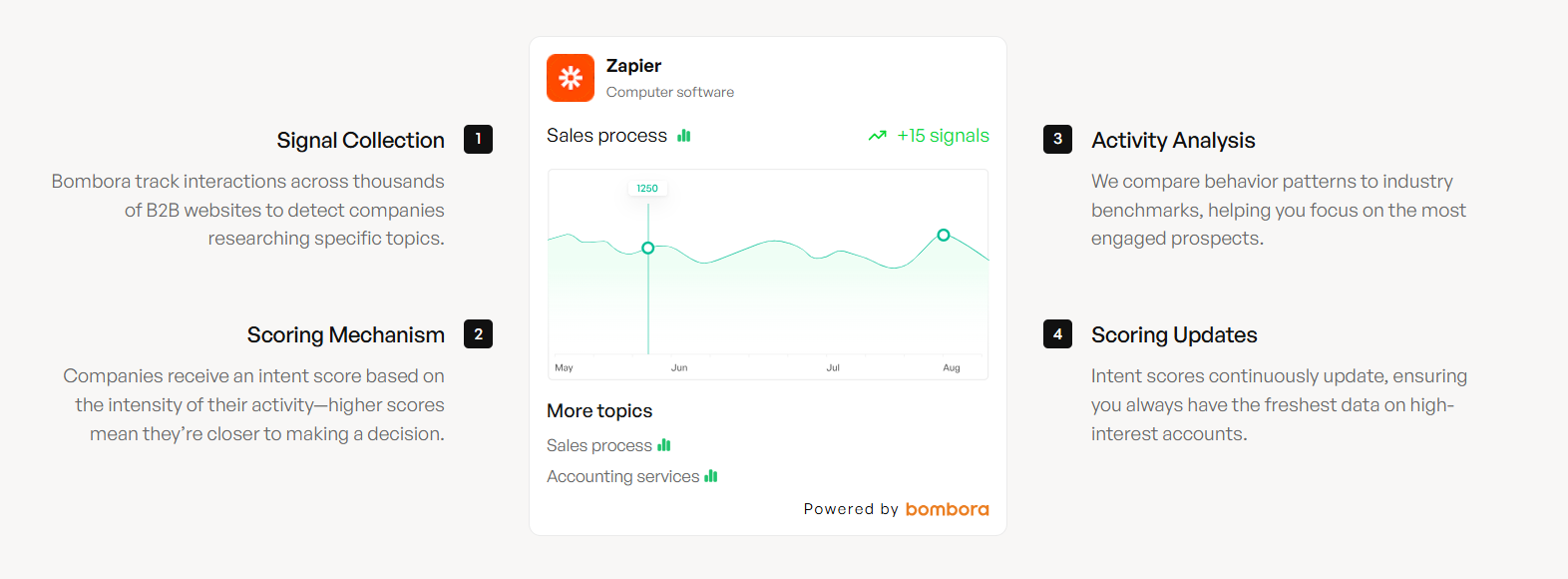
We've tested this workflow extensively with Prospeo, which covers sourcing, verification, and intent-based prioritization in one platform. The database spans 300M+ professional profiles with 30+ search filters, including buyer intent powered by Bombora across 15,000 topics, technographics, job changes, headcount growth, and funding signals. Every email runs through a 5-step verification process with catch-all handling, spam-trap removal, and honeypot filtering - delivering 98% email accuracy on a 7-day refresh cycle, compared to the 6-week industry average.

The results speak for themselves. Meritt went from a 35% bounce rate to under 4% after switching, and their pipeline tripled from $100K to $300K per week.
You need 20-50+ qualified contacts per closed deal, and 25% of reps say reaching decision-makers is their top challenge. Prospeo's database maps buying committees with verified emails and 125M+ direct dials - so your BANT-qualified prospects actually pick up the phone.
Turn your prospect definition into a pipeline that closes.
Prospect Definition FAQ
What's the difference between a lead and a prospect?
A lead is anyone who's shown initial interest - downloaded a resource, filled out a form, visited your site. A prospect is a lead you've qualified: they match your ICP, have budget and authority, and show real buying intent. Treating unqualified leads as prospects inflates your pipeline and wastes rep time.
What does prospecting mean in sales?
Sales prospecting is the process of identifying, researching, and reaching out to potential customers who fit your ideal customer profile. In 2026, that means signal detection, buying committee mapping, and data verification - not just cold calling a purchased list.
How do you qualify a prospect?
Use the BANT framework: confirm Budget, Authority, Need, and Timeline. Or use the simpler Fit-Interest-Intent checklist - ICP match, active engagement, and buying signals like demo requests or pricing page visits. Teams using structured qualification see conversion rate increases up to 59%.
How do you find verified prospect contact data?
Use a B2B data platform that verifies emails and phone numbers before you send. Free tools with monthly caps work for small teams; platforms with 30+ ICP filters, intent data, and real-time verification scale for outbound at volume.
Why Your Prospect Definition Matters More Than Your Tools
Let's be honest: most teams don't have a prospecting problem. They have a definition problem. When marketing calls everything a "prospect," when SDRs promote leads to opportunities before confirming budget, when the CRM has three different meanings for the same word - that's when pipelines bloat and close rates collapse.
The cheapest fix in sales ops is getting your team to agree on what these words mean. Lead, prospect, opportunity - three stages, clear gates between them. Align on your prospect definition before you buy any tool, hire any rep, or launch any campaign. Everything downstream gets easier once the language is right.
If you're running shorter sales cycles with smaller deal sizes, you probably don't even need sophisticated tooling. You need a shared vocabulary and the discipline to enforce it (see lead status and sales pipeline challenges).