

How to Send a Prospect Email That Actually Gets Replies
You spent two hours crafting the perfect prospect email. You hit send on 200 contacts. Forty-seven bounced. The rest got ignored.
That's not a copywriting problem - it's a data and infrastructure problem. The average cold email reply rate sits at 3.43%, while top performers clear 10.7%+. The gap between those numbers isn't better templates. It's verified data, authenticated domains, and disciplined follow-up.
What You Actually Need
You don't need 55 templates - Outreach published that many. You need three good ones, verified data, and a warmed domain.
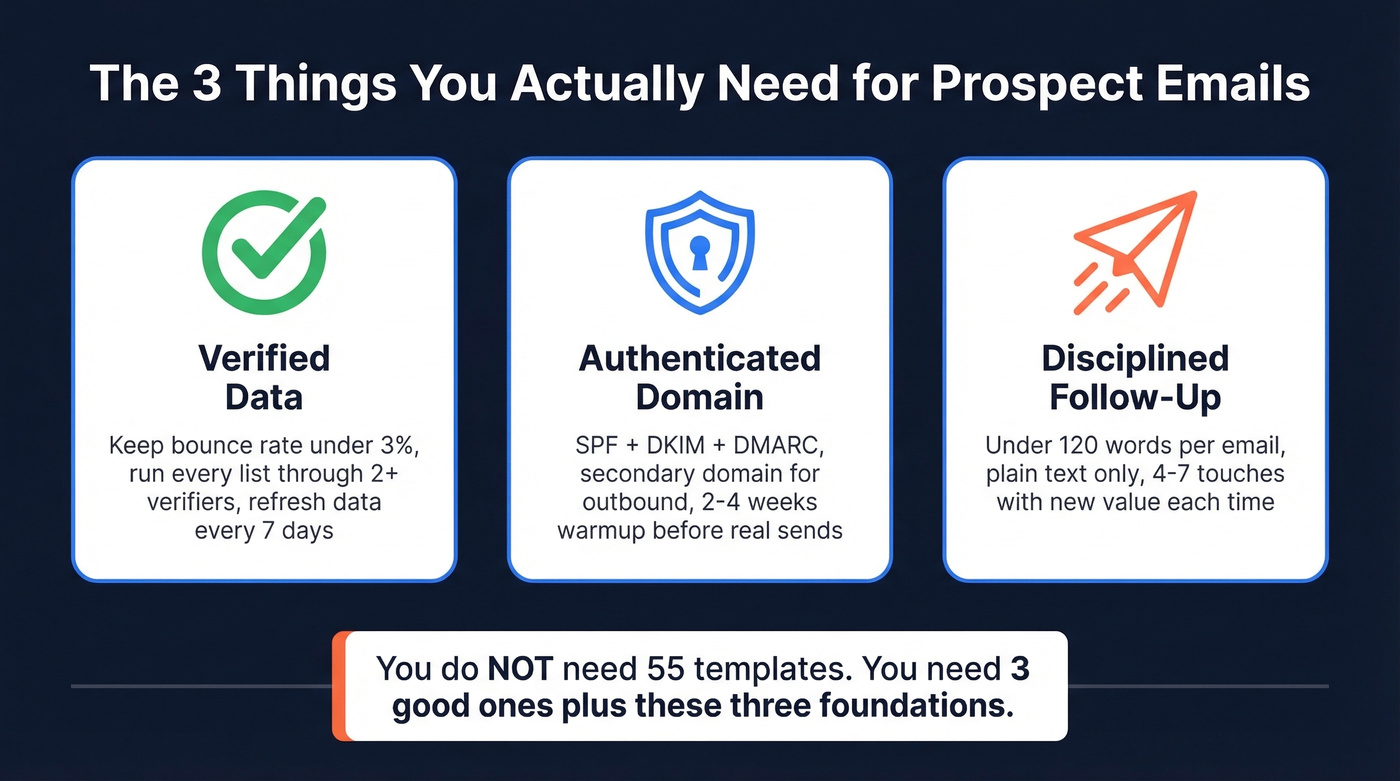
- Verify every email address before sending. A bounce rate above 3% damages your domain reputation, and that damage compounds fast. (If you want the deeper benchmarks and fixes, see our guide on bounce rate.)
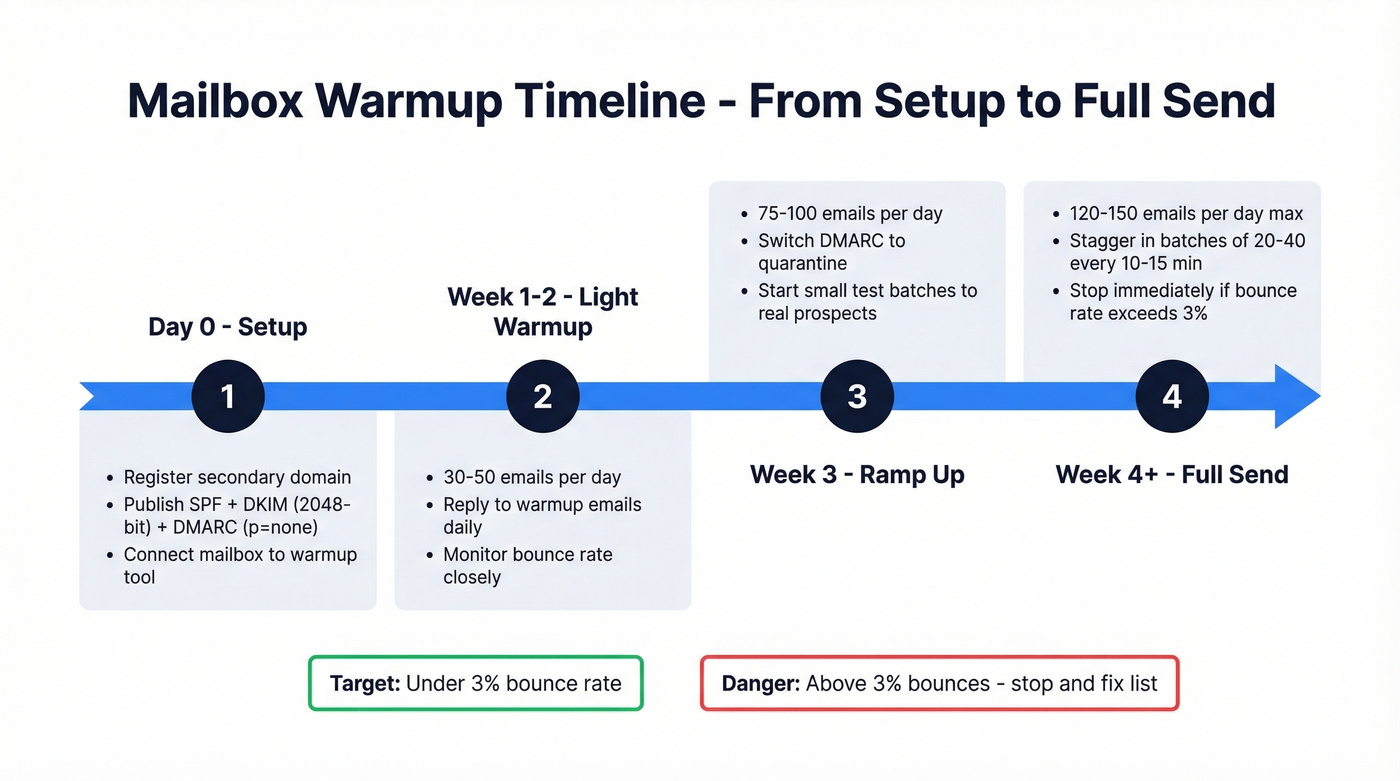
- Set up SPF, DKIM, and DMARC. Warm your mailbox for 2-4 weeks before sending real campaigns.
- Write short emails and follow up. Under 120 words, plain text, one ask. Then follow up 4-7 times with new value each touch (use these sales follow-up templates if you need a starting point).
Here's the thing: most guides jump straight to templates. That's backwards. Fix your data and infrastructure first, then the templates actually work.
Before You Write: Clean Your Data
Bad data is the silent killer of outbound. Every bounce tells inbox providers your sending habits are sloppy, and enough bounces means your future emails - even the good ones - route straight to spam. Keep bounce rates under 3% and spam complaints under 0.1% per mailbox.
Practitioners on r/salesdevelopment recommend running lists through two verifiers minimum. We've seen teams use Prospeo's 5-step verification process (covering catch-all domains, spam traps, and honeypots on a 7-day refresh cycle) to hold 94%+ deliverability with zero domain flags across all clients. Stack Optimize built to $1M ARR running exactly that workflow.

Infrastructure checklist before your first send:
- Use a secondary domain for outbound - never your primary domain (more on protecting deliverability in our email deliverability guide)
- Publish SPF, DKIM (2048-bit keys), and DMARC records (start at p=none, move to quarantine/reject after ~30 days)
- Warm each mailbox gradually: Week 1 at 30-50 emails/day, scaling to 120-150/day by Week 4 only if metrics stay clean (keep an eye on safe email velocity)
- Add one-click unsubscribe headers required for bulk senders
- Stagger sends in batches of 20-40 every 10-15 minutes to avoid minute-zero bursts
Writing Emails That Get Replies
An analysis of 85M+ cold emails found that subject lines of 1-4 words in all-lowercase outperform longer alternatives on open rates. Empty subject lines boost opens by 30% but reduce replies by 12% - a gimmick that costs you the metric that matters. (For more options, swipe from these cold email subject line examples.)
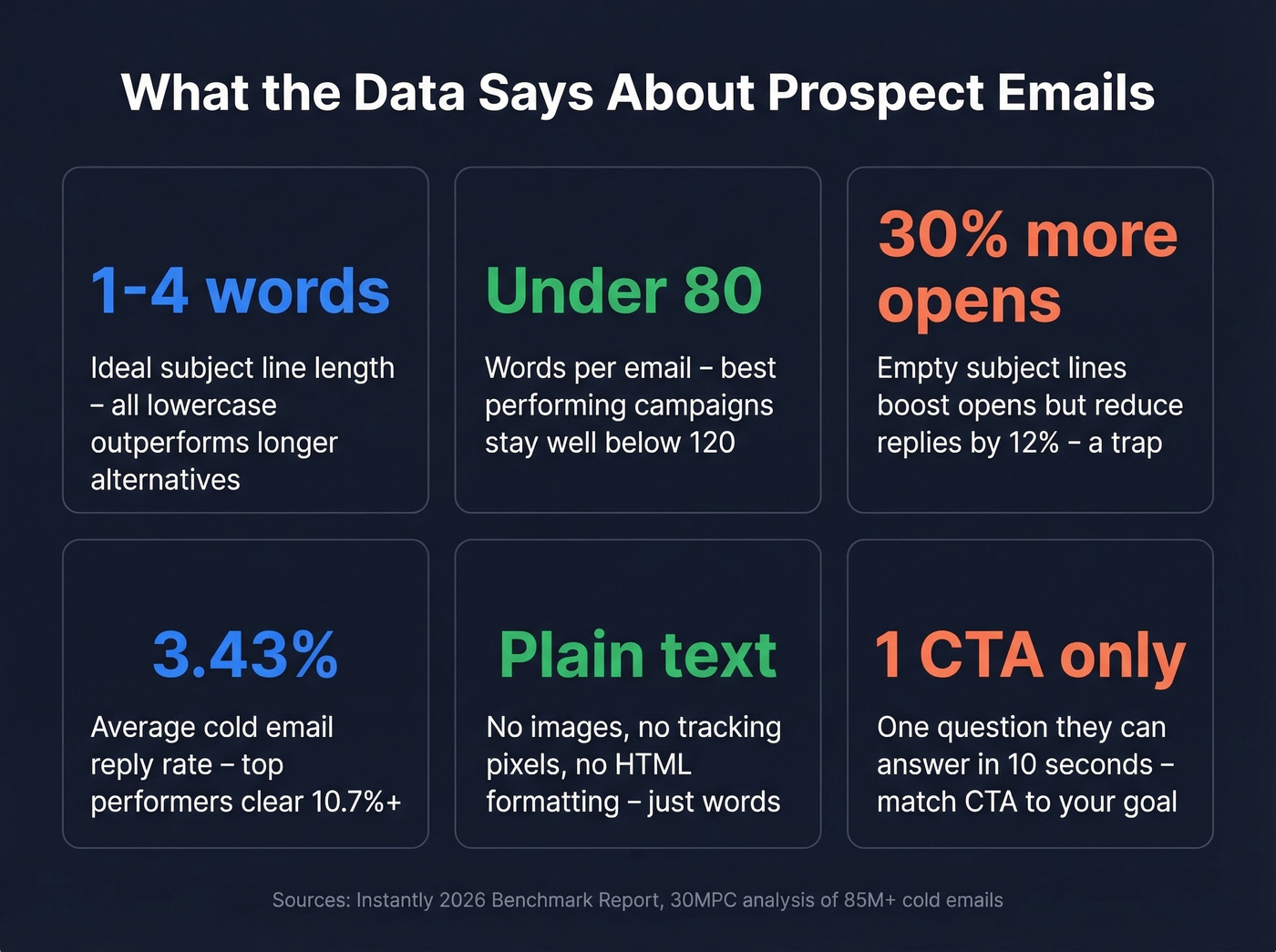
For the body, under 120 words keeps you safe on deliverability, but the best-performing campaigns we've tested keep emails under 80 words. Plain text, no images, no tracking pixels. One CTA - a single question the recipient can answer in 10 seconds (see more email call to action rules and examples).
Asking for the prospect's "thoughts" generates higher replies but fewer booked meetings than a direct calendar ask. Match your CTA to your goal.
Reply rate is the only metric I'd treat as primary in 2026. Open rates are unreliable post-Apple Mail Privacy Protection, and everyone in the space knows it. Build one persona per target role with company details, pain points mapped to your solution, competitor context, and tone guidelines (use an Ideal Customer Profile to keep targeting tight). A CTO's frustrations aren't a VP of Sales's frustrations. Generic emails get generic results - which is to say, no results.

You just read why bounce rates above 3% destroy domain reputation. Prospeo's 5-step verification - with catch-all handling, spam-trap removal, and 7-day data refresh - keeps teams like Stack Optimize at 94%+ deliverability with zero domain flags.
Fix your prospect email data before you rewrite a single subject line.
Three Prospect Email Templates
Template 1: Cold Opener (Pain-Point-First)
Subject: slow pipeline?
Body: {{First Name}}, most {{title}} teams at {{company size}} companies tell us the same thing - reps spend 4+ hours finding contacts that bounce. We cut that to 20 minutes with verified data. Worth a 15-min call this week?
Under 50 words. Leads with a pain point, not a pitch.
Template 2: Trigger-Based
Subject: saw the raise
Body: {{First Name}}, congrats on the {{funding round}}. Most teams at this stage start scaling outbound before the data infrastructure is ready - and burn domains in the first month. We help {{similar company}} avoid that. Can I share how?
This one ties to a real event and positions your solution against a specific risk the prospect is already thinking about.
Template 3: Follow-Up (New Value)
Subject: re: slow pipeline?
Body: {{First Name}}, quick follow-up - I pulled some data on {{industry}} bounce rates that might be relevant. Happy to share the breakdown if useful.
Adds a new data point instead of "just checking in." Never send a follow-up that doesn't earn its existence.
Follow-Up Cadence That Works
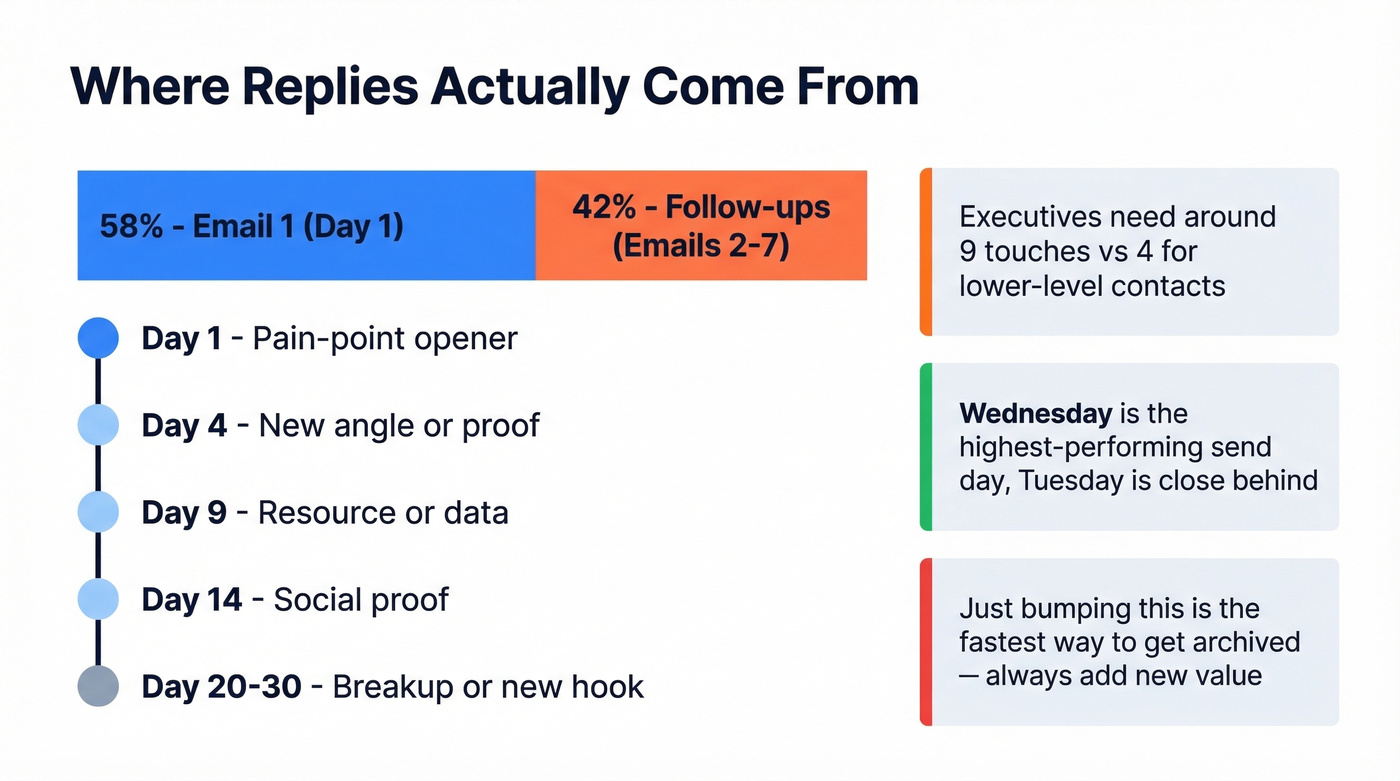
58% of all replies come from Step 1 of a sequence. Follow-ups contribute the remaining 42%. The sweet spot is 4-7 touchpoints. (If you’re building sequences end-to-end, use this B2B cold email sequence framework.)
| Touchpoint | Timing | Purpose |
|---|---|---|
| Email 1 | Day 1 | Pain-point opener |
| Email 2 | Day 4 | New angle or proof |
| Email 3 | Day 9 | Resource or data |
| Email 4 | Day 14 | Social proof |
| Email 5-7 | Day 20-30 | Breakup or new hook |
Reaching executives often requires ~9 touches compared to 4 for lower-level contacts. Wednesday is the highest-performing send day, with Tuesday close behind. Space follow-ups 3-5 business days apart and make every touch carry a new angle, proof point, or resource. "Just bumping this" is the fastest way to get archived.
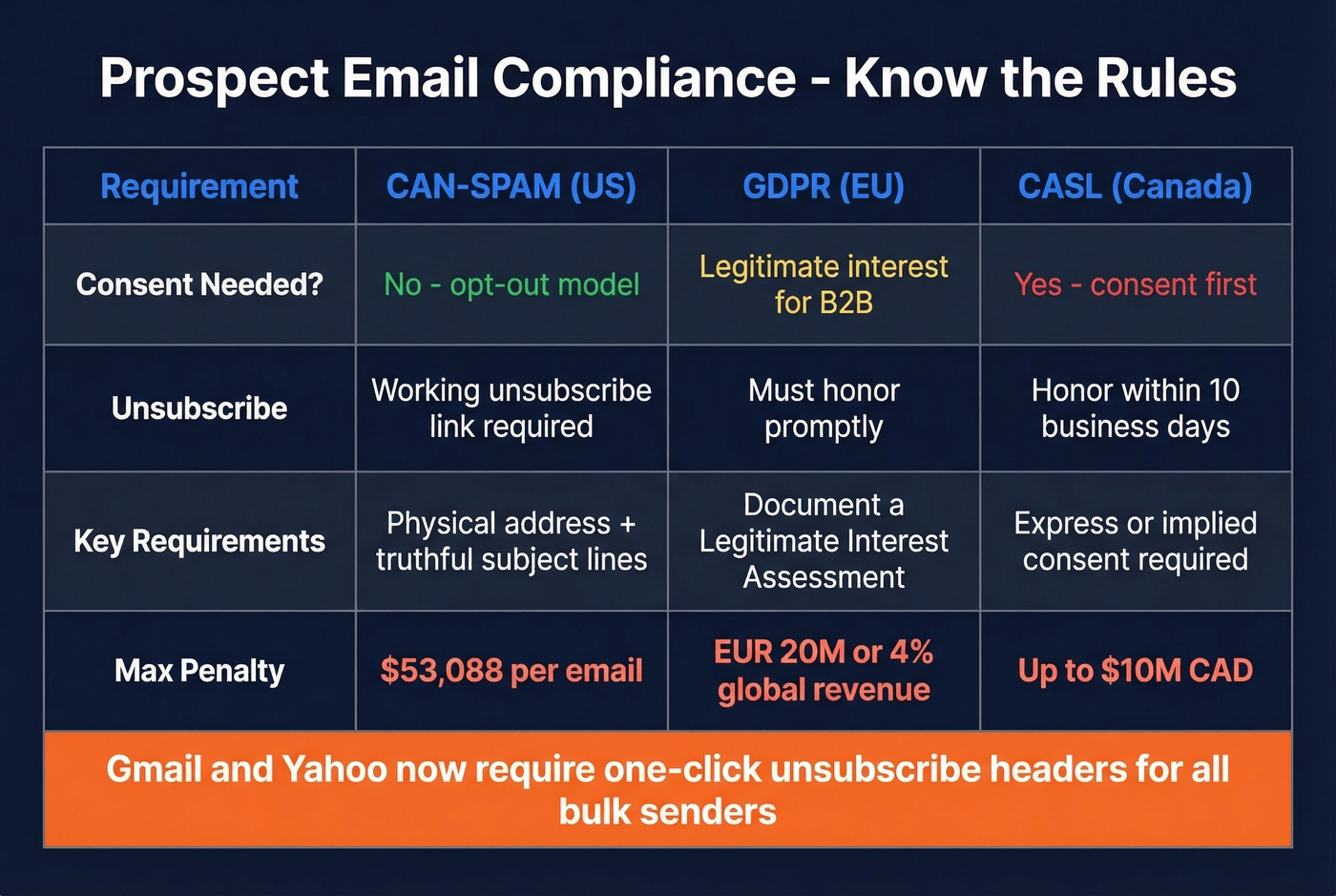
Compliance in 60 Seconds
- CAN-SPAM (US): Include a physical address, truthful subject lines, and working unsubscribe. Penalties run up to $53,088 per email.
- GDPR (EU): Article 6(1)(f) legitimate interest applies to B2B cold email. Document a Legitimate Interest Assessment. Max fines: EUR 20M or 4% of global revenue.
- CASL (Canada): Consent-first. Honor unsubscribe within 10 business days.
- Gmail/Yahoo: One-click unsubscribe header is mandatory for bulk senders.
Skip the compliance shortcuts. One complaint from the wrong recipient can tank a domain you spent weeks warming.
Measuring What Matters
Reply rate is your primary KPI. For competent campaigns with tight ICP targeting, expect a meeting-booking rate of 0.5-2% from delivered emails. A/B test subject lines and CTAs weekly; small changes compound fast (here’s a practical email copywriting guide if you’re iterating fast).
In our experience, if your bounce rate creeps above 3%, stop sending and fix your list immediately. That's always a data problem, not a copy problem. We've watched teams rewrite emails five times when the real issue was a list full of dead addresses - don't be that team.
Let's be honest about tooling: if your average deal size is under five figures, you probably don't need a $30k/year data platform. A credit-based tool at ~$0.01 per verified email will outperform an enterprise contract you're only using at 10% capacity.
Every prospect email template above assumes one thing: the address is real. At $0.01 per verified email, Prospeo gives you 300M+ profiles with 98% accuracy - no contracts, no sales calls, and a free tier to start today.
Stop rewriting emails five times when the real problem is dead addresses.
FAQ
Is cold email still worth it vs. cold calling?
Yes - 80% of B2B buyers prefer communicating with sellers via email. Cold calling converts faster per touch, but email scales better. One seller on r/sales found calling outperformed email in cybersecurity, so test both for your market.
How many prospect emails should I send per day?
Start at 30-50 per warmed mailbox. Scale to 120-150/day over four weeks only if bounce and spam metrics stay clean. Pushing volume before warmup is done will torch your domain reputation permanently.
What's the best tool for finding verified prospect emails?
Look for a provider that offers catch-all verification, spam-trap removal, and a fast data refresh cycle. Credit-based pricing (around $0.01 per email) with a free tier lets you test accuracy before committing. The key metric isn't database size - it's what percentage of those emails actually land in an inbox.