

Prospect List Meaning: What It Is and How to Build One
A prospect list isn't a spreadsheet of names you scraped from the internet. It's a curated set of potential buyers who match your ideal customer profile but haven't engaged with you yet - and it's the single most important asset in any outbound operation. Get it wrong, and every step that follows - sequences, calls, demos - runs on bad fuel.
Quick Version
- A prospect list is a curated set of potential buyers who match your ICP but haven't engaged yet. Not a contact dump, not a newsletter subscriber list, not a random CSV from a data broker.
- It must include verified contact data, firmographics, and buying signals - funding rounds, tech stack, hiring patterns, direct dials. Not just names and emails.
- Quality beats quantity every time. 100 targeted decision-makers outperform 1,000 generic contacts. Emails to large untargeted lists get 67% fewer replies.
The Core Definition
A prospect list is a structured collection of potential customers who fit your ideal customer profile and have the means to buy, but haven't yet interacted with your company. It's the pre-engagement layer of your pipeline.
The key word is curated. A prospect list isn't everyone at companies with 50+ employees. It's the VP of Engineering at Series B SaaS companies using Kubernetes who just posted a DevOps role. That specificity separates a prospect list from a contact dump.
Why does it matter? Because 96% of buyers do their own research before engaging with a sales rep, and 71% prefer independent research over talking to a rep at all. They're already filtering you out if your outreach feels generic. Your list needs to be sharp enough to support messaging that doesn't feel like spam.
Prospect vs. Lead vs. Contact
These terms get used interchangeably, and it causes real confusion inside sales orgs. Let's clear it up.
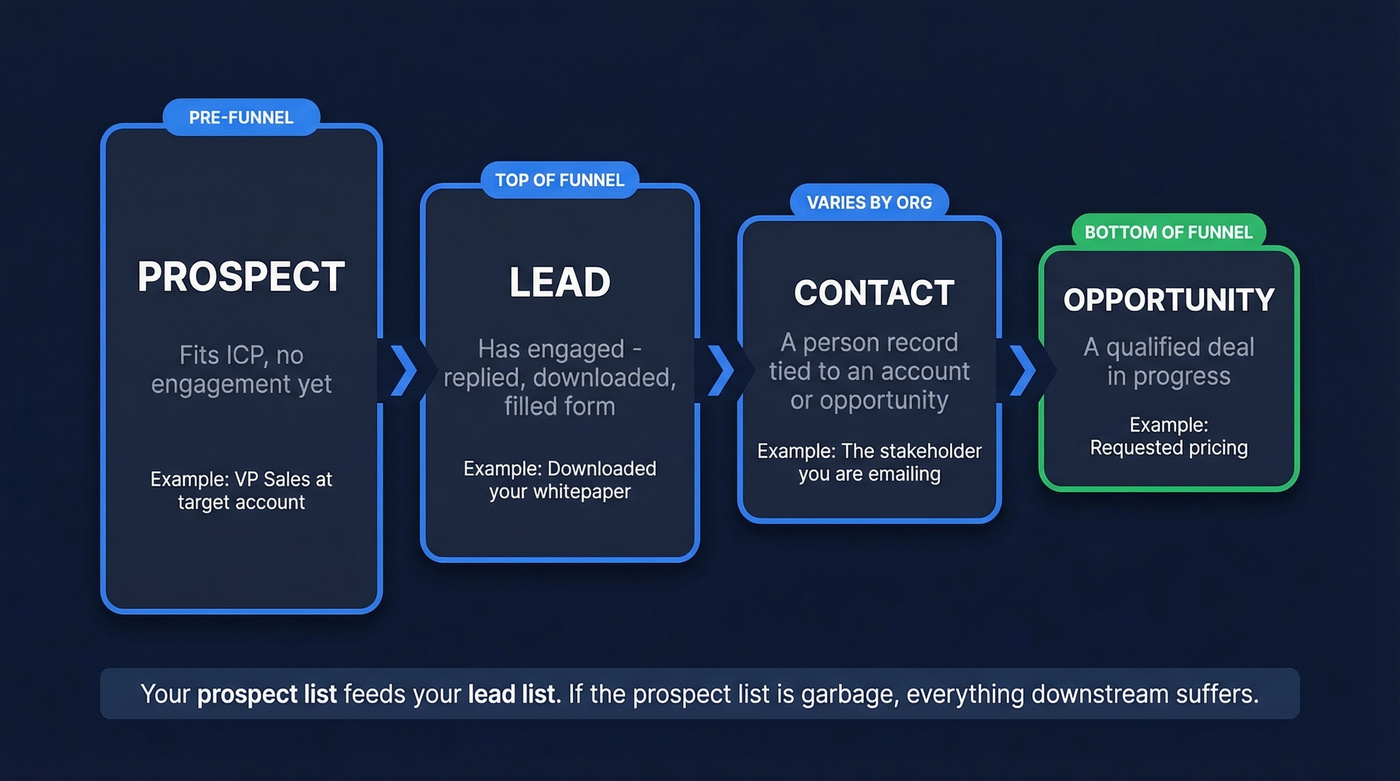
| Term | Definition | Funnel Stage | Example |
|---|---|---|---|
| Prospect | Fits ICP, hasn't engaged yet | Pre-funnel | VP Sales at target account |
| Lead | Has engaged (replied, downloaded, form fill) | Top of funnel | Downloaded your whitepaper |
| Contact | A person record tied to an account/lead/opportunity | Varies by org | The stakeholder you're emailing |
| Opportunity | A qualified deal in progress | Bottom of funnel | Requested pricing |
Adobe qualifies at three layers: organization-level, opportunity-level, and stakeholder-level. The underlying logic is the same everywhere, though. Prospects are pre-engagement, leads are post-engagement, and personalization should increase as someone moves down the funnel.
Your prospect list feeds your lead list. If the prospect list is garbage, everything downstream suffers.
What to Include in Every Record
A prospect list is more than names and emails. Here's what a complete record looks like:
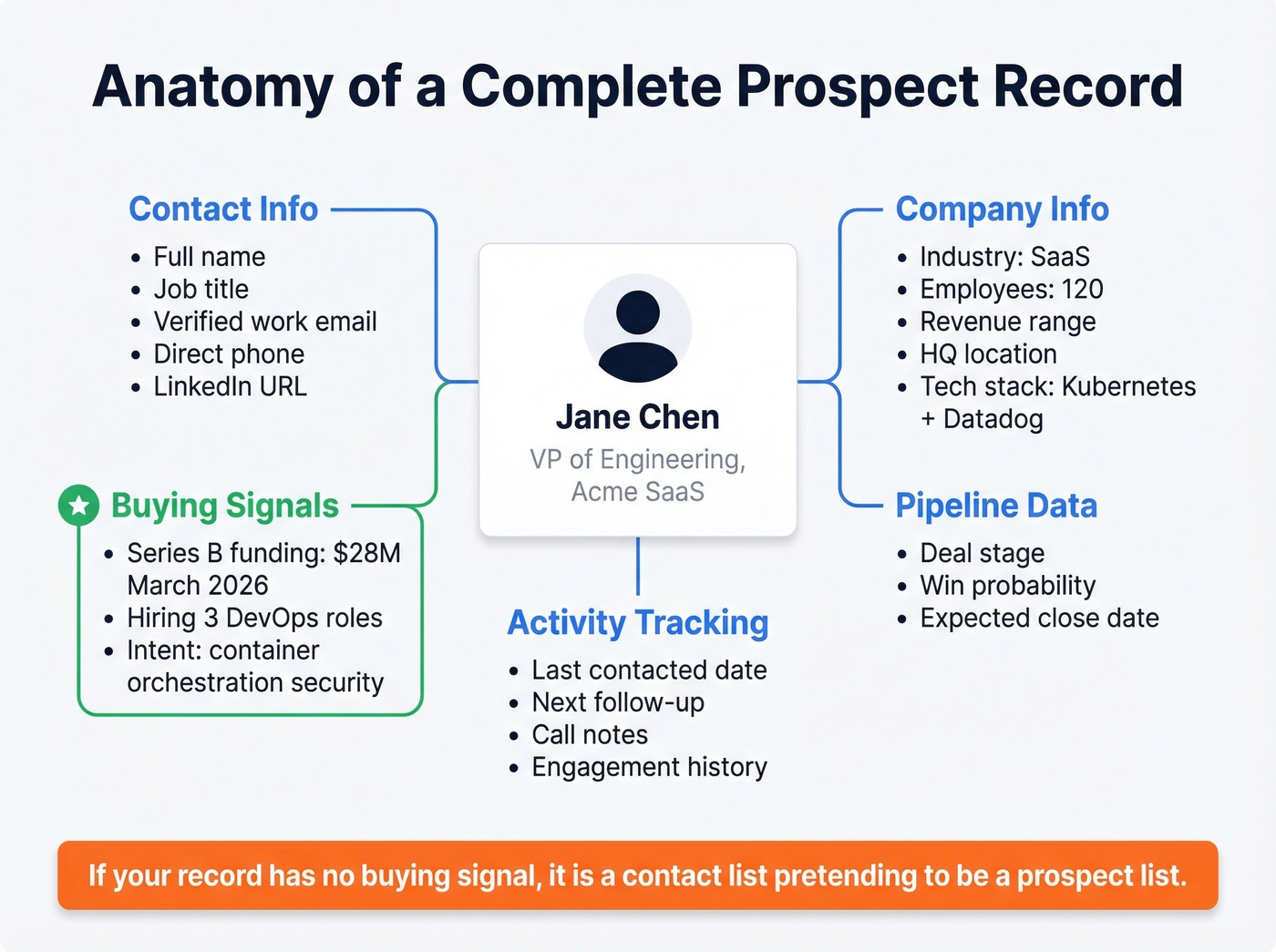
Contact Information Full name, job title, department, verified work email, direct phone or mobile, professional profile URL.
Company Information Company name, industry, website, employee count, revenue range, HQ location, tech stack. Each prospect account should include enough firmographic detail to personalize your first touch.
Buying Signals Recent funding rounds, hiring patterns (especially SDR/AE roles), expansion signals, intent data showing active category research.
Pipeline Data Deal stage, win probability, expected close date.
Activity Tracking Last contacted date, next follow-up, notes from calls and meetings, engagement history.
Here's the thing: if your prospect list doesn't include at least one buying signal per record, it's a contact list pretending to be a prospect list. The signal is what makes it actionable.
A concrete example makes this real:
Example record: Jane Chen, VP of Engineering, Acme SaaS (Series B, 120 employees, uses Kubernetes + Datadog). Just posted 3 DevOps roles on their careers page. Last funding: $28M in March 2026. Intent signal: researching "container orchestration security."
That's a prospect. A name and an email is not.

That example record - name, title, funding, tech stack, intent signal - takes hours to assemble manually. Prospeo's 30+ search filters let you build prospect lists with every field covered: verified emails (98% accuracy), direct dials, technographics, hiring signals, and Bombora intent data across 15,000 topics. 75 free emails to start.
Build a prospect list that matches this article's standard in minutes, not days.
What Makes a Good List
Four characteristics define a list that actually drives pipeline:
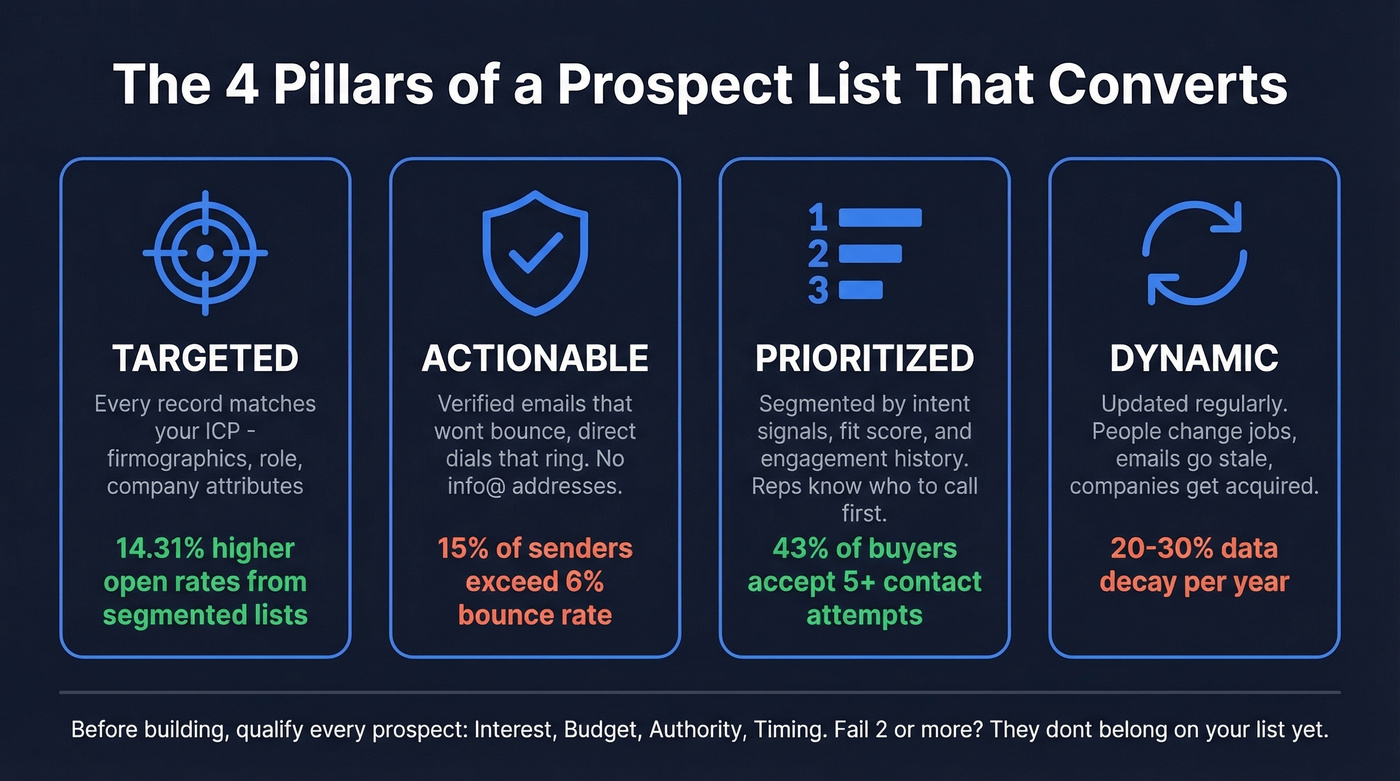
Targeted. Every record matches your ICP - firmographics, role demographics, company attributes. ICP discipline is the #1 separator between high-performing lists and contact dumps.
Actionable. Every contact has verified data you can use - a real email that won't bounce, a direct dial that rings. A list full of info@ addresses and switchboard numbers isn't actionable.
Prioritized. Contacts are segmented by intent signals, fit score, and engagement history. For enterprise deals, map multiple stakeholders per prospect account: economic buyer, technical evaluator, end user. Your reps should know who to call first, not just who to call.
Dynamic. The list gets updated regularly. People change jobs, companies get acquired, emails go stale. A static list decays fast - we've seen teams lose 25% of their list accuracy in a single quarter when they stop maintaining it.
Beyond these four, a good list is multi-channel ready and compliant with GDPR, CCPA, and CAN-SPAM. Segmented campaigns get 14.31% higher open rates - so the segmentation built into your list directly impacts performance. And 58% of buyers say their sales meetings aren't valuable, which is exactly what happens when reps work from untargeted lists.
Before you start building, run every prospect through a quick qualification filter: Interest/Need (do they have the problem you solve?), Budget (can they afford it?), Authority (can they sign?), Timing (is this urgent?). If a prospect fails two or more, they don't belong on your list yet.
How to Build a Prospect List
Five steps. This is the workflow we've seen produce the best results across dozens of outbound teams.
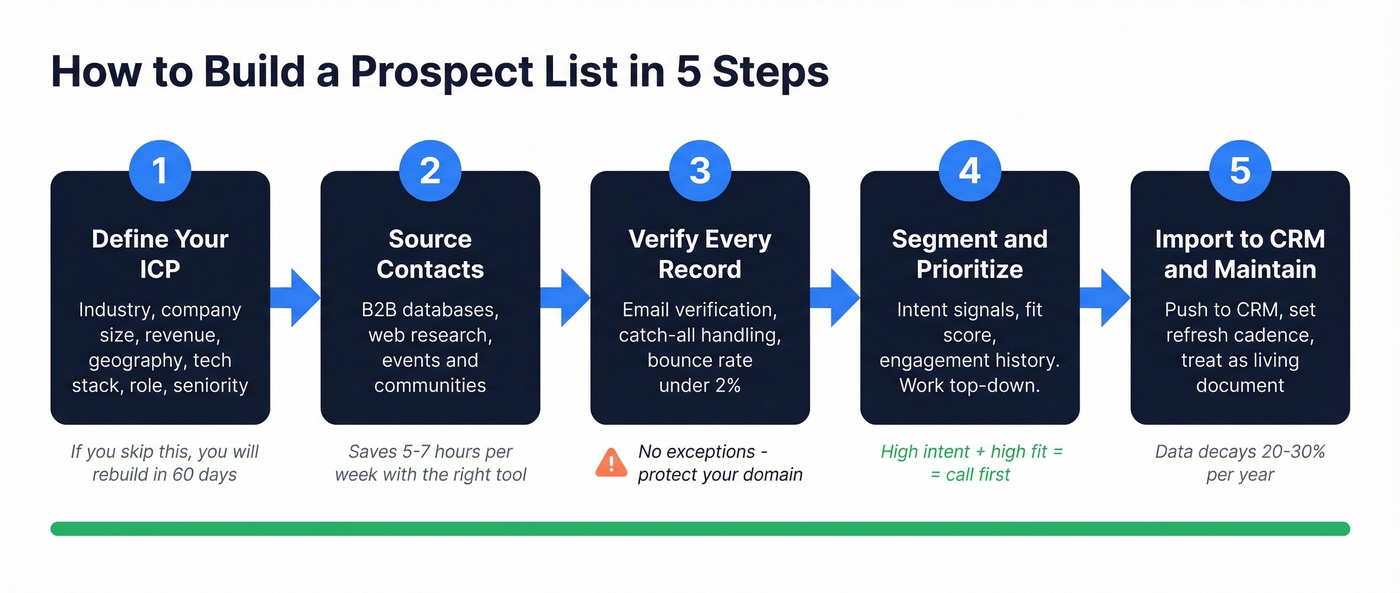
1. Define Your ICP
Start with firmographics: industry, company size, revenue range, geography, tech stack. Layer in role demographics: title, department, seniority. The tighter your ICP, the higher your reply rates. In our experience, teams that skip this step end up rebuilding their lists within 60 days.
A good ICP answers one question: "If this person replied to our cold email, would we actually want to get on a call with them?" If the answer isn't an immediate yes, tighten the criteria.
2. Source Your Contacts
This is where tooling matters. B2B databases, web research, and events/communities are your three main channels. For most teams, a database is the fastest path - teams using dedicated prospecting tools report saving 5-7 hours per week on contact research alone.
Prospeo covers 300M+ professional profiles with 30+ search filters - buyer intent, technographics, job changes, headcount growth, funding, revenue. Search by your ICP criteria and you'll have a targeted list in minutes rather than days. The free tier gives you 75 verified emails per month to test the workflow before committing.

3. Verify Every Record
Keep bounce rate below 2% to protect your sender reputation. 15% of cold email senders report bounce rates above 6% - at that level, you're actively damaging your domain. Every email needs verification before it enters a sequence. No exceptions.
For a deeper deliverability breakdown, see our email bounce rate benchmarks and fixes.
4. Segment and Prioritize
Not all prospects are equal. Segment by intent signals, fit score, and engagement history. Your reps should work the list top-down, starting with high-intent, high-fit prospects. 43% of buyers who accept meetings say it's fine to be contacted five or more times - but that persistence only pays off when you're targeting the right people.
If you need a system for scoring signals, use a simple framework for identifying buying signals.
5. Import to CRM and Maintain
Push your verified, segmented list into your CRM and set a refresh cadence. B2B contact data decays 20-30% per year. Even a few months of neglect can leave a noticeable chunk of records outdated. The best teams treat their prospect list as a living document, not a one-time export.
If you're evaluating tools, start with our guide to contact management software.
You just read that a good prospect list needs verified data, buying signals, and regular updates. Prospeo refreshes all 300M+ records every 7 days - not the 6-week industry average - so your list never decays. Bounce rates stay under 2% with our 5-step email verification and catch-all handling.
Keep your prospect list accurate at $0.01 per verified email.
Should You Buy a Prospect List?
Use this if: You need speed. 78% of customers buy from the first responder. If being first matters more than being perfect, a purchased list can bridge the gap while you build your own.
Skip this if: You care about deliverability. Purchased lists run $0.05-$0.25 per record unverified, and the data quality is a coin flip. 48% of cold email senders report bounce rates of 2-5%, and purchased lists with unverified data are a major contributor.
If you're considering it, read our breakdown on email list providers and the legal side of buying email lists.
We've tested purchased lists against self-built ones. The deliverability gap is real, and the domain damage compounds over time. Purchased lists aren't inherently evil, but they're a shortcut that usually costs more in sender reputation than they save in time. The consensus on r/sales echoes this - most experienced SDRs treat purchased lists as a starting point for verification, never as a finished product.
Common Mistakes That Kill Your List
No ICP defined. Without clear criteria, your list is a random collection of contacts. Every record should pass the "would we want this meeting?" test.
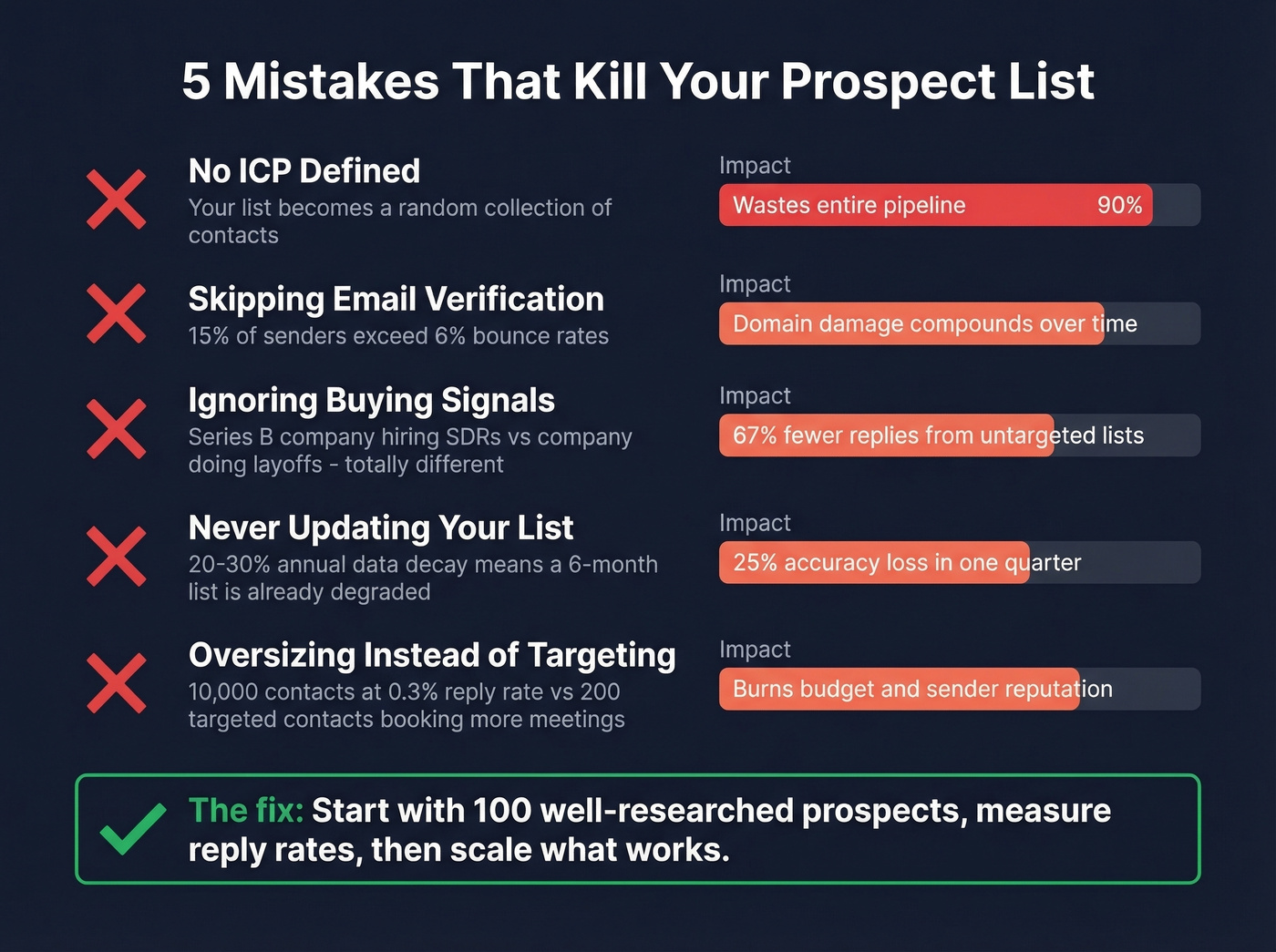
Skipping verification. 15% of senders exceed 6% bounce rates. There's no excuse for sending to unverified emails when verification tools catch bad addresses before they damage your domain.
Ignoring buying signals. A prospect who just raised a Series B and is hiring SDRs is fundamentally different from one who laid off 20% of their team last quarter. Your list should capture these signals - and if it doesn't, you're flying blind.
Never updating. With 20-30% annual data decay, a six-month-old list is already significantly degraded. Quarterly refresh minimum.
Oversizing instead of targeting. Bigger isn't better. Start with 100 well-researched prospects, measure reply rates, then scale what works. I've watched teams burn through 10,000-contact lists with a 0.3% reply rate when 200 targeted contacts would've booked more meetings.
Compliance You Can't Ignore
If you're building prospect lists, you're handling personal data. The penalties for getting this wrong are severe.
| Regulation | Model | Max Penalty | Key Requirement |
|---|---|---|---|
| GDPR | Opt-in | EUR 20M or 4% revenue | Consent for EU data |
| CCPA | Opt-out | $7,500/violation | "Do Not Sell" link required |
| CAN-SPAM | Opt-out | $53,088/email | Physical address + 10-day unsub |
| TCPA | Consent | $500-$1,500/call | Prior express consent |
The TCPA numbers should scare you. A thousand contacts without proper consent could trigger $500K-$1.5M in fines. CAN-SPAM requires a valid physical postal address and a visible unsubscribe link in every email, with opt-outs processed within 10 business days.
Use compliant data sources, honor opt-outs immediately, and document your consent basis. This isn't optional - it's the cost of doing outbound in 2026.
FAQ
What's the difference between a prospect and a lead?
A prospect fits your ICP but hasn't engaged yet. A lead has taken an action - replying, downloading content, filling out a form. Your prospect list is pre-engagement, your lead list is post-engagement. The distinction matters because messaging and cadence should differ at each stage.
How often should I update my prospect list?
Quarterly at minimum, since B2B contact data decays 20-30% per year as people change jobs and emails go stale. Prospeo refreshes records every 7 days compared to the 6-week industry average, so teams using it spend less time on manual list hygiene.
How many prospects should be on my list?
Start with 100 well-researched, ICP-matched decision-makers with verified contact data and at least one buying signal per record. Measure reply rates and conversion over 2-3 weeks, then scale the segments producing above-average engagement. Resist the urge to go big before you've validated what's working.