

How to Build a Prospect Nurture Sequence That Actually Converts
You built a list of 500 prospects, loaded them into your sequencer, and hit send. Three days later: 47 bounced, another 200 landed in spam, and you're staring at 6 replies - two of which are "please remove me."
The sequence didn't fail because your copy was bad. It failed because your data was bad. Only 10% of low-performing organizations rate themselves "very good" at nurturing, compared to 69% of high performers. The gap isn't talent. It's infrastructure.
The Short Version
Use a 3-phase framework: Trust, Value, Decision - spread over 21 days with 13 emails and built-in rest days.
Add at least one non-email touchpoint per week. A call or social touch. Email-only sequences leave meetings on the table.
Your tool stack: Prospeo for data verification and enrichment, Outreach/Instantly/Lemlist for execution, HubSpot or Salesforce for CRM scoring and lead handoff tracking.
What Is a Nurture Sequence?
A prospect nurture sequence is a structured series of touchpoints - emails, calls, social interactions - designed to move known contacts who haven't converted toward a buying decision. It's sales-owned, outbound-adjacent, and built around specific individuals your team has already identified.
This is different from lead nurturing, which is marketing-owned and triggered by inbound actions like form fills or content downloads. Marketing nurture runs on automated drip logic. A sales-owned sequence is deliberate, personalized, and responsive to engagement signals.
The distinction matters because 73% of B2B leads aren't ready to buy at first contact. Nurture sequences bridge that gap with sequenced, multi-angle outreach that earns attention over time - not generic content blasts.
Why Nurturing Matters in 2026
Sales cycles are getting longer. 40.4% of B2B buyers take 6-12 months to make a purchase decision, and 15.4% take over a year. Three quarters of organizations now report longer cycles, with buying groups expanding to 10-20 individuals. You're not selling to one person anymore - you're nurturing a committee.
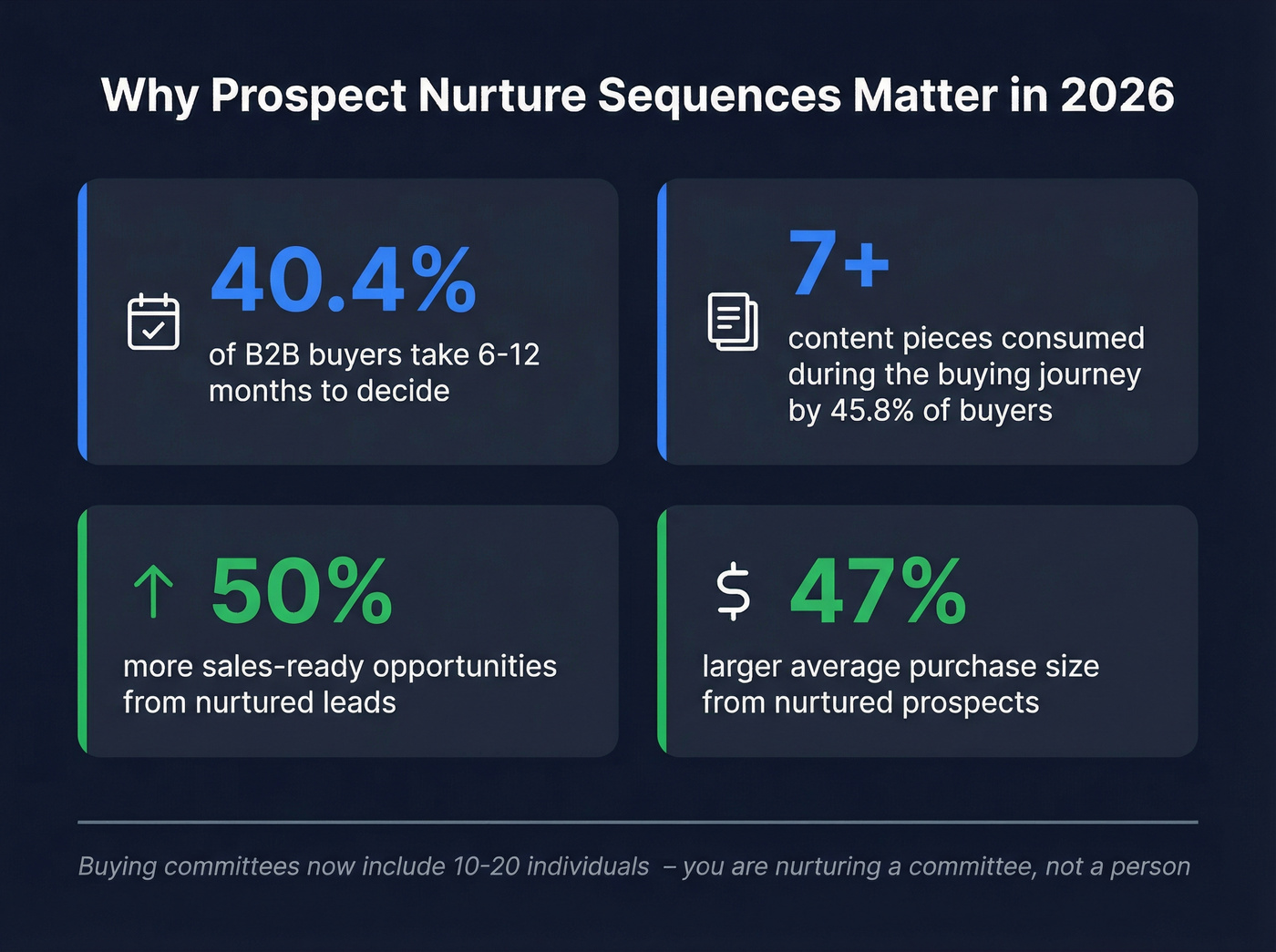
The content numbers tell the same story. 45.8% of buyers consume 7+ content pieces during their purchase journey. If you're sending three emails and calling it a sequence, you're quitting before the buyer even starts paying attention.
Nurtured leads produce [50% more sales-ready opportunities](https://www.marketingprofs.com/articles/2022/48002/lead-nurture-marketing-vs-sales) at 33% lower cost, with purchases averaging 47% larger and pipeline velocity 23% faster. The math is clear: nurture sequences aren't a nice-to-have. They're the mechanism that makes outbound economics work.
The Data Foundation Most Guides Skip
Here's the thing: stop optimizing your subject lines. Start optimizing your list.
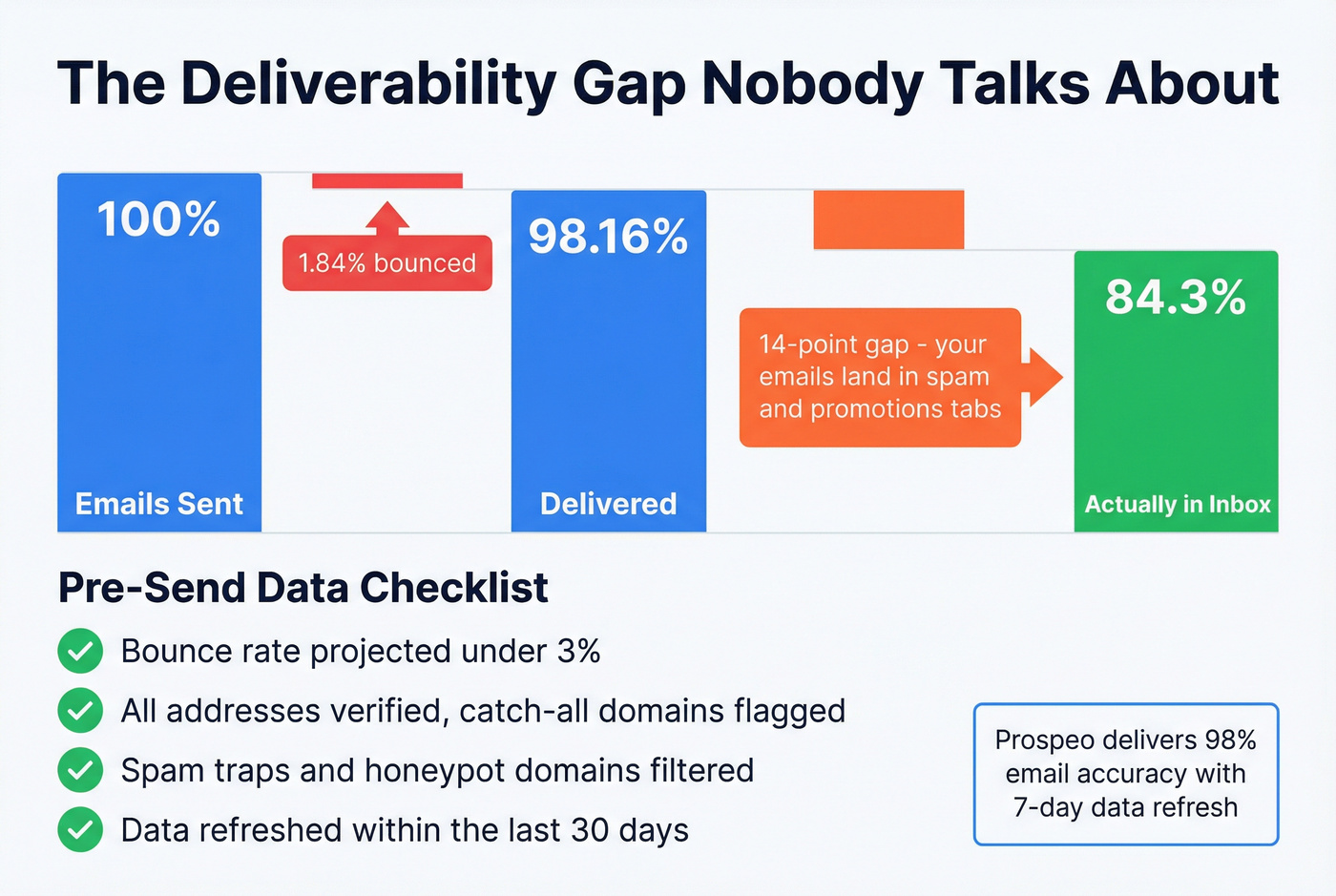
The gap between email delivery and inbox placement is enormous. A [98.16% delivery rate sounds great](https://www.litmus.com/blog/the-difference-between-deliverability-and-delivery-rate) - until you realize only 84.3% of those emails actually land in the inbox. That's a 14-point gap where your carefully crafted nurture emails disappear into spam folders and promotions tabs. Every bounce damages your sender reputation, which drags down deliverability for your entire domain, not just the current campaign.
Pre-send data checklist:
- Bounce rate projected under 3% (see hard bounce definitions and fixes)
- All addresses verified (catch-all domains flagged or removed) with an email validity check
- Spam traps and honeypot domains filtered out
- Data refreshed within the last 30 days
We've watched teams spend weeks perfecting email copy while sending to lists that were 20% invalid. Prospeo's 5-step verification process catches invalid addresses, handles catch-all domains, and filters spam traps before they torch your sender reputation - with 98% email accuracy and a 7-day data refresh cycle.
One more thing: Apple Mail Privacy Protection inflates open rates by 10-15%. Don't trust opens as your primary signal. Track replies and clicks instead (more on open rate vs click rate).


Your 13-email nurture sequence falls apart if 20% of your list bounces. Prospeo's 5-step verification delivers 98% email accuracy on a 7-day refresh cycle - so every touchpoint in your Trust, Value, and Decision phases actually reaches a real inbox.
Clean your list before you launch your sequence - starting at $0.01/email.
The 3-Phase Nurture Flow
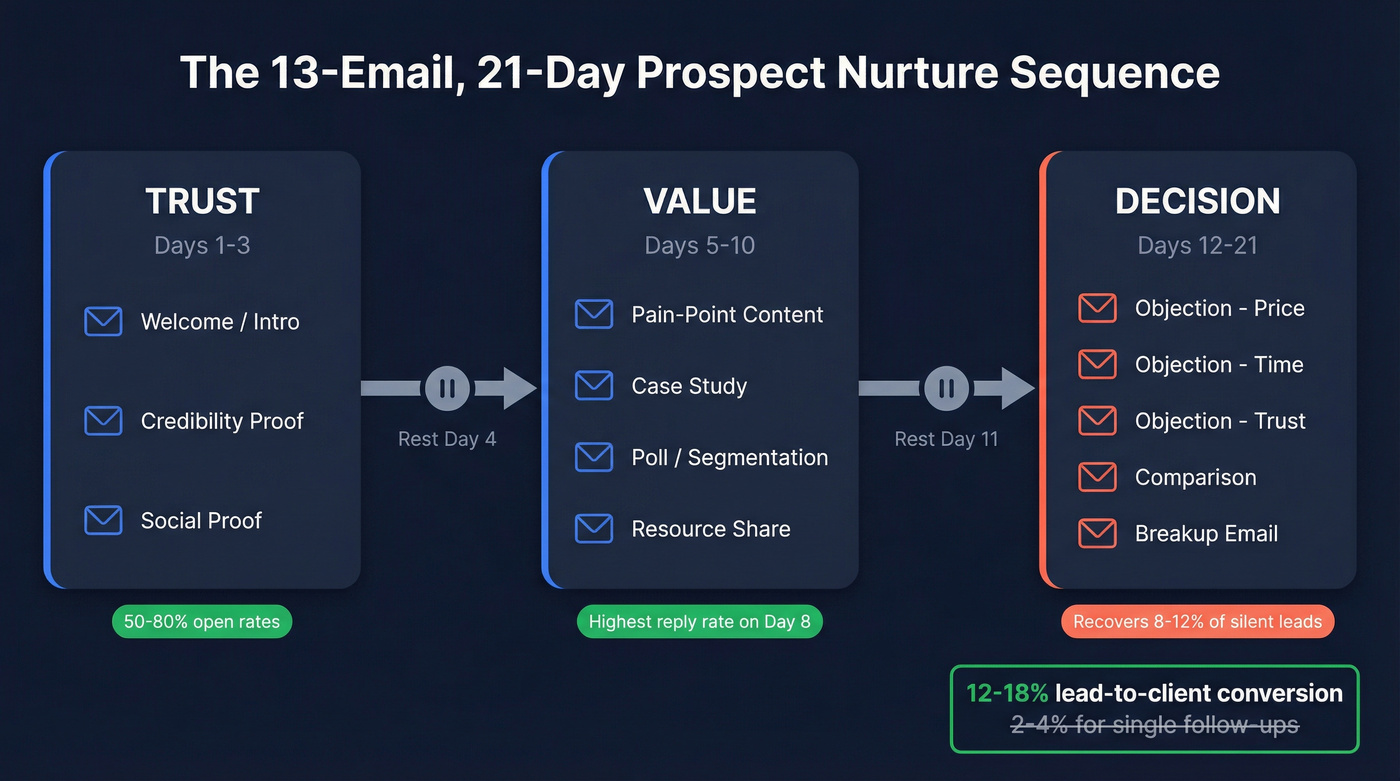
A well-built prospect nurture sequence follows a 13-email, 21-day arc across three phases. This structure converts at 12-18% lead-to-client, compared to 2-4% for single follow-ups.
| Day | Phase | Email Purpose | CTA Type |
|---|---|---|---|
| 1 | Trust | Welcome / intro | Soft (reply) |
| 2 | Trust | Credibility proof | Content link |
| 3 | Trust | Social proof | Reply / case study |
| 5 | Value | Pain-point content | Resource link |
| 7 | Value | Case study | Soft meeting |
| 8 | Value | Poll / segmentation | Reply (1 question) |
| 10 | Value | Resource share | Content link |
| 12 | Decision | Objection: price | Reply |
| 14 | Decision | Objection: time | Reply |
| 15 | Decision | Objection: trust | Social proof link |
| 17 | Decision | Comparison | Meeting request |
| 19 | Decision | Urgency | Meeting request |
| 21 | Decision | Breakup | Final reply ask |
Rest days fall on Days 4, 11, and 18. Don't skip them - they prevent fatigue and give engaged prospects time to act on what you've already sent.
Phase 1: Trust (Days 1-3)
Days 1-3 set the conversion ceiling for your entire sequence. The welcome email is your highest-leverage touchpoint - it drives 50-80% open rates, far above anything else you'll send. Use it to establish who you are, why you're reaching out, and what the prospect can expect. Curiosity-driven subject lines outperform benefit-driven ones by 18-23% in A/B testing, so lead with a question, not a promise.
Email two builds credibility. Share a relevant insight, a quick stat, or a perspective that signals you understand their world. Email three introduces social proof - a customer result, a recognizable logo, a specific outcome.
Don't ask for anything yet. You're earning the right to their attention.
Phase 2: Value (Days 5-10)
After a rest day, shift to delivering tangible value. Email five addresses a specific pain point with actionable content - not a product pitch, but something the prospect can use regardless of whether they buy from you. Teach the prospect something useful about solving their problem, and your solution becomes the obvious next step.
Day 7 is your case study email. Make it specific: same industry, same role, concrete numbers. Day 8 separates good sequences from great ones. Instead of another content push, send a one-question email. Ask how they currently handle a specific challenge, with two or three multiple-choice options. This does two things - it prompts a reply (which boosts deliverability) and it segments the prospect for more relevant follow-up.
We've tested this across dozens of campaigns, and the Day 8 poll consistently generates more replies than any other touchpoint in the sequence. "Since you mentioned proving ROI fast..." is infinitely more compelling than another generic value prop.
Day 10 closes the phase with a resource share - a guide, a tool, a benchmark report. Something worth bookmarking.
Phase 3: Decision (Days 12-21)
This is where most sequences fall apart. Reps either go too hard on the ask or give up entirely.
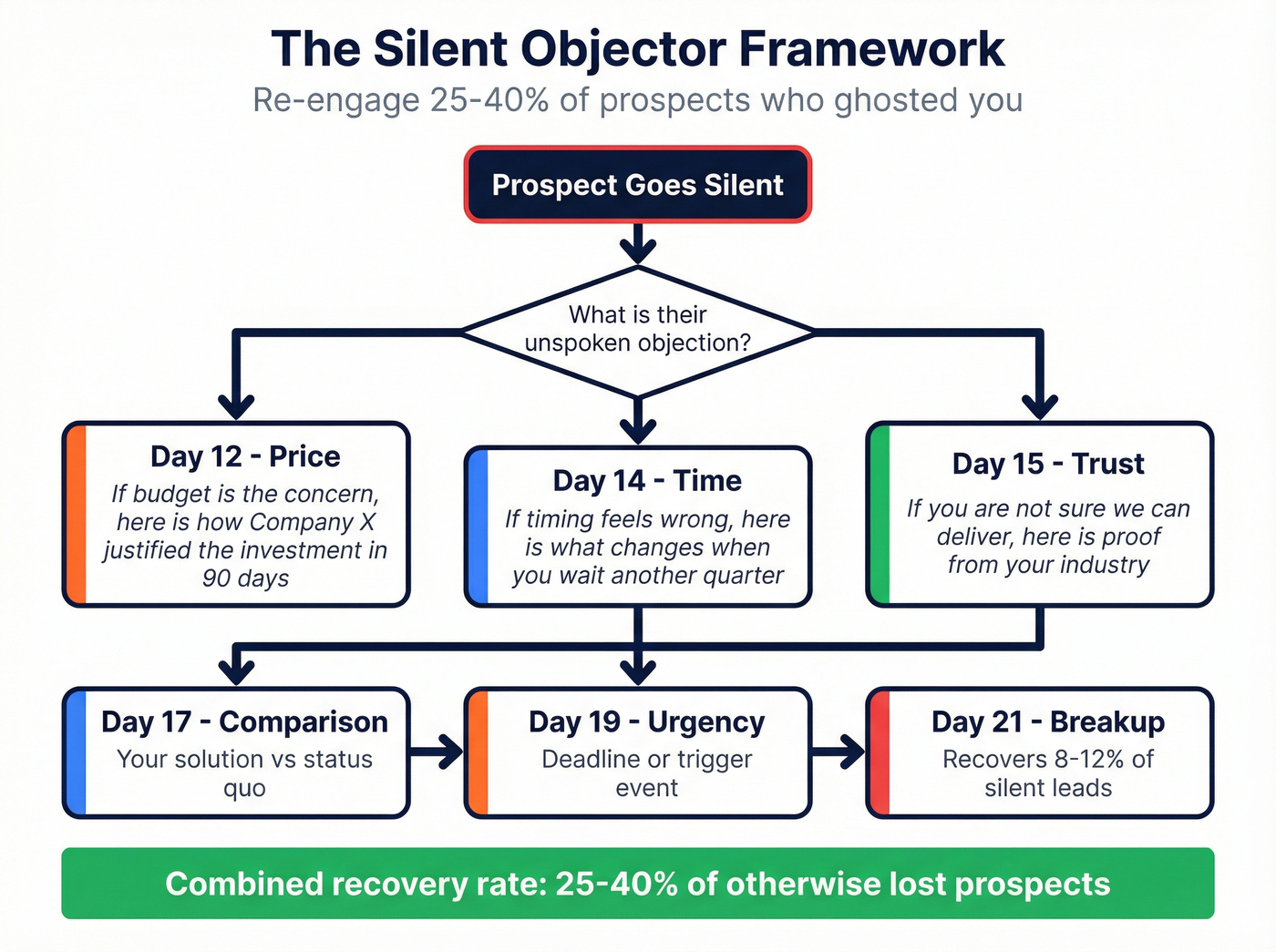
The silent objector framework solves this. Most prospects who ghost you aren't uninterested - they have a specific objection they haven't voiced. The three most common: price, time, and trust. Days 12-15 each address one objection directly. "If budget is the concern, here's how [company] justified the investment in 90 days." These emails re-engage 25-40% of otherwise silent prospects.
Day 17 introduces a direct comparison - your solution vs the status quo or a competitor. Day 19 adds urgency through a deadline, a relevant trigger event, or a capacity constraint. Day 21 is the breakup email, which recovers 8-12% of silent leads. Keep it short, respectful, and final.
Once this base sequence is working, add conditional branches. A prospect who clicks the case study gets a different Day 14 email than one who replied to the poll. These adaptive sequences let you scale from 13 emails to 22+ with branching logic - but nail the linear version first.
After Day 21: Don't Walk Away
If a prospect goes dark after Day 21, drop them to a monthly touch for 60 days. After 90 days of silence, run a re-engagement mini-sequence of 3-4 emails over two weeks with completely fresh angles. If that doesn't land, remove them. Dead weight in your CRM costs you nothing in software fees and everything in mental overhead.
Nurture sequences convert 12-18% when built on verified data. Prospeo enriches every contact with 50+ data points - job title, intent signals, technographics - so your pain-point emails and case studies hit the right person with the right message.
Stop nurturing dead addresses. Enrich your list and send with confidence.
Cadence and Timing Rules
For active sequences, 3-day spacing is the sweet spot. Keep emails under 100 words with one clear CTA per message. Send mid-week between 8-10 AM in the recipient's timezone - Monday and Friday consistently underperform.
| Stage | Frequency | Duration |
|---|---|---|
| Awareness | Every 2-3 days | Short series |
| Consideration | Weekly | 4-6 weeks |
| Retention | Monthly/quarterly | Ongoing |
Each email should use a different angle. If email one leads with a pain point, email two should lead with social proof, and email three with a resource. Repeating the same pitch with different subject lines isn't a sequence - it's spam with variety.
Let's be honest: if your average deal size is under $10K, you probably don't need a 21-day sequence at all. A tight 7-day, 5-email sprint with one phone call will close faster and cost less in rep time.
Go Multichannel
Email-only nurture sequences leave meetings on the table. Coordinated multichannel outreach - email, phone, and social - drives 2-3x higher meeting rates than single-channel approaches. 42% of B2B respondents use 11+ touchpoints during their buying journey, and more than half will switch suppliers when the experience feels disconnected across channels.
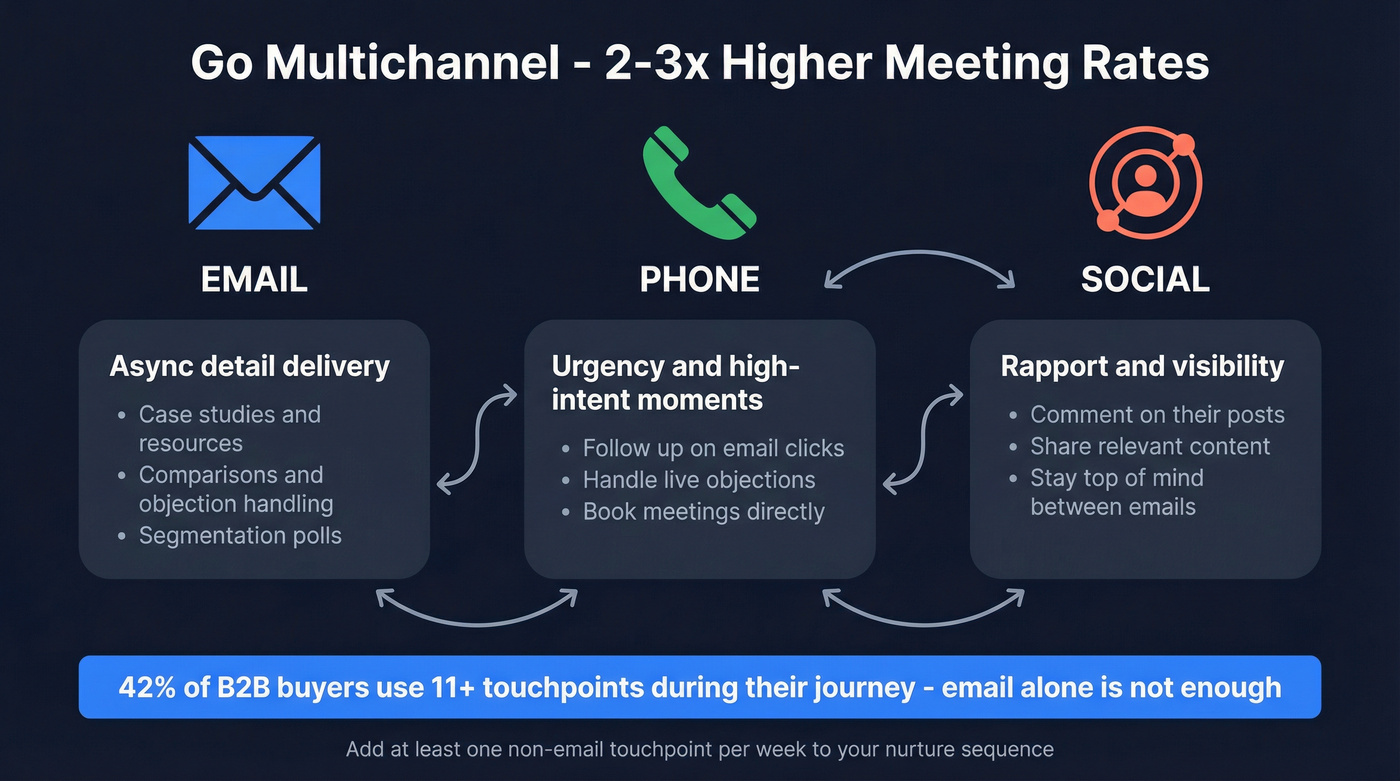
Each channel has a role. Email handles async detail - the case study, the resource, the comparison. Phone creates urgency and handles high-intent moments (see the benefits of cold calling when used correctly). Social builds rapport and keeps you visible between emails.
The key rule: don't duplicate your pitch across channels. Reference the prior touch instead. "I sent over that case study yesterday - did anything stand out?" is a warm call. Repeating your email script verbatim is a cold one. Each touchpoint makes the next one more effective, and that compounding effect is where multichannel really pays off.
On social, keep connection requests under 200 characters - shorter messages get 25% higher acceptance rates. The 150-175 character range works best. The consensus on r/sales echoes this: personalized, short connection notes outperform templated pitches every time.
Five Mistakes That Kill Nurture Sequences
1. Sending to unverified lists. Verify every address before email one. Bounce rate above 3% means stop and clean. No exceptions. Bad data tanks your domain reputation across every campaign, not just the current one.
2. Generic spray-and-pray messaging. Segment by industry, role, and company size. Reference specific triggers - funding rounds, job posts, product launches. "Dear decision-maker" is a delete button. Even a single personalized line doubles response rates (use a personalization system, not vibes).
3. Pressing for a sale too early. Deliver value for at least 10 touchpoints before a hard ask. Your first email shouldn't mention pricing or a demo. SDR teams in r/sales threads repeat this constantly: the reps who lead with value book more meetings than the ones who lead with a calendar link.
4. Stopping after 3 emails. 40% of buyers take 6-12 months. Three emails isn't nurturing - it's quitting. Build sequences that match the actual buying timeline.
5. Measuring only opens. With Apple MPP inflating open rates by 10-15%, opens are a vanity metric. Track reply rate and click rate instead. Those tell you who's actually engaged.
Specialized Nurture Tracks
The 3-phase framework is your backbone, but specific situations call for dedicated sequences layered on top.
Free trial nurturing. If your product offers a free trial, build a separate campaign that runs alongside your main sequence. Focus on activation milestones - first login, first feature used, first result achieved. Reminder emails tied to trial expiration dates recover 15-25% of users who'd otherwise churn silently.
No-show recovery. When a prospect books a meeting and doesn't show, don't just send one "sorry we missed you" email. Build a 3-4 email cadence that re-establishes value and offers flexible rescheduling. These recover roughly 30% of no-shows when executed within 24 hours.
Post-close onboarding. Nurturing doesn't end at close. A post-sale campaign focused on onboarding, adoption, and expansion keeps churn low and creates upsell opportunities. The same 3-phase logic applies - just shift the content from "why buy" to "how to get maximum value."
New stakeholder outreach. When a new decision-maker joins an account you're already working, trigger a sequence that brings them up to speed on the relationship and value delivered so far. This prevents deals from stalling when champions change roles. Skip this track if your average deal involves fewer than three stakeholders - it won't be worth the setup time.
Executing at Scale Without Losing Personalization
The framework above gives you structure. Execution is where most teams stumble.
Start with segment-level personalization, not individual-level. Group prospects into tracks by industry, role, and buying stage, then customize the first and last sentences of each email for the individual. This gives you the efficiency of templates with the feel of one-to-one outreach. We ran a test last quarter where segment-level personalization with custom openers outperformed fully templated emails by 3.2x on reply rate - and it only added about 90 seconds per email.
Use trigger-based sends for high-intent moments - a prospect visits your pricing page, downloads a resource, or engages with a social post. These real-time touches convert at 3-5x the rate of scheduled sends because they arrive when the prospect is already thinking about the problem (see intent signals you can operationalize).
Build your campaigns with reply-optimization in mind. Every reply improves your sender reputation, which improves deliverability for every subsequent email. Ask questions. Use the poll technique from Day 8. Make it easy for prospects to respond with a single line.
2026 Benchmarks
Here's what good looks like right now.
| Metric | Benchmark |
|---|---|
| Open rate | 36.7-42.35% |
| Click-through rate | 2-4% (top quartile: 10%+) |
| Cold reply rate | 5.8% |
| Email ROI | $36-42 per $1 spent |
| 3-phase nurture conversion | 12-18% |
| Multichannel vs single-channel | 2-3x meeting uplift |
Apple MPP inflates open rates by ~10-15%. If your open rates look suspiciously high, they probably are.
We've seen teams obsess over open rates while ignoring that their reply rate is under 1%. Opens tell you the subject line worked. Replies tell you the message worked. Optimize for the metric that actually predicts revenue.
FAQ
How many emails should a prospect nurture sequence have?
Eight to thirteen over two to three weeks. A 13-email, 21-day sequence with rest days converts at 12-18%, far above the 2-4% typical of single follow-ups. Shorter sprints of 5 emails work for deals under $10K.
What's the difference between a nurture sequence and a drip campaign?
Drip campaigns are automated and marketing-owned, triggered by inbound actions like form fills. A sales-owned nurture sequence targets known contacts and adapts based on engagement signals like replies and clicks - it's deliberate outreach, not scheduled automation.
How do I re-engage prospects who stop responding?
Use the silent objector framework: send emails addressing unspoken objections around price, time, and trust. This re-engages 25-40% of ghosted prospects. End with a breakup email that recovers another 8-12%.
What tools do I need to run a nurture sequence?
Three layers: data verification (Prospeo gives you 98% email accuracy plus 125M+ verified mobiles), sequence execution (Outreach, Instantly, or Lemlist), and CRM (HubSpot or Salesforce) for scoring and handoff tracking.
When should I hand off a nurtured prospect to sales?
When they hit scoring thresholds - multiple pricing page visits, case study clicks, replies with buying questions, or repeat site visits. Combine behavioral signals with ICP fit indicators like role, company size, and industry to avoid premature handoffs.