

How to Write a Prospecting Introduction Email That Gets Replies
You just sent 500 prospecting introduction emails and got 3 replies - two of which were "please remove me from your list." Your email copy is fine. Your data is the problem, and so is everything that happens before you hit send.
What You Need (Quick Version)
- Fix your data first. Verified emails, bounce rate under 2%, or nothing else matters.
- Keep emails under 80 words with a single clear CTA.
- Follow up 4-7 times. 42% of replies come after the first email.
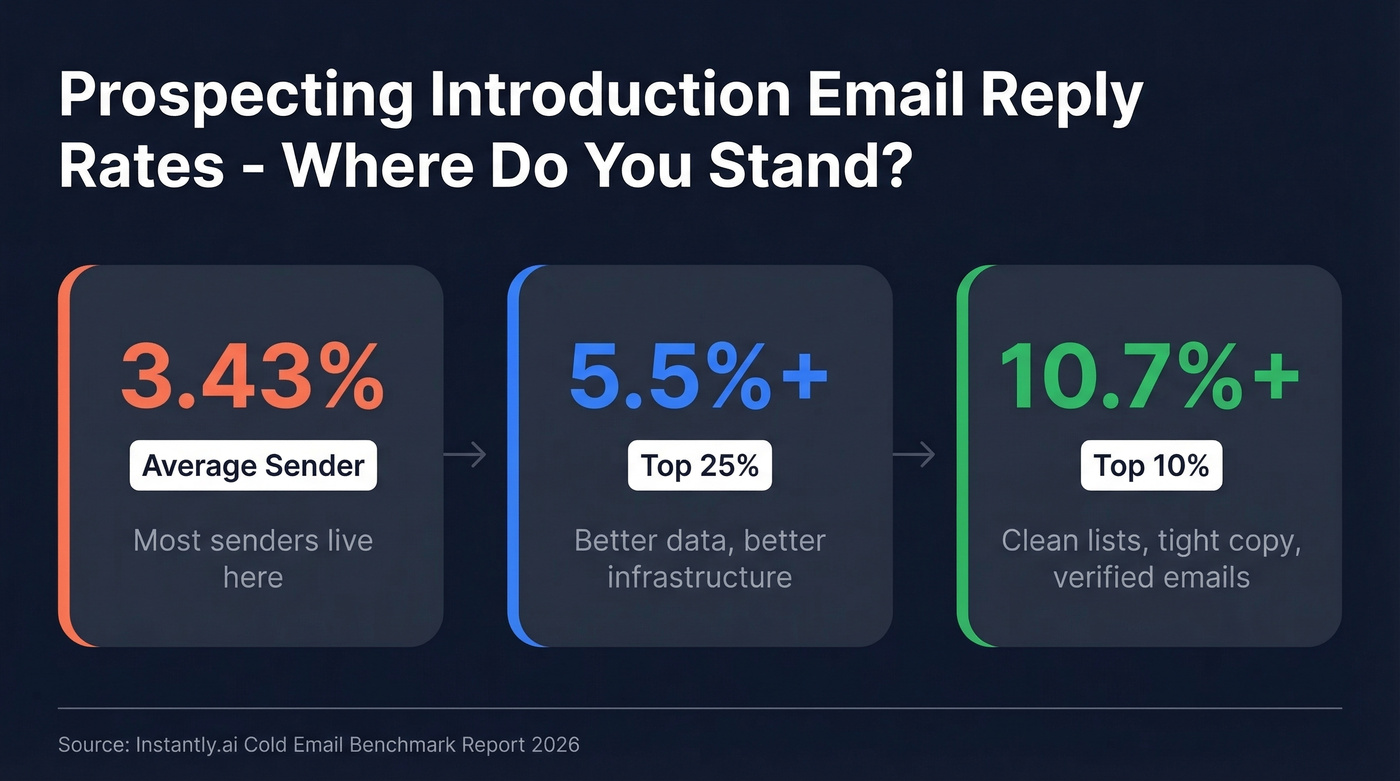
The average cold email reply rate is 3.43%. Top-quartile senders hit 5.5%+. The top 10% break 10.7%. The gap isn't talent - it's infrastructure, list quality, and discipline. Nearly half of senders don't even track bounce rates, which is honestly baffling. Don't be one of them.
Before You Write a Word
Most guides jump straight to templates. That's backwards. The bulk of your reply rate is determined before you write a single word.
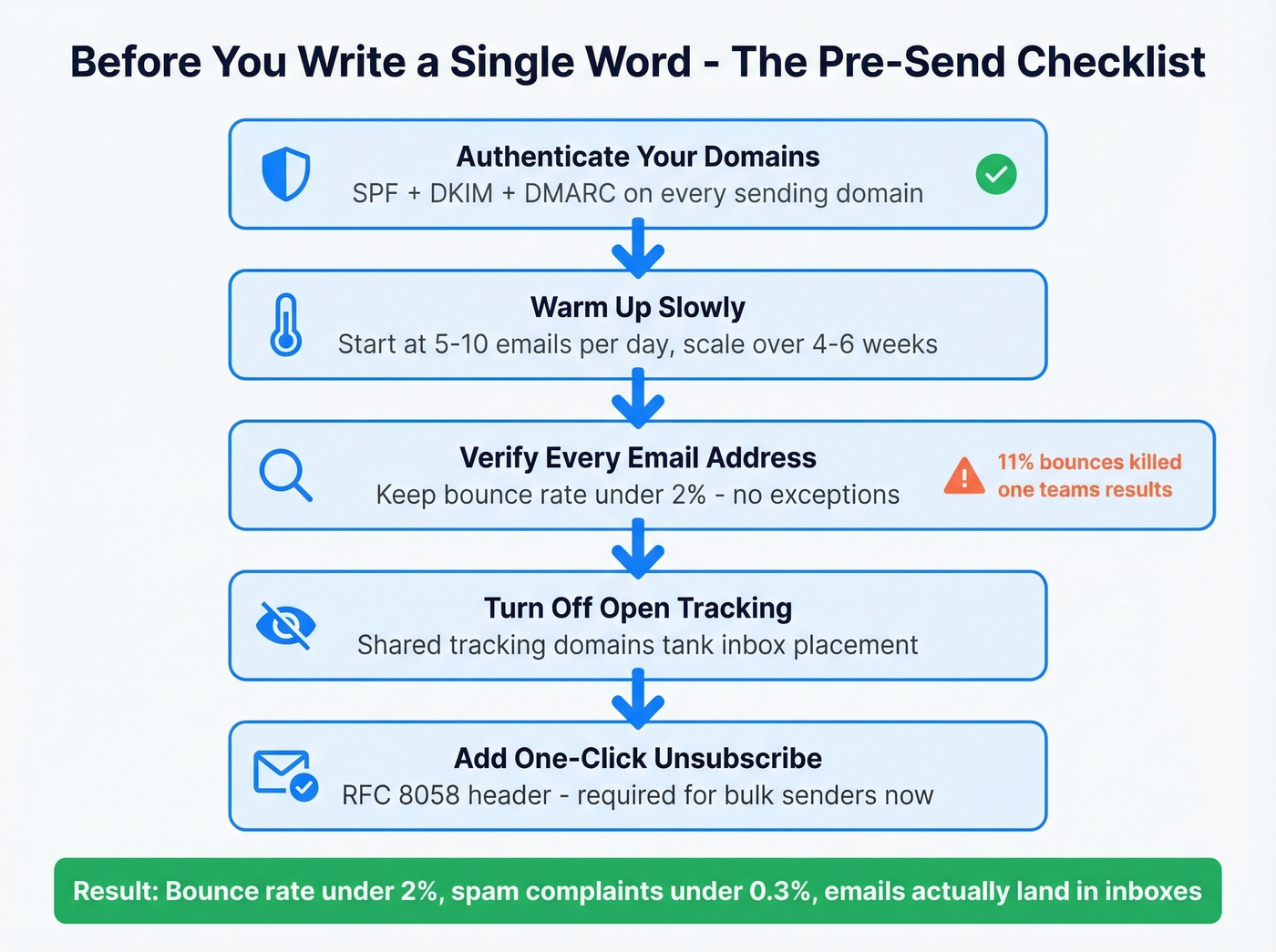
Authentication is non-negotiable. SPF, DKIM, and DMARC need to be configured on every sending domain. Without them, you're dramatically increasing the odds Gmail and Outlook route your emails to spam. Include a one-click unsubscribe header (RFC 8058) - it's required for bulk senders now. Keep spam complaints under 0.3% and bounces under 2%.
Warm up properly. Start new domains at 5-10 emails per day and scale over 4-6 weeks. One practitioner on r/Entrepreneur rebuilt their entire infrastructure - going from 3 domains to 7, capping each at 26 emails/day - and watched their bounce rate drop from 11% to under 2%. That single change was the foundation for doubling their reply rate from 3% to 6%.
Turn off open tracking and avoid images. Both introduce tracking pixels and extra elements that hurt deliverability. If you must track, use a branded tracking domain. Shared tracking domains tank inbox placement.
That Reddit case study doubled reply rates after fixing deliverability and list quality. Verify every address before sending. Prospeo's email finder runs a 5-step verification process at 98% accuracy and refreshes data every 7 days - compared to the 6-week industry average. The free tier gives you 75 verified emails per month plus 100 Chrome extension credits, enough to test whether your list is the bottleneck. If you're comparing tools, start with email verification and data enrichment services.

Anatomy of an Effective Introduction Email
Subject Line
An analysis of 85M+ cold emails found 1-4 words is the ideal subject length. All-lowercase tends to get the highest open rates. Salesy techniques - exclamation marks, "limited time," anything that smells like marketing - reduce opens by up to 17.9%. For more ideas, pull from proven cold email subject line examples and broader prospecting email subject lines.
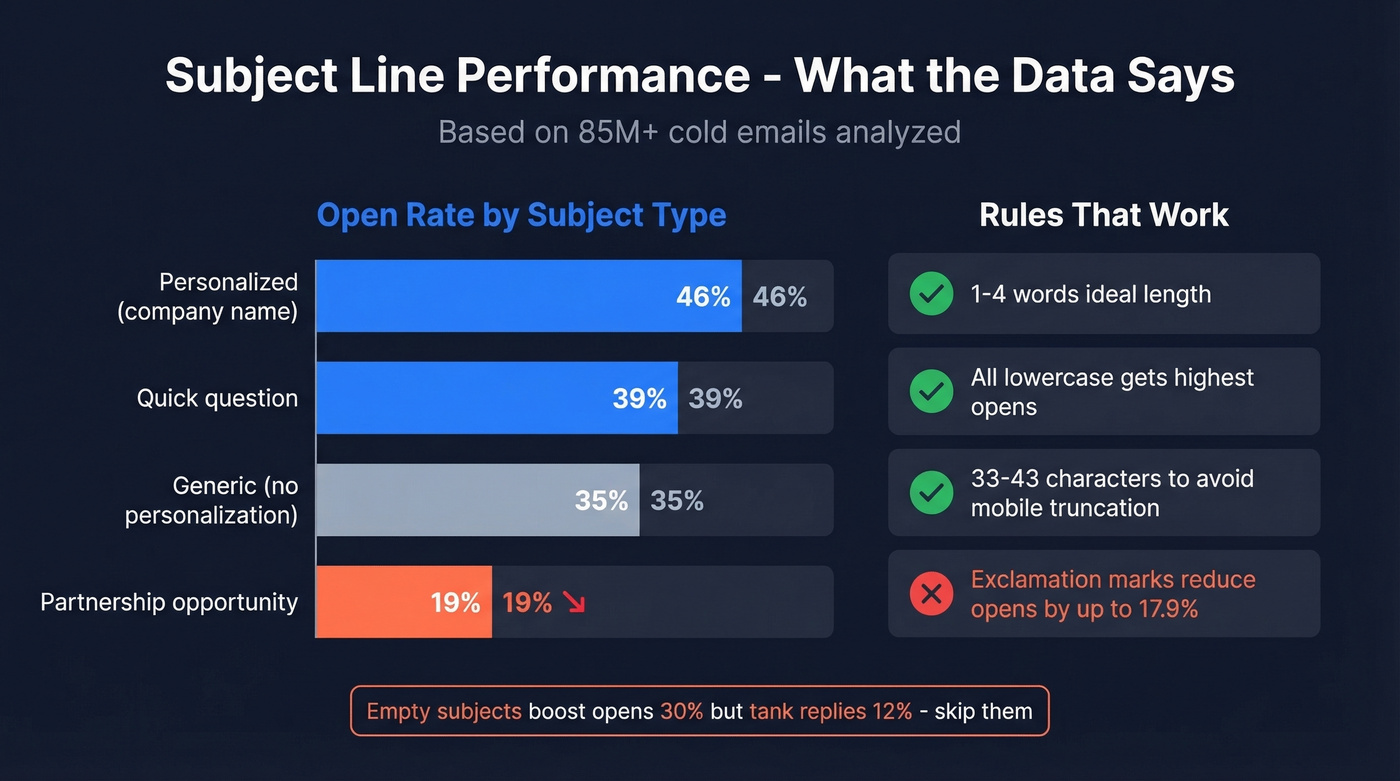
Personalized subject lines hit 46% open rates vs. 35% without. In that Reddit case study, "Quick question" pulled 39% opens, company-name subjects hit 33%, and "Partnership opportunity" cratered below 19%. A/B test subject lines weekly. Top performers iterate constantly.
Skip empty subject lines. They boost opens by 30% but tank reply rates by 12%. You want replies, not opens. Keep subjects to 33-43 characters so they don't truncate on mobile.
Opening Line
Only 5% of senders personalize every email. Those who do get 2-3x better results.
The best opening lines stack personalization layers: role context, company news, industry dynamics, and timing signals. Trigger-event targeting - referencing a recent funding round, a key hire, or a product launch - delivers 2.3x higher reply rates. "Saw you just raised a Series B" beats "I help companies like yours" every single time, because it proves you actually looked at their business before hitting send. If you want a system for this, use sales prospecting techniques and a tighter ideal customer profile.
Body and CTA
Keep it under 80 words. That same case study cut emails from 141 words to under 56 and saw immediate improvement. Every extra sentence is a reason to stop reading.
Use a low-friction CTA like "Worth a quick look?" or "Open to a 10-minute chat?" If you need more options, see email call to action examples. When you follow up, make it feel like a reply, not a formal second attempt. Follow-ups that read like casual replies outperform structured follow-ups by ~30%. You can also borrow structure from these cold email follow-up templates.
One note on seniority: executive-level prospects often require more touches than mid-level contacts, but those touches need to be higher quality. Don't blast your VP list with the same seven-step sequence you use for managers.

You just read that bounces above 2% kill reply rates. Prospeo's 5-step email verification delivers 98% accuracy with a 7-day data refresh - so every prospecting introduction email you send actually lands. 75 free verified emails per month, no credit card.
Fix your list before you fix your copy.
Prospecting Introduction Email Templates
You don't need a dozen templates. You need five good ones and verified data.
Cold Introduction (No Prior Contact)
Subject: {{company}} + {{your company}}
Hi {{first_name}}, noticed {{specific company detail - recent blog post, product update, job listing}}. We help {{role type}} at companies like {{similar customer}} do {{specific outcome}}. Worth a quick look? - {{your name}}
52 words. No fluff, one CTA, one detail that proves you did your homework.
Trigger Event
Subject: congrats on the round
Hi {{first_name}}, saw {{company}} just {{closed Series B / hired a new VP Sales / launched in EMEA}}. Teams at that stage usually hit {{specific problem}}. We helped {{similar company}} solve that in {{timeframe}}. Happy to share how - interested?
48 words. Trigger events work because they prove relevance and timing.
Referral - Before and After
Most people bury the referral name. Don't.
Weak version: "Hi {{first_name}}, I wanted to reach out because I think our solution could help your team. By the way, {{mutual connection}} suggested I contact you."
Strong version:
Subject: {{mutual connection}} suggested I reach out
Hi {{first_name}}, {{mutual connection}} mentioned you're working on {{initiative}}. We helped their team with {{outcome}}. Worth 10 minutes this week?
30 words. Name-drop in the first line or don't bother.
Re-Engagement vs. Follow-Up
These serve different purposes. Re-engagement revives a dead thread. Follow-ups continue an active sequence.
Re-engagement (gone cold - format it to look like a reply, no formal re-intro):
Subject: re: {{original subject}}
Hey {{first_name}}, circling back. Wanted to share {{new data point or resource}} relevant to {{their initiative}}. Still on your radar?
Follow-up (after no response - every touch adds new value, never just "checking in"):
Subject: re: {{original subject}}
{{first_name}} - quick bump. Since my last note, we {{new proof point: case study, signed a competitor, released a feature}}. Worth a conversation?
42% of replies come from follow-ups. Don't give up after one send.
Timing and Sequencing
Send Tuesday through Thursday, 8-11 AM in the recipient's timezone. Wednesday consistently shows the highest reply rates. Shifting sends to this window improved opens by 16% in the Reddit case study. If you want a deeper breakdown, see the best time to send cold emails.
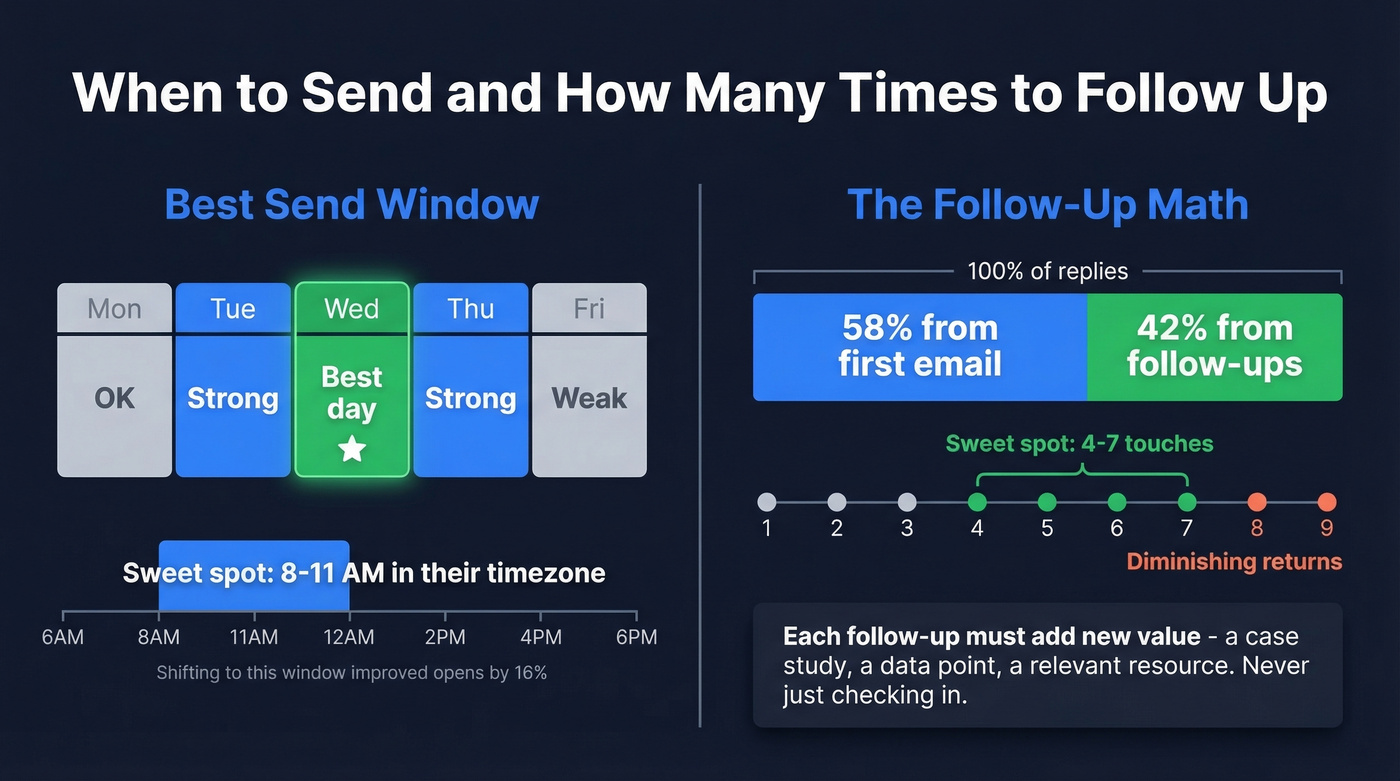
The 4-7 touchpoint range is the sweet spot. 58% of replies come from the first email; 42% come from follow-ups. Fewer than 4 touchpoints means you're giving up too early. More than 7 sees diminishing returns unless each touch adds genuine new value - a new case study, a relevant industry stat, something that justifies the inbox space.
What Separates 3% From 10%
Here's the thing: if you're selling deals under $10k, you don't need a $2,000/month sales stack. You need clean data and tight copy. If you're building the rest of your outbound motion, start with a solid B2B cold email sequence and a clear email deliverability guide.
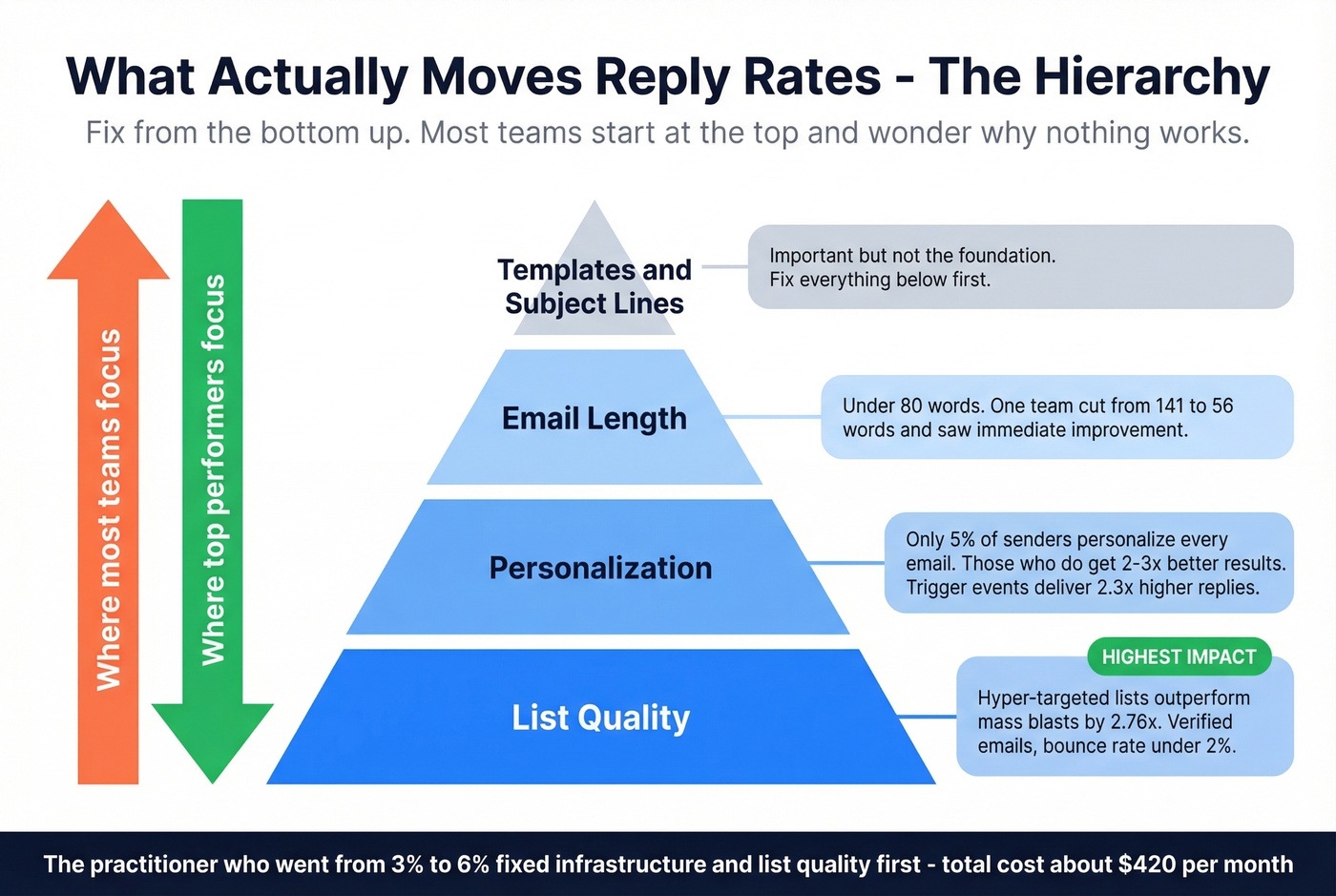
One practitioner rebuilt everything: 7 domains at 26 emails/day each, emails cut from 141 to under 56 words, bounce rate dropped from 11% to under 2%, hyper-personalized opening lines. Total stack cost: ~$420/month. Output: 16 qualified leads per month, reply rate doubled from 3% to 6%.
In our experience, the hierarchy is always the same. Hyper-targeted lists outperform mass blasts by 2.76x. List quality matters more than personalization, which matters more than email length, which matters more than templates. We've seen teams obsess over subject line A/B tests while sending to lists with 15% bounce rates. Fix the foundation first. The replies follow.
Templates don't matter if half your list is outdated. Prospeo gives you 300M+ profiles with 30+ filters - buyer intent, job changes, funding rounds - so every trigger-event email hits a real person at the right moment. At $0.01 per email, bad data is a choice.
Send 500 prospecting emails and actually get replies this time.
FAQ
What's a good reply rate for a prospecting introduction email?
Average is 3.43%. Top quartile hits 5.5%+. Above 10% puts you in the top 10% of cold emailers. If you're below 2%, your list quality or deliverability infrastructure needs work before you touch your copy.
How many follow-ups should I send?
Four to seven. 42% of replies come after the first email, but beyond 7 touches returns diminish sharply. Each follow-up should add new value - a case study, a data point, or a relevant resource. Skip "just checking in" entirely.
How do I verify email addresses before sending?
Use a dedicated verification tool that checks for catch-all domains, spam traps, and honeypots. Prospeo's 5-step verification process delivers 98% accuracy with a 7-day refresh cycle, and the free tier (75 emails/month) lets you test list quality before committing to a paid plan.
How do I make sure my emails reach the inbox?
Set up SPF, DKIM, and DMARC on every sending domain. Verify every email address before sending. Keep bounces under 2% and spam complaints under 0.3%. Warm new domains at 5-10 sends per day, scaling gradually over 4-6 weeks. And turn off open tracking unless you're using a branded tracking domain - shared ones are a deliverability killer.