

Purchasing Contact Lists: What to Know Before You Spend a Dollar
A RevOps lead we know bought 10,000 contacts from a "premium" list broker last year. Within 72 hours, their ESP suspended the account. Within a week, their sending domain landed on a blocklist. The $2,500 they spent turned into $15,000 in lost pipeline and three weeks of deliverability rehab.
That story isn't unusual when purchasing contact lists - it's the norm.
What You Need (Quick Version)
- Buying static contact lists for email outreach is the wrong move - bounce rates, ESP bans, and legal fines make it a losing bet.
- If you need lists for direct mail or telemarketing, Bookyourdata or Data Axle are solid pay-as-you-go options.
What "Buying Contact Lists" Actually Means
There's a meaningful distinction most articles blur. On one side, you've got static list brokers - companies like Experian, DirectMail.com, and Data Axle that sell CSVs of names, addresses, and sometimes phone numbers. These have been around for decades and serve direct mail and telemarketing well.
On the other side, you've got modern prospecting platforms that let you build targeted contact lists on demand with real-time verification. These aren't "purchased lists" in the traditional sense. Purchased data is contact intelligence, not permission to blast marketing campaigns. That distinction drives everything: legal risk, deliverability, and whether your domain survives the first send.
The Legal Reality
Here's what you're risking.
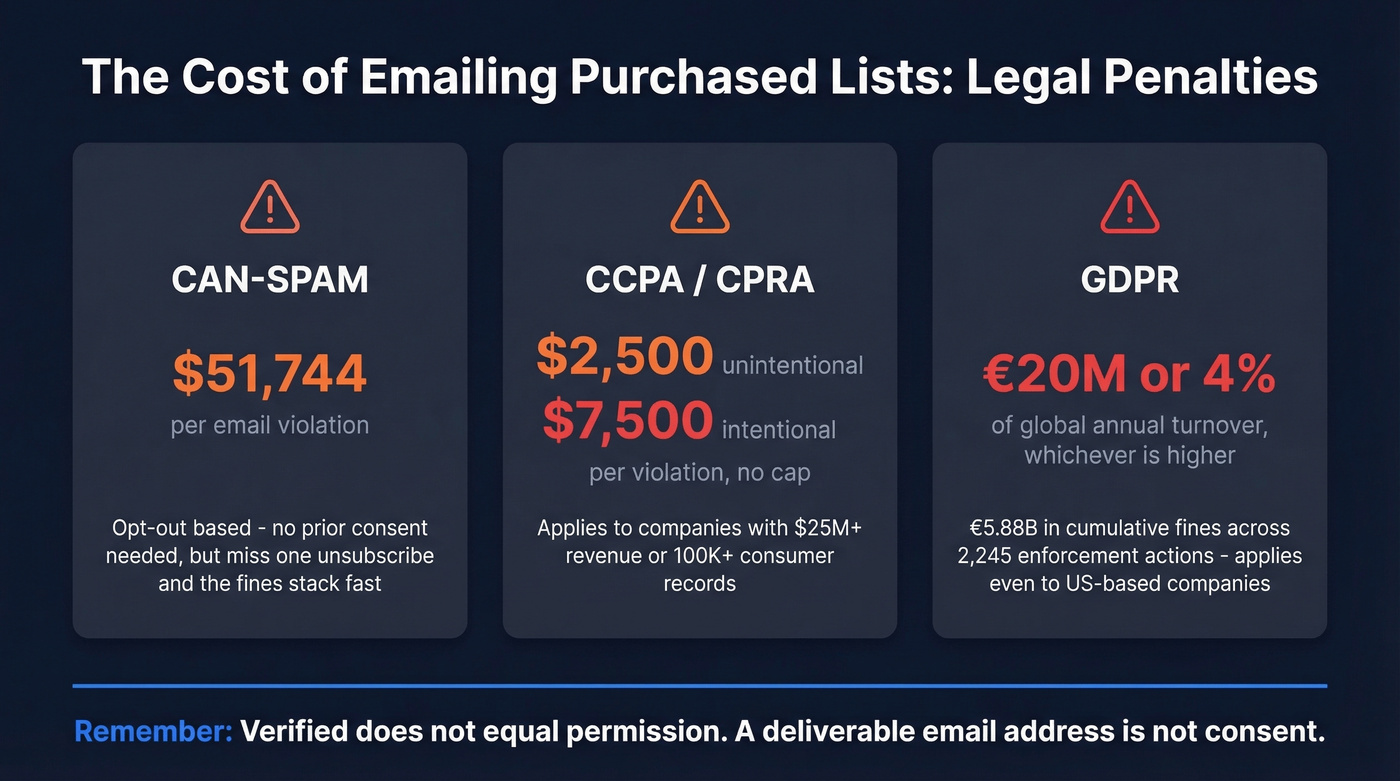
CAN-SPAM
CAN-SPAM is opt-out based, meaning you don't technically need prior consent to email someone in the US. But violations carry fines of up to $51,744 per email. Per email. Miss an unsubscribe request on a 5,000-contact blast and the math gets ugly fast.
CCPA/CPRA
Per-violation penalties hit $2,500 for unintentional violations and $7,500 for intentional ones, with no cap. If you're processing data from California residents - and you probably are - this applies to companies with $25M+ revenue or those handling 100,000+ consumer records.
GDPR
The big one for anyone emailing EU contacts. Maximum penalties reach euro20M or 4% of global annual turnover, whichever is higher. Cumulative GDPR fines have hit roughly euro5.88B across 2,245 enforcement actions. GDPR applies extraterritorially - being based in the US doesn't protect you.
The state-level patchwork makes this worse. Delaware, Iowa, Nebraska, and New Hampshire all have privacy laws in effect, as do New Jersey, Maryland, and Minnesota - each with its own nuances and active enforcement in 2026. "We didn't know" isn't a defense.
Here's the thing: "verified" on a purchased list means the email address is technically deliverable. It doesn't mean the person consented to hear from you. Verified doesn't equal permission.
What Happens When You Email a Purchased List
The legal risk is theoretical until it isn't. The deliverability damage is immediate.
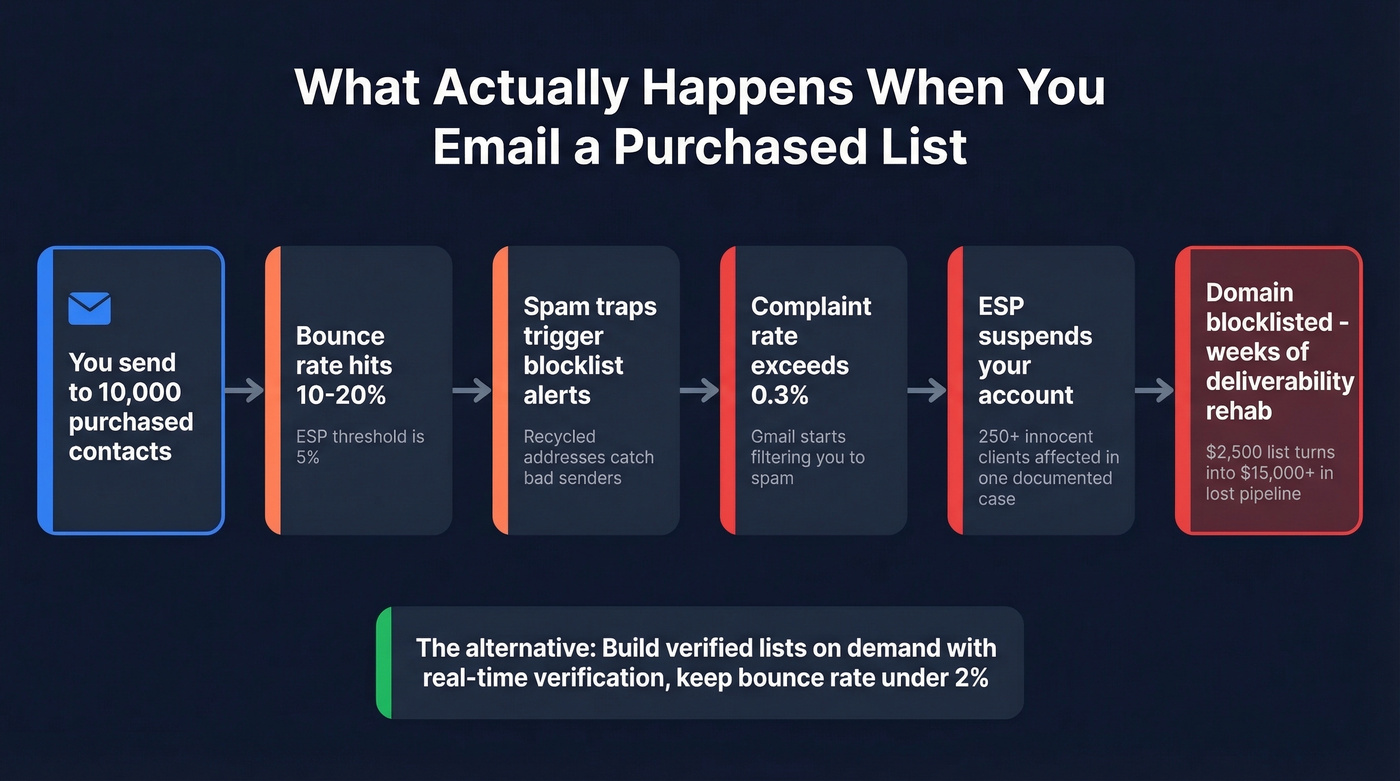
Purchased lists correlate with spam trap hits - recycled email addresses that ISPs and blocklist operators use specifically to catch senders using bad data. One documented case: Spamhaus blocklisted 255 IP addresses, affecting 250+ innocent clients, because a single sender on a shared ESP sent to a purchased list. That's not just your domain getting hurt. That's everyone on your ESP's infrastructure.
Gmail reacts when spam complaint rates exceed 0.3%. Purchased lists blow past that threshold on the first send. And legitimate ESPs prohibit sending to purchased lists - they'll shut you down without warning because one bad sender can poison shared infrastructure.
Here's what inbox placement looks like even under normal conditions:
| ISP | Inbox | Spam | Missing |
|---|---|---|---|
| Gmail | 87.2% | 6.8% | 6.0% |
| Microsoft | 75.6% | 14.6% | 9.8% |
| Yahoo/AOL | 86.0% | 4.8% | 9.2% |
| Apple Mail | 76.3% | 14.3% | 9.4% |
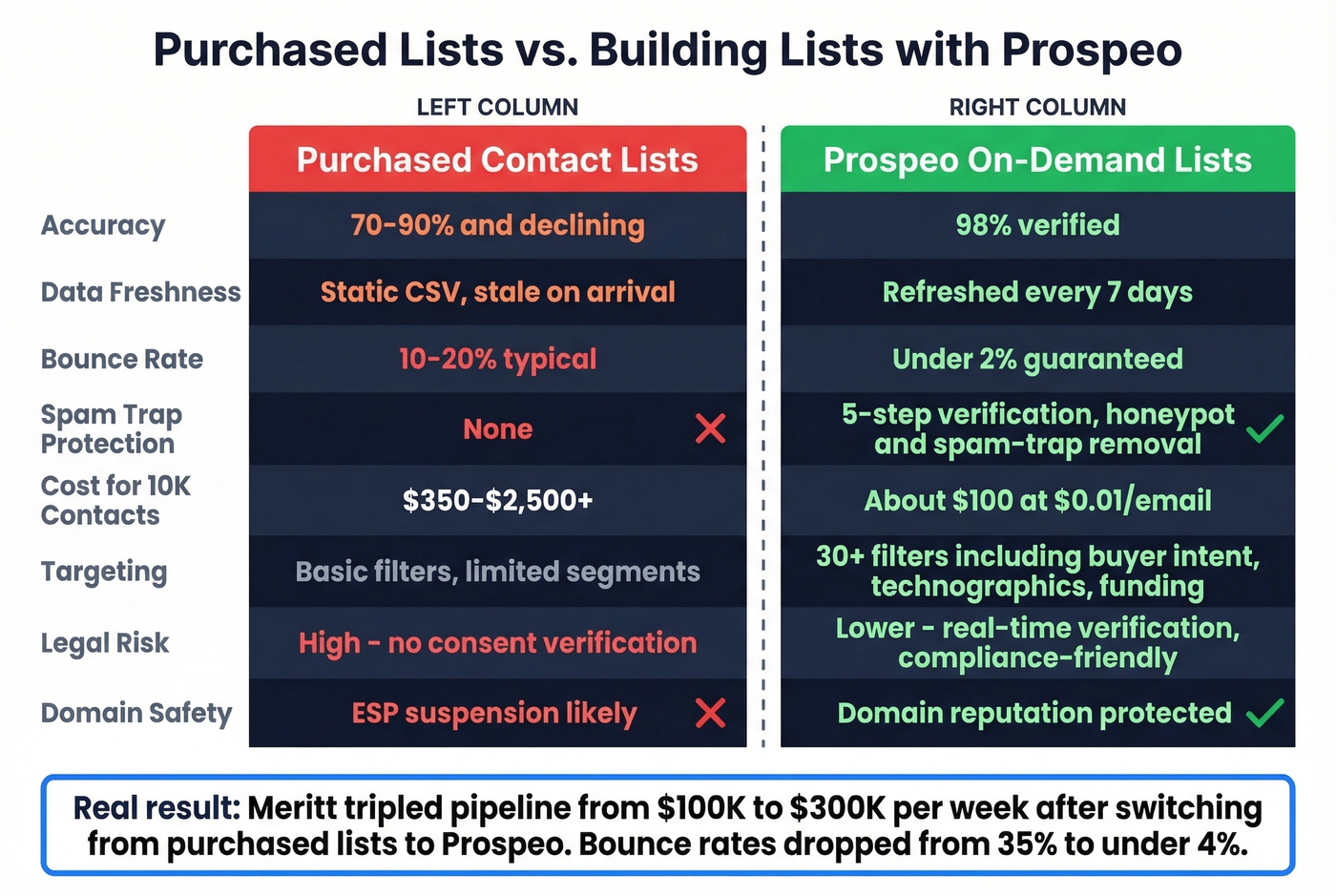
That's with clean, opted-in lists. With purchased data, expect those inbox numbers to crater. A healthy cold email bounce rate sits under 2%. Above 5% and you're risking domain reputation damage and ESP suspension. In our experience, the 5% threshold is generous - most platforms start throttling well before that. Purchased lists regularly exceed 10-20% bounces.
If you want a deeper breakdown of what "too high" looks like, start with bounce rate benchmarks and remediation.

Purchased lists decay at 22% per year. Prospeo refreshes all 300M+ profiles every 7 days - not every 6 weeks like competitors. Every email is run through 5-step verification with spam-trap and honeypot removal, delivering 98% accuracy and keeping your bounce rate under 2%.
Stop buying lists that expire. Build them fresh for $0.01 per email.
Data Decay: Why Lists Go Stale
Even if you buy a "fresh" list, it starts dying the moment you receive it. Business email data decays at roughly 22% per year - about 2% per month. People change jobs, companies shut down, email servers get decommissioned.
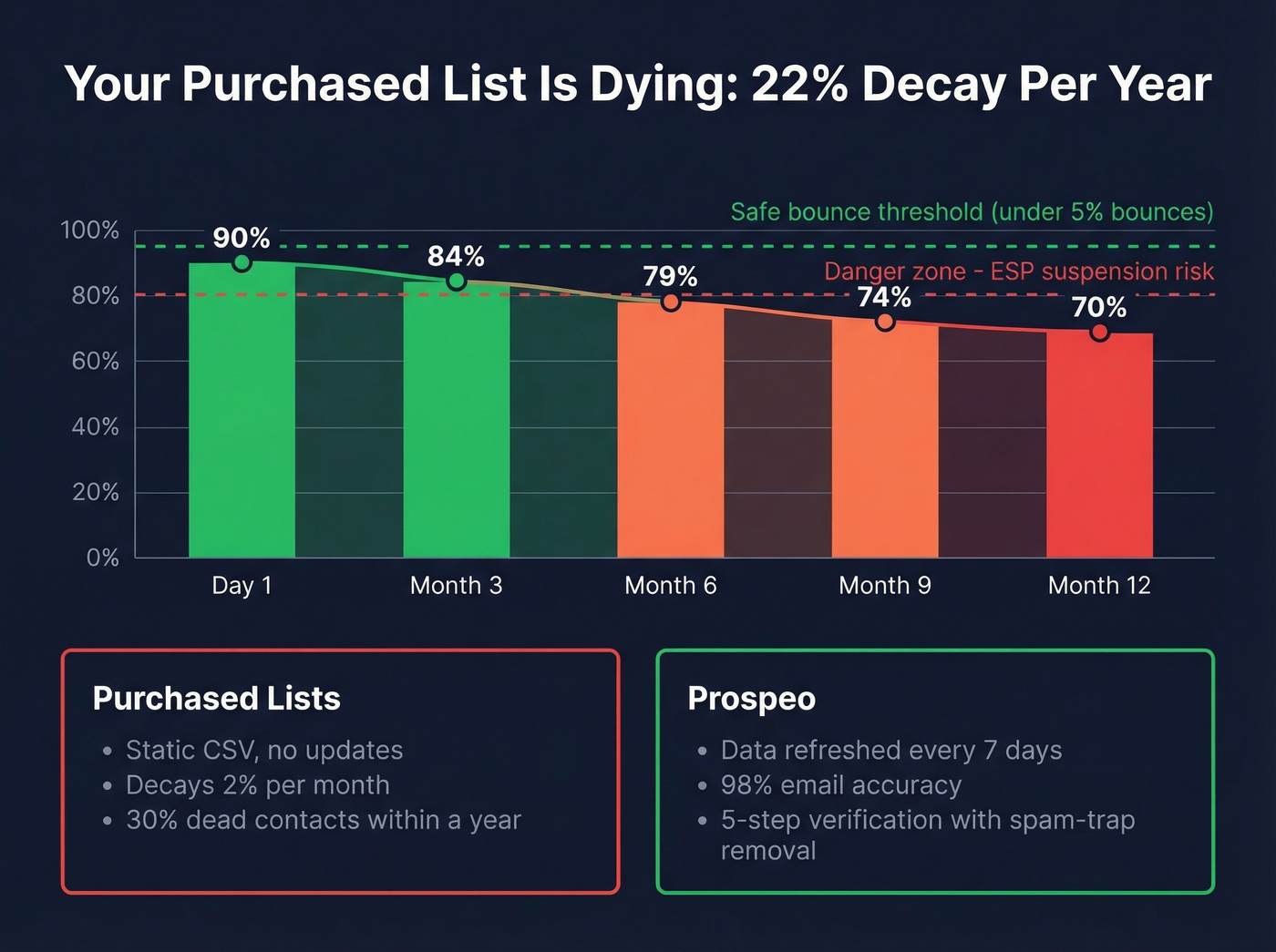
A list that was 90% accurate when you bought it drops to roughly 70% within a year. Nearly a third of your sends are bouncing, hitting spam traps, or reaching someone who hasn't worked at that company in months. Tie that back to the 5% bounce threshold and the problem is obvious: a six-month-old purchased list is a deliverability time bomb.
When Buying Contact Data Makes Sense
Let's be honest - there are legitimate use cases for purchased contact data. Not many, but they exist:
- Direct mail campaigns where you need physical addresses at scale
- Telemarketing where phone numbers matter more than email deliverability
- One-time event outreach like trade show invitations or local market saturation
- Geographic saturation for regional businesses targeting specific zip codes
For email outreach, it's the wrong move. The economics collapse when your bounce rate tanks your domain reputation on the first campaign.
If your average deal size is under $10K, you don't need purchased lists at all. A $39/month prospecting tool and 30 minutes of targeting will outperform a $2,500 list every single time.
Where to Buy Marketing Lists (If You Must)
Pricing depends heavily on whether you're buying consumer direct mail, business direct mail, telemarketing data, or email addresses.
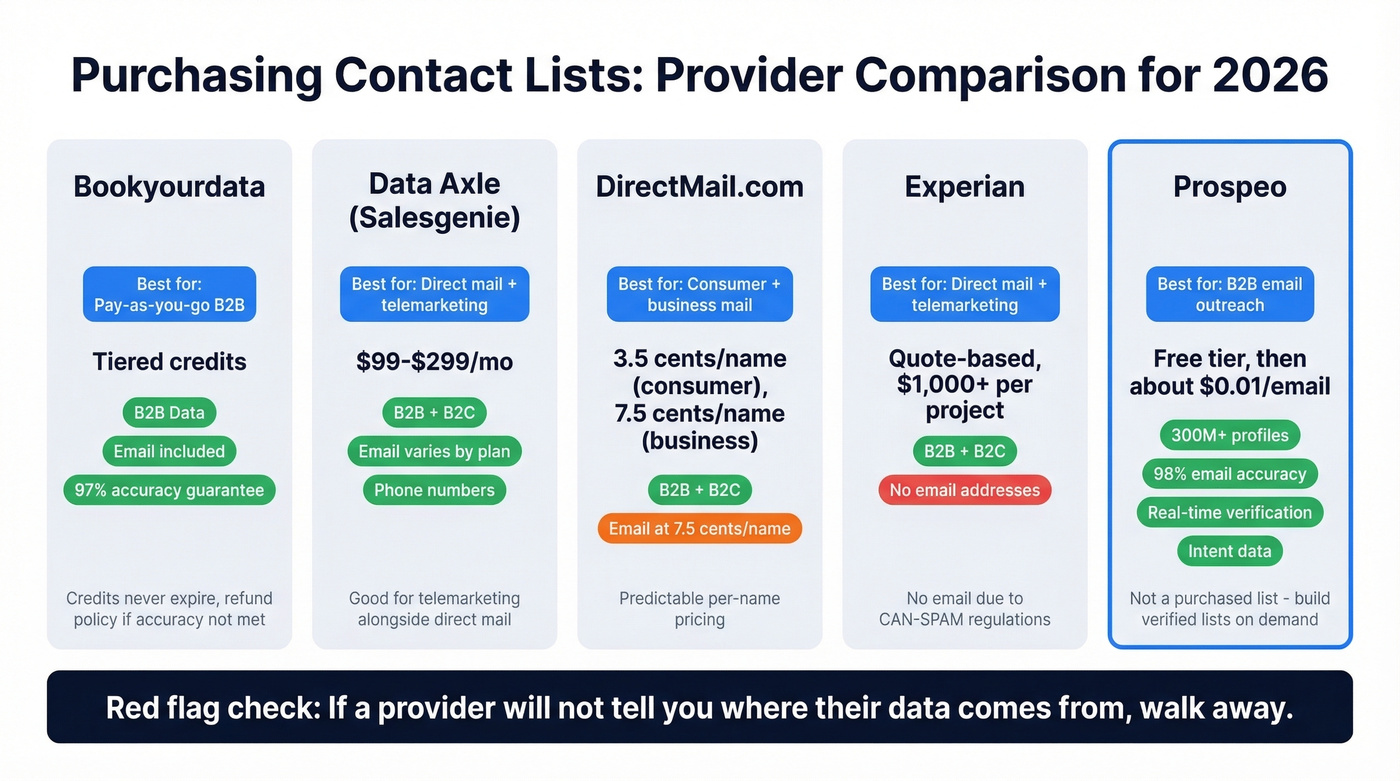
DirectMail.com lists start as low as 3.5 cents per name for consumer lists and 7.5 cents per name for business lists - so 10,000 names can be as little as $350-$750 before any selects or add-ons. Email lists start at 7.5 cents per name. More targeted B2B datasets and "premium" brokers can run into the thousands depending on filters, recency, and whether phone numbers are included.
Here's how the providers break down for direct mail and telemarketing use cases:
| Provider | Best For | Pricing | Data Type | Email? |
|---|---|---|---|---|
| Bookyourdata | Pay-as-you-go B2B | Tiered credits; no subscription | B2B | Yes |
| Data Axle (Salesgenie) | Direct mail + tele | $99-$299/mo | Both | Yes (varies by package) |
| DirectMail.com | Consumer + business mail | 3.5 cents/name (consumer); 7.5 cents/name (business) | B2C/B2B | 7.5 cents/email |
| Experian | Direct mail + telemarketing | Quote-based, commonly $1,000+ per project | Both | No |
Bookyourdata is a strong option for B2B teams that genuinely need a static list. They offer a 97% accuracy guarantee and a policy to refund credits if accuracy isn't met, plus pay-as-you-go credits that never expire.
Data Axle works well for teams running telemarketing campaigns alongside direct mail. Salesgenie plans run $99/month (Basic), $149/month (Pro), and $299/month (Team).
DirectMail.com's per-name pricing keeps costs predictable for consumer and business mailing lists.
Experian handles business and consumer prospect lists for direct mail and telemarketing, but due to CAN-SPAM regulations, their lists don't include email addresses. Pricing is quote-based, and projects commonly start around $1,000+.
If a provider won't tell you where their data comes from, walk away. No sourcing transparency, no accuracy guarantee, no replacement policy, no recent verification timestamps? That's a red flag, not a vendor.
If you're evaluating vendors, compare them against modern email list providers and broader sales prospecting databases before you commit.
The Smarter Alternative: Build Verified Lists on Demand
Email data quality varies wildly across providers. That's why the tool you choose matters more than the size of its database - verification, refresh cycles, and filtering are what keep your bounce rate under control.
Prospeo
Instead of buying a stale CSV, you build targeted lists from 300M+ professional profiles - 143M+ verified emails and 125M+ verified mobile numbers - with real-time email verification and 98% email accuracy.

Prospeo runs a 5-step verification process with catch-all handling, spam-trap removal, and honeypot filtering. Meritt saw their pipeline triple from $100K to $300K/week after switching from purchased lists - bounce rates dropped from 35% to under 4%. Data refreshes every 7 days versus the 6-week industry average, so you're not fighting decay.
The 30+ search filters include buyer intent signals powered by Bombora across 15,000 topics, technographics, job changes, headcount growth, and funding data. Pricing starts free with 75 emails/month, and paid plans run about $0.01 per email. No contracts, no sales calls required.
If you want to operationalize this, use an Ideal Customer Profile and a repeatable lead generation workflow so list building doesn’t turn into random scraping.
That $2,500 purchased list will tank your domain. Prospeo gives you 30+ filters - buyer intent, technographics, funding, headcount growth - to build targeted lists on demand with real-time verification. Teams using Prospeo book 35% more meetings than Apollo users and keep bounce rates under 4%.
Replace purchased lists with verified contacts you actually control.
Apollo
Apollo's free tier is genuinely useful - you get limited monthly credits and access to sequence automation, making it a solid starting point for teams that want prospecting and outreach in one platform. Paid plans start at $49/mo per user, scaling to $199/mo for the Organization tier. The database is large, the UI is intuitive, and the built-in email sequences save you from buying a separate tool.
ZoomInfo
The most comprehensive B2B data platform on the market - and priced accordingly. Annual contracts start at $15,000-$18,000 for Professional, climbing to $35,000-$45,000+ for Elite. Renewals typically increase 10-20%. Excellent data if you're a 50+ rep org that can justify the spend. Overkill for everyone else.
Lusha
Skip this if you need bulk list building. Lusha is built for quick lookups, not volume. Free tier gives you 70 credits/month. Phone reveals cost 10 credits each, so heavy dialers burn through credits fast.
Hunter.io
Best for domain searches - paste a company domain and get every email pattern associated with it. Free tier available, paid plans start around 28 pounds per user/month billed annually. It's not a full prospecting platform, but it's a useful complement if you already know which companies you're targeting.
Always Verify Before You Send
Whether you build a list or buy one, verification isn't optional. Here's what standalone verification costs:
- Bouncer: $0.008/email or $24/month
- ZeroBounce: from $18/month
- Kickbox: $5 for 500 credits
If your first send exceeds 5% bounces, stop immediately. Don't send the second batch. We've seen teams recover from purchased-list damage in as little as three weeks - but only if they stop sending before the domain takes permanent damage. Also consider DNC screening if you're running any phone outreach alongside email.
If you're already in trouble, start with spam trap removal and then work through a full email deliverability guide to rebuild reputation safely.
FAQ
Is it legal to buy email lists?
In the US, CAN-SPAM doesn't prohibit purchasing contact lists outright, but fines reach $51,744 per email for violations like missing unsubscribe links. GDPR applies to EU contacts with penalties up to euro20M or 4% of global turnover. Legal doesn't mean safe - your ESP will ban you before regulators notice.
How much do marketing contact lists cost?
DirectMail.com lists start at 3.5 cents per name (consumer) and 7.5 cents per name (business); email lists start at 7.5 cents per name. Salesgenie plans run $99-$299/month. B2B prospecting platforms range from free tiers to $45,000+/year for ZoomInfo.
Why do ESPs ban purchased lists?
High bounce rates and spam complaints damage shared sending infrastructure. One bad sender on a shared IP can get hundreds of accounts blocklisted - Spamhaus once blocked 255 IPs over a single purchased-list sender.
What's the difference between buying a list and using a prospecting tool?
A purchased list is a static CSV that decays roughly 2% per month with no refresh mechanism. Prospecting tools build fresh, verified lists on demand with real-time data, targeting filters, and weekly data refreshes - keeping bounce rates under control.
What bounce rate is too high for cold email?
Under 2% is healthy for cold outreach. Above 5% risks domain reputation damage and ESP suspension. Purchased lists regularly hit 10-20% bounces on the first send, well past the danger threshold.