

Quality Lead Generation: The System That Turns Leads Into Revenue
Your marketing team generated 1,877 leads last month. Sounds great - until you realize 79% of marketing leads never convert to sales. That's not a lead generation problem. It's a lead quality problem. And in a B2B lead generation services market projected to reach $32.85B by 2035, the teams that win aren't generating more leads. They're generating better ones.
The fix comes down to three things: choosing channels with proven ROI, qualifying with structured frameworks, and starting with verified contact data. Most quality lead generation advice focuses on the first two. The silent killer is actually the third - your data. We'll get to why.
What "Quality" Actually Means
Quality lead generation is the practice of attracting prospects who match your ideal customer profile, have a real need, and are likely to buy. It's the opposite of the "spray and pray" approach that fills your CRM with thousands of contacts nobody calls.
The distinction matters more now than it did five years ago. Modern B2B deals involve 6-10+ stakeholders in the buying group. You're not selling to a person - you're selling to a committee. A junior analyst downloading a whitepaper is fundamentally different from a VP of Engineering visiting your pricing page for the third time this week. And the shift isn't just from volume to quality - it's from individual leads to buying groups. Qualifying a single contact is insufficient when a committee makes the decision. You need account-level intent signals that tell you the company is in-market, not just one person.
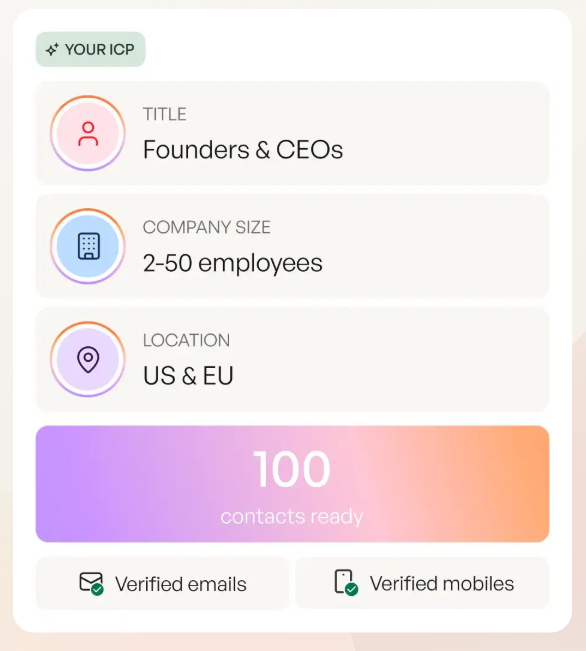
An ICP-first approach flips the funnel. Instead of generating leads and then figuring out which ones are good, you define what "good" looks like first - industry, company size, tech stack, buying signals - and then build campaigns that attract prospects matching those specific profiles. Volume drops. Conversion rates climb. Sales stops complaining.
Best Channels for High-Quality Leads
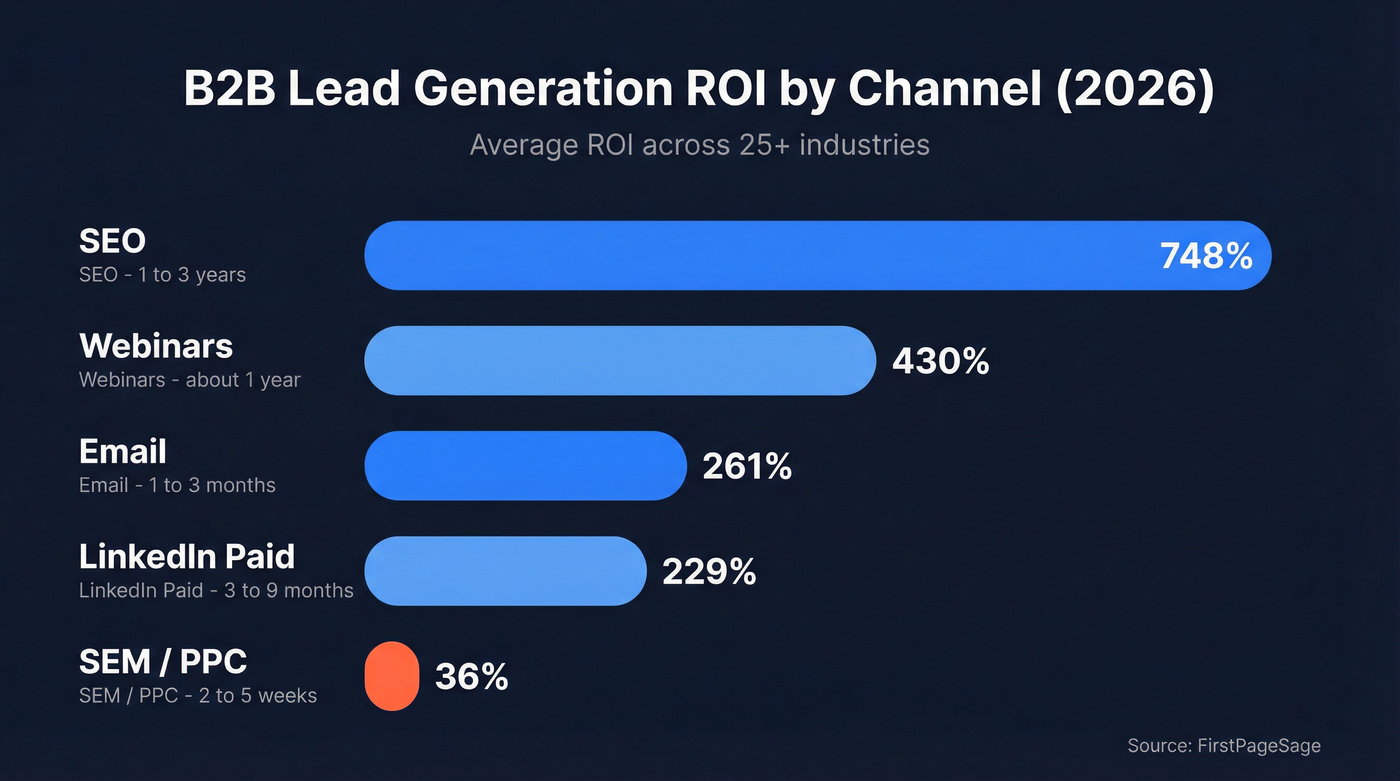
The ROI gap between channels is wider than most teams realize. Here's the data across 25+ industries:
| Channel | B2B ROI | Monthly Cost | Time to Return |
|---|---|---|---|
| SEO | 748% | $2k-$15k | 1-3 years |
| Webinars | 430% | ~$6k | ~1 year |
| 261% | $500-$5k | 1-3 months | |
| LinkedIn Paid | 229% | $5k-$20k | 3-9 months |
| SEM/PPC | 36% | $3k-$30k | 2-5 weeks |
SEO & Content
SEO's 748% ROI isn't a typo - it's the compounding effect of content that keeps generating leads for years after you publish it. Content marketing generates 3x more leads than outbound at 62% lower cost. The catch is patience. Companies publishing 16+ posts per month see 4.5x more leads, but it takes 1-3 years to see full returns. This is a foundation, not a quick win.
Webinars & Email
Webinars are the quality play. 73% of B2B marketers say webinars produce their best leads, and the average CPL is just ~$72 - compared to ~$92 for SEM and a brutal ~$811 for trade shows. Email remains the workhorse at 261% ROI. Cold email in the 15-25% open range with 1-5% reply rates still moves pipeline when the list is clean.
Paid Channels & ABM
Here's the thing about SEM: 36% ROI looks terrible next to SEO's 748%, but SEM delivers results in 2-5 weeks. It's an accelerant, not a strategy.
LinkedIn deserves attention too - 89% of B2B marketers use it for lead gen, and Lead Gen Forms convert at roughly 13% versus 2.74% for standard visitor-to-lead flows. ABM is where the real quality conversation gets interesting: 97% of B2B marketers report ABM delivers higher ROI than other approaches, with 28% faster sales cycles. Layer in intent data and you're looking at 93% higher conversion rates.
A survey of 337 marketing professionals shows 24% expect email to deliver the highest ROI in 2026, followed by paid social and search at 20% each. The theme is clear - measurable, targetable channels win under budget pressure. The era of "let's sponsor a conference and hope for the best" is fading fast.
How to Qualify Leads
Generating qualified prospects is half the battle. The other half is qualifying them before they eat up your sales team's time. We've seen teams burn entire quarters chasing leads that were never going to close - all because they didn't have a qualification framework in place.
BANT: The Quick Pre-Filter
Picture this: your SDR gets a hand-raise from a 15-person startup. Budget? Nonexistent. Authority? The intern filled out the form. Need? Maybe, someday. Timeline? "Next year, probably."
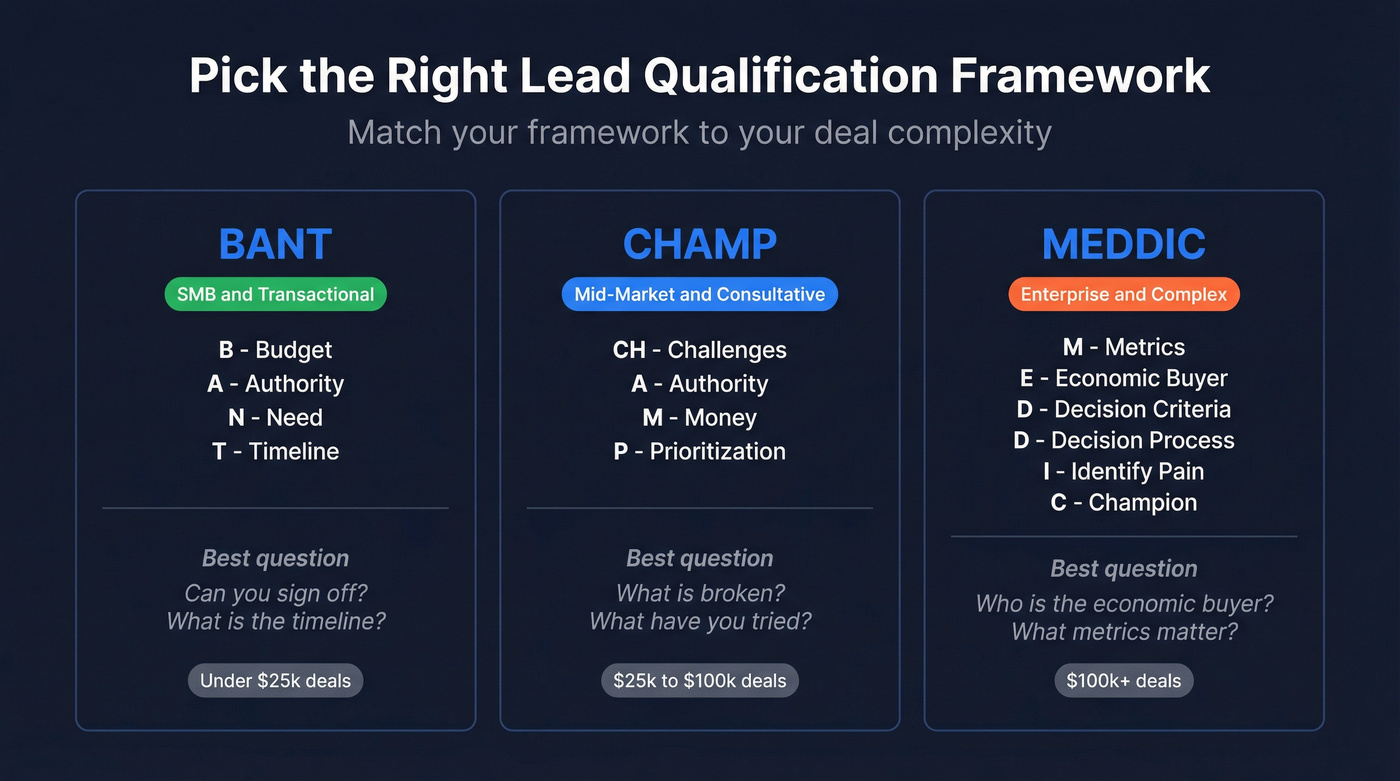
BANT - Budget, Authority, Need, Timeline - catches this in 90 seconds. For SMB and transactional deals with smaller contract values, BANT gets you 80% of the way there.
CHAMP: Buyer-Centric Discovery
CHAMP flips the script by leading with Challenges instead of Budget. This matters in consultative sales where the prospect doesn't know their budget until they understand the problem. The key question isn't "what can you spend?" but "what's broken?" If your sales motion is solution-selling to mid-market, CHAMP surfaces pain that justifies budget creation - not just budget confirmation.
MEDDIC: Enterprise Deals
If you're selling enterprise and still using BANT alone, you're leaving money on the table. MEDDIC - Metrics, Economic Buyer, Decision Criteria, Decision Process, Identify Pain, Champion - was built for complex, multi-stakeholder deals where a single "yes" isn't enough. Our gating rule: require at least Metrics + Economic Buyer + Pain + Champion before investing heavy sales effort. Skip any of those four and your 6-month deal cycle becomes a 12-month loss.
Which Framework to Use When
| Framework | Best For | Key Questions | When to Use |
|---|---|---|---|
| BANT | SMB, transactional | "Can you sign off? What's the timeline?" | Top-of-funnel filter |
| CHAMP | Consultative sales | "What's broken? What have you tried?" | Mid-market discovery |
| MEDDIC | Enterprise, complex | "Who's the economic buyer? What metrics matter?" | Pipeline qualification |
Most teams don't need all three. Pick one that matches your average deal complexity and actually enforce it in your CRM. AI-driven lead scoring improves qualification accuracy by roughly 40% over manual methods, so layer automation on top of whichever framework you choose. A framework nobody uses is worse than no framework at all.
Using Intent Signals to Prioritize
89% of B2B buyers research independently before ever talking to sales. By the time someone fills out your demo form, they've already visited your pricing page, read three competitor reviews, and watched a webinar. The question is whether you're tracking those signals or flying blind.
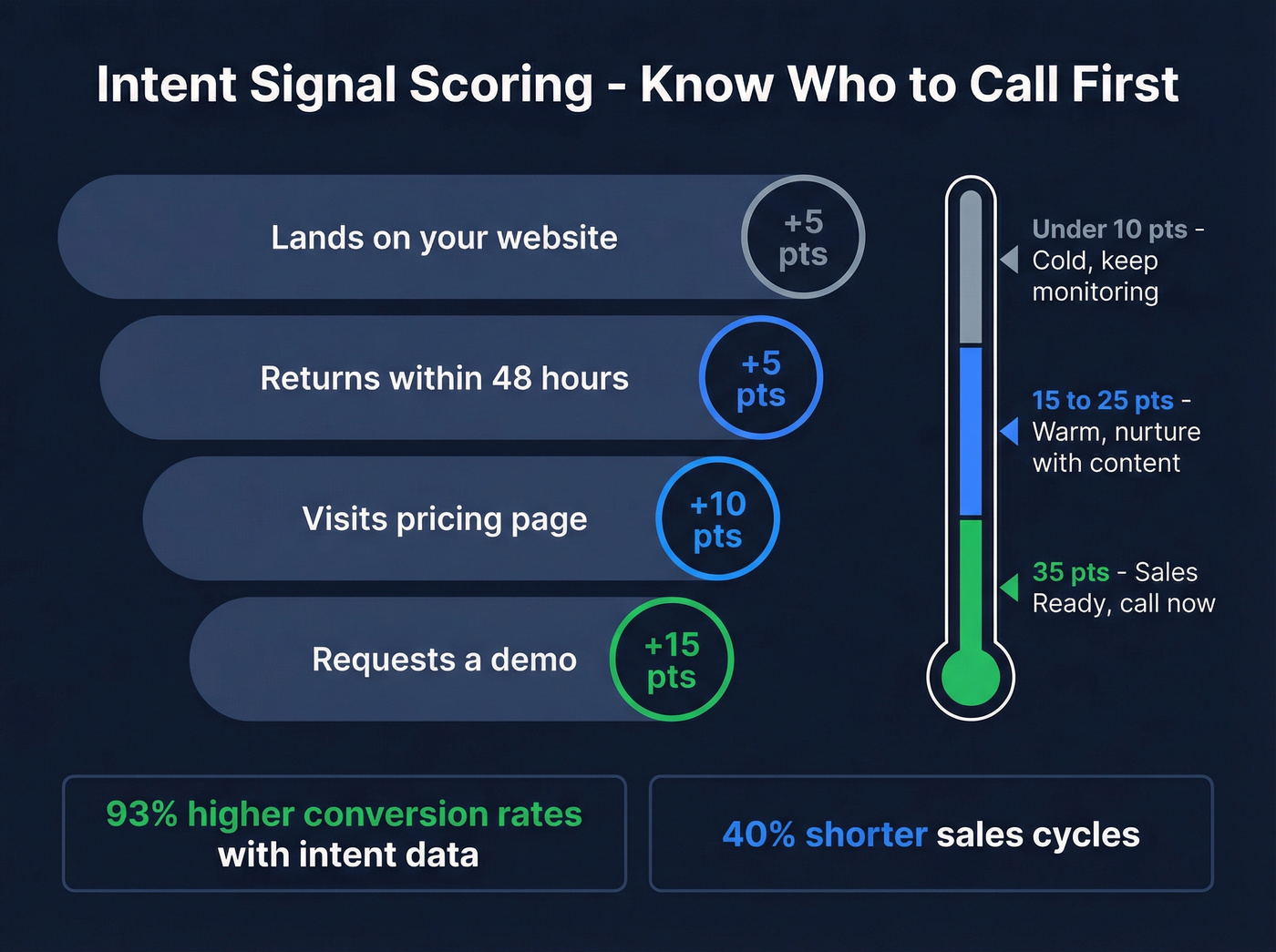
First-party intent is what happens on your own properties - pricing page visits, content downloads, return visits within 48 hours. Third-party intent tracks activity elsewhere: review site research, competitor comparisons, topic-level interest across the web.
Here's a starting scoring framework:
- Lands on your website: +5 points
- Returns within 48 hours: +5 points
- Visits pricing page: +10 points
- Requests a demo: +15 points
Teams using intent data report 93% higher conversion rates and 40% shorter sales cycles. That's the difference between a team that hits quota and one that doesn't. What kills pipeline is always the same two things: bad data and slow follow-up. Intent data solves prioritization by telling you who to call. Speed-to-lead solves the second.
Let's be honest - if your average deal size is under $15k, you probably don't need a $50k/year intent data platform. A well-configured lead scoring model using first-party signals and a verified contact database gets you 80% of the value at 10% of the cost.

You just read that 79% of marketing leads never convert. The silent killer? Bad data. Prospeo's 300M+ profiles are verified through a 5-step process with 98% email accuracy and a 7-day refresh cycle - so every lead you generate is actually reachable.
Stop generating leads that bounce. Start generating leads that buy.
Data Quality Is the Foundation
Here's the contrarian thesis of this entire article: the biggest threat to your lead quality isn't your strategy, your channels, or your qualification framework. It's your data.
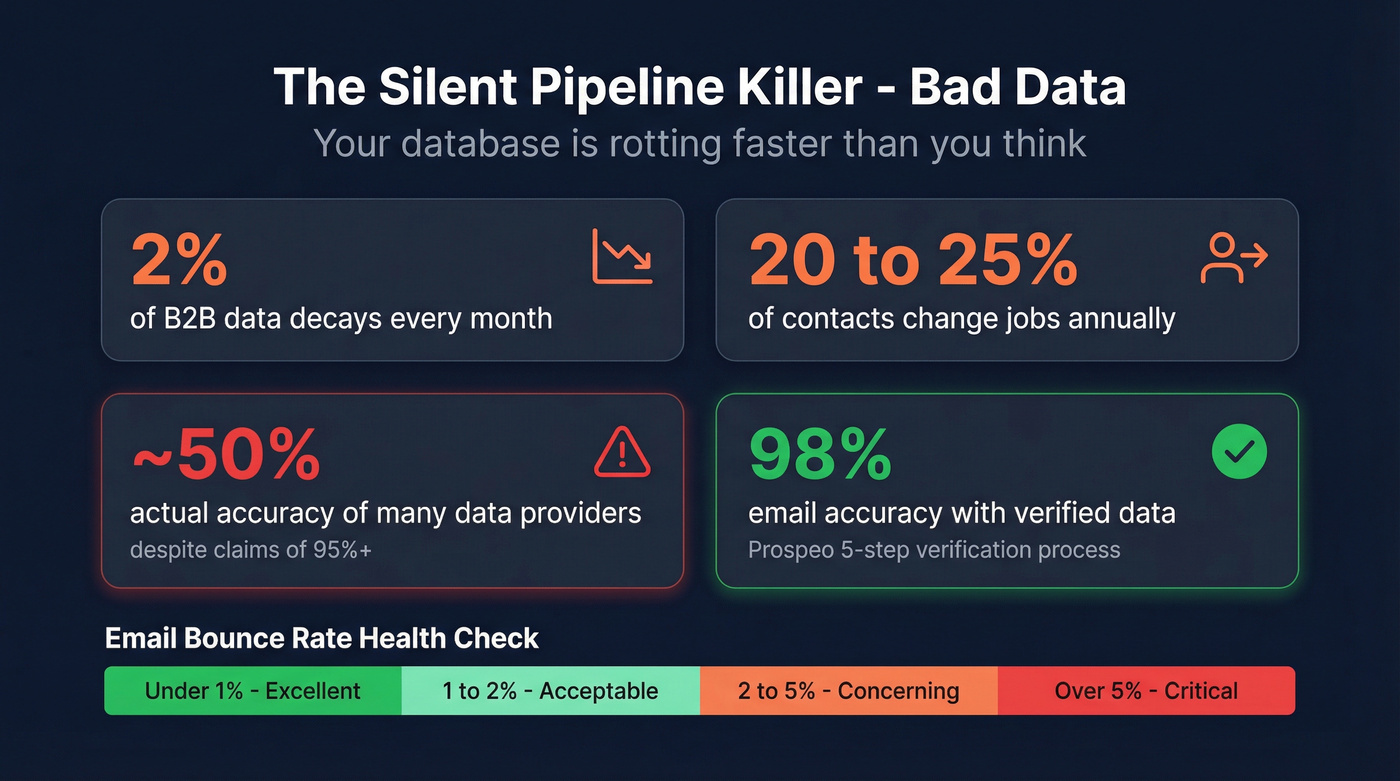
B2B data decays at roughly 2% per month. Contacts change jobs at a 20-25% annual rate. A database you built six months ago has already lost around 12% of its accuracy - and that's before accounting for data that was wrong when you bought it. Independent testing shows many B2B data providers average ~50% accuracy despite marketing claims of 95%+. If your data provider claims 95%+ accuracy, test it. Run a 1,000-contact sample through a verification tool and see what actually comes back. We've done this exercise ourselves, and the results are often sobering.
The most common complaint we hear from sales leaders: "Marketing sends us leads, but half the phone numbers are wrong." The downstream impact is brutal:
| Bounce Rate | Status | Impact |
|---|---|---|
| <1% | Excellent | Domain safe |
| 1-2% | Acceptable | Monitor closely |
| 2-5% | Concerning | Reputation risk |
| >5% | Critical | Domain damage likely |
Phone connect rates tell a similar story. Industry average is 3-5%. Verified direct-dial data pushes that to 8-12%. The difference between those two numbers is the difference between a rep making 100 dials for 4 conversations versus 100 dials for 10. If you're serious about generating high-quality B2B leads, fixing your data is the single highest-leverage move you can make.

Prospeo was built around this problem. The platform covers 300M+ professional profiles with 98% email accuracy, verified through a proprietary 5-step process that includes catch-all handling, spam-trap removal, and honeypot filtering. Data refreshes every 7 days, compared to the 6-week industry average. Snyk's 50-person AE team saw bounce rates drop from 35-40% to under 5% after switching, with AE-sourced pipeline up 180% and 200+ new opportunities per month. You can test it on a free tier without contracts - self-serve, no sales calls required.
Intent data drives 93% higher conversion rates, but only if you can reach those in-market buyers. Prospeo layers Bombora intent signals across 15,000 topics with 143M+ verified emails and 125M+ direct dials - so your quality lead generation strategy connects to real decision-makers, not dead inboxes.
Prioritize buyers who are already researching - and actually get through to them.
Speed-to-Lead: The Overlooked Multiplier
Responding within the first hour increases qualification odds by 7x. Not 7%. Seven times. Every hour after that, the odds crater.
Speed-to-lead isn't a nice-to-have - it's the single fastest way to improve conversion rates without changing anything else about your process. Clean data is the prerequisite. You can't be fast if half your contact records are wrong and your reps are spending 20 minutes per prospect just finding a working phone number.
Metrics That Actually Matter
Stop reporting on total leads generated. Start reporting on these:
| Metric | Benchmark | Why It Matters |
|---|---|---|
| Lead to MQL | 31% (39% for B2B SaaS) | ICP alignment check |
| MQL to SQL | 13% | Qualification effectiveness |
| Cost per qualified lead | Varies by channel | True efficiency measure |
| Speed-to-lead | <1 hour target | Conversion multiplier |
| Hard bounce rate | <2% | Data quality indicator |
| Phone connect rate | 8-12% with quality data | Dial efficiency |
Companies with strong lead nurturing generate 50% more sales-ready leads at 33% lower cost. But nurturing only works when you're nurturing the right people with accurate contact data.
These metrics form a diagnostic chain. If your lead-to-MQL rate is below 31%, your targeting is off. If MQL-to-SQL is below 13%, your qualification framework needs work. If your bounce rate is above 2%, your data is the bottleneck. Fix them in reverse order - data first, then qualification, then targeting.
Mistakes That Kill Lead Quality
No ICP definition. "Companies with 50-500 employees" isn't an ICP - it's a census filter. Add industry, tech stack, growth signals, and buying triggers.
No scoring model. Treating every lead the same means your best reps waste time on your worst prospects. Even a basic point system beats gut feel.
Slow follow-up. Every hour past the first costs you conversions. If your speed-to-lead is measured in days, you're losing deals you already paid to generate.
Stale data, no verification. Data decays 2% per month. If you're not verifying before every campaign, you're burning sender reputation and wasting rep time. The consensus on r/sales is pretty clear on this one - bad data is the #1 reason outbound campaigns fail, ahead of bad messaging and bad targeting.
Misaligned MQL/SQL definitions. When marketing and sales disagree on what "qualified" means, leads fall into a black hole. Define it together. Revisit quarterly.
Ignoring intent signals. A prospect researching your category on review sites is worth 10x more than a random webinar attendee. Skip this if your deal volume is high enough that you can afford to treat every lead equally - but for most teams, that's not the case.
FAQ
What makes quality lead generation different from volume-based approaches?
It targets prospects who match your ICP, show buying intent, and have verified contact data - so your team reaches real decision-makers instead of chasing thousands of unqualified names. The result is higher conversion rates and lower cost per opportunity.
What's the best channel for generating high-quality B2B leads in 2026?
SEO delivers 748% ROI long-term. Webinars generate the highest-quality leads short-term, with 73% of marketers ranking them #1 for quality. Email is the reliable workhorse at 261% ROI. Most teams need all three working together.
How do you measure lead quality?
Track lead-to-MQL conversion (benchmark: 31%), MQL-to-SQL conversion (13%), cost per qualified lead, speed-to-lead, and hard bounce rate. If your bounce rate exceeds 2%, fix your data before optimizing anything else.
What's a good free tool for building verified lead lists?
Prospeo's free tier includes 75 email credits and 100 Chrome extension credits per month with full verification - enough to test data quality on real campaigns. Hunter offers 25 free searches monthly but caps enrichment features.
How does data verification improve lead generation?
Verified data keeps bounce rates under 2%, protects sender reputation, and ensures reps reach real people at current companies. Weekly refresh cycles mean your outbound campaigns hit live inboxes instead of dead ends.