

Quote Request Email Templates That Actually Get Responses
You sent 10 RFQs last quarter. Three vendors responded. One quote was actually usable.
That's not a communication problem - it's a structural one. Most quote request email template guides hand you a generic paragraph and wish you luck. The real issue is that nearly 60% of RFQs fail to capture the right level of detail, which means vendors either ignore them, send back quotes you can't compare, or ask five clarifying questions before they start. One practitioner on r/ChemicalEngineering reported a ~30% response rate when requesting equipment quotes - and that person was already attaching engineering specs. Meanwhile, nearly 40% of organizations lack clear procurement policies at all. The bar is higher than most people think, and most teams aren't clearing it.
What You Need (Quick Version)
Three things move the needle on RFQ response rates. First, specific specs - vendors skip vague requests, and if you don't define exactly what you need (materials, quantities, tolerances, delivery windows), you'll get quotes you can't compare or no quotes at all. Second, a response deadline, because without one your email sits at the bottom of the pile; give vendors 5-7 business days for standard requests, 10-14 for complex ones. Third, a standardized bidder template - attach an Excel sheet with your required fields, and you force apples-to-apples responses that cut evaluation time dramatically.
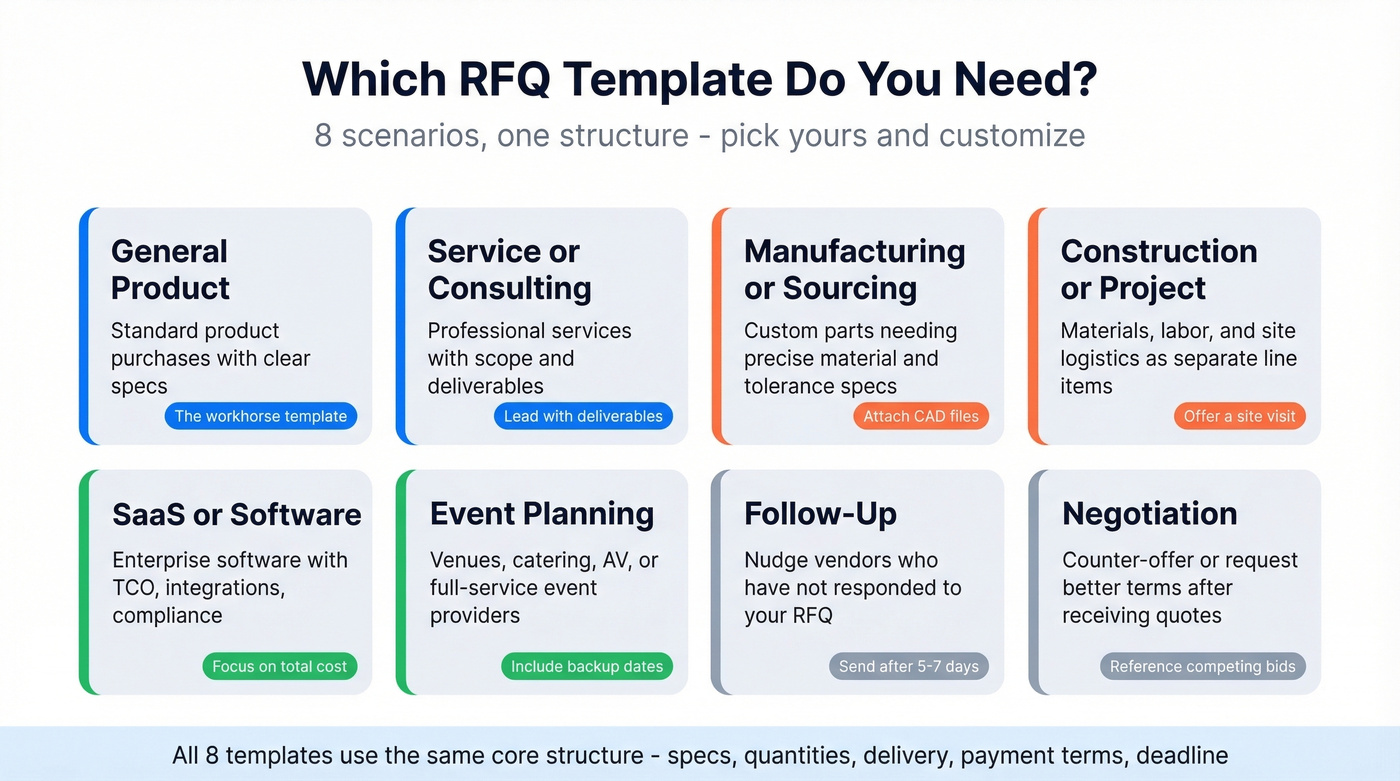
You don't need 10 templates. You need one solid structure and the discipline to customize it for each vendor. The eight templates below - covering general product, service, manufacturing, construction, SaaS, event planning, follow-up, and negotiation scenarios - give you that structure. Before you send any of them, verify your vendor contact emails. A bounced RFQ is invisible failure: you wait a week for a response that was never going to arrive. Prospeo's email verification catches invalid addresses before that happens, with 98% accuracy and a free tier for 75 emails/month.
RFQ vs RFP vs RFI
If you send an RFQ when you should've sent an RFP, you'll often get responses you can't compare.
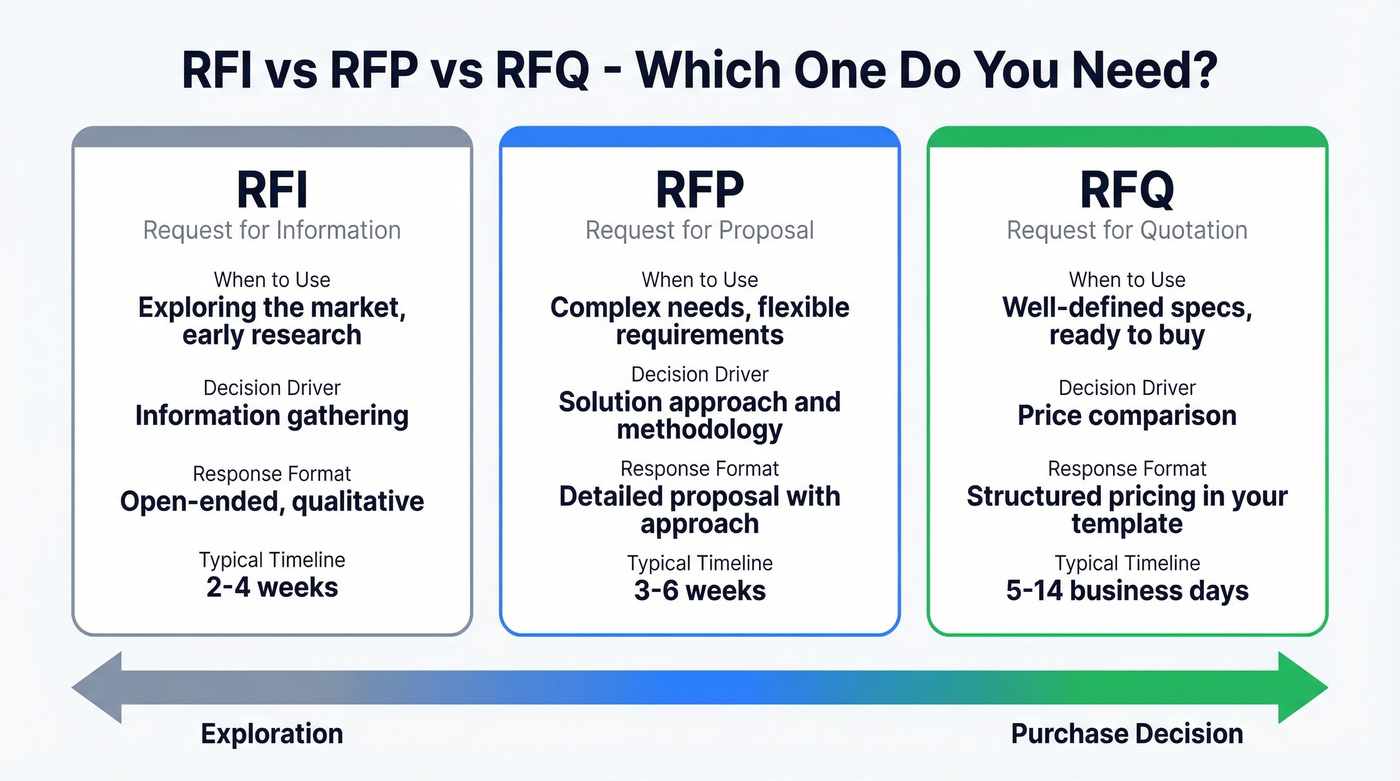
| Document | When to Use | Decision Driver |
|---|---|---|
| RFI | Exploring the market | Information gathering |
| RFP | Complex, open-ended needs | Solution approach |
| RFQ | Well-defined specs | Price comparison |
An RFI gathers general vendor and market info. An RFP requests a detailed proposal when requirements are still flexible. An RFQ is what you send when you know exactly what you need and you're comparing prices. Most of the templates below are RFQs - you've already defined the specs, and now you need numbers.
Anatomy of an Effective RFQ Email
Before you copy a template, make sure your email covers these eight elements. Miss one and you'll either get incomplete quotes or radio silence.
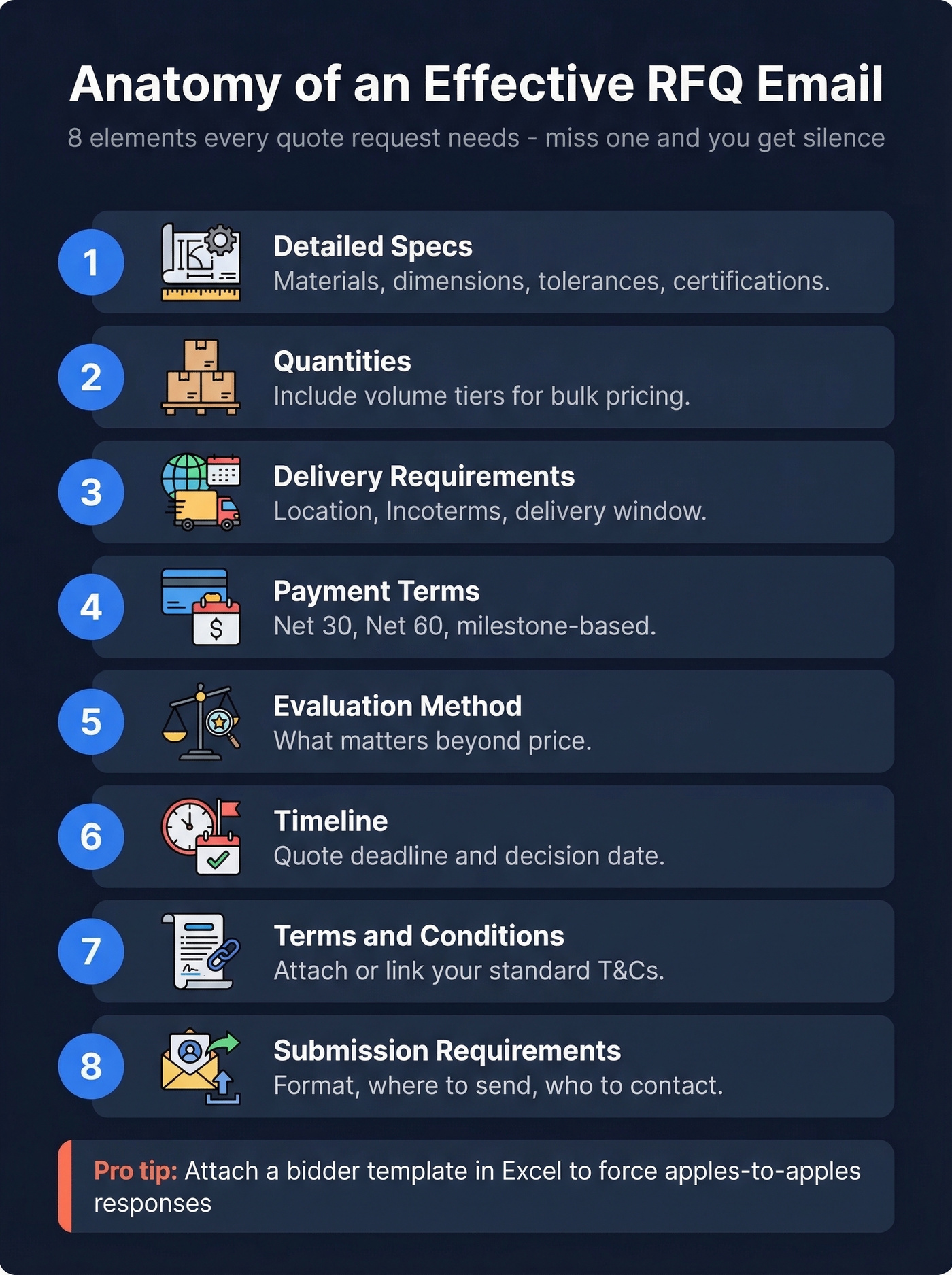
- Detailed specs. Materials, dimensions, performance requirements, certifications. "304 stainless steel, 2mm tolerance" beats "stainless steel part."
- Quantities. Include volume tiers if you want bulk pricing. Vendors price differently at 500 vs 5,000 units.
- Delivery requirements. Ship-to location, Incoterms if international, required delivery window.
- Payment terms. Net 30? Net 60? Milestone-based? State it upfront so vendors don't assume.
- Evaluation method. Tell vendors what matters beyond price - lead time, certifications, warranty, support. This signals you're a serious buyer, not just price-shopping.
- Timeline. When you need the quote back, and when you plan to decide.
- Terms and conditions. Link to or attach your standard T&Cs. Don't surprise vendors after they've quoted.
- Submission requirements. Format (Excel template preferred), where to send it, who to contact with questions.
Beyond these basics, structure your questions by category: vendor qualifications, scope, [pricing and TCO](https://www.investopedia.com/terms/t/totalcostofownership.asp), delivery, [quality and SLAs](https://en.wikipedia.org/wiki/Service-level_agreement), and compliance. This framework catches the hidden fees, scope exclusions, and assumption mismatches that make quotes impossible to compare.
Here's the thing: attaching a bidder template in Excel is the single highest-leverage move you can make. It forces every vendor into the same format, which means you can actually compare responses side by side instead of decoding three different PDF layouts. In our experience, the bidder template is the most skipped step - and the one that saves the most time during evaluation.
Subject Line Formulas
Your subject line determines whether the email gets opened or buried. Keep it under 60 characters to avoid mobile truncation, and aim for seven words or less.
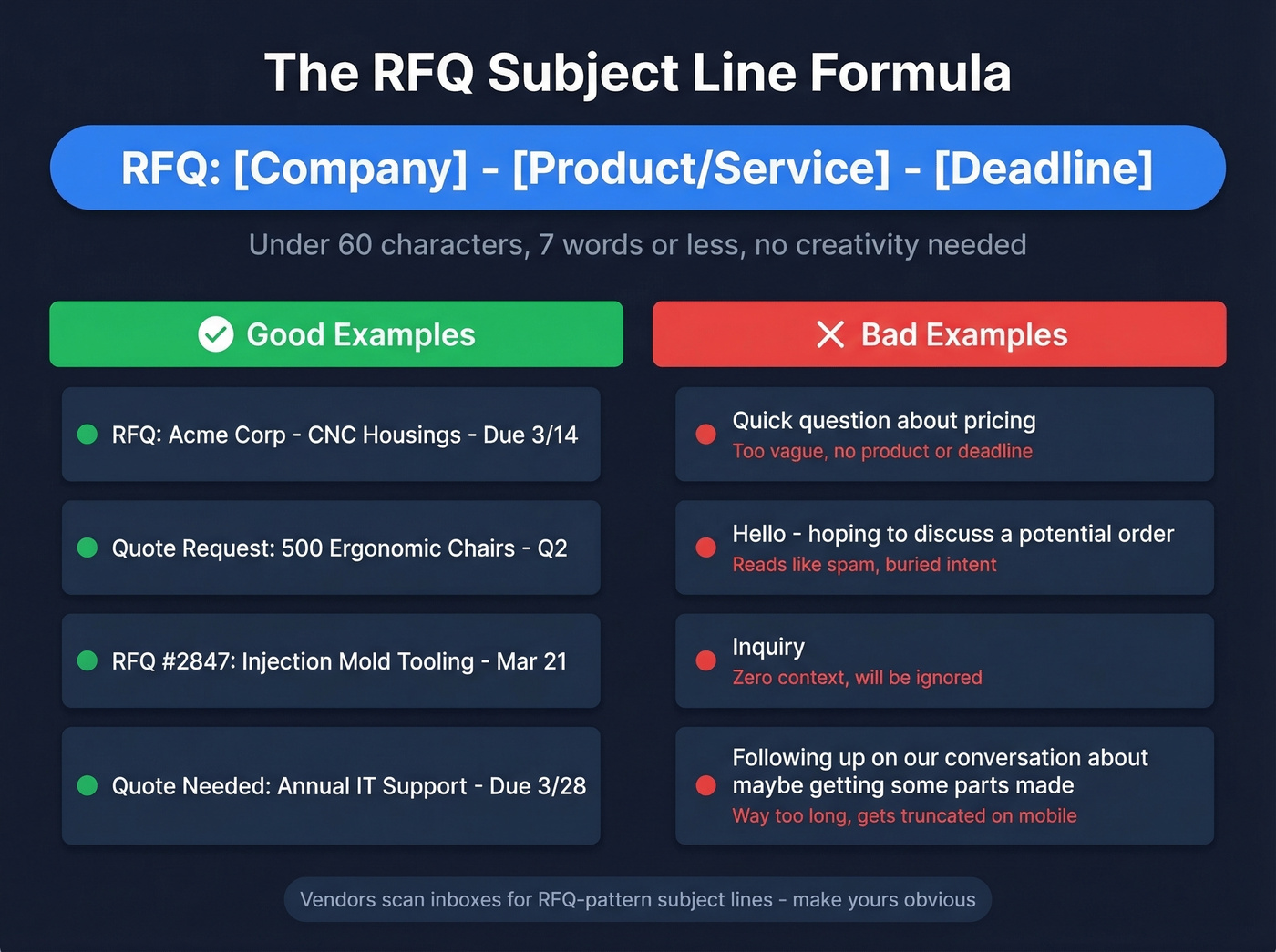
The formula that works best: RFQ: [Company] - [Product/Service] - [Deadline]
Examples:
- RFQ: Acme Corp - CNC Housings - Due 3/14
- Quote Request: 500 Ergonomic Chairs - Q2
- RFQ #2847: Injection Mold Tooling - Mar 21
- Quote Needed: Annual IT Support - Due 3/28
- RFQ: Catering for 200-Person Event - Apr 5
Don't get creative. Vendors scan inboxes for RFQ-pattern subject lines. A clear, scannable format signals you're a real buyer with a real deadline - not someone kicking tires.

A bounced quote request is worse than a bad one - you wait days for a reply that was never possible. Prospeo's email verification catches invalid vendor addresses before you send, with 98% accuracy and a 7-day data refresh cycle.
Verify 75 vendor emails free every month - no credit card needed.
8 Copy-Paste RFQ Templates
General Product Quote
Use this for standard product purchases where specs are straightforward. It's the workhorse template - if you only save one, save this one.
Subject: RFQ: [Your Company] - [Product Name] - Due [Date]
Hi [Vendor Name],
[Your Company] is requesting a quote for the following items:
- Product: [Name/SKU/Description]
- Quantity: [X units] (please also quote pricing at [Y] and [Z] volumes)
- Specifications: [Material, dimensions, color, grade, or relevant specs]
- Delivery location: [Address/City]
- Required delivery date: [Date or window]
Please include unit pricing, bulk discount tiers, shipping costs, and payment terms. I've attached our bidder template - kindly use it for your response.
Deadline for quotes: [Date]. Questions? Reply to this email or contact [Name] at [Phone].
Thanks, [Your Name, Title, Company]
Service or Consulting Quote
For professional services where scope and deliverables matter more than unit pricing. When asking for a quote in an email for services, lead with clear deliverables and timelines rather than open-ended descriptions.
Subject: RFQ: [Service Type] - [Your Company] - Due [Date]
Hi [Vendor Name],
We're evaluating providers for [service type] and would like a detailed quote based on the following scope:
- Project overview: [2-3 sentence description]
- Key deliverables: [List specific outputs]
- Timeline: [Start date] to [End date]
- Team requirements: [Seniority level, certifications, headcount]
Please break down pricing by phase or deliverable, specify payment terms (milestone-based preferred), and note any assumptions or exclusions.
Attached: scope document and bidder template. Quotes due by [Date].
Best, [Your Name, Title, Company]
Manufacturing or Sourcing Quote
This is where most RFQs fall apart. Manufacturing vendors need a level of precision that other industries don't - vague material specs or missing tolerances will get your email deleted. Technical precision matters more here than anywhere else.
Subject: RFQ #[Number]: [Part Name] - Custom Manufacturing - Due [Date]
Hi [Vendor Name],
We're requesting a quote for custom manufacturing of the following component:
- Part: [Name/Part Number]
- Material: [e.g., 304 stainless steel, injection-molded ABS with Pantone 485C]
- Dimensions/tolerances: [Reference attached CAD drawings]
- Quantity: [MOQ + volume tiers]
- Certifications required: [CE, RoHS, ISO 9001, etc.]
- Surface finish: [Specify]
Attached: CAD files (STEP + PDF), engineering spec sheet, and bidder template.
Please include tooling costs (amortized and one-time), unit pricing at each volume tier, lead time, and sample availability. Quotes due [Date].
Regards, [Your Name, Title, Company]
Construction or Project Quote
For construction work where materials, labour, and site logistics need separate line items. Always offer a site visit - contractors often add contingency when quoting without one.
Subject: RFQ: [Project Name] - [Your Company] - Due [Date]
Hi [Contractor Name],
We're requesting a quote for the following project:
- Project/Job Reference: [Number]
- Scope: [Brief description - e.g., foundation excavation to 600mm, brick wall construction per attached drawings]
- Location: [Site address]
- Site visit available: [Yes/No - dates]
Please break your quote into Materials, Labour, and any subcontractor costs separately. Include estimated timeline, payment schedule, and warranty terms.
Attached: project drawings and bidder template. Quotes due [Date].
Thanks, [Your Name, Title, Company]
SaaS or Software Procurement Quote
For software purchases where TCO, integrations, and compliance matter as much as the sticker price. Skip this template if you're buying off-the-shelf software with public pricing - just buy it. This one's for enterprise or team-level purchases where negotiation is expected.
Subject: RFQ: [Software Category] - [Your Company] - [Seat Count] Users
Hi [Vendor Name],
We're evaluating [software category] solutions and need a detailed quote:
- Users/seats: [Number]
- Required integrations: [CRM, ERP, SSO provider, etc.]
- SLA requirements: [Uptime %, support response time]
- Compliance: [SOC 2, GDPR, HIPAA, etc.]
- Contract preference: [Annual/monthly, multi-year discount?]
Please provide a TCO breakdown: recurring license fees, one-time implementation/onboarding costs, per-seat overage pricing, and any add-on modules priced separately.
Bidder template attached. Quotes due [Date].
Best, [Your Name, Title, Company]
Event Planning Quote
For venues, catering, AV, or full-service event providers.
Subject: Quote Request: [Event Type] - [Date] - [Headcount] Guests
Hi [Vendor Name],
We're planning a [event type] and need a quote for the following:
- Date: [Date] (backup: [Alternate date])
- Headcount: [Number]
- Venue/service needed: [Venue rental, catering, AV, full-service, etc.]
- Setup/teardown: [Time requirements]
- Special requirements: [Dietary restrictions, accessibility, branding, etc.]
Please include itemized pricing, cancellation/rescheduling terms, deposit requirements, and any minimum spend thresholds.
Quotes due [Date]. Happy to schedule a walkthrough if helpful.
Thanks, [Your Name, Title, Company]
Follow-Up (No Response)
Send this 3-5 business days after your original RFQ if you haven't heard back. Keep it short - the goal is a yes/no, not a guilt trip.
Subject: Re: RFQ: [Original Subject Line]
Hi [Vendor Name],
Following up on the quote request I sent on [Date] for [brief description]. I want to make sure it reached the right person.
Quick recap: we need pricing for [1-line spec summary] by [Deadline]. Happy to clarify any details or adjust the scope if needed.
Is this something your team can quote on? A quick yes/no would be helpful either way.
Thanks, [Your Name, Title, Company]
Revision or Negotiation
Use after receiving an initial quote when you need clarification, a breakdown, or want to explore better terms. Don't lead with "your price is too high." Lead with questions that give the vendor room to offer alternatives.
Subject: Re: Quote #[Number] - Clarification + Volume Pricing
Hi [Vendor Name],
Thanks for the quote (#[Number], dated [Date]). A few follow-up requests:
- Could you provide an itemized breakdown of [specific line item]?
- What pricing would you offer at [higher volume]?
- Are there alternative specs (e.g., [material/tier]) that would reduce cost without compromising [key requirement]?
We're comparing quotes from [X] vendors and plan to decide by [Date]. An updated quote by [Date] would help us include you in the final evaluation.
Best, [Your Name, Title, Company]
How to Increase Your Response Rate
Templates are the starting point. Getting vendors to actually respond requires understanding why they don't.
Personalize the opening. A Gong Labs study of 30,000+ sales emails found that individual-based personalization more than doubles reply rates. Company-based personalization triples response rates when you're reaching directors and above. Even industry-level personalization lifts replies by 88%. One sentence referencing the vendor's recent work or a mutual connection is enough - and 97% of sellers are unhappy with their email reply rate, so this isn't a problem unique to procurement teams.
Understand the vendor's perspective. From the other side of the inbox, quote-only requests with no context are routinely deprioritized. Sellers on r/sales describe vague RFQs as time-wasters - they've been burned too many times by tire-kickers who request quotes with no intention of buying. Showing you're a serious buyer with specific specs, a clear timeline, and stated evaluation criteria separates your RFQ from the noise.
Set a realistic deadline. 5-7 business days for standard RFQs, 10-14 for complex or custom requests. Too tight and vendors won't bother. Too loose and you signal it isn't urgent.
Follow up at 3 and 7 days. We've seen teams send 10 RFQs and assume silence means "no." A short follow-up at the 3-day mark recovers a surprising number of responses, and a second follow-up around day 7 catches the ones that slipped through the cracks. If you want a tighter system, borrow a few lines from these follow-up templates.
Verify your contacts before sending. This is the step almost everyone skips. A bounced email is invisible failure - you wait a week for a response that was never going to come. Run your vendor contact list through an email verification tool like Prospeo, remove the dead addresses, and send only to verified contacts. If deliverability is a recurring issue, start with an email deliverability guide and track your email bounce rate.
Let's be honest: if your average purchase is under $5,000, you probably don't need a formal RFQ process. Just call the vendor. RFQs earn their overhead on purchases where the comparison savings justify the process time. For everything else, a phone call and a follow-up email will close faster.
What to Do After Quotes Arrive
Most guides stop at "click send." The real work starts when quotes come back and you need to compare three vendors who each formatted their response differently.
Build a comparison matrix. Standardize every quote into the same spreadsheet so you're evaluating apples to apples. We've found that teams who use weighted scoring cut their vendor selection time by days compared to those who eyeball it - and the difference compounds when you're running multiple RFQ cycles per quarter. If you're standardizing vendor data across systems, data enrichment services can help keep records consistent.
| Vendor | Unit Price | Total (w/ Ship) | Lead Time | Score |
|---|---|---|---|---|
| Vendor A | $12.50 | $14,200 | 4 weeks | 87 |
| Vendor B | $11.80 | $13,900 | 6 weeks | 74 |
| Vendor C | $13.10 | $14,800 | 3 weeks | 91 |
Vendor A: Net 30, ISO 9001, 2-year warranty. Vendor B: Net 60, CE + RoHS, 1-year warranty. Vendor C: Net 30, ISO + CE, 3-year warranty.
Use a weighted scoring model - not all criteria are equal. If lead time is twice as important as price for this purchase, assign it a weight of 0.4 vs 0.2. A vendor who's $500 cheaper but two weeks slower might cost you more in the end when you factor in downstream delays, expedited shipping, or missed launch dates. If you're negotiating after scoring, use an anchor in negotiation to set the range.
Watch for red flags: unusually low prices (corners are being cut somewhere), unclear terms, or missing information. Always evaluate Total Cost of Ownership - shipping, installation, maintenance, and disposal costs can dwarf the sticker price over the life of the purchase. A $13 unit that lasts three years with full warranty coverage beats an $11 unit that fails after one year. Every time.
Mistakes That Kill Your RFQ Emails
- Vague specs. "We need some office chairs" gets you five quotes for five different products. Specify model, quantity, material, and delivery requirements.
- No deadline. Without a response date, your RFQ goes to the bottom of every vendor's priority list.
- No bidder template. If you let vendors quote in their own format, you'll spend hours normalizing data before you can compare anything.
- Sending to unverified email addresses. A bounced RFQ is worse than no RFQ - you think you're in the running when you're not. If you're cleaning lists at scale, use an AI email checker or learn how to check if an email will bounce.
- No follow-up plan. One email isn't a process. Plan for a follow-up at day 3 and day 7 at minimum. If you need wording options, see how to say just checking in professionally.
- Asking for too much at once. If your RFQ covers 15 product categories and 40 line items, vendors will put it off. Break large requests into focused RFQs.
- Not stating evaluation criteria. Vendors who know you're evaluating on lead time and certifications - not just price - will put more effort into a competitive response.
Your RFQ templates are only as good as the contact data behind them. If you're emailing outdated addresses, your response rate drops before vendors even read your specs. Prospeo finds and verifies professional emails across 300M+ profiles at $0.01 per address.
Stop sending perfect RFQs to dead inboxes.
FAQ
How long should a quote request email be?
Aim for 150-250 words in the email body. Include specs, quantities, timeline, and your response deadline. Attach detailed requirements, drawings, or a bidder template as separate files rather than cramming everything inline. Longer emails get skimmed; shorter ones lack the detail vendors need to quote accurately.
How many days should I give vendors to respond?
Give vendors 5-7 business days for standard RFQs and 10-14 for complex or custom requests. State the deadline in both the subject line and the email body. Anything under 3 business days will get ignored by most suppliers.
Should I send the same RFQ to every vendor?
Yes for the core specs and bidder template - that's how you get comparable quotes. But personalize the opening line. Gong's research shows individual personalization more than doubles reply rates, so a sentence referencing the vendor's recent project is worth the 30 seconds it takes.
What's the difference between an RFQ and an RFP?
An RFQ requests pricing for well-defined specifications where the decision is primarily cost-driven. An RFP requests a detailed proposal when requirements are complex or open-ended. Send an RFQ when you know exactly what you want; send an RFP when you need vendors to propose a solution.
How do I make sure my RFQ actually reaches the vendor?
Verify vendor email addresses before sending. Invalid or outdated contacts mean your request bounces silently and you wait for a response that never comes. Tools like Prospeo's bulk email verification flag dead addresses in seconds - upload your list, remove the bad ones, and send only to verified contacts.