

Reciprocity in Sales: Scripts, Frameworks, and Tactics That Work
You sent 200 cold emails last week. Eight people unsubscribed. Three replied - two of them to say "remove me from your list." The average B2B reply rate sits at 5.1%, and most teams hover below that. The problem isn't your subject line. It's that you're asking before you've given anything worth responding to.
Reciprocity in sales fixes that dynamic - but not the way most reps think.
On r/Entrepreneur, a common refrain captures the confusion perfectly: "Maybe offering free xyz in hopes they purchase something... but unsure how to go about it." That uncertainty is the problem. Most reps think reciprocity means giving something away and crossing their fingers. It doesn't. It's a system - a sequence of calibrated gestures mapped to each stage of the deal. Get the timing and the "gift" right, and you shift the dynamic from interruption to exchange.
Here's what we've found after watching hundreds of outbound campaigns: reciprocity isn't about generosity. It's about giving the right thing at the right stage. Generic free ebooks trigger nothing. The highest-leverage move is the Give-Get Framework in negotiation, where every concession you make earns a commitment back. And none of it works if your outreach lands in the wrong inbox - accurate prospect data is the prerequisite for everything below.
The Psychology Behind Give-to-Get Selling
In 1971, psychologist Dennis Regan ran a now-famous experiment. A confederate either brought participants an unsolicited Coke or didn't. Later, the confederate asked participants to buy raffle tickets. Participants who received the Coke bought significantly more - even when they didn't like the person who gave it to them. Reciprocity overrode liking.
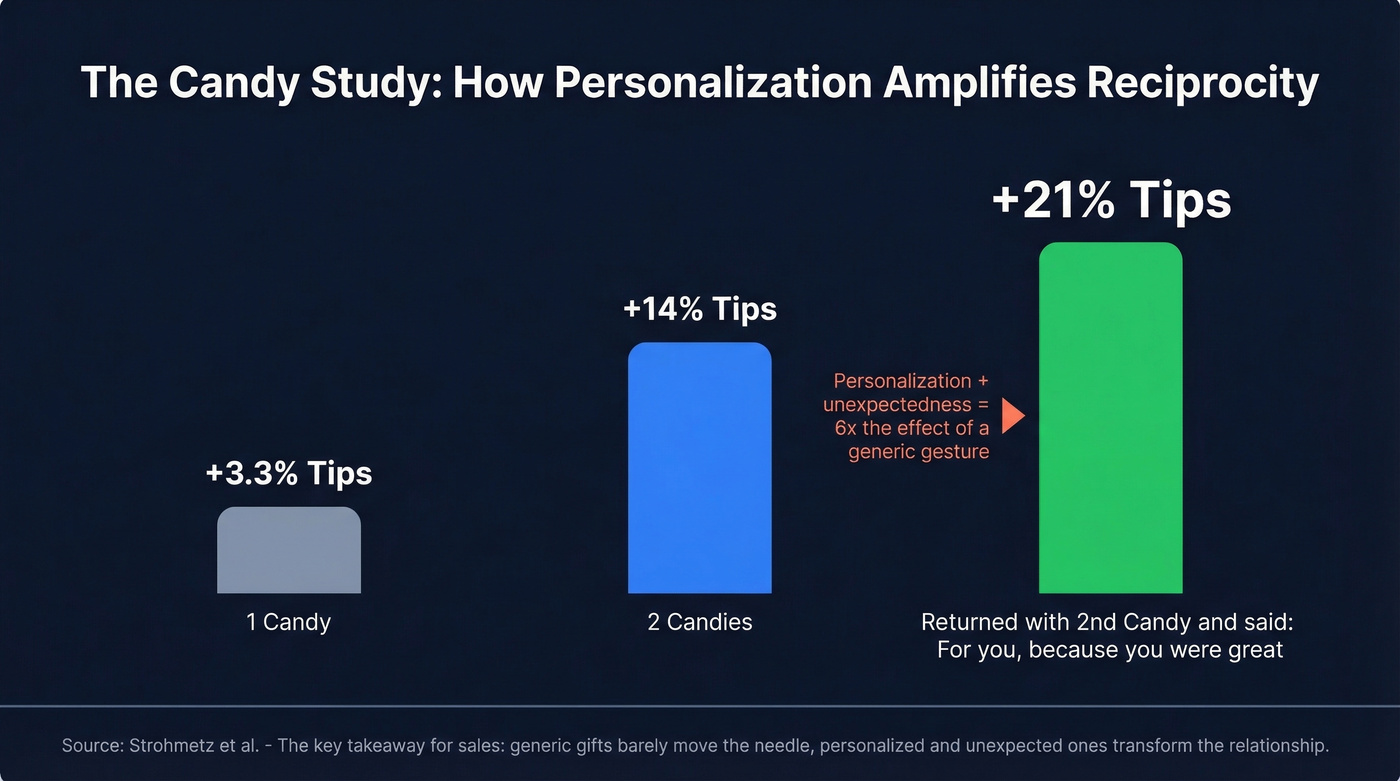
A restaurant tipping study tells the same story with different numbers. One candy with the bill increased tips by 3.3%. Two candies bumped it to around 14%. But one candy, then the waiter returning with a second and saying "for you, because you were great" - tips jumped 21%. The lesson isn't about candy. It's about personalization and unexpectedness.
One distinction worth internalizing: emotional reciprocity (listening deeply, sharing an insight, making someone feel seen) and material reciprocity (free trials, discounts, resources) trigger the same psychological mechanism but land differently. In B2B, emotional reciprocity almost always outperforms material reciprocity because it's harder to fake and impossible to mass-produce. The stage-by-stage playbook below leans heavily on the emotional side early, then layers in material gestures as the deal matures.

Your competitive teardown means nothing if it bounces. Prospeo verifies emails with 98% accuracy on a 7-day refresh cycle - so every personalized insight you craft actually reaches the decision-maker you researched. At $0.01 per email, the cost of reciprocity-first outreach is negligible. The cost of sending it to a dead inbox is a wasted relationship.
Give the right gift to the right inbox - every time.
How to Apply Reciprocity at Each Deal Stage
Prospecting - Lead with an Insight
A gated product PDF isn't reciprocity. It's lead gen. The prospect knows you're extracting their email in exchange for content they could find elsewhere. Real reciprocity in prospecting means giving something that costs you effort and costs them nothing.
If you want more ways to structure this kind of outreach, start with proven sales prospecting techniques and then layer reciprocity on top.
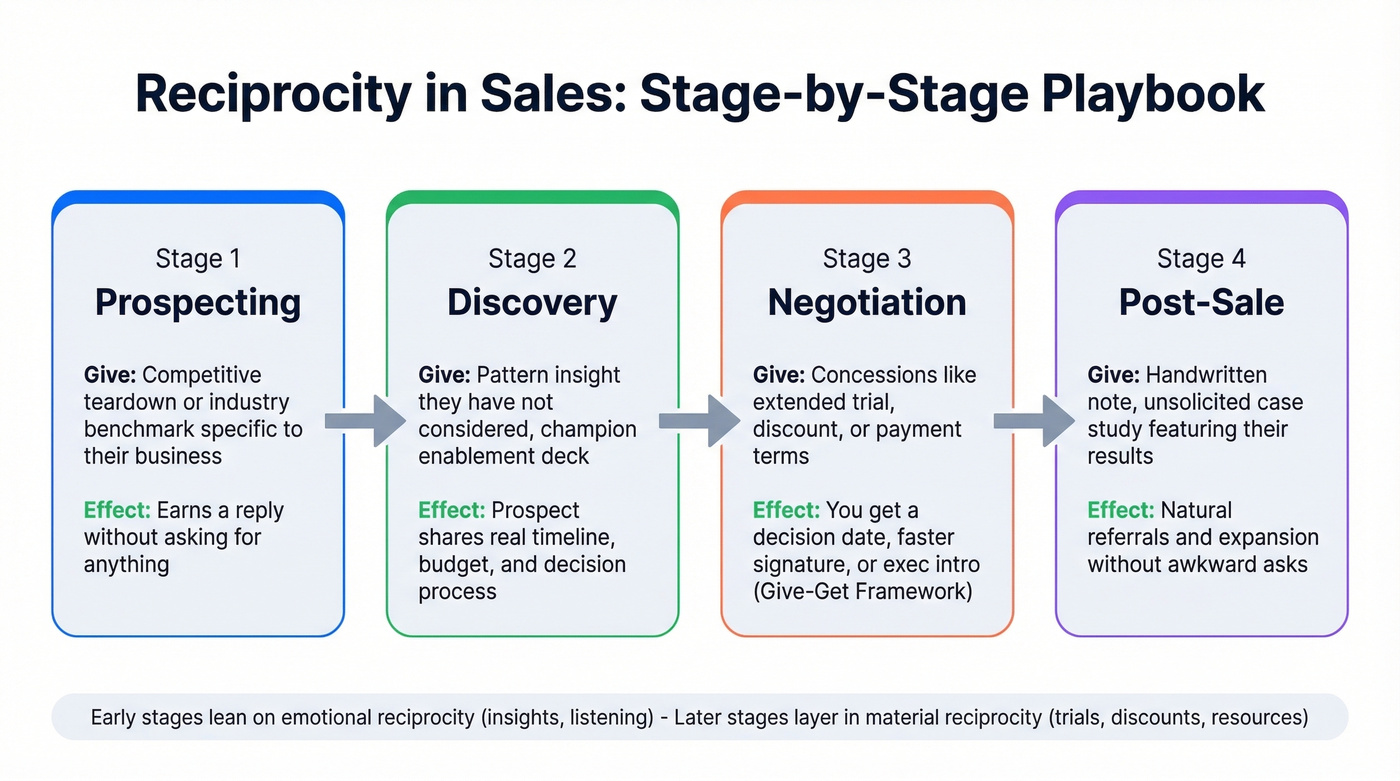
The highest-performing cold emails we've seen lead with an "insight gift" - something specific to the prospect's business that they didn't already know:
The Competitive Teardown: "Hi [Name], I noticed [Competitor X] just launched [feature/campaign]. Here's a quick breakdown of what they're doing differently from you on [specific dimension] - thought it might be useful as you plan Q3. No ask here, just wanted it on your radar."
The Relevant Benchmark: "Hi [Name], we pulled conversion benchmarks for [their industry vertical] last month. Your segment averaged [X%] - you're likely above that given [specific observation]. Happy to share the full dataset if it's useful."
Notice what's missing: no calendar link, no "15 minutes of your time," no pitch. The ask comes later, after the value has landed.
Of course, none of this matters if the email bounces. You can't send a personalized competitive teardown to a dead address. Prospeo verifies emails in real time with 98% accuracy and refreshes data every 7 days, so your reciprocity-first outreach actually reaches the person you researched. (If you're troubleshooting deliverability, see email bounce rate and the full email deliverability guide.)

Discovery - Listening Is the Gift
Most reps treat discovery calls as interrogations. Flip it. The Salesforce State of Sales report found that listening topped the list of behaviors salespeople said had an extreme or substantial impact on converting a prospect to a customer.
The reciprocity move in discovery is telling prospects something they don't know about themselves. A seller at a cybersecurity firm once surfaced that a prospect's internal champion had left the company - information the buying committee didn't have yet. That single insight earned more trust than any demo could.
Try this: after your prospect describes a challenge, respond with "Here's what I'm seeing across companies in your position..." and share a pattern they haven't considered. When you do the homework and share what you find, the prospect reciprocates with honesty about their timeline, budget, and decision process. The rule of reciprocity works because the exchange feels organic, not transactional. (For a tighter structure, use a discovery questions framework.)
For enterprise deals, take this further. Build a champion enablement deck - a one-pager with ROI projections and stakeholder-specific messaging your champion can circulate internally. You're doing their job for them. We've watched deals accelerate by weeks when the champion doesn't have to build the internal business case from scratch. This pairs well with a clear MEDDIC sales qualification process.
Negotiation - The Give-Get Framework
If you only implement one tactic from this article, make it this one.
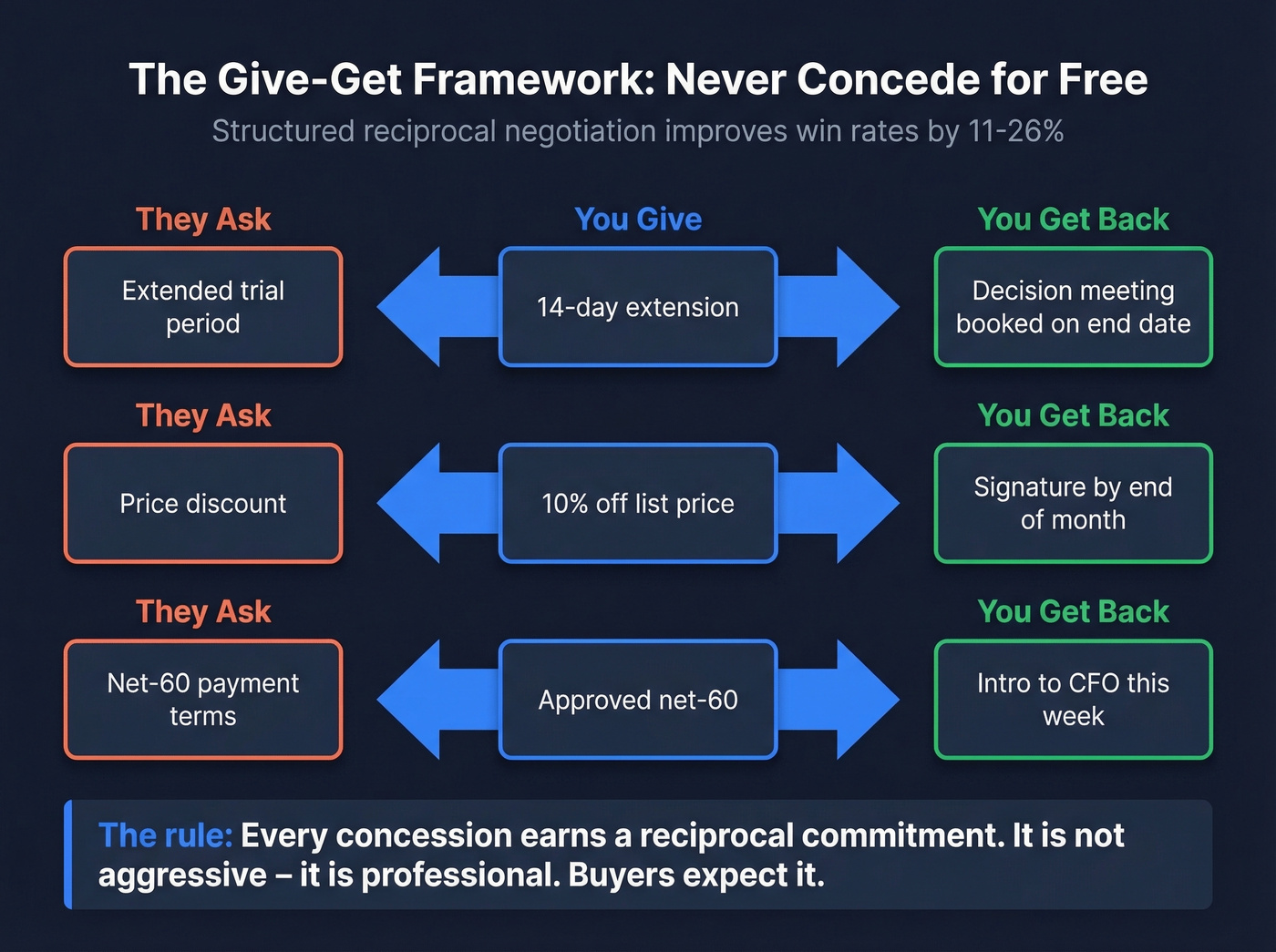
The Give-Get Framework is simple: every concession you grant earns a reciprocal commitment from the buyer. Sales Career Hub cites analysis showing that structured reciprocal negotiation improves win rates by 11-26%. With B2B sales cycles lengthening over 22% in recent years, you can't afford to give away concessions for free. (Related: how to anchor in negotiation without burning trust.)
| They Ask For | You Give | You Get Back |
|---|---|---|
| Extended trial | 14-day extension | Decision meeting on end date |
| Discount | 10% off list | Signature by end of month |
| Net-60 terms | Approved | Intro to CFO this week |
Never concede without a reciprocal ask. It's not aggressive - it's professional. Buyers expect it, and it accelerates deals because both sides are making commitments simultaneously. In our experience, reps who use the Give-Get Framework close faster and with better terms than those who don't.
Post-Sale - Unexpected Gestures Drive Expansion
Reciprocity doesn't stop at closed-won.
A handwritten note congratulating a champion on their promotion costs you five minutes and a stamp. An unsolicited mini case study featuring the customer's results - sent before you ask for a testimonial - creates genuine goodwill. The referral conversation becomes natural when you've been generous post-sale. You've already earned the introduction by sending that case study three weeks before renewal, not by cornering them with "who else should I talk to?" (If you're building an expansion motion, start with renewal rate fundamentals.)
When Give-to-Get Tactics Backfire
Not every "gift" triggers reciprocity. Four failure modes kill it:
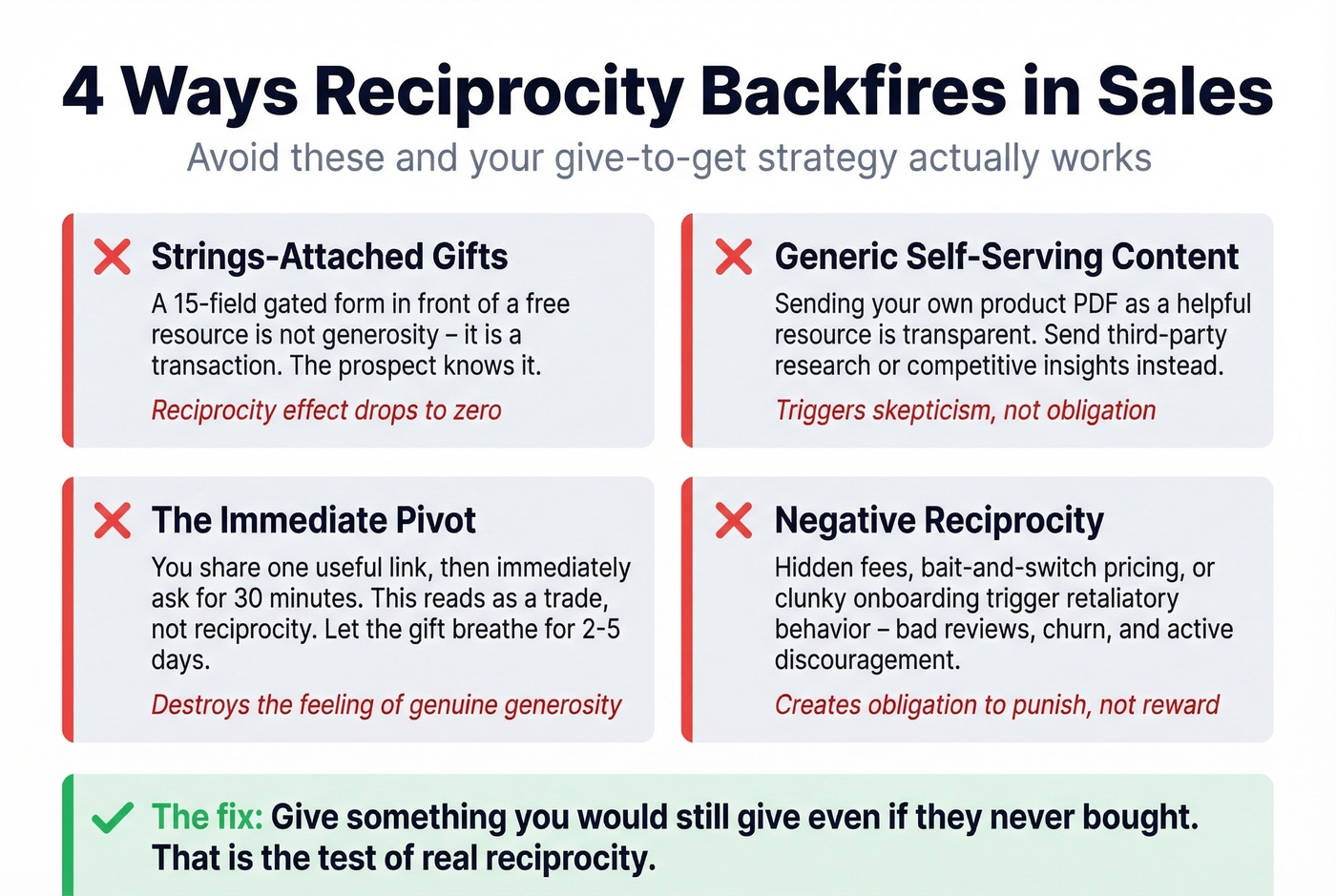
Strings-attached gifts. A 15-field gated form in front of a "free" resource isn't generosity - it's a transaction. The prospect knows it, and the reciprocity effect drops to zero.
Generic, self-serving content. Sending your own product PDF as a "helpful resource" is transparent. Send third-party research, a relevant benchmark, or a competitive insight instead. (More examples: how to add value in sales.)
The immediate pivot. You share one useful link, then immediately ask for 30 minutes. As Sybill's research notes, giving something small then immediately asking for something big reads as a trade, not reciprocity. Let the gift breathe. Follow up days later, not seconds. (If you need copy, use these sales follow-up templates.)
Negative reciprocity. This one cuts the other direction. Hidden fees, bait-and-switch pricing, or a clunky onboarding experience trigger retaliatory behavior - bad reviews, churn, and active discouragement of peers from buying. Every negative experience creates an obligation to punish, not reward.
Let's be honest: if your deal size is under $15k, you probably don't need a complex reciprocity playbook. One genuine insight email and one clean Give-Get in negotiation will outperform any elaborate multi-touch "value sequence." Skip the sophistication. Sincerity at the right moment is what closes.
The Give-Get Framework only works when you're negotiating with real buyers. Prospeo's 300M+ profiles with 30+ filters - including buyer intent, job changes, and headcount growth - let you find prospects who are actually in-market before you invest the effort of personalized outreach. Teams using Prospeo book 26% more meetings than ZoomInfo users.
Stop giving value to the wrong people. Find real buyers first.
FAQ
What's the difference between reciprocity and bribery in sales?
Reciprocity means giving genuine value with no explicit strings attached. The test: would you still give this if the prospect never bought? If yes, it's reciprocity. The moment a gesture feels like a quid pro quo, the psychological effect collapses entirely.
Does the law of reciprocity work in cold outreach?
Yes - but only when the gift is specific and useful. A relevant competitive benchmark triggers reciprocity; a mass-blast ebook doesn't. The 21% tip increase in the candy study came from making the gesture feel individual and unexpected.
What tools help execute reciprocity-first prospecting?
You need accurate contact data to personalize at scale. Prospeo gives you verified emails across 300M+ professionals with 98% accuracy and 30+ search filters to find the exact decision-maker, so your insight email reaches the right person. Pair it with intent data to time your outreach when prospects are actively researching.
How long should I wait before making an ask after giving value?
Wait at least 2-5 business days after delivering your insight or resource. Following up the same day turns a gift into a transaction. The delay lets the gesture register as genuine - and the prospect's sense of obligation actually strengthens over a short gap.