

Referral Selling: The 2026 Playbook With Scripts & Data
A rep closes a deal, the customer's thrilled, everyone celebrates - and then nobody asks for an introduction. That moment of goodwill evaporates, and the team goes back to cold-calling strangers at $1,980 a pop.
Referral selling is the highest-leverage motion in B2B sales, and almost nobody runs it as a system.
What You Need (Quick Version)
- An introduction, not just a name. Trust transfers when someone the prospect knows makes the connection.
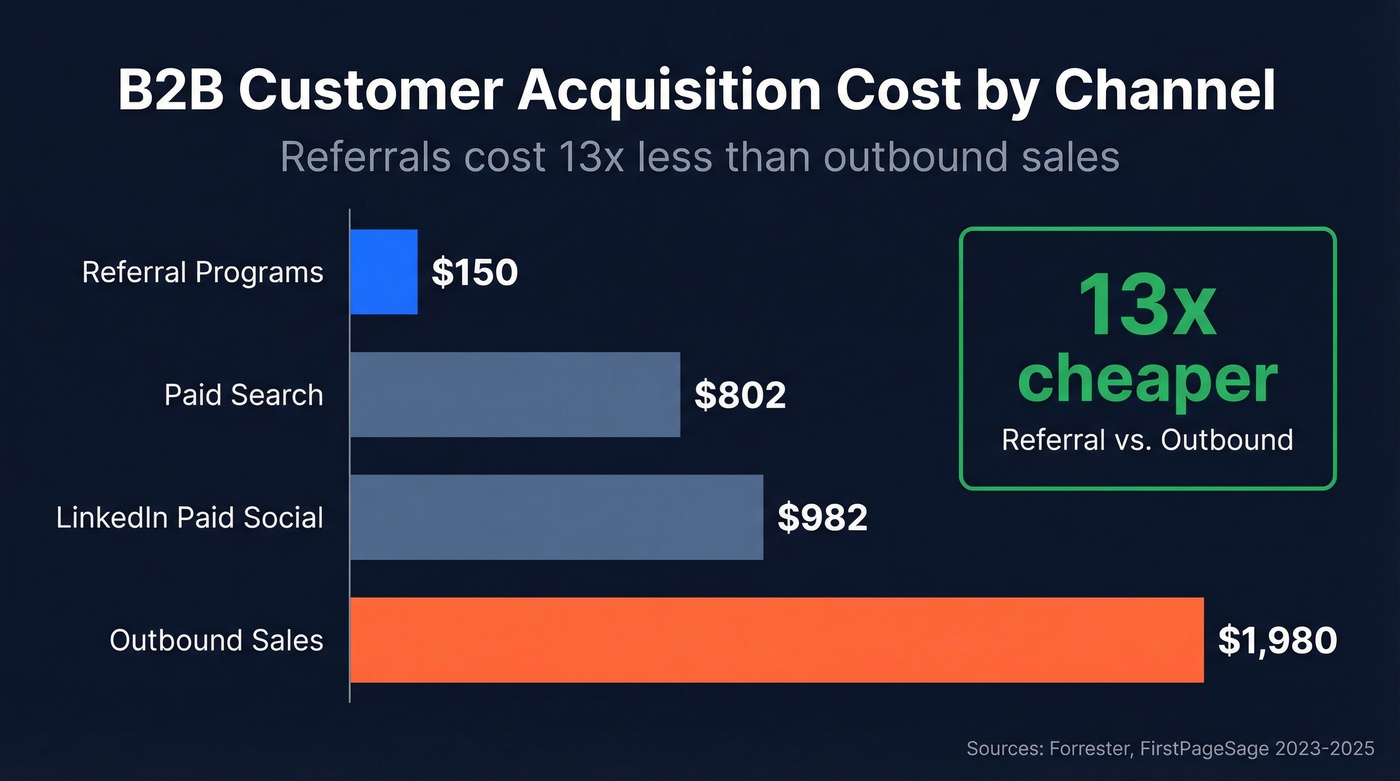
- The cost difference is staggering. Referral CAC runs about $150 for B2B SaaS vs. $1,980 for outbound sales - a 13x gap. (If you want to benchmark CAC properly, see cost to acquire customer.)
- Your single next action: Use the script in Section 5 after your next QBR or customer success check-in. One ask, this week.
What It Actually Means
Referral selling is a structured sales motion where you ask satisfied customers, partners, or professional contacts to personally introduce you to someone who fits your ideal buyer profile. The key word is introduce - not "mention" or "pass along my info."
Joanne Black, who literally wrote the book on this, draws a hard line: a referral is an introduction, not just getting a name. That trust transfer can replace the 8-15 touches it normally takes to book a meeting - all with a single warm handoff. Don't confuse this with referral marketing, which is automated programs with share links and discount codes, or affiliate programs where partners earn commissions. This motion is rep-driven and relationship-driven. It lives in your sales process, not your marketing automation platform.
Why Referrals Are 13x Cheaper
Between 2023 and 2025, customer acquisition costs jumped 40-60% across most B2B channels. Referrals remained the cheapest channel by a wide margin.
| Channel | Avg. B2B CAC |
|---|---|
| Referral programs | $150 |
| Paid search | $802 |
| LinkedIn paid social | $982 |
| Outbound sales | $1,980 |
Referral programs deliver 5.7x average ROI, and mature programs reach 8-12x ROI within three years according to Forrester research. Meanwhile, 84% of B2B decision-makers start their buying process influenced by a referral.
B2B companies with a referral program rate their sales effectiveness at 55%, compared to 35% for companies without one. That's a 20-point gap driven by process, not talent. Referrals also convert at multiples of cold outbound and produce customers with higher lifetime value - referred customers are 37% more likely to stay than those acquired through other channels. You're not just filling pipeline cheaper. You're filling it with better customers.
Here's the thing: most B2B teams don't need a better outbound tool or another intent data vendor. They need to systematically ask their happiest customers for introductions. If your average deal size is above $15k and you aren't generating at least 15-20% of new pipeline from warm introductions, you're leaving the cheapest revenue on the table.
Why Most Teams Fail at Referrals
Everyone believes in referrals. Almost nobody has a system for them.
Threads on r/sales surface the same questions over and over: When exactly do I ask? Who on my team should be asking? What do I say? Should I offer an incentive? These aren't strategic questions - they're execution questions. The fact that experienced sellers are still asking them means most organizations have never built the muscle.
Think about the last time your customer said "this has been really valuable" or "our team loves the product." You said "thanks, glad to hear it" and moved to the next agenda item. That was the window. And it's gone.
The three blockers are always the same: unclear timing, no script, and no accountability. Referral selling doesn't fail because it doesn't work. It fails because it's treated as a nice-to-have instead of a tracked activity.
The 5-Step Referral Selling Process
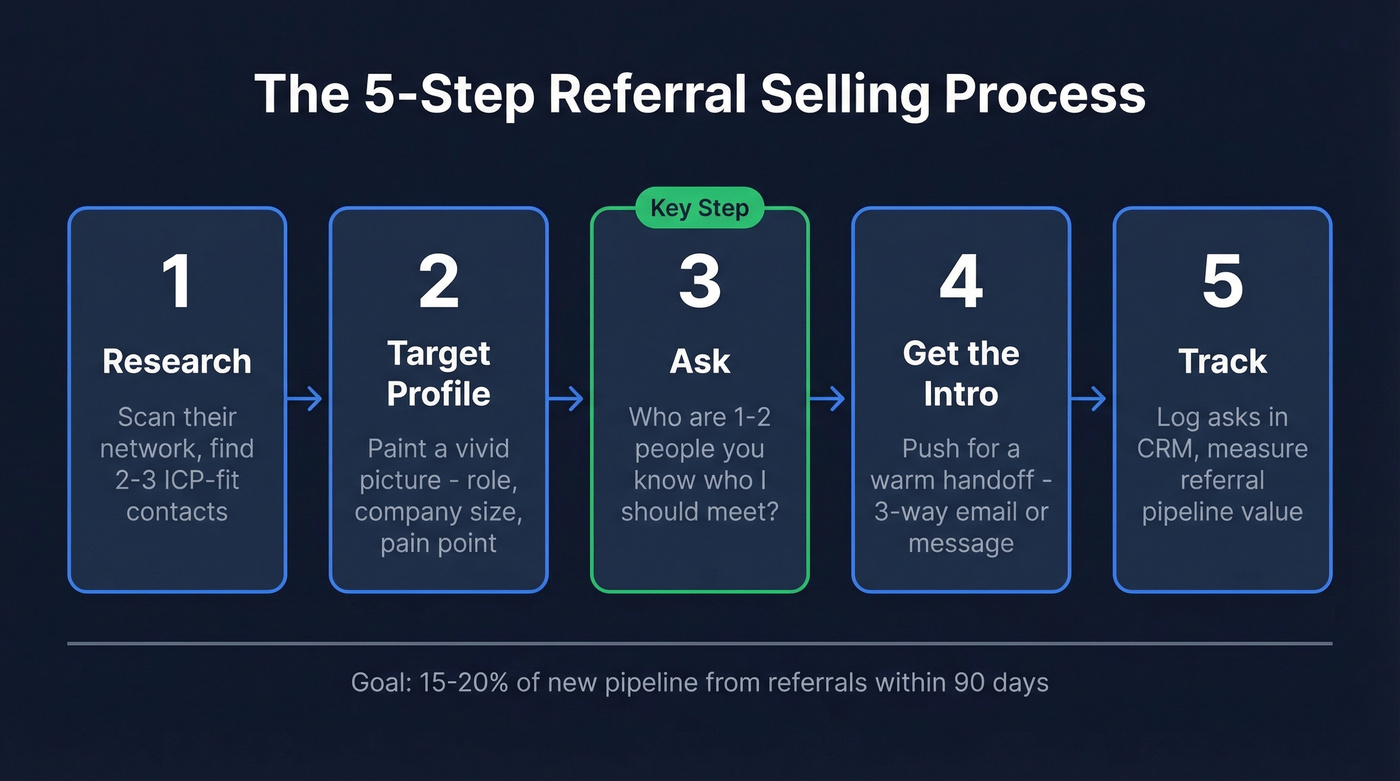
This synthesizes Joanne Black's methodology with practical elements from Pipedrive's referral techniques and Sandler's process discipline. A repeatable system is what separates teams that get occasional introductions from teams that build predictable pipeline.
Step 1: Research
Before you ask, look at your customer's professional network. Identify two or three specific people at companies that match your ICP. This takes 10 minutes and makes the ask dramatically more effective.
Step 2: Identify Your Target Profile
Paint a vivid picture of who you're looking for. Don't say "anyone who might need our product." Say "a VP of Marketing at a B2B SaaS company with 50-200 employees who's scaling their outbound team." Vague asks get vague results.
Step 3: Ask
This is where most reps freeze. The fix is simple: avoid yes/no questions. Instead of "Can you refer me to someone?", use Joanne Black's phrasing: "Who are one or two people you know who I should meet?" That question assumes the introduction will happen. Ask it right after a moment of delivered value - a successful onboarding, a strong QBR result, a renewed contract.
Step 4: Get the Introduction
A name isn't a referral. An introduction is. Ask your customer to make a warm handoff - a three-way email, a brief message, even a text. If your customer just gives you a name and says "tell them I sent you," you've lost most of the advantage. Push gently for the actual connection.
Step 5: Track
Log referral asks as a CRM activity. Track referrals received, referral-to-meeting conversion, and referral pipeline value. In our experience, teams go from zero referral pipeline to 15-20% of new pipeline within a quarter just by adding "referral ask" as a required field in their opportunity close workflow. Set a target of 15-20% within 90 days and hold reps accountable to it. (If you need a baseline for what to log, see sales activities.)

You researched your customer's network, identified two perfect-fit contacts, and got the introduction. Now you need a verified email to follow up before that warm goodwill fades. Prospeo finds verified emails across 300M+ profiles at 98% accuracy - so your referral follow-up lands in the inbox, not a bounce folder.
Turn every warm introduction into a booked meeting for $0.01 per email.
Scripts That Actually Work
Post-Success Email
Subject: Quick favor - and a thank you
Hi [Name],
Really glad [specific result] landed the way it did.
Quick ask: who are one or two people in your network - maybe a peer at another company - dealing with [specific problem you solved]? I'd love an introduction if you think it'd be valuable for them.
No pressure. And thanks again for the partnership.
Verbal Ask at a QBR
After the customer shares positive feedback: "That's great to hear. The best clients we work with tend to know other leaders facing similar challenges. Who are one or two people you'd feel comfortable introducing me to?"
A "share card" works well here too - a one-page PDF your customer can forward that explains who you help and how to reach you. It reduces friction. People want to help; they just don't want it to be hard.
Once you have the name, find their verified email in seconds so you follow up before the introduction goes cold. Prospeo's email finder pulls a verified contact in one click - 98% accuracy across 143M+ emails. (For follow-up wording that gets replies, use these sales follow-up templates.)
The 5 Best Moments to Ask
Post-onboarding win. The customer just saw first value. Excitement is high, and they're thinking about the problem you solved - strike now.
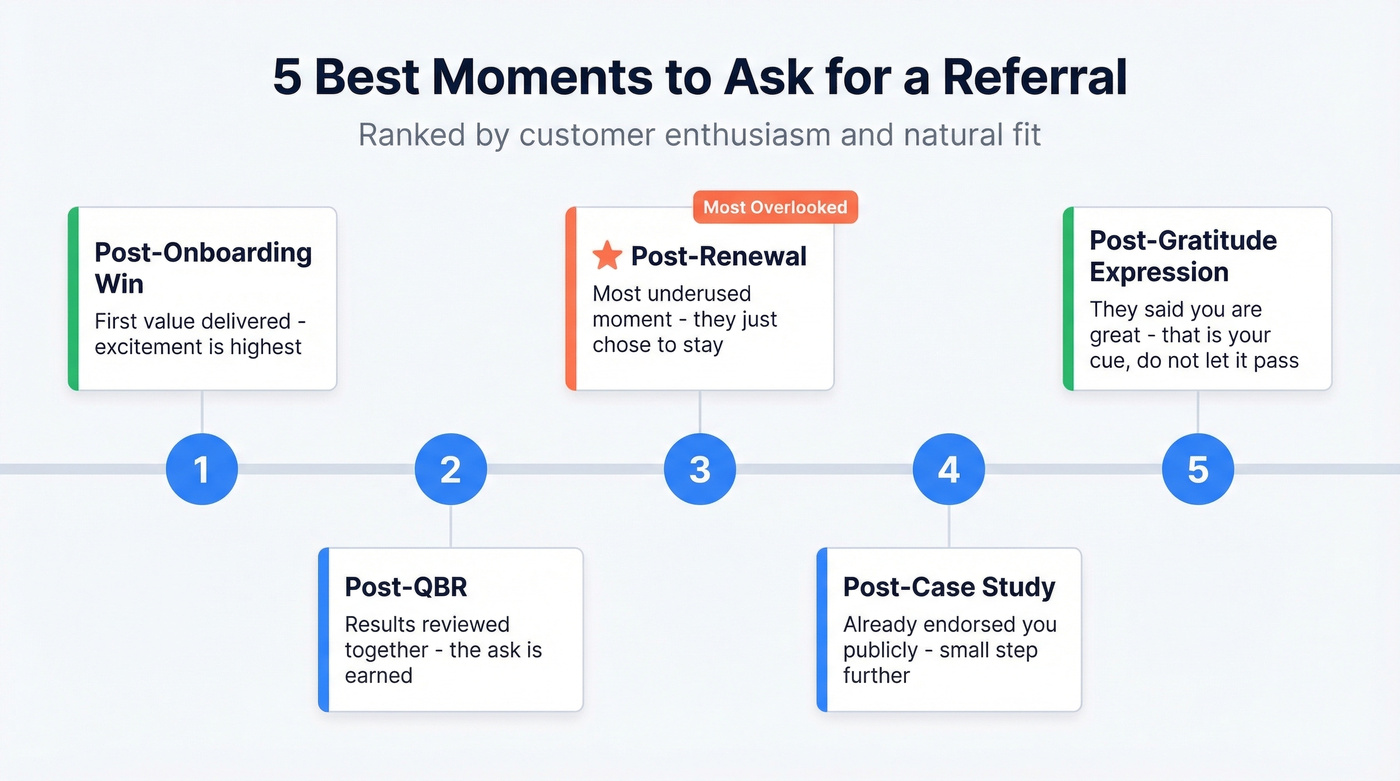
Post-QBR. You've just reviewed results together. If the numbers are good, the ask is natural and earned. (If you want to tighten your agenda, steal these QBR questions.)
Post-renewal. They chose to stay. That's an implicit endorsement - make it explicit. We've found this is actually the most underused moment because reps treat renewals as administrative rather than relational. (Track it alongside your renewal rate.)
Post-case study. They agreed to be featured publicly. Asking for an introduction is a small step further.
Post-gratitude expression. Anytime a customer says "you guys are great" - that's your cue. Don't let it pass.
Incentives: What Works, What Backfires
Focus on making the ask easy and well-timed. In B2B, the best referrals come from genuine relationships and delivered value. If you want to reward someone, a surprise gift after the referral converts - a nice bottle of wine, a handwritten note, a donation to their favorite cause - lands better than a pre-announced bounty. It feels like gratitude, not a transaction.
Don't build an elaborate incentive program before you've built the habit. We've seen this pattern repeatedly: 90% of B2B teams don't need an incentive program. They need a process. Gift cards and cash bonuses work in B2C and ecommerce, where ReferralCandy reports 1,220% average ROI, but B2B buyers aren't referring you for a $50 Amazon card. They're referring you because you made them look good.
Let's be honest: if you need to bribe your customers to refer you, you have a product or service problem, not a referral problem.
Tools for Scaling Referrals
Start with process before software. A spreadsheet and a CRM custom field will outperform a $1,750/month platform if your reps aren't making the ask. Once you have volume, dedicated tools help you track, reward, and scale. (If you're evaluating your stack, start with contact management software.)
| Tool | Starts at | Best for |
|---|---|---|
| Rewardful | $49/mo | SaaS affiliate + referral |
| ReferralCandy | $59/mo | Ecommerce referral programs |
| Referral Factory | $95/mo | Multi-channel campaigns |
| Referral Rock | $200/mo | B2B + B2C hybrid |
| GrowSurf | $450/mo | SaaS-focused, tech-forward |
| SaaSquatch | $1,750/mo | Enterprise loyalty + referral |
These tools manage the program itself - tracking, rewards, dashboards. But they don't solve the real bottleneck: you get a name and a company, and then you can't find a working email address. The warm introduction dies in a bounced inbox. Prospeo's Chrome extension pulls verified contact data from any company page in one click, with 98% email accuracy and a 7-day data refresh cycle. (If you're troubleshooting bounces, see email bounce rate.)
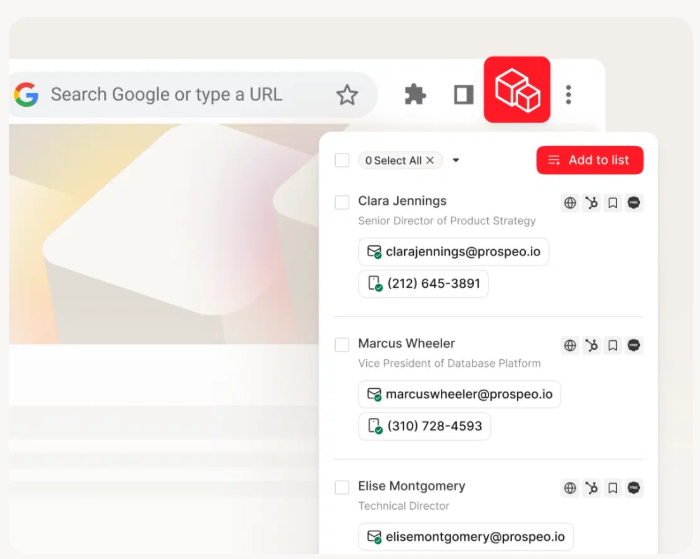
Step 1 of your referral process says to research your customer's network and identify ICP-fit contacts. Prospeo's 30+ search filters - buyer intent, technographics, headcount growth, funding - let you pinpoint exactly who to ask for. Walk into that QBR with two specific names, not a vague request.
Stop asking for 'anyone who might need this.' Show up with names.
How to Measure Your Referral Program
Track these six metrics to turn referral selling from a vibe into a system:
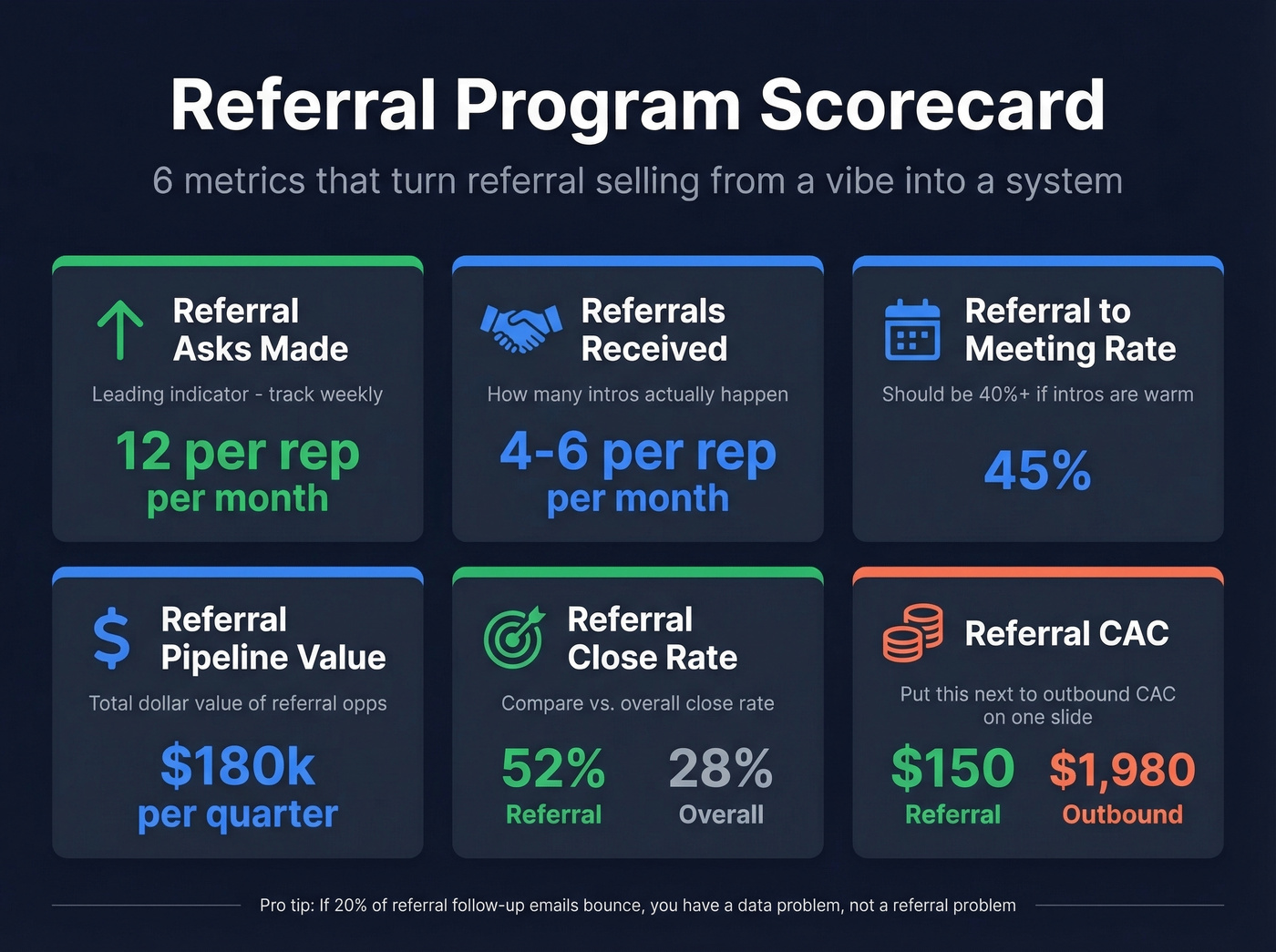
- Referral asks made - this is the leading indicator, and it's the one most teams skip
- Referrals received
- Referral-to-meeting conversion rate
- Referral pipeline value
- Referral close rate vs. overall close rate
- Referral CAC
Put your referral CAC next to your outbound CAC on one slide. That slide sells itself. (To pressure-test your funnel math, use these funnel metrics.)
If 20% of your referral follow-up emails bounce, you don't have a referral problem - you have a data problem. Skip this metric if your team isn't making at least 10 referral asks per month; you need volume before measurement matters.
FAQ
What's the difference between referral selling and referral marketing?
Referral selling is a sales rep asking a customer for a warm introduction to a specific prospect. Referral marketing is an automated program with share links and rewards. Sales owns the first; marketing owns the second. The key distinction is human relationship versus scalable automation - and in B2B with deal sizes above $15k, the human version wins every time.
Should I offer incentives for B2B referrals?
Usually not upfront. B2B referrals convert best when driven by genuine relationships and delivered value, not gift cards. Focus on making the ask easy, well-timed, and specific - then surprise-reward after conversion with a thoughtful gesture.
How quickly should I follow up on a warm introduction?
Within 24 hours. Speed is everything. Referred prospects convert at 3-5x the rate of cold outbound, but only if you capitalize on the trust window. Reference the mutual connection by name in your first message and personalize around the specific problem discussed.
What if my customer gives me a name but won't make the intro?
Take what you can get, but know you've lost most of the advantage. Reference the mutual connection in your outreach, be specific about why you're reaching out, and keep the email short. It's still warmer than pure cold outbound - just not as warm as a proper three-way introduction.