

Request for Meeting Letter Templates That Actually Get Replies
Meetings have increased 70% since the pandemic, yet the average cold email reply rate sits at 5.8%. That means 94 out of 100 meeting requests get ignored. Most templates floating around are too long, too vague, and written for a world where executives didn't spend 23 hours a week in meetings. Here's the thing: you need 30 minutes with a VP of Operations at a target account, and your message has roughly three seconds to earn attention in a crowded inbox. Whether you need a formal business letter or a quick email, everything below is backed by data from 16.5 million emails - so you can actually beat those odds.
Letter vs. Email - When to Use Which
Email is the right call for most meeting requests. It's faster, trackable, and what people expect. But a printed letter still has a place - and when it's the right move, it cuts through precisely because nobody sends them anymore.
Use a formal letter when you're contacting government officials, when the context is legal or regulatory, when you're proposing a board-level partnership, or when your emails have gone unanswered three times and you need to escalate the channel. Michigan State's ombudsperson guidance puts it well: a letter helps when email isn't getting attention or a more formal method is required. For everything else - sales outreach, client check-ins, internal requests, vendor coordination - email is the move.
| Formal Letter | ||
|---|---|---|
| Best for | Government, legal, escalation | Sales, clients, internal, vendors |
| Speed | Days (mail delivery) | Instant |
| Tone | Highly formal | Professional to casual |
| Tracking | None | Open/click tracking |
| When emails fail | Strong escalation signal | Diminishing returns after 2-3 |
Formal Meeting Request Letter Format
Most formal business letters follow the same anatomy:
- Sender's full mailing address (top left or letterhead)
- Date
- Recipient's name, title, and mailing address
- Subject line (Re: Meeting Request - [Topic])
- Salutation (Dear Mr./Ms./Dr. [Last Name])
- Body - purpose in the first 1-2 sentences, propose 2-3 times
- Complimentary closing (Sincerely, Respectfully)
- Signature (handwritten + printed name and title)
- Enclosure/copy notations (when relevant)
Here's a complete, copy-paste sample letter requesting an appointment for a business meeting:
[Your Name] [Your Title], [Your Company] [Your Address] [City, State ZIP]
[Date]
[Recipient Name] [Recipient Title] [Company/Organization] [Address] [City, State ZIP]
Re: Meeting Request - [Topic, e.g., Strategic Partnership Discussion]
Dear [Mr./Ms./Dr. Last Name],
I'm writing to request a 30-minute meeting to discuss [specific purpose - e.g., a potential partnership between our organizations in the Northeast market]. [One sentence of context - e.g., Our teams share overlapping customer segments, and a joint approach could benefit both sides.]
I'm available [Date 1], [Date 2], or [Date 3] and happy to meet at your office or a location convenient for you.
Sincerely,
[Signature] [Your Printed Name] [Phone Number] [Email Address]
What the Data Says
Belkins analyzed 16.5 million cold emails across 93 business domains. The findings changed how we think about meeting requests.
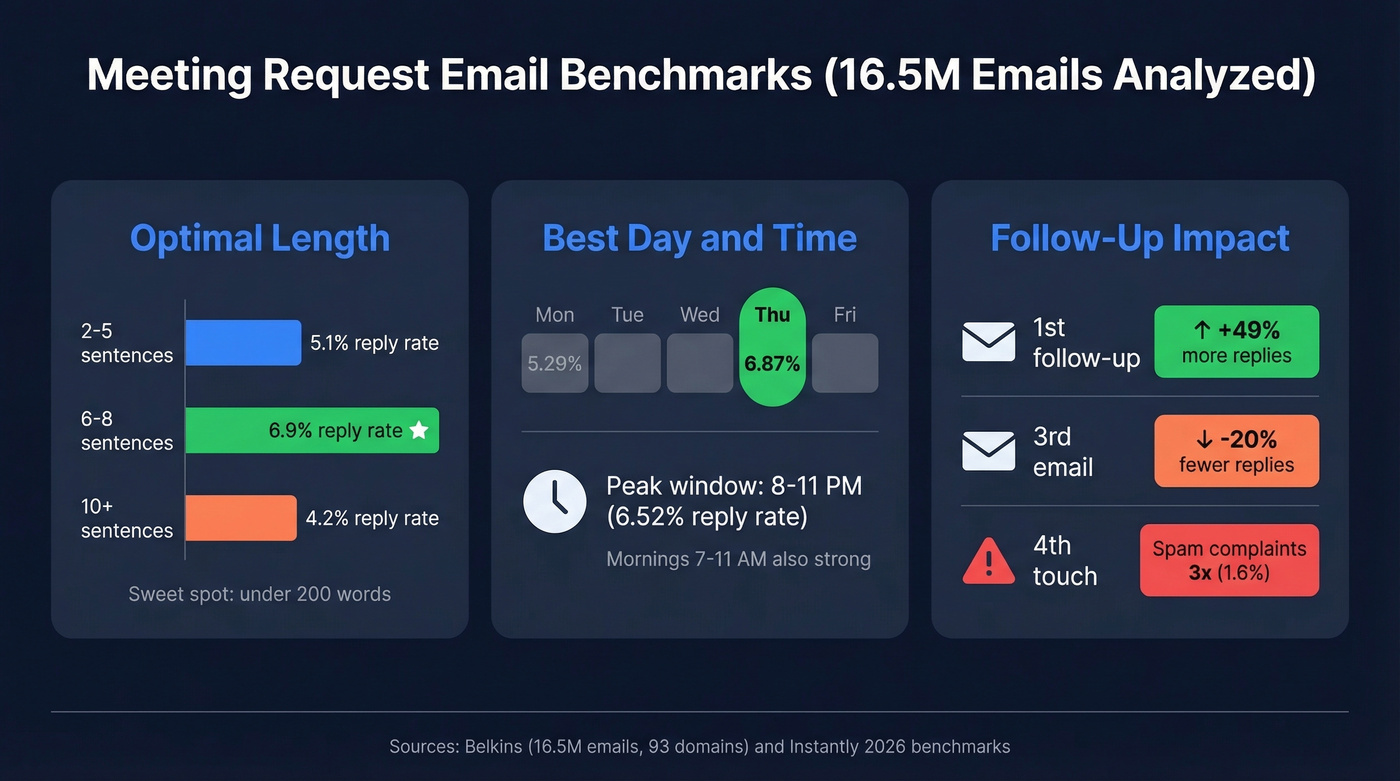
Keep it short. Emails with 6-8 sentences hit a 42.67% open rate and 6.9% reply rate - the best-performing length bracket. HubSpot goes even further, claiming the best prospecting emails are two sentences or shorter. Over 200 words and returns start dropping. (If you want more structure, see our guide to email copywriting.)
Send on Thursday evening. Thursday pulled a 6.87% reply rate versus Monday's 5.29%. The peak reply window is 8-11 PM at 6.52%, with mornings from 7-11 AM also strong. If you're optimizing send windows, our breakdown of the best time to send cold emails goes deeper.
Follow up once. The first follow-up boosts replies by up to 49%. After that, returns drop sharply - the third email brings roughly 20% fewer responses, and spam complaints triple by the fourth touch (0.5% to 1.6%). If you need more options, use these sales follow-up templates.
Instantly's 2026 benchmark data puts the average cold email reply rate at 3.43%, with top performers clearing 10%+. The gap between average and great is enormous, and it comes down to structure, brevity, and relevance.
Let's be honest: if your meeting request email is longer than your "About" section on any professional profile, you've already lost. We've seen teams book more meetings just by cutting email length below 200 words. The template isn't the magic - the editing is.

The best meeting request template in the world won't get a reply if it lands in the wrong inbox. Prospeo gives you 98% verified emails for the exact decision-makers you're targeting - so your carefully crafted ask actually reaches the VP, not a dead address.
Stop perfecting templates for email addresses that bounce.
Meeting Request Templates for Every Scenario
Every template below stays under 200 words. Brackets indicate where you personalize.
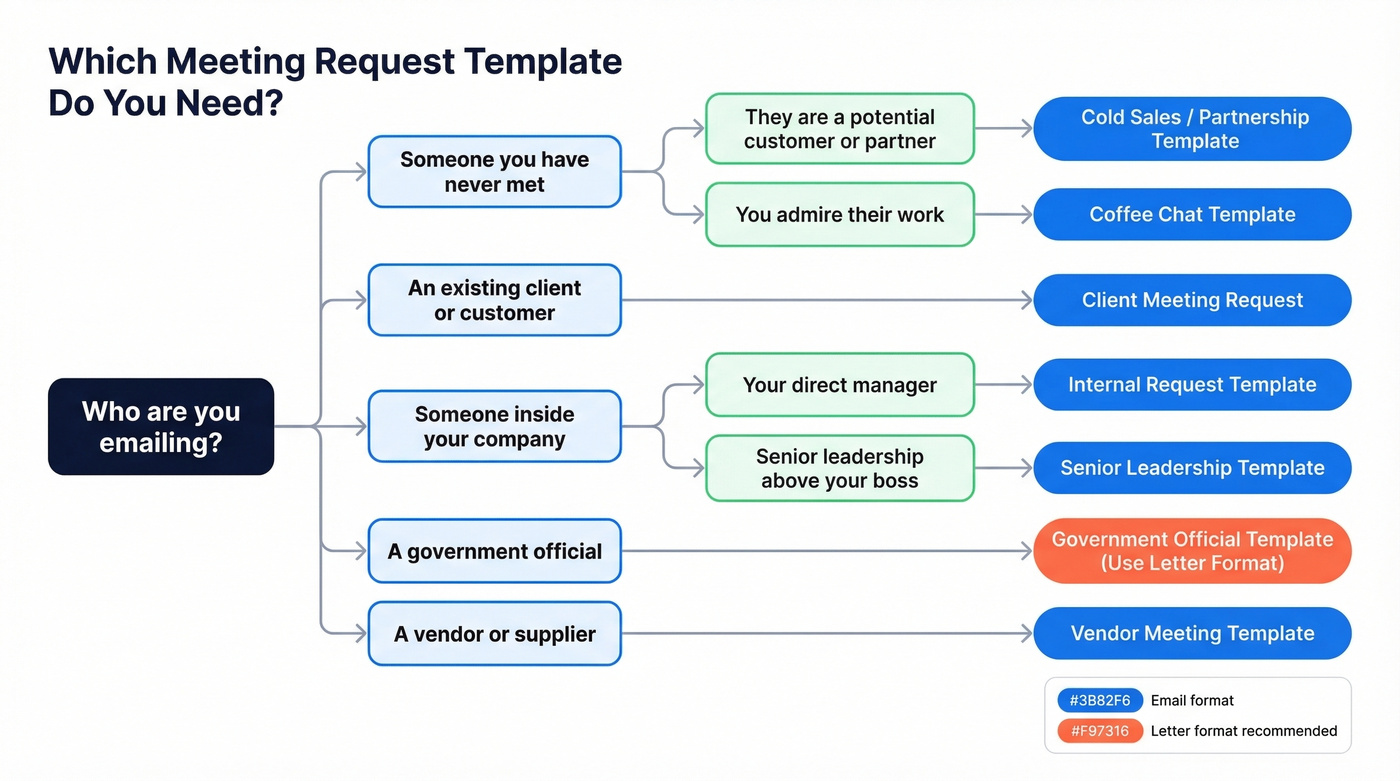
Formal Business Meeting (Letter)
Best for partnerships, vendor negotiations, or formal proposals where a printed letter carries weight.
Dear [Mr./Ms. Last Name],
I'd like to request a meeting to discuss [specific topic - e.g., a supply agreement for Q3]. [One sentence of relevant context.]
Would [Date 1] or [Date 2] work for a 30-minute conversation at your office? I'm happy to adjust to your schedule.
Sincerely, [Your Name], [Title]
Client Meeting Request
For existing relationships - quarterly reviews, presenting new work, or checking in. If you're running QBRs, this QBR meaning explainer can help align expectations.
Hi [First Name],
I'd love to set up 30 minutes to [walk you through Q2 results / present the new proposal / align on next steps]. Are you free [Date 1] or [Date 2]?
Happy to work around your calendar.
Best, [Your Name]
Cold Sales / Partnership Request
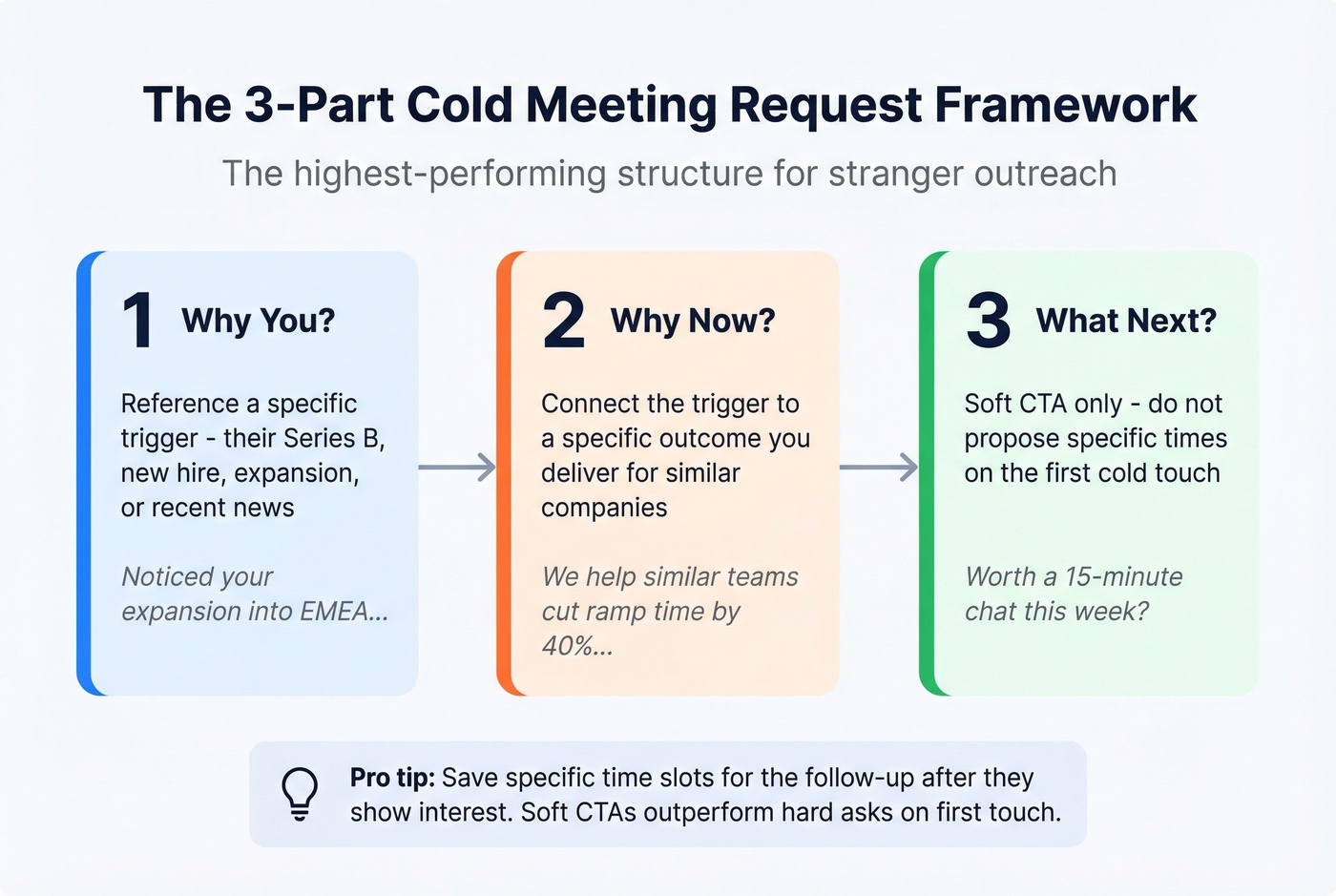
This is stranger outreach, and it's where most templates fail. The "Why you? Why now? What next?" framework is the highest-performing structure per Instantly's testing. One nuance: for cold outreach specifically, a soft CTA like "Worth a chat?" outperforms proposing specific times. Save the time slots for the follow-up after they've shown interest. For a full sequence approach, use our B2B cold email sequence guide.
Hi [First Name],
Noticed [specific trigger - e.g., your Series B announcement / your new VP of Sales hire / your expansion into EMEA]. We help [similar companies] [specific outcome - e.g., cut outbound ramp time by 40%].
Worth a 15-minute chat this week?
[Your Name]
Internal Request (To Your Boss)
Skip this one if your company runs on Slack - just DM them. But if your manager lives in email or you need a paper trail for a resource request, this works.
Hi [First Name],
Could we grab 20 minutes this week? I want to [align on the Q3 roadmap / get your input on the vendor shortlist / flag a resourcing gap on Project X].
I'm open [Date 1] or [Date 2] - happy to work around your schedule.
Thanks, [Your Name]
Senior Leadership (When You're Junior)
This scenario comes up constantly - one Reddit thread captured the anxiety perfectly: reaching out to your boss's boss feels daunting. Lead with the business reason, keep it short, and acknowledge their time. In our experience, mentioning your manager as the one who suggested the meeting removes a lot of the awkwardness.
Hi [First Name],
I'm [Your Name], [role] on [Team]. As part of my onboarding, [Manager Name] suggested I set up a brief intro meeting with you to align on [specific topic].
Would 15 minutes work sometime this week or next? I know your calendar is tight - happy to take whatever slot works.
Best, [Your Name]
Follow-Up (After No Response)
Your first email got no reply. The first follow-up boosts replies by up to 49%, so this isn't optional. If you're unsure about timing, see when should you follow up on an email.
Hi [First Name],
Just floating this back up - I'd still love to connect on [topic]. Would [new Date 1] or [new Date 2] work for a quick call?
No worries if the timing's off. Happy to revisit next month.
[Your Name]
Reschedule Request
Be brief and apologetic. Nobody wants a three-paragraph explanation of why you're moving the meeting.
Hi [First Name],
Apologies - I need to reschedule our [Day] meeting. Could we move to [Date 1] or [Date 2] at the same time? Sorry for the shuffle.
[Your Name]
Government Official / Elected Representative
Letter format recommended. This is one of the few scenarios where formality isn't just appropriate - it's expected.
Dear [Title] [Last Name],
As a constituent of [District/Region], I'm writing to request a meeting regarding [specific issue - e.g., the proposed zoning changes on Main Street].
I'd appreciate 20 minutes of your time to share how this impacts [local businesses / our neighborhood / the community]. I'm available [Date 1], [Date 2], or [Date 3] at your office.
Thank you for your service and your time.
Respectfully, [Your Name] [Address]
Vendor or Supplier Meeting
Hi [First Name],
I'd like to schedule a meeting to discuss [contract renewal terms / our Q3 order forecast / the service issues we flagged last month]. Are you available [Date 1] or [Date 2] for 30 minutes?
[Your Name]
Informational Interview / Coffee Chat
Keep it warm and low-commitment. The worst thing you can do here is make it sound like a sales call.
Hi [First Name],
I've been following your work on [specific project/topic] and would love to pick your brain over a 20-minute coffee chat, virtual or in person. No agenda - just curious about [specific question].
Totally understand if you're slammed. Either way, appreciate what you're putting out there.
[Your Name]
Virtual Meeting Request
Hi [First Name],
Could we jump on a quick call to discuss [topic]? I've blocked 30 minutes on [Date] at [Time] [Timezone].
Here's the link: [Zoom/Teams/Google Meet URL]
Agenda: [1-2 bullet points]. Let me know if another time works better.
[Your Name]
Post-Event Follow-Up
Hi [First Name],
Great meeting you at [Event Name] - enjoyed our conversation about [specific topic]. I'd love to continue that discussion over a 20-minute call this week.
Are you free [Date 1] or [Date 2]?
[Your Name]
Subject Lines That Get Opened
Instantly's testing shows that subject lines that look internal outperform clever ones. Plain beats creative every time. Seven you can steal (and if you want more, browse these email subject line examples):
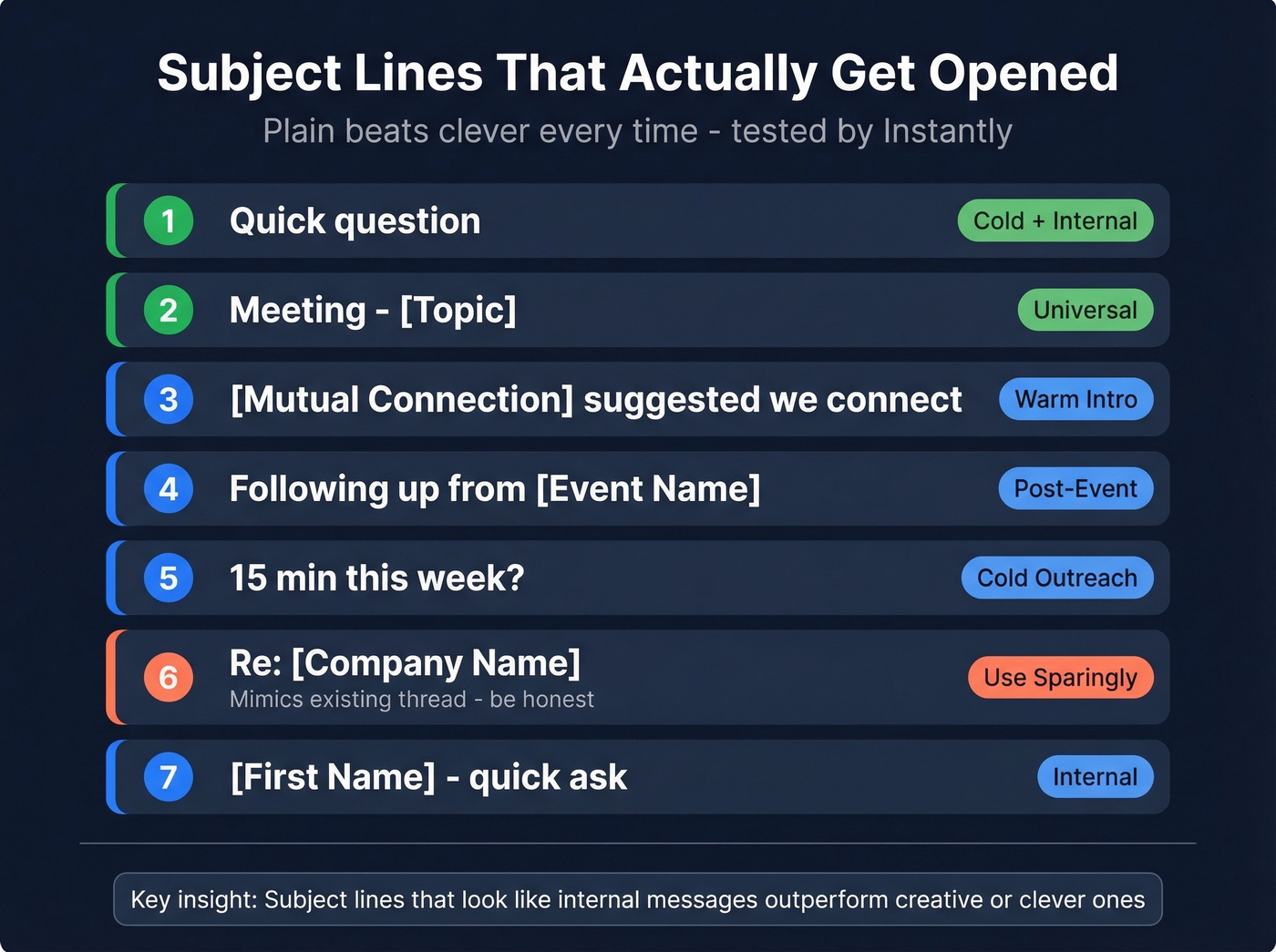
- "Quick question" - works for cold outreach and internal requests
- "Meeting - [Topic]" - direct, scannable, professional
- "Re: [Company Name]" - mimics an existing thread (use sparingly and honestly)
- "[Mutual Connection] suggested we connect" - warm intro signal
- "Following up from [Event Name]" - post-conference
- "15 min this week?" - low-commitment, high open rate
- "[First Name] - [specific trigger]" - personalized cold outreach
For formal letters, the "Re:" line on the letter itself serves the same function. Keep it specific: "Re: Meeting Request - Q3 Partnership Discussion" beats "Re: Meeting."
Mistakes That Kill Response Rates
Writing more than 200 words. The data is unambiguous. Emails with 6-8 sentences outperform everything longer. If your meeting request needs a scrollbar, it's too long.
Burying the purpose. MSU's guidance nails this: state your purpose in the first 1-2 sentences. "I'm reaching out because..." should appear in sentence one, not paragraph three.
Sending a Calendly link in your first message. Look, I get the appeal - it feels efficient. But it's lazy, and it costs you meetings. The consensus on r/sales is that prospects who seemed interested disappear after getting a scheduling link cold. Propose 2-3 specific times instead. Save the booking link for the follow-up after they've said yes.
Not proposing specific times. "Let me know when you're free" puts the work on the recipient. Offer two or three concrete slots and you'll get faster replies. The one exception is cold outreach, where a softer ask like "Worth a chat?" actually outperforms - but for warm contacts and internal requests, specific times win.
Sending to the wrong email address. The best meeting request letter template in the world is worthless if it bounces. Verify the recipient's email before sending - tools like Prospeo check addresses in real time with 98% accuracy, so your message actually lands in an inbox instead of the void. If you're troubleshooting bounces, start with email bounce rate.
Before You Send - Verify the Inbox
You can nail the template, the subject line, the timing - and still get zero replies because you're sending to a dead address. Spam complaints jump from 0.5% to 1.6% by the fourth email in a sequence, and bounces damage your sender domain over time. We've watched outbound teams burn through weeks of pipeline because 15% of their list was bad data. Before you hit send, take 10 seconds to confirm the address is live. (For the full deliverability picture, see our email deliverability guide.)
You just saw the data: cold emails average a 3.43% reply rate, and top performers clear 10%+. The gap isn't just copy - it's targeting. Prospeo's 300M+ profiles with 30+ filters let you find the right person, verify their email, and send with confidence at $0.01 per lead.
Great templates deserve accurate data behind every send.
FAQ
How do you politely ask for a meeting in a letter?
State your purpose in the very first sentence - don't bury it under pleasantries. Propose two or three specific dates and times, keep the entire letter under 200 words, and close with a clear next step like "Please let me know which time works best." Match formality to the recipient's role; see the formal business meeting template above.
What's the best email format for requesting a business meeting?
Use the "Why you? Why now? What next?" framework: open with a specific trigger about the recipient's company, state the value you bring in one sentence, and close with a low-friction ask like "Worth a 15-minute chat?" Keep the entire email under 200 words - emails with 6-8 sentences hit a 6.9% reply rate per Belkins' analysis.
Should I send a meeting request as a letter or an email?
Email works for 90%+ of meeting requests - it's faster, trackable, and expected. Use a formal printed letter for government officials, legal contexts, or when multiple emails have gone unanswered and you need to escalate the channel. Letters cut through precisely because nobody sends them anymore.
How many follow-ups should I send after a meeting request?
One follow-up is essential - it boosts reply rates by up to 49%. After that, returns diminish sharply, and by the fourth touch spam complaint rates rise from 0.5% to 1.6%. Stick to one or two follow-ups max, spaced 3-5 business days apart.
How do I make sure my meeting request reaches the right person?
Verify the recipient's email address before sending. A perfect template sent to a dead inbox produces zero meetings. Real-time verification tools catch invalid addresses, spam traps, and catch-all domains before they tank your deliverability.