

Retail Go to Market Strategy: The Tactical Playbook Generic Guides Won't Give You
You're sitting across from a category manager at a regional grocery chain. She doesn't care about your brand story or your Instagram following. She wants to know one thing: will this product move off the shelf fast enough to justify the space?
That meeting is where most retail go to market strategies fall apart - because most founders never built one that speaks the buyer's language. Up to 91% of retail consumers now shop across channels, which means shelf space is more competitive than it's ever been. Roughly 60% of new items at major U.S. retailers get pulled within three years. The margin for error is razor-thin.
What You Need Before the 40-Slide Deck
Nail these four things first:
- Wholesale margin math. Back into your wholesale price from the target shelf price. If the math doesn't work, nothing else matters.
- Retail-ready checklist. Shelf-ready packaging, a line sheet, inventory depth, and reliable fulfillment.
- ROI-first buyer pitch. Lead with margin structure and expected turn rate, not your founder story.
- Trade spend budget. Budget 15-25% of gross sales in year one. Slotting fees, promos, and retail media add up fast.
Nail Your Wholesale Pricing Math
This is where we see the most confusion - and where Reddit threads from CPG founders consistently go sideways. The question is always some version of "do retailers mark up 2x or 3x?" The answer is simpler than you think, but you have to work backwards from the target shelf price.
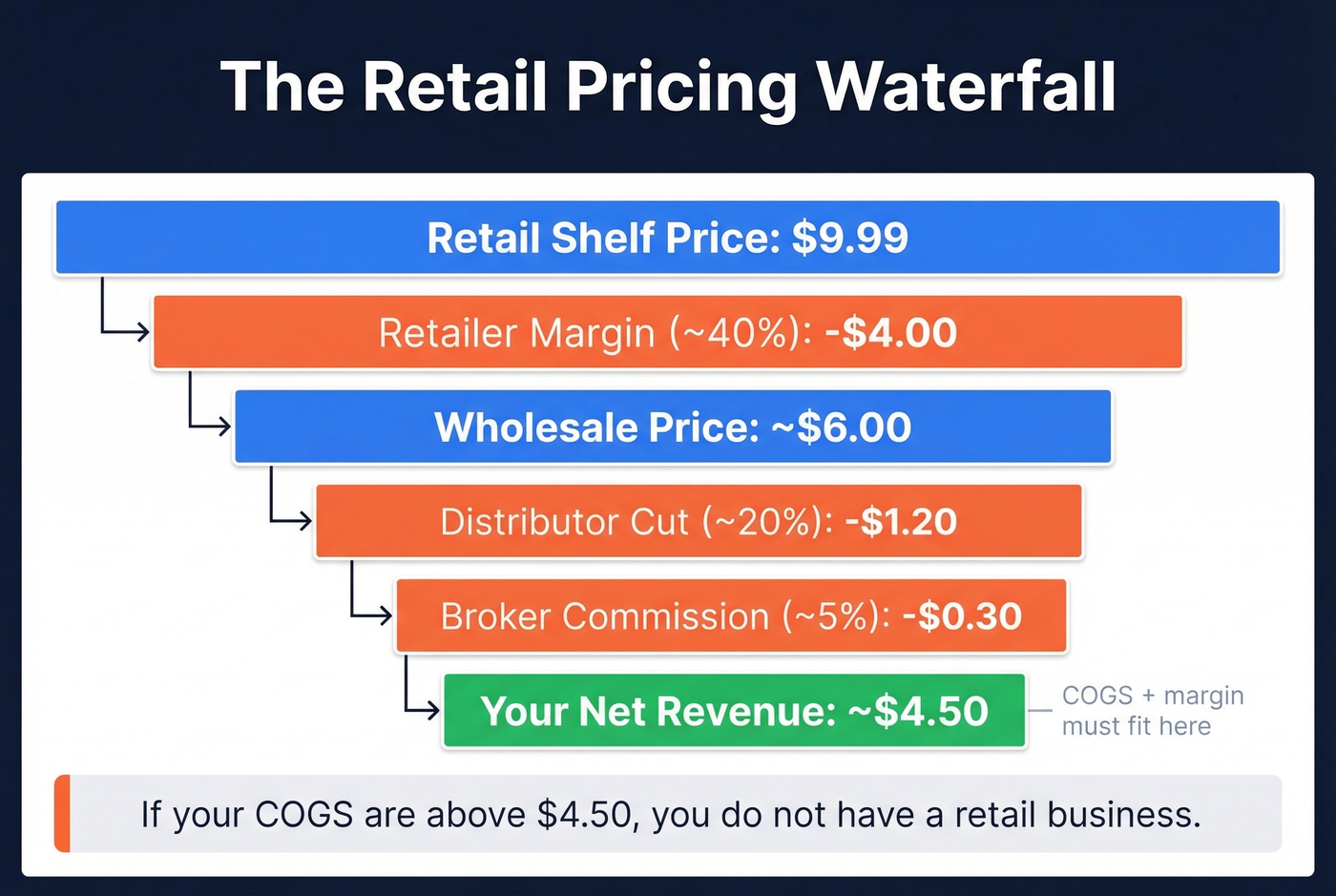
The retailer takes their margin off that number, typically 35-45% for grocery and mass-market categories. Then subtract distributor margins of 15-30% and broker commissions running 3-7% of wholesale if you're not going direct. What's left has to cover your COGS and your margin.
| Line Item | Amount |
|---|---|
| Target shelf price | $9.99 |
| Retailer margin (~40%) | -$4.00 |
| Wholesale price | ~$6.00 |
| Distributor cut (~20%) | -$1.20 |
| Broker commission (~5%) | -$0.30 |
| Your net revenue | ~$4.50 |
| Your COGS + margin | Must fit here |
If your COGS are $3.50, you're making a dollar a unit before marketing and overhead. That's tight. If your COGS are $5.00, you don't have a retail business - you have a DTC brand pretending to be retail-ready.
Here's the thing: most brands that fail in retail don't fail because of bad products. They fail because they never ran this math before signing a distribution agreement. Do this exercise before everything else. If the numbers don't work at wholesale, no amount of marketing will save you.
If you want a clean way to pressure-test assumptions, borrow a few sales prospecting techniques to validate demand signals before you scale distribution.
The Retail Readiness Checklist
No buyer will take your call if you can't check these boxes:
- Shelf-ready packaging. Designed for the planogram, not your website hero image. UPC codes, regulatory compliance, dimensions that fit standard shelf sets.
- Inventory depth. Can you fulfill 50 stores? 200? The fear of 30,000 bottles collecting dust in a warehouse is real - but so is winning a placement you can't stock.
- Reliable fulfillment. One missed PO and you're training the buyer to distrust you.
- Line sheet and sell sheet. SKUs, wholesale pricing, MOQs, lead times, benefits, and lifestyle imagery. Table stakes.
- Social proof. DTC sales velocity, press mentions, customer reviews. As one retail consultant put it: "Follow the green, not the dream."
Skip this checklist at your own risk. We've watched brands land a meeting with a national buyer, nail the pitch, then lose the deal because they couldn't produce a compliant line sheet on the spot.
If your outreach is stalling before you even get a meeting, tighten your sales communication so the buyer instantly understands the economics.

Getting past retail gatekeepers starts with verified contact data. Prospeo gives you direct access to category managers, procurement leads, and retail buyers across 300M+ professional profiles - filtered by job title, company, and department. 98% email accuracy means your pitch lands in the right inbox, not a spam folder.
Stop emailing info@ addresses. Reach the buyer who controls shelf space.
Choose Your GTM Motion
Not every brand should walk into Walmart on day one. Your channel-led motion determines your cost structure, speed, and risk profile.
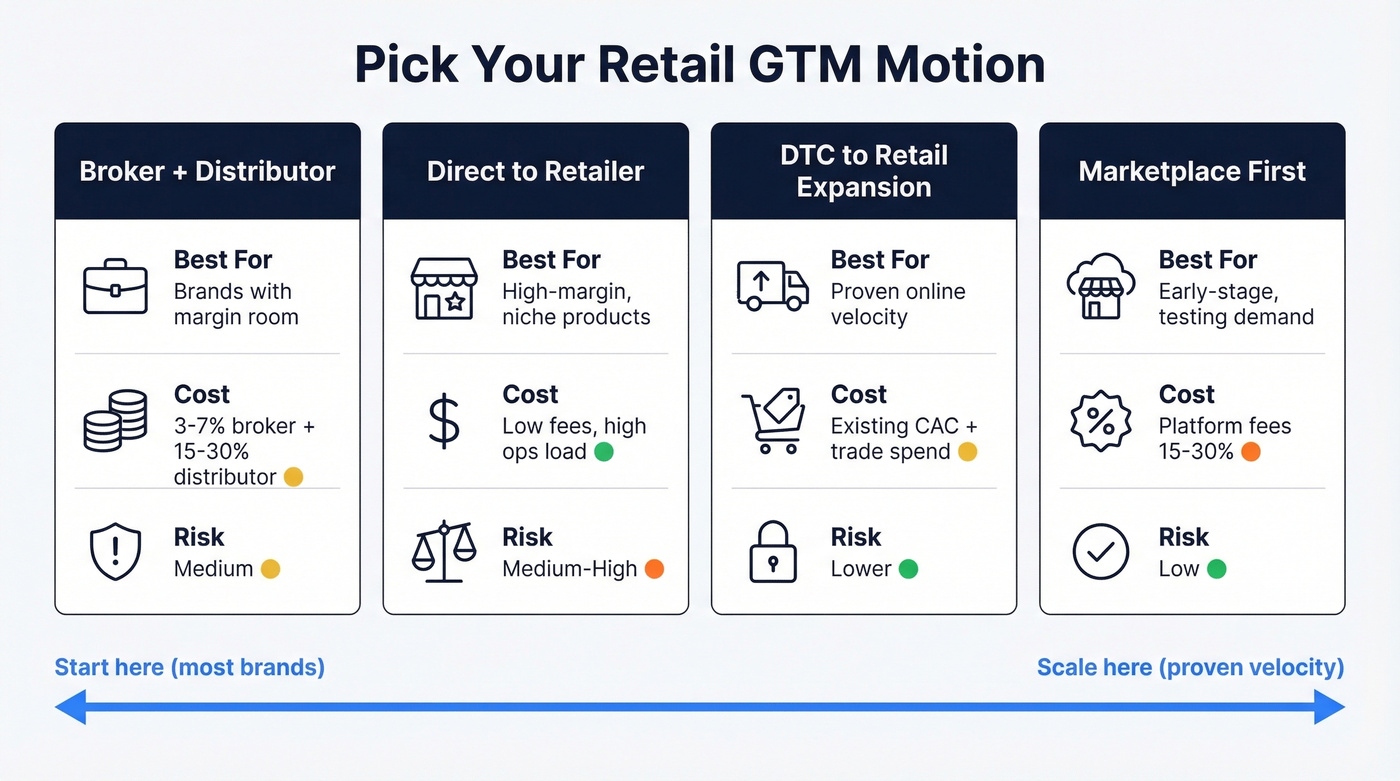
| Motion | Best For | Cost Structure | Risk Level |
|---|---|---|---|
| Broker + distributor | Brands with margin room | 3-7% broker + 15-30% dist. | Medium |
| Direct to retailer | High-margin, niche products | Low fees, high ops load | Medium-high |
| DTC to retail expansion | Proven online velocity | Existing CAC + trade spend | Lower |
| Marketplace-first | Early-stage, testing demand | Platform fees 15-30% | Low |
In 2026, physical retail differentiation has shifted toward hyper-local storytelling - localized assortments, city-specific activations, and community events that drive foot traffic. This makes regional chains even more receptive to brands with a local angle.
The smartest path for most brands: start with regional chains, prove velocity, then use that data to pitch national buyers. Chamberlain Coffee scaled from 1,000 stores to 12,000+ in a single year by following exactly this playbook - proving demand at smaller scale before expanding aggressively. Let's be honest, though: that kind of explosive growth is the exception. Most brands should plan for a 12-18 month regional proving period before national conversations get serious.
To keep the motion disciplined, treat it like a pipeline problem - track funnel metrics and review them on a cadence.
Build Your Retail Buyer List
The hardest part of getting into retail isn't having a great product. It's finding the right person to pitch.
Category managers at major chains don't publish their emails on the company website. They're buried behind procurement portals and gatekeepers, and if you're cold-emailing info@retailer.com, your pitch is going straight to a spam folder. Prospeo lets you search 300M+ professional profiles by job title, company, and department, then export verified emails with 98% accuracy - so you're reaching the actual decision-maker, not a generic inbox.

In our experience, brands that walk into trade shows with a pre-built buyer list close meetings at dramatically higher rates than those who wing it. Once you've got the contact, your pitch needs to lead with ROI.
If you're building lists at scale, use a repeatable lead generation workflow so you’re not reinventing the process for every chain.
Open with the margin story. What does the retailer make per unit, per linear foot? Show velocity evidence from DTC sales data, regional store performance, or market research. Address fulfillment head-on - prove you can deliver on time, at scale. Close with trade support and the promotional dollars you're bringing to drive trial.
When you follow up after the first conversation, use proven sales follow-up templates to keep momentum without sounding needy.
Timing matters enormously. Plan for 1-2 planogram resets per year in many categories, with submission deadlines often 3-6 months ahead. Slotting fees often run $1,000-$5,000+ per SKU per store, and at competitive chains they can go higher. At 1,000 stores, that's $1M-$5M+ in slotting before you sell a single unit.
Budget for Trade Spend and Retail Media
Trade spend is the silent killer of retail margins. Budget 15-25% of gross sales in year one, covering slotting fees, promotional allowances, in-store demos, and co-op advertising. This isn't optional - it's the cost of doing business.
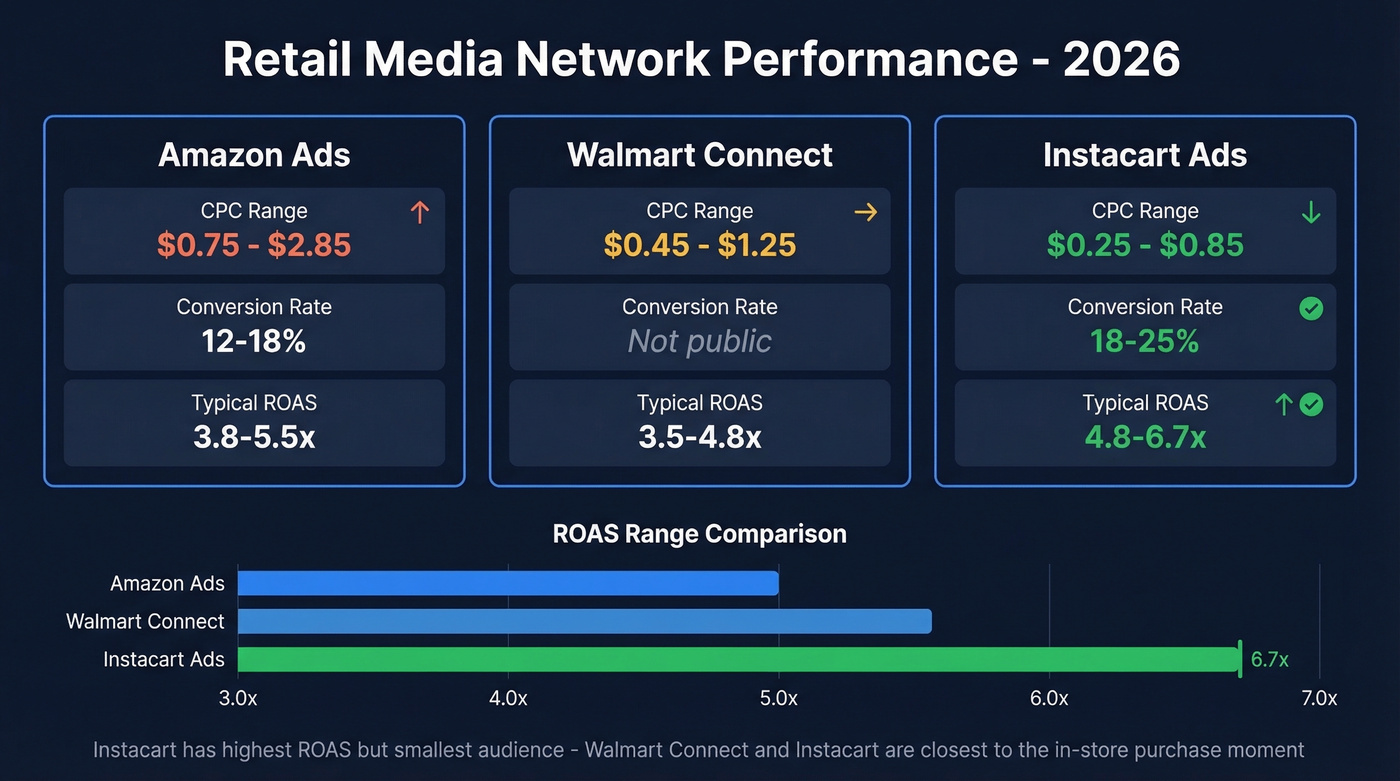
Retail media spend is projected to hit a $130.2B market in 2026, and it's increasingly where brands drive trial once they're on shelf.
| RMN | CPC Range | Conversion Rate | Typical ROAS |
|---|---|---|---|
| Amazon Ads | $0.75-$2.85 | 12-18% | 3.8-5.5x |
| Walmart Connect | $0.45-$1.25 | Not public | 3.5-4.8x |
| Instacart Ads | $0.25-$0.85 | 18-25% | 4.8-6.7x |
Instacart's conversion rates are striking, but the audience is smaller. For most CPG brands launching into physical retail, Walmart Connect and Instacart make the most sense - they're closest to the in-store purchase moment. Amazon Ads work well for brands already selling on the platform, but the CPC premium eats into margins fast if you're not careful with targeting.
If you’re forecasting what you can afford, map trade spend against cost to acquire customer so you don’t confuse growth with profitability.
Measure Velocity or Get Delisted
If you're not moving roughly 1-2 units per store per week in the first few months, you're on the delisting watchlist. Velocity is the only metric that matters to a category manager deciding whether to keep you on the shelf. Everything else - brand awareness, social following, press hits - is noise unless it translates to sell-through.
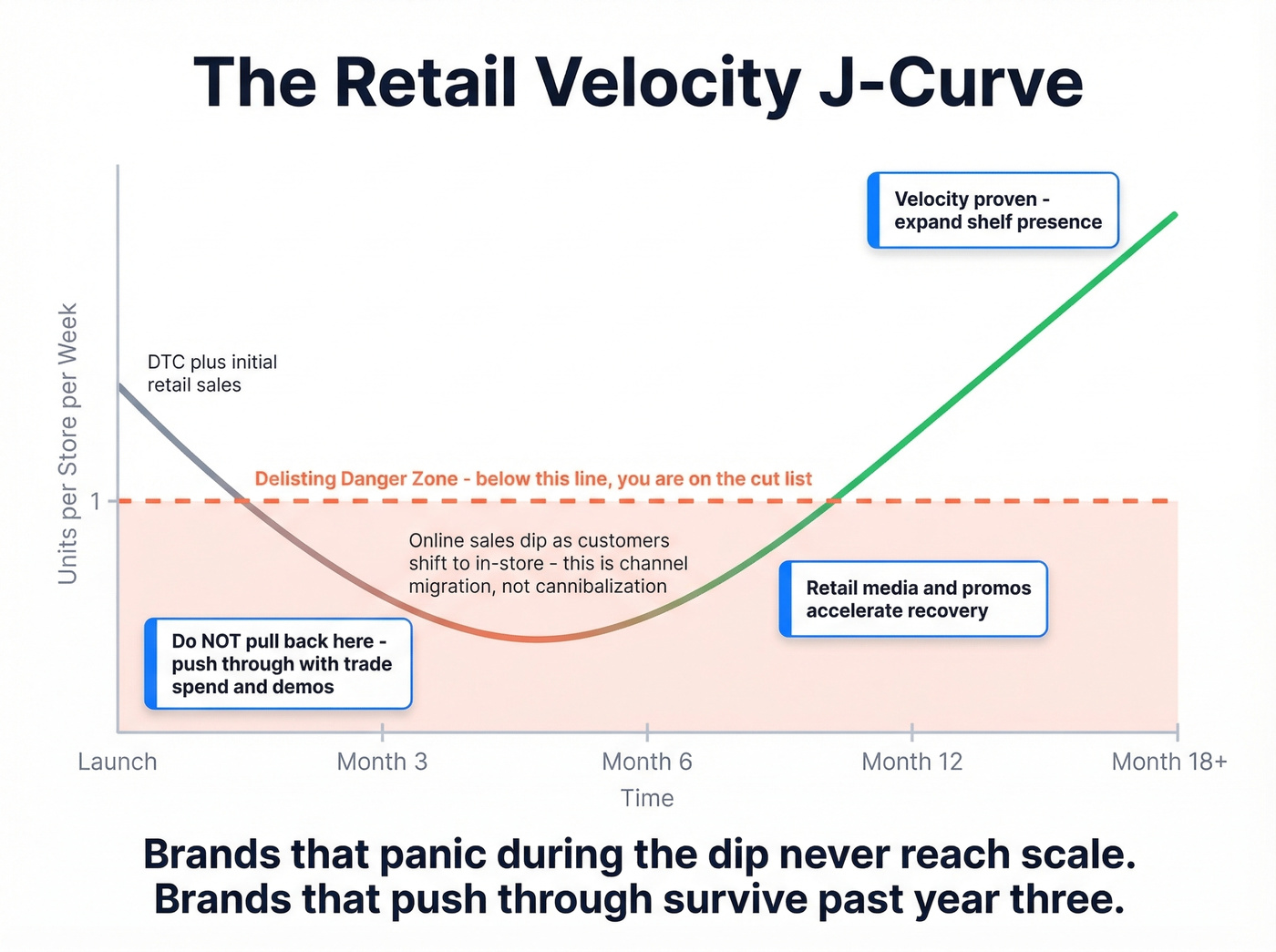
For DTC brands expanding into retail, expect a J-curve. Online sales dip temporarily as customers shift to buying in-store. This isn't cannibalization - it's channel migration. The brands that panic and pull back during this dip never reach scale. The brands that push through with trade spend, retail media, and in-store demos survive past year three.
A solid retail go to market strategy doesn't end at the first PO. It's an ongoing cycle of proving velocity, reinvesting in trade support, and expanding shelf presence. Don't end up 200 stores deep and bleeding cash because you skipped the margin math in step one.
To keep the team aligned on what “good” looks like, set targets using sales pipeline benchmarks and review them like a weekly operating rhythm.
Your retail GTM timeline is tight - planogram resets happen once or twice a year, and submission deadlines hit months early. Prospeo's 7-day data refresh means you're always pitching current category managers, not people who changed roles six weeks ago. Build your buyer list in hours, not weeks.
Build a verified retail buyer list before your next trade show.
FAQ
What's the biggest hidden cost of launching into retail?
Trade spend eats 15-25% of gross sales in year one. Slotting fees alone run $1,000-$5,000+ per SKU per store - at 1,000 stores, that's $1M-$5M+ before you sell a single unit. Budget for promos, demos, and retail media on top of that.
How do I find retail buyer contact information?
Category managers rarely publish their emails publicly. Prospeo lets you search 300M+ profiles by job title and company, then export verified contacts at 98% accuracy - ideal for building a targeted outreach list before trade shows or category review deadlines.
How long does it take to get a product on retail shelves?
Most retailers run 1-2 planogram resets per year, with submission deadlines 3-6 months ahead. From first pitch to shelf placement at a national chain, expect 6-12+ months. Starting with regional chains shortens the timeline significantly.
What velocity do I need to avoid getting delisted?
Aim for 1-2 units per store per week in the first few months, though benchmarks vary by category. Below that threshold, you're likely on the buyer's cut list. In-store demos, retail media, and promotional pricing are the fastest levers to boost early sell-through.