

How to Set Revenue Goals That Actually Get Hit
It's December. You're staring at a board deck with a number on it - $12M ARR by end of next year. The CEO picked it because it sounds right. Nobody's checked whether the pipeline, the headcount, or the market can actually support it. By Q2, the goal is already dead, and the whole company knows it.
Most revenue goals fail not because teams can't execute, but because the goal itself was never grounded in strategy, benchmarks, or pipeline math. Let's fix that.
What Is a Revenue Goal?
A revenue goal is the specific dollar amount your company commits to generating over a defined period - usually a quarter or fiscal year. Simple enough. But confusion starts when teams blur the line between four related but very different concepts.
| Term | What It Means |
|---|---|
| Forecast | What's likely to happen, updated regularly from data |
| Plan | What's assumed to happen, the annual budget backbone |
| Goal | What's hoped to happen - motivational, stretch but not snap |
| Target | What's incentivized to happen, tied to comp and rewards |
When your forecast becomes your target, you get sandbagging. When your goal becomes your plan, you get magical thinking. As Rich Mironov puts it, revenue targets are outcomes, not strategies. A number alone doesn't tell Product what to build, Marketing what to run, or Engineering what to prioritize. It's a destination without a map.
The short version: anchor to current benchmarks (median SaaS growth dropped to 28.29% in 2025), build the pipeline math backward from your number, and validate that your team has the capacity and data quality to execute.
Benchmarks That Shape Your 2026 Number
You can't set a realistic revenue goal without knowing what "realistic" looks like right now. The macro environment has shifted hard.
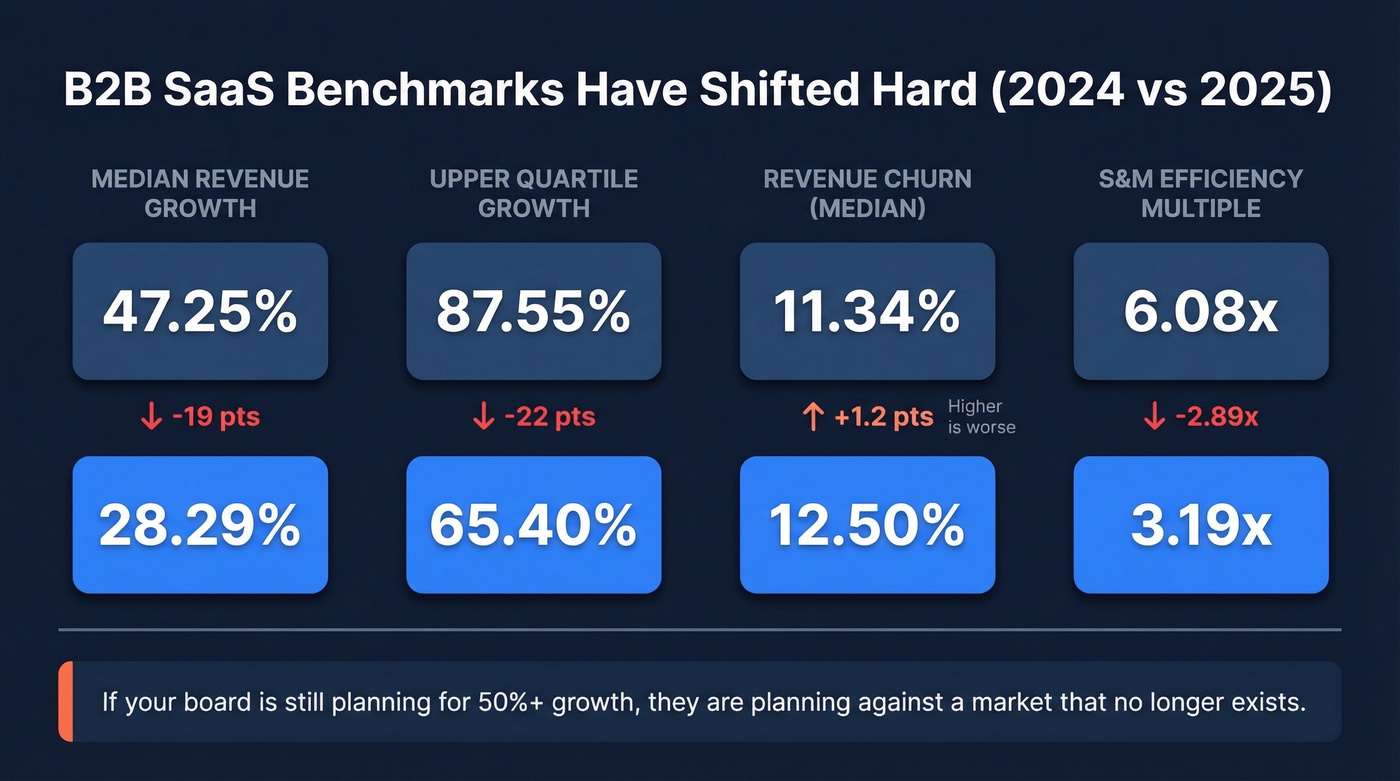
Median annual revenue growth for private B2B SaaS companies hit 28.29% in 2025, down from 47.25% the year prior. Upper quartile growth dropped from 87.55% to 65.40%. If your board is still planning for 50%+ growth "because we're a growth company," they're planning against a market that no longer exists.
Revenue churn climbed to a median of 12.50%, up from 11.34%. That means your gross number needs to be even bigger to hit the same net target. And the efficiency squeeze is real - the median Sales & Marketing multiple fell to 3.19x, down from 6.08x. Every S&M dollar goes roughly half as far as it did two years ago. On the efficiency side, SaaS Capital's annual survey of 1,000+ companies pegs median ARR per employee at $129,724. For $1M-$3M ARR companies, the overall median sits at $99,858, but bootstrapped firms in that band run $110,000 ARR/FTE versus $94,444 for equity-backed. That gap tells you something about the discipline that comes with spending your own money.
How to Set Revenue Goals Step by Step
There are three methodologies, and most teams should use a hybrid of all three.
Top-down starts with the board or executive team setting a number based on strategic ambition - investor expectations, market opportunity, competitive positioning. It's fast and aligned, but it can be completely disconnected from ground-level capacity. Bottom-up starts with individual teams building their numbers from activity data, territory plans, and pipeline reality. It's more accurate but slower, and it invites sandbagging when comp is tied to the budget.
The hybrid approach - leadership sets strategic guardrails while teams fill in operational details - is what actually works. Annual planning that tries to lock in iron-clad commitments while claiming organizational agility is a contradiction, and it rarely produces accurate numbers.
Let's follow a fictional company through this. Call them NovaCRM, a $5M ARR mid-market SaaS platform. Here are the five steps we've seen produce targets that survive contact with reality.
Start With Strategic Context
Before you touch a spreadsheet, answer three questions. Where are we today? Where does the business need to be in 12 months, and why that number? What strategic bets are we making to get there - new segments, new geos, product launches, pricing changes?
NovaCRM's answers: $5M ARR, 32% growth last year, 10% revenue churn. The board wants $7M by year-end. The bet is expanding into enterprise with a new security module. Planning that skips this step ends up as arbitrary percentage increases stapled to last year's number.
Anchor to Benchmarks
Use the benchmarks above as a sanity check. NovaCRM's $7M target implies 40% growth - well above the 28.29% median. That's fine, but it means they're targeting upper-quartile performance. Acknowledge it, resource for it, and have a plan B if you land at the median.
The difference between ambition and delusion is knowing where you sit relative to the market.
Build the Pipeline Math
This is where most goals die. We cover the full math in the next section, but the short version: work backward from your revenue target through conversion rates, average deal size, pipeline coverage, and required activity volume. If the math says you need 4,000 qualified opportunities and you've never generated more than 2,000, you don't have a goal. You have a wish.
Validate Cross-Functionally
Revenue isn't a sales problem. It's a company problem. Product needs to know which features support the plan. Marketing needs pipeline targets that tie to the number. CS needs expansion and retention targets. For NovaCRM, the enterprise push means Product must ship the security module by Q2, Marketing needs enterprise case studies, and CS needs an upsell playbook. If your target lives only in the sales org's OKRs, it's already at risk.
Set Dual Forecasts
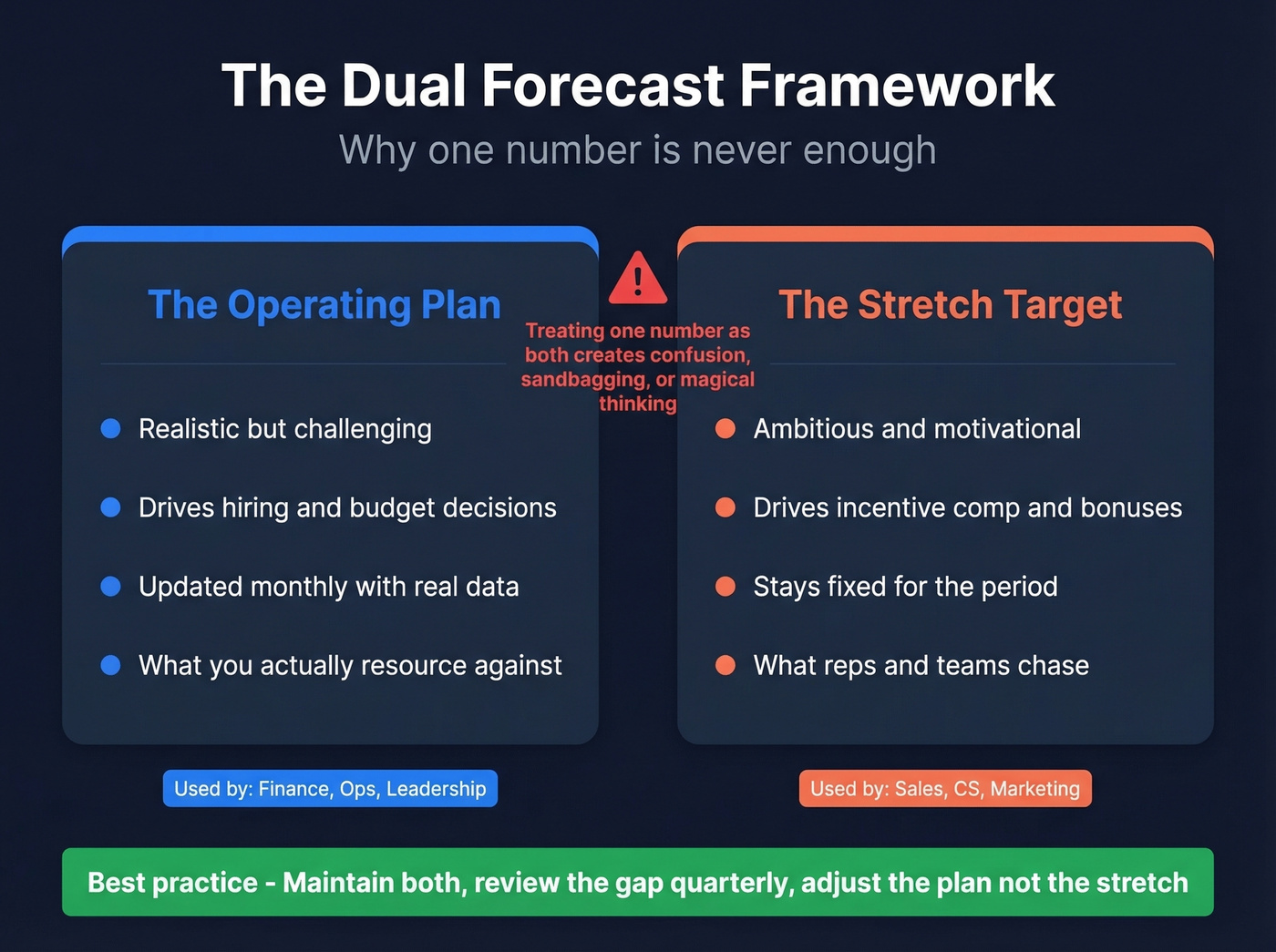
Best practice from FP&A planning: maintain two versions. A "realistic but challenging" plan that drives operational decisions and a stretch target that drives incentive comp. When you treat a single number as both your forecast and your target, you get confusion, sandbagging, or both. (If you want the definitions nailed down, see sales forecast vs sales goal.)

You just saw the math: 40,000 contacts to hit $4M in new business. If 20% of those emails bounce, you need 50,000 contacts to compensate - and your CAC explodes. Prospeo's 98% email accuracy and 7-day data refresh mean your pipeline coverage ratio reflects reality, not fiction.
Stop inflating your pipeline math with bad data.
The Pipeline Math Behind Your Number
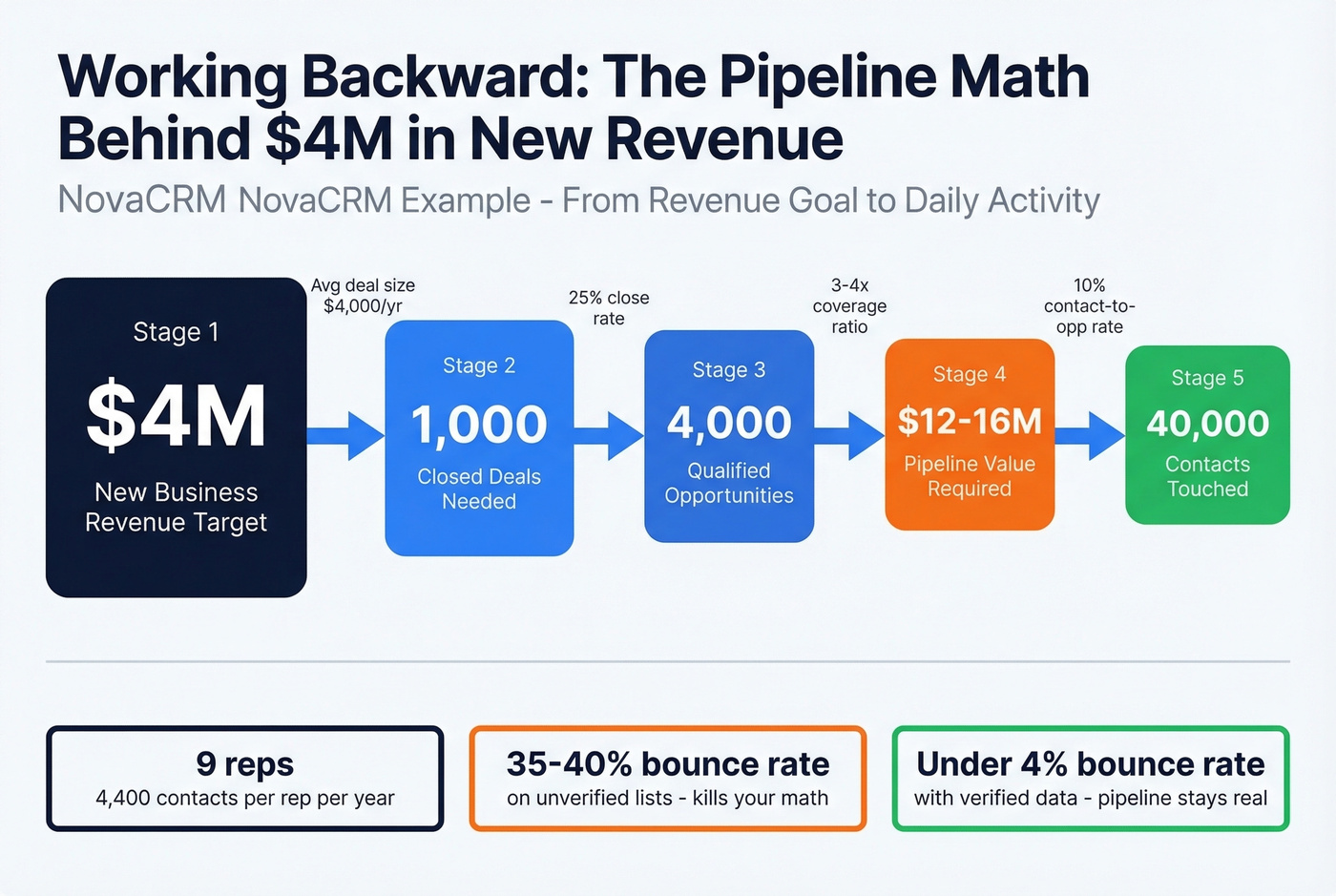
Let's run NovaCRM's numbers. Their target is $4M in new business revenue, with the remaining $3M from expansion and renewals. Average deal size is $4,000/year, so they need 1,000 closed deals. At a 25% close rate from qualified opportunity to won deal, that's 4,000 qualified opportunities. At a standard 3-4x pipeline coverage ratio, they need $12-16M in pipeline value at any given time.
Now work backward to the activity level. If the team converts 10% of outbound contacts into qualified opportunities, they need 40,000 contacts touched. With 9 full-cycle reps, that's roughly 4,400 contacts per rep per year - manageable, but only if the data is clean.
Here's the thing: the variable most teams ignore is data quality. A RevOps Co-op worked example modeled total S&M spend of $2,125,000 across 880 deals - a CAC of $2,414.77 per customer. That math only works if those 880 deals actually close. If a huge chunk of your outbound emails bounce, you need more pipeline just to break even. Your CAC inflates, your coverage ratio lies, and your number becomes fiction. (If you want to pressure-test this, use a proper cost to acquire customer model.)
This is where data quality stops being a "nice to have" and becomes a pipeline variable. We've seen teams running unverified lists hit bounce rates of 35-40%, which means their "3x coverage" is really closer to 2x. Prospeo's 98% email accuracy on a 7-day refresh cycle keeps bounce rates under 4%, so the pipeline numbers actually reflect contacts who receive your outreach. That gap alone can make or break coverage math. (More on this in our email bounce rate benchmarks guide.)
Don't forget rep ramp time. SMB reps ramp in 2-4 months, mid-market in 4-6, and enterprise reps take 6-9+ months before they're at full productivity. If NovaCRM hires enterprise reps in Q1 to hit a Q4 number, the math works. Hire in Q3, and it won't. (If you're building onboarding around this, use a 30-60-90 day plan for sales reps.)
Most companies that miss revenue goals don't have a sales execution problem - they have a data and capacity problem. Fix the inputs, and the outputs follow. The obsession with closing techniques and sales methodologies is a distraction when a big chunk of your pipeline is phantom contacts who never see the email.
Revenue Goal Examples in OKR Format
Concrete examples beat abstract frameworks. Here are targets structured as OKRs you can steal.
SaaS Growth OKRs
Objective: Hit $10M in quarterly new business revenue.
- KR1: Close 200 new deals at an average deal value of $50,000.
- KR2: Improve proposal-to-close conversion from 25% to 40%.
- KR3: Maintain 3x pipeline coverage consistently throughout the quarter.
Objective: Accelerate deal velocity across the mid-market segment.
- KR1: Reduce average sales cycle from 62 days to 45 days.
- KR2: Increase conversion from discovery to proposal from 22% to 30%.
Revenue Efficiency OKRs
Objective: Improve revenue efficiency without adding headcount.
- KR1: Increase ARR per employee from $125,000 to $140,000.
- KR2: Reduce CAC by 15% through better lead qualification and data quality.
- KR3: Grow net revenue retention from 105% to 115% via expansion plays.
Services and E-commerce OKRs
Objective: Grow monthly recurring revenue to $150K by Q4.
- KR1: Add 50 new clients at $1,500 average MRR.
- KR2: Reduce monthly churn from 5% to 3%.
- KR3: Launch annual prepay option with 20% adoption by existing base.
Objective: Increase e-commerce revenue 25% YoY.
- KR1: Raise average order value from $85 to $105 through bundling.
- KR2: Improve repeat purchase rate from 22% to 30%.
- KR3: Win 3 enterprise wholesale accounts above $100K annually.
Common OKR trap: writing activity-based key results like "make 500 calls" instead of outcome-based ones. If the KR doesn't tie to revenue movement, it doesn't belong here.
5 Mistakes That Kill Your Target
These aren't theoretical. We see them every quarter.
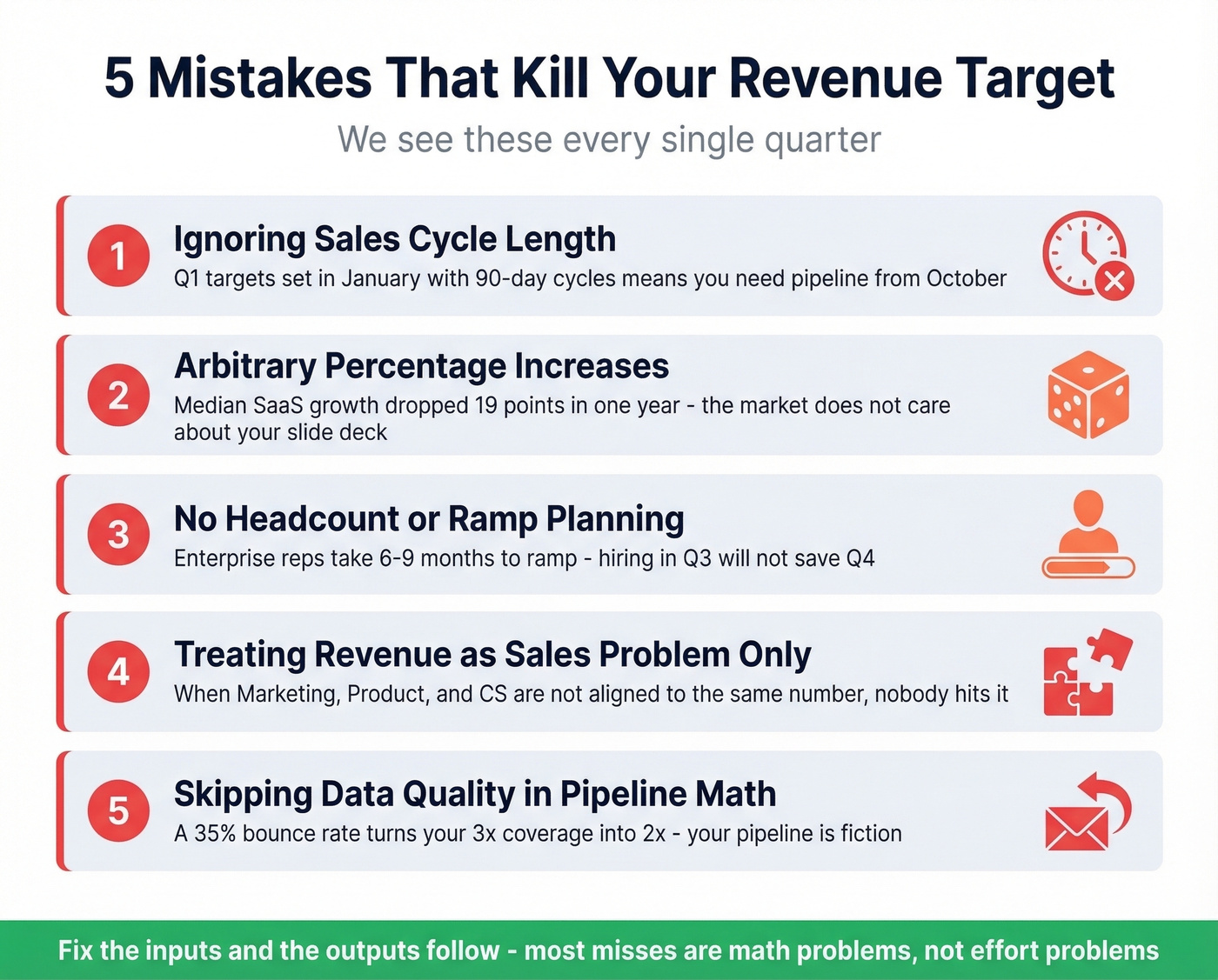
1. Ignoring sales cycle length. If your average deal takes 90 days to close and you set a Q1 target in January, you're relying entirely on pipeline that already exists. NovaCRM's enterprise push means longer cycles - they need Q4 pipeline built in Q1. Any goal that doesn't account for cycle time and seasonality is built on sand.
2. Arbitrary percentage increases. "We grew 30% last year, so let's target 40%." This is how you demoralize a sales team. Growth targets need to be tied to market conditions, capacity, and investment - not vibes. Median SaaS growth dropped nearly 20 points in a single year. The market doesn't care about your slide deck.
3. No headcount or ramp planning. You can't hit a $15M target with a team built for $8M. And hiring doesn't equal capacity - enterprise reps take 6-9 months to ramp. If the headcount plan doesn't precede the revenue plan, you're already behind.
4. Treating revenue as Sales' problem. A Reddit thread on r/sales summed up a common planning failure: not knowing sales goals until the current month. That's a symptom of revenue being siloed. When Marketing, Product, and CS aren't aligned to the same number, nobody owns the gaps.
5. Setting targets without pipeline goals. The most common and most fatal mistake. You can't manage what you don't measure upstream. Pipeline goals need to tie directly to conversion rates, and those conversion rates depend on data quality. When a big chunk of outbound never lands, your "3x coverage" is really 2x - and your number is fiction before the quarter starts. (If you're diagnosing this, start with pipeline health metrics.)
Revenue Goals for Small Businesses
Enterprise SaaS gets all the frameworks, but small businesses need revenue goals too - and the math looks different.
The Profit First methodology offers a clean way to reverse-engineer your target from what you actually need to take home. "Real revenue" means total revenue minus materials and subcontractors. From there, allocate across four buckets:
| Revenue Tier | Profit | Owner's Pay | Tax | OpEx |
|---|---|---|---|---|
| Under $250K | 5% | 50% | 15% | 30% |
| $250K-$500K | 10% | 35% | 15% | 40% |
| $500K-$1M | 15% | 20% | 15% | 50% |
| $1M-$5M | 20% | 10% | 15% | 55% |
If you want $120K in owner's pay and you're in the $250K-$500K band, your real revenue target is roughly $343K ($120K / 0.35). That's your number - derived from a tangible outcome, not a growth percentage pulled from thin air. Implement via the 10/25 rule: transfer allocations on the 10th and 25th of each month to enforce the discipline.
For small businesses building outbound pipelines, Smartsheet's goal-setting templates offer free, downloadable worksheets to track progress against these numbers weekly. Skip these if you already have a CRM with built-in reporting - they're most useful for teams still running on spreadsheets. (If you're still building your outbound motion, start with these sales prospecting techniques.)
Revenue goals die at the activity layer. Your reps need 4,400+ verified contacts each to hit quota - and every bounce, wrong number, or stale record widens the gap. Prospeo gives you 300M+ profiles with 98% verified emails and 125M+ direct dials, refreshed every 7 days. At $0.01/email, your CAC stays where the model says it should.
Make your revenue goal survivable with data that actually connects.
FAQ
What's a good revenue growth rate in 2026?
Median B2B SaaS growth sits at 28.29%, with upper quartile companies hitting 65.40%. Adjust your target downward for revenue churn - currently at a 12.50% median. Planning above 30% means you're targeting above-median performance and need the pipeline, headcount, and data quality to back it up.
How do you calculate a revenue goal?
Divide your target revenue by average deal size to get required deals, divide by close rate to get required opportunities, then multiply by 3-4x for pipeline coverage. Back into the activity volume and headcount needed to fill that pipeline. If the math doesn't work with your current team, the goal needs to change - or the investment plan does.
Why do most companies miss their revenue goals?
The gap between the number and operational reality. No pipeline math, no capacity plan, and bad prospect data that inflates pipeline on paper. When outbound emails bounce at 35%+, your "3x coverage" is really 2x. Verified contact data keeps bounce rates under 4%, so the pipeline math tells the truth.
How often should you revisit your targets?
Quarterly at minimum, monthly if your business has short sales cycles. The annual plan sets direction, but the forecast should update every 30 days based on actual pipeline, conversion rates, and market signals. Teams that treat their number as set-and-forget are the ones blindsided in Q3 when it's already out of reach.
What tools help small teams hit revenue goals?
For pipeline math, a simple spreadsheet works. For the data that feeds it, Prospeo's free tier - 75 emails plus 100 Chrome extension credits per month - gives small teams enterprise-grade contact accuracy without enterprise pricing. Pair that with a CRM like HubSpot's free plan and a sequencing tool like Instantly to run the full outbound motion.