

Revenue Marketing: What It Is, Why It Fails, and How to Build It Right
You spent $200K on campaigns last quarter. The CFO pulls up the board deck and asks one question: "How much revenue did marketing generate?" The room goes quiet. If you've been in that meeting - or you're the marketer dreading it - you already know why revenue marketing exists. It's not a buzzword. It's the answer to the question marketing has been dodging for twenty years.
The top thread on r/marketing about this role is literally someone asking what it even means day-to-day. Job descriptions are vague. KPIs are muddled. Let's fix that.
The Short Version
- Revenue marketing = marketing accountable to pipeline and closed revenue, not MQLs. If your team celebrates leads but can't tell the CFO what those leads turned into, you're doing demand gen with a fancier title.
- Start with three things: shared revenue goals with sales, a multi-touch attribution model (U-shaped is the right starting point), and clean contact data.
- The stack that matters: CRM + data enrichment + automation + attribution. Everything else is optional until these four work together.
What Is Revenue Marketing?
It ties every marketing activity - every campaign, every dollar, every headcount decision - directly to pipeline creation and closed revenue. Not impressions. Not MQLs. Revenue.
So what does a revenue marketer actually do all day? They build attribution models, run pipeline reviews with sales, optimize campaigns based on revenue outcomes instead of click-through rates, and report on marketing-sourced pipeline in the same language the CRO uses. They sit in forecast calls. They care about win rates.
The definition is straightforward: it's the strategic and operational discipline of holding marketing accountable to the same financial outcomes as the rest of the revenue team. The term only exists because the industry spent two decades optimizing for vanity metrics and needed a label for the correction.
Why This Approach Exists
The simplest explanation? Sales got tired of it.
Browse r/sales and you'll find a recurring theme: revenue leaders believe marketing prioritizes brand awareness and content calendars over urgent financial impact. That perception created the pressure for revenue-based marketing - proving contribution in dollars, not downloads.
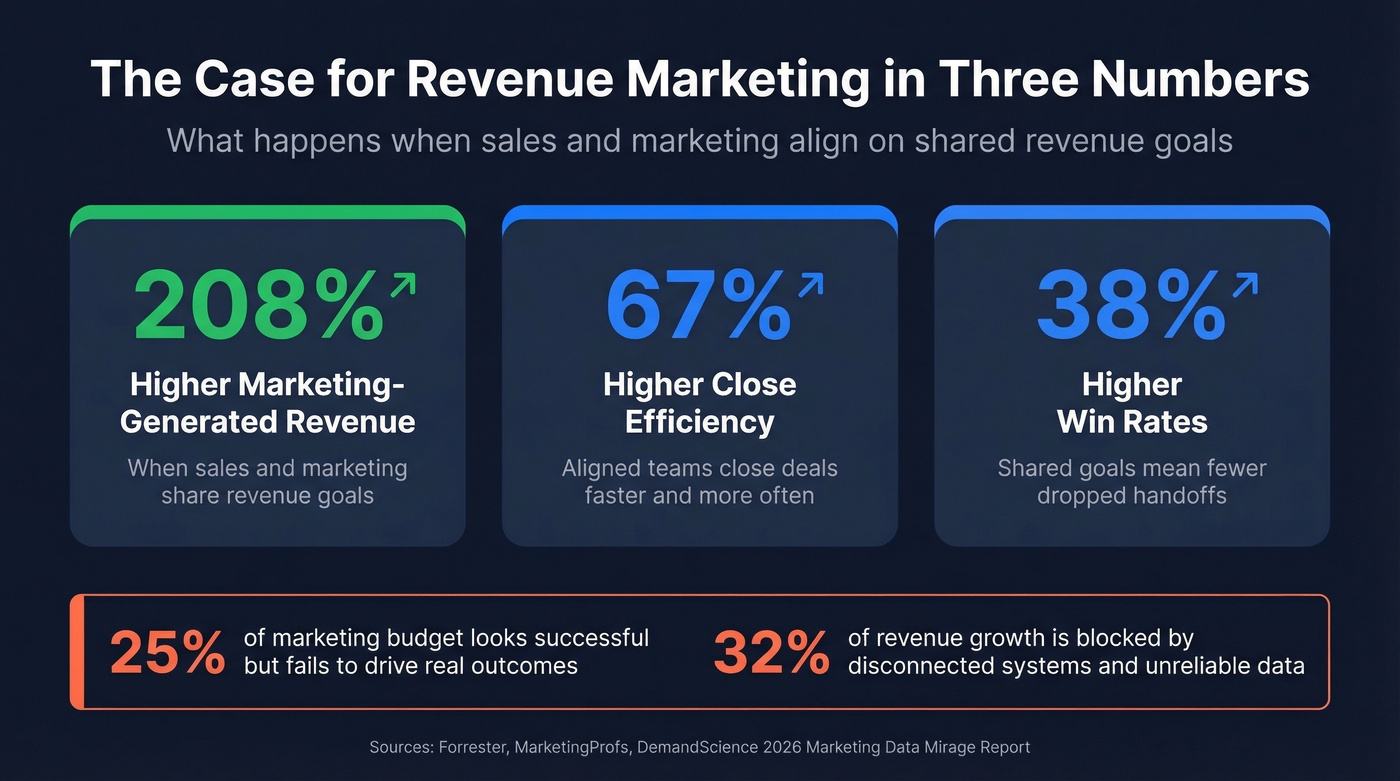
The data backs up the urgency. Widely cited Forrester and MarketingProfs research shows that when sales and marketing align on shared revenue goals, companies see 67% higher close efficiency, 208% higher marketing-generated revenue, and 38% higher win rates. Those aren't marginal improvements. That's a different business.
A DemandScience survey of 750+ senior B2B marketing leaders paints the other side: 25% of marketing budget "looks successful but fails to drive real outcomes," 85% of teams spend more time fixing problems than creating programs, and 32% of revenue growth is blocked by disconnected systems and unreliable data. Add in the Gartner stat that B2B buyers spend only 17% of their purchase journey with any vendor, and the margin for wasted effort shrinks to almost nothing.
Revenue Marketing vs. Demand Gen vs. Growth Marketing
These three terms get used interchangeably. They shouldn't.
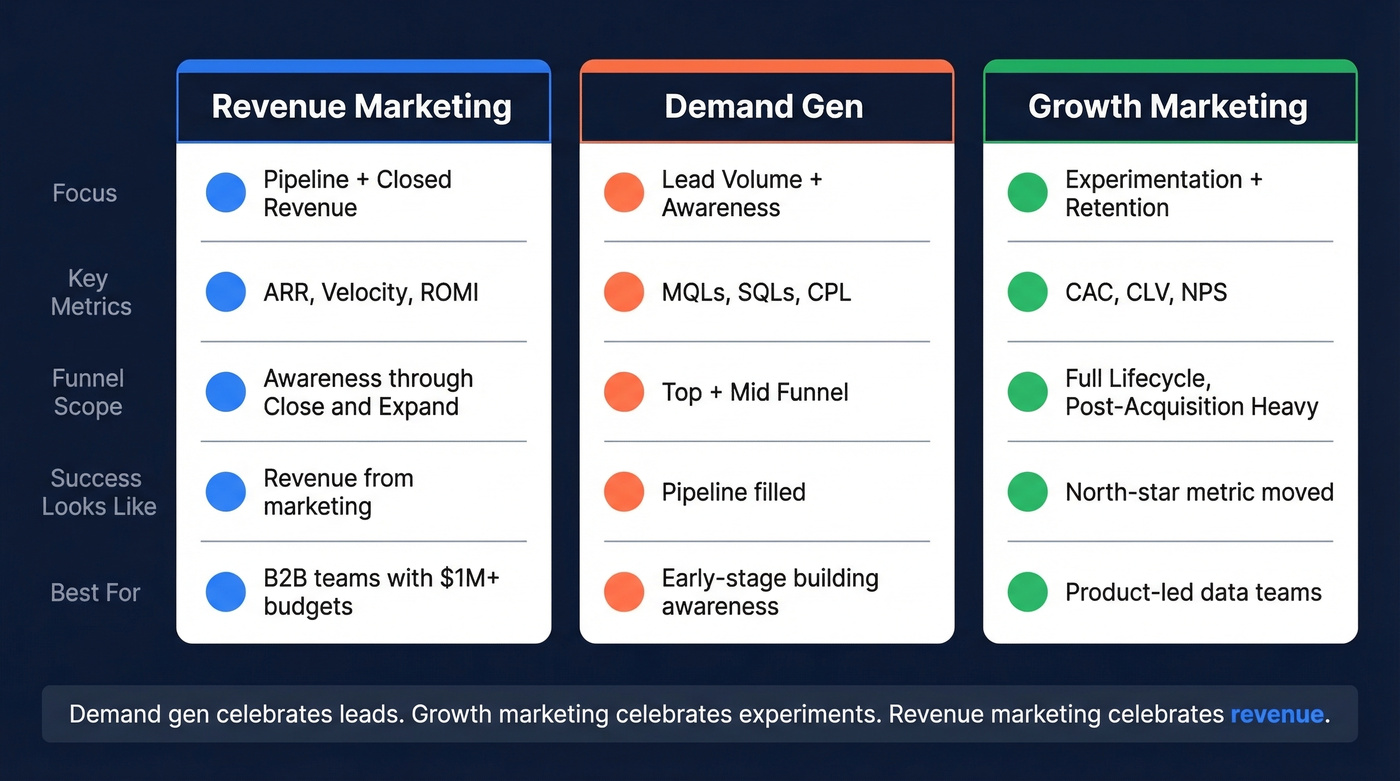
| Revenue Marketing | Demand Gen | Growth Marketing | |
|---|---|---|---|
| Focus | Pipeline + closed revenue | Lead volume + awareness | Experimentation + retention |
| Primary metrics | Revenue, ARR, velocity | MQLs, SQLs, CPL | CAC, CLV, NPS, retention |
| Funnel scope | Awareness through close and expand | Top + mid funnel | Full lifecycle, post-acquisition heavy |
| Accountability | Shared revenue targets | Marketing-owned leads | Cross-functional loops |
| Success = | Revenue from marketing | Pipeline filled | North-star metric moved |
| Best for | B2B teams with $1M+ budgets | Early-stage building awareness | Product-led data teams |
Demand gen is a subset - it handles the top of the funnel. Growth marketing borrows from product, engineering, and data science to run rapid experiments across the full lifecycle. Revenue marketing connects all of it to the number the board actually cares about.
The verdict: demand gen celebrates leads. Growth marketing celebrates experiments. Revenue marketing celebrates revenue.
Metrics That Actually Matter
The #1 complaint on r/marketing about revenue goals? Marketers can't identify which KPIs credibly prove revenue contribution.
Tier 1 - Start Here
These are the metrics your CFO already understands. Report on them before you try anything fancier.
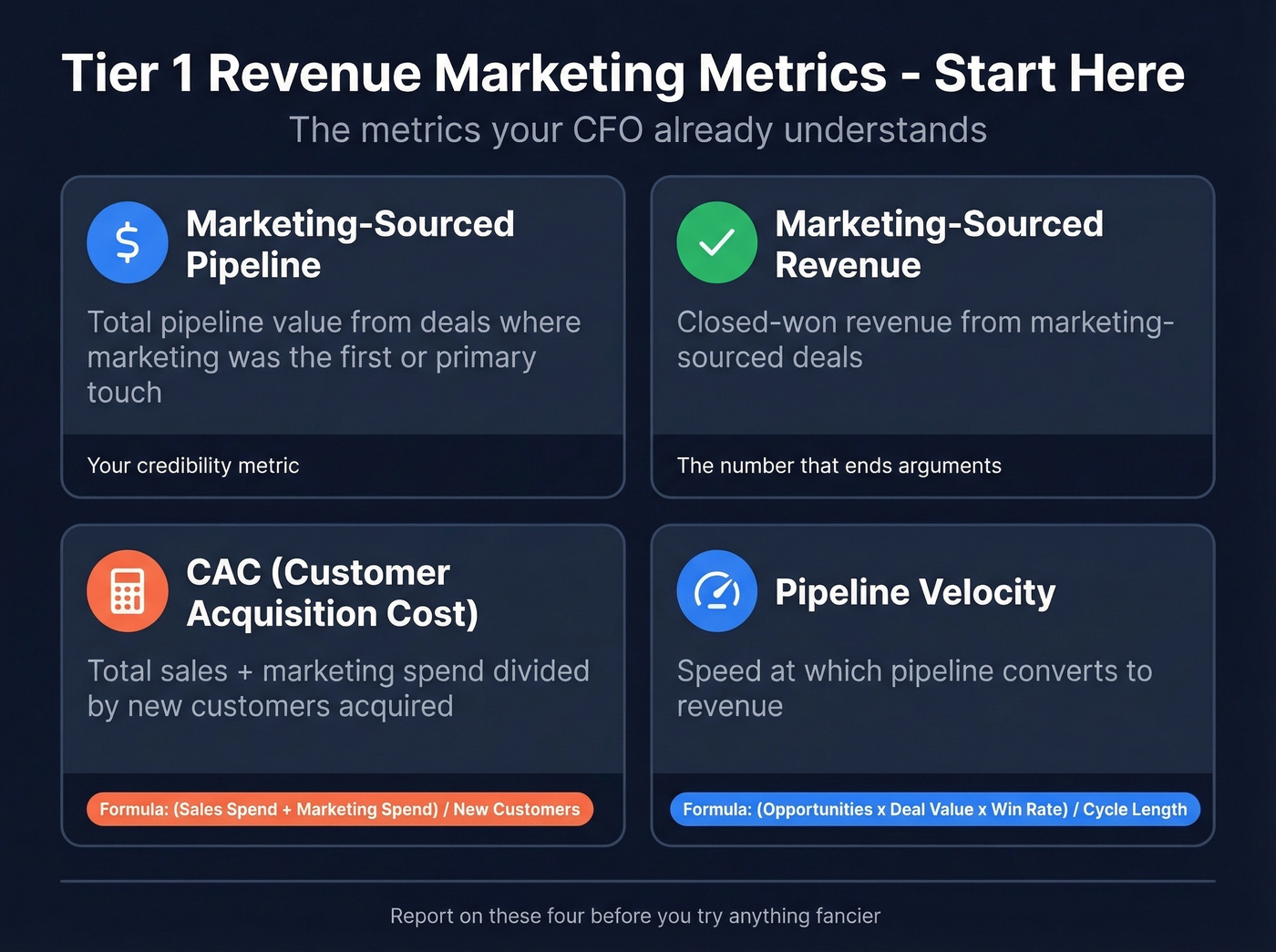
Marketing-sourced pipeline: Total pipeline value from deals where marketing was the first or primary touch. This is your credibility metric.
Marketing-sourced revenue: Closed-won revenue from marketing-sourced deals. The number that ends arguments.
CAC (Customer Acquisition Cost): Total sales + marketing spend divided by new customers acquired. (If you need a clean definition and formula, see CAC.)
Pipeline velocity: The speed at which pipeline converts to revenue. Formula: (# of opportunities x avg deal value x win rate) / sales cycle length.
Tier 2 - Graduate To
Once Tier 1 is running clean, layer in LTV/CLV for subscription businesses, NRR for expansion revenue, ROMI for marketing spend efficiency, and MQA for ABM-heavy teams replacing MQLs with account-level qualification. These metrics separate teams that report on activity from teams that report on impact.
A goal with teeth looks like this: "Generate $2M in marketing-sourced revenue this quarter, max CAC $1,000, 30% MQL-to-customer conversion." That's specific enough to hold a team accountable. Lead-to-customer conversion is the second most important KPI for marketers across business sizes in 2026 - the industry is finally moving past vanity metrics.
Attribution Models - Pick One
Most teams that take revenue performance seriously move beyond last-touch and adopt multi-touch attribution, because B2B buying journeys rarely happen in a straight line.
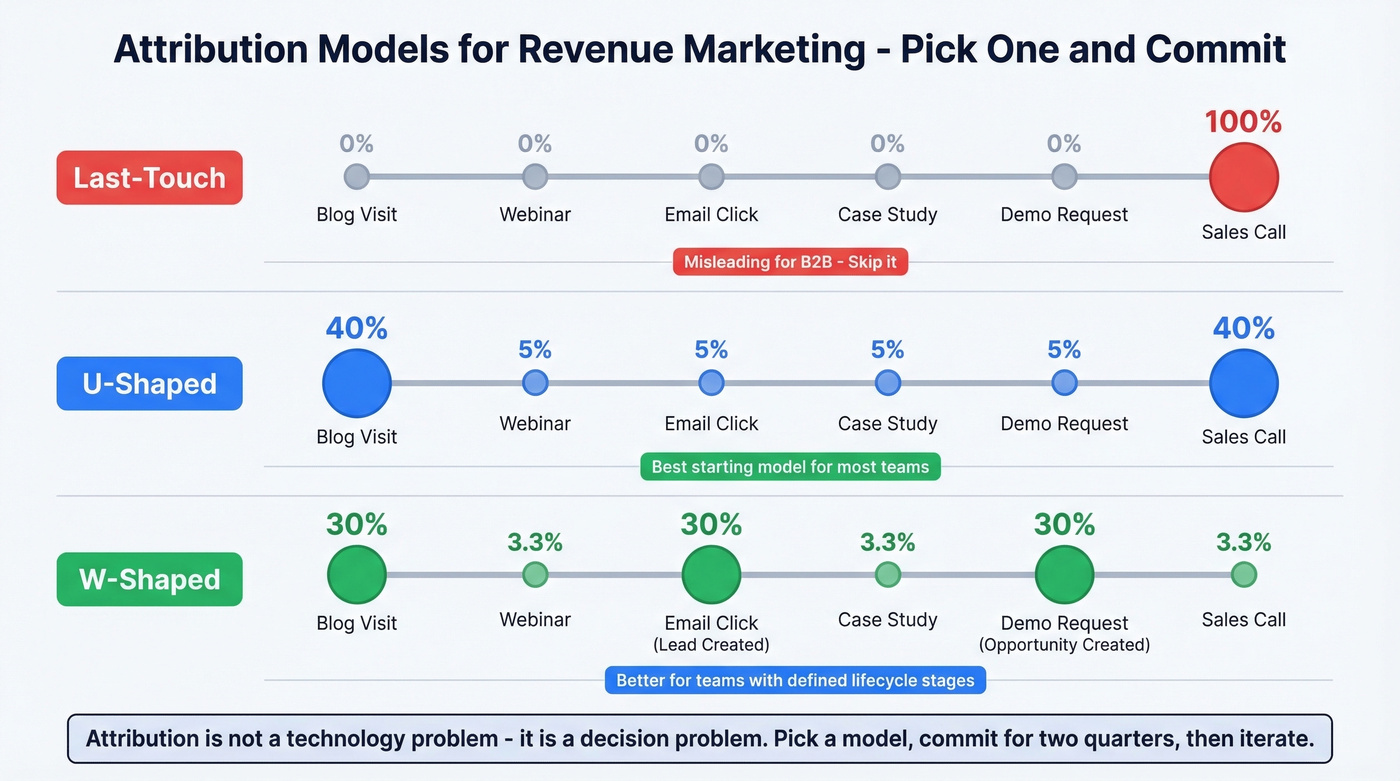
Last-touch gives 100% credit to the final touchpoint before conversion. Misleading for B2B, where buying cycles involve multiple touches across multiple stakeholders. Skip it.
U-shaped / position-based assigns 40% credit to the first touch, 40% to the last touch, and distributes the remaining 20% across middle interactions. This is the right starting model for most teams because it values both demand creation and demand capture without requiring complex infrastructure.
W-shaped splits credit three ways: 30% first touch, 30% lead creation, 30% opportunity creation, with 10% spread across everything else. Better for teams with clearly defined lifecycle stages in their CRM.
Here's the thing: attribution isn't a technology problem - it's a decision problem. Pick a model, commit to it for two quarters, and iterate. The teams that stall are the ones endlessly debating which model is "right" instead of measuring anything at all. Your attribution model is only as good as the data feeding it. If your emails bounce, you're attributing revenue to contacts that never received your message.

32% of revenue growth is blocked by disconnected systems and unreliable data. Prospeo's 98% email accuracy, 7-day data refresh, and CRM enrichment returning 50+ data points per contact means your attribution models actually work - because the contacts are real.
Stop attributing revenue to leads that never existed.
How to Build a Revenue Marketing Strategy
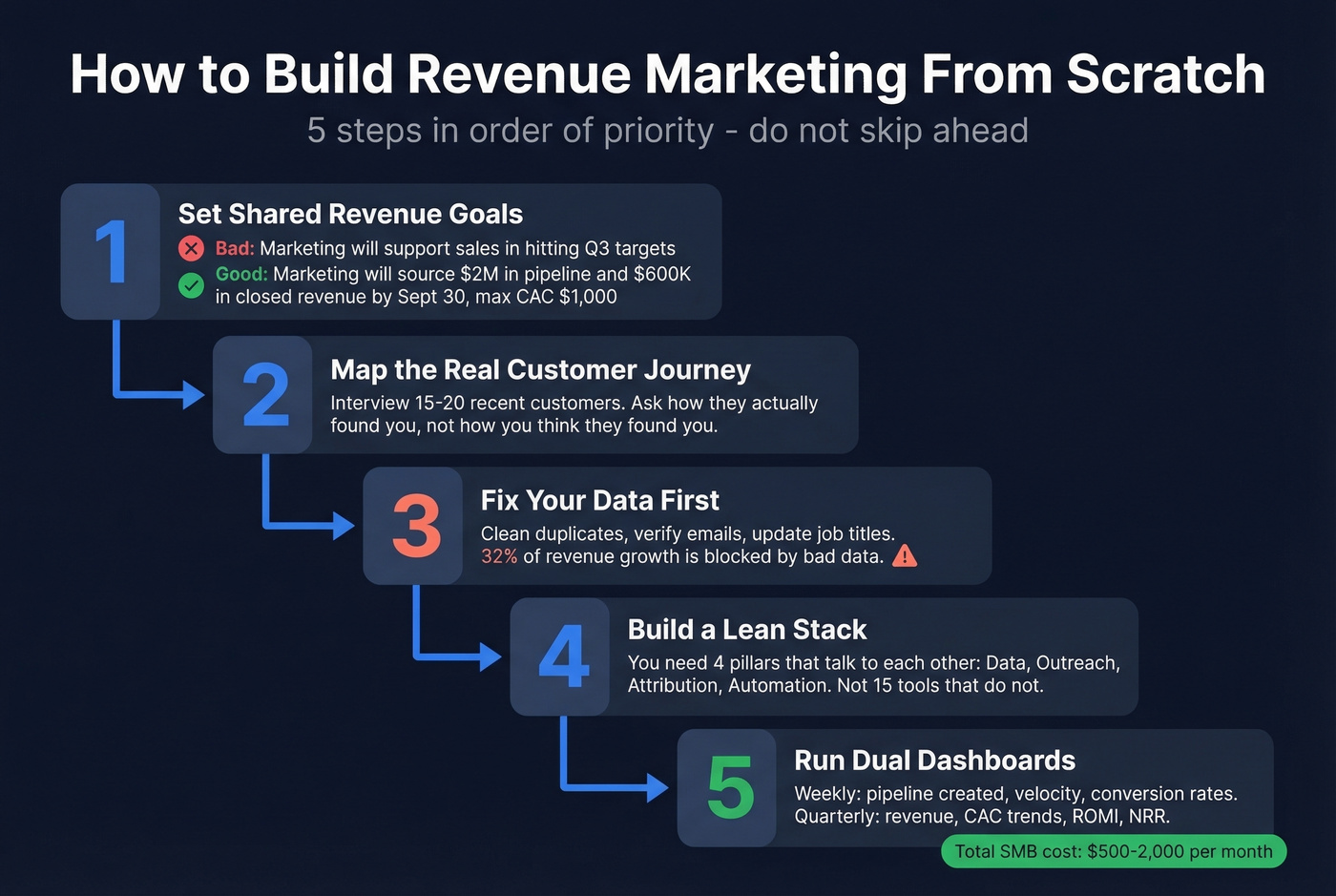
Set Shared Revenue Goals
Vague: "Marketing will support sales in hitting Q3 targets." Specific: "Marketing will source $2M in pipeline and $600K in closed revenue by September 30, with a max CAC of $1,000." The second version creates accountability. The first creates finger-pointing.
Map the Real Customer Journey
Don't map the journey you think customers take. Interview 15-20 recent customers and ask how they actually found you, what content they consumed, and what pushed them to buy. We've done this exercise ourselves, and the results are always humbling - you'll likely discover your highest-converting channel is one you've been underfunding for years.
Fix Your Data First
That 32% of revenue growth blocked by disconnected systems and unreliable data? This is where it hits. You can't attribute revenue to campaigns if your CRM is full of duplicates, bounced emails, and stale job titles. Data hygiene isn't glamorous, but it's the foundation everything else sits on. (If you're diagnosing bounces, start with email bounce rate.)
Build a Lean Stack
The number of martech tools hit 15,384 by 2025, up 9% year-over-year. Marketing teams now dedicate roughly 31.4% of total budgets to technology. Most of that spend is wasted. You need five tools that talk to each other, not fifteen that don't. The four pillars: Data, Outreach, Attribution, and Automation.
Run Dual Dashboards
Weekly: pipeline created, pipeline velocity, conversion rates by stage. Quarterly: marketing-sourced revenue, CAC trends, ROMI, NRR. 53% of CROs emphasize these dual operating rhythms as critical to revenue execution. The weekly view keeps you honest. The quarterly view keeps you sane.
The Tech Stack for Revenue Teams
Here's what a realistic stack costs at each stage:
| Category | SMB ($500-2K/mo) | Mid-Market ($3-10K/mo) | Enterprise ($15K+/mo) |
|---|---|---|---|
| CRM | HubSpot (free to paid tiers) | Salesforce (per-seat pricing) | Salesforce (enterprise tiers) |
| Data Enrichment | Prospeo ~$0.01/lead | ZoomInfo ~$15-40K/yr | ZoomInfo ~$30-60K/yr |
| Automation | HubSpot ~$50-500/mo | Marketo ~$1-3K/mo | Marketo ~$3-10K/mo |
| Attribution | GA4 + spreadsheets | Dreamdata ~$500-2K/mo | CaliberMind or custom |
| Intent Data | Bombora-powered tools | 6sense ~$2-5K/mo | Demandbase ~$30-100K+/yr |
For teams building from scratch, our honest recommendation: HubSpot or Salesforce for CRM, Prospeo for data enrichment, GA4 plus a multi-touch attribution tool, and whatever automation platform your team already knows. Total SMB cost: $500-2,000/month.

Prospeo earns the data enrichment slot because its 300M+ professional profiles come with 98% email accuracy and a 7-day data refresh cycle - the industry average is six weeks. It also includes real-time email and mobile verification, CRM and CSV enrichment returning 50+ data points per contact, and a 92% API match rate. On enrichment coverage, 83% of leads come back with contact data. Native integrations with Salesforce, HubSpot, Smartlead, Instantly, Lemlist, Clay, Zapier, and Make mean it plugs into whatever stack you're already running. (If you're comparing providers, start with data enrichment services.)
At roughly $0.01 per email with a free tier and no annual contracts, it's a fraction of what ZoomInfo charges. For revenue-focused teams specifically, the intent data layer - tracking 15,000 topics via Bombora - means you can prioritize accounts showing buying signals without bolting on a separate enterprise intent platform. (For a practical framework, see identifying buying signals.)
Scaling With Automation
Revenue marketing automation is what separates teams that run a handful of campaigns from teams that systematically convert pipeline at scale. The goal isn't to automate everything - it's to automate the repetitive data handoffs, lead routing, and attribution tagging that break down when done manually.
Start with three automation priorities: lead scoring that updates based on revenue outcomes (not just engagement), CRM enrichment that triggers when new contacts enter the pipeline, and attribution tracking that tags every touchpoint without requiring manual UTM discipline from every team member. Once those three workflows run reliably, layer in more complex sequences.
Data Quality - The Silent Revenue Killer
Here's a scenario that plays out in pipeline reviews across SaaS companies every single week. Your SDR team is burning through call blocks. Emails bounce. Marketing runs a campaign, attributes it to a list of contacts, and a chunk of those contacts never received the message. Your attribution model says the campaign worked. It didn't.

If your average deal size is under five figures, you probably don't need a $40K data platform. But you absolutely need accurate data. The difference between a $500/month enrichment tool with 98% accuracy and a platform that's materially less accurate isn't just cost - it's deliverability, domain reputation, and whether your attribution model reflects reality. (If deliverability is slipping, use an email deliverability guide to troubleshoot systematically.)
A revenue-tied marketing program without data quality is just expensive demand gen. You can build the most sophisticated attribution model in the world, but if a big chunk of your contacts are unreachable, you're optimizing a broken system.
What Success Looks Like
BOLT ON Technology partnered with an inbound-focused agency and saw 411% ROI on marketing-impacted revenue, 139% ROI on marketing-created revenue, and a 272% increase in inbound demos booked. That's not "marketing influenced" hand-waving - that's demos on the calendar.
SAP's "Inspire the Future" campaign generated EUR 924.4M in pipeline and EUR 266.15M in projected revenue, with 48% higher engagement than other SAP social campaigns. Proof that even at enterprise scale, brand and pipeline can coexist when the measurement framework is right.
On the smaller end, Insight Assurance drove a 142% increase in organic traffic and 46.34% more leads from organic - showing that revenue-driven principles apply to content-led motions too. The common thread across all three: they measured what mattered, aligned marketing and sales on shared targets, and invested in data infrastructure to make attribution credible.
Team Structure
70% of CROs describe the ideal revenue leader as owning the entire revenue cycle across sales, marketing, customer success, RevOps, and partnerships. The problem? Most CROs are still miscast as glorified VPs of Sales, which leaves marketing operating in a silo.
A revenue marketing team needs five core roles: a Revenue Marketing Manager who owns pipeline targets and attribution, a Marketing Ops or RevOps lead who maintains the tech stack and reporting, a Demand Gen Lead who runs campaigns optimized for pipeline, a Content Strategist who builds assets mapped to buying stages, and a Data/Analytics Lead who keeps attribution models honest.
You don't need all five on day one. Start with the Revenue Marketing Manager and the Ops lead. Those two roles - strategy plus infrastructure - create the foundation everything else builds on. Skip the data enrichment slot if you want, but don't skip the person who makes the numbers trustworthy.
Revenue marketing demands that every campaign ties to closed deals. That starts with verified contact data. Prospeo gives you 300M+ profiles with 30+ filters - buyer intent, technographics, funding, headcount growth - so marketing-sourced pipeline is built on contacts that convert, not bounce.
Build marketing-sourced pipeline that survives the CFO's questions.
FAQ
What is revenue marketing in simple terms?
Marketing measured by pipeline and closed revenue instead of leads or impressions. Every campaign gets evaluated by dollars generated, and marketing shares accountability with sales for financial outcomes - tying spend directly to revenue rather than activity metrics.
How is it different from demand generation?
Demand gen fills the top of funnel and stops at lead handoff. Revenue marketing owns the full journey from first touch through closed-won and into expansion. Demand gen is a component of the broader revenue strategy, not a synonym for it.
What KPIs should a revenue marketer track first?
Start with four: marketing-sourced pipeline, marketing-sourced revenue, CAC, and pipeline velocity. These give you immediate credibility with finance and sales - no one argues with closed-won dollars and acquisition cost.
What's the most affordable way to start?
HubSpot CRM (free tier), Prospeo for data enrichment at roughly $0.01/lead with a free plan of 75 emails/month, GA4 for attribution, and your existing automation tool. Total cost under $500/month - enough infrastructure to track pipeline and prove ROI.
How long before results show?
Pipeline impact typically appears within one to two quarters. Full attribution maturity - where you confidently report marketing-sourced revenue to the board - takes six to twelve months of consistent measurement and data hygiene.