

Revenue Operations Roles: A Practical Guide for 2026
A RevOps lead I know ran a three-tool bake-off last quarter. The "best" database created 4,000 duplicate contacts in Salesforce in five days. The cheapest tool had better phone connect rates. That's revenue operations roles in a nutshell - you're the person who prevents expensive chaos across the entire revenue engine, and the function barely existed a decade ago.
Here's what every role actually looks like in 2026, from analyst to CRO.
Quick Version
If you're short on time:
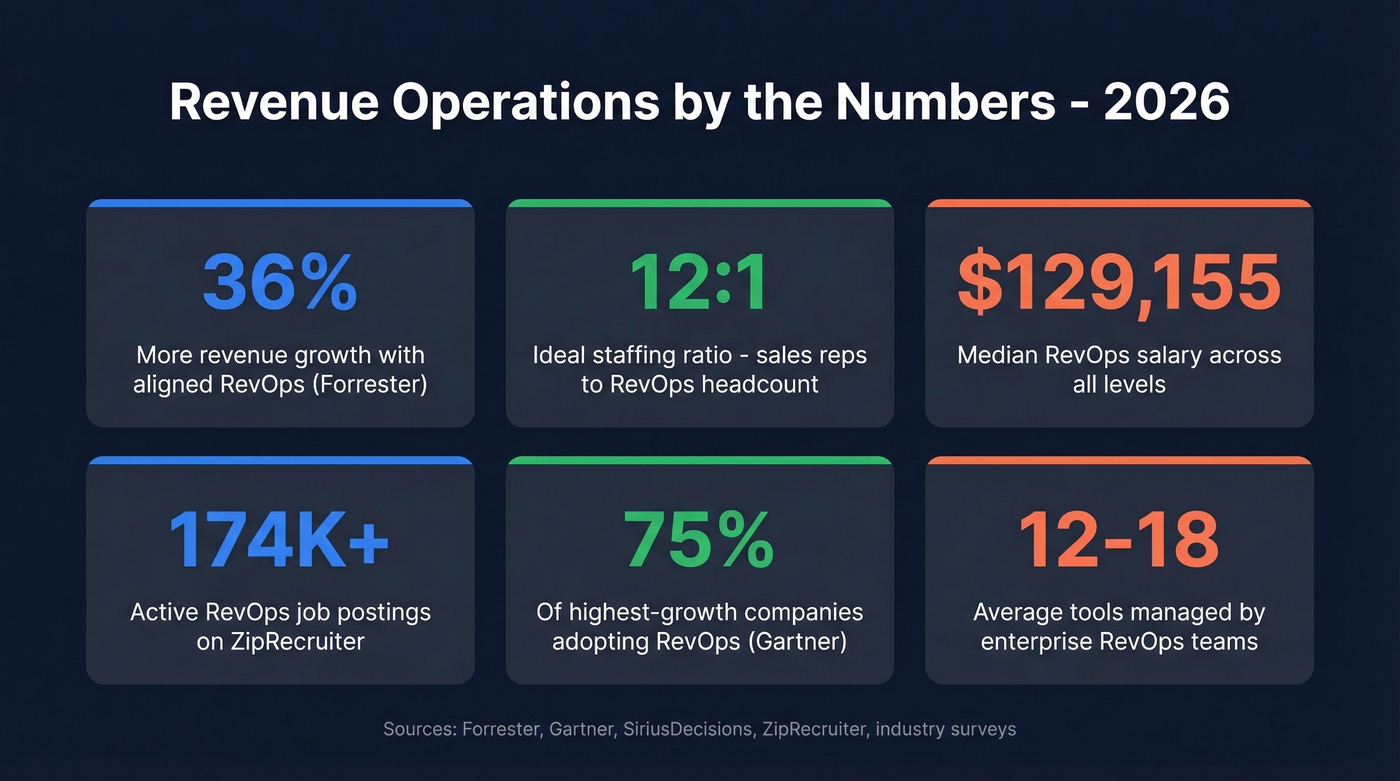
- RevOps unifies sales, marketing, and CS operations under one team that owns process, systems, data, and enablement across the full customer lifecycle.
- Companies with aligned RevOps functions see 36% more revenue growth and up to 28% higher profitability, per Forrester research. SiriusDecisions found aligned companies grew 12-15x faster and were 34% more profitable.
- The typical staffing ratio is 12:1 - twelve sales reps for every one RevOps person.
- Core roles span from RevOps Analyst ($85,000-$124,500) to VP/SVP level (~$216,571+), with roughly 5% year-over-year salary growth across the function.
- The median RevOps professional earns $129,155. In San Francisco or New York, add 20-30%.
- First hire should be a RevOps Manager, not a systems admin. You need strategic thinking before you need Salesforce customization.
- The average enterprise RevOps team manages 12-18 tools. Consolidation is the 2026 theme.
One thing those bullets don't capture: RevOps owns data quality, and that's the hidden workload nobody warns you about. Without enrichment and verification tools feeding clean data into your CRM, "CRM cleanup" becomes your actual job instead of the strategic work you were hired to do.
Why RevOps Exploded
Revenue Operations was named the fastest-growing job in America by LinkedIn's jobs analysis in 2023, as Forbes reported. That wasn't a blip. ZipRecruiter data shows 174,000+ job postings in the space, and nearly 60% of companies established their RevOps function in just the last two years.
The reason is straightforward: B2B go-to-market got complicated. Companies went from one product sold by one team through one channel to multi-product, multi-segment, multi-channel motions. Marketing, sales, and customer success all touch the same buyer at different stages, and when those three functions each run their own ops silo - their own CRM fields, their own definitions of "qualified," their own reporting cadence - the result is a forecasting nightmare and a customer experience that feels disjointed.
RevOps exists to fix that. It's the organizational answer to a structural problem: who owns the coordination layer between marketing, sales, and CS? Before RevOps, the answer was "nobody" or "the Sales Ops person who also happens to know Marketo." That doesn't scale past 50 reps.
Let's be honest about the scale of this shift. 90% of organizations are actively changing how they align revenue teams and operations, according to research cited in the book Revenue Operations. The global RevOps market was valued at $4.39 billion in 2024 and is projected to hit nearly $17 billion by 2033. This isn't a trend. It's a permanent restructuring of how B2B companies operate.
RevOps in Modern GTM
Gartner predicted 75% of the highest-growth companies would adopt a RevOps model. Here's what the function covers, broken into four pillars.
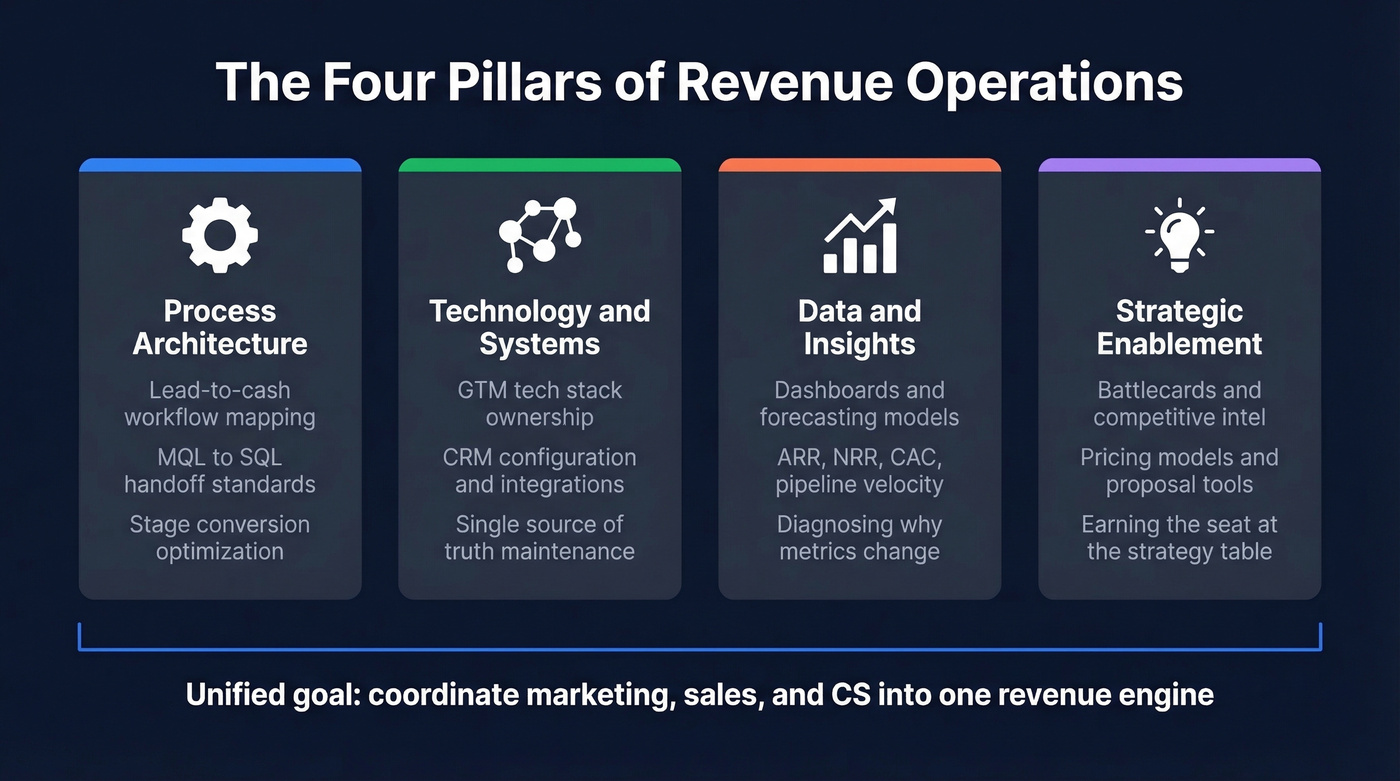
Process Architecture
RevOps maps and optimizes the lead-to-cash workflow. That means automating lead routing in Salesforce so inbound leads hit the right rep in under five minutes. It means standardizing the MQL-to-SQL handoff so marketing and sales agree on what "qualified" actually means. It means building a quote-to-cash process that doesn't require three Slack threads and a spreadsheet to get a deal signed.
The day-to-day is unglamorous but high-impact. You're auditing conversion rates between stages, identifying where deals stall, and redesigning workflows to eliminate bottlenecks. A good RevOps process architect can shave two weeks off an average sales cycle just by fixing handoff points.
Technology and Systems
RevOps owns the GTM tech stack - or at least the integration layer that makes it function as a single system rather than 15 disconnected tools. CRM configuration, workflow automation, data flow between platforms, and ensuring the "single source of truth" actually stays singular. When marketing's Marketo instance sends leads to Salesforce with different field mappings than the web form, RevOps fixes it.
Data and Insights
Dashboards, reporting, and forecasting models. RevOps tracks ARR, NRR, CAC, and pipeline velocity - but the real value isn't reporting what happened. It's diagnosing why. Why did Stage 2 conversion drop 8% this quarter? Why are enterprise deals taking 15 days longer to close?
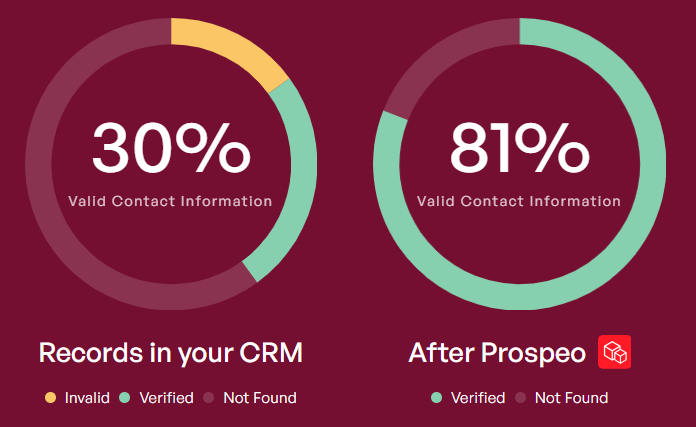
A pipeline dashboard built on stale data is just a confidence generator for bad decisions. If 20% of your CRM contacts have stale emails or wrong titles, your pipeline reporting is fiction. Enrichment and verification aren't optional - they're foundational. Tools like Prospeo, which refreshes data every 7 days and delivers 98% email accuracy, turn data quality from a quarterly fire drill into an automated background process. (If you're comparing vendors, start with these data enrichment services.)
Strategic Enablement
RevOps uses insights to unblock deals. Battlecards, pricing models, competitive intelligence, proposal tools - anything that helps a rep close faster. This pillar is where RevOps earns its seat at the strategy table rather than being perceived as "the Salesforce team."
Every Level, From Analyst to VP
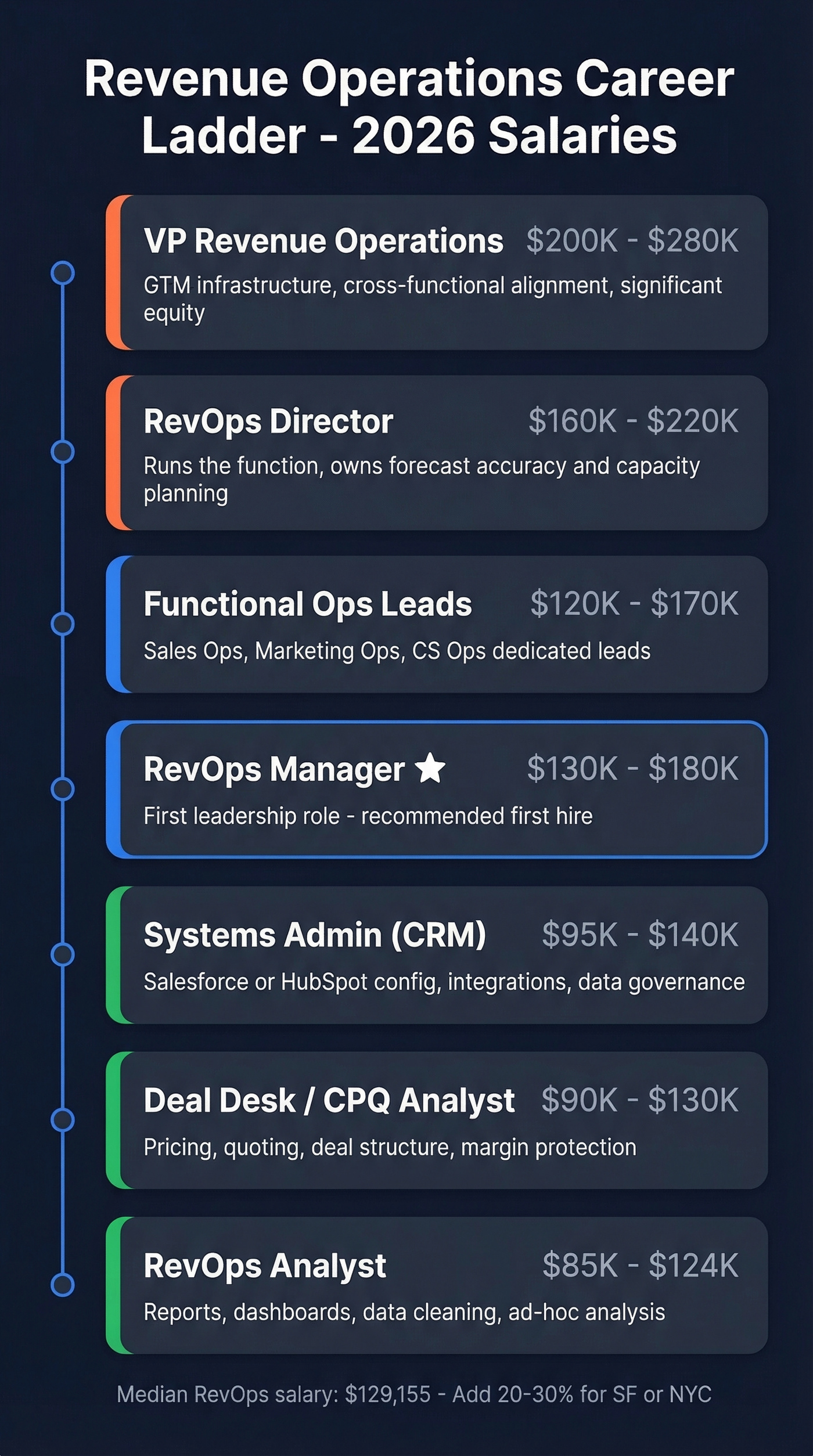
Revenue operations roles aren't standardized yet. An analysis of hundreds of job descriptions found that no two RevOps JDs are the same. But the career ladder has solidified enough to map clearly.
The most common frustration we hear from RevOps practitioners: they were hired to be strategic but spend 60% of their time on CRM cleanup and ad-hoc reporting requests. Keep that tension in mind as you read these role descriptions - the intended scope and the actual scope rarely match until the team matures.
RevOps Analyst - $85,000-$124,500
The entry point. You're building reports, maintaining dashboards, cleaning data, and running ad-hoc analyses when leadership asks "why did churn spike in Q2?" Expect heavy CRM work, SQL or BI tool proficiency, and a lot of time in spreadsheets. About 19.5% of RevOps professionals previously worked in Sales Ops, and "Revenue Operations Analyst" is the most posted RevOps title on job boards.
Deal Desk / CPQ Analyst - $90,000-$130,000
A specialized IC role focused on pricing, quoting, and deal structure. You're configuring CPQ tools, reviewing non-standard deal terms, and ensuring reps don't give away margin. This role sits at the intersection of RevOps and finance. You're ready for it when you can look at a deal and immediately spot where the discount structure erodes margin - and you know how to restructure it without losing the buyer.
Systems Admin (CRM) - $95,000-$140,000
The technical backbone. You own Salesforce or HubSpot configuration, integrations, automation rules, and data governance policies. Certifications matter here more than in any other RevOps position. The common mistake at this level: building technically elegant solutions that nobody uses because they weren't designed around actual seller workflows.
RevOps Manager - $130,000-$180,000
The first leadership role and, critically, the first hire most companies should make. You're overseeing the RevOps process end-to-end, aligning customer-facing teams, and translating executive strategy into operational execution. You manage analysts and admins, own the reporting cadence, and serve as the bridge between sales leadership and the data.
Functional Ops Leads - $120,000-$170,000
As teams scale, you'll see dedicated Sales Ops, Marketing Ops, and CS Ops leads reporting into RevOps leadership. The Sales Ops Lead owns pipeline management, deal desk, CRM workflows, and comp plan administration. The Marketing Ops Lead handles lead lifecycle, attribution modeling, and MAP/CRM sync. The CS Ops Lead manages renewal workflows, health scoring, and expansion playbooks.
RevOps Director - $160,000-$220,000
You're running the function. Multiple direct reports across functional ops, analytics, and systems. You own forecast accuracy, capacity planning, and stack cohesion. Directors typically report to a VP of RevOps or directly to the CRO. The biggest stakeholder management challenge lives here: every department thinks their priorities should come first, and you're the one saying no.
VP Revenue Operations - $200,000-$280,000
The strategic leader. You own GTM infrastructure, cross-functional alignment, data integrity, and the operating model that connects marketing spend to closed revenue. At Affirm, the VP RevOps reports to the Chief Commercial Officer with direct reports spanning analytics, sales enablement, program management, field ops, selling systems, and incentive compensation. Equity is significant at this level.
CRO (Where It Fits)
The CRO isn't a RevOps role - it's a revenue leadership role. But in many orgs, the VP of RevOps reports to the CRO. The distinction matters: the CRO owns revenue targets and go-to-market strategy, while the VP RevOps owns the operational infrastructure that makes those targets achievable. Some companies blur this line, especially at the growth stage where one person wears both hats. That's common early on. Past 200 employees, you need both.
RevOps vs. Functional Ops
"Is RevOps just Sales Ops with a new title?" We get this question constantly. No. But the confusion is understandable because many companies did exactly that - renamed Sales Ops to RevOps without changing scope.
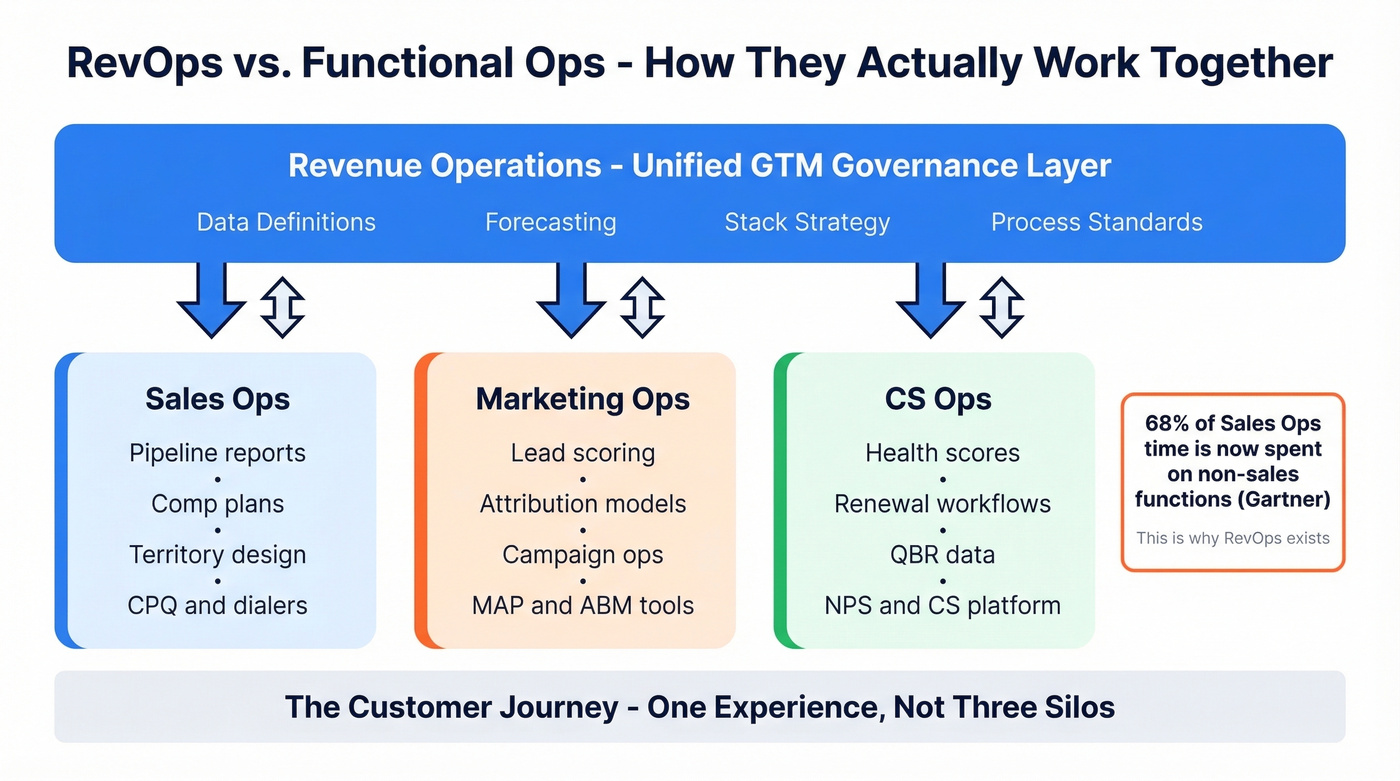
Real RevOps is a governance layer. It doesn't replace functional ops; it unifies them. Gartner found that Sales Ops professionals now spend 68% of their time on non-sales functions, up from 39% in 2019. That stat alone explains why the old model broke. Sales Ops people were already doing cross-functional work - RevOps just made it official.
| Function | Primary Charter | Typical Outputs | Tools Owned |
|---|---|---|---|
| RevOps | Unified GTM governance | Forecasts, process maps, stack strategy | CRM config, BI, integration |
| Sales Ops | Sales execution | Comp plans, pipeline reports, territories | CPQ, sequencing, dialer |
| Marketing Ops | Demand gen execution | Attribution, lead scoring, campaigns | MAP, ABM, intent |
| CS Ops | Retention execution | Health scores, renewals, QBR data | CS platform, NPS |
RevOps sets the rules. Functional ops execute within them. When this works, you get consistent data definitions, unified reporting, and a customer journey that doesn't feel like three different companies.

RevOps owns data quality - but bad data from legacy providers turns strategic hires into full-time CRM janitors. Prospeo refreshes every record every 7 days with 98% email accuracy and a 92% enrichment match rate, returning 50+ data points per contact. Your RevOps team was hired to optimize the revenue engine, not scrub stale contacts.
Give your RevOps team clean data so they can do actual RevOps.
Org Charts That Work
There's no single "right" org chart, but the Skaled hierarchy model maps well to most B2B SaaS companies: VP RevOps at the top, functional ops leads in the middle, analysts and technical contributors at the base.
| Stage | Structure | Reporting Line |
|---|---|---|
| Seed-Series A (50 or fewer) | 1 RevOps generalist | Reports to CEO or VP Sales |
| Series B (51-200) | Manager + 1-2 ICs | Reports to CRO or VP Sales |
| Growth (201-500) | Director + functional leads + analysts | Reports to CRO |
| Scale (500-1,000) | VP + directors + pods | Reports to CRO or COO |
| Enterprise (1,000+) | SVP/CRO + full org | Reports to CEO or President |
The reporting line matters more than the org chart shape. RevOps Co-op's research suggests the VP of RevOps should ideally report to the CRO. When RevOps reports to the VP of Sales, it inevitably gets pulled toward sales-only priorities, and marketing and CS ops become afterthoughts.
At Affirm, the VP RevOps reports to the Chief Commercial Officer with a broad mandate spanning analytics through incentive compensation. At Conga, they consolidated Sales Ops, Field Ops, Deal Desk, and Order Ops under a single RevOps umbrella - a common pattern during the "RevOps transformation" phase where previously siloed teams merge.
The pattern we see repeatedly: companies start with a generalist, add functional leads as they cross 200 employees, and build dedicated analytics and systems pods past 500. The mistake is hiring specialists too early. A RevOps Manager who can do 70% of everything is more valuable at Series A than a Salesforce admin who can do 100% of one thing.
Team Size Benchmarks
The 2025 RevOps Compensation & Impact Report provides some of the clearest benchmarks available. The numbers are counterintuitive - smaller companies often have proportionally larger RevOps teams because they're building from scratch.
| Company Size | Avg RevOps FTEs | What They Cover |
|---|---|---|
| 50 or fewer employees | 4.4 | CRM, reporting, process - everyone does everything |
| 51-200 | 3.7 | Manager + analyst + admin (lean and scrappy) |
| 201-1,000 | 7.8 | Functional leads + analytics + systems |
| 1,000+ | 15.4 | Full pods across sales/mktg/CS ops + strategy |
The ARR-based view tells a complementary story:
| ARR Band | RevOps FTEs | Leadership Layer |
|---|---|---|
| ~$50M | 4-5 | Manager or Director leading |
| ~$100M | 7-10 | Director + functional leads |
| ~$200M | 14-19 | VP + directors + specialist pods |
The 12:1 ratio (twelve reps per RevOps person) is a useful gut check. If you've got 60 reps and two RevOps people, you're understaffed. If you've got 20 reps and five RevOps people, you're probably over-indexed on ops relative to your GTM maturity.
For early-stage companies, the decision framework is more granular. At 0-10 employees, you don't need in-house RevOps. At 11-25, outsource to a fractional consultant handling CRM setup, data hygiene, and initial process design. At 26-50, make your first dedicated hire. The trigger is usually cross-functional dysfunction - when marketing, sales, and CS are visibly misaligned on definitions, handoffs, or reporting.
Who to Hire First
The MarketerHire framework gets the sequence right: RevOps Manager first, Data Analyst second, Systems Admin third.
Hire 1: RevOps Manager. You need someone who can assess the current state, map processes, identify the biggest leaks, and build a roadmap. This person should be a strategic generalist - comfortable in a CRM, capable of building reports, and skilled at stakeholder management. They don't need to be a Salesforce architect. They need to understand the full revenue cycle and prioritize ruthlessly.
Hire 2: Data Analyst. Once you know what to fix, you need someone who can measure whether it's working. Forecasting accuracy, pipeline conversion analysis, cohort reporting - this is the person who turns RevOps from "we think this is working" to "here's the data proving it." (If you want a tighter KPI set, use these pipeline health metrics.)
Hire 3: Systems Admin. Now you've got strategy and measurement. The systems admin builds the technical infrastructure to scale what's working - automation rules, integrations, custom objects, data governance policies.
Skip this if you're under 25 employees. We've seen teams hire a Salesforce admin as their first RevOps person and end up with a beautifully configured CRM that tracks the wrong metrics and supports the wrong processes. Systems should serve strategy, not the other way around.
Salaries and Comp in 2026
RevOps compensation has been climbing steadily - roughly 5% year-over-year based on ZipRecruiter and BoostUp data. The 2025 RevOps Compensation and Impact Report pegs the median at $129,155 across all levels.
| Role | Base Range | Median | Notes |
|---|---|---|---|
| RevOps Analyst | $85k-$124.5k | ~$105k | Entry-level; SQL + CRM |
| Systems Admin | $95k-$140k | ~$115k | Salesforce cert = premium |
| RevOps Manager | $130k-$180k | ~$155k | First leadership role |
| Ops Lead (functional) | $120k-$170k | ~$145k | Sales/Mktg/CS specialization |
| RevOps Director | $160k-$220k | ~$190k | Multi-team oversight |
| VP RevOps | $200k-$280k | ~$217k | Strategic + exec-level |
| VP/SVP or 10+ yrs exp | $216k-$300k+ | $216,571 | Equity often significant |
A few patterns worth noting.
Geography matters enormously. San Francisco and New York command a 20-30% premium over the national median. A RevOps Manager making $155k in Austin could command $190k-$200k in Manhattan.
Title beats team size for comp. The report found something counterintuitive: managing a team doesn't necessarily increase salary once experience is accounted for. A senior IC with 10 years of experience earns approximately $147,504 - often out-earning managers with five years of tenure. Title and experience carry more weight than span of control.
Incentive structures are evolving. The best RevOps comp plans don't copy sales comp. They include profit-sharing with quarterly payouts, accelerators tied to forecast accuracy, and bonuses linked to churn reduction, expansion revenue, or pipeline health metrics. Equity is increasingly common at director level and above. As RevOps leader Sarah Ditmars puts it: RevOps incentives should reflect cross-functional impact, not individual deal contribution.
For the latest salary benchmarks by level, the Revenue Operations Landscape & Salary Report from the ROA is one of the most thorough datasets available.
Tech Stack by RevOps Role
The average enterprise RevOps team manages 12-18 tools. That's too many. The 2026 trend is consolidation - fewer tools, deeper integrations, and AI handling the glue work that used to require Zapier chains and CSV exports.
| Category | Key Tools | Price Range | Primary Owner |
|---|---|---|---|
| CRM | Salesforce, HubSpot | ~$25-$330/user/mo | Systems Admin |
| Sales engagement + CI | Outreach, Salesloft, Gong | $50-$150/user/mo | Sales Ops Lead |
| Data + enrichment | Prospeo, ZoomInfo, Apollo | $0-$40k+/yr | RevOps Manager |
| Analytics + forecasting | Clari, Looker, Tableau | $30k-$100k+/yr | Data Analyst |
| Orchestration | Clay, Zapier, Make | $20-$1,000+/mo | Systems Admin |
Look, if your average deal size is under $15k, you probably don't need ZoomInfo-level data spend. A dedicated verification and enrichment tool paired with a self-serve database covers 90% of what mid-market teams actually use. ZoomInfo is still strong for enterprise intent data - but most teams don't need all-in-one. They need accurate data.
ZoomInfo and Apollo have roughly 70% coverage overlap on US business contacts, which means many teams are paying for redundant data. The smarter play is picking one database and pairing it with a dedicated verification layer. ZoomInfo typically runs $15k-$40k/year and excels at US database depth and intent data breadth. Apollo works well for self-serve prospecting at the SMB level at $49-$99/user/month.
Three stack trends are reshaping RevOps in 2026: AI-driven automation replacing manual enrichment workflows, no-code integration tools like Zapier and Make replacing custom API work, and customer data unification platforms reducing the need for point-to-point integrations. If you're auditing your stack, start with a shortlist of sales prospecting databases and a dedicated lead enrichment layer.
Managing 12-18 tools is the 2026 RevOps reality. Prospeo consolidates your enrichment, verification, and prospecting data into one platform - with native Salesforce, HubSpot, and API integrations. At $0.01 per email, you cut vendor spend by 90% compared to ZoomInfo while getting higher accuracy.
Consolidate your data stack before your next RevOps hire.
How to Break Into RevOps
About 19.5% of RevOps professionals come from Sales Ops backgrounds, but that's not the only path. We've seen successful transitions from FP&A, business intelligence, marketing ops, customer success, and even sales itself. The current gender split sits at roughly 36% women and 64% men - a gap that's narrowing but still significant.
The common thread isn't a specific background. It's analytical thinking, systems fluency, and the ability to manage stakeholders who all think their function should be the priority. A common refrain on r/RevOps and in RevOps Slack communities: "Learn to sell before you try to optimize selling." Understanding the seller's workflow from the inside makes you a dramatically better practitioner.
The skills that get you hired center on CRM proficiency (Salesforce or HubSpot - pick one and go deep), SQL or BI tool fluency, process mapping and documentation, stakeholder management across sales, marketing, and CS, and a working understanding of data governance. Advanced Excel still counts. Don't let anyone tell you otherwise.
Your 90-day plan for breaking in:
- Days 1-30: Get Salesforce Admin certified or HubSpot Revenue Operations certified. The Revenue Operations Alliance also offers a dedicated RevOps certification worth exploring. Build two portfolio dashboards - one pipeline analysis, one conversion funnel. (To sharpen your funnel thinking, use an AIDA sales funnel framework.)
- Days 31-60: Join the Revenue Operations Alliance and Pavilion communities. Attend virtual events. Start networking with RevOps practitioners who are actually doing the work, not just posting about it.
- Days 61-90: Apply for RevOps Analyst or Associate roles. Target companies in the 50-200 employee range where you'll get broad exposure rather than narrow specialization.
The job descriptions are all over the place. One "RevOps Analyst" role is really a Salesforce admin job. Another is a data analyst role. Read the actual responsibilities, not the title. And expect that your first six months will involve more CRM cleanup and stakeholder alignment battles than the job description promised - that's normal, and it's where you prove your value.
FAQ
Is RevOps the Same as Sales Ops?
No. Sales Ops focuses on sales execution - comp plans, pipeline methodology, CRM workflows for sellers. RevOps is a governance layer that unifies Sales Ops, Marketing Ops, and CS Ops under one strategic function. Sales Ops often reports into RevOps. The clearest distinction: Sales Ops optimizes the sales team; RevOps optimizes the entire revenue cycle.
What Are the Most Common Revenue Operations Roles?
The most common titles are RevOps Analyst, RevOps Manager, RevOps Director, and VP of Revenue Operations. Specialized positions include Deal Desk Analyst, CRM Systems Admin, and functional ops leads for sales, marketing, and customer success. "Revenue Operations Analyst" remains the most posted RevOps title on major job boards.
How Much Does a RevOps Manager Make in 2026?
The median RevOps Manager base salary is approximately $155,000, based on 2025 compensation data and roughly 5% year-over-year growth. In San Francisco or New York, expect $185,000-$200,000. Total comp including bonuses and equity can push well above $200,000 at growth-stage companies.
When Should a Company Hire Its First RevOps Person?
Hire at 26-50 employees - or when you have at least 10-15 quota-carrying reps. Below 25 employees, outsource to a fractional consultant handling CRM setup, data hygiene, and initial process design. The trigger is usually cross-functional dysfunction: marketing, sales, and CS are visibly misaligned on definitions, handoffs, or reporting.
What Tools Should I Learn for a RevOps Career?
Start with Salesforce or HubSpot for CRM, a BI tool like Looker or Tableau, and a data enrichment platform for keeping contact data verified and current. Contact data degrades at roughly 30% per year, so automated enrichment on a weekly refresh cycle prevents the "quarterly CRM cleanup" that eats analyst time. Add SQL proficiency and you'll cover 80% of what hiring managers look for.