

What Is a Revenue Organization - and How Do You Build One That Actually Works?
A study of 2,500 B2B software companies found an aggregate ratio of 12 sellers for every RevOps person - and many of those teams have just 2-4 people. If your revenue organization is understaffed, misstructured, or nonexistent, every metric downstream suffers.
Here's how to build one that holds up.
What Is a Revenue Organization?
Traditional GTM teams run three separate ops functions: Sales Ops, Marketing Ops, and CS Ops. Each optimizes its own KPIs, manages its own tools, and reports into its own leadership. This siloed structure creates handoff friction, data loss, and a disjointed customer experience that compounds quarter over quarter until someone finally asks why the numbers don't add up.
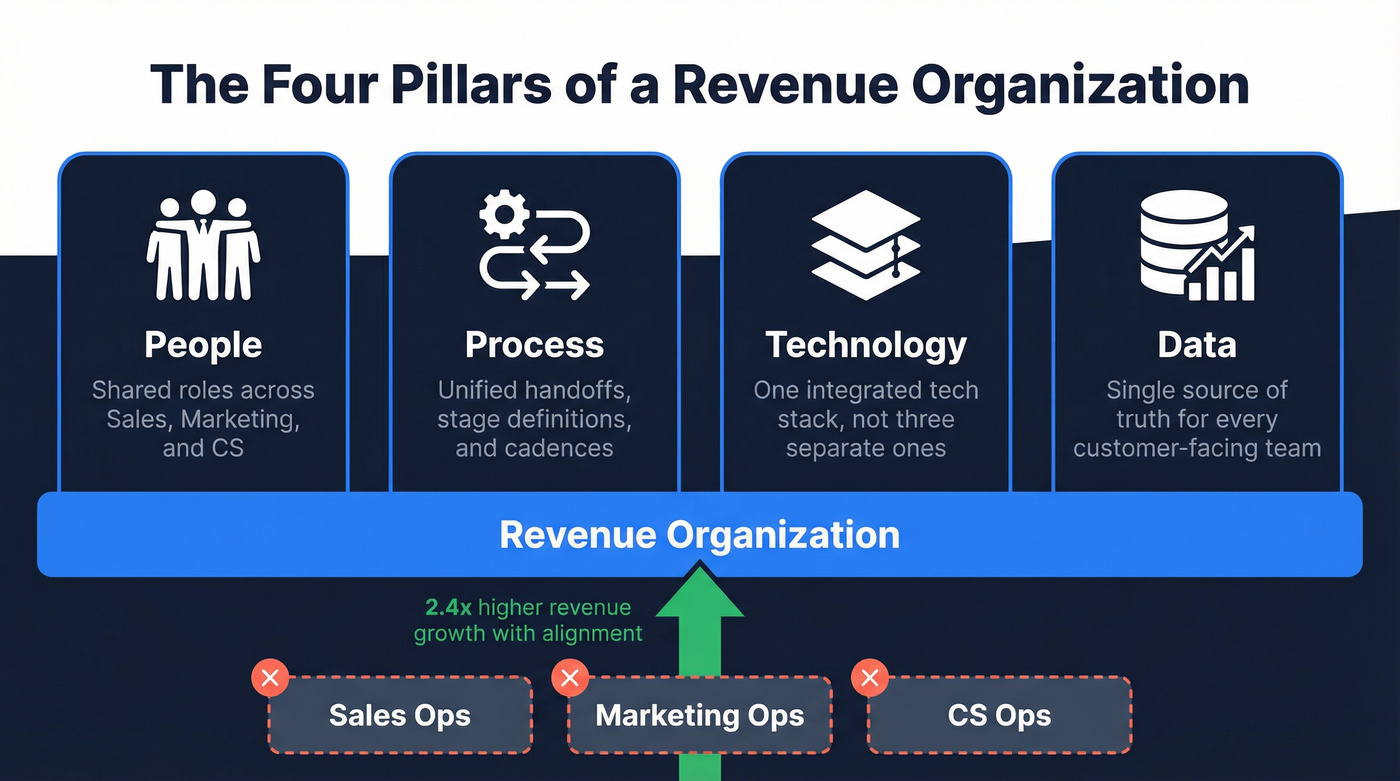
A revenue organization collapses those silos. It rests on four pillars: People, Process, Technology, and Data. Every customer-facing function shares a single operating cadence, a unified tech stack, and metrics that connect upstream activity to downstream revenue.
One distinction worth getting right early: revenue enablement and RevOps aren't the same thing. Enablement equips reps with training and content. RevOps manages systems, data, and processes. Both live inside the broader org, but confusing them produces job descriptions that try to do everything and accomplish nothing.
Why Unified Teams Outperform Silos
Forrester found that firms with high alignment across customer-facing functions report 2.4x higher revenue growth and 2x higher profitability growth compared to those without alignment. For emerging companies under $100M, the numbers still hold: 36% more revenue growth and up to 28% more profitability.
BCG benchmarks commonly cited in RevOps literature put the sales productivity lift around 10-20% when ops functions are centralized. Let's make that concrete. For a company doing $30M in ARR, 20% more seller productivity is the equivalent of adding headcount without adding headcount - and that's the pitch you make to your CFO. Centralized revenue operations deliver this because they eliminate duplicated tooling, conflicting data definitions, and the coordination tax of three separate ops teams all trying to own the forecast.
How to Structure Your Revenue Organization
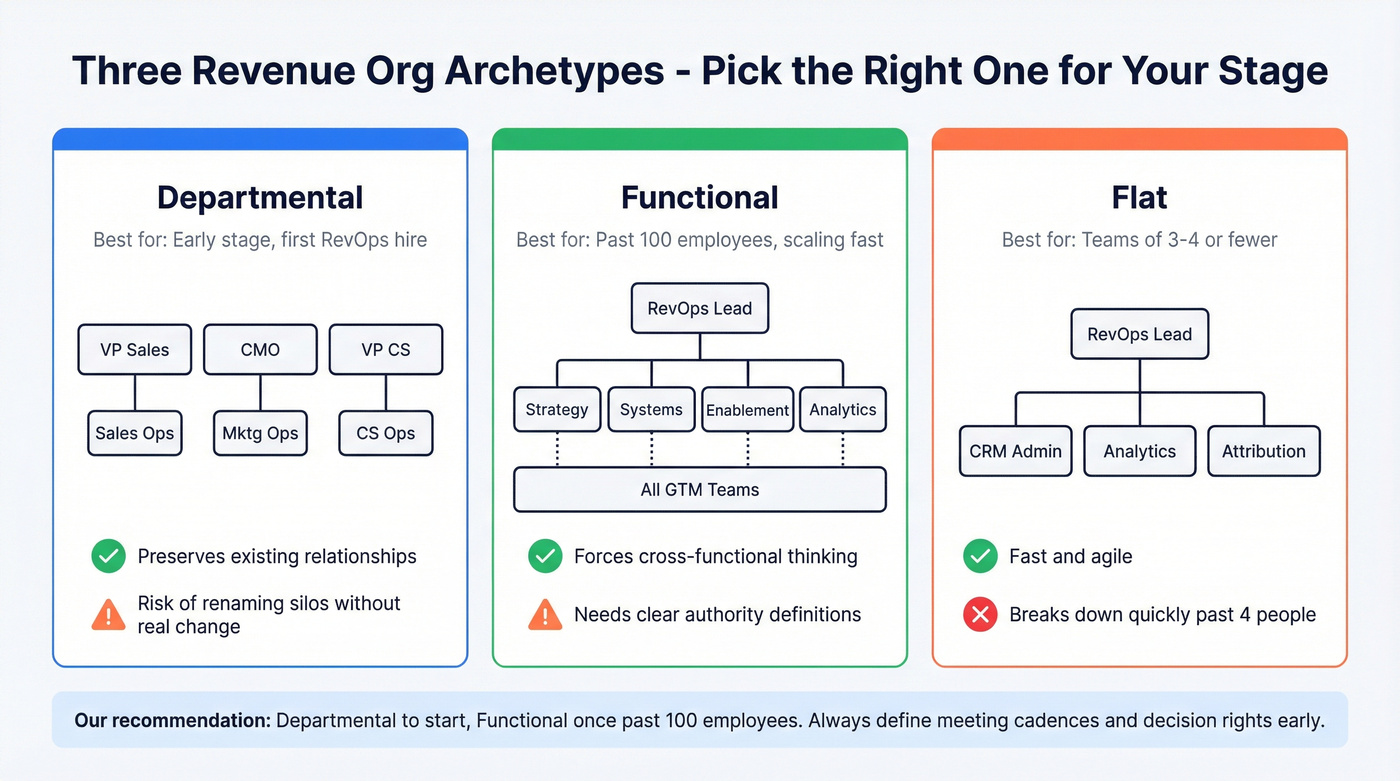
Three common archetypes cover most situations. Picking the wrong structure for your stage creates more problems than having no structure at all.
Departmental
The fastest path from "we have no RevOps" to "we have something." Ops people stay aligned to their home departments - sales ops reports to the VP of Sales, marketing ops to the CMO, and so on. It works because it preserves existing relationships and doesn't require a reorg. The risk: if the three ops leads don't share a boss and a weekly sync, you've just renamed three silos. A common question at this stage is whether you can have both RevOps and Sales Ops. You can, but only if Sales Ops rolls up into the broader RevOps charter rather than operating as a parallel kingdom.
Functional
Instead of splitting ops by department, organize by capability - strategy, systems, enablement, analytics - each serving all GTM teams. We've seen this work well past 100 employees where complexity justifies the overhead. It forces cross-functional thinking but needs clear authority definitions to avoid turf wars. This is the most common model among high-growth B2B companies scaling past their first few hires.
Flat
Everyone reports to one RevOps lead. No sub-teams. Fast and agile, but it breaks down quickly because one person can't context-switch between CRM admin, pipeline analytics, and marketing attribution without dropping balls. Skip this once your ops team grows beyond three or four people.
Our recommendation: departmental for early-stage companies making their first RevOps hire, functional once you're past 100 employees. Regardless of structure, define meeting cadences and decision rights early. Governance is what separates a revenue organization from a rebranded ops team.
Reporting lines matter too. RevOps under the CRO keeps it growth-focused. Under the COO or CFO, it tilts toward process rigor. Pick based on what your company needs now, not what looks good on an org chart.

A unified revenue organization is only as strong as the data flowing through it. Dirty contacts break every metric downstream - pipeline coverage, sales velocity, win rate, forecast accuracy. Prospeo gives your RevOps team 300M+ profiles with 98% verified emails, refreshed every 7 days, so your CRM stays clean without manual triage.
Stop letting bad data sabotage your revenue org's performance.
Staffing Your Revenue Ops Team
A PeerSignal analysis of 2,500 B2B software companies found an aggregate ratio of 12:1 - twelve sellers for every RevOps person. Revenue ops team headcount runs under 1% of total company headcount.
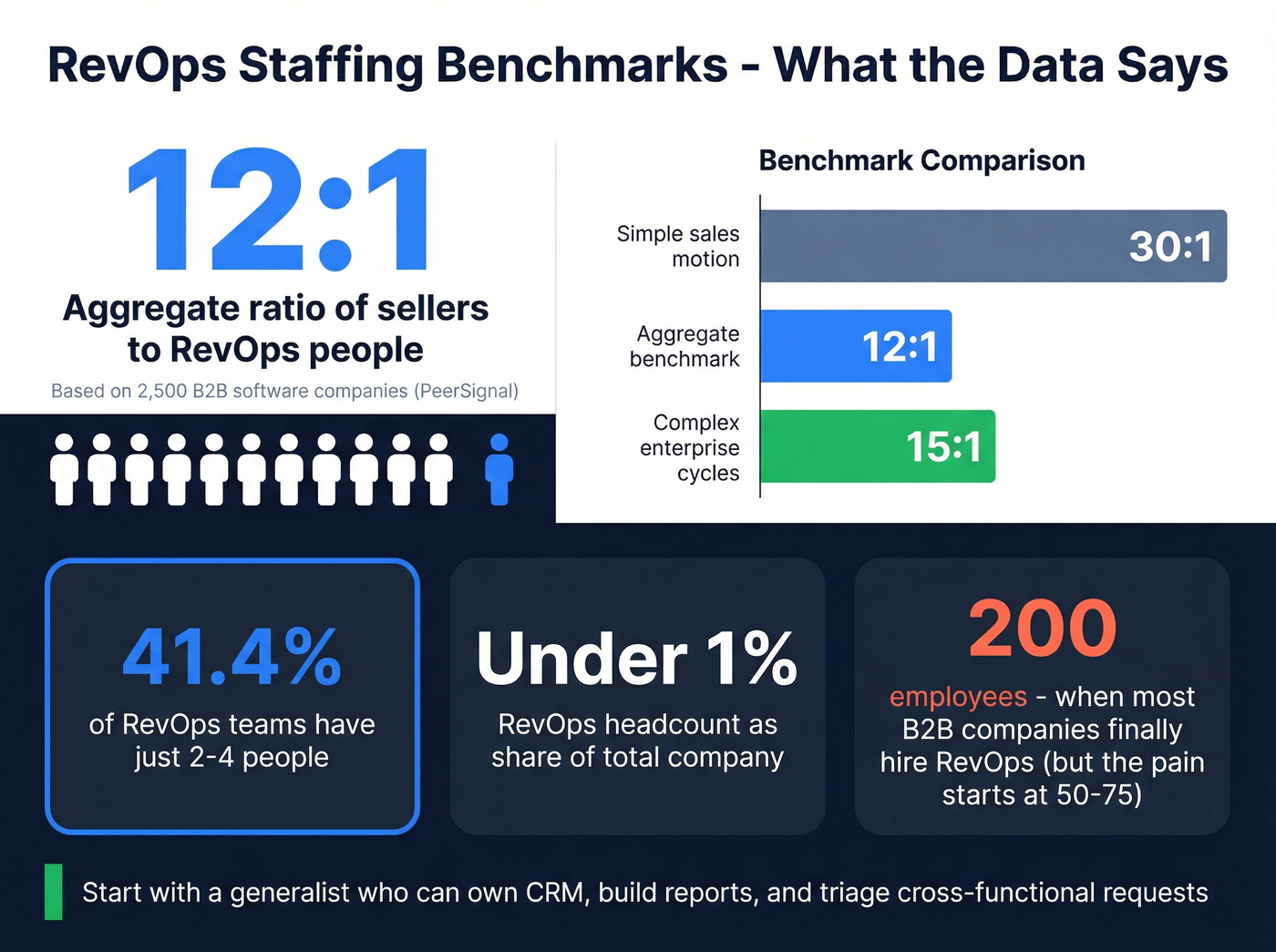
In practice, the range is wider. Simpler sales motions stretch to 30:1. Complex enterprise cycles with multiple handoffs need closer to 15:1. About 41.4% of RevOps teams have just 2-4 people, meaning many teams run lean with generalists covering CRM admin, routing, pipeline hygiene, and reporting simultaneously. By 200 employees, almost every B2B company has hired internal RevOps. But the pain starts much earlier.
We typically recommend starting with a generalist - someone who can own the CRM, build reports, and triage cross-functional requests. Here's the thing: if your AEs are spending more than an hour a week fixing CRM data, you're already past the point where you needed this hire. The cost of not hiring is invisible but real. It shows up as forecast inaccuracy, missed handoffs, and reps who stop trusting the system.
Four Metrics That Matter Most
Most RevOps teams track too many metrics. Start with four. Add more once these are clean.
Pipeline coverage. Qualified pipeline divided by your revenue target. New logo business needs 3-5x quarterly coverage. Expansion can run tighter at 2-3x. Below these thresholds, you don't have a closing problem - you have a creation problem. (If you want a deeper diagnostic, start with pipeline health.)
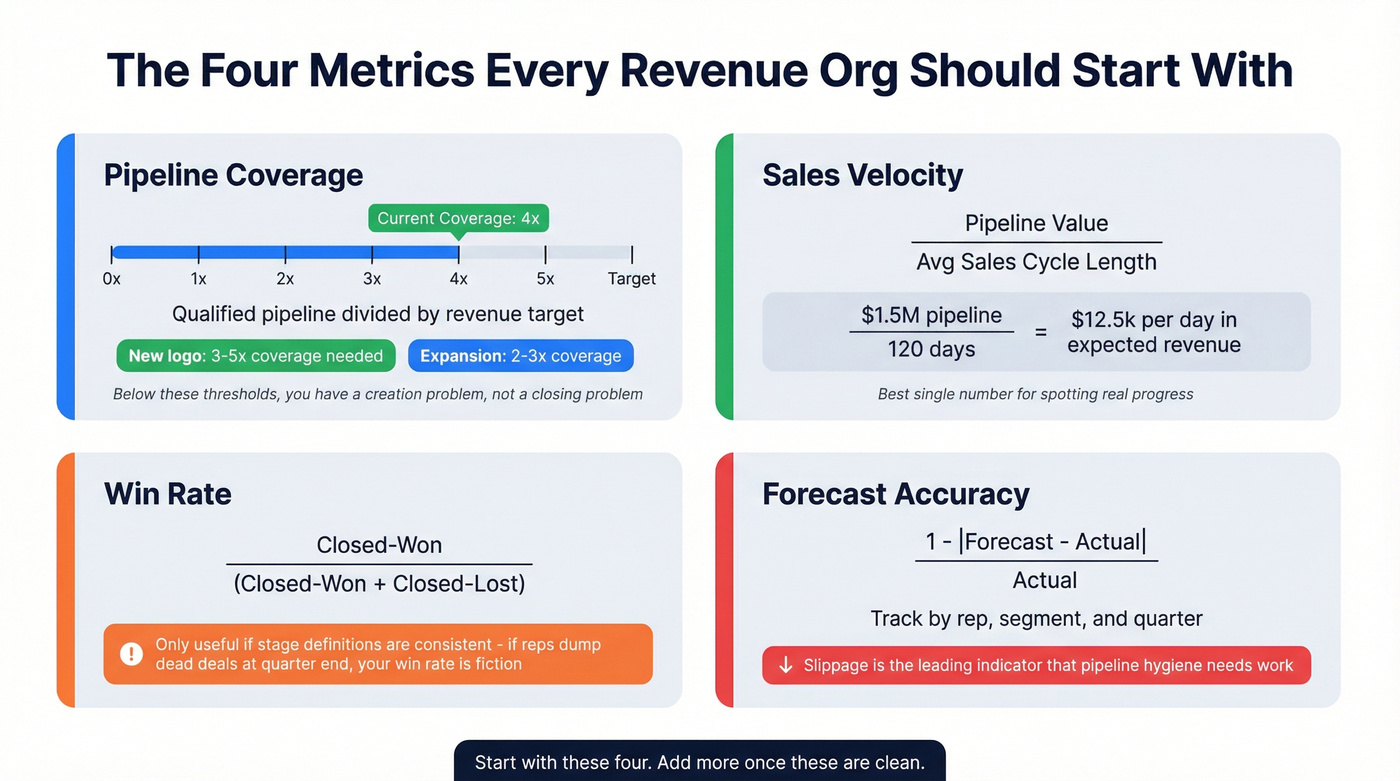
Sales velocity. Pipeline value divided by average sales cycle length. A team with $1.5M in pipeline and a 120-day cycle generates roughly $12.5k per day in expected revenue. This is the single best number for spotting whether changes to deal size, win rate, or cycle time are actually moving the needle.
Win rate. Closed-won divided by closed-won plus closed-lost in a period. Only useful if stage definitions are consistent. If reps dump dead deals into "closed-lost" at quarter end to clean up their pipeline, your win rate is fiction.
Forecast accuracy. One minus the absolute value of forecast-minus-actual divided by actual. Track by rep, segment, and quarter. Slippage is the leading indicator that pipeline hygiene needs work. (If you're rebuilding this, see sales forecasting solutions.)
Warning Signs Your RevOps Is Broken
These anti-patterns show up repeatedly in companies between $15M and $50M ARR. Catching them early is the difference between course correction and a painful restructure.
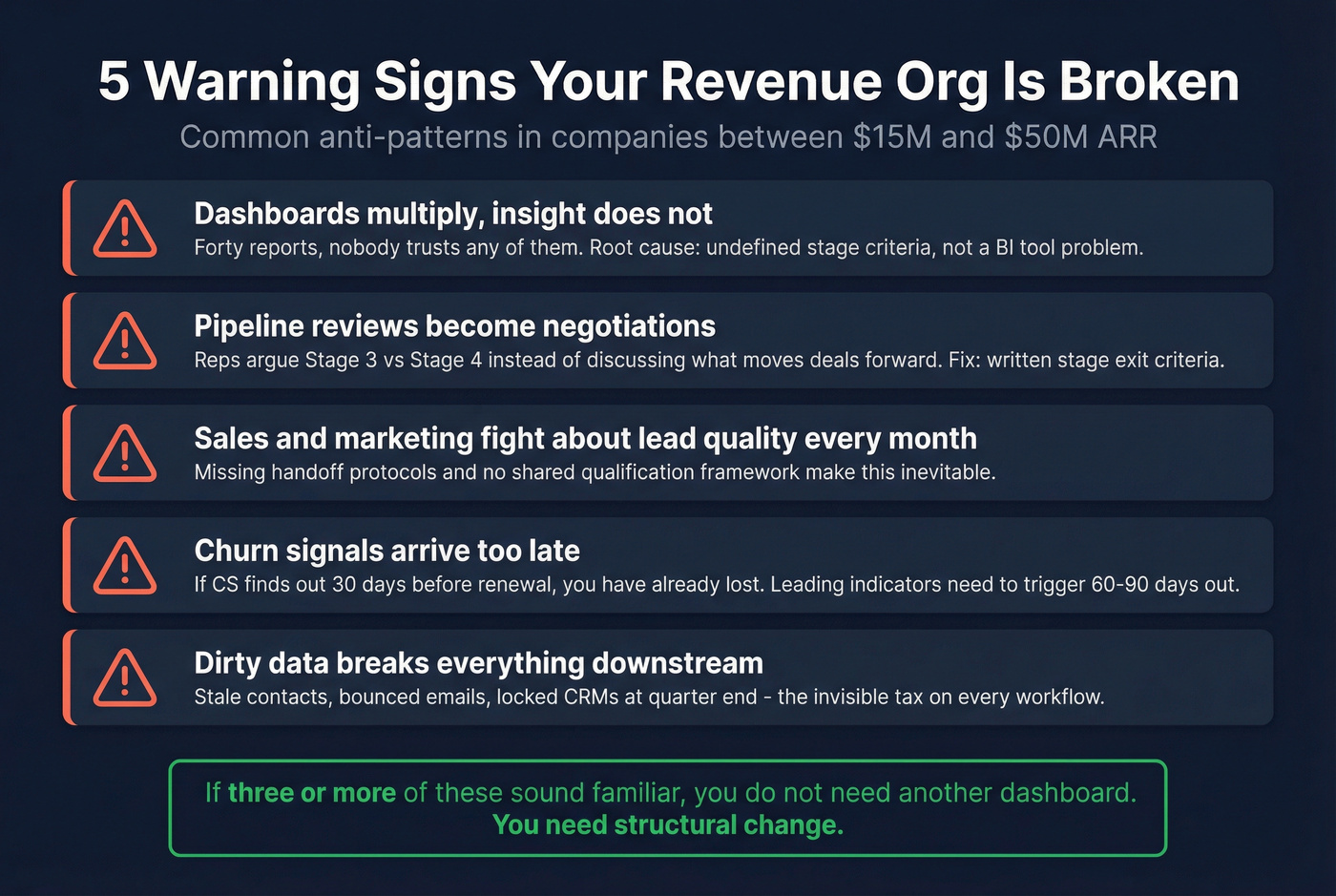
- Dashboards multiply, insight doesn't. Forty reports, nobody trusts any of them. The root cause is undefined stage criteria, not a BI tool problem.
- Pipeline reviews become negotiations. Reps argue Stage 3 vs. Stage 4 instead of discussing what moves deals forward. You need stage exit criteria, written down and enforced.
- Sales and marketing fight about lead quality every month. Missing handoff protocols and no shared qualification framework make this inevitable. (A practical fix is tightening your lead status definitions.)
- Churn signals arrive too late. If CS finds out a customer is at risk 30 days before renewal, you've already lost. Leading indicators need to trigger 60-90 days out. (More on this in churn analysis.)
- Dirty data breaks everything downstream. One practitioner shared a case where a marketing automation admin maxed out Salesforce API limits at quarter end, locking the entire sales team out of CRM during the most critical week of the quarter.
If three or more of these sound familiar, you don't need another dashboard. You need structural change.
Data Quality: The Foundation Nobody Wants to Talk About
Every workflow in a revenue organization - pipeline reporting, forecast accuracy, lead routing, enrichment - depends on accurate contact and account data. When the data's wrong, bounced emails tank your sequences, forecasts lose credibility, and reps stop trusting the CRM entirely. We've watched teams spend months building beautiful dashboards on top of data that was 30% stale. It's like putting a fresh coat of paint on a house with a cracked foundation.
Prospeo keeps CRM records accurate with 98% email verification, a 7-day refresh cycle, and 50+ data points per enriched contact. Snyk's team of 50 AEs saw bounce rates drop from 35-40% to under 5%, and AE-sourced pipeline jumped 180% after switching to verified data. That's the kind of impact clean data has on a revenue organization - not incremental, but transformational for pipeline creation. (If you're evaluating vendors, compare data enrichment services and track your email bounce rate.)
Your revenue org is only as good as the data flowing through it.
If your AEs spend hours fixing CRM data, your revenue org is bleeding productivity. Prospeo's enrichment API returns 50+ data points per contact at a 92% match rate - plugging directly into Salesforce and HubSpot. That's the 10-20% seller productivity lift BCG talks about, delivered through data quality instead of headcount.
Enrich your entire CRM for roughly $0.01 per email.
FAQ
What's the difference between a revenue organization and RevOps?
A revenue organization is the structural model - sales, marketing, and CS operating as one unified team with shared goals. RevOps is the operational function inside it that manages processes, systems, and data. Think of the org as the blueprint and RevOps as the team that builds and maintains it.
When should a company hire its first RevOps person?
Most B2B companies wait until 200 employees, but the pain starts earlier - usually around 50-75 headcount. If forecasts rely on spreadsheets or teams argue about lead quality monthly, you're overdue. Start with a generalist who can own CRM hygiene and cross-functional reporting.
What tools does a revenue organization need?
At minimum: a CRM like Salesforce or HubSpot, a data enrichment platform to keep contact records accurate at scale, and a BI layer for pipeline and forecast reporting. Add engagement and intent tools as you scale past $10M ARR.
How do you onboard new hires into a revenue org?
Every new rep, marketer, or CS manager should be trained on shared stage definitions, the unified tech stack, and cross-functional handoff protocols from day one. Without standardized onboarding, new hires default to whatever process they used at their last company, and alignment erodes within weeks.