

SaaS Revenue Growth: Benchmarks, Levers, and What "Good" Actually Looks Like
A founder on r/SaaS shared that they were stuck at $40k MRR for three years - not because the product was bad, but because they were scaling GTM on a broken foundation. That story captures the state of SaaS revenue growth better than any gated PDF.
Here's what five major benchmark sources say so you don't have to fill out six forms to find out.
The quick version: Median private SaaS growth is 25% YoY. Top quartile is 50%+. And the most fixable lever for most teams isn't pricing or product - it's the data quality feeding your pipeline.
What It Actually Measures
SaaS revenue growth is your year-over-year change in ARR (or MRR annualized). The formula is straightforward, but the ARR bridge underneath is where the insight lives - Net New ARR breaks into Gross New, Expansion, Contraction, Churn, and Restart ARR.
ChartMogul's research shows most companies go from $1M to $10M ARR primarily by growing their subscriber base; fewer than 5% get there predominantly by increasing ARPA. That tells you where to focus: more customers, not higher prices - at least until you're at meaningful scale. For any SaaS growth plan, subscriber acquisition should come first.
2026 Benchmarks by Stage
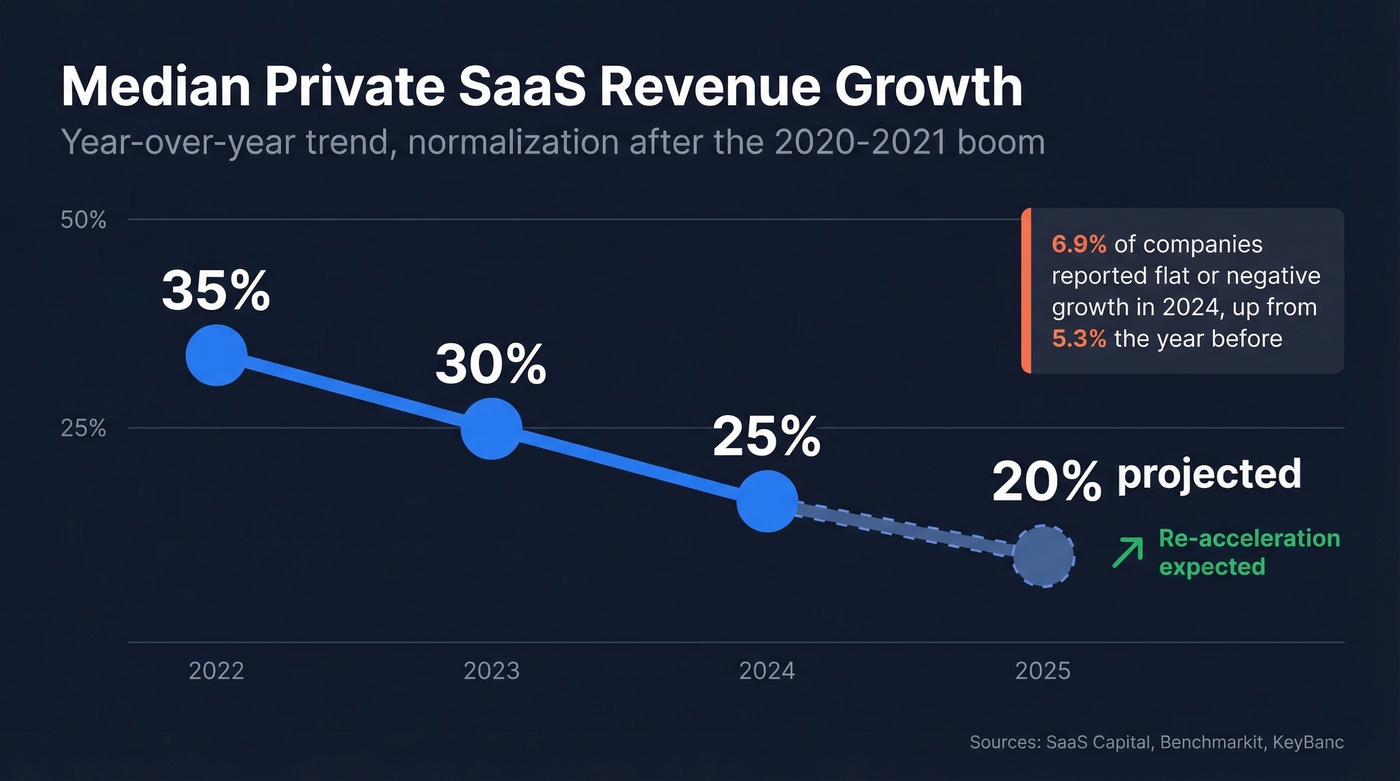
Median private SaaS growth has fallen from 35% (2022) to 30% (2023) to 25% (2024). That's normalization after the 2020-2021 sugar high, not a crisis. But 6.9% of companies reported flat or negative growth in 2024, up from 5.3% the year before.
| Source | Year | Median | Top Quartile | Top Decile |
|---|---|---|---|---|
| SaaS Capital | 2024 | 25% | Not reported | Not reported |
| Benchmarkit | 2024 | 26% | 50% | Not reported |
| ChartMogul (top decile by ARR band) | 2023 | Not reported | Not reported | $1-3M: 192% / $3-8M: 121% / $8-15M: 110% |
| KeyBanc + Sapphire (expected ARR growth) | 2025 | 20% | Not reported | Not reported |
Stop benchmarking against top decile. That's survivorship bias in a spreadsheet. A company growing at 192% in the $1-3M band is the exception, not the target. Aim for top quartile at 50%.
Bootstrapped companies grew at a 25% median versus equity-backed at 30% in SaaS Capital's 2023 data. VC doesn't cause growth - the companies that raise are typically already growing faster. One bootstrapped founder shared on Reddit that they hit $272k ARR (AUD) in 14 months with 35 customers, $57k coming from expansions alone and only 1 churn. That's what disciplined growth looks like without outside capital.
Here's the thing: if your deal sizes sit below $15k ACV, you probably don't need a $50k+ data platform or a bloated tech stack. You need accurate prospect data, a tight ICP, and relentless focus on net revenue retention. The companies that nail those three things outgrow their better-funded competitors.
Five Levers That Drive Growth
Net Revenue Retention
NRR is the single strongest predictor of growth trajectory. The Benchmarkit 2025 report puts median NRR at 101%. Moving NRR from the 90-100% range to 100-110% improves growth by roughly 10 percentage points.
We've watched companies obsess over top-of-funnel while ignoring expansion - and it's the most expensive mistake in SaaS. Expansion ARR now accounts for 40% of total new ARR across the dataset, up 5 points year-over-year. If you aren't measuring expansion separately, you can't optimize your most efficient growth channel. Accelerating recurring revenue through expansion is often cheaper than acquiring net-new logos.
Multi-Product Strategy
Tidemark's 2025 vertical SaaS benchmark found multi-product companies grew roughly 21% faster than single-product peers. With 59% of vertical SaaS companies now multi-product, single-product companies are increasingly the slower-growing minority.
AI-Native Product Development
AI companies now make up 42% of the Bessemer Cloud 100, up from 21% in 2024. AI-native companies reach $100M ARR in 5.7 years versus the 7.5-year average.
Across High Alpha's dataset of 800+ SaaS companies, AI-core products grew fastest at every ARR band. If you're building SaaS in 2026 without an AI component, you're conceding the fastest-growing segment to everyone else.
GTM Data Quality & Efficiency
Here's the lever nobody talks about at board meetings.
The median new customer CAC ratio hit $2.00 of S&M spend per $1.00 of new customer ARR in 2024 - up 14% year-over-year. A huge chunk of that waste comes from bad prospect data: bounced emails burn sender domains, wrong phone numbers waste entire call blocks, and reps spend hours chasing contacts who left the company six months ago.
We've seen this pattern repeatedly - teams blame the channel when the real issue is the data feeding it. One founder on Reddit described how cold email "burned domains" and social outreach triggered account blocks, all before they fixed their underlying data problem. Snyk's 50-person AE team saw sourced pipeline jump 180% after switching to Prospeo's 98%-accuracy emails with a 7-day refresh cycle, and Meritt tripled pipeline from $100K to $300K per week while dropping bounce rates from 35% to under 4%.

Pricing Optimization
Hybrid pricing models - subscription plus usage - deliver best-in-class NRR. Outcome-based AI pricing is the emerging variant, where customers pay for results rather than seats. This isn't just a pricing philosophy; it's a retention mechanism that creates natural expansion revenue without requiring a sales motion.
Across High Alpha's benchmarks, the winning combination is consistent: high NRR plus short CAC payback on lean teams. ARR per employee is up since 2022, and median headcount is down at $5M+ ARR. Efficiency and growth aren't opposites anymore.

Your CAC ratio is $2.00 per $1 of new ARR - and bad prospect data is a major reason why. Prospeo's 98% email accuracy and 7-day data refresh cut the waste that inflates acquisition costs. Meritt tripled pipeline from $100K to $300K/week. Snyk's 50 AEs grew sourced pipeline 180%.
Stop bleeding CAC on bounced emails and stale contacts.
Building Your ARR Growth Strategy
Knowing the benchmarks is only half the equation. You need a strategy that connects the levers above into a coherent plan.
The highest-performing companies in the Benchmarkit and High Alpha datasets share three traits: they measure NRR weekly (not quarterly), they treat data quality as a revenue function (not an ops task), and they sequence investments - fixing retention before pouring into acquisition. Let's break that sequencing down, because it's where most teams go wrong.
Start by auditing your ARR bridge. If contraction and churn are eating more than 10% of opening ARR, no amount of top-of-funnel spend will sustain healthy revenue growth. Fix the leak, then scale the pipe. Skip this step if you're pre-$1M ARR and still finding product-market fit - at that stage, growth rate matters more than retention math.
If you need a tighter diagnostic, run a quick churn analysis and map the downstream impact on pipeline health.
Efficiency Metrics Worth Tracking
The Rule of 40 is an outdated blunt instrument. Bessemer's Rule of X weights growth 2-3x more than FCF margin, and the valuation data proves it - a 1% increase in growth has 2.3x the valuation impact of a 1% margin improvement.
| Metric | Benchmark | Source |
|---|---|---|
| R40 beat rate (<$30M) | 9% | BCG |
| R40 beat rate (>$80M) | 26% | BCG |
| Burn multiple ($1-3M ARR) | 1.7x | MetricHQ (Capchase) |
| Burn multiple ($5-10M ARR) | 0.65x | MetricHQ (Capchase) |
| ARR per FTE ($100M+) | ~$300K | Benchmarkit |
Only 9% of companies under $30M revenue beat the Rule of 40. Scale makes efficiency easier, which is why early-stage companies should prioritize growth rate first and margin optimization second.
If outbound is a core motion, track your cost to acquire customer alongside subscriber acquisition cost so you can separate sales efficiency from pure demand.
2026 Outlook
Growth is expected to re-accelerate for the first time in three years. KeyBanc's private SaaS survey shows ARR growth climbing from 15% (2024) to 20% (2025), with gross retention trending back toward ~90%. Over 50% of companies plan to increase AI spend by more than 21%, 67% are already monetizing AI, and zero plan to decrease AI investment.
The SaaS market overall is projected to grow from $315.68B in 2025 to $375.57B in 2026, at an 18.7% CAGR through 2034.
The companies that'll capture this re-acceleration are the ones fixing their data and retention foundations now - not the ones chasing the next AI feature. SaaS revenue growth in 2026 will reward disciplined operators over well-funded experimenters.
If you're tightening outbound, start with email deliverability and keep an eye on email bounce rate before you scale volume.
The benchmarks are clear: NRR and GTM efficiency separate top-quartile SaaS companies from the rest. You can't hit 50%+ growth sending outbound to contacts who left six months ago. Prospeo refreshes 300M+ profiles every 7 days - not the 6-week industry average - so your reps reach real buyers.
Build pipeline on data that's never more than a week old.
FAQ
What's a good SaaS growth rate?
Median private SaaS growth is 25% YoY as of 2024; top-quartile companies grow at 50%+. Aim for top quartile - top decile numbers like 192% reflect survivorship bias, not a realistic target for planning purposes.
How long does it take to reach $10M ARR?
The average SaaS company takes slightly over 5 years to reach $10M ARR, and only 13% get there even after a decade. Top-tier companies hit $1M ARR in about 9 months; the median takes nearly 3 years.
Does raising venture capital improve growth rates?
Not meaningfully. Bootstrapped median growth is 25% versus equity-backed at 30%. The companies that raise are already growing faster - capital follows momentum, it doesn't create it.
How can early-stage SaaS companies reduce CAC while scaling?
Focus on data quality first. Bad prospect data inflates CAC by burning sender domains and wasting rep time. Cutting bounce rates below 4% lets teams scale outbound without proportionally scaling spend - that's the single fastest path to a healthier CAC ratio.