

SaaS Revenue Operations: What Every Guide Gets Wrong (and What Actually Works)
Gartner predicted that by 2026, 60% of B2B organizations would fail to build a functioning end-to-end revenue process and revert back to functional silos. We're here now, and the prediction is playing out exactly as expected. SaaS revenue operations was supposed to fix the coordination problem - but most companies treated it as a reorg instead of an operating model.
The CEO asks why pipeline is up 40% but closed-won is flat. Marketing blames sales for not following up. Sales blames marketing for junk leads. CS is quietly watching churn tick up and wondering why nobody invited them to the forecast call. Sound familiar?
The Short Version
- Audit your data quality first. The #1 blocker practitioners cite is CRM data integrity. If 30%+ of your emails bounce, nothing downstream works.
- Align on metric definitions. Get sales, marketing, CS, and finance to agree on what ARR, bookings, and pipeline actually mean. Sounds basic. Almost nobody does it.
- Follow the 30/60/90-day playbook below. Map reality first, then fix systems.
The urgency signal? Median NRR across B2B SaaS sits at 101%. That's barely treading water. If your number is below that, RevOps isn't a nice-to-have - it's triage.
What RevOps Actually Means for SaaS
RevOps isn't Sales Ops with a new title. Sales Ops focuses on the sales team's processes and tools. The revenue operations model SaaS companies actually need aligns sales, marketing, customer success, and finance under a single operating framework with shared metrics and a unified tech stack.
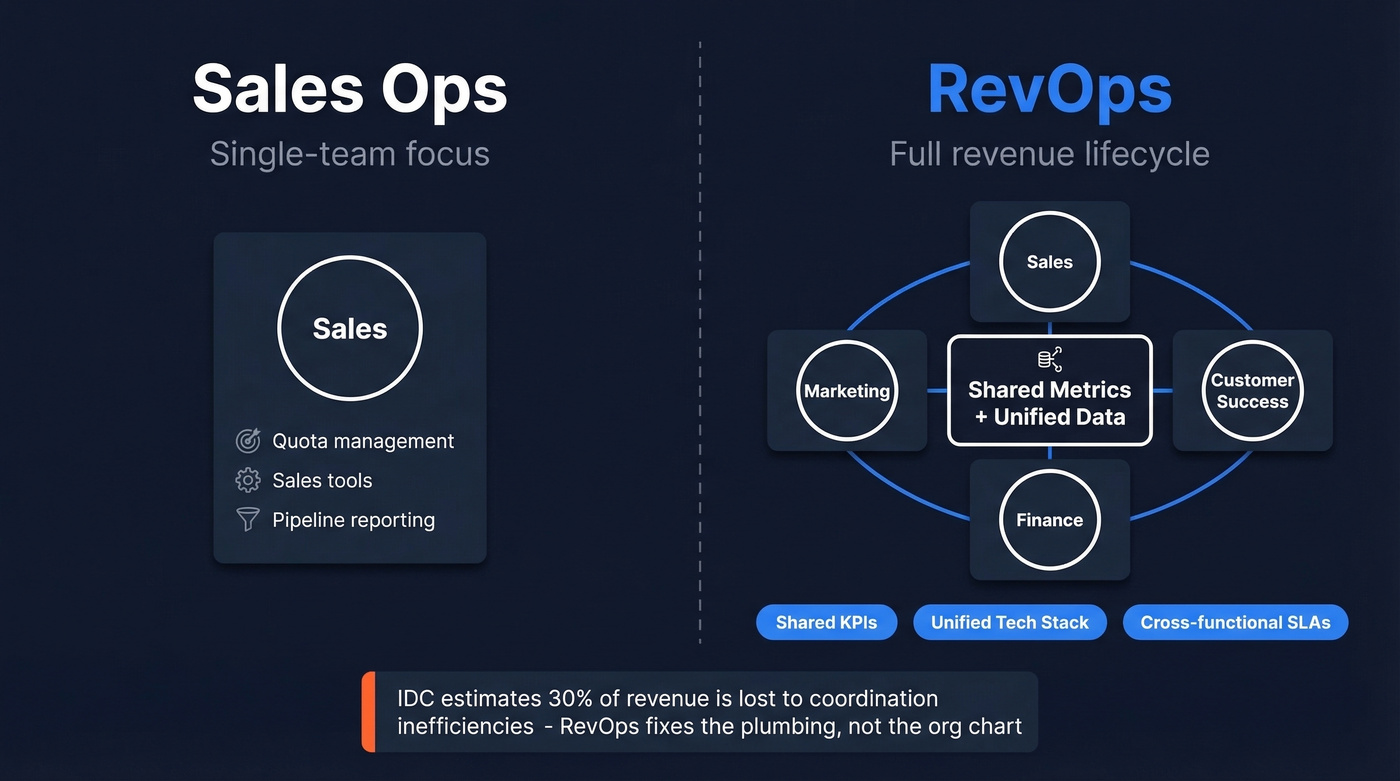
The distinction matters because IDC estimates businesses lose 30% of revenue to inefficiencies across the revenue workflow. That's not a tooling problem - it's a coordination problem. Competing sources of truth, broken handoffs, duplicated reporting, low cross-functional trust. RevOps fixes the plumbing. Not an org chart change, but a commitment to running revenue as one system.
The Business Case
BCG's research on B2B tech companies running RevOps properly shows impact ranges that are hard to ignore: 10-20% increases in sales productivity, 100-200% increases in digital marketing ROI, 10% increases in lead acceptance, and 30% reductions in GTM expenses. Those aren't theoretical. They come from eliminating duplicated effort, misaligned targeting, and data inconsistency.
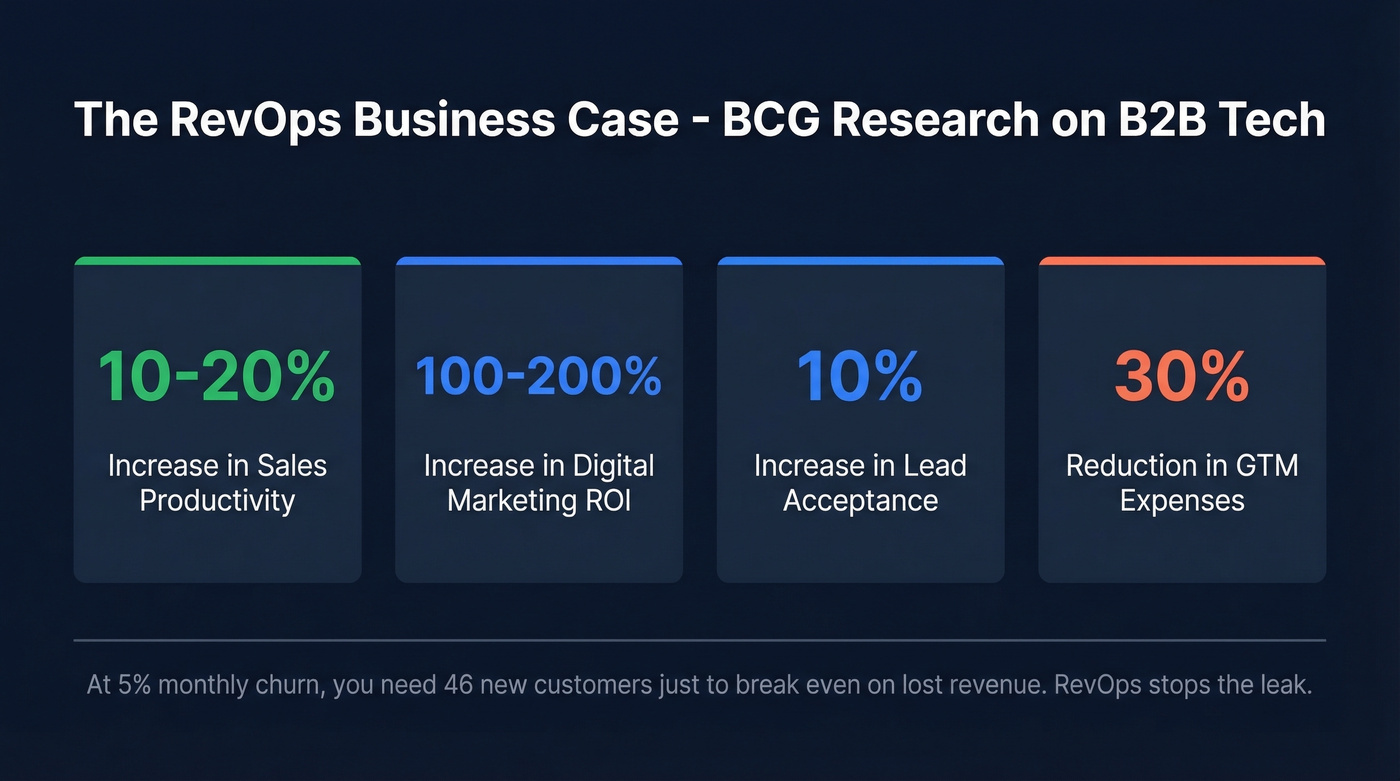
Let's make the churn math concrete: at 5% monthly churn, you need to acquire 46 new customers just to break even on lost revenue. A mature RevOps function is how you stop that leak.
2026 SaaS Benchmarks
Based on Benchmarkit's latest benchmarks and supplementary ranges from Visdum:
| Metric | Median / Target | Context |
|---|---|---|
| NRR | 101% | Barely treading water |
| GRR | 88% | Down from 90% over three years |
| New CAC Ratio | $2.00 | $2 spent per $1 new ARR |
| Expansion ARR | 40% of new ARR | >50% above $50M ARR |
| ARR per FTE | $200-300k | Scales with company size |
| LTV:CAC | 3:1 (healthy) | 4:1+ is excellent |
| Magic Number | >0.75 | Below 0.5 = inefficient |
GRR dropping from 90% to 88% over three years means the industry is getting worse at keeping customers, even as expansion revenue grows. In our experience, companies below 88% GRR are already in crisis mode - they just haven't realized it yet.
Median growth has settled at 26%, and the top quartile dropped from 60% to 50%. The era of growth-at-all-costs is over. Efficiency metrics - CAC ratios, ARR per FTE, Magic Number - are what boards care about now, and RevOps is the function that owns them.

You just read that IDC estimates 30% of revenue is lost to workflow inefficiencies. The biggest culprit? Stale CRM data that breaks every handoff, forecast, and campaign downstream. Prospeo's enrichment returns 50+ data points per contact at a 92% match rate - refreshed every 7 days, not the 6-week industry average.
Stop feeding your RevOps engine bad data. Start with records you can trust.
Building Your RevOps Team
RevOps responsibilities break into four pillars: Process (SLAs, handoffs, GTM architecture), Enablement (cross-functional adoption), Insights (dashboards, attribution, forecasting), and Systems & Tools (tech stack architecture, integrations, license governance).
For hiring sequence:
- RevOps Manager - your first hire, owns the operating model
- Data Analyst - builds the reporting layer and single source of truth
- Systems Administrator - manages CRM, integrations, and tool hygiene
The emerging role to watch is the GTM Engineer - someone who bridges strategy and systems execution through scripting, custom integrations, and workflow automation. Most companies don't need a dedicated RevOps function until around 100 employees. Before that, one person can wear the hat part-time.
RevOps Tech Stack by Stage
Here's the thing: as of 2022, companies used an average of 130 apps within their organizations. Most of them don't talk to each other. Map your motion first, then buy software - not the other way around.
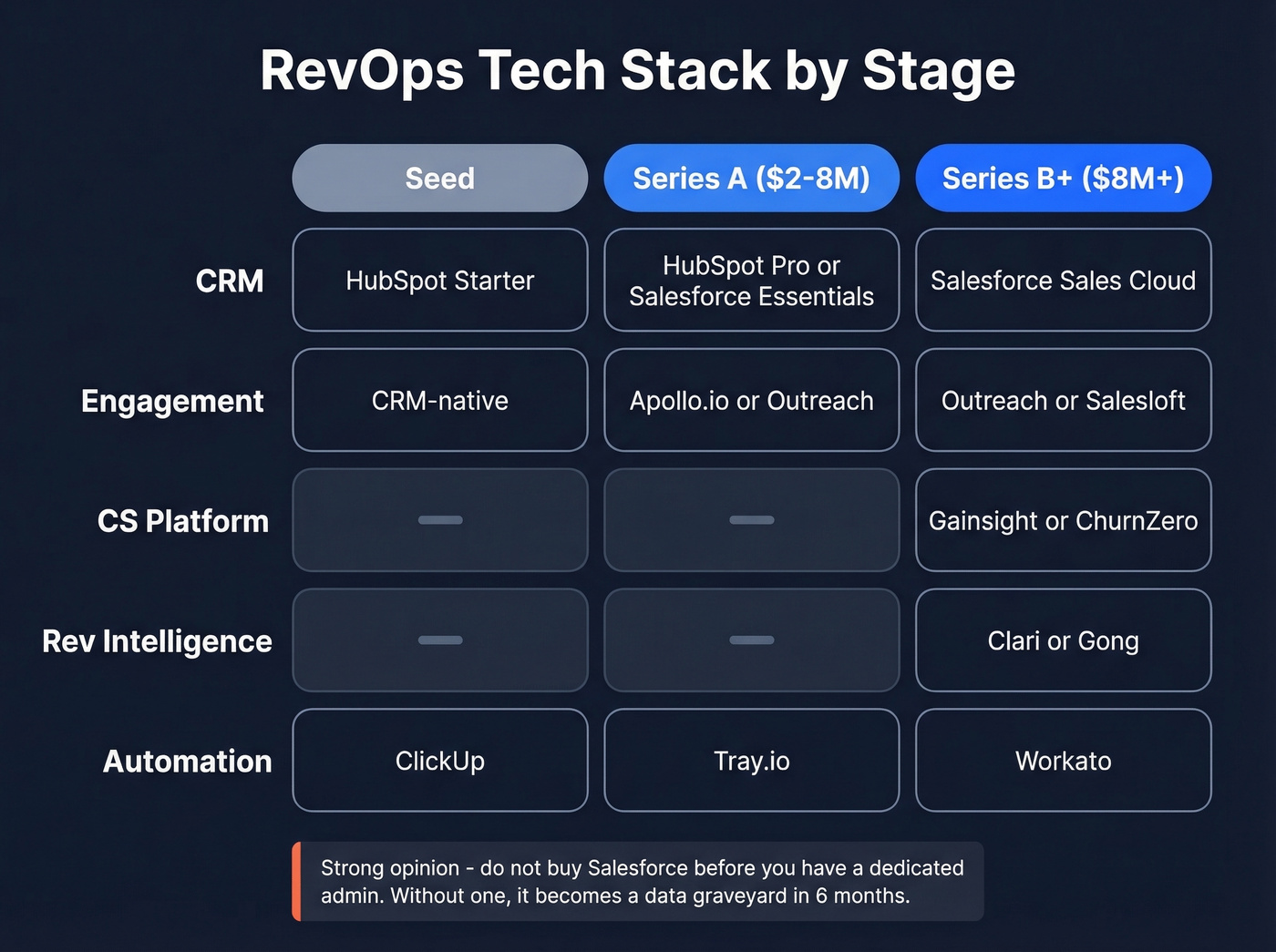
| Layer | Seed | Series A ($2-8M) | Series B+ ($8M+) |
|---|---|---|---|
| CRM | HubSpot Starter | HubSpot Pro / Salesforce Essentials | Salesforce Sales Cloud |
| Engagement | CRM-native | Apollo.io or Outreach | Outreach or Salesloft |
| CS Platform | - | - | Gainsight or ChurnZero |
| Rev Intelligence | - | - | Clari or Gong |
| Automation | ClickUp | Tray.io | Workato |
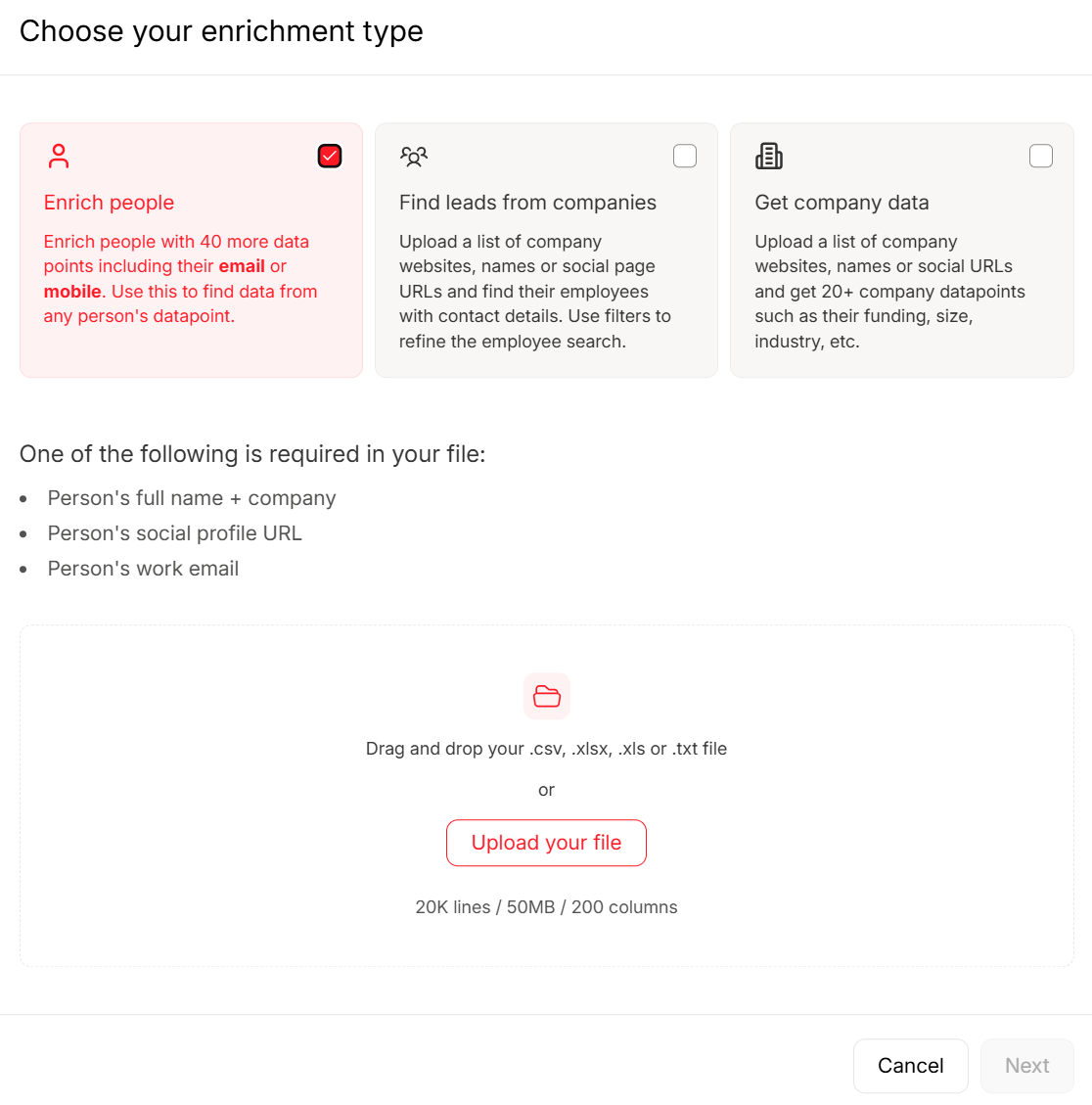
For contact data enrichment, accuracy is the foundation. Stale records poison every downstream metric - conversion rates, CAC, forecasting accuracy. We've tested tools across this stack extensively, and a 7-day data refresh cycle versus the industry average of six weeks is the difference between pipeline reporting you can trust and pipeline fiction.
One strong opinion: don't buy Salesforce before you have an admin. Without someone owning it, Salesforce becomes a data graveyard within six months. We've seen this pattern repeatedly - the CRM that was supposed to be the source of truth becomes the source of fiction.
AI in RevOps - 2026 Reality
BCG frames it well: predictive AI is table stakes; GenAI and agentic AI shift RevOps from prediction to execution. Companies are already cutting RFP turnaround times by up to 20% with GenAI.
The use cases actually working right now: GenAI drafting sequences tailored to persona and intent signals. Conversation intelligence flagging objection patterns mid-call. Agentic AI handling follow-ups, deal tracking, and CRM updates autonomously. Self-optimizing cadences that adjust timing and channel mix based on engagement data.
The part everyone ignores: none of this works without clean, governed data. AI amplifies whatever you feed it. Feed it stale CRM records and you get confidently wrong outputs at scale.
Skip the full AI-powered RevOps stack if your average deal size is under $15k. A clean CRM, one enrichment tool, and a shared dashboard will outperform a $200k/year Frankenstack that nobody maintains. RevOps is an operating discipline, not a software budget.
Your First 90 Days in RevOps
The narrative arc, as Pavilion frames it: map reality, align the system, deliver proof.
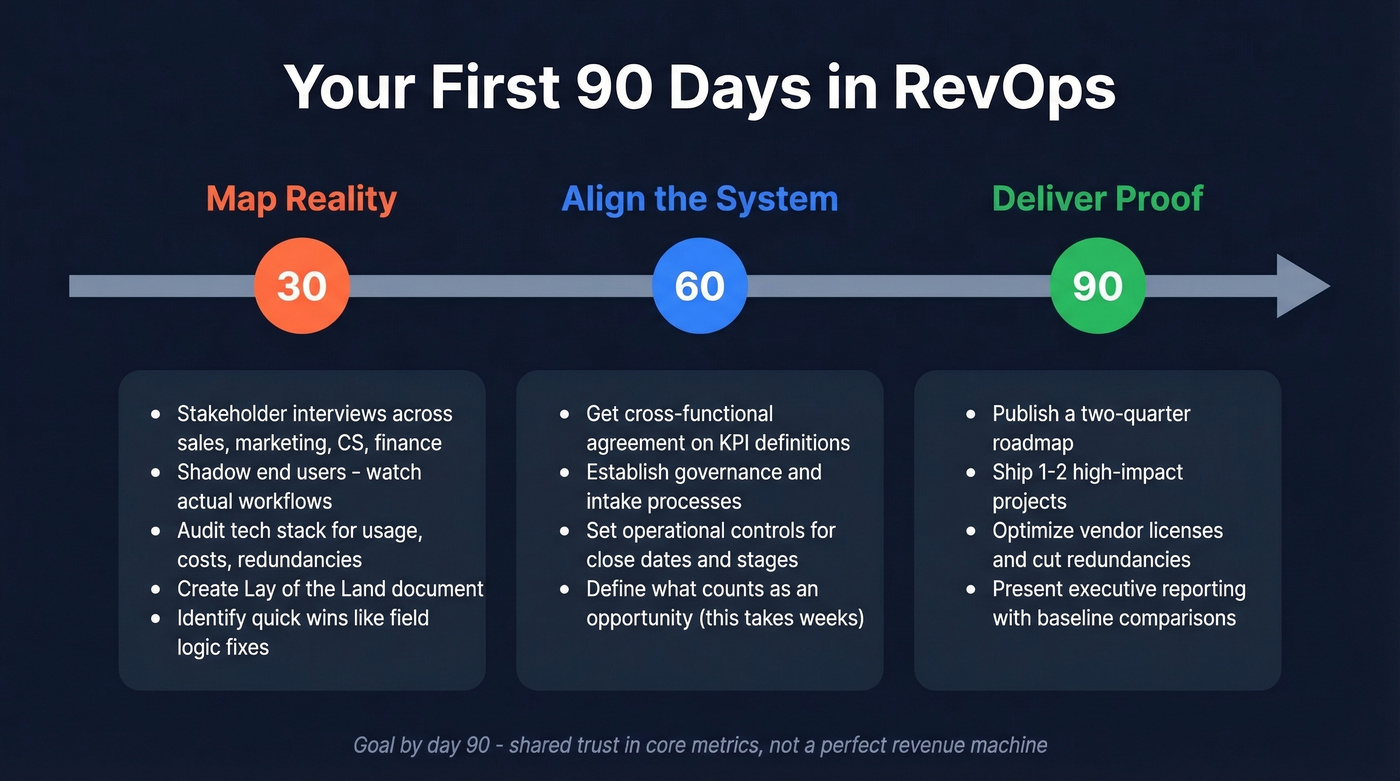
Days 0-30: Map Reality. Run stakeholder interviews across sales, marketing, CS, and finance. Shadow end users - sit with BDRs, AEs, and CSMs to see actual workflows, not the workflows they describe in meetings. Audit the tech stack for usage, costs, and redundancies (use this sales tech stack audit approach). Create a "Lay of the Land" document capturing the current state, and identify quick wins like field logic fixes and simple dashboards.
Days 31-60: Align the System. Get cross-functional agreement on KPI definitions. This takes longer than you think - I've seen teams spend three weeks just agreeing on what counts as an "opportunity." Establish governance: intake processes, documentation standards, SLAs. Set operational controls for close date hygiene, stage definitions, and data entry standards.
Days 61-90: Deliver Proof. Publish a two-quarter roadmap. Ship 1-2 high-impact projects: data cleanup, unified forecasting dashboard, segment reporting. Optimize vendor licenses - you'll find redundancies. Present executive reporting with baseline-to-impact comparisons.
By day 90, the goal isn't a perfect revenue machine. It's shared trust in core metrics.
Why Most RevOps Initiatives Fail
Remember that Gartner prediction about 60% reverting to silos? The root cause isn't strategy - it's execution.
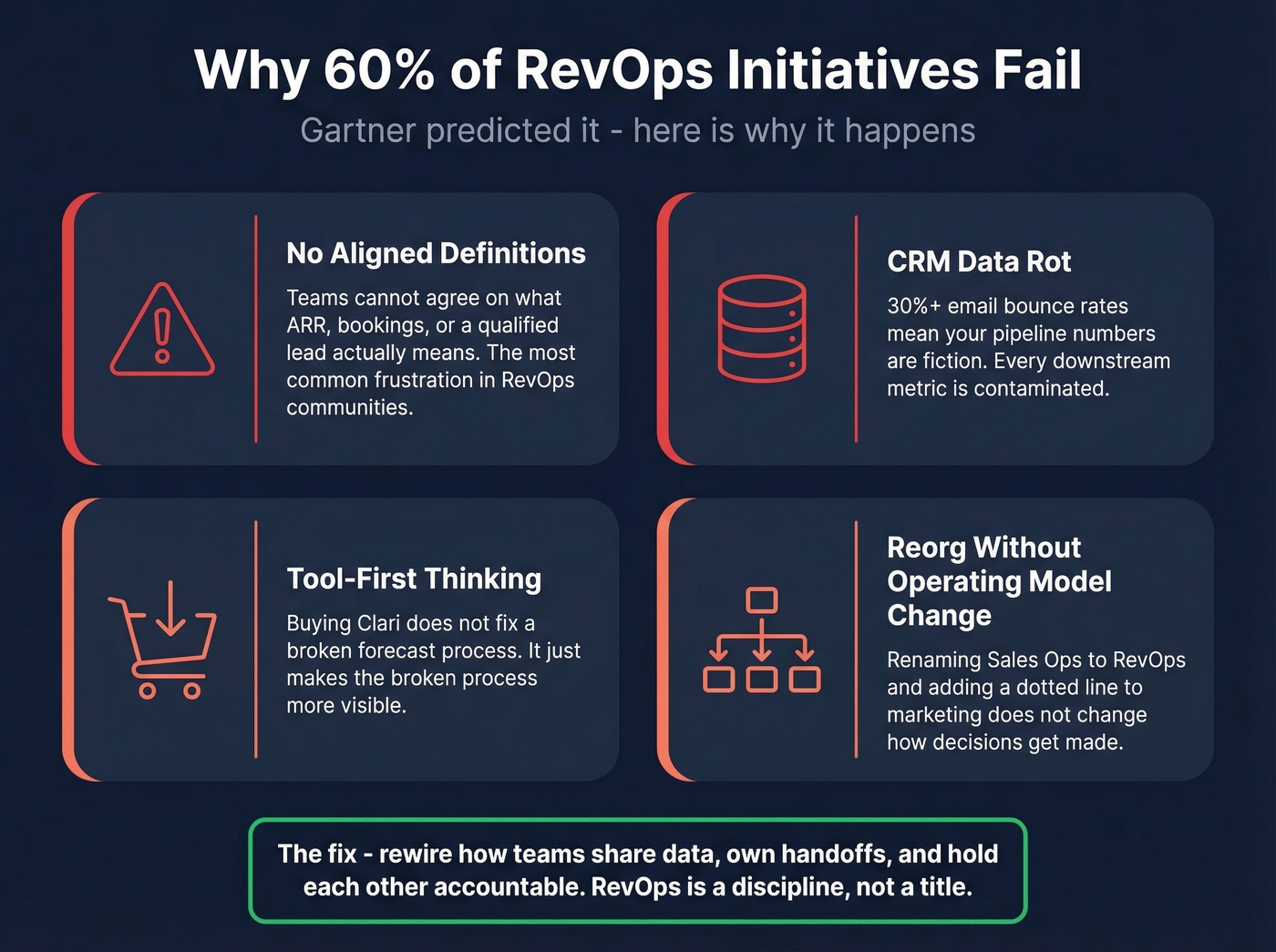
No aligned definitions. Practitioners regularly call out the same basics: not tracking bookings data, mixing revenue streams, and having no common basis for ARR vs MRR vs TCV reporting (see ACV vs ARR). The consensus on r/sales and r/salesoperations echoes this - the most upvoted RevOps frustrations aren't about tools. They're about teams that can't agree on what a qualified lead is.
CRM data rot. If 30%+ of your emails bounce on the first sequence, your pipeline numbers are fiction. Every downstream metric is contaminated. This is where enrichment tools earn their keep - Snyk's team of 50 AEs cut bounce rates from 35-40% to under 5% after switching to Prospeo, which directly improved forecast accuracy and grew AE-sourced pipeline by 180%.
Tool-first thinking. Buying Clari doesn't fix a broken forecast process. It just makes the broken process more visible (and if you're evaluating options, compare revenue intelligence platforms by use case, not hype).
Org design without operating model change. Renaming Sales Ops to RevOps and adding a dotted line to marketing doesn't change how decisions get made. True revenue operations requires rewiring how teams share data, own handoffs, and hold each other accountable (start with Sales & Marketing Alignment Best Practices).
A clean CRM and one enrichment tool will outperform a $200K/yr AI stack - but only if the data is accurate. Prospeo delivers 98% email accuracy, 125M+ verified mobiles, and costs roughly $0.01 per email. No contracts, no sales calls, no six-figure commitments.
Enterprise-grade data quality without the enterprise pricing. That's RevOps done right.
FAQ
What's the difference between RevOps and Sales Ops?
Sales Ops focuses on the sales team's processes, tools, and quota management. RevOps aligns sales, marketing, CS, and finance under a single operating model with shared metrics - owning the entire revenue lifecycle from lead creation through renewal, not just the sales motion.
When should a SaaS company invest in RevOps?
Most companies hit the inflection point around 100 employees or $5M ARR - when forecasts miss by 20%+, teams use disconnected systems, and handoffs between marketing and sales consistently break. Below that threshold, one person wearing the RevOps hat part-time is usually enough.
How do I fix CRM data quality for RevOps?
Start with an automated enrichment and verification layer that refreshes on a weekly cycle - not quarterly manual cleanups. Pair that with governance rules like mandatory fields, standardized stage definitions, and regular audits. Clean data is the foundation every revenue operations initiative depends on.
What does a RevOps tech stack cost at Series A?
Expect $30k-$80k/year depending on CRM tier and tooling choices. A HubSpot Pro CRM ($18k), an enrichment tool ($1k-$3k), and a sequencing platform like Apollo ($6k-$12k) covers most needs. Avoid stacking revenue intelligence platforms until you've outgrown spreadsheet forecasting - premature tooling is the #1 budget waste in early-stage RevOps.