

SaaS Sales Enablement: What Actually Works (and What Reps Ignore)
Sellers spend roughly 25% of their time actually selling. The rest disappears into CRM hygiene, internal meetings, and enablement trainings that were supposed to help them sell more. One Reddit thread put it bluntly: enablement teams scheduling two to three hour-long video trainings per week, eating 20-25% of every rep's week. That's SaaS sales enablement. That's a compliance program wearing a sales hat.
What You Need (Quick Version)
Build battlecards and case studies before anything else - those are the assets reps actually use to close deals. Structure onboarding as a 30-day ramp, not a content dump on day one. Start your tech stack with three things: a CRM, verified prospecting data, and conversation intelligence. Everything else can wait until you're past $5M ARR.
What Enablement Means in SaaS
Sales enablement in SaaS isn't generic corporate training repackaged with a subscription logo. The subscription model shifts the sales motion toward renewals and expansion, not just the initial close. In hybrid motions, sales and success teams drive 58% of upsells - the product itself only accounts for 10%. That's why enablement for expansion revenue matters just as much as enablement for new logos.
Here's the tension, though. 75% of B2B buyers now prefer a rep-free experience. But 43% of those self-service buyers report higher purchase regret. That gap is exactly where a well-enabled rep changes the outcome. Enablement's job isn't to make reps busier - it's to make those moments count.
Why It Matters in 2026
Organizations with a dedicated enablement strategy achieve a 49% higher win rate on forecasted deals. That number alone should end the "do we need enablement?" debate. As of 2026, an estimated 65% of B2B sales organizations have shifted from intuition-based to data-driven decision making, and 65% of marketing content never gets used by sales. That second stat isn't a content problem. It's an alignment problem, and it's the one enablement exists to fix.

The 30-Day Onboarding Framework
Most SaaS companies dump a Google Drive folder on new reps and call it onboarding. We've seen it dozens of times. Structured enablement programs decrease onboarding time by 40-50%, and here's a 30-day framework that actually ramps people:
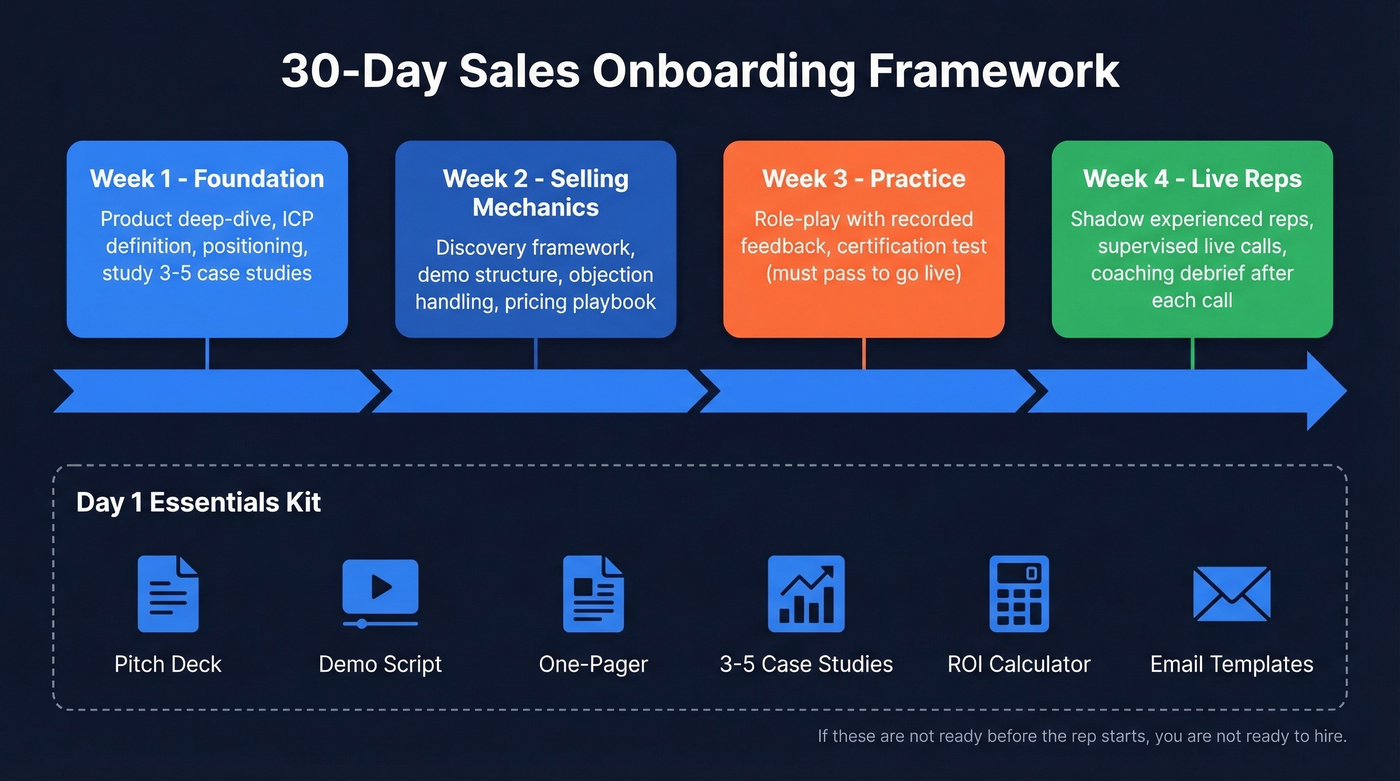
Week 1 - Foundation. Product deep-dive, ICP definition, positioning, and messaging. Review 3-5 case studies - not skim, study the deal mechanics. Understand why the customer bought, not just what they bought.
Week 2 - Selling Mechanics. Discovery framework, demo structure, objection handling, pricing, and negotiation playbook. This is where reps learn the "how" after absorbing the "what."
Week 3 - Practice. Role-play sessions with recorded feedback. Certification test - a real gate, not optional. If a rep can't pass, they don't get on live calls. Period.
Week 4 - Live Reps. Shadow experienced reps on real calls, then supervised live calls with coaching debrief after each one.
Every rep should have these on day one: pitch deck, demo script, one-pager, 3-5 case studies, ROI calculator, and email templates. If you don't have these ready before the rep starts, you're not ready to hire.

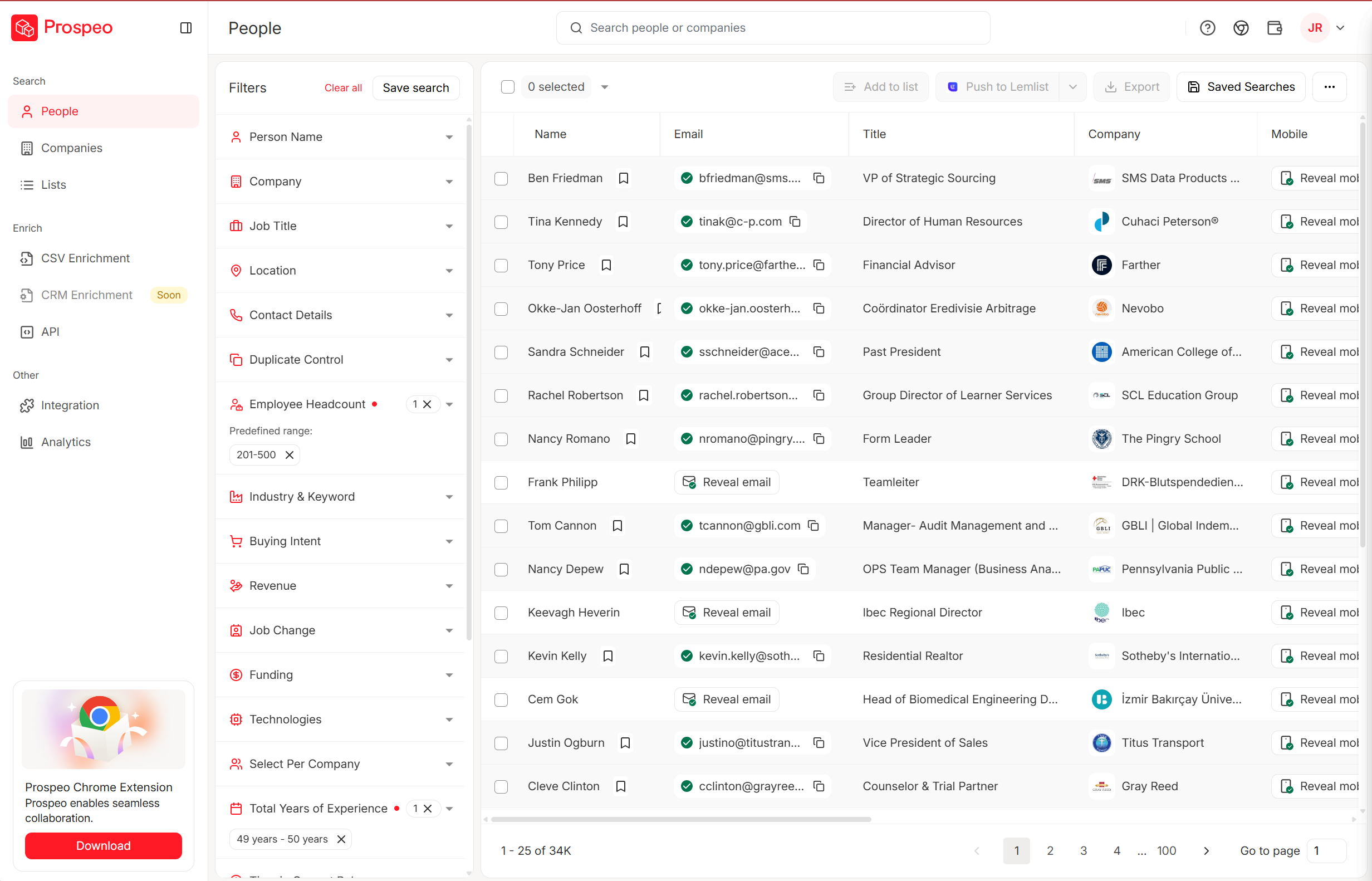
Your 30-day onboarding framework falls apart when new reps spend week one chasing bounced emails. Prospeo's 98% email accuracy and 7-day data refresh mean every account in your ramp plan connects to a real person - not a dead inbox.
Stop onboarding reps into a broken data layer.
What to Build First
Let's be honest about what reps actually want. The consensus on r/SaaSSales is consistent: battlecards, case studies, and competitive decks. Not generic training videos. Not 40-page playbooks nobody reads.
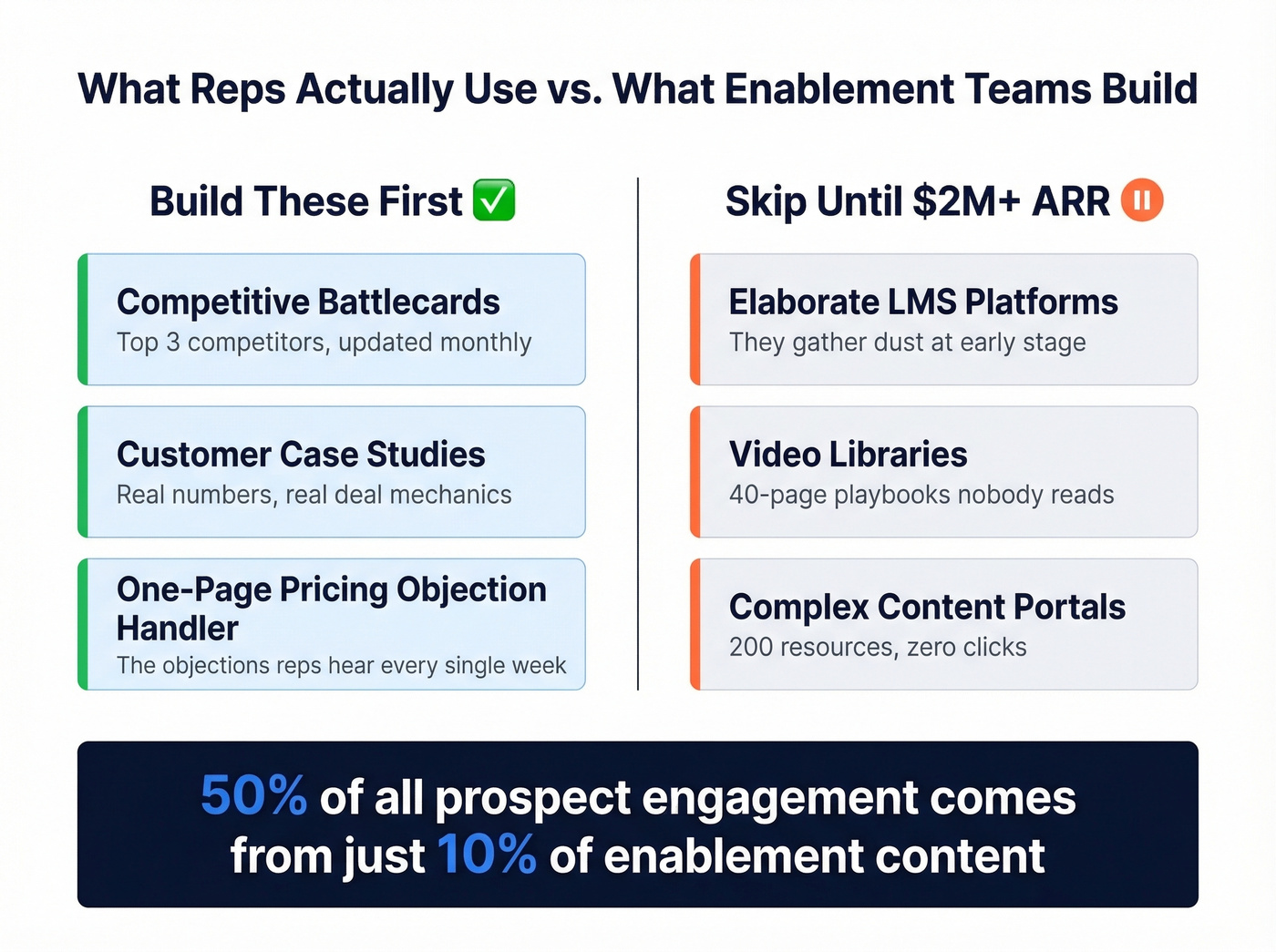
50% of all prospect engagement comes from just 10% of sales enablement content. In our experience, a sharp battlecard against your top three competitors moves more deals than a polished onboarding portal with 200 resources nobody clicks. Build competitive battlecards, customer case studies with real numbers, and a one-page pricing objection handler first. Skip elaborate LMS platforms and video libraries until you're past $2M ARR - they'll just gather dust.
The Enablement Tech Stack
Only 22% of the average enablement budget goes to technology. Be ruthless about what you buy.
| Category | Tool | Pricing |
|---|---|---|
| CRM | HubSpot Sales Hub | Free-$150+/user/mo |
| CRM | Salesforce Sales Cloud | $25-$330/user/mo |
| Prospecting Data | Prospeo | Free tier; ~$0.01/email |
| Conversation Intel | Gong | ~$100-$200/user/mo |
| Content Management | Highspot | ~$50-$150/user/mo |
| Engagement | Outreach | ~$100-$200/user/mo |
| Training | Seismic Learning | ~$30-$100/user/mo |
For teams under $5M ARR, you really only need the first three rows. Gong is nice to have but not essential until you've got five or more reps generating enough call volume to spot patterns.
Your enablement program fails silently when 15-40% of outbound emails bounce. New reps are especially vulnerable - they're running the playbook you built, targeting the accounts you assigned, and hitting dead addresses because nobody verified the data. GreyScout cut rep ramp time from 8-10 weeks to 4 weeks after cleaning up their data layer, largely because new reps stopped wasting their first month chasing bounced emails.
AI-Powered Enablement in 2026
According to Allego's 2025 report, 100% of revenue enablement leaders now use GenAI in some capacity. 48% say it's boosted revenue. 51% report shorter sales cycles. 44% have reduced onboarding time.
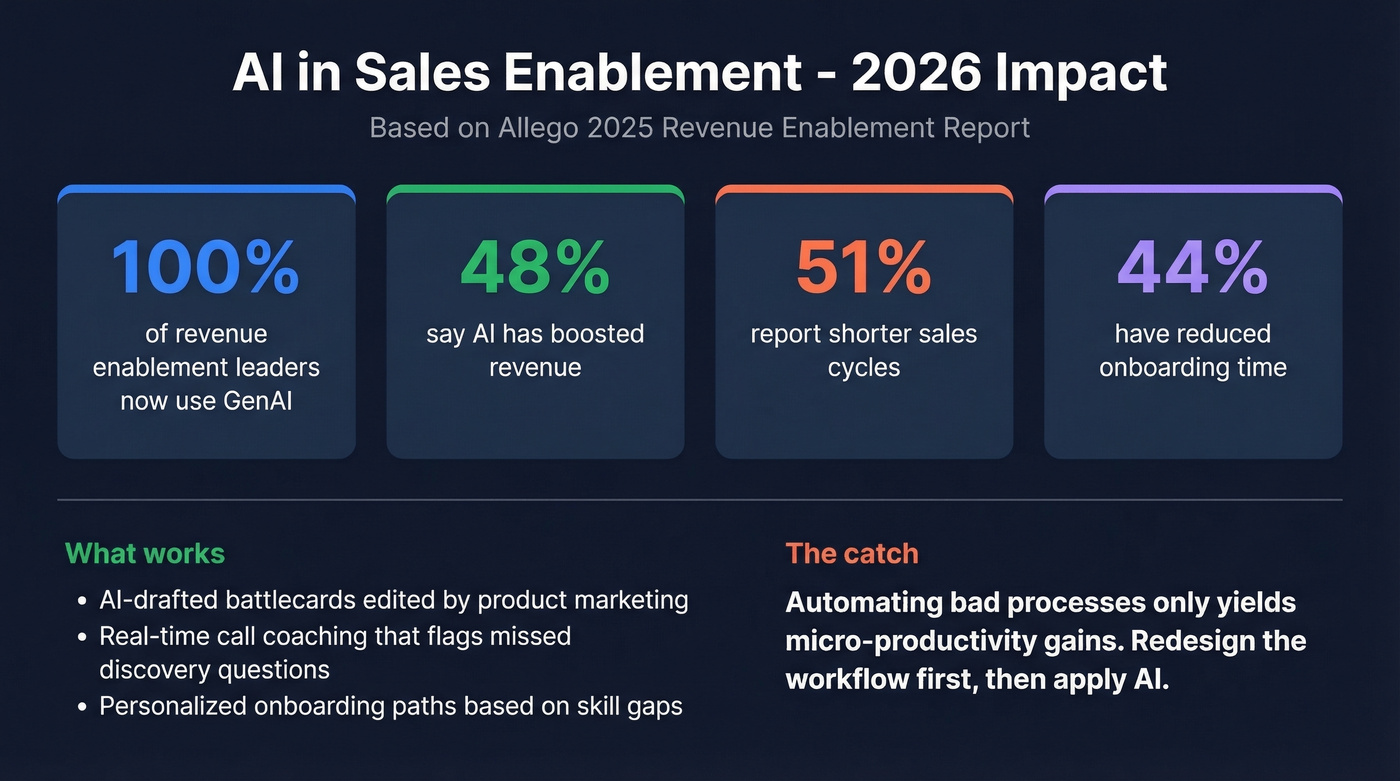
The practical use cases are real: AI-generated first drafts of battlecards and email sequences, real-time call coaching that flags missed discovery questions, and personalized onboarding paths based on a rep's skill gaps. We've seen teams cut battlecard creation from two weeks to two days using AI drafts that a product marketer then edits.
The catch: automating bad processes yields only micro-productivity gains. The teams seeing 30%+ win-rate improvements redesign the workflow first, then apply AI. If your discovery framework is broken, AI-powered call coaching just gives you faster feedback on a broken process.
How to Measure Enablement ROI
If your enablement team measures success by training attendance, you've got a compliance program, not an enablement program. Gartner's research shows that reducing drag - the friction that slows reps down - yields higher returns than piling on more training. Measure what you're removing, not just what you're adding.
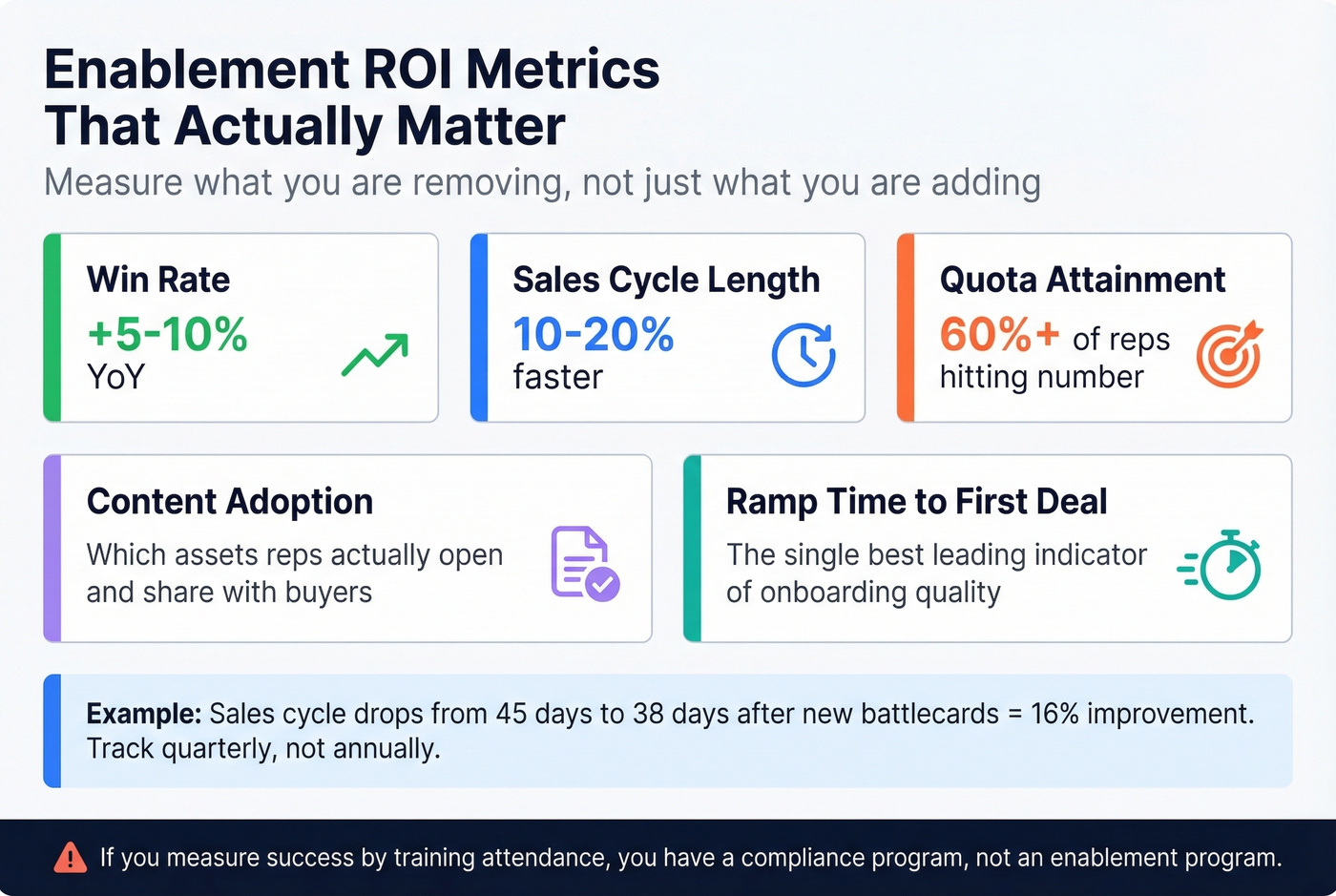
These are the metrics that actually matter:
- Win rate - target +5-10% year over year
- Sales cycle length - 10-20% faster
- Quota attainment - above 60% of reps hitting number
- Content adoption - which assets reps actually open and share with buyers
- Ramp time to first deal - the single best leading indicator of onboarding quality
If your average sales cycle was 45 days last quarter and drops to 38 after rolling out new battlecards, that's a 16% improvement - right in the target range. Track it quarterly, not annually, so you can course-correct before bad habits calcify.
Look, most teams over-invest in enablement content and under-invest in enablement infrastructure. If your reps have beautiful battlecards but 30% of their emails bounce, you've built a race car with flat tires. Fix the email bounce rate and email deliverability first, then worry about the content library.
GreyScout cut rep ramp time in half by fixing their data foundation. With 300M+ verified profiles, 30+ search filters for ICP targeting, and emails at $0.01 each, Prospeo gives enablement teams the one thing no battlecard can fix: accurate contact data that actually reaches buyers.
Enablement content is useless if it's aimed at dead addresses.
FAQ
What's the difference between sales enablement and revenue enablement?
Revenue enablement extends the same principles beyond sales to include marketing, customer success, and post-sale teams. More than 50% of CSOs expect enablement to cover marketing and CS within three years. In practice, that means shared content libraries, unified buyer journey data, and cross-functional KPIs instead of siloed metrics.
How long does it take to see ROI from enablement programs?
Onboarding improvements show up within 30-90 days - ramp time to first deal is the earliest signal. Win-rate and cycle-length gains become measurable within two quarters, typically 4-6 months after rolling out new playbooks or tools. Don't expect overnight results, but don't wait a year to evaluate either.
What's the most overlooked part of an enablement tech stack?
Prospecting data quality. You can build the best playbook and arm reps with killer battlecards, but if 15-40% of their emails bounce, every other investment underperforms. Fixing bounce rates from 35% down to under 5% is often the single highest-ROI move an enablement team can make - and it's usually the last thing they think about.