

Sales Agenda Templates That Actually Work (2026)
The average professional spends 11.3 hours per week in meetings, and 35% of those are a waste - roughly $29,000 per employee per year in meeting time. A good sales agenda doesn't organize a meeting. It prevents the bad ones from happening at all.
Three Agendas Every Sales Org Needs
If you standardize only three agendas, make it these:
- Weekly team meeting (30 min) - keeps the forecast honest and surfaces blockers before they stall deals.
- Pipeline review (45 min) - forces advance/stall/kill decisions on every deal in play.
- 30-minute discovery call - sets expectations with the prospect so you actually learn something.
Everything else - QBRs, demos, proposal reviews - builds on these foundations. The templates below give you timeboxed, copy-paste formats for each one.
What a Sales Agenda Actually Is
Most agendas are topic lists. "Pipeline update. Forecast review. Open discussion." That's not an agenda. It's a table of contents with no plot.
Write agendas as outputs: decisions to make, actions to assign, and what will be true by the end of the meeting that wasn't true before. When [70% of meetings] are unproductive](https://www.outreach.io/resources/blog/plan-sales-meeting-and-agenda) and 57% are scheduled ad-hoc with zero preparation, the problem isn't missing agendas - it's agendas that don't demand outcomes.
Internal agendas drive team decisions. Prospect-facing agendas set mutual expectations and protect your discovery time. They share anatomy but serve completely different purposes.
Non-Negotiable Anatomy
Every sales agenda - internal or external - needs six components:
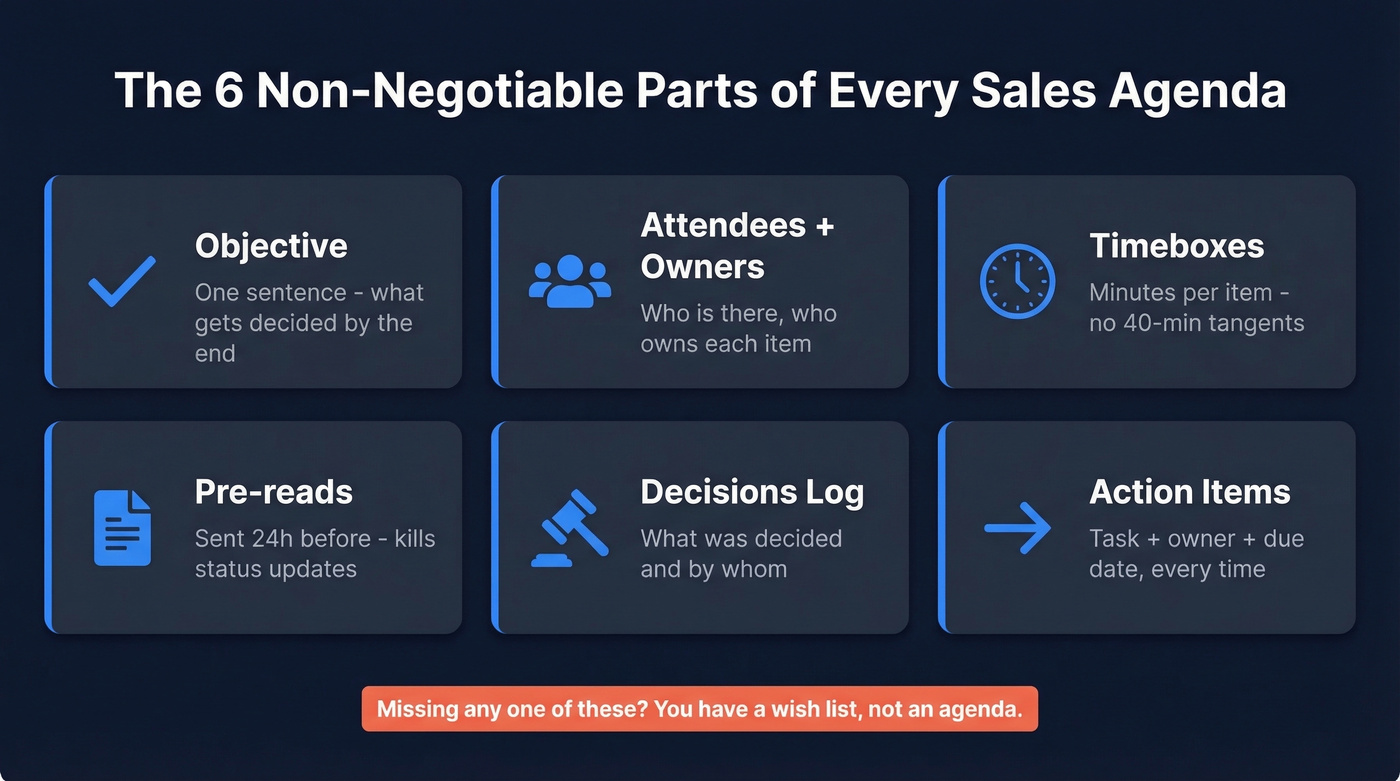
| Component | What It Does |
|---|---|
| Objective | One sentence: what's decided by end |
| Attendees + owners | Who's there, who owns each item |
| Timeboxes | Minutes per item - prevents 40-min tangents |
| Pre-reads | Docs sent 24h before - eliminates status updates |
| Decisions log | What was decided, by whom |
| Action items | Task + owner + due date |
Without all six, you've got a wish list.
Internal Sales Agenda Templates
Weekly Team Meeting (30 min)
Objective: Surface blockers, align on the week's priorities, leave with named owners on every action.
| Time | Item | Owner |
|---|---|---|
| 3 min | Wins + shoutouts | Manager |
| 5 min | Forecast snapshot | Manager |
| 10 min | Blockers + deal help | Reps (round-robin) |
| 7 min | Coaching moment | Manager |
| 5 min | Action items + owners | Manager |
That 7-minute coaching slot isn't filler - consistent coaching is linked to 32% higher win rates and 28% higher quota attainment. We've tested both weekly and biweekly cadences; weekly wins for cycles under 90 days. One rule: if it's a status update, put it in Slack. Reps spend [30% of their time selling] and 70% on everything else. Don't make meetings part of the problem.
Here's the thing: the 30-minute cap is sacred. Break it once and it becomes 45 minutes permanently. If your weekly regularly runs over, you're covering too many topics - not too few. That's one of the most overlooked sales meeting tips: constrain time first, then cut scope to fit.
Pipeline Review (45 min)
Most pipeline reviews follow the same depressing script: 45 minutes of status updates, zero decisions, everyone leaves confused. We've sat through hundreds of these. The fix is structural, and it's what separates a productive meeting from a calendar tax.
The anti-pattern: Rep reads CRM notes aloud. Manager nods. Next rep. Repeat. Time's up. "Let's circle back."
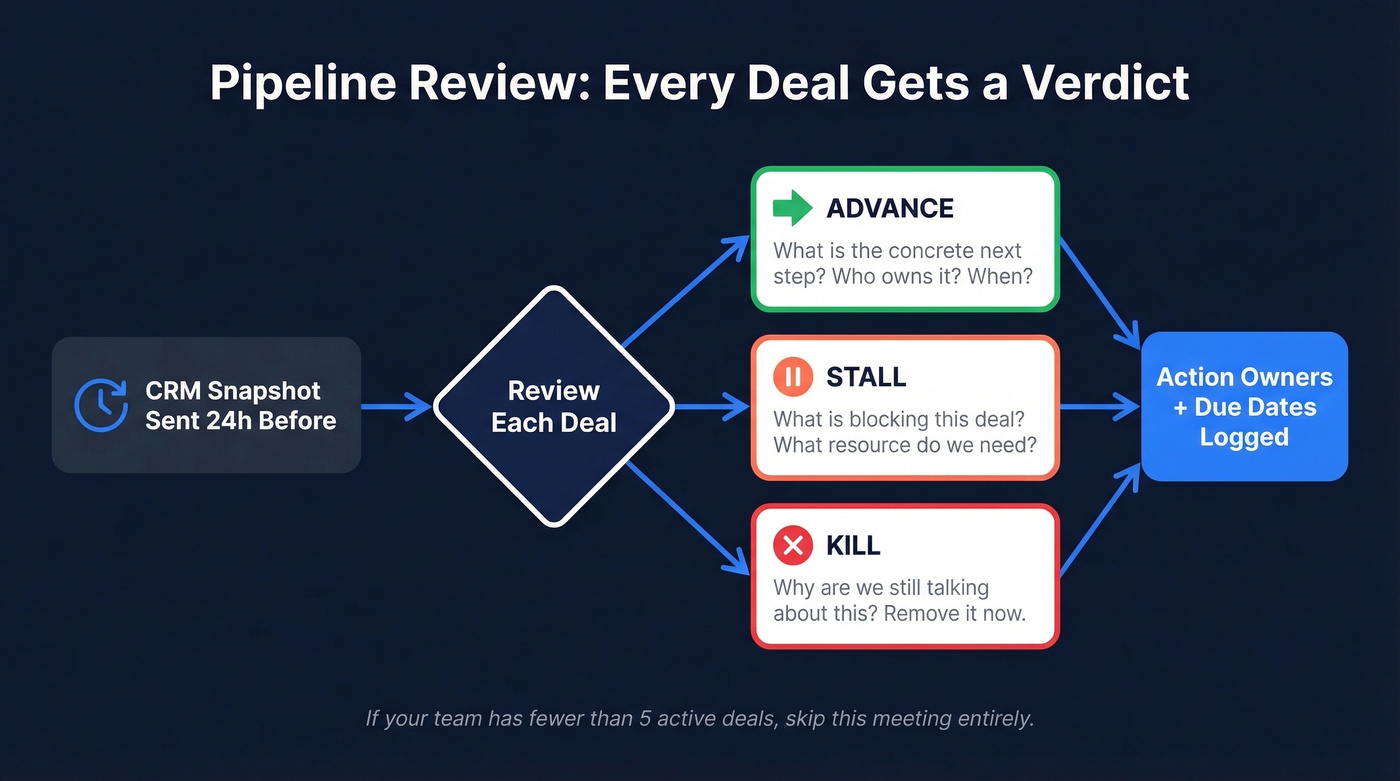
The fix: Every deal gets one label - advance (what's the next step?), stall (what's blocking it?), or kill (why are we still talking about this?). The CRM snapshot goes out 24 hours before. Nobody reads notes aloud.
| Time | Item | Owner |
|---|---|---|
| Pre-meeting | CRM snapshot sent 24h prior | RevOps / Manager |
| 30 min | Deal-by-deal decisions | Rep per deal |
| 10 min | Resource asks | Reps |
| 5 min | Action owners + due dates | Manager |
If your team has fewer than five active deals, skip this meeting entirely. Seriously. Protect the calendar.
Quarterly Business Review (60 min)
QBRs die when they become backward-looking KPI recaps. The signal-driven approach flips this: dedicate at least a third of QBR time to proactive plays based on current signals. "40% drop in user logins over 30 days plus two unanswered outreach attempts" is actionable. "Account is at risk" is not.
| Time | Item | Owner |
|---|---|---|
| 20 min | Signal review | Account team |
| 25 min | Implications + plays | Manager + reps |
| 10 min | Resource / enablement asks | Reps |
| 5 min | Action owners + due dates | Manager |

A tight pipeline review agenda means nothing if half your contact data is wrong. Prospeo gives your reps 300M+ profiles with 98% email accuracy and 125M+ verified mobiles - refreshed every 7 days, not every 6 weeks.
Stop reviewing stalled deals caused by bad data. Fix the source.
Prospect-Facing Agenda Examples
30-Minute Discovery Call
Objective: Qualify the prospect, understand their pain, and lock a next step - or end the process cleanly.
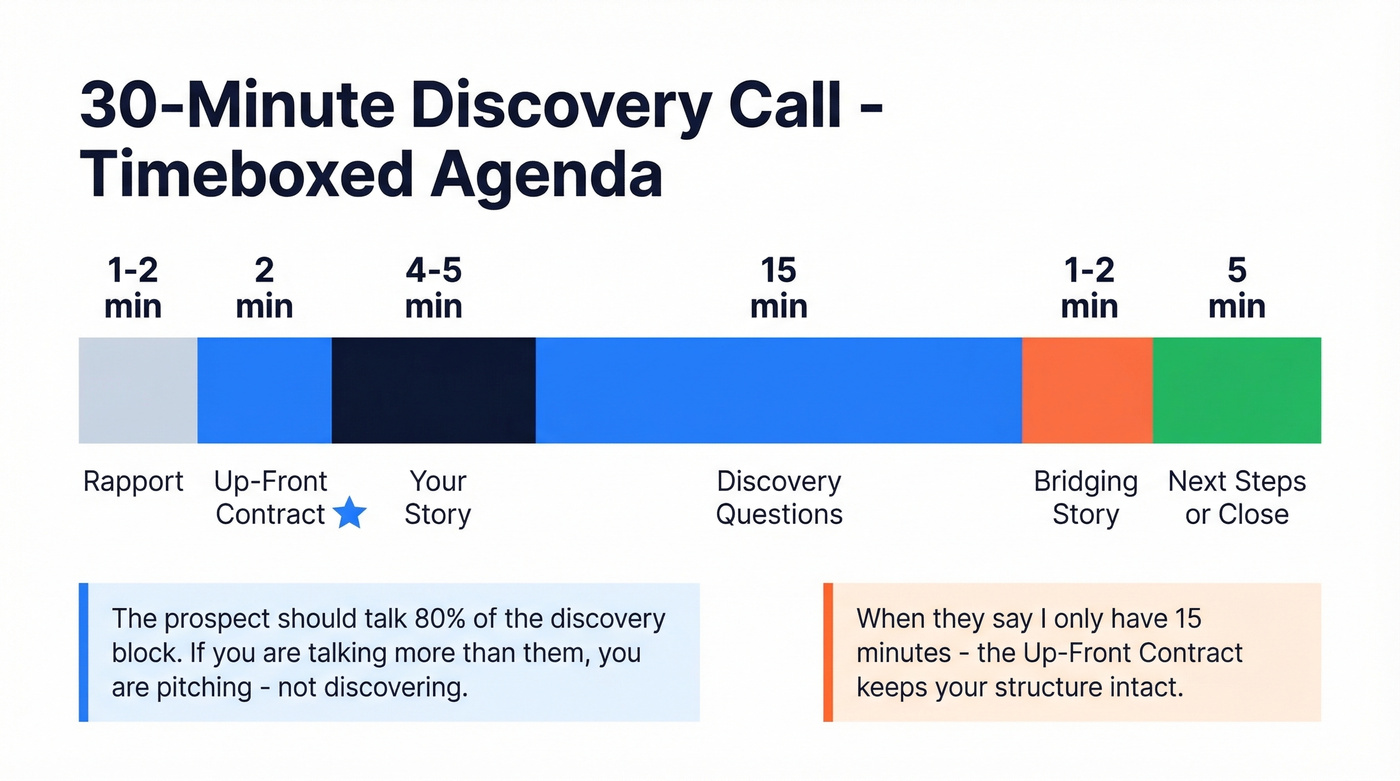
| Time | Item |
|---|---|
| 1-2 min | Small talk / rapport |
| 2 min | Agenda setting (Up-Front Contract) |
| 4-5 min | Your story / context |
| 15 min | Discovery questions |
| 1-2 min | Bridging story |
| 5 min | Next steps / close |
The Up-Front Contract is what separates a structured discovery call from a rambling conversation. This framework gets discussed constantly on r/sales, and the consensus is clear - it works:
"Thanks for making time. I've got three things I'd like to cover: [your context], [their situation], and [whether it makes sense to keep talking]. By the end, we'll either book a follow-up or agree this isn't a fit - both are fine. Before we start, is there anything you'd add to that agenda?"
This draws from Sandler's UFC framework - time check, their agenda, your agenda, and defined outcomes. When your prospect says "I only have 15 minutes," the UFC prevents your plan from collapsing. The prospect should talk 80% of the discovery block.
Demo / Proposal Review (45 min)
Don't jump straight into the demo. Recap what you learned in discovery first - it proves you listened and gives the prospect a chance to correct course. HubSpot calls this the "bookends" technique: mini-UFC at the start, outcome agreement at the close.
| Time | Item | Owner |
|---|---|---|
| 5 min | Recap discovery findings | You |
| 5 min | Mini-UFC for this call | You |
| 20 min | Demo tailored to pain | You |
| 10 min | Objection surfacing | Prospect |
| 5 min | Next step locked | Both |
If you want a tighter close, pair this with a simple product demo checklist so nothing critical gets skipped.
Meeting Types at a Glance
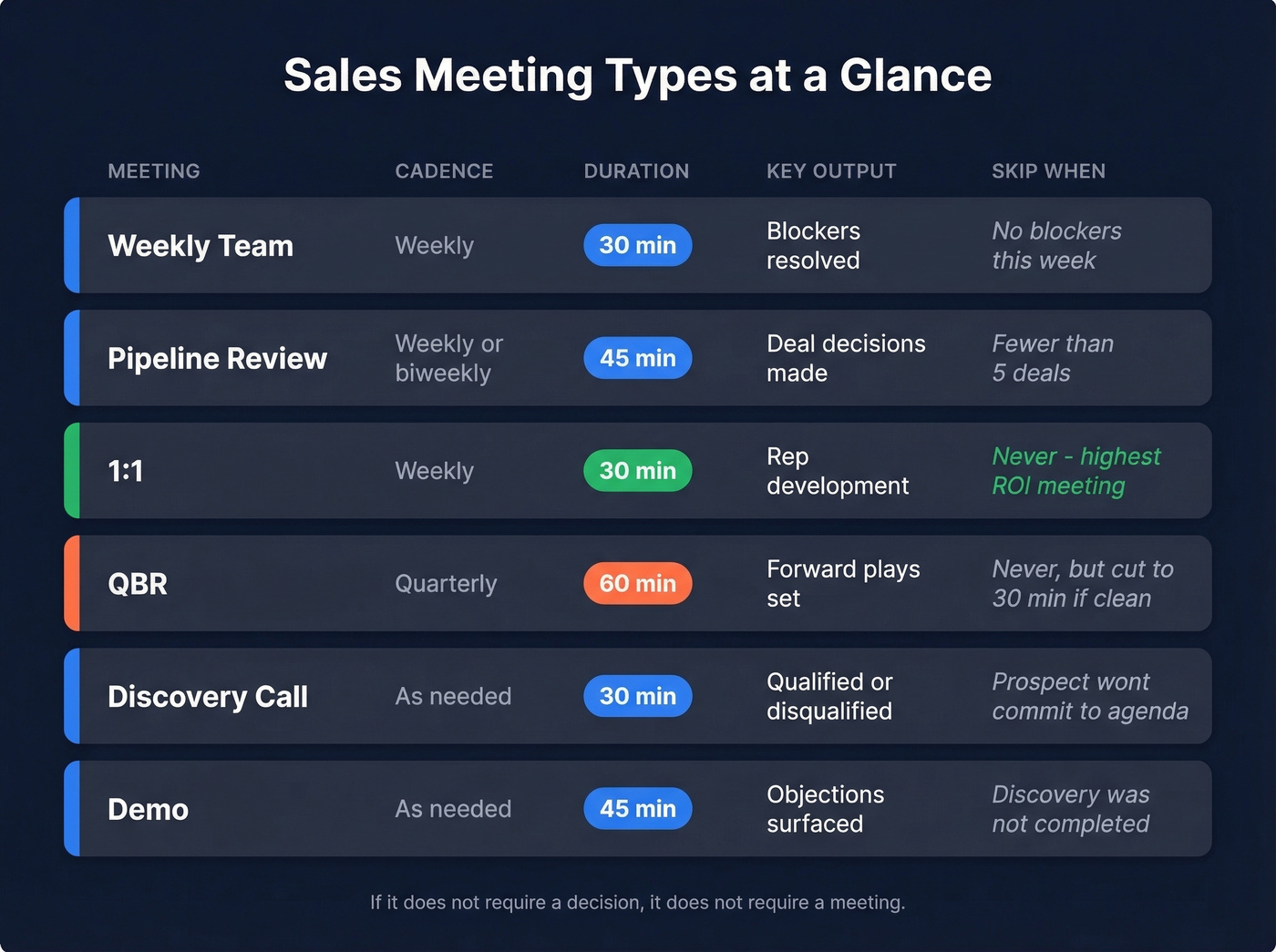
| Meeting Type | Cadence | Duration | Key Output | When to Skip |
|---|---|---|---|---|
| Weekly team | Weekly | 30 min | Blockers resolved | No blockers this week |
| Pipeline review | Weekly/biweekly | 45 min | Deal decisions | Fewer than 5 active deals |
| 1:1 | Weekly | 30 min | Rep development | Never - highest-ROI meeting |
| QBR | Quarterly | 60 min | Forward plays set | Never, but cut to 30 min if signals are clean |
| Discovery call | As needed | 30 min | Qualified / disqualified | Prospect won't commit to agenda |
| Demo | As needed | 45 min | Objections surfaced | Discovery wasn't completed |
Running Hybrid Sales Meetings
86% of meetings now include at least one remote participant. Hybrid is the default - treat it that way.
Assign roles before the call: facilitator, notetaker, and tech support. Send pre-reads 24 hours ahead with specific input requests ("flag your top 3 deals" beats "see attached"). Rotate start times across time zones so the same people don't always get the 7 AM slot. 55% of workers find video calls more distracting than in-person meetings, so make camera policies context-based. Cameras on for discovery calls and coaching. Optional for pipeline reviews.
If it doesn't require a decision, it doesn't require a meeting. Full stop. (If you're running fully distributed, these remote sales meeting tips help keep calls tight.)
After the Meeting: The 15-Minute Follow-Up
Let's be honest - if your meeting doesn't end with named action owners and a scheduled next step, it failed. The meeting itself is only half the work.
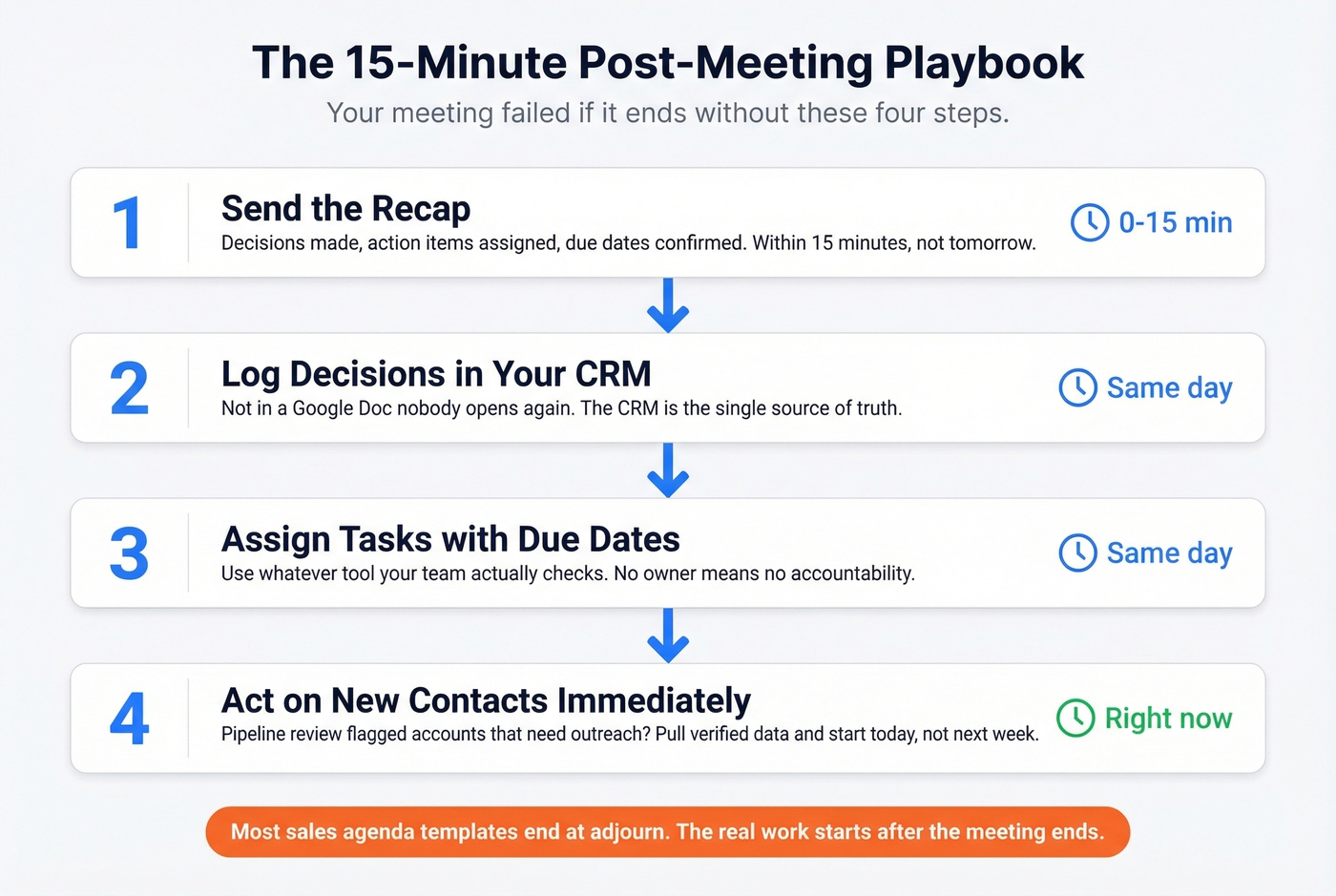
- Send a recap within 15 minutes. Decisions made, action items assigned, due dates confirmed.
- Log decisions in your CRM - not in a Google Doc nobody opens again.
- Assign tasks with due dates in whatever tool your team actually uses.
- Act on new contacts immediately. When your pipeline review flags accounts that need outreach, you need verified contact data fast. Prospeo's 7-day refresh cycle and 98% email accuracy mean the next step actually happens instead of stalling on bounced emails and dead numbers.
The follow-up is where most sales agenda templates fall short. They end at "adjourn" instead of carrying momentum into execution. If you want copy-paste language, use these sales follow-up templates or a dedicated sales meeting follow-up email format.
Your discovery call agenda is dialed in. But if you're burning 15 hours a week building lists instead of running those calls, the agenda can't save you. Prospeo cuts list-building to under 3 hours with 30+ filters - intent, technographics, job changes, and more.
Spend your time selling, not sourcing. Lists start at $0.01 per email.
FAQ
What should a sales meeting agenda include?
Every sales meeting agenda needs six elements: a clear objective, timeboxed items, assigned owners, pre-reads sent 24 hours prior, a decisions log, and action items with due dates. These turn a routine check-in into a meeting with measurable outcomes.
How long should a weekly sales team meeting be?
Thirty minutes, max. Move status updates to Slack or your team channel and reserve live time for blockers, coaching, and decisions. If you consistently run over, cut topics - don't extend the meeting.
What's an Up-Front Contract in sales?
An Up-Front Contract is a verbal agreement at the start of a prospect call that sets the agenda, confirms available time, and defines outcomes - a clear yes, no, or agreed next step. It prevents discovery calls from going off-track and is one of the most reliable frameworks in our experience for keeping 30-minute calls on schedule.
How do you handle follow-ups after a pipeline review?
Send a recap within 15 minutes listing every deal decision (advance, stall, or kill), assigned owners, and due dates. Log decisions in your CRM, then pull verified contact data for any new accounts flagged during the review so outreach starts the same day - not next week.