

How to Run a Sales Audit That Actually Changes Something
Your VP just presented the quarterly forecast and it missed by 30%. Again. The pipeline looks full, the team's busy, and nobody can explain why revenue isn't tracking. That gap between activity and results is exactly what a sales audit is designed to diagnose - and most teams have never run one properly.
What You Need (Quick Version)
A sales audit diagnoses why revenue isn't matching effort. Start with the operational audit - it surfaces the most actionable findings fastest. The three metrics that reveal the most about your sales health in under an hour: stage-to-stage conversion rates, average deal age by stage, and email bounce rate.
What Is a Sales Audit?
It's a systematic review of your strategies, processes, tools, and team performance designed to find inefficiencies, gaps, and missed opportunities across your revenue engine. Pipeline health, seller output, lead quality, methodology adherence, and resourcing all get examined under the same lens. Think of it as a diagnostic scan for the entire sales operation.
Quick disambiguation: if you're in retail, "sales audit" means something completely different - it's about POS and OMS transaction integrity, balancing cashier-level totals, and tracking over/short variances at the store-day level. This guide covers B2B. If you're running an MSP, the same framework applies but you'll zero in on recurring revenue metrics like MRR churn, service agreement renewals, and managed services pipeline velocity.
When to Run One
Not every quarter needs a full audit. But certain signals should trigger one immediately. If you're seeing two or more of these, it's time:
- Revenue plateau while the pipeline "looks full"
- Conversion rates declining at one or more funnel stages
- Win rates or average deal sizes dropping quarter over quarter
- Sales cycles lengthening without a clear reason
- Consecutive forecast misses
- Pre-investment decisions - before adding headcount or buying new tech
- New market or ICP expansion that hasn't been validated
- Lead quality complaints from reps that nobody's quantified
That last one is more common than people admit. 59% of sales reps say marketing leads are high-quality per HubSpot's State of Sales - which means 41% don't. The gap between high-intent and low-intent outbound is massive: 20-30% connect rates for high-intent prospects versus 3-7% for low-intent contacts. If your team can't tell you which bucket their leads fall into, that's a trigger.
Three Types of Sales Audits
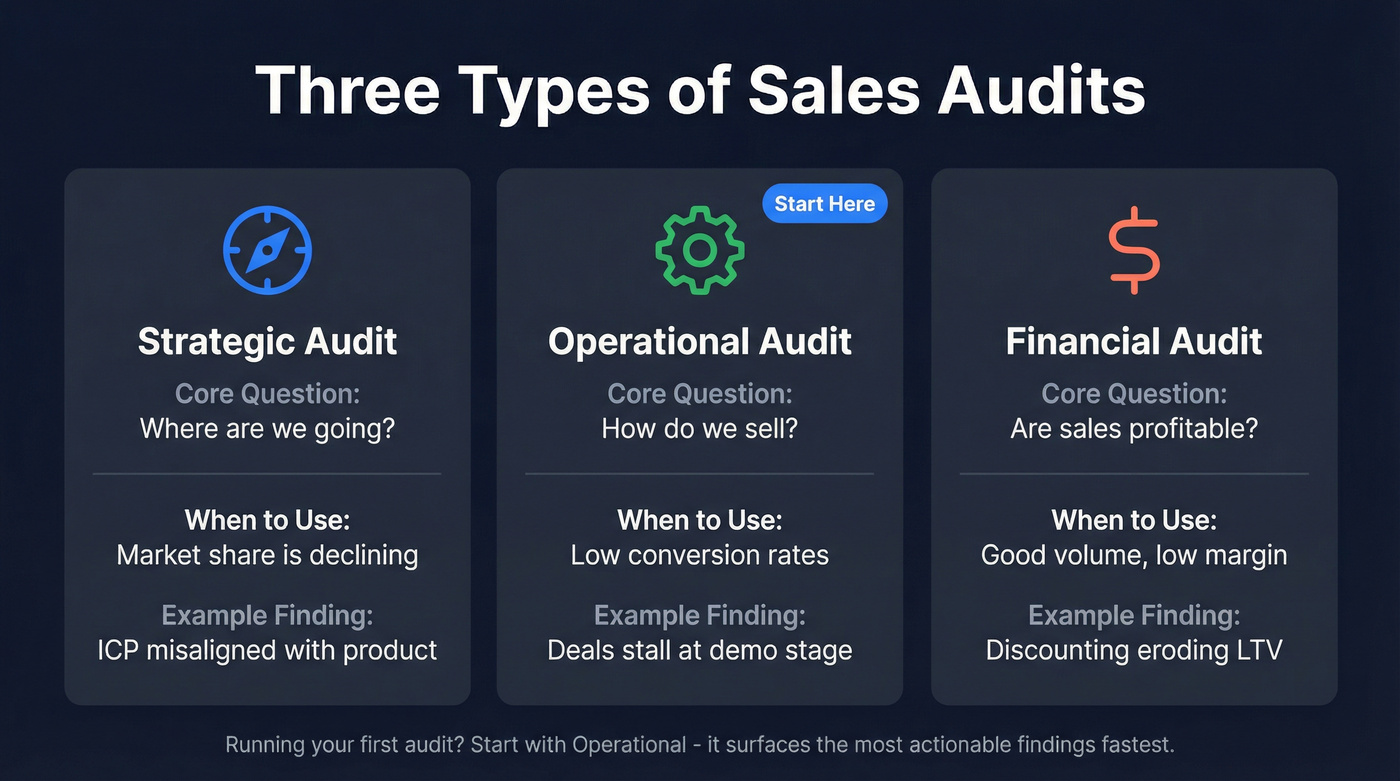
Before you start pulling CRM reports, decide which type of audit you're running. Each one answers a different question.
| Type | Core Question | When to Use | Example Finding |
|---|---|---|---|
| Strategic | Where are we going? | Market share declining | ICP misaligned with product |
| Operational | How do we sell? | Low conversion rates | Deals stall at demo stage |
| Financial | Are sales profitable? | Good volume, low margin | Discounting eroding LTV |
Strategic audits examine positioning, target audience, and competitive environment. Operational audits dig into the funnel - lead quality, CRM usage, handoff points, and process discipline. Financial audits focus on profitability: CAC, LTV, discount policies, and margin by segment.
If you're running your first audit, go operational. It surfaces the most actionable findings fastest, and it doesn't require the cross-functional buy-in that strategic audits demand.
How to Conduct a Sales Audit: 7 Steps
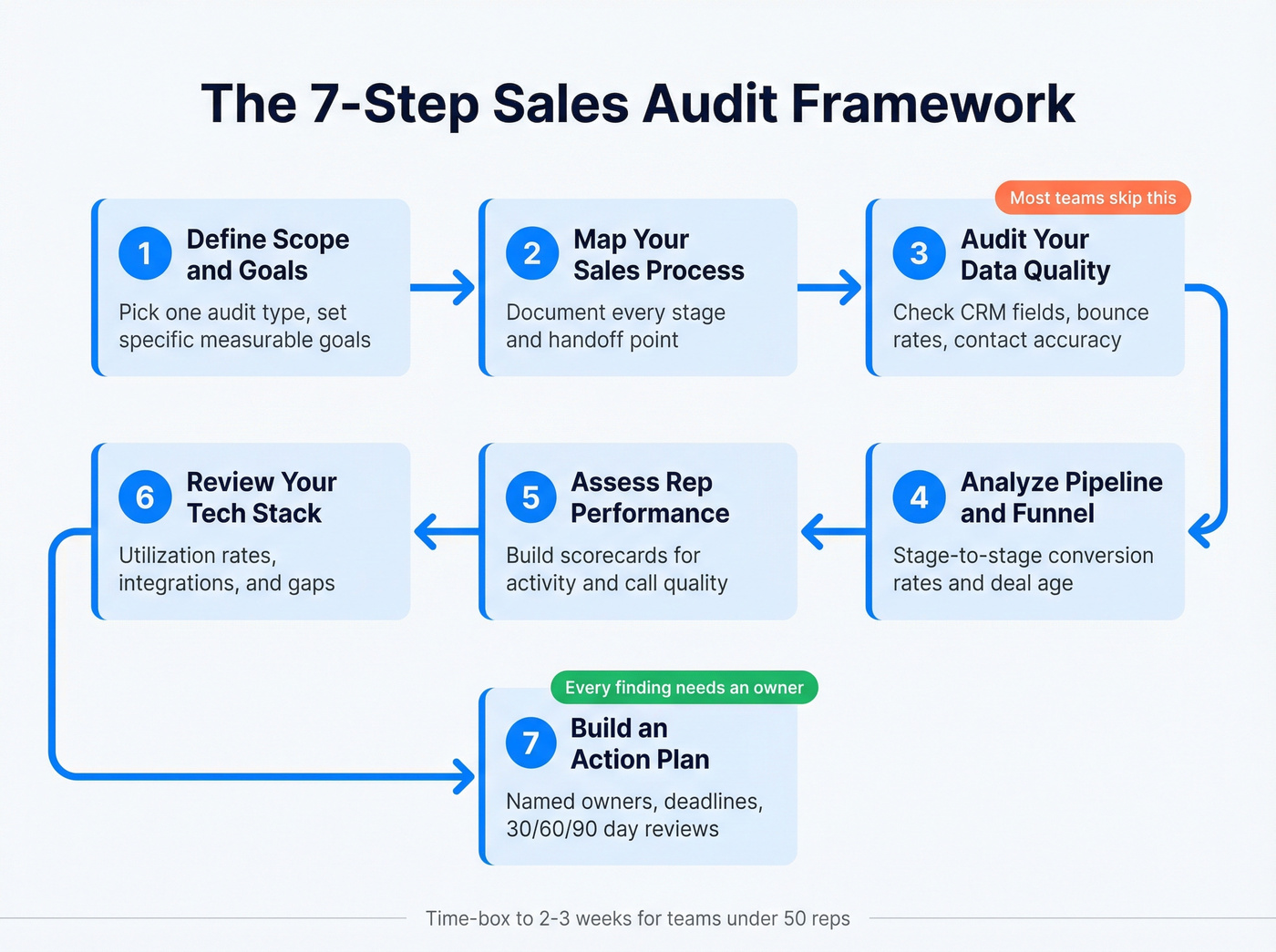
Here's the framework we use, built on QuotaPath's checklist but enriched with benchmarks and artifacts at each step.
1. Define Scope and Goals
Pick one audit type and set specific goals. "Improve sales" isn't a goal. "Identify why stage 3-to-4 conversion dropped 15% in Q2 and build a remediation plan by end of month" is a goal. Time-box the audit to 2-3 weeks for teams under 50 reps. Anything longer and you'll lose momentum before you reach the action plan.
2. Map Your Sales Process
Document every stage from lead to close. Write down every handoff point between marketing, SDRs, AEs, and CS. This sounds basic, but we've seen teams discover their documented process has seven stages while their CRM has five - and reps are actually using three. A thorough sales process review at this stage often reveals that the workflow reps follow day-to-day bears little resemblance to what's in the playbook.
Note where deals stall. The classic red flag: 200 "active" opportunities in the pipeline, 80 of which haven't been touched in 90+ days. Those aren't opportunities. They're wishful thinking clogging your forecast.
The consensus in practitioner communities is that the biggest gripe about audits isn't the work - it's that the report gets filed and forgotten. Mapping the process is only valuable if you're willing to act on what you find, which is why every step below ends with an action, not just an observation.
3. Audit Your Data Quality
This is the step most teams skip, and it's the one that costs them the most.
Pull your CRM field completion rates. Check contact accuracy. Measure your email bounce rate. Look at how many records haven't been updated in 6+ months. Manual data entry is a growth killer - pipeline visibility breaks down the moment reps stop logging activities or contact data goes stale. Modern tools now convert unstructured call and email data into structured CRM fields automatically, and if your stack doesn't do this, your data will decay faster than your team can maintain it.
Here's the thing: if your bounce rate is above 5%, you've got a data problem that's actively hurting deliverability, sender reputation, and rep productivity. Fixing data quality is the highest-ROI move most teams can make during an audit. One of our customers, Meritt, went from a 35% bounce rate to under 4% after cleaning their database with Prospeo's email verification - and their pipeline tripled from $100K to $300K per week. That's not a marginal improvement. That's a different business.
Benchmark your contact data against 98% verified email accuracy and sub-5% bounce rates. Anything worse and you're burning budget on emails that never arrive.
4. Analyze Pipeline and Funnel Metrics
Pull stage-to-stage conversion rates for the last two quarters. Compare them against the benchmarks in the next section. Look at pipeline coverage - the standard heuristic is 3x-5x quota, but let's be honest about that number.
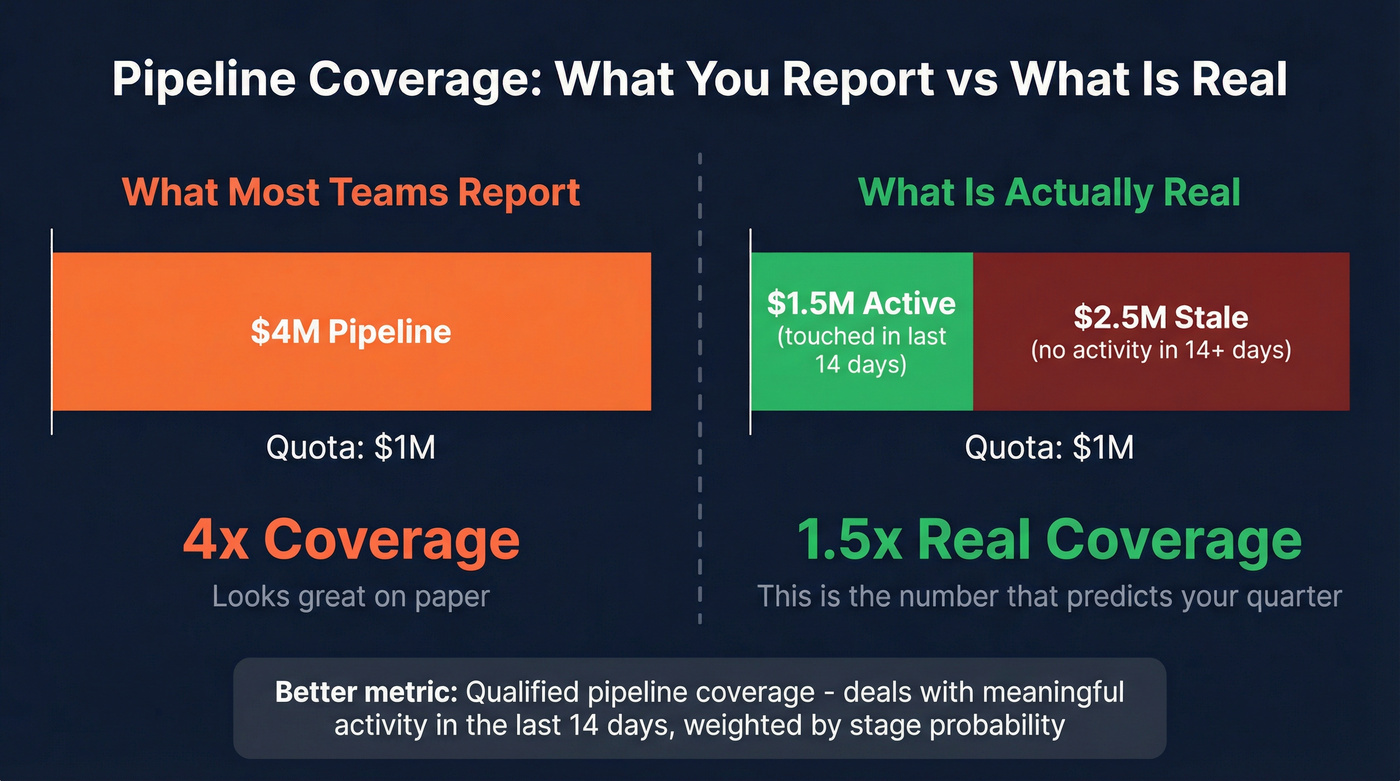
Pipeline coverage ratios lie. 4x coverage means nothing if 40% is stale deals that should have been closed-lost three months ago. A better metric is qualified pipeline coverage: deals that have had meaningful activity in the last 14 days, weighted by stage probability. If you have $4M in pipeline against a $1M quota but only $1.5M has had activity in the last 14 days, your real coverage is 1.5x, not 4x. That number tells you whether you'll actually hit the quarter.
Track average deal age by stage too. If deals are sitting in "proposal sent" for 45 days when your average close-to-win from that stage is 12 days, those deals are dead. Your reps just haven't admitted it yet.
If you want a deeper set of KPIs beyond stage conversion and deal age, use a standard funnel metrics framework so you can compare performance across segments and channels.
5. Assess Rep Performance
Build a rep scorecard that tracks weekly activity against quarterly targets. The Sales Enablement Collective's template is a solid starting point - it tracks calls, conversations, presentations, and deals closed, then auto-calculates percent-to-target and the weekly pace needed to hit quota. Available in PDF, XLSX, and Google Docs.
For call quality, use a weighted QA scorecard. Allocate points by impact: Product Knowledge gets 10 points, Needs Identification gets 5, Professionalism gets 3. This weighting forces reps to prioritize substance over style. There are 12 free Excel templates with dropdown scoring that work well as a starting framework - adapt the criteria to your sales motion.
If your scorecards show activity but not outcomes, zoom out and audit sales activities to see which behaviors actually correlate with pipeline movement.
6. Review Your Tech Stack
The question isn't "what tools do we have?" It's "what tools do our reps actually use, and do they talk to each other?"
Evaluate every tool by utilization rate, complexity, and training investment required. Here's a concrete test: can your tools flag a deal that's gone silent for 10 days and auto-trigger a follow-up sequence? Can they surface which reps are consistently losing deals at the same stage? If your stack can't do this - if it's a patchwork of point solutions that don't share data - that's a gap worth flagging. Your CRM is the baseline. Everything else should either feed it clean data or pull insights from it. If a tool does neither, cut it.
If you're missing core capabilities (sequencing, dialing, enrichment, intent), start with a shortlist of SDR tools and map each one to a specific workflow in your process.
7. Build an Action Plan
Every finding needs a named owner and a deadline. Full stop.
If your audit doesn't produce that, it's a waste of time - you've just created a PowerPoint that'll sit in a shared drive until the next forecast miss. Schedule follow-up reviews at 30, 60, and 90 days. Don't treat the audit as a one-time event. The teams that get the most value run continuous monitoring on key metrics - weekly pipeline reviews, monthly conversion tracking - with periodic deep-dive audits quarterly or annually. Big-bang annual audits miss too much between cycles.
If you need a structure for the follow-through, borrow a 30/60/90-day plan format and assign owners per workstream.

Step 3 of your audit will expose stale contacts and high bounce rates. Prospeo's 5-step verification delivers 98% email accuracy on 300M+ profiles - refreshed every 7 days, not every 6 weeks. Meritt cut their bounce rate from 35% to under 4% and tripled pipeline to $300K/week.
Don't just diagnose bad data - replace it at $0.01 per verified email.
Benchmarks: What Good Looks Like
Numbers without context are useless. Here's what "good" and "great" look like across the metrics that matter most.
Win Rates by Segment
| Segment | Average | Top Performers |
|---|---|---|
| Enterprise | 20-25% | 30%+ |
| Mid-market | 25-35% | 40%+ |
| SMB | 30-40% | 45%+ |
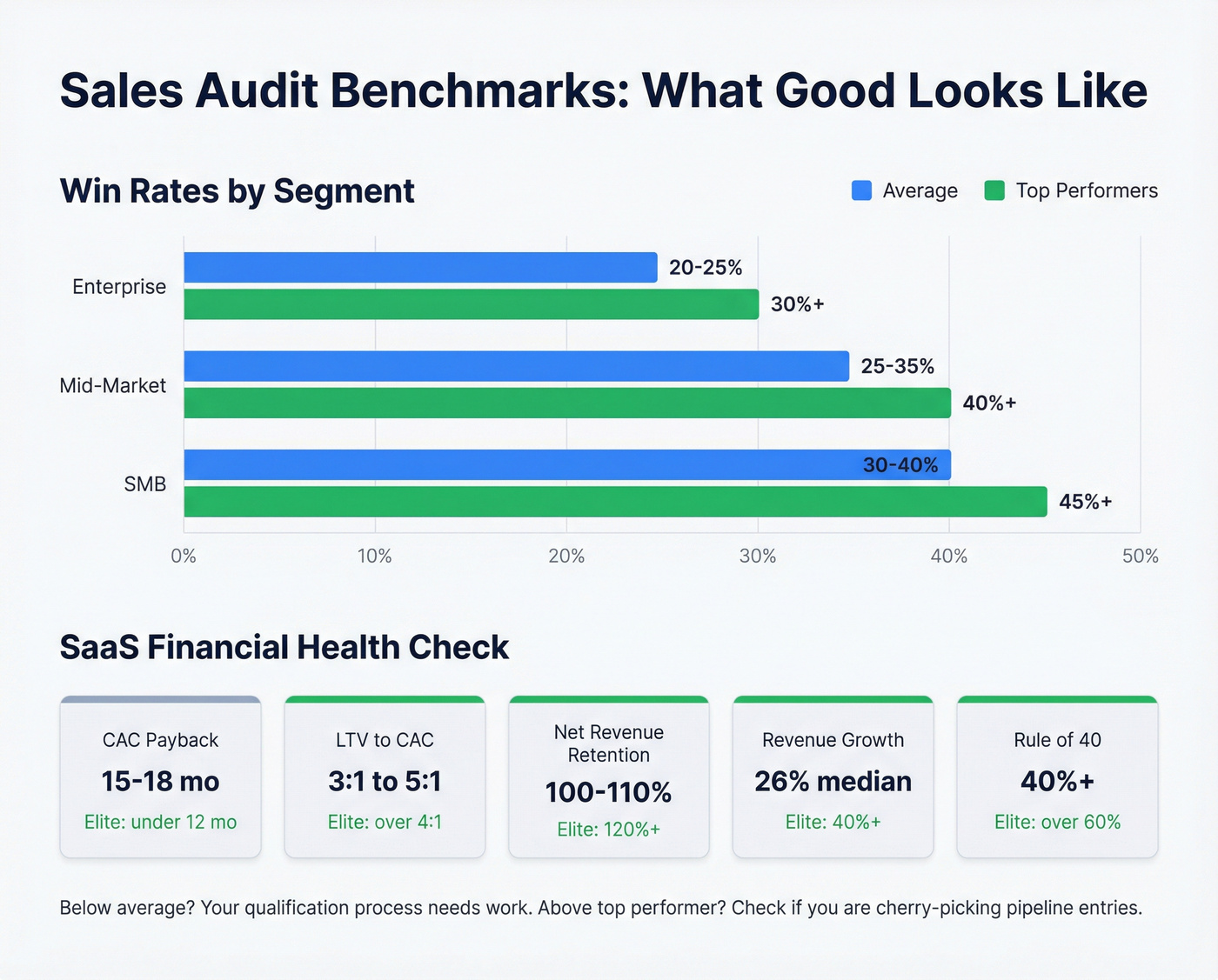
Source: Forecastio's win-rate analysis. If your win rates fall below the average column, your qualification process needs work. If they're above the top-performer column, double-check that you're not cherry-picking which deals enter the pipeline.
If you want to sanity-check your funnel against broader norms, compare your numbers to current sales pipeline benchmarks before you rewrite the whole process.
SaaS Financial Benchmarks
| Metric | Median / Healthy | Elite / Top |
|---|---|---|
| CAC Payback | 15-18 months | <12 months |
| LTV:CAC | 3:1-5:1 | >4:1 |
| NRR | 100-110% | 120%+ |
| Revenue Growth | 26% median | 40%+ |
| Rule of 40 | 40%+ | >60% |
Revenue growth data from Phoenix Strategy Group's 2026 SaaS benchmarks. That median - 26% - is down from 47% in 2024. The bar has shifted. Companies hitting Rule of 40 scores above 60% see 2-3x higher valuations than peers, and NRR is the metric investors watch most closely right now: companies with NRR above 120% see 2.3x higher valuations than those below.
For pipeline coverage, target 3x-5x quota in qualified pipeline. Sales cycle benchmarks vary by segment: SMB deals close in weeks, mid-market takes 1-3 months, and enterprise deals run 3-12 months. If your cycles are significantly longer than these ranges, your audit should investigate why.

Templates and Scorecards
You don't need to build everything from scratch. Three template types cover most audit needs.
Rep performance scorecard. Tracks calls, conversations, presentations, and deals closed on a weekly basis, then auto-calculates percent-to-target and the weekly pace needed to hit quarterly goals. Grab it in PDF, XLSX, or Google Docs from the Sales Enablement Collective.
Call QA scorecard. Twelve free Excel templates with dropdown scoring and automatic calculations. Weight criteria by impact - discovery calls need different criteria than demo calls, so customize the behaviors to match your sales motion.
Factor-criteria-score diagnostic. Define your audit pillars, set criteria under each, score them, and generate radar charts and column charts for visual reporting. Setup takes about 15-30 minutes, and the framework is reusable for future audits. ProfitSchool's guide walks through the methodology.
If you want to go beyond templates and fix the root cause, start by tightening your lead generation workflow so fewer bad-fit leads enter the funnel in the first place.
What a Sales Audit Costs
| Company Size | Internal Cost | Consultant Cost |
|---|---|---|
| SMB (<50 reps) | Staff time: 40-80 hrs | $3K-$15K |
| Mid-market | $5K-$15K | $15K-$50K |
| Enterprise | $15K-$30K | $50K-$150K+ |
You don't need a consultant for your first audit. For teams under 50 reps, run one internally in two weeks with a CRM, a spreadsheet, and the benchmarks above. The internal cost is staff time - and the ROI from fixing even one pipeline leak usually pays for itself within a quarter.
Here's our hot take: most teams that hire a $50K consultant don't have a strategy problem. They have a data hygiene problem and a process discipline problem. Fix those first. If revenue still isn't tracking after that, bring in outside help.
If you're unsure where to start on the data side, a quick scan of data enrichment services can help you understand what's possible (and what should be automated).
Making Audit Results Stick
Most audits fail because they stop at the PowerPoint. The findings get presented, everyone nods, and nothing changes.
Look, the fix isn't complicated - it just requires discipline. Focus on benefits, not blame. If the audit reveals that 60% of deals stall at the proposal stage, the conversation isn't "reps are bad at proposals." It's "we need better proposal templates and a tighter follow-up cadence." Frame every finding as a process optimization, not a performance indictment. Provide training and support - role-plays, coaching sessions, and updated playbooks make adoption real. Managers need to lead by example, because if leadership doesn't use the new process, nobody will.
Celebrate early wins publicly. When a rep closes a deal faster because of a process change the audit surfaced, make sure the team knows about it.
Schedule the next audit before you close this one. Continuous monitoring with periodic deep-dives beats the annual big-bang approach every time. The teams that treat sales performance reviews as an ongoing discipline - not a crisis response - are the ones that consistently hit forecast.
If follow-up is one of your biggest leaks, standardize it with proven sales follow-up templates so reps aren't reinventing the wheel deal-by-deal.
A sales audit without accurate contact data is just a report that collects dust. Prospeo gives you 143M+ verified emails, 125M+ direct dials, and CRM enrichment that returns 50+ data points per contact at a 92% match rate - so your remediation plan actually works.
Turn audit findings into pipeline. Start with data you can trust.
Sales Audit FAQ
How often should you run one?
Annually at minimum, with quarterly check-ins on key metrics like conversion rates and pipeline coverage. Run an ad-hoc audit when revenue plateaus, forecasts miss consecutively, or before major investments like adding headcount.
Who should lead the audit?
RevOps or sales leadership - someone with CRM access and cross-functional authority. Include marketing, CS, and product for input. External consultants add value for enterprise orgs but aren't necessary for teams under 50 reps.
How long does a sales audit take?
Two to four weeks for a thorough operational audit at an SMB or mid-market company. Enterprise audits spanning multiple regions can take 6-8 weeks. Time-box aggressively - momentum matters more than completeness.
What's the most common mistake?
Stopping at the report. If findings don't have named owners, deadlines, and a 30/60/90-day follow-up schedule, nothing changes. The audit is worthless without an action plan that someone is accountable for executing.
How do you fix bad data uncovered during an audit?
Measure email bounce rates, CRM field completion, and contact freshness. Anything above a 5% bounce rate signals a data problem. Clean your database in bulk before re-launching outbound campaigns - tools with 98% verified accuracy and weekly refresh cycles exist specifically for this, and the cost is a fraction of what you'll lose running campaigns against stale contacts.