

The Sales Call Planner Template That Actually Gets Used
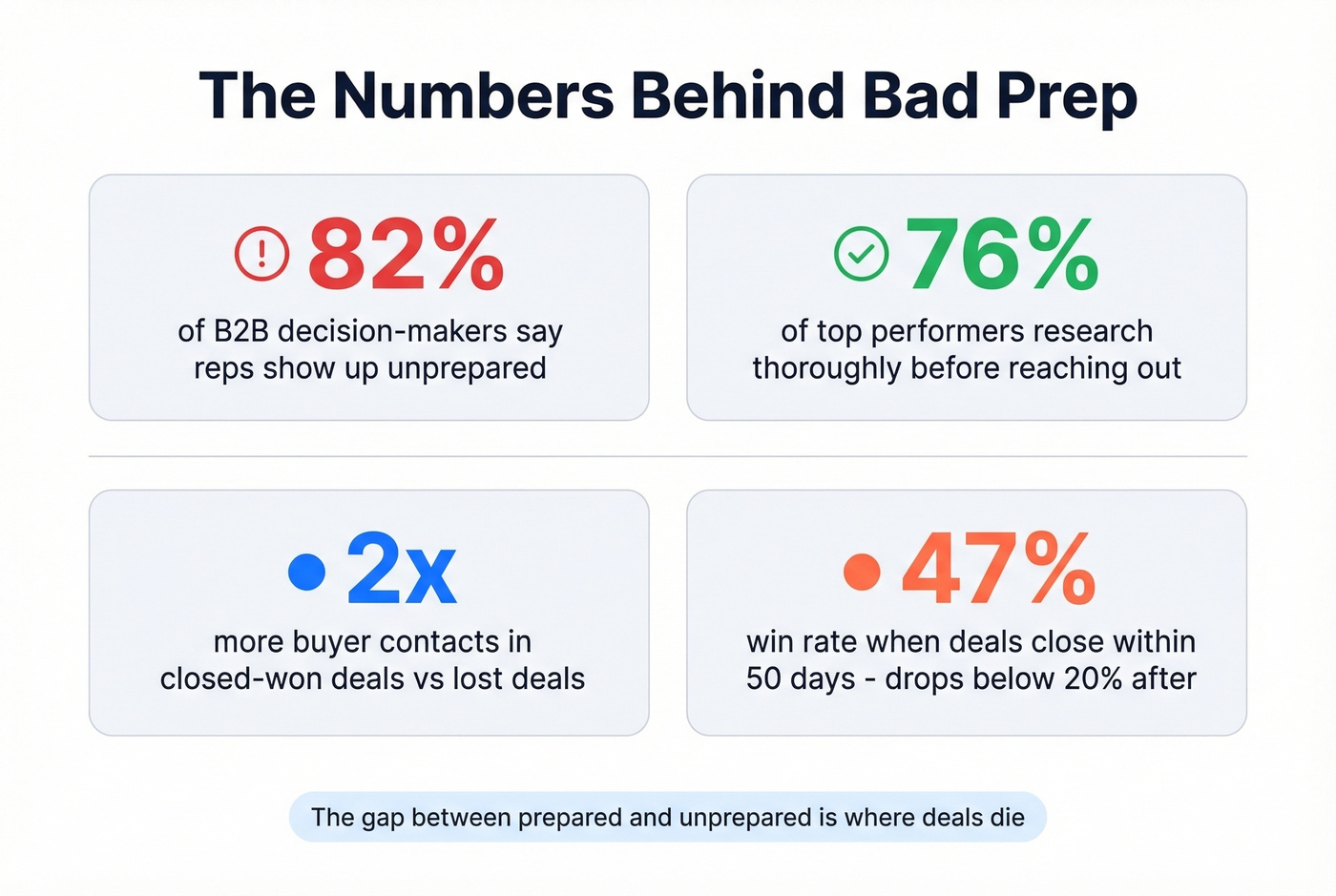
You're two minutes from a discovery call, scrambling through tabs, and you can't remember if this prospect raised Series B or Series C. 82% of B2B decision-makers say sales reps show up unprepared, while 76% of top performers research thoroughly before reaching out. The gap between those two numbers is where deals die.
You don't need a 25-field CRM form. You need a sales call planner template that takes five minutes, fits one screen, and actually gets filled out.
What Every Call Planner Needs
Six fields. That's it.
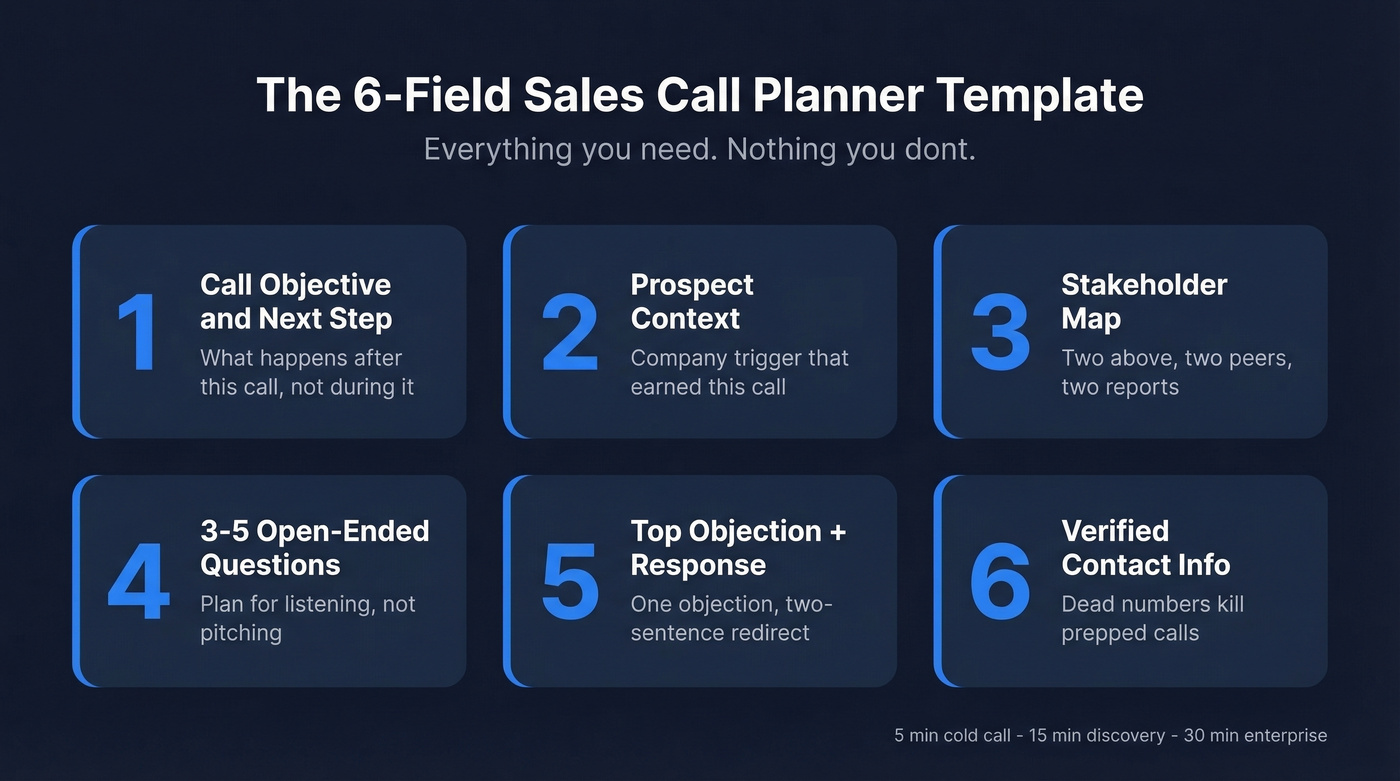
The fastest way to kill a planning sheet is to make it feel like homework. Nobody fills out 25 fields between back-to-back calls. We stripped ours down to the essentials after watching reps ignore every bloated template we'd ever built:
- Call objective & desired next step
- Prospect context (company, role, trigger)
- Stakeholder map (who else is involved)
- 3-5 open-ended questions
- Top objection + your response
- Verified contact info
Deals closed within 50 days hit a 47% win rate - after that, it drops below 20%. Prep compresses cycles. Budget accordingly: 5 minutes for cold calls, 10-15 for discovery, 20-30 for enterprise demos.
Free Template Download
Ungated - no email, no demo request:
- Google Sheets (make a copy)
- Excel (.xlsx download)
- PDF (print-friendly)
Color-coded by field priority, pre-loaded with placeholder examples, designed to fit a single screen.
The 6 Fields, Explained
Most templates fail because they ask for too much. Here's what each field does and why it earns its spot.
Call Objective & Next Step
Write down what you want to happen after the call, not during it. "Qualify mutual fit and schedule a technical demo" works. "Close the deal" on a first call doesn't. Your objective should be the next step in the sales process, not the last one. Prepare 2-3 objectives ranked by priority so you can adapt mid-conversation - because calls rarely go exactly how you planned, and having a fallback objective keeps you from freezing when the conversation takes a turn.
Prospect Context & Stakeholder Map
Context means the company trigger that earned this call: a funding round, a job posting, a tech stack change.
But context without a stakeholder map is incomplete. Analysis of 1.8M opportunities found that closed-won deals have roughly 2x as many buyer contacts as deals that don't close. Strategic enterprise deals average 17 contacts. Multi-threading boosts win rates by 130% on deals over $50K. Use SBI Growth's heuristic: map two people above your contact, two peers, and two direct reports.
Verified Contact Info
None of this matters if you're dialing a disconnected number.
Verifying contact data before the call is the planning step most reps skip - and the most preventable failure in outbound. We've seen teams invest 20 minutes prepping a call only to hit a dead number. Run your list through Prospeo before your call block: 98% email accuracy, a 7-day data refresh cycle, and 125M+ verified mobile numbers mean you're not working off stale records. The Chrome extension pulls verified emails and direct dials from any website in one click, so even last-minute prep stays accurate. If you're building lists from scratch, start with proven sales prospecting techniques so your planner is filled with the right targets.

Questions & Objection Prep
Writing down 5 open-ended questions is the single highest-leverage prep activity. Build a question bank you can pull from as the conversation flows, not a script. The optimal talk-to-listen ratio is 43:57, and high performers maintain that ratio consistently whether they win or lose. Low performers swing 10 percentage points between won and lost deals, talking far more when things go sideways. For a deeper bank, keep a set of discovery questions ready by persona and deal stage.
For objection prep, pick the one objection most likely to surface and write a two-sentence response that acknowledges and redirects. One is enough. You're not scripting a debate.
How Much Prep Does This Call Need?
Not every call deserves 30 minutes of research. Your top 15% of accounts generate 65% of revenue. Prep accordingly using an A/B/C segmentation:
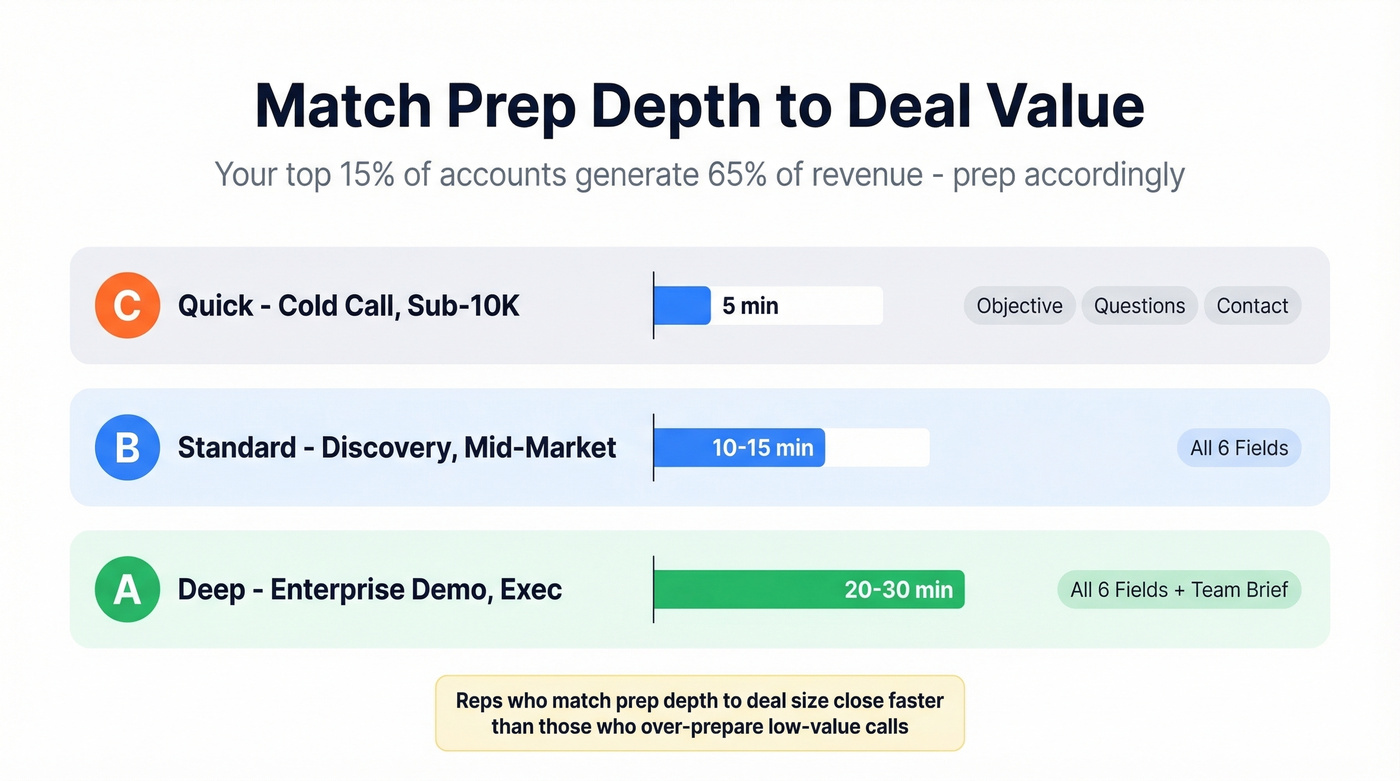
| Tier | Call Type | Prep Time | What to Fill |
|---|---|---|---|
| C (Quick) | Cold call, sub-$10K deal | 5 min | Objective, 3 questions, contact |
| B (Standard) | Discovery, mid-market | 10-15 min | All 6 fields |
| A (Deep) | Enterprise demo, exec | 20-30 min | All 6 + team brief |
Here's the thing: if you're working deals under $15K, you probably don't need more than Tier C prep. Field reps averaging 15-25 visits per week can't spend 20 minutes on every stop. In our experience, reps who match prep depth to deal size close faster than those who over-prepare low-value calls and under-prepare high-value ones. If you're standardizing this across the org, align it with your sales activities so reps know what “good prep” looks like per motion.

You just spent 15 minutes prepping the perfect discovery call - don't waste it on a disconnected number. Prospeo gives you 125M+ verified mobile numbers and 98% accurate emails, refreshed every 7 days. Fill in Field 6 of your planner with data that actually connects.
Stop prepping calls you'll never make. Verify the contact first.
Match Your Planner to Your Methodology
The template stays the same - your questions change. Here's how the six fields map to whatever framework your team runs:
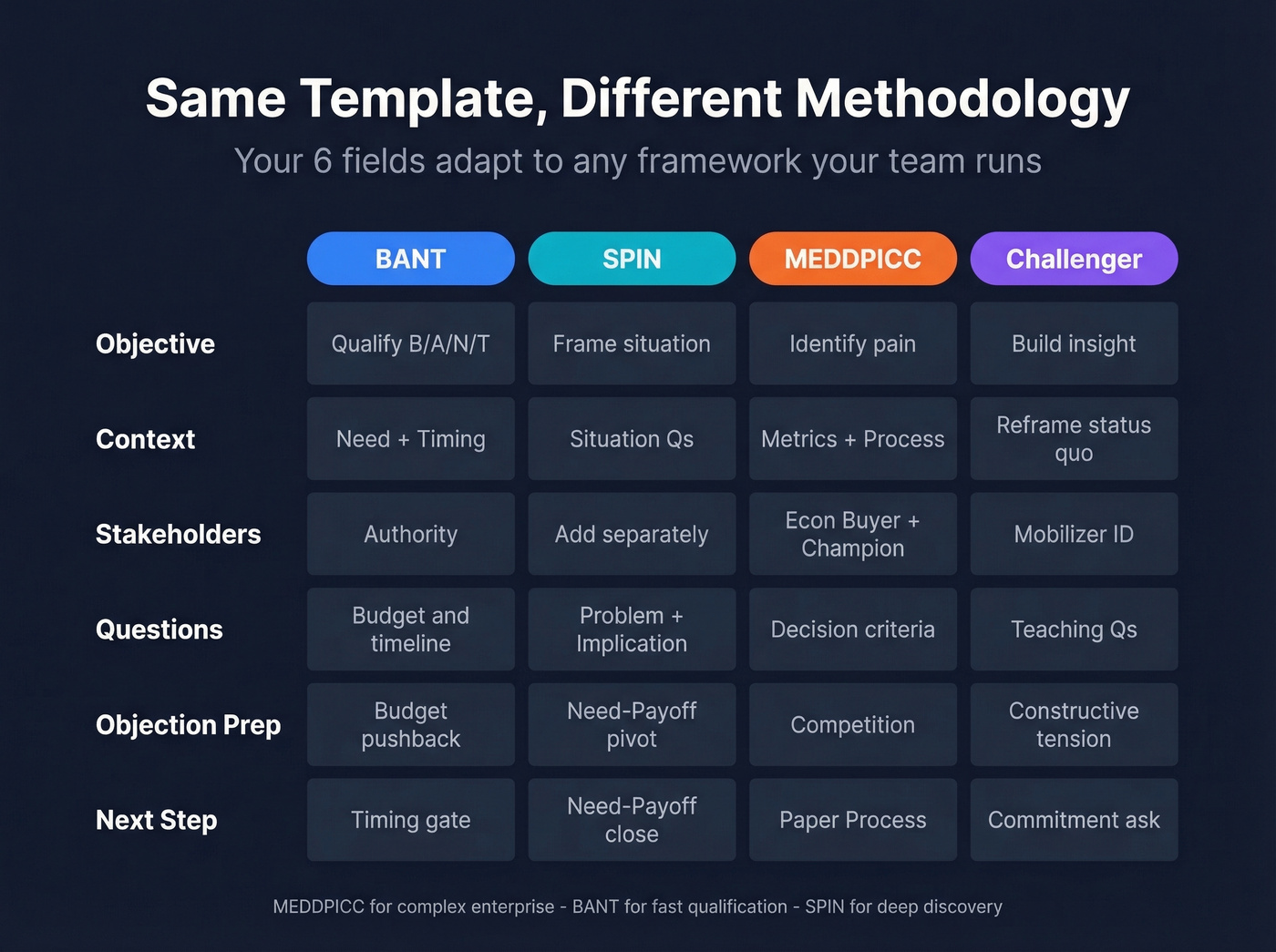
| Template Field | BANT | SPIN | MEDDPICC | Challenger |
|---|---|---|---|---|
| Objective | Qualify B/A/N/T | Frame situation | Identify pain | Build insight |
| Context | Need + Timing | Situation Qs | Metrics + Process | Reframe status quo |
| Stakeholder Map | Authority | Add separately | Econ Buyer + Champion | Mobilizer ID |
| Questions | Budget/timeline | Problem + Implication | Decision criteria | Teaching Qs |
| Objection Prep | Budget pushback | Need-Payoff pivot | Competition | Constructive tension |
| Next Step | Timing gate | Need-Payoff close | Paper Process | Commitment ask |
MEDDPICC fits complex enterprise cycles. BANT fits faster, transactional qualification. Skip SPIN unless you're running deep discovery where you need to uncover pain and build toward a Need-Payoff - it's overkill for a 10-minute cold call. If you're running MEDDIC-style qualification, keep a set of MEDDIC discovery questions handy.
Pre Call Planning Examples
These pre call planning examples show how the same six-field template adapts to very different selling motions.
SaaS Discovery - Series B Fintech, VP Engineering
| Field | Entry |
|---|---|
| Objective | Qualify technical fit, schedule SE demo |
| Context | Raised $40M Series B, hiring 12 engineers, uses Datadog |
| Stakeholders | VP Eng (call), CTO (decision), DevOps lead (influence) |
| Questions | "What's breaking at your current scale?" / "Who owns the vendor eval?" |
| Top Objection | "Building in-house" -> "What's the team's bandwidth for that build vs. the roadmap?" |
| Next Step | Book 30-min SE demo with VP Eng + DevOps lead |
Agency Cold Call - Local Marketing Agency, Owner
| Field | Entry |
|---|---|
| Objective | Book 15-min intro call |
| Context | 8-person agency, no paid ads on own site |
| Questions | "How are you generating inbound leads right now?" / "Biggest growth bottleneck this quarter?" |
| Top Objection | "We handle marketing ourselves" -> "Most agencies say the same. Curious what's working best." |
| Next Step | Send case study, confirm 15-min call Thursday |
Notice the difference in depth. The SaaS example fills every field because it's a Tier B call with a multi-threaded deal. The agency example skips the stakeholder map entirely - it's a one-person decision, and spending time mapping a non-existent org chart would be wasted prep. After the call, use a tight follow-up system (these sales follow up templates help) so the “next step” doesn’t stall.
Planning Mistakes That Kill Deals
The most common deal-killers are exactly what the template prevents.
Talking too much tops the list. Low performers' talk ratio swings 10 percentage points between won and lost deals, and the questions field forces you to plan for listening. Failing to set a clear objective means you leave the call without knowing if the deal is real.
Skipping the stakeholder map means you're pitching someone who can't sign - closed-won deals involve 2x more contacts for a reason. And the objection you didn't anticipate is the one that ends the conversation. One prepared response changes the dynamic entirely. If objections are a recurring pattern, build a playbook to reduce sales objection rate across the team.
Tools That Speed Up Call Prep
Revenue teams waste 74% of their time on non-selling activities. Four tools compress prep into minutes.
Start with your CRM. Pull last-touch notes, deal history, and activity timeline. If your CRM's empty, that's a different problem - and one worth fixing before you invest in anything else. If you're evaluating systems, these examples of a CRM can help you sanity-check what “good” looks like.
Conversation intelligence platforms like Gong or Chorus let you review past recordings with an account. What did they say last time? What objections came up? Frontify saw a 30% lift in lead conversions after adopting AI-powered prep workflows.
AI research tools are the biggest force multiplier - sellers using AI generate 77% more revenue. Use them to summarize 10-Ks, scan job postings, or draft question banks in seconds. If you're building a stack, start with these generative AI sales tools.
Contact verification ties it all together. Every minute of prep is wasted if you're calling a dead number or emailing a bounced address. Verify before you prep, not after. If you're comparing vendors, see our roundup of data enrichment services.
FAQ
How long should I spend on pre-call planning?
Five minutes for cold calls, 10-15 for discovery, 20-30 for enterprise demos. Your A-tier accounts (top 15%) deserve the deepest research. Don't spend 20 minutes prepping a cold call to a company that won't pick up - a focused planning template keeps you at the right depth without over-investing.
What's the difference between a call plan and a call script?
A call plan is strategic context - objective, stakeholder map, questions, next steps. A script is word-for-word dialogue. Plans adapt in real time; scripts don't. The best reps use plans and improvise from there.
How do I verify contact data before the call?
Run your list through a verification tool before your call block. Prospeo's free tier gives you 75 email verifications and 100 Chrome extension lookups per month - enough to cover a weekly call block without paying a cent. Bad data wastes every minute of prep you invested.
Can I use this template with my existing CRM?
Yes. The six-field format maps directly to custom fields in Salesforce, HubSpot, or any CRM with note fields. Most teams paste the completed planner into the activity log before the call, creating a searchable prep history for every account.
The best call planner in the world can't fix stale data. Prospeo's Chrome extension lets you pull verified emails and direct dials from any prospect's profile in one click - so even two minutes before a call, your contact info is current. At $0.01 per email, accurate prep costs less than a wasted dial.
One click. Verified number. Connected call. That's the last field handled.