

Sales Call Tracking: What to Measure and Which Tools Are Worth It
Your team made 847 dials last week. Twelve conversations. Three meetings booked. The VP of Sales wants to know what went wrong, and you're staring at a spreadsheet that tells you nothing useful.
That's the gap sales call tracking fills - and most teams set it up wrong because they focus on the tool before they fix the data feeding it. Nearly 60% of consumers research online before making a major purchase, which means by the time someone picks up the phone, there's already context to capture. Call tracking is how you capture it.
What You Need (Quick Version)
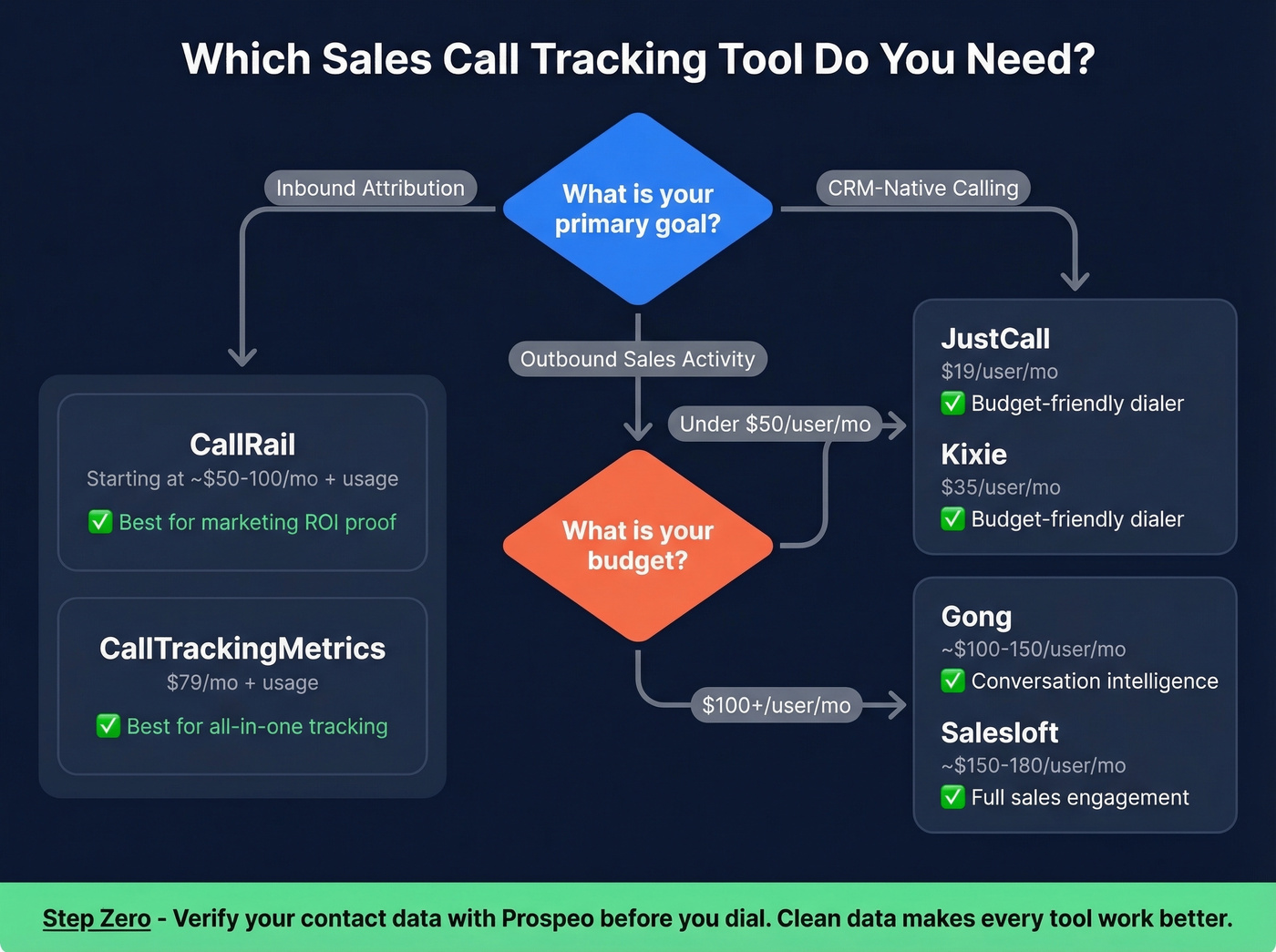
- Tracking inbound marketing calls? CallRail or CallTrackingMetrics. Both handle dynamic number insertion and attribution well.
- Tracking outbound sales activity? Kixie or JustCall for budget dialers, Gong for conversation intelligence.
- Before you track anything: make sure your contact data is actually valid. This is the step most teams skip, and it's why their call metrics look terrible. (If you’re cleaning and enriching lists at scale, see data enrichment options.)
What Is Sales Call Tracking?
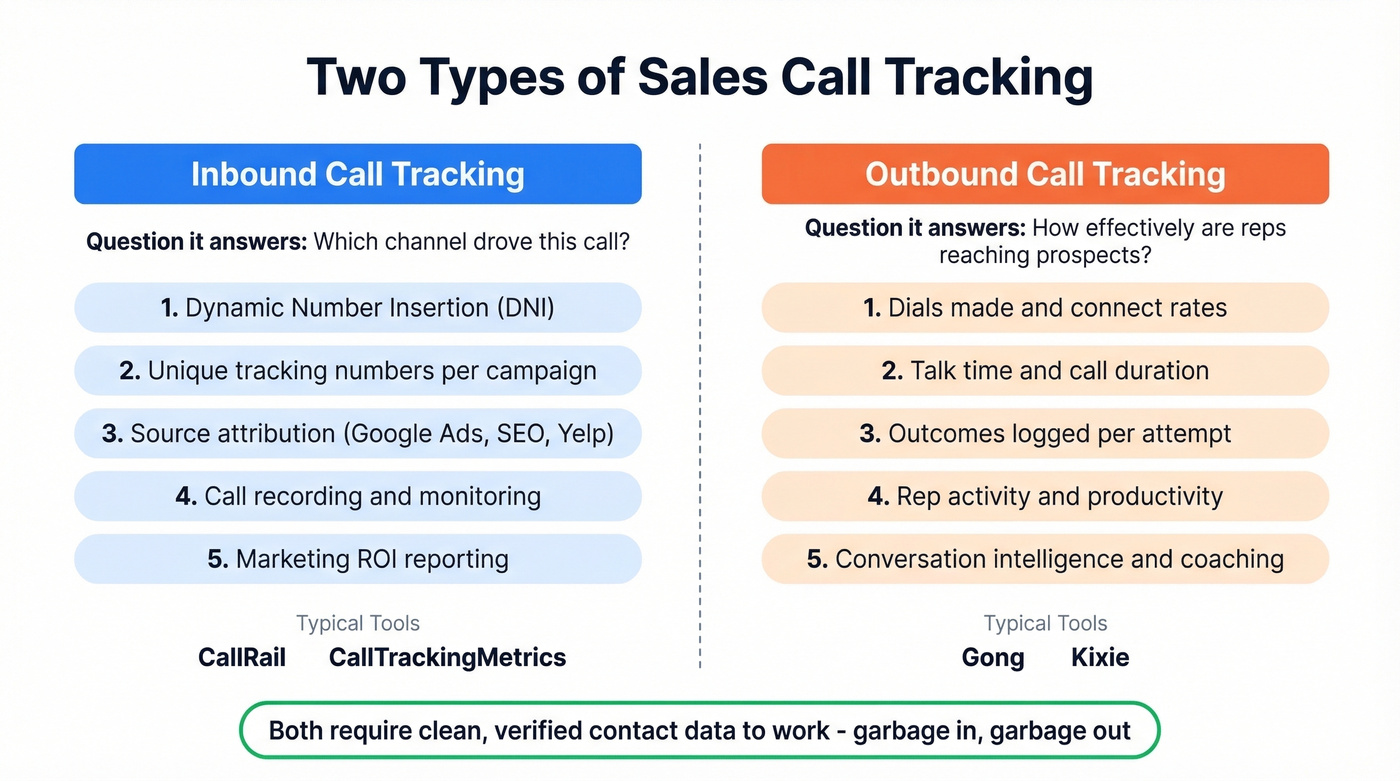
Sales call tracking is the practice of recording, attributing, and analyzing phone calls to understand what's driving revenue. Sounds simple. But the category splits into two very different disciplines.
Inbound Call Tracking
Inbound tracking uses dynamic number insertion (DNI) and unique phone numbers to attribute incoming calls to specific marketing sources - a Google Ads campaign, a landing page, a Yelp listing. The goal is attribution: which channel drove this call?
G2's inbound call tracking category requires tools to generate unique trackable numbers (including DNI), attribute calls and texts to sources, support call recording and monitoring, provide real-time analytics, and integrate with marketing and sales platforms.
Outbound Call Tracking
Outbound tracking measures rep activity and effectiveness. Dials made, connects achieved, talk time, outcomes logged. It answers a different question: how effectively is the sales team reaching prospects?
The tooling is different too - dialers, conversation intelligence platforms, and sales engagement suites rather than marketing attribution software. Most teams start with basic tracking (how many calls happened?) and graduate to campaign-level, then session-level, then visitor-level attribution. Know where you are on that spectrum before you buy anything.
Why It Matters in 2026
The case for monitoring and analyzing call activity has gotten stronger, not weaker, as AI reshapes sales workflows.
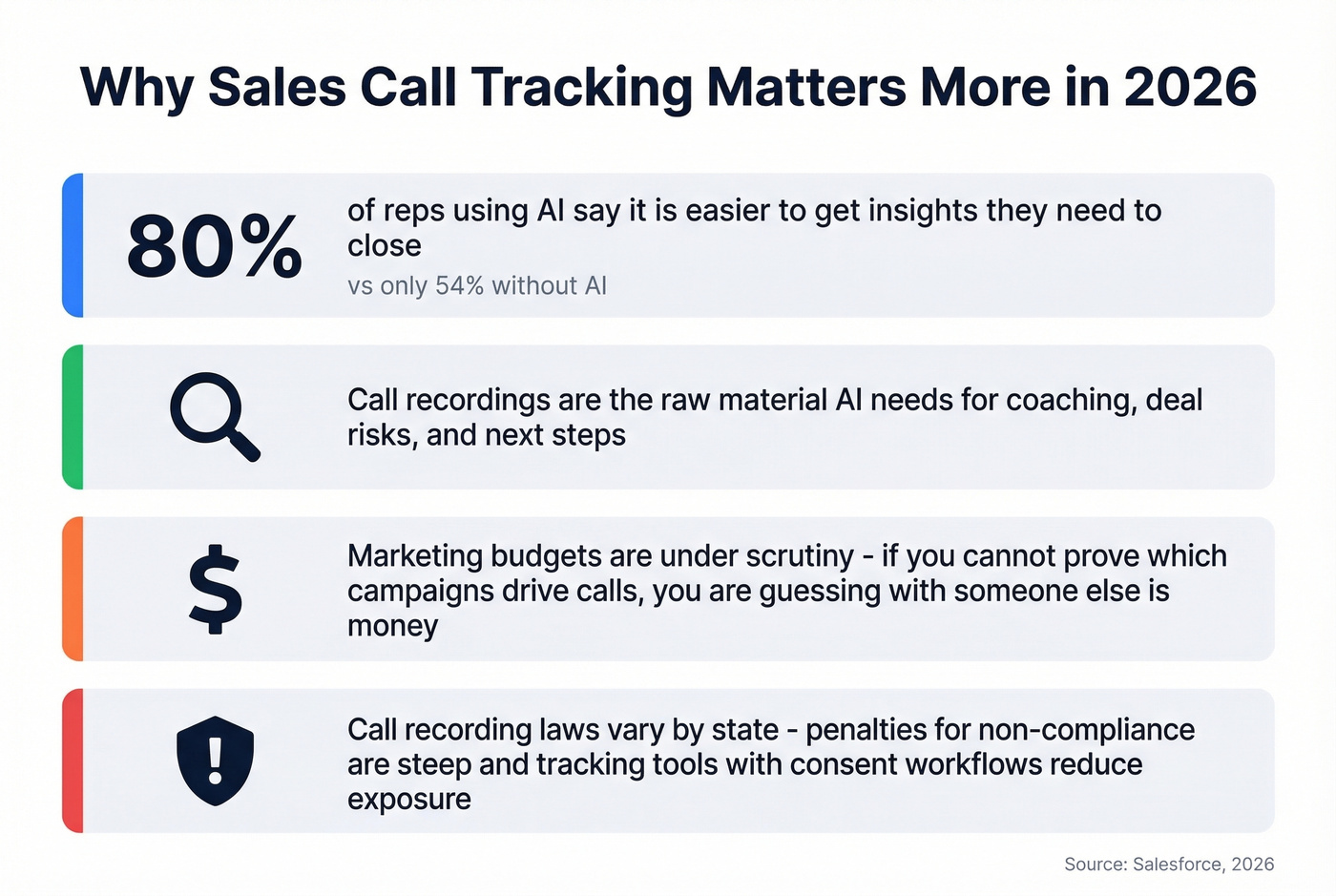
AI makes call data far more useful. 80% of reps using AI say it's easier to get the insights they need to close, compared to 54% without AI. Call recordings are the raw material AI needs to surface coaching moments, deal risks, and next steps.
Attribution isn't optional anymore. Marketing budgets are under scrutiny. If you can't prove which campaigns drive phone calls, you're guessing with someone else's money.
Rep productivity is measurable now. With outbound tracking, you can see which reps make enough attempts, which give up too early, and which have conversations that actually convert. A solid calling activities report makes these patterns impossible to ignore. (If you need a framework for what to log, use these sales activities examples.)
Compliance risk is real. Call recording laws vary by state, and the penalties for getting it wrong are steep. Tracking tools with built-in consent workflows reduce that exposure.
Key Metrics: Call History That Matters
Knowing what to measure matters more than which tool you pick. Here are the benchmarks that separate good from great.
Inbound / Call Center Metrics
| Metric | Good | World-Class |
|---|---|---|
| First Call Resolution | 70-79% | 80%+ |
| CSAT | 75-84% | 85%+ |
| Avg Handle Time | 7-10 min | Varies by industry |
| NPS | +30 to +50 | +50 to +70 |
| Service Level | 80/20 | 90% in 15 sec |
Service level means 80% of calls answered within 20 seconds - that's the industry standard. Leading teams push for 90% within 15 seconds, which requires serious staffing discipline.
Outbound / Cold Calling Metrics
| Metric | Benchmark |
|---|---|
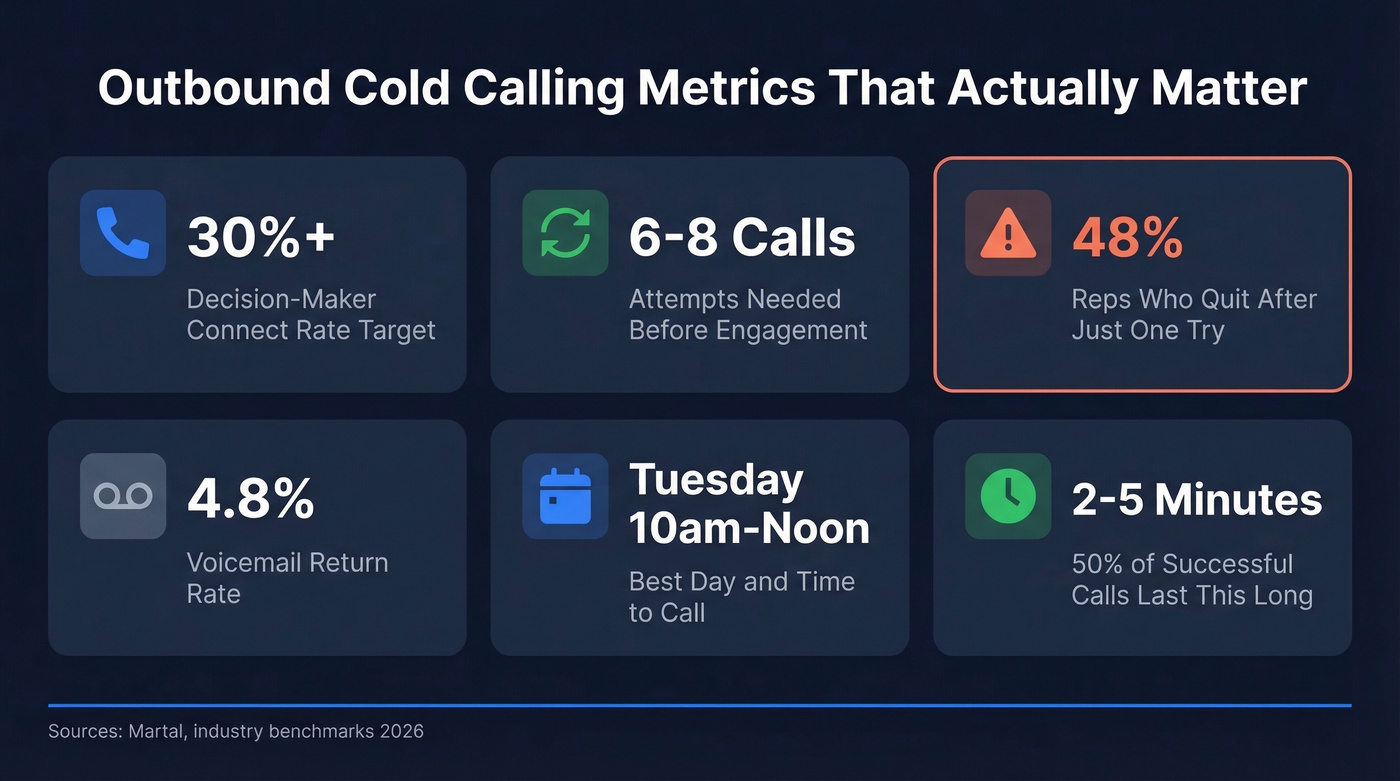
| Decision-maker connect rate | 30%+ target |
| Attempts before engagement | 6-8 calls |
| Reps who quit after one try | 48% |
| Voicemail return rate | 4.8% |
| Best day/time | Tuesday, 10 a.m.-noon |
| Successful call length | ~50% last 2-5 min |
That 48% stat should haunt every sales manager. Nearly half of reps abandon a prospect after a single attempt, when the data shows it takes 6-8 touches to get engagement. Reviewing prospect call history makes this pattern visible - and fixable. (If you’re rebuilding your approach, start with a cold calling system.)

48% of reps quit after one call attempt. But what if the number was disconnected in the first place? Prospeo gives you 125M+ verified mobile numbers refreshed every 7 days - not the 6-week-old data that tanks your connect rates.
Stop tracking failures. Start dialing verified numbers at $0.01 per lead.
Best Tools for Tracking Sales Calls
| Tool | Best For | Starting Price | Key Limitation |
|---|---|---|---|
| Prospeo | Fixing phone/email data quality before dialing | ~$0.01/email; 10 credits per mobile | Not a dialer or call recording tool |
| CallRail | Inbound attribution | ~$50-100/mo + usage | Mobile app and some third-party sync friction |
| CallTrackingMetrics | All-in-one tracking | $79/mo + usage | Complexity at scale |
| Gong | Conversation intel | ~$100-150/user/mo | Enterprise pricing |
| Salesloft | Sales engagement | ~$150-180/user/mo | Dialer costs extra |
| HubSpot Sales Hub | CRM-native calling | ~$100-150/user/mo | Limited outside HubSpot |
| Kixie | Budget outbound | $35/user/mo | Basic analytics |
| JustCall | Budget outbound | $19/user/mo | Fewer integrations |
Prospeo (Fix Your Data First)
Here's the thing: most teams don't have a call tracking problem. They have a data quality problem that call tracking makes painfully visible.
Prospeo sits upstream of every tool on this list. With 300M+ professional profiles, 143M+ verified emails at 98% accuracy, and 125M+ verified mobile numbers refreshed on a 7-day cycle (the industry average is six weeks), it ensures your reps are actually dialing real, current numbers. It also includes real-time email and mobile verification, CSV and CRM enrichment, intent data across 15,000 topics, and API access. (If you’re comparing sources, start with B2B company data providers.)
If your reps are dialing disconnected numbers or stale mobiles, call tracking will just document the failure more precisely. Clean the list first, then measure what actually changed.
CallRail
CallRail is the default choice for inbound marketing attribution, and for good reason. It's the Leader on G2's inbound call tracking category with a 4.5/5 rating across 1,658 reviews. The setup is straightforward: assign unique tracking numbers to campaigns, enable DNI on your website, and CallRail attributes every inbound call to its source.
Pricing typically runs ~$50-100/mo as a base, plus usage fees for minutes and numbers. Users consistently praise the reporting and integration ecosystem, though some flag the mobile app and occasional data sync challenges with third-party tools. Neither is a dealbreaker for most teams. For marketing teams that need to prove ROI on ad spend, this is the fastest path to clean attribution data.
CallTrackingMetrics
Use this if you need inbound attribution, outbound tracking, form tracking, and conversation analytics in a single platform. CTM publishes its tier pricing publicly, which alone makes it worth evaluating.
Skip this if you're a small team that only needs basic inbound attribution - CTM's depth becomes unnecessary complexity.
CTM's pricing tiers break down clearly: Marketing Lite at $79/mo, Marketing Pro at $179/mo, Sales Engage at $329/mo, and Enterprise at $1,999/mo - all plus usage. Annual prepay drops those to $65, $149, $274, and $1,999 respectively. Two-year prepay drops prices further - Marketing Pro to $135/mo, for example - and Enterprise to $1,500/mo. The Marketing Pro tier is the sweet spot for most teams: it includes form tracking (5,000 submissions), 3,000 transcribed minutes, AI-powered AskAI, automation triggers, and premium integrations with Google Ads, GA4, and HubSpot. Usage pricing is granular - transcription runs $0.02/min beyond included minutes. In a category where many vendors hide costs behind "talk to sales," CTM's transparency is a real advantage.

Gong
Gong isn't call tracking in the traditional sense - it's conversation intelligence. It records, transcribes, and analyzes sales calls to surface coaching insights, deal risks, and competitive mentions. If your problem is "we don't know what's happening on calls," Gong is the answer.
Mid-market pricing runs approximately $100-150/user/mo. Enterprise contracts can hit $30K-$100K+/year depending on seats and modules. We've seen teams cut ramp time for new reps significantly by using Gong's call libraries as training material - it's genuinely useful for that. The tradeoff is that Gong doesn't do marketing attribution or outbound dialing. It's a layer on top of your phone system, not a replacement for it. (For a broader stack view, compare SDR tools that pair with dialers and CI.)
SalesLoft
Salesloft is a sales engagement platform that bolts on call tracking as an add-on. The dialer isn't included in the base subscription. The Advanced plan lists at ~$150-180/user/mo, and you can typically negotiate 35-45% off list. But the Unlimited Calling & Messaging add-on runs an additional ~$7,500/yr for 25 users. Local presence dialing? Another paid module, charged per number per month.
Look, charging extra for a dialer in a sales engagement platform is frustrating. But if your team lives in Salesloft for sequences and cadences, the integrated calling experience is smooth. Budget the total cost carefully - the base price is just the starting point. (If you’re tightening the post-call motion, keep sales follow-up templates handy.)
HubSpot Sales Hub
If you're already running HubSpot CRM, Sales Hub's built-in calling is the path of least resistance. Calling is available in Professional and Enterprise tiers, typically around ~$100-150/user/mo depending on the package and billing. Calls log directly to contact records, recordings are searchable, and the data flows into HubSpot's reporting without any integration work - every conversation is documented without reps switching between apps. It won't match CallRail for attribution or Gong for conversation intelligence, but for teams that want calling inside their CRM without adding another vendor, it works. (If you’re evaluating systems, see examples of a CRM before you commit.)
Kixie vs. JustCall
These two compete for the same buyer: budget-conscious outbound teams that need a dialer without enterprise pricing.
Kixie starts at $35/user/mo with multi-line dialing, local presence, and CRM integrations - it's the better pick if dial volume is your priority. JustCall is the most affordable entry point at $19/user/mo, covering outbound dialing, SMS, call recording, and basic analytics. Choose JustCall if you're an early-stage team or agency that needs to track calls without committing to a larger platform. Both lack the analytics depth of Gong or the attribution power of CallRail, but that's not what they're for.
Other tools worth checking: CloudTalk ($25/user/mo) and Aircall ($30/user/mo) are solid mid-range options if neither fits.
Fix Your Data Before You Track Calls
Let's be honest about something we see constantly: teams invest in call tracking software, configure everything perfectly, and then watch their connect rate sit at 8%. The dashboards are beautiful. The data they're measuring is garbage.
Call tracking measures outcomes. But if your reps are dialing disconnected numbers, calling people who left the company six months ago, or reaching the wrong department entirely, you're just documenting failure more precisely. The real problem is upstream.
When Snyk's 50-person AE team was struggling with outbound, their bounce rate sat at 35-40%. After switching to Prospeo for contact data, bounce rates dropped under 5%, AE-sourced pipeline jumped 180%, and the team generated 200+ new opportunities per month. The call tracking didn't change. The data feeding it did. (If you’re diagnosing list quality, start with email bounce rate benchmarks and fixes.)
Call Recording Compliance
Recording sales calls without proper consent can cost you. The rules aren't complicated, but they vary by state, and getting them wrong carries real penalties.
38 states use one-party consent - your rep's knowledge counts as consent. 11 states require all-party consent: California, Connecticut, Delaware, Florida, Illinois, Maryland, Massachusetts, Montana, New Hampshire, Pennsylvania, and Washington. 2 states have mixed-consent rules that depend on context - check local statutes for Vermont and Hawaii.
Penalties are steep. The Federal Wiretap Act carries up to 5 years imprisonment, $100/day or $10,000 in statutory damages (whichever is greater). TCPA violations run $500-$1,500 per violation.
The safest approach is simple: disclose the recording at the start of every call, regardless of state. "This call may be recorded for quality purposes" takes three seconds and eliminates the risk. Most call tracking tools automate this with a pre-call announcement. Consult legal counsel for your specific situation - this is a working framework, not legal advice.
How to Set Up Call Reporting
Five steps to get from zero to useful data:
- Audit your contact data. Verify your phone list before you start dialing. Upload a CSV to a verification tool and clean the list - disconnected numbers get flagged before your reps waste dials on them.
- Choose your tool type. Inbound attribution (CallRail, CTM) or outbound activity tracking (Kixie, JustCall, Gong)? Most teams need one of each, not a single tool that does both poorly.
- Configure tracking numbers. For inbound, set up DNI on your website and assign unique numbers to each campaign. For outbound, configure local presence dialing if your tool supports it.
- Integrate with your CRM. Call data that doesn't flow into Salesforce or HubSpot is call data that gets ignored. Every tool on this list integrates with major CRMs - use it.
- Set KPI baselines. Use the benchmarks from the metrics section above. You can't improve what you haven't baselined. Give it 2-4 weeks of clean data before you start optimizing, and make sure reps are logging call notes during this period so you have the context needed to interpret the numbers later. (If you’re building a measurement layer, align it with sales operations metrics.)
Call tracking tools document the problem. Prospeo fixes it upstream. With 98% email accuracy, 125M+ verified mobiles with a 30% pickup rate, and a 7-day refresh cycle, your reps actually reach decision-makers instead of dead lines.
Clean your list first, then watch every call metric improve.
FAQ
What's the difference between inbound and outbound call tracking?
Inbound tracking uses dynamic number insertion to attribute incoming calls to marketing campaigns - answering which channel drove the call. Outbound tracking logs rep activity (dials, connects, talk time) to measure sales team performance. Most tools specialize in one; teams doing both typically need separate solutions.
How much does call tracking software cost?
Entry-level plans start at $19-$35/user/month (JustCall, Kixie). Mid-range platforms like CallTrackingMetrics run $79-$329/month plus usage. Conversation intelligence tools like Gong typically cost $100-$150/user/month. Budget $50-$100/month for basic inbound attribution with CallRail.
Do I need consent to record sales calls?
Yes, but requirements vary. 38 states require only one-party consent (your rep counts); 11 states require all-party consent. For interstate calls, follow the strictest applicable state's law. Safest move: disclose recording upfront on every call. It takes three seconds and eliminates legal risk.
What should I fix before investing in call tracking tools?
Start with your contact data. If reps are dialing disconnected or outdated numbers, even the best tracking software just documents failure. Tools like Prospeo's Mobile Finder provide verified numbers on a 7-day refresh cycle, while services like NeverBounce or ZeroBounce handle phone validation. Clean data first, then measure what changes.
What's a good connect rate for outbound sales calls?
For cold outbound, 6-10% connect rates on direct dials is solid for most mid-market teams. Below 4% usually signals a data quality or list targeting problem rather than a rep performance issue. Teams using verified mobile numbers consistently see 15-25% connect rates compared to 5-8% on general office lines.