

Sales Call Training: The 2026 Playbook for Managers
A RevOps lead we know ran a sales call training initiative last year that cost $45,000 and took six weeks to roll out. Three months later, reps were back to the same habits - winging discovery calls, fumbling objections, reading scripts like hostage notes. The training wasn't bad. The program around it was.
With ramp costs estimated at 3x base salary, a rep who quits in 90 days is often a six-figure loss. Here's how to build a program that actually sticks.
What You Need (Quick Version)
A program that moves numbers needs four things: a methodology (SPIN, Challenger, or Sandler - pick one), a coaching scorecard your managers will use weekly, AI practice tools so reps get volume without burning real prospects, and clean prospect data so trained reps actually reach live humans. We're covering all four with specific recommendations, pricing, and a usable scorecard template.
Why Most Programs Fail
Only 32% of sales reps say they receive excellent training or coaching. That's a Salesforce survey number from 2021, and nothing suggests it's gotten better. Average SaaS ramp time has climbed to 5.7 months - up 32% since 2020. Enterprise reps take 9-12 months. That's nearly a year before a new hire is fully productive.
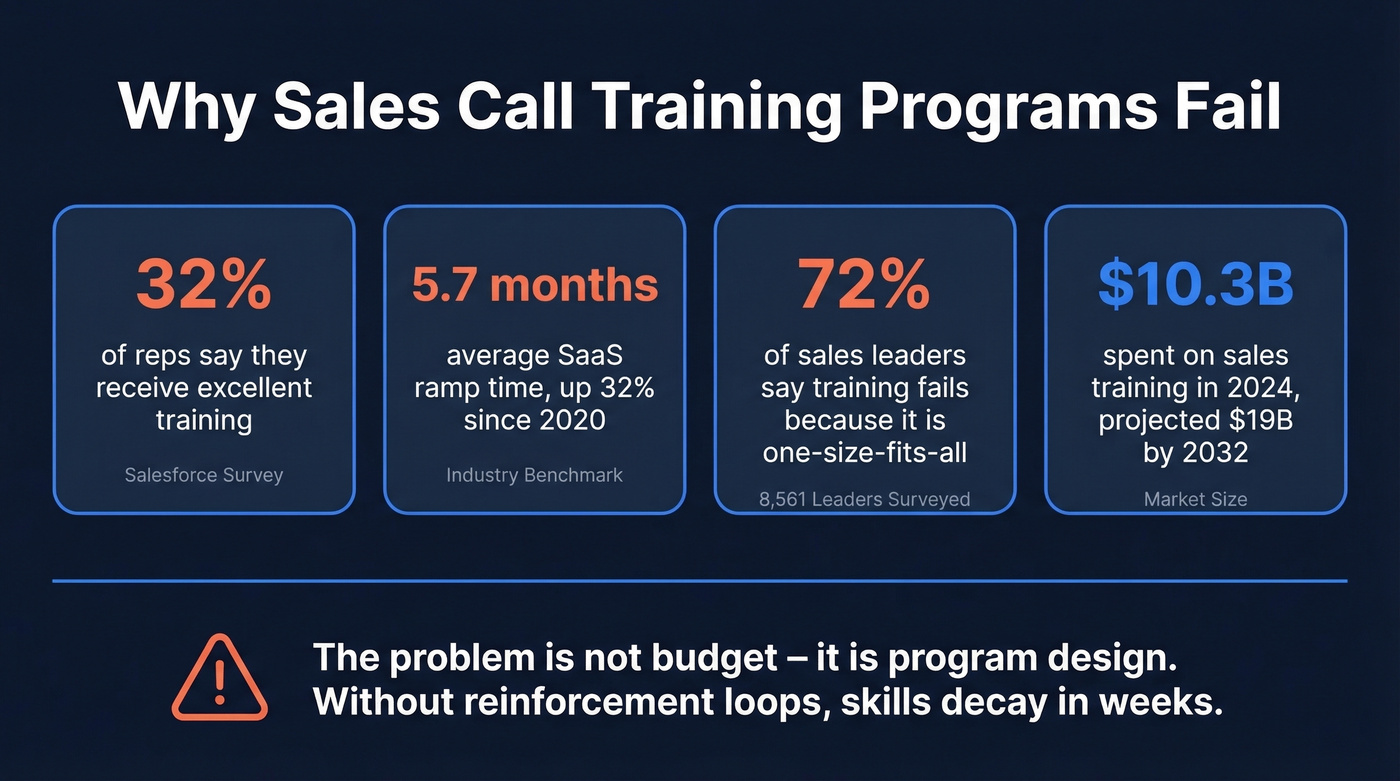
The global sales training market hit $10.32 billion in 2024 and is projected to reach roughly $19 billion by 2032. Companies are spending more than ever. The problem isn't budget - it's design. Most programs treat "sales calls" as a monolithic skill, deliver training as a one-time event, and never measure whether anything changed. Without a reinforcement loop, skills decay in weeks.
A survey of 8,561 US sales leaders found that 72% say training fails because it's one-size-fits-all. Another 62% cite outdated content as the biggest barrier.
Here are the five ways training programs die:
- Training as an event. A two-day workshop with no follow-up is a team-building exercise, not a development program. Skills decay within weeks without reinforcement.
- No reinforcement loop. Spaced learning works. One-and-done doesn't. If managers aren't coaching to the methodology weekly, the methodology doesn't exist.
- Lazy delivery. Reading slides to a Zoom room isn't training. Reps need to practice, not spectate.
- Irrelevant topics. Training your enterprise AEs on cold calling openers when they haven't made a cold call in two years? Training SDRs on negotiation tactics they'll never use? Match the content to the role.
- Poor buy-in. If leadership doesn't communicate why the training matters and what changes afterward, reps treat it as a compliance checkbox.
These aren't theoretical. They're the five pitfalls Modern Sales Foundations identified, and we've seen every one play out in real teams.
Three Methodologies That Work
Don't build a program from scratch. Pick a methodology with research behind it, then customize it to your sales motion.
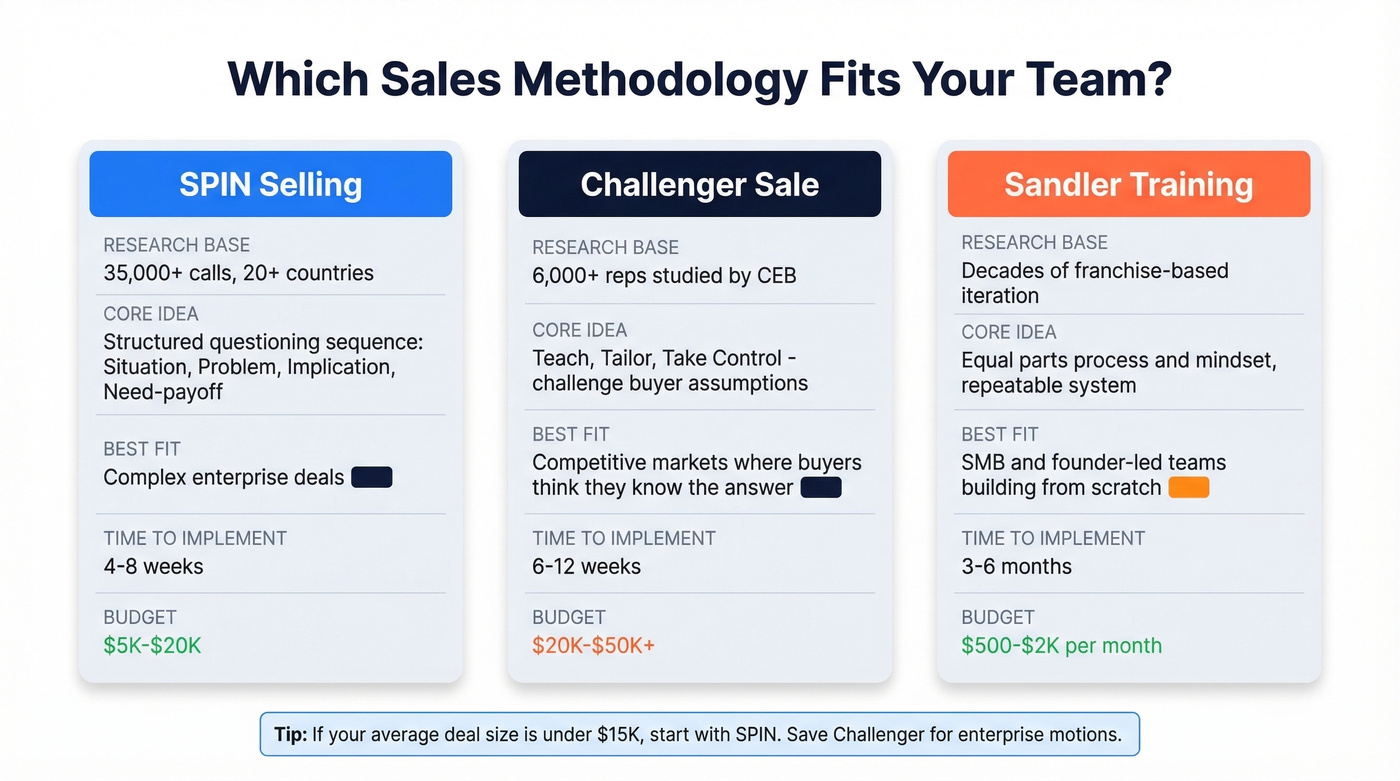
| Methodology | Research Base | Best For | Time to Implement | Cost Range |
|---|---|---|---|---|
| SPIN Selling | 35,000+ calls, 20+ countries | Complex enterprise | 4-8 weeks | $5K-$20K (est.) |
| Challenger Sale | 6,000+ reps (CEB) | Competitive markets | 6-12 weeks | $20K-$50K+ |
| Sandler Training | Franchise model, decades | SMB/founder-led | 3-6 months | $500-$2K/mo |
SPIN Selling
SPIN is built on 12 years of research across 35,000+ sales calls in 20+ countries. The questioning sequence - Situation, Problem, Implication, Need-payoff - gives reps a framework for discovery that's structured enough to coach but flexible enough to feel natural. It's the strongest fit for complex enterprise sales where the buyer doesn't know they have a problem yet.
The downside: SPIN is a questioning framework, not a full sales process. You'll need to layer it into your existing methodology for prospecting, demos, and closing.
Challenger Sale
CEB's research on 6,000+ reps found that the highest performers don't just build relationships - they challenge buyers' assumptions. Teach, Tailor, Take Control is the framework. Xerox reported a 17% increase in sales and $65M in contract value after implementing Challenger.
This works best in competitive markets where buyers think they already know what they need. It's harder to implement than SPIN because it requires reps to develop genuine industry insight, not just follow a question sequence. Budget $20-50K+ for enterprise-level Challenger engagements.
Sandler Training
Sandler is process and mindset in equal measure. The franchise model means quality varies by location - a common complaint on r/sales and in practitioner communities - but the best Sandler trainers build lasting behavioral change. It takes months to embed, so this isn't a quick fix. For SMB and founder-led teams that need a repeatable sales process from scratch, Sandler is worth the patience. Expect $500-$2,000/month depending on your market.
Training by Call Type
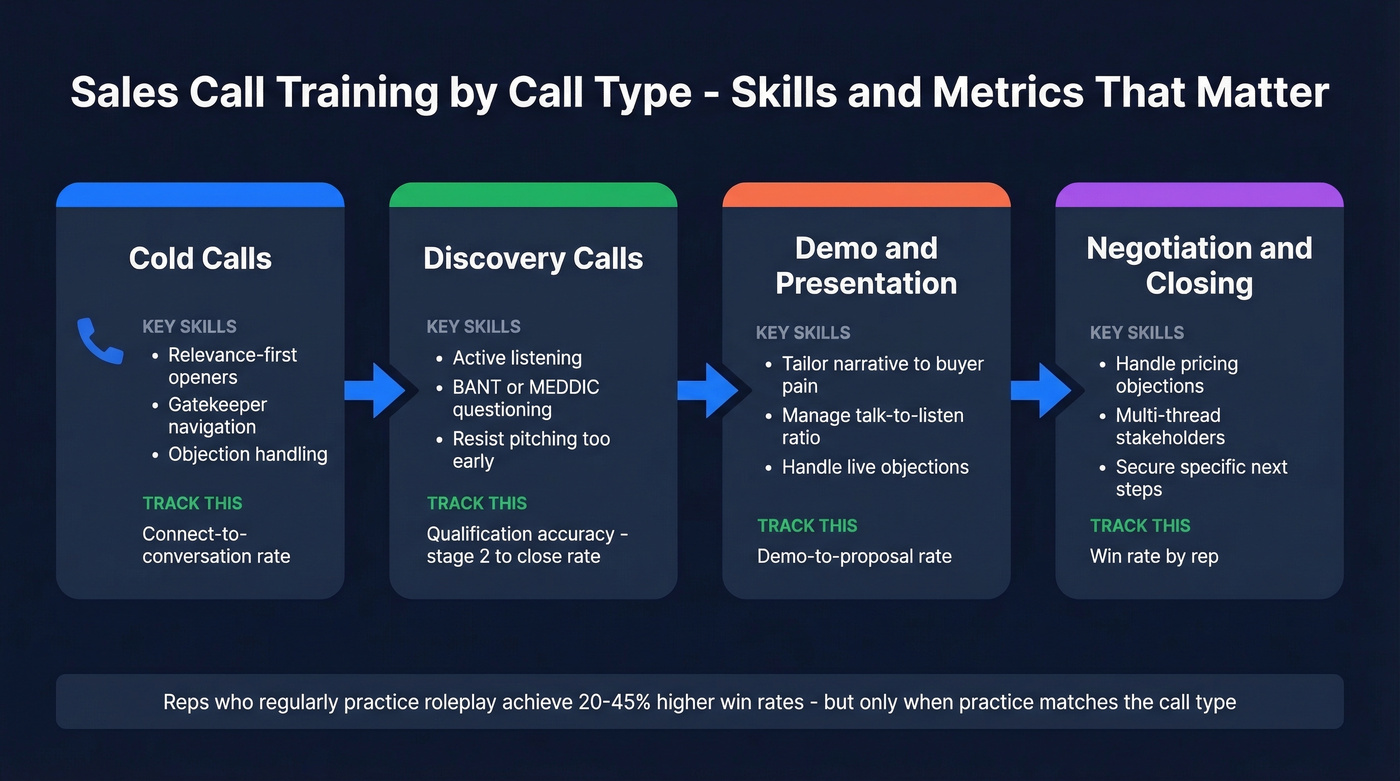
Here's the thing: if your average deal size is under $15K, you probably don't need a $40,000 Challenger engagement. What you need is to stop treating "sales calls" as one skill. A cold call and a negotiation call have almost nothing in common. Each call type demands distinct skills, distinct metrics, and distinct practice methods. Sellers who regularly practice roleplay achieve 20-45% higher win rates - but only when the practice matches the call type they're actually running.
Cold Calls
The skills that matter: relevance-first openers (you have seconds), gatekeeper navigation, and objection handling for the "not interested" reflex. 76% of top performers always research before reaching out - so "just dial" isn't a strategy.
Track connect-to-conversation rate, not dials. A rep making 80 dials with a 2% conversation rate needs different coaching than one making 40 dials at 8%. Practice method: AI roleplay for objection reps, then live call blitzes with a manager listening in real time. If you're building a repeatable outbound motion, a cold calling system helps standardize what "good" looks like.
Discovery Calls
Structure matters more here than anywhere else. A solid discovery call follows four phases: Introduction, Exploration, Validation, Qualification. The skills are active listening and disciplined questioning - BANT or MEDDIC frameworks give reps a skeleton to work from.
The biggest mistake in discovery? Pitching too early. Reps who jump to their solution before understanding the buyer's context lose deals they should've won. Track qualification accuracy - how often does a "qualified" opportunity actually close? If your stage-2-to-close rate is below 15%, your discovery training needs work. For a tighter call plan, build a shared bank of discovery questions.
Demo and Presentation Calls
The demo is where training either compounds or collapses. A rep who ran a strong discovery call should tailor every demo to the pain points they surfaced. A rep who skipped discovery will give a generic feature tour that bores everyone.
Train reps to manage talk-to-listen ratio (they should be listening more than talking, even in demos), tailor the narrative to the buyer's specific situation, and handle live objections without getting defensive. The metric here is demo-to-proposal rate. If you want a repeatable standard, use a product demo checklist across the team.
Negotiation and Closing
This is where deals die quietly. Reps who can't handle pricing objections, who don't multi-thread across stakeholders, or who leave calls without clear next steps are leaking revenue every week. Train reps to secure verbal commitments with specific timelines - "I'll follow up next week" isn't a next step. "I'll send the contract Tuesday and we'll review Thursday at 2pm" is.
The metric is win rate by rep. If one rep closes at 35% and another at 18% with similar pipeline quality, the gap is almost always in negotiation skills. If you want a simple lever to improve outcomes, start with anchoring and concession planning.

You just invested weeks training reps on cold calls, discovery, and objection handling. Don't waste that investment on bad phone numbers. Prospeo delivers 125M+ verified mobiles with a 30% pickup rate - so trained reps actually reach live humans, not voicemail graveyards.
Stop burning trained reps on dead numbers. Start connecting.
Building a Coaching Scorecard
Only 26% of reps receive weekly coaching. Coaching leads to 25% higher quota attainment and 30% more deals won - but only if it's structured. A manager saying "nice call" after a ride-along isn't coaching.
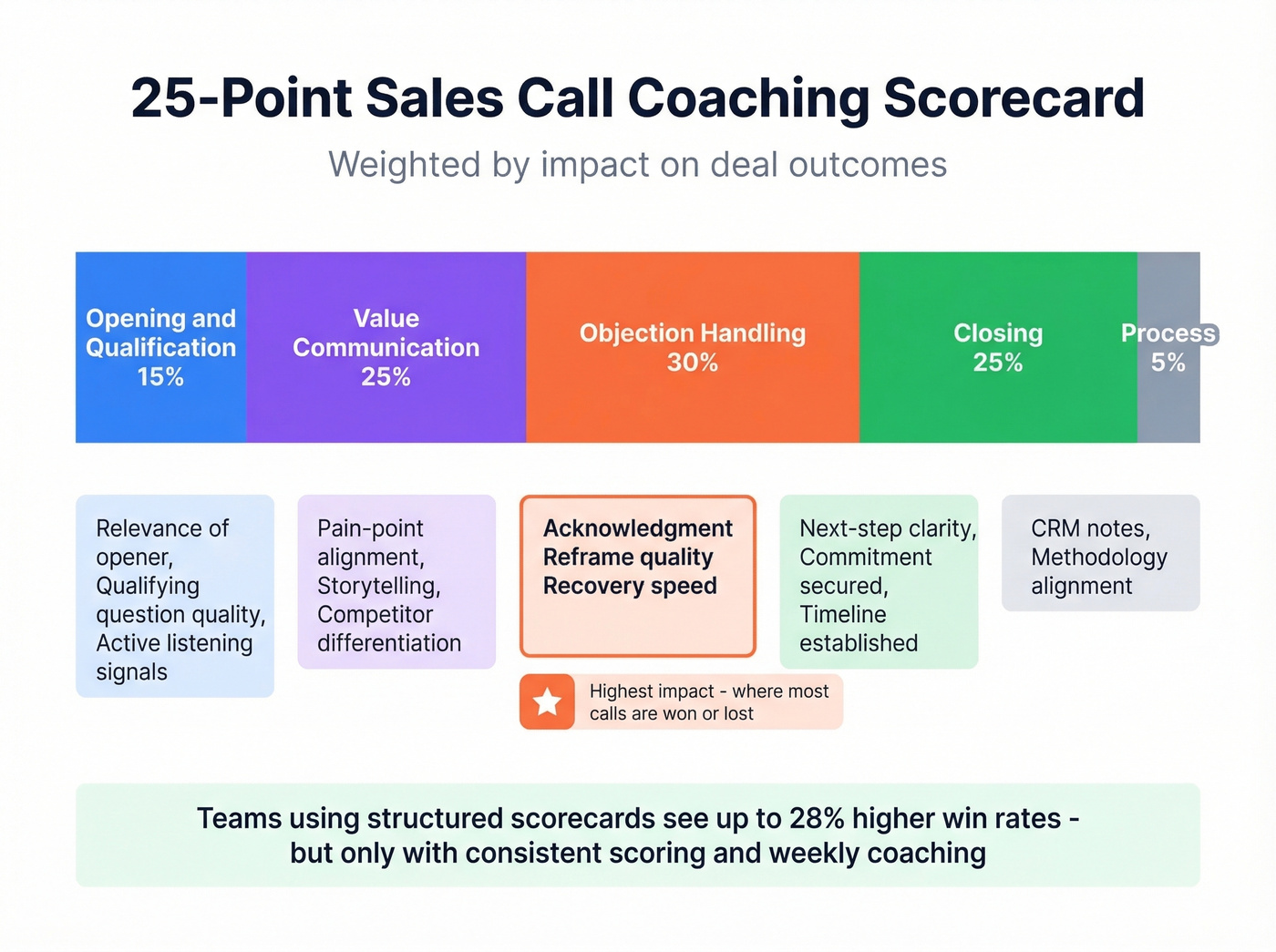
Here's a 25-point scorecard template you can adapt immediately:
| Category | Weight | What to Score (5 pts each) |
|---|---|---|
| Opening & Qualification | 15% | Relevance of opener, qualifying question quality, active listening signals |
| Value Communication | 25% | Pain-point alignment, storytelling, competitor differentiation |
| Objection Handling | 30% | Acknowledgment, reframe quality, recovery speed |
| Closing | 25% | Next-step clarity, commitment secured, timeline established |
| Process Adherence | 5% | CRM notes, methodology alignment |
Objection handling gets the heaviest weight because it's where most calls are won or lost. A rep who nails the opener but crumbles at "we're happy with our current vendor" is still losing the deal.
Anti-patterns to watch for: reps who talk more than they listen, skip qualification entirely, or default to jargon when plain language would land better. Pilot this scorecard for 4-6 weeks with a small group before rolling it out company-wide. Calibrate scoring across managers - if one manager scores a 4 where another scores a 2 on the same call, the scorecard isn't working yet. Win rates can climb up to 28% with structured scorecards, but only when scoring is consistent and coaching conversations happen weekly. If you want to make this operational, tie scorecard outcomes to sales operations metrics and review them in your weekly cadence.
AI Tools for Practice and Coaching
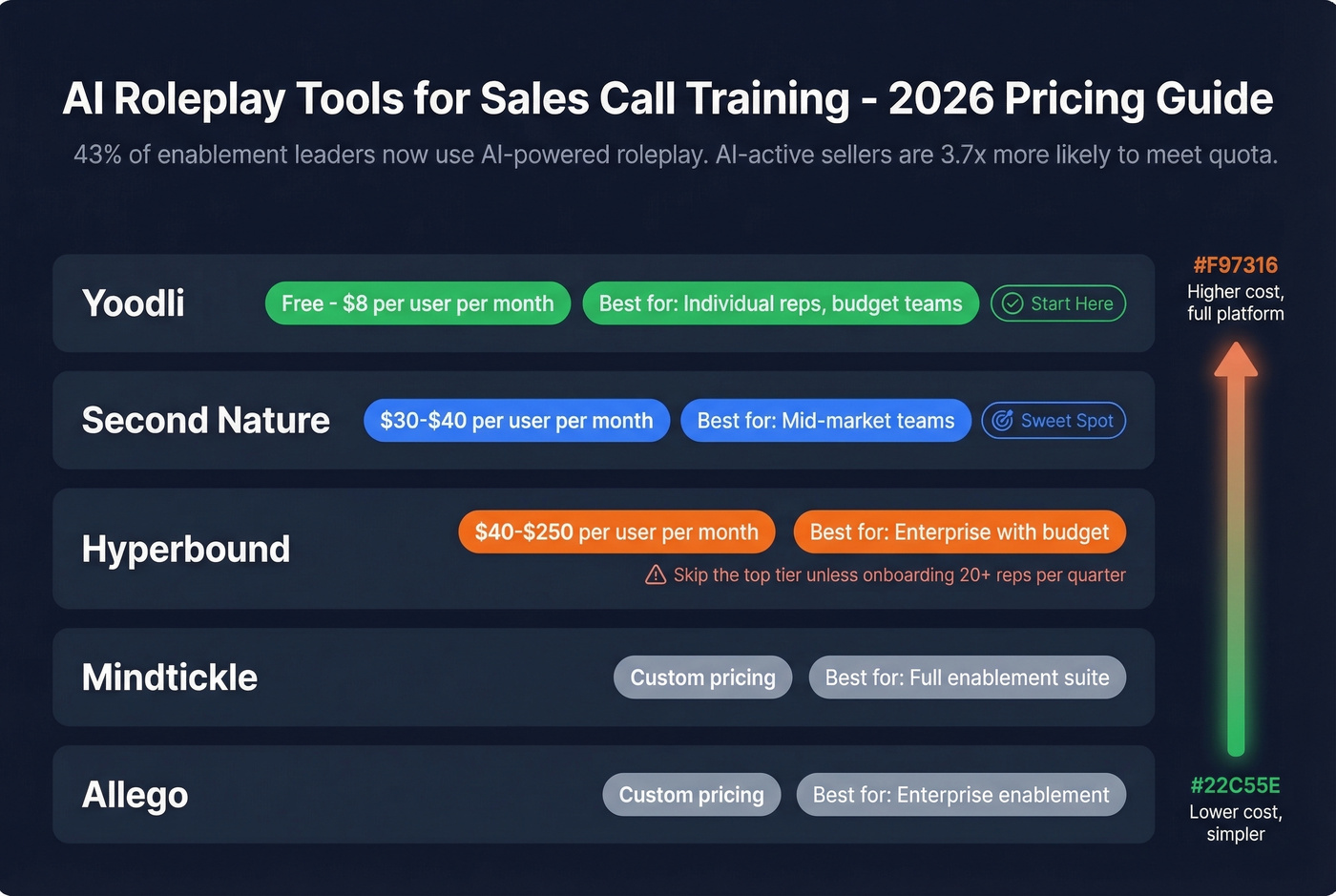
The AI coaching landscape splits into three lanes: conversation intelligence (diagnose what happened on real calls), roleplay tools (practice before the real call), and AI assistants (automate prep and follow-up). 43% of enablement leaders now use AI-powered roleplay. AI-active sellers are 3.7x more likely to meet quota.
AI Roleplay Tools
These let reps practice objection handling, discovery questions, and cold call openers against an AI buyer persona. Quality varies wildly. If you're evaluating the broader stack, start with a ranked list of SDR tools to see what fits your motion.
| Tool | Pricing | Best For |
|---|---|---|
| Yoodli | Free-$8/user/mo | Individual reps, budget teams |
| Second Nature | ~$30-40/user/mo | Mid-market teams |
| Hyperbound | ~$40-250/user/mo | Enterprise with budget |
| Mindtickle | Custom pricing | Full enablement suite |
| Allego | Custom pricing | Enterprise enablement |
Yoodli is the obvious starting point if you've never used AI roleplay - the free tier is genuinely usable, and $8/user/month is trivial. Second Nature hits the sweet spot for mid-market teams that want structured scenarios without enterprise pricing. Skip Hyperbound's top tier unless you're onboarding 20+ reps per quarter; the $250/user/month price tag is hard to justify otherwise.

Conversation Intelligence
CI tools record, transcribe, and analyze real sales calls. They're the diagnostic layer - showing you where reps struggle so you can coach to specific moments instead of vague impressions.
| Tool | Pricing | Best For |
|---|---|---|
| Gong | ~$1,200-$1,600/yr + platform fee | Gold standard, enterprise |
| Chorus (ZoomInfo) | ~$100-150/user/mo | Mid-market |
| Fireflies.ai | Free + paid plans under ~$30/user/mo | Best value, small teams |
| Avoma | Free + paid plans under ~$100/user/mo | Strong free tier |
| Highspot | ~$50-80/user/mo | Coaching + enablement |
| Cirrus Insight | ~$14-21/user/mo | Budget CI |
Let's be honest: Gong is overkill for teams under 20 reps. With per-user pricing plus a platform fee, it commonly lands in the five-figure range annually. Fireflies or Avoma get you most of the value at a fraction of the cost. Chorus is solid if you're already a ZoomInfo customer, but as a standalone purchase, Avoma or Fireflies are better bets.
The Data Quality Blind Spot
Picture this: your newly trained SDR sits down Monday morning, fires up the dialer, and makes 47 calls. Four people pick up. Zero meetings booked. The rep thinks they're bad at cold calling. Their manager thinks the training didn't work.
The real problem? Thirty of those numbers were disconnected, and twelve went to the wrong person.
We've watched this pattern kill training ROI at three companies in the last year alone. You can have the best methodology, the sharpest scorecard, and $50,000 worth of Gong licenses - none of it matters if your reps are calling dead numbers and emailing bounced addresses. It's the most frustrating failure mode because everyone blames the training when the data was rotten from the start. If you're fixing this systematically, start with data enrichment services and a clear refresh cadence.
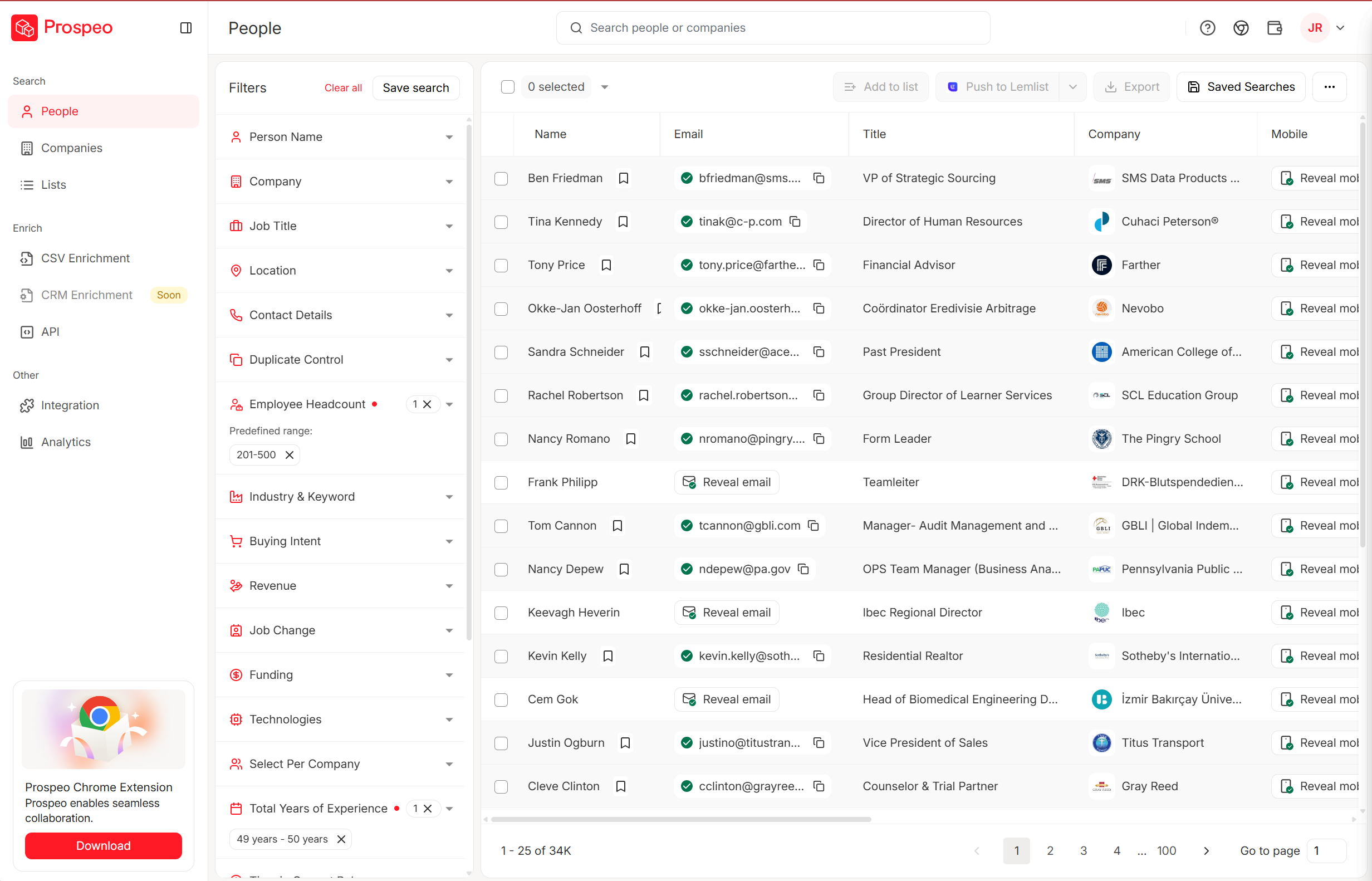
Industry average data refresh is around six weeks. That means the list your rep is calling could be a month and a half stale. Prospeo refreshes every 7 days, which is why teams using it see materially higher connect rates and more live conversations per hour. With 300M+ professional profiles, 98% email accuracy, and a 30% mobile pickup rate, reps reach roughly one in three direct dials - compared to industry benchmarks around 11-12%. If you're comparing vendors, use a baseline like a sales prospecting database checklist (coverage, refresh, verification, and export limits).
GreyScout cut rep ramp time from 8-10 weeks to 4 weeks after switching their data provider - not because they changed their training, but because new reps were actually reaching live prospects from day one. Snyk's 50-person AE team dropped bounce rates from 35-40% to under 5%, and AE-sourced pipeline jumped 180%. When reps connect with 2-3x more live prospects per hour, every minute of call training compounds faster.
Before you train the call, fix the list.
How to Choose a Program
Not all programs deserve your budget. Here's a five-point checklist before you sign anything:
Do they roleplay with real deals? Generic scenarios teach generic skills. The best programs use your actual pipeline for practice.
Do they train managers, not just reps? If your managers can't coach to the methodology, the methodology dies the week after training ends. This is also where strong sales leadership makes or breaks adoption.
Is reinforcement built in? Weekly touchpoints, deal reviews, and spaced learning should be part of the package - not a $15,000 add-on.
Is pricing published? If a training vendor makes you sit through a discovery call to learn what they charge, you're about to get "discovery called" by the same people selling you discovery call training. Transparent pricing is a trust signal.
Does it address your data layer? Step one of any implementation should be auditing your contact data quality. If 30-40% of your list is stale, no amount of coaching will move metrics. If you need a practical starting point, use an ideal customer profile rubric to tighten targeting before you refresh data.
Match the program to your team's actual gap. If reps can't get past gatekeepers, you don't need an enterprise methodology overhaul - you need cold call training and better phone numbers. For a broader vendor landscape, Training Industry publishes an annual Top Sales Training Companies list that's useful for shortlisting.
76% of top performers research before every call. Prospeo's 300M+ profiles with 30+ filters - buyer intent, job changes, technographics - give your reps the context they need to run discovery calls that actually qualify. Data refreshes every 7 days, not 6 weeks.
Arm every rep with research-ready prospect data at $0.01 per lead.
FAQ
How much does sales call training cost?
Structured programs like Sandler run $500-$2,000/month; enterprise engagements with Challenger cost $20-50K+. AI roleplay tools add $8-250/user/month. Most mid-market teams spend $10-25K/year total across methodology training and tools. Free resources like HubSpot Academy cover the basics if budget is tight.
How long until training improves metrics?
Individual skill improvement shows up in 2-4 weeks with daily practice and weekly coaching. Team-wide metric shifts - connect rates, win rates, ramp time - take 60-90 days with a consistent coaching cadence and reinforcement built into the workflow.
Can AI replace live coaching?
No. AI roleplay is excellent for building muscle memory - 43% of enablement leaders now use it - but manager coaching on real deals remains irreplaceable. AI can't read the political dynamics of a deal or coach a rep through a career-defining negotiation. Use both: AI for volume practice, managers for judgment calls.
What's the ROI of investing in call training?
Effective training returns $4.53 per $1 spent. Structured onboarding reduces ramp time by up to 34% and retains 50% more new hires. A rep who ramps in 4 months instead of 6 generates two extra months of pipeline in their first year - that's where the compounding kicks in.
Does prospect data quality affect training outcomes?
Absolutely. If 30-40% of your contact data is stale, reps practice rejection instead of selling, eroding confidence and distorting every metric you track. Fresh, verified data means trained reps actually reach live prospects, turning practice into pipeline instead of frustration.