

How to Build a Sales Channel Strategy That Actually Produces Revenue
A RevOps lead we know spent six months building a channel program in a conference room. Beautiful slide deck. Tiered partner structure. Executive buy-in. Then they launched it, and zero partners closed a deal in the first quarter. The program wasn't bad on paper - it just skipped the nuts and bolts that make a sales channel strategy actually work.
Your CEO just asked about channel. Maybe it was the board. Someone saw that a fully burdened direct sales rep costs north of $275,000 per year, and they want to know why you aren't using partners to cover more of the market. Here's the uncomfortable truth: direct sales realistically covers your top 4% of strategic accounts. Channel covers the other 96%. If you don't have a B2B channel strategy, you don't have a market coverage strategy.
What Separates Programs That Work
Three things separate channel programs that produce revenue from those that don't:
- A quantitative channel selection method. Not gut feel. A scoring formula that forces you to rank channels by economics, reach, and conversion probability - then cut the bottom third.
- A deal registration system partners actually trust. If partners think you'll undercut them, they'll stop registering deals. Then you lose visibility. Then you lose the program.
- Fewer channels, resourced deeply. The instinct is to sign 100 partners and hope. The winning move is 10-15 committed partners with real enablement behind them.
The headline number: partner channels deliver a $150 CAC versus $1,980 for outbound - a 13x cost advantage. That's not a rounding error. That's a different business model.
Sales Channels vs. Channel Sales
Before we go further, let's get the terminology straight - because people confuse these constantly.
"Sales channel" refers to any route to the customer: direct sales, partners, resellers, distributors, affiliates, digital marketplaces, or some combination. "Channel sales" specifically means the indirect side - partners selling on your behalf. Your strategy is the deliberate plan for which routes you'll invest in, how you'll manage them, and how you'll prevent them from stepping on each other.
One more distinction worth knowing: multichannel means you're present in multiple channels that operate independently. Omnichannel means those channels are integrated, sharing customer context and data across touchpoints. Most B2B companies are multichannel. Very few are truly omnichannel.
Why Channel Economics Matter in 2026
The economics of direct sales have gotten brutal. CAC increased 40-60% from 2023 to 2025 across most B2B categories, driven by competition, privacy regulations, and attribution complexity. Indirect channels keep getting more efficient.
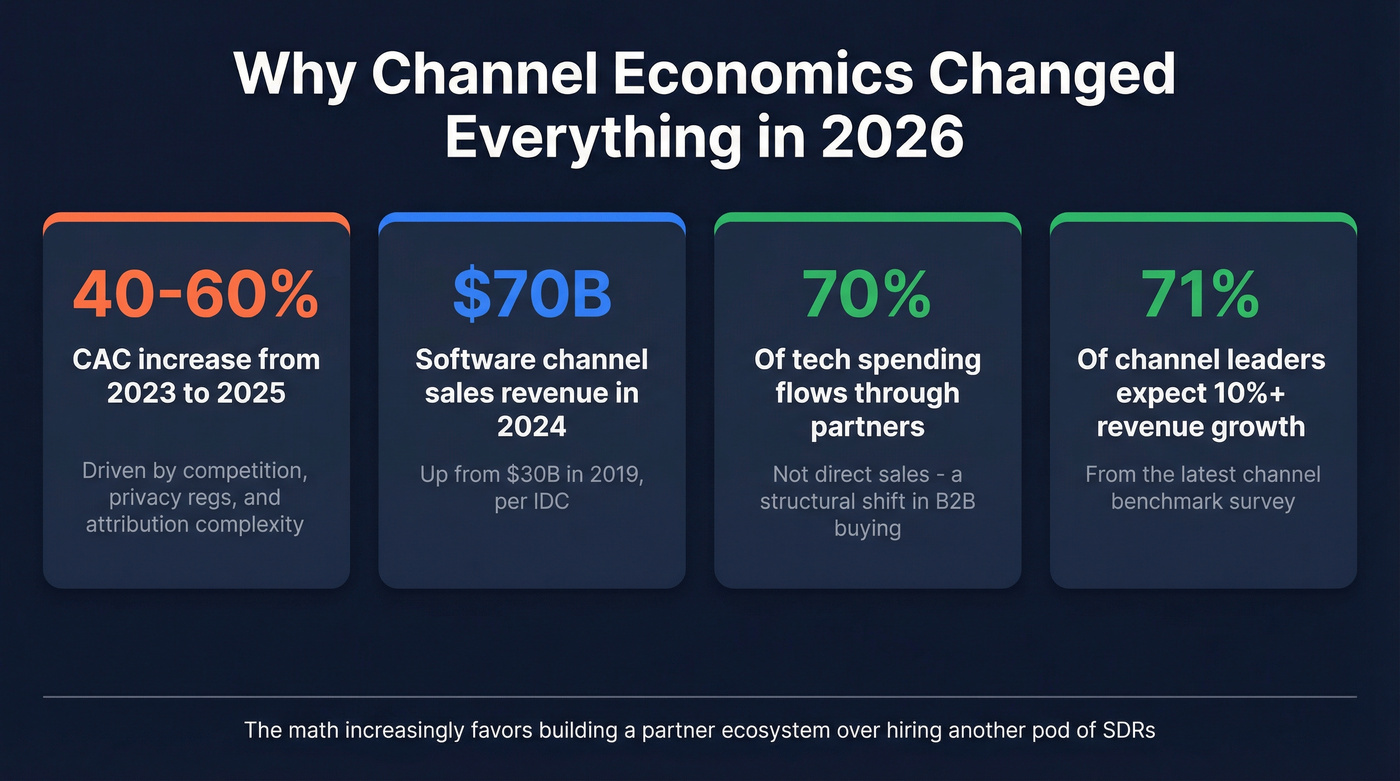
The scale is hard to ignore. IDC pegged software channel sales revenue at $70 billion in 2024, up from $30 billion in 2019. About 70% of customer spending on technology and IT services now [flows through partners](https://www.channelfutures.com/channel-business/channel-partners-to-drive-more-than-70-of-it-spending-in-2023), not direct sales. And 71% of channel leaders [expected partner-generated revenue to climb more than 10%](https://www.demandgenreport.com/resources/channel-partner-marketing-benchmark-survey/47183/) in the most recent benchmark survey. These aren't aspirational numbers from a consulting deck - they reflect a structural shift where the math increasingly favors building a partner ecosystem over hiring another pod of SDRs.
The Numbers That Get CFO Buy-In
Here's the slide that gets your CFO's attention.
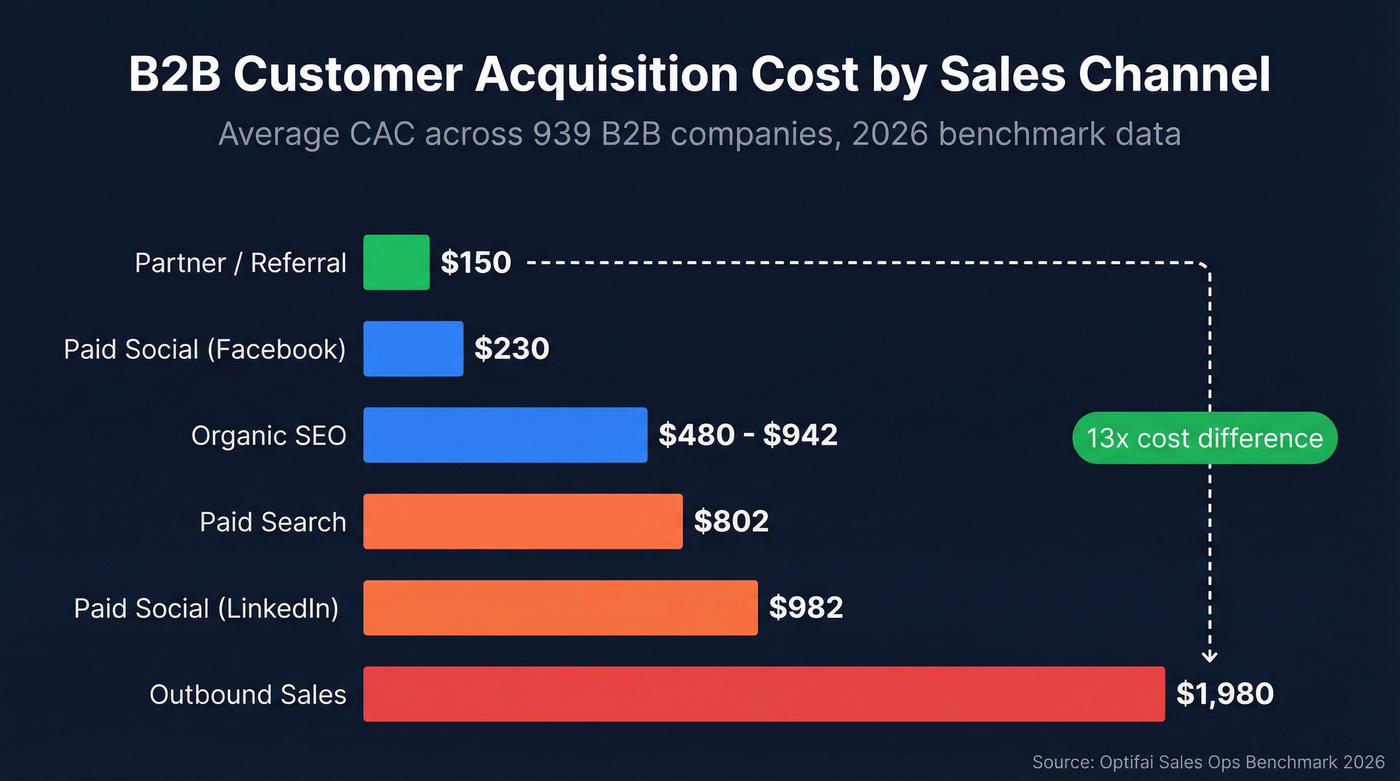
| Channel | Avg. CAC (B2B) | Notes |
|---|---|---|
| Partner / Referral | $150 | 13x cheaper than outbound |
| Organic (SEO) | $480-$942 | Drops to ~$290 once mature |
| Paid Social (Facebook) | $230 | B2C-leaning; limited B2B |
| Paid Search | $802 | High intent, expensive |
| Paid Social (LinkedIn) | $982 | B2B-targeted, premium CPL |
| Outbound Sales | $1,980 | Fully burdened rep cost |
Data compiled from the Optifai Sales Ops Benchmark 2026 (939 B2B companies).
CAC is only half the story, though. Partner-sourced deals consistently outperform direct deals on the metrics that actually move the needle: 40% higher average order value, 46% faster close cycles, and 53% higher win rates.
The leverage math seals it: one channel manager can oversee 40-60 active partners. Compare that to a single direct rep covering a fraction of that territory. At a $150 partner CAC, hitting a 3:1 LTV:CAC ratio is straightforward for most SaaS price points. At $1,980 outbound CAC, you need substantial contract values just to break even.
Here's the thing - if your ACV sits below $15K, an outbound-heavy model is nearly impossible to make work at those acquisition costs. Indirect channels become the obvious path forward.

You just read that partner channels deliver a $150 CAC vs $1,980 for outbound. But that only works if your partners have accurate contact data. Prospeo gives your channel partners 300M+ profiles with 98% email accuracy and 125M+ verified mobiles - at $0.01 per email. Arm every partner with the same data quality your direct team uses.
Stop losing partner deals to bad data. Start your free account in 30 seconds.
How to Choose Your Sales Channels
Most teams pick channels based on what competitors are doing or what the VP of Sales used at their last company. That's gut instinct, and gut-instinct management without systems wastes more than 40% of sales capacity annually.
If you need a clean way to define and score your target accounts first, start with an ideal customer profile before you rank channels.
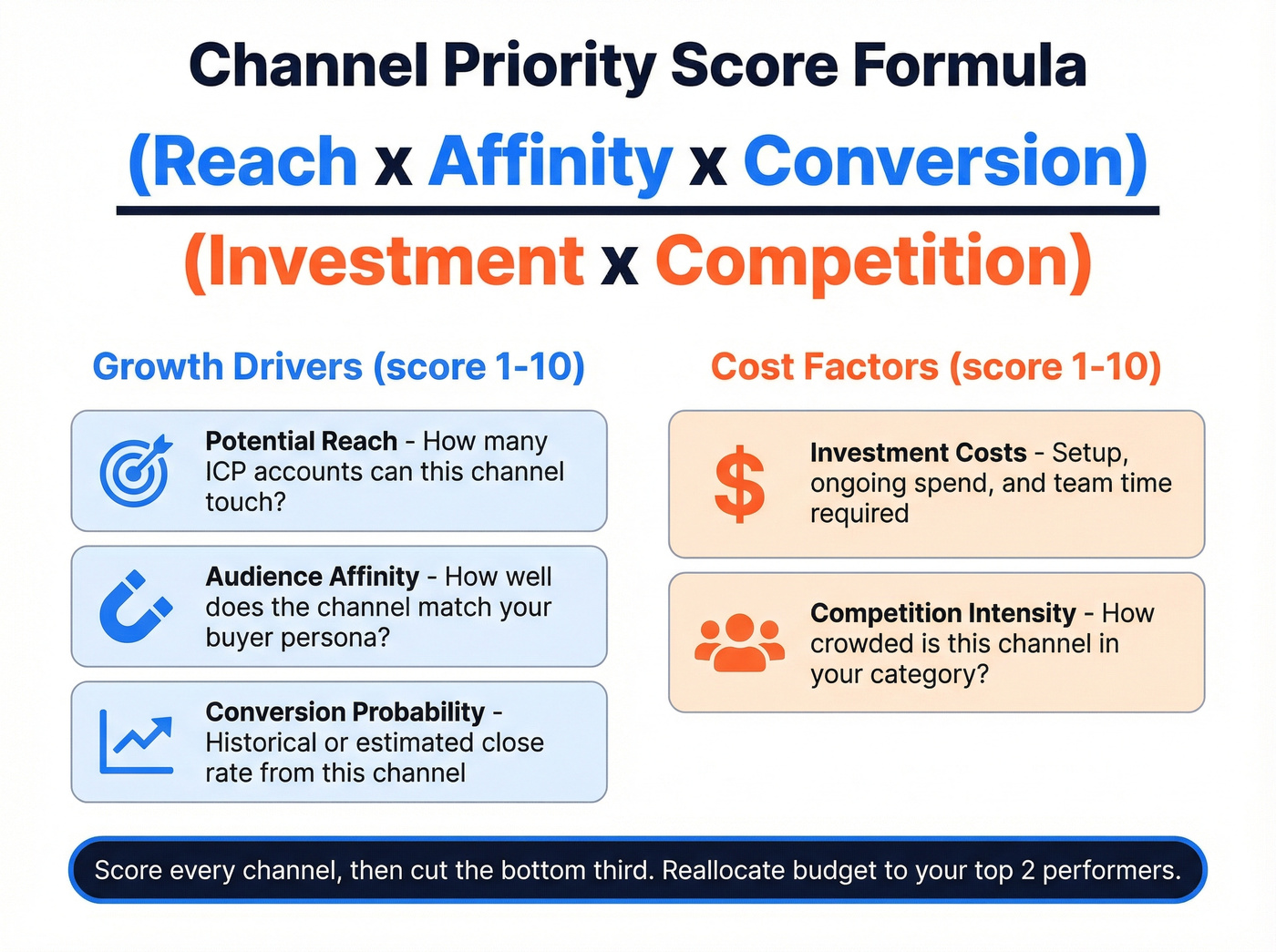
Use a scoring formula instead. The Channel Priority Score works like this:
(Potential Reach x Audience Affinity x Conversion Probability) / (Investment Costs x Competition Intensity)
Score every channel you're considering on a 1-10 scale for each variable. Multiply the top three, divide by the bottom two. The output isn't magic - it's a forcing function that makes you quantify assumptions instead of hand-waving. This is the foundation of effective sales process optimization, because it replaces opinion with data before you commit budget.
Structure your portfolio into three buckets: Owned (your website, direct sales, email), Paid (ads, sponsored content, paid partnerships), and Earned (referrals, organic, partner-sourced). Score every channel within each bucket. Then cut the bottom third and reallocate that budget to your top two performers.
Two channels with real investment behind them will outperform six channels with token effort every time.
Building Your Partner Program
Partner Types Worth Pursuing
Not all partners are created equal. The main categories, with when each makes sense:
- Resellers - buy and resell your product; best for geographic expansion
- VARs - add services or customization; strong in enterprise
- Referral partners - send leads for a fee; lowest friction to start
- Affiliates - drive traffic for commission; works for self-serve products
- Distributors - manage reseller networks; useful when you can't manage hundreds of partners directly
The 3-Tier Model
Keep it simple. Three tiers. More than three is bureaucracy that partners won't bother navigating.
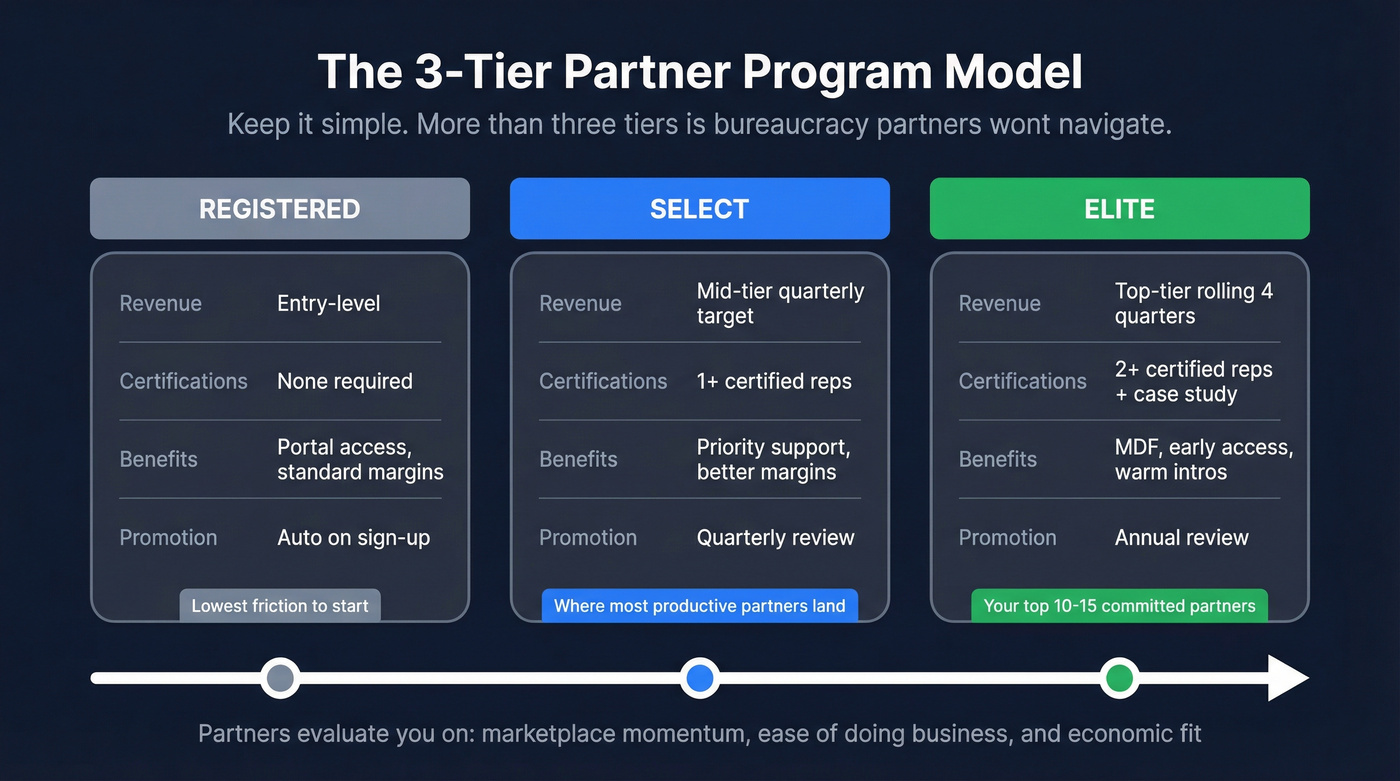
| Registered | Select | Elite | |
|---|---|---|---|
| Revenue | Entry-level | Mid-tier quarterly | Top-tier rolling 4Q |
| Certifications | None | 1+ certified reps | 2+ certified + case study |
| Benefits | Portal, standard margins | Priority support, better margins | MDF, early access, warm intros |
| Promotion | Auto on sign-up | Quarterly review | Annual review |
Partners evaluate your ecosystem on three factors: marketplace momentum, ease of doing business, and economic fit. If any one of those is broken, they'll deprioritize you - no matter how generous your margins look on paper.
The 90-day rollout: days 1-15, define rules and criteria. Days 16-30, wire the data and test your portal. Days 31-60, pilot co-sell and co-marketing with 3-5 partners. Days 61-90, publish the program and set quarterly review cadence. We've seen companies skip the pilot phase and stall at launch - don't be one of them.
If you're building the operating rhythm around those quarterly reviews, a tight QBR questions list helps keep partner conversations measurable.
Incentives and Enablement
The incentive toolkit includes SPIFs, rebates, tier-based margin increases, points programs, and non-monetary recognition like awards and conference speaking slots. The principle is straightforward: set partners up for success with simplified pricing, proper training, and the right level of support without micromanagement.
The one thing most programs get wrong is internal rep compensation. If your direct reps earn less when a deal goes through channel, they'll sabotage the program. Period. Implement channel-neutral compensation - reps get paid the same regardless of fulfillment path.
Recruiting the Right Partners
Finding the right partners is a prospecting problem. You need to reach channel directors, VP-level partnership leads, and business development executives at organizations that align with your ICP. Your first email to a potential partner sets the tone for the entire relationship - a bounced message or wrong contact signals you aren't serious.
If you want to systematize that outreach, borrow a few sales prospecting techniques and pair them with proven sales follow-up templates.
Channel Conflict Management
Deal registration is the single most important mechanism in channel sales. Not partner portals. Not MDF programs. Not tier structures. Deal registration. If partners don't trust it, nothing else matters.
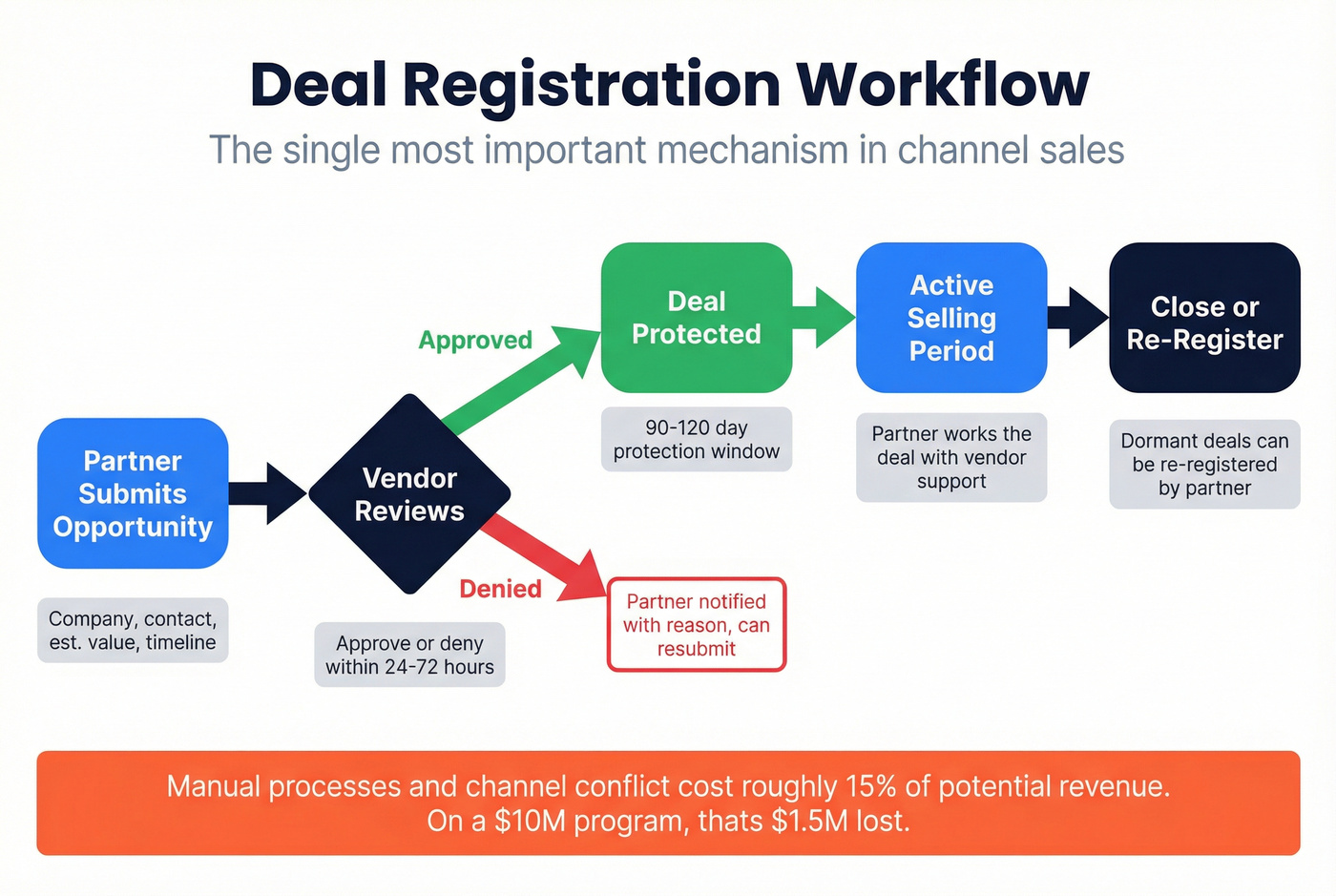
The workflow should be airtight:
- Partner submits an opportunity with sufficient detail - company, contact, estimated value, timeline
- Vendor approves or denies within 24-72 hours
- Approved deals are protected for a defined period, typically 90-120 days
- If a deal goes dormant and reactivates, the partner can re-register
- Rules are enforced consistently, regardless of deal size or partner tier
Publish clear rules of engagement. Automate the entire process through a web portal - don't run it through email or spreadsheets. The consensus on r/channelsales and r/msp is that "spreadsheet death" kills more partner programs than bad economics do: manual POS tracking, delayed rebate reconciliation, and deal registration run through email threads. If your program still operates this way, partners will deprioritize you.
Manual processes and channel conflict cost roughly 15% of potential revenue. On a $10M channel program, that's $1.5M walking out the door.
Measuring Channel Performance
Two metrics matter most, and most teams confuse them. Partner-sourced pipeline is the sum of opportunity values where the partner was the lead source. Partner-influenced pipeline captures deals where a partner was involved but didn't originate the lead - the "surround-sound" effect of partners touching deals at multiple stages.
The conversion rate formula: (Closed-won deals from partner leads / total partner leads) x 100. In high-performing programs, partner-sourced conversion rates exceed direct marketing channels by 10-20 percentage points. If yours don't, the problem is usually partner enablement, not partner quality.
To keep reporting consistent, align your definitions with core sales operations metrics and monitor overall pipeline health.
One warning that's easy to overlook: up to 60% of MDF goes unspent in the average channel program - money allocated for co-marketing that never gets used because the application process is too complex or reimbursement is too slow.
Track KPIs on a phased cadence: weekly pipeline reviews, monthly conversion and CAC analysis, quarterly program health assessments. Without this rhythm, underperforming partners stay in the program too long and top performers don't get the attention they deserve.
8 Mistakes That Kill Channel Programs
- Building the program in a back room for months before engaging the market. Ship a minimum viable program and iterate.
- Chasing mega-partners for 2+ years. We've seen companies waste entire quarters pursuing SAP or Oracle partnerships that never materialize. The odds of meaningful engagement are low. Skip this if you're under $20M ARR.
- Letting direct salespeople manage partners. Channel management is a different skill set entirely. When hiring dedicated channel managers, look for digital fluency signals: a Social Selling Index above 70, active content creation, and a network that overlaps with your target partner ecosystem.
- Unrealistic revenue timelines. Expecting channel revenue in 90 days is a fantasy. Plan for 6-12 months to meaningful pipeline.
- Expecting results without training. Partners won't sell what they don't understand. Full stop.
- CEO-to-CEO agreements without engaging the partner's sales team. Executive handshakes don't close deals. Partner reps do.
- Over-investing in single-opportunity partners. One deal isn't a partnership - it's a transaction.
- Blindly awarding or refusing exclusivity. Both extremes are wrong. Exclusivity should be earned, time-bound, and tied to performance commitments.
A well-built sales channel strategy isn't a side project. Build the mechanics right, resource it properly, and it becomes the most capital-efficient growth engine in your business.
One channel manager overseeing 40-60 partners needs scalable data infrastructure behind them. Prospeo's API delivers a 92% match rate with 50+ data points per contact, refreshed every 7 days - not the 6-week industry average. Plug it into Salesforce, HubSpot, or Clay so every partner rep hits verified buyers, not bounced emails.
Give your channel the data advantage that makes the 13x CAC gap real.
FAQ
What's the difference between a sales channel and a distribution channel?
A sales channel is any route through which you sell - direct, partners, e-commerce, marketplaces. A distribution channel specifically handles delivery logistics and fulfillment. In B2B SaaS the distinction matters less since delivery is digital, but in physical goods they're separate budget lines with different partners.
How long before a channel program generates revenue?
Plan for 6-12 months before meaningful partner-sourced pipeline. The first quarter should focus on partner activation and deal registration volume, not closed revenue. Programs that expect returns in 90 days almost always get killed before they mature.
How many partners should a new program start with?
Start with 10-15 committed partners, not 100 signed and inactive. One channel manager can support 40-60 active partners at scale, but early-stage programs need concentrated attention on fewer relationships to build repeatable co-sell playbooks before expanding.
What are common B2B sales channel strategy examples?
The three most proven models are a reseller-led approach for geographic expansion - say, a US SaaS company using regional VARs to enter EMEA - a referral partner program where consultancies send qualified leads for a 15-25% revenue share, and a marketplace play listing on platforms like AWS or HubSpot's ecosystem. The right mix depends on your ACV, product complexity, and post-sale support requirements.
How do you find the right channel partners?
Treat partner recruitment like outbound prospecting: define your ideal partner profile by industry, company size, and tech stack overlap, then build a targeted list. Prospeo's 30+ search filters let you identify channel directors and VP-level partnership leads at companies matching those criteria, with 98% email accuracy so your first outreach actually lands.