

Cold Calling Techniques: The Data-Backed Playbook for 2026
You're 45 minutes into your call block. Eighteen dials, zero pickups, and a growing suspicion that half these numbers are disconnected. The problem isn't your script - it's that you're dialing dead numbers at the wrong time with no pre-call intel. 82% of buyers accept meetings from cold calls, so the channel works. Your technique just needs a data-driven overhaul.
The Compressed Playbook
- Fix your data first. Verified phone numbers are the single biggest multiplier. Everything else is optimization on top of a broken foundation if your numbers don't connect.
- Call Monday-Tuesday, 8-11 AM local time. Monday at 8 AM hits a 30.4% connect rate vs. the 20.8% average.
- Master one opener, one objection framework, and one voicemail script - then A/B test from there.
Before You Dial
Most cold calling advice jumps straight to scripts. That's backwards. The three things that determine whether your call block produces meetings happen before you ever pick up the phone.
When to Call
MightyCall analyzed 187,684 valid weekday calls and found the timing gaps are massive:
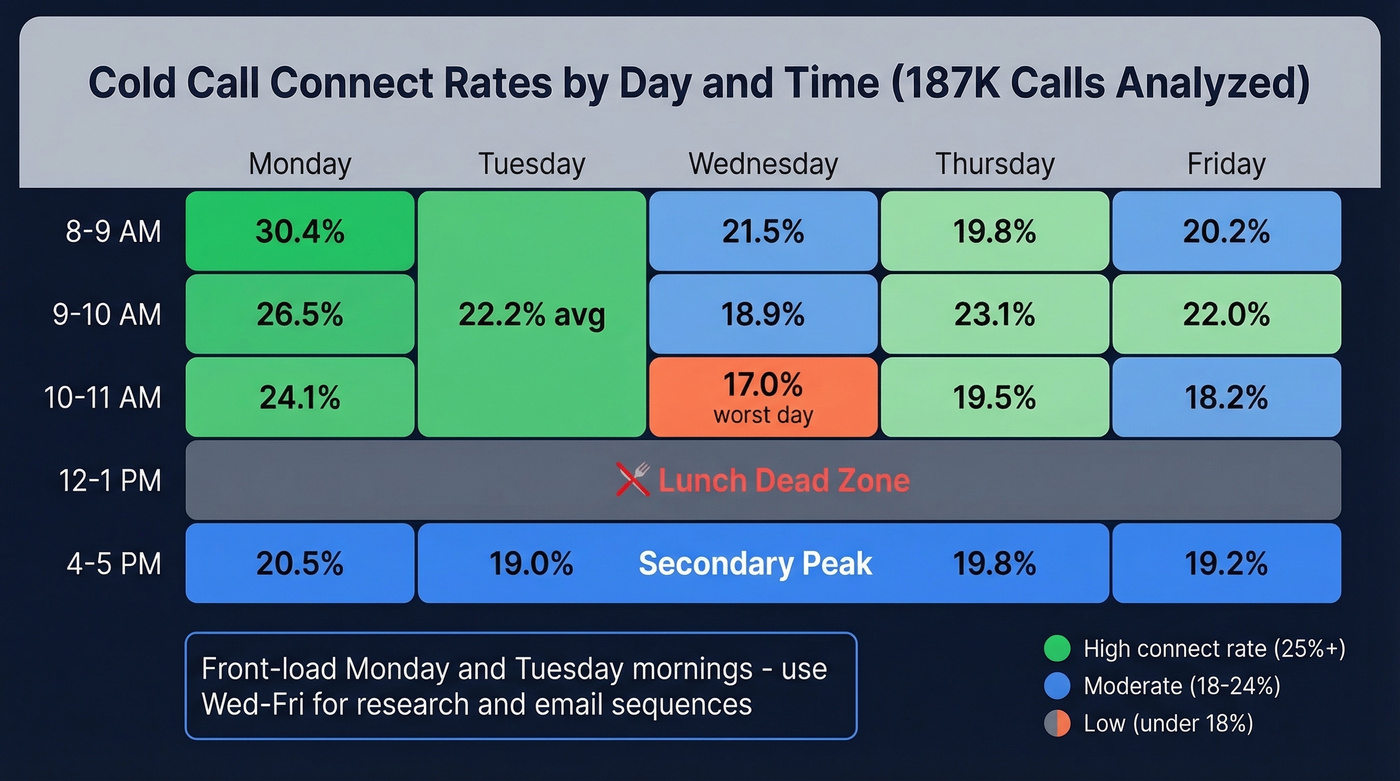
| Day | Best Time Slot | Success Rate |
|---|---|---|
| Monday | 8 AM | 30.4% |
| Tuesday | 8-11 AM | 22.2% avg |
| Any day | 10-11 AM | Peak window |
| Any day | 4-5 PM | Secondary peak |
| Wednesday | 10 AM | 17.0% (worst day) |
Monday and Tuesday mornings before 11 AM are where the connect rates live. Classic InsideSales/MIT research points to late afternoon as another strong window, and Gong's call-timing research also highlights 4-5 PM as a secondary peak. Wednesday is the low point. If you're scheduling call blocks, push them to the front of the week and avoid the 12-1 PM lunch dead zone entirely.
Here's the thing: most teams spread their call blocks evenly across the week. That's leaving 30%+ connect rate on the table. Front-load Monday and Tuesday mornings, then use Wednesday through Friday for research, email sequences, and social touches.
Your Numbers Matter More Than Your Script
The best opener in the world doesn't help if the number's disconnected. We've seen teams obsess over scripts while 30-40% of their dial list is stale data. When Meritt switched to Prospeo's verified mobile database, their connect rate tripled to 20-25% and their bounce rate dropped from 35% to under 4%. Fix the data layer first, then optimize technique.
The 2-Minute Research Checklist
Before every dial, spend two minutes on these four things:
- Title and reporting line - know who you're talking to and who they report to
- Company trigger - recent funding, hiring surge, leadership change, or product launch
- Tech stack signal - what tools they're already running, which tells you where you fit
- Mutual connection or content - anything that earns you 10 extra seconds of attention
If you want a tighter system for this, use a repeatable call prep checklist.
Set Your Environment
This one gets overlooked. Stand up or use a standing desk, put on noise-canceling headphones, and close Slack. Some reps swear by a dedicated "call block playlist" to get into rhythm. It sounds trivial, but your energy and focus in the first 10 seconds of a call determine whether the prospect stays on the line or hangs up. A distracted rep sounds distracted - and prospects can tell immediately.
Openers That Actually Convert
Most reps default to "Hi, this is [name] from [company], how are you?" That's the fastest way to sound like every other cold caller who interrupted someone's morning.
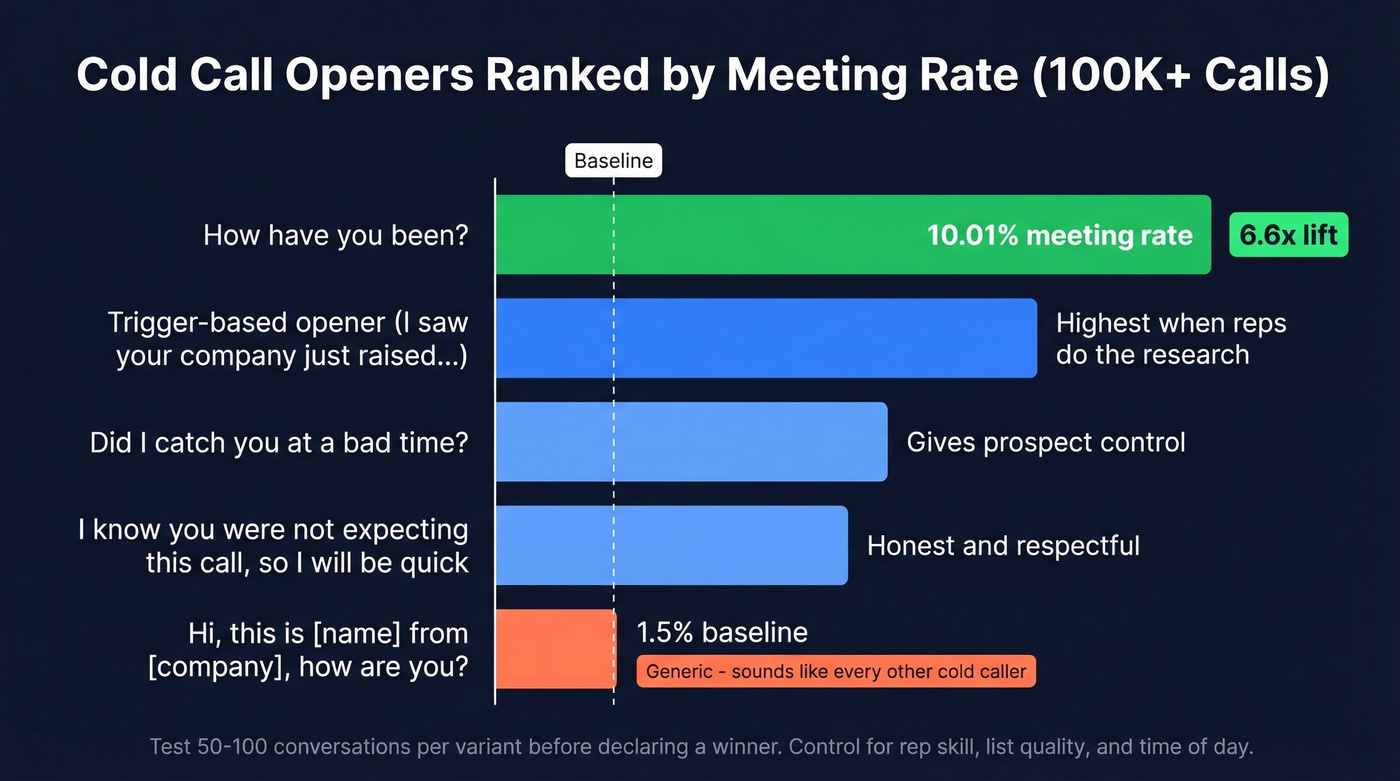
Research across 100K+ calls found that the opener "How have you been?" produced a 10.01% meeting rate - a 6.6x lift over the 1.5% baseline. Why? It creates a pattern interrupt. The prospect's brain expects a pitch and gets a question that sounds like a familiar conversation instead.
Other pattern interrupts that work:
- "Did I catch you at a bad time?" - counterintuitive, but it gives the prospect control and reduces resistance
- "I know you weren't expecting this call, so I'll be quick." - honest and respectful of their time
- Drop your last name and company from the intro. Rory Vaden's approach: just use your first name. "Hey Sarah, it's Mike" sounds like someone she knows. "Hi Sarah, this is Michael Thompson from Acme Solutions" sounds like a cold caller.
- Trigger-based opener: "I saw [company] just raised a Series B - congrats. That usually means the sales team is scaling fast. Is that happening for you?"
The trigger-based opener takes more prep but converts at the highest rate in our experience because it proves you did homework. We've tested all four of these across different verticals, and the trigger-based approach consistently wins when reps actually do the research. When they don't, "How have you been?" is the safer bet.
If you want more options, pull from these sales openers and keep your testing disciplined.
How to test: Run 50-100 conversations per variant before declaring a winner. Control for rep skill, list quality, and time of day. Anything less than 50 conversations is noise, not signal.
Discovery Questions - SPIN in 5 Minutes
Neil Rackham's SPIN Selling framework comes from 35,000 observed sales calls. The question structure compresses beautifully into a cold call's tight window.
| SPIN Type | Purpose | Cold Call Example |
|---|---|---|
| Situation | Understand context | "How's your team handling outbound today?" |
| Situation | Map the stack | "What tools are you using for lead gen?" |
| Problem | Surface pain | "Where does that process break down?" |
| Problem | Quantify friction | "How much time does list building take per week?" |
| Implication | Deepen urgency | "What happens to pipeline when data goes stale?" |
| Implication | Connect to outcomes | "How does that affect quota attainment?" |
| Need-Payoff | Let them sell themselves | "If you cut research time in half, what changes?" |
| Need-Payoff | Bridge to next step | "Worth 20 minutes to see how others solved this?" |
You won't get through all eight on a cold call. Pick two or three based on what the prospect gives you. The goal is to ask enough to earn the meeting, not to run a full discovery session on the phone. Teams that commit to a defined sales process are 33% more likely to hit high-performance benchmarks, so pick SPIN or Challenger and stick with it.
For more targeted prompts, keep a short bank of cold call qualifying questions by persona.

Your cold calling technique is only as good as your data. Prospeo gives you 125M+ verified mobile numbers refreshed every 7 days - not the 6-week-old stale lists tanking your connect rates. Meritt tripled their connect rate to 20-25% after switching.
Fix the data layer first. Everything else is optimization on a broken foundation.
Objection Handling Framework
About 60% of cold calls encounter "not interested" as the first response. That's not a rejection - it's a reflex. Knowing how to navigate these moments is what separates effective sales cold calling techniques from generic scripts that crumble at the first pushback.
If you want a deeper library, keep a swipe file of objection handling examples and practice them out loud.
Blocking vs. Qualifying Objections
Blocking objections are reflexive brush-offs: "I'm busy," "send me an email," "not interested." The prospect hasn't actually processed what you're offering. They're trying to end the interruption.
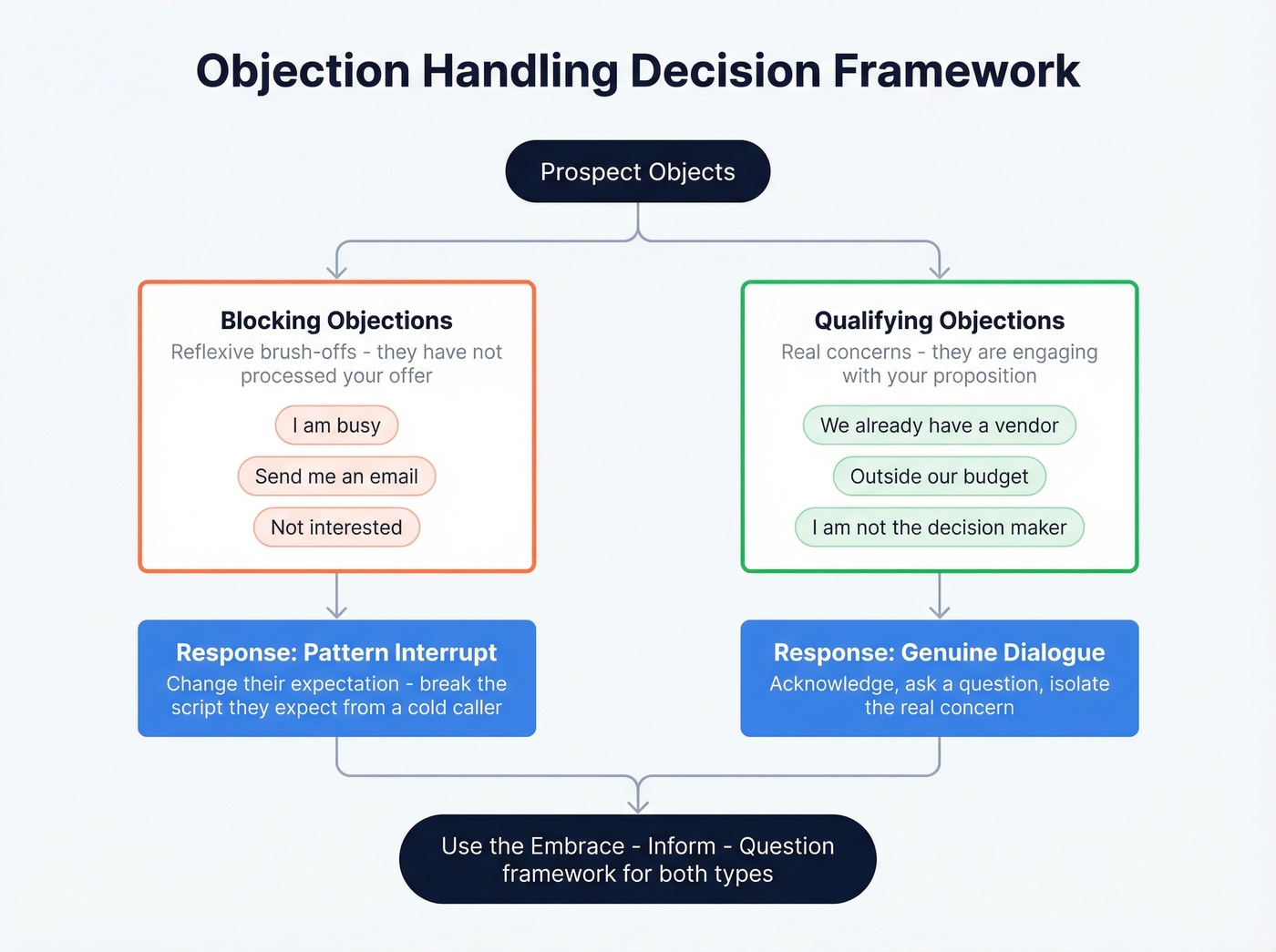
Qualifying objections are real concerns: "we already have a vendor," "it's outside our budget," "I'm not the decision maker." These mean the prospect is engaging with your proposition. The Embrace-Inform-Question framework works for both types, but your energy should be different. Blocking objections need pattern interrupts. Qualifying objections need genuine dialogue.
For a full system, see our cold calling objection handling guide.
The 5 Most Common Pushbacks
Budget - "Too expensive" "Totally fair - what outcomes would make this a no-brainer investment for you?"
Timing - "Not a good time" "I get it. When's a better 5 minutes this week?" Always offer a specific alternative. Never leave it open-ended or you'll never get them back.
Need - "We're happy with what we have" "Makes sense. Out of curiosity, how are you handling [specific gap]?" This works because it targets a known weakness in their current setup without directly attacking their vendor choice.
Authority - "I'm not the decision maker" "Who owns decisions around [area]? I'd love to make sure they see this too." Then ask if they'd be willing to make an intro.
Brush-off - "I'm not interested" "I hear you. Give me 90 seconds - if it's not relevant, I'll never call again." The "never call again" commitment is bold, but it works because it lowers the perceived risk of listening.
When someone says "send me an email," don't just comply. Try: "Happy to - but let me ask one quick question first so I can send you something actually relevant instead of a generic pitch." If you can isolate the real objection, close with: "If we could resolve [X], is there anything else preventing you from taking a closer look?"
Voicemails - What 300M Calls Reveal
An analysis of 300M+ cold calls produced counterintuitive voicemail data. Leaving voicemails reduces your future connect rate by 28% (5.17% vs. 7.18% without voicemails). But it more than doubles your email reply rate - from 2.73% to 5.87%.
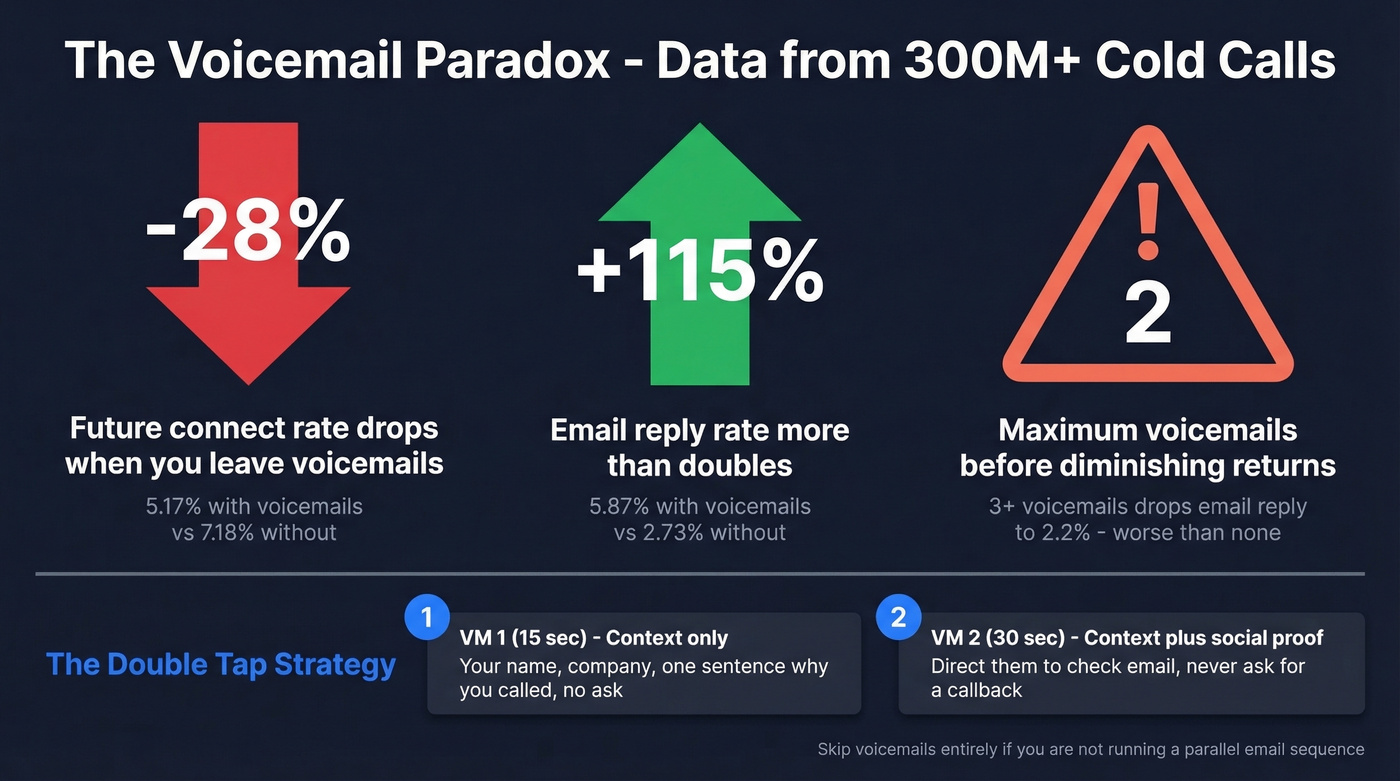
The catch: this only works with one or two voicemails. Three or more drops email reply rate to 2.2%, worse than leaving none at all.
If you want templates, keep a few proven cold call voicemail scripts ready so you’re not improvising.
The Double Tap
- Voicemail 1 (~15 seconds): Context only. Your name, company, one sentence about why you're calling. No ask.
- Voicemail 2 (~30 seconds): Context plus social proof. "We helped [similar company] do [specific result]." Direct them to check your email - never ask for a callback.
Skip voicemails entirely if you aren't running a parallel email sequence. In the time it takes to leave a message, you could make roughly 25% more dials. The math only works when voicemails feed into a multichannel cadence - they're an amplifier, not a standalone tactic.
After the Call
The call ends. Most reps move to the next dial and forget everything that just happened.
Don't do that. Send a post-call email within five minutes. Use a simple subject line like "Thanks for the conversation today" and reference one specific thing from the call to prove it isn't a template. After every call block, score yourself 1-10 with sub-scores for opener execution, discovery depth, and objection handling. This sounds tedious, but it's how you identify which phase of the call is costing you meetings. I started doing this two years ago and it changed how I approached every single call block - the patterns become obvious fast.
A cold call should never exist in isolation. The sequence is call, email, social touch, call again. It typically takes at least five follow-ups to get a prospect's attention, so plan your cadence before you start dialing.
To tighten the system, build a repeatable cold calling cadence instead of winging follow-ups.
Mistakes Killing Your Cold Calls
Even well-practiced sales cold calling techniques fall apart when reps make these fundamental errors:
- Not researching the prospect. Two minutes of prep separates you from every other cold caller. Skip it and you sound generic.
- Pitching in the first 30 seconds. Your job on a cold call is to earn a meeting, not deliver a demo. Lead with questions.
- Reading scripts word-for-word. Use frameworks, not scripts. Prospects can hear when you're reading, and it kills trust instantly.
- Giving up after one or two attempts. Most meetings get booked on the third to fifth touch. If you're one-and-done, you're quitting right before the payoff.
- Using stale data. This is the most expensive mistake on the list because it compounds every single day. Dialing numbers that haven't been verified in months means 20-40% of your call block is wasted before you start. The consensus on r/sales is pretty clear: bad data is the #1 reason reps hate cold calling, and they're right.
If you want a broader benchmark view, track your cold call connect rate and fix the biggest leak first.
FAQ
How many cold calls does it take to book a meeting?
Dial-to-meeting rates sit around 2-3%. That means roughly 35-50 dials per booked meeting. Teams using verified mobile numbers with weekly refresh cycles report higher connect rates, which compresses the funnel significantly.
Is cold calling still effective in 2026?
Yes. 82% of buyers accept meetings from cold calls, and 57% of C-level executives prefer phone contact. The channel isn't dead; bad execution is. Teams that combine verified data, smart timing, and structured prospecting consistently outperform email-only outreach on pipeline generation.
What's the best cold call opener?
Research across 100K+ calls shows "How have you been?" produces a 6.6x higher meeting rate than baseline openers. But the best opener is the one you've A/B tested across 50+ conversations with your specific audience. What works selling cybersecurity to CISOs won't necessarily work selling HR software to CHROs.
How do I get accurate phone numbers for cold calling?
Prospeo's mobile finder covers 125M+ verified numbers with a 30% pickup rate and a 7-day refresh cycle. Free alternatives like company websites and professional directories work at small scale, but teams dialing 100+ numbers per day need a dedicated provider to avoid 30-40% disconnected-number waste.
You just spent two minutes researching a prospect's triggers, tech stack, and reporting line. Now imagine dialing a disconnected number. Prospeo's database pairs 30+ search filters - including intent data, technographics, and job changes - with verified direct dials at 98% email accuracy and 30% mobile pickup rates.
Turn every pre-call research minute into a conversation that actually happens.