

Cold Calling Objection Handling: What 300M+ Calls Actually Reveal
It's 9:02 AM. You've got a fresh call list, a coffee going cold, and a prospect who just hit you with "I'm not interested" before you finished your second sentence. Most reps think cold calling objection handling requires a playbook with 50 responses for 50 objections. They don't. Five objections account for 74% of all cold call pushback, and they fall into just three categories. Master those five, and you've handled three-quarters of every cold call you'll ever make.
The Short Version
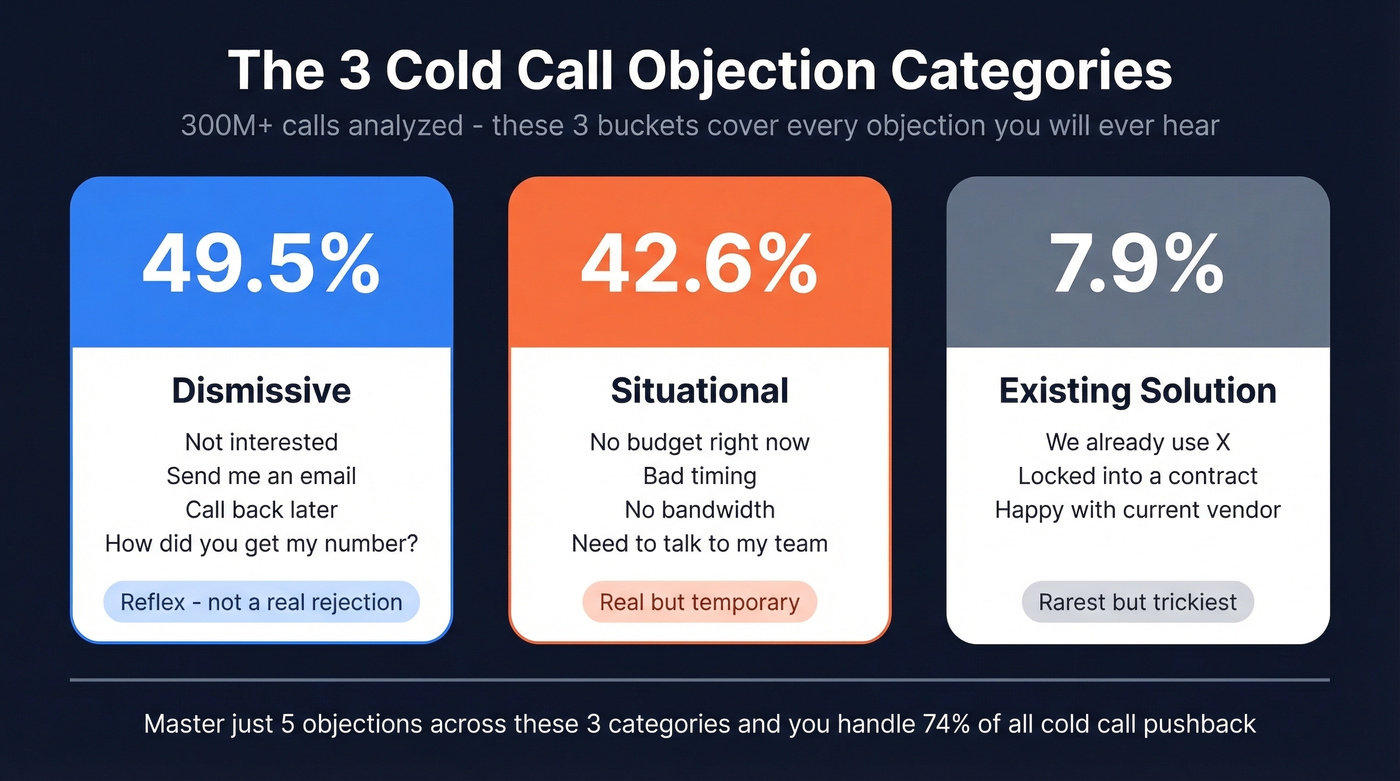
An analysis of 300M+ cold calls breaks all objections into three buckets: dismissive (49.5%), situational (42.6%), and existing-solution (7.9%). The move isn't to memorize scripts - it's to diagnose the category first, then respond with a simple framework: Agree, Incentivize, Sell the Test Drive. Learning how to handle objections in cold calling comes down to pattern recognition, not improv talent. The rest of this article gives you the data, the responses, and the practice method to make it stick.
What "Normal" Looks Like in 2026
Cold calling performance has tightened. The 2024 meeting-book rate was 4.82%. By 2025, Cognism showed that success rate had nearly halved - putting a working benchmark around 2-3% heading into 2026.
The average cold call now lasts about 93 seconds, up from 83 the year before. That's a sign reps who survive the opener are having slightly better conversations.
Here's what separates the top quartile: they book 3x+ more meetings than average reps. Not because they're smoother talkers - because they handle the first 60 seconds better and know when to stop dialing. Data shows 93% of conversations happen by the third call attempt and 98.6% by the fifth. Beyond five, you're burning dials for near-zero return.
A common benchmark on r/sales is that a ~5% connect rate with 200+ dials per day is workable if your data, dialer, and messaging are solid. That tracks with what we've seen across teams using verified mobile data.
The Three Cold Call Objection Categories
Dismissive Objections (49.5%)
Nearly half of all objections are reflexive. "Not interested." "Send me an email." "Call back later." "How'd you get my number?" These aren't reasoned rejections - they're a guard going up before you've said anything meaningful.
The key is reading tone, not words. If a prospect answers with a flat "I'm good" and zero reciprocity, that's the first roadblock. They're not evaluating your offer. They're trying to end the conversation. Prospects can hear a smile - literally. Stay warm and upbeat even when the prospect is flat. Don't mirror negative energy.
The "send me an email" objection gets called a pipeline killer in sales Reddit threads for a simple reason: most reps freeze and comply automatically. Don't. Here's how that exchange should go:
Prospect: "Just send me an email." You: "Happy to - what specifically should I cover so it's actually useful to you?" Prospect: "I don't know, just whatever you've got." You: "Fair enough. Most [their role] I talk to are dealing with [specific pain]. If that's on your radar, I can send something targeted. Is it?"
If they can't answer, it was a brush-off. If they can, you've just started a real conversation.
For "not interested," the instinct is to apologize and hang up. Fight that instinct:
Prospect: "I'm not interested." You: "Totally fair - most people say that before they know why I'm calling. Quick question: are you still [one-sentence value hook tied to their role]?"
You're not arguing. You're buying ten more seconds. And ten seconds is all you need to land one insight that earns curiosity.
If you want more scripts for the moment after the first “no,” see our guide to cold call rejection.
Situational Objections (42.6%)
"No budget." "Bad timing." "No bandwidth." These are real but not dead ends. Timing and resources shift - especially now that B2B buying groups have grown from 6 to 12 stakeholders. Your prospect might genuinely want what you're selling but can't act right now.
The response here is to acknowledge the constraint and reframe the ask. You're not selling a contract on a cold call. You're selling a 15-minute conversation:
Prospect: "We don't have budget for this right now." You: "Totally get it - budget cycles are brutal. Would it make sense to grab 15 minutes next month so you're not starting from scratch when the timing's right?"
You're planting a seed, not closing a deal. Only 13% of customers believe a salesperson can understand their requirements. Situational objections are your chance to prove you're not the other 87% by showing you actually listened.
If you’re tightening your outbound motion overall, pair this with a simple cold calling system so timing objections don’t derail your week.
Existing-Solution Objections (7.9%)
"We already use X." "We're locked into a contract."
These are the rarest but the trickiest, because reps instinctively trash the competitor. Gong's research is clear: criticizing the current vendor makes prospects defensive. They chose that vendor. Attacking it feels like attacking their judgment.
Competitive mentions in sales conversations are up 57% since 2022 - prospects are comparing more actively than ever. Use that to your advantage:
Prospect: "We already use [Competitor]." You: "Good - glad you've got something in place. Curious: if you could change one thing about how it's working, what would it be?"
52% of B2B buyers say they're open to switching providers in the next two years. But they need to arrive at that conclusion themselves. Your job is to surface the gap, not create it.
For more on handling “we already use X” without getting defensive, build a lightweight competitive intelligence strategy.
The Response Framework That Works
The data-backed sequence works across all three categories:
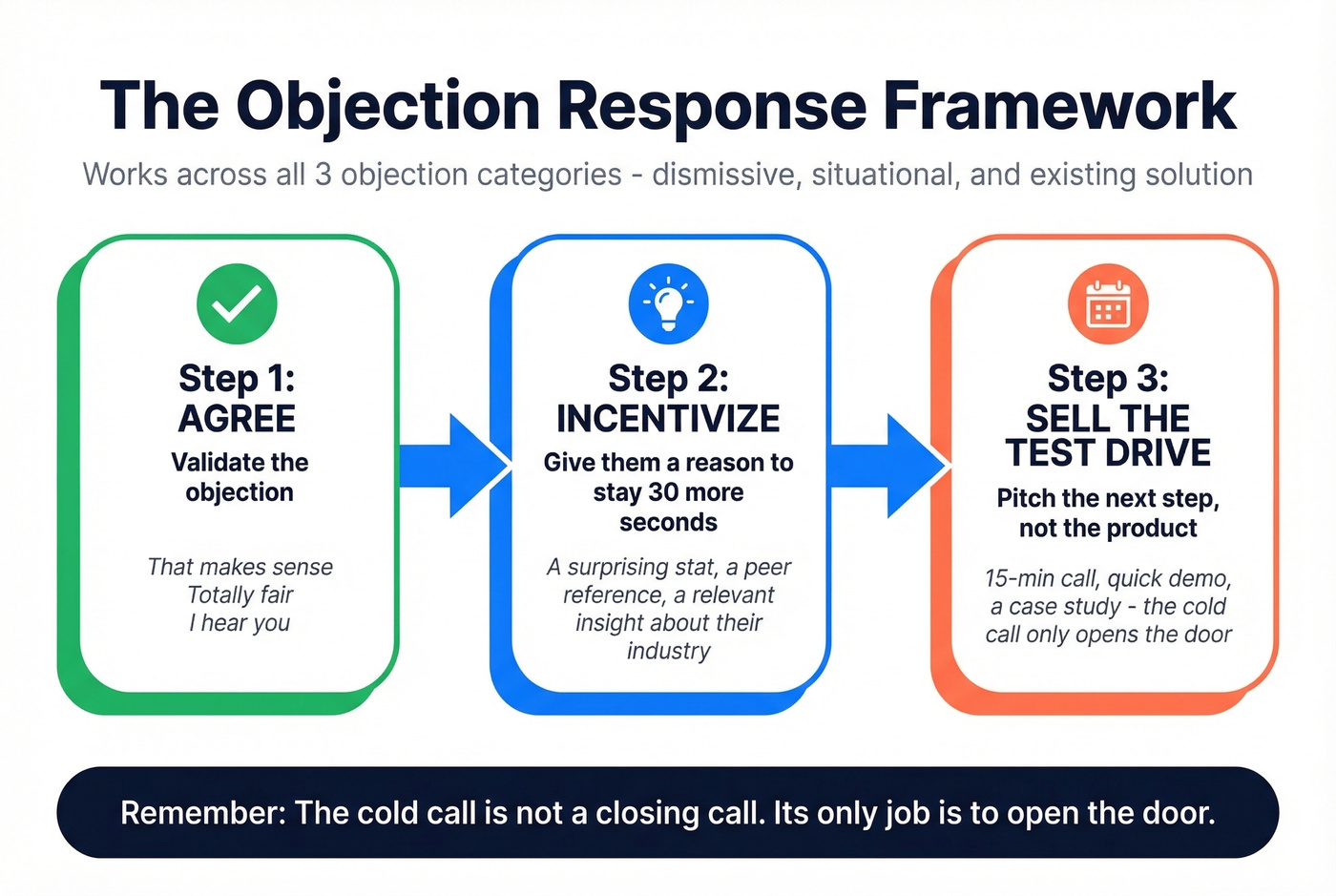
- Agree - Validate the objection. "That makes sense" or "Totally fair." This disarms the reflex and signals you're not going to bulldoze.
- Incentivize - Give them a reason to stay on the line for 30 more seconds. A surprising stat, a relevant insight about their industry, a peer reference. Something that earns curiosity.
- Sell the Test Drive - Don't pitch the product. Pitch the next step. A 15-minute call. A quick demo. A case study. The cold call's only job is to open the door.
This isn't a magic script. It's a decision tree that works because it matches how objections actually function - as reflexes, not conclusions. Once you internalize this loop, overcoming cold call objections becomes a repeatable skill rather than a guessing game.
If you want more ready-to-use language for the “one-sentence value hook,” pull from these sample elevator pitches.

93% of conversations happen by the third attempt - but only if you're dialing real numbers. Prospeo gives you 125M+ verified mobile numbers with a 30% pickup rate, so every dial actually reaches a decision-maker. Stop burning attempts on dead lines.
Fewer wasted dials. More conversations to actually handle objections on.
Mistakes That Create Objections
Most objections aren't inevitable. They're manufactured by bad habits. Let's be honest - if you want fewer objections, start by eliminating the behaviors that trigger them.
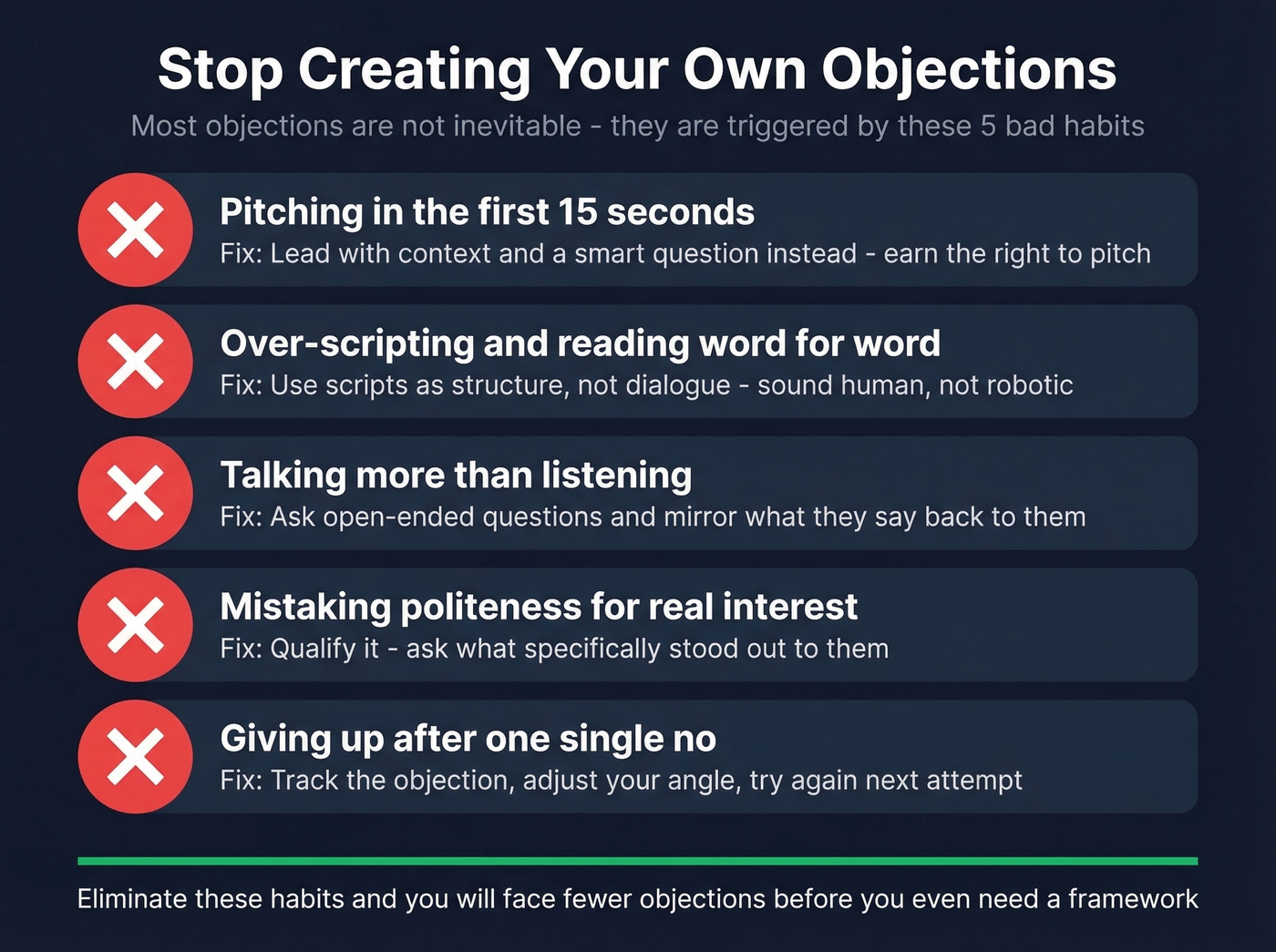
Pitching in the first 15 seconds. You haven't earned the right to pitch yet. Lead with context and a smart question instead.
Over-scripting. Scripts are structure, not dialogue. Reading verbatim makes you sound like a robot, and prospects can tell within five seconds. I once listened to a call recording where the rep read a 45-second opener word-for-word, complete with stage directions they accidentally said out loud. The prospect hung up at "pause for effect."
Talking more than listening. Open-ended questions and mirroring beat monologues every time. (If you want a broader set of tactics beyond calls, see these sales prospecting techniques.)
Mistaking politeness for interest. "That's interesting" doesn't mean they're buying. Qualify it: "When you say 'interesting,' what specifically stood out?" If they can't answer, you don't have a lead.
Giving up after one "no." A single objection is the start of the conversation, not the end. Track the objection, adjust your angle, and try again on the next attempt. But pushing past three clear rejections on a single call damages your brand. Know when to fold.
If you’re trying to reduce pushback at the source, this pairs well with a simple plan to reduce sales objection rate.
Why "Failed" Calls Still Work
Here's the thing: even calls that end in objections aren't wasted. Cross-channel data shows cold calling nearly doubles email reply rates - 3.44% vs 1.81% without calls. Leave a voicemail and the effect is even stronger: email replies jump from 2.73% to 5.87%.
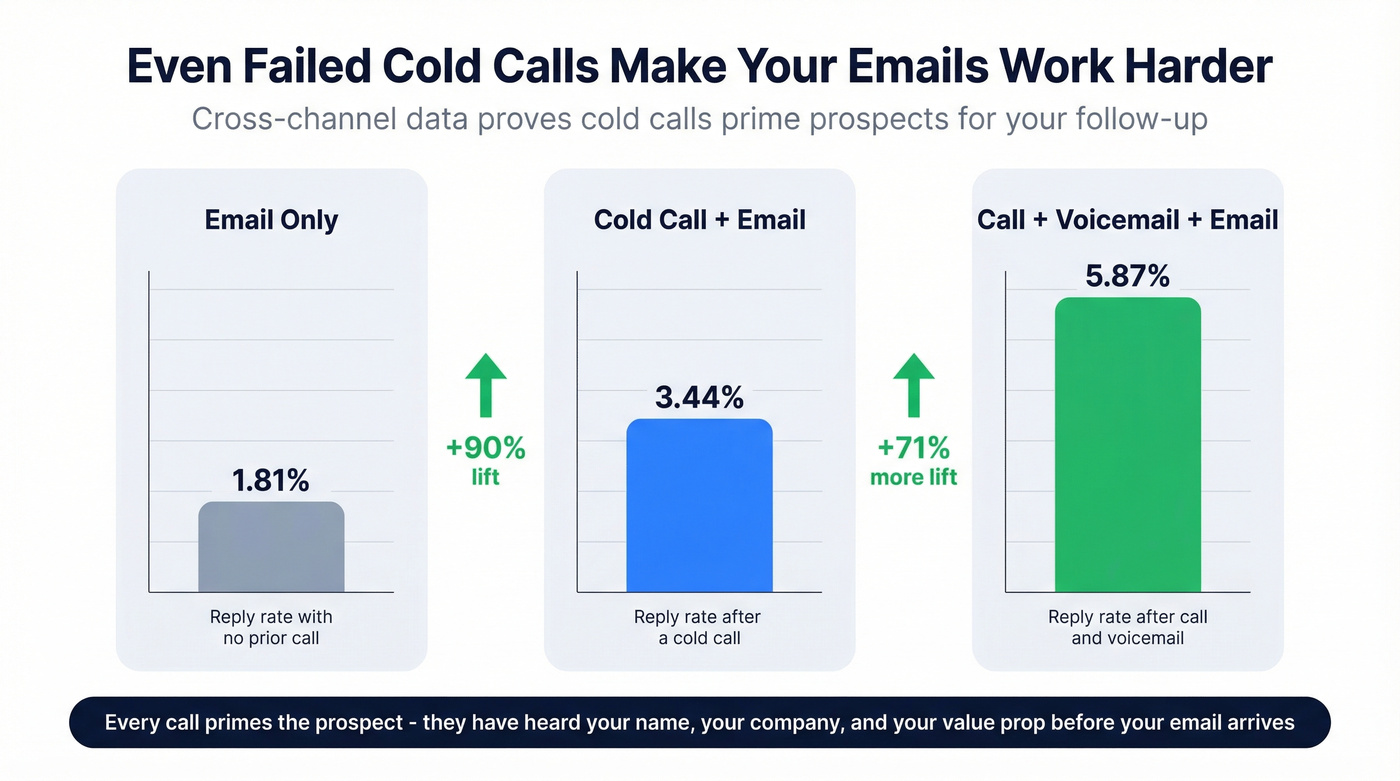
Every "failed" call primes the prospect for your next touch. They've heard your name, your company, maybe a one-sentence value prop. When your follow-up email hits their inbox, it's not cold anymore.
But that follow-up only works if it reaches a real inbox. We've seen teams lose entire sequences to bounced emails because their data was stale. Prospeo's email finder returns 98%-accurate addresses, so your post-call email actually lands instead of vanishing into a bounce log.
To tighten the post-call motion, keep a few proven sales follow-up templates ready to go.
Fix the Data Before the Dial
Look - bad data causes more "failed" cold calls than bad scripts ever will. B2B contact data decays roughly 2.1% per month. That's 22.5% of your list going stale every year. Reps lose 27.3% of their selling time to bad contact data. Three wrong numbers in a row tanks your energy, and that frustration bleeds into the fourth call. That's when the real objections start - not from the prospect, but from your own tone.
If your deal sizes are modest, you can't afford to waste dials on dead numbers. Verify your list before every call block. Email verification runs about $0.01 per address with Prospeo, and verified mobile numbers deliver a 30% pickup rate across all regions. The cheapest improvement you can make to your objection-handling results is ensuring someone actually picks up.
Skip the data step if you're calling a list of 10 warm referrals. But for any outbound list over 50 contacts? Verify first. Always.
If you’re cleaning lists at scale, compare options in our roundup of data enrichment services.
How to Practice Objection Handling
Lecture-based training has roughly 5% retention. Roleplay hits 75%. That gap explains why most cold call training doesn't stick.
In our experience, here's the practice loop that actually moves the needle:
- Pick one skill - opener, objection response, or closing. Don't practice everything at once.
- Build a persona - title, industry, likely objections, difficulty level. Make it specific: "VP of Marketing at a 200-person SaaS company who just renewed their contract with a competitor last quarter."
- Run the roleplay without pausing or checking notes. Simulate real pressure.
- Review feedback - tone, filler words, talk-to-listen ratio, missed moments.
- Repeat with one adjustment. Change one thing each round.
Practice the five core objections twice a week minimum. The reps who don't skip this are the ones who consistently book 3x more meetings than their peers. It's not talent. It's reps.
If you’re building a repeatable onboarding plan around this, plug it into a 30-60-90 day plan for sales reps.
The best objection-handling framework in the world can't save a call to the wrong person. Prospeo's 30+ search filters - including buyer intent, job changes, and department headcount - put you in front of prospects who match your ICP. At $0.01 per verified email and direct dials included, your call list pays for itself.
Build a call list worth picking up the phone for.
FAQ
What's the most common cold call objection?
"I'm not interested" - a dismissive reflex, not a reasoned rejection. Analysis of 300M+ calls shows dismissive objections account for 49.5% of all pushback. Don't treat it as a final answer. Agree, incentivize with a quick insight, and pitch the next step instead of the product.
How many times should you call a prospect?
Data shows 93% of conversations happen by the third attempt and 98.6% by the fifth. Beyond five calls, you're burning dials for near-zero return. Focus your energy on fresh prospects rather than grinding past diminishing returns.
Does cold calling still work in 2026?
Yes, but meeting rates have tightened to around 2-3%. The bigger insight: cold calling nearly doubles email reply rates (3.44% vs 1.81%), so even "failed" calls amplify your other channels. Pair calls with verified contact data to maximize every dial.
How should you respond to objections about budget or timing?
These are situational objections - real constraints, not brush-offs. Acknowledge the limitation, then reframe your ask from "buy now" to "let's talk so you're ready when timing shifts." This respects the prospect's reality while keeping the door open.
What's the best framework for handling cold call objections?
The Agree, Incentivize, Sell the Test Drive sequence. Validate the objection first, offer one insight that earns curiosity, then pitch the next step - never the product. It works because objections are reflexes, not conclusions.