

Sales Cycle Optimization: Kill Bad Deals Faster, Close Good Ones Sooner
The average B2B sales cycle now runs 6.5 months - up from 4.9 months in 2019. Your reps aren't getting slower. The buying process is getting harder, and most teams chasing sales cycle optimization are fixing the wrong things entirely.
What You Actually Need
- Stop trying to speed up every deal. Start killing bad-fit deals in week 2 instead of month 4.
- Know your benchmarks (tables below). If your cycle is 50%+ longer than your segment, it's a process problem, not a rep problem.
- Fix data quality first, then qualification, then automation. In that order.
Why Your Sales Cycle Keeps Getting Longer
Three forces are compounding against you. Buying committees have ballooned to an average of 25 stakeholders, up from 16 in 2017. More people means more alignment meetings, more internal selling, and more chances for a deal to stall completely.
Reps spend only [28-30% of their week](https://www.salesforce.com/news/stories/sales-research-2023/) actually selling. The rest disappears into CRM updates, internal meetings, and chasing bad contact data. Meanwhile, buyers do 60-70% of their research before ever talking to a rep, so the old "educate the prospect" playbook just wastes everyone's time. A RAIN Group study found 43% of sales leaders say cycles have increased while only 16% report them getting shorter. This isn't anecdotal. It's structural.
Here's the thing: a common refrain on r/sales captures the frustration perfectly - leadership demands shorter cycles while simultaneously adding more tools that slow reps down.
Benchmarks by Segment
These tables are your diagnostic baseline. Find your segment, compare your numbers, and flag the gap.
By Industry
| Industry | Avg. Days |
|---|---|
| Retail | 70 |
| Software | 90 |
| Financial Services | 98 |
| Consulting | 103 |
| Technology | 121 |
| Healthcare | 125 |
| Education | 126 |
| Insurance | 127 |
| Manufacturing | 130 |
| Pharmaceuticals | 153 |
| Energy | 155 |
| Non-Profit | 162 |
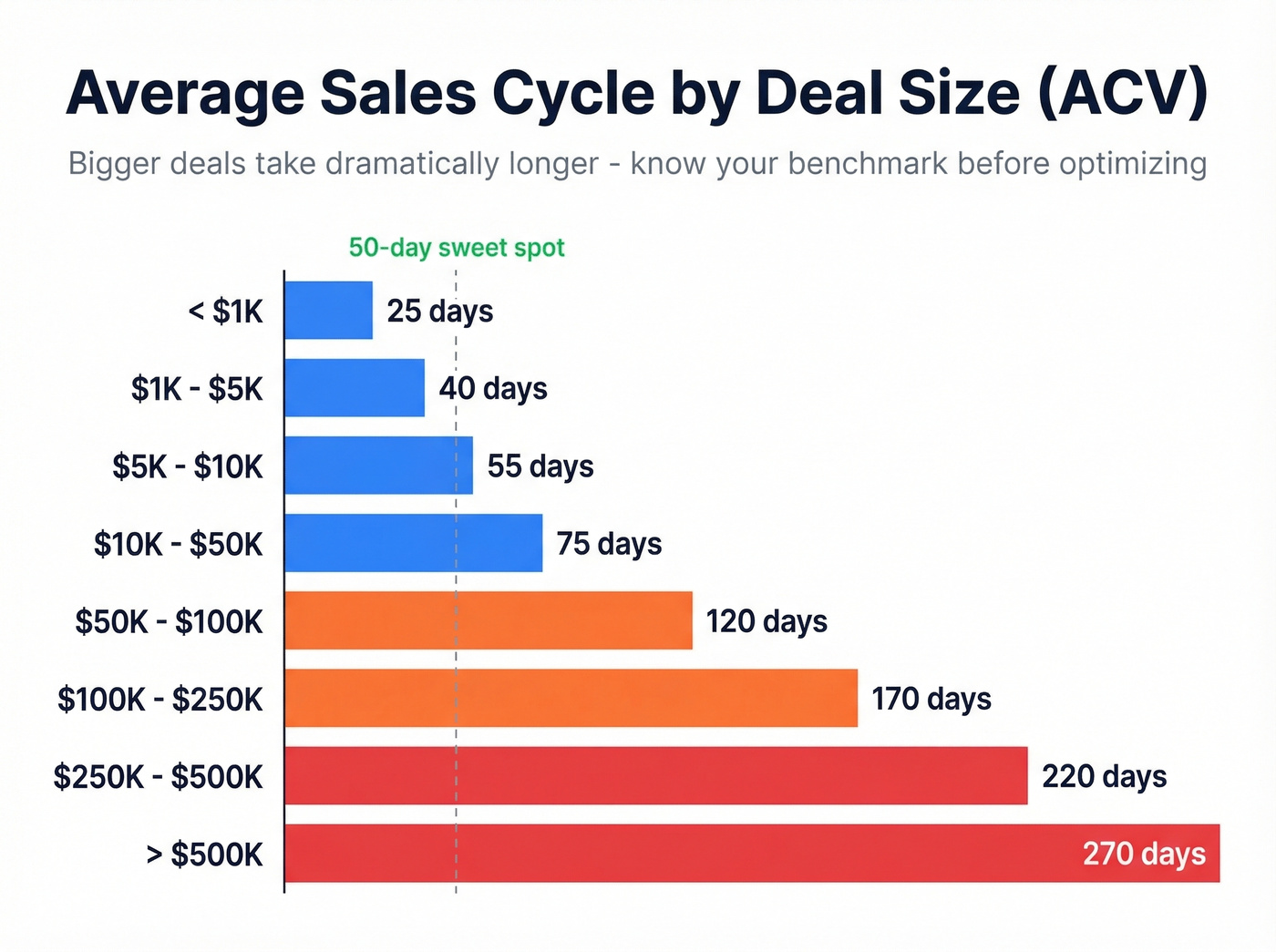
By Deal Size (ACV)
| Deal Size | Avg. Days |
|---|---|
| < $1K | 25 |
| $1K-$5K | 40 |
| $5K-$10K | 55 |
| $10K-$50K | 75 |
| $50K-$100K | 120 |
| $100K-$250K | 170 |
| $250K-$500K | 220 |
| > $500K | 270 |
By Prospect Company Size
| Employees | Avg. Days |
|---|---|
| 1-10 | 38 |
| 11-50 | 57 |
| 51-200 | 77 |
| 201-500 | 95 |
| 501-1,000 | 115 |
| 1,001-5,000 | 135 |
| 5,001-10,000 | 158 |
| 10,001+ | 185 |
By Channel
| Channel | Low Complexity | Med Complexity | High Complexity |
|---|---|---|---|
| Referrals | 20 days | 35 days | 60 days |
| Cold Calling | 60 days | 85 days | 110 days |
| Trade Shows | 80 days | 100 days | 150 days |
Stage-Level Example (Software, 90-Day Avg.)
| Stage | Avg. Days |
|---|---|
| Initial Contact | 14 |
| Proposal | 30 |
| Negotiation | 25 |
| Closing | 21 |
If your cycle is 50%+ longer than your segment benchmark, don't blame reps. Diagnose the process.
The 50-Day Rule
This stat should change how you run pipeline reviews. According to Outreach's 2025 analysis, deals closed within 50 days have a 47% win rate. After 50 days, win rates drop to 20% or lower.
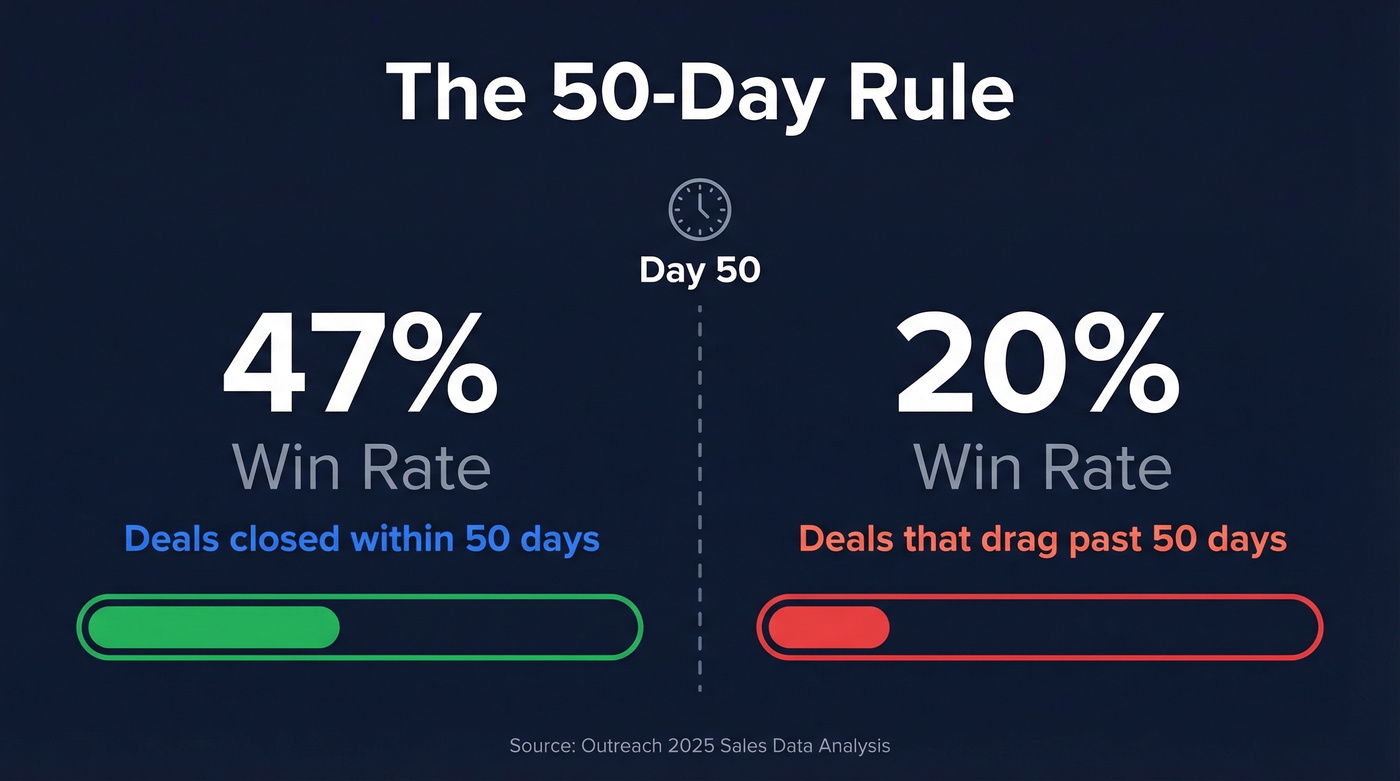
Every day past 50 costs you money - not just in rep time, but in opportunity cost. Those hours could go toward deals that actually close. Flag anything past 50 days in your CRM and force a review-or-kill decision. We've seen this single change do more for pipeline velocity than any tool purchase.

Deals that stall past 50 days drop to a 20% win rate. Every bounced email and wrong number pushes you closer to that cliff. Prospeo delivers 98% email accuracy and 30% mobile pickup rates on a 7-day refresh cycle - so your reps reach real buyers on the first attempt, not the fifth.
Stop losing weeks to dead contact data.
Why Deals Stall
Most cycle bloat comes from five root causes:
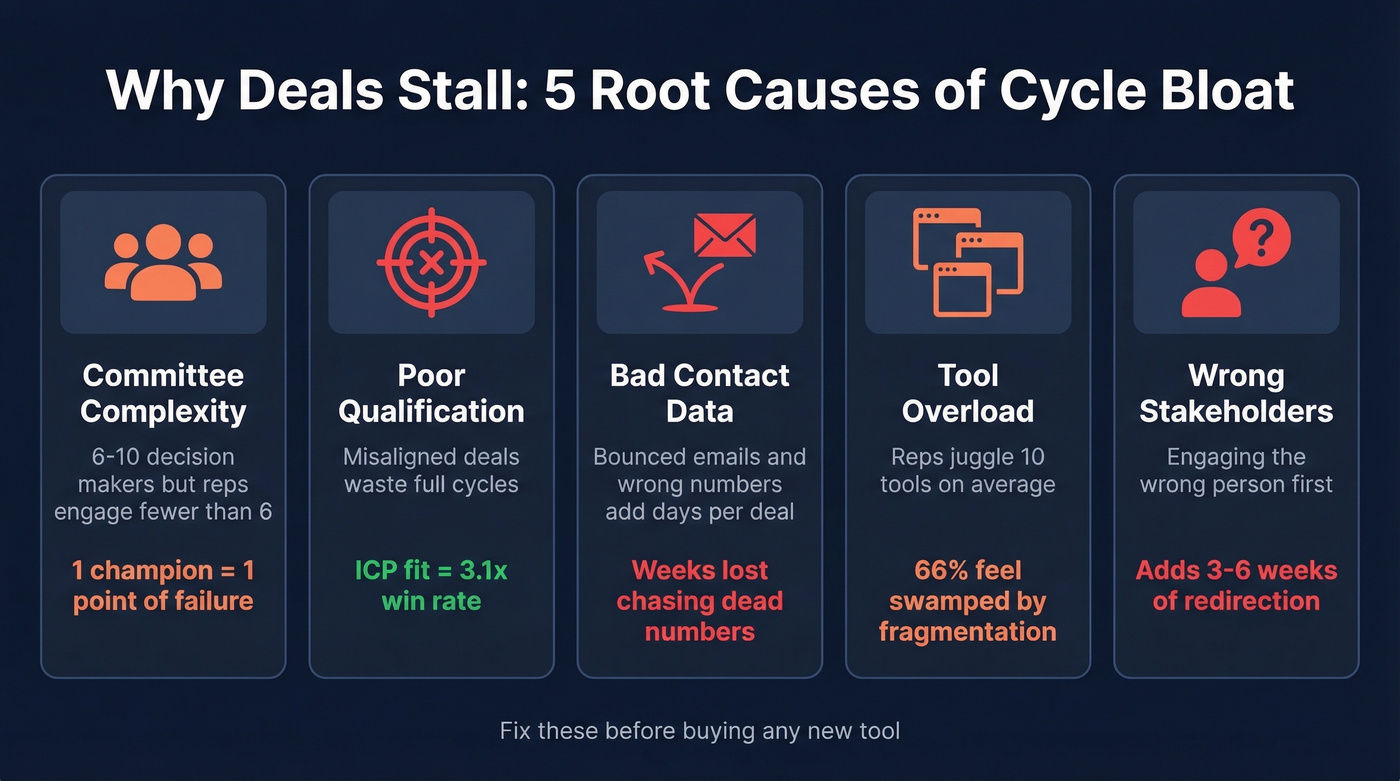
- Buying committee complexity. Industry research puts the typical B2B decision at 6-10 decision-makers, but reps often engage fewer than six contacts. Single-threaded deals die when your champion goes on vacation.
- Poor qualification. ICP-aligned deals win at 3.1x the rate of misaligned ones. If you aren't disqualifying early, you're investing full cycles in deals that were never going to close.
- Bad contact data. Bounced emails and wrong numbers aren't just annoying - they're dead touchpoints that add days to every deal. We've watched teams lose entire weeks chasing outdated phone numbers. (If you’re tracking this, start with bounce rate benchmarks and fixes.)
- Tool overload. Reps use an average of 10 tools, and 66% feel swamped by the fragmentation. More tools doesn't mean more productivity.
- Wrong stakeholders. Engaging the wrong person first adds 3-6 weeks while you get redirected to the actual decision-maker.
How to Optimize Your Sales Cycle
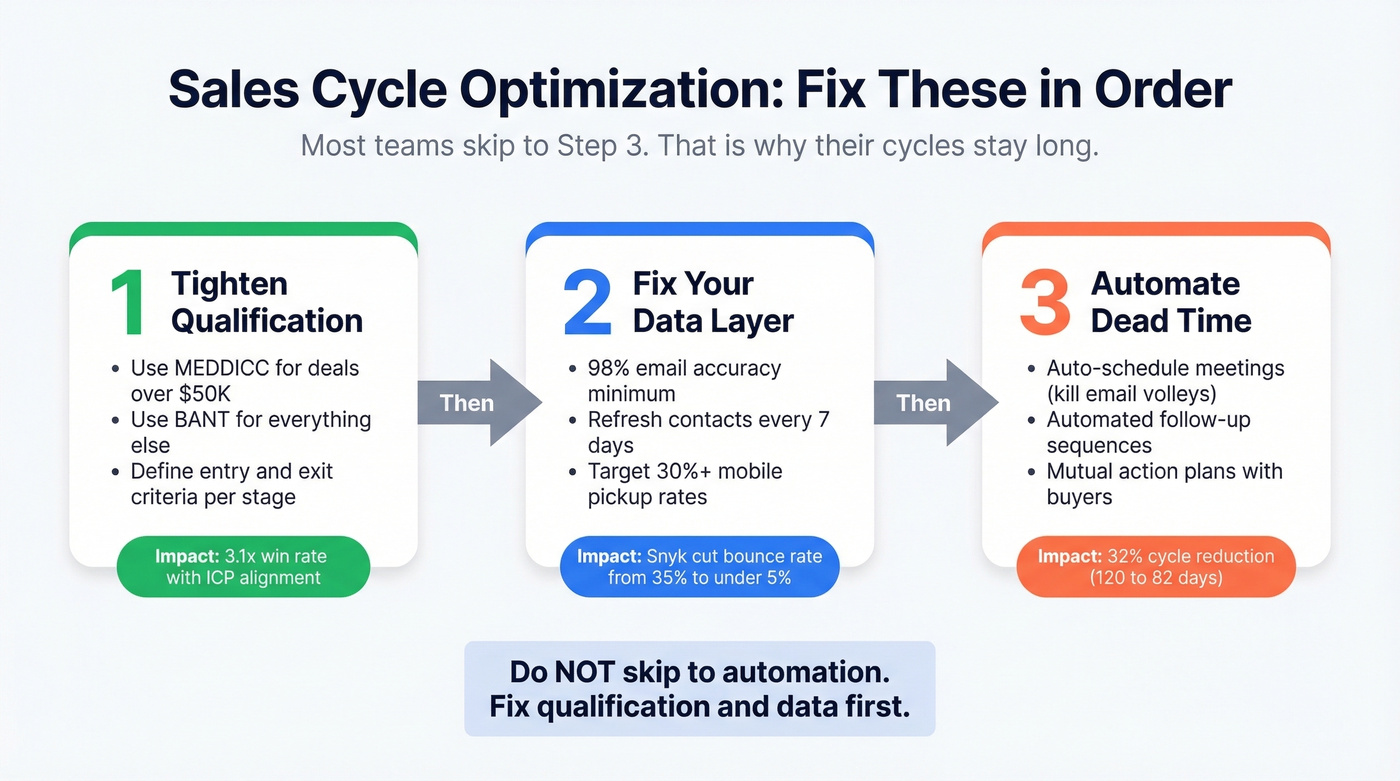
Most teams obsess over automation while ignoring the two things that actually move the needle. Here are the three levers in priority order.
Tighten Qualification
Use MEDDICC for deals over $50K and BANT for everything else. Stop overcomplicating it. ICP alignment drives a 3.1x win-rate multiplier, and process-led sales teams outperform by 25-30% on win rate compared to teams that let reps freelance their qualification.
Define entry and exit criteria for every pipeline stage. If a deal can't meet the exit criteria for Discovery within your median timeframe, it shouldn't advance - it should get killed or recycled. Skip this step if you're selling sub-$5K deals with short cycles; the overhead isn't worth it at that price point. If you need a tighter rubric, use an ideal customer profile scoring template.
Fix Your Data Layer
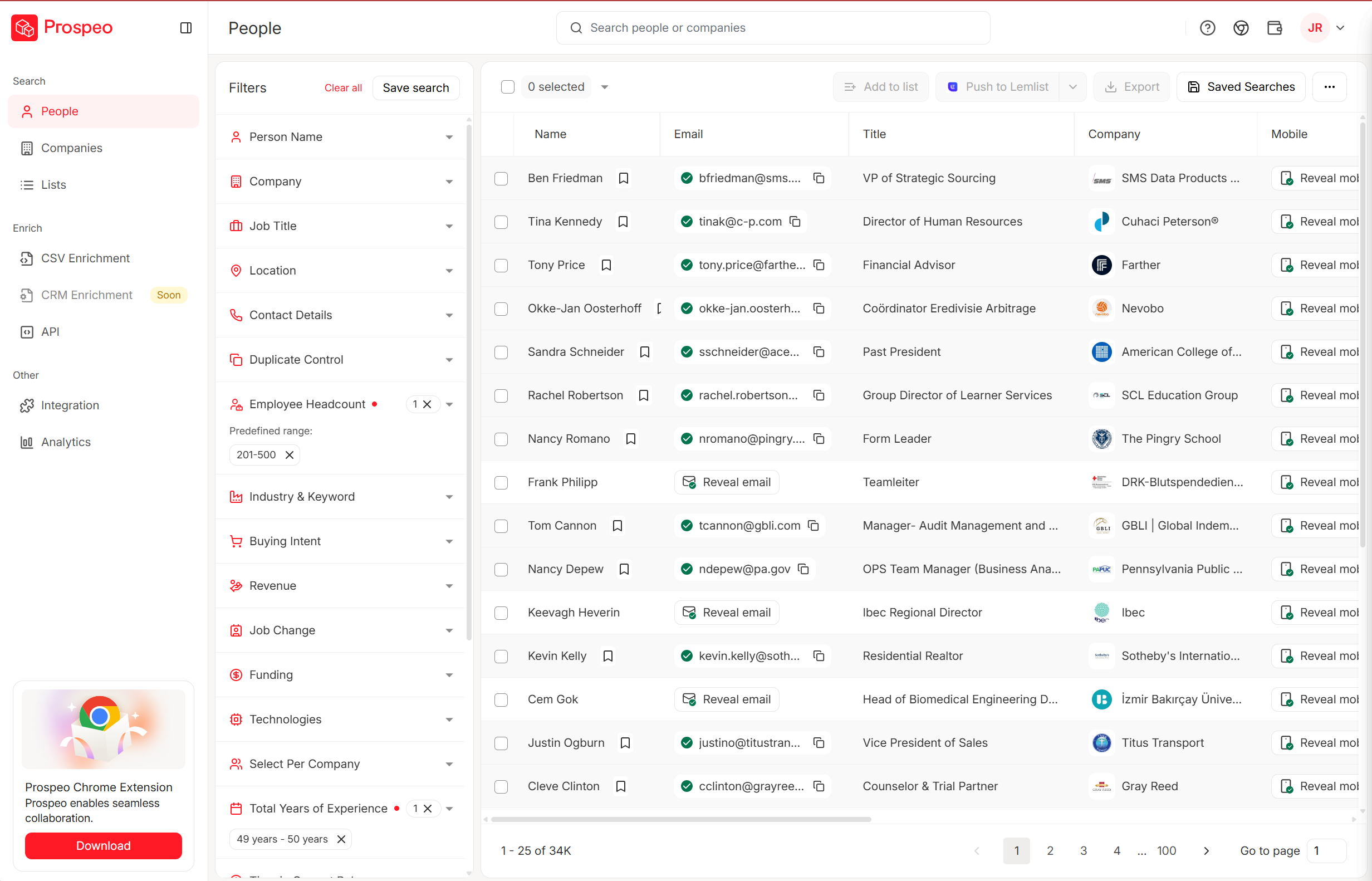
The fastest way to compress your cycle is to stop wasting time on contacts who never pick up. Prospeo handles this at the source: 98% email accuracy, a 7-day data refresh cycle, and 30% mobile pickup rates. Snyk's 50-person AE team went from a 35-40% bounce rate to under 5% after switching, and AE-sourced pipeline jumped 180%. If you’re evaluating vendors, compare data enrichment services and sales prospecting databases before you commit.
Automate Dead Time
Once qualification and data are solid, automate the administrative drag. Scheduling tools like Calendly or Chili Piper eliminate the 3-5 day email volley to book a meeting. Automated follow-up sequences keep deals warm without manual effort - use proven sales follow-up templates to standardize messaging. Mutual action plans give buyers a clear path to close - and in our experience, deals with a shared timeline close 15-20% faster than those without one.
A mid-market SaaS company cut their cycle from 120 to 82 days - a 32% reduction - by tightening qualification criteria and automating follow-up sequences. No new headcount. No expensive platform. Just process discipline. If your pipeline still feels stuck, audit common sales pipeline challenges next.
Mistakes That Lengthen Cycles
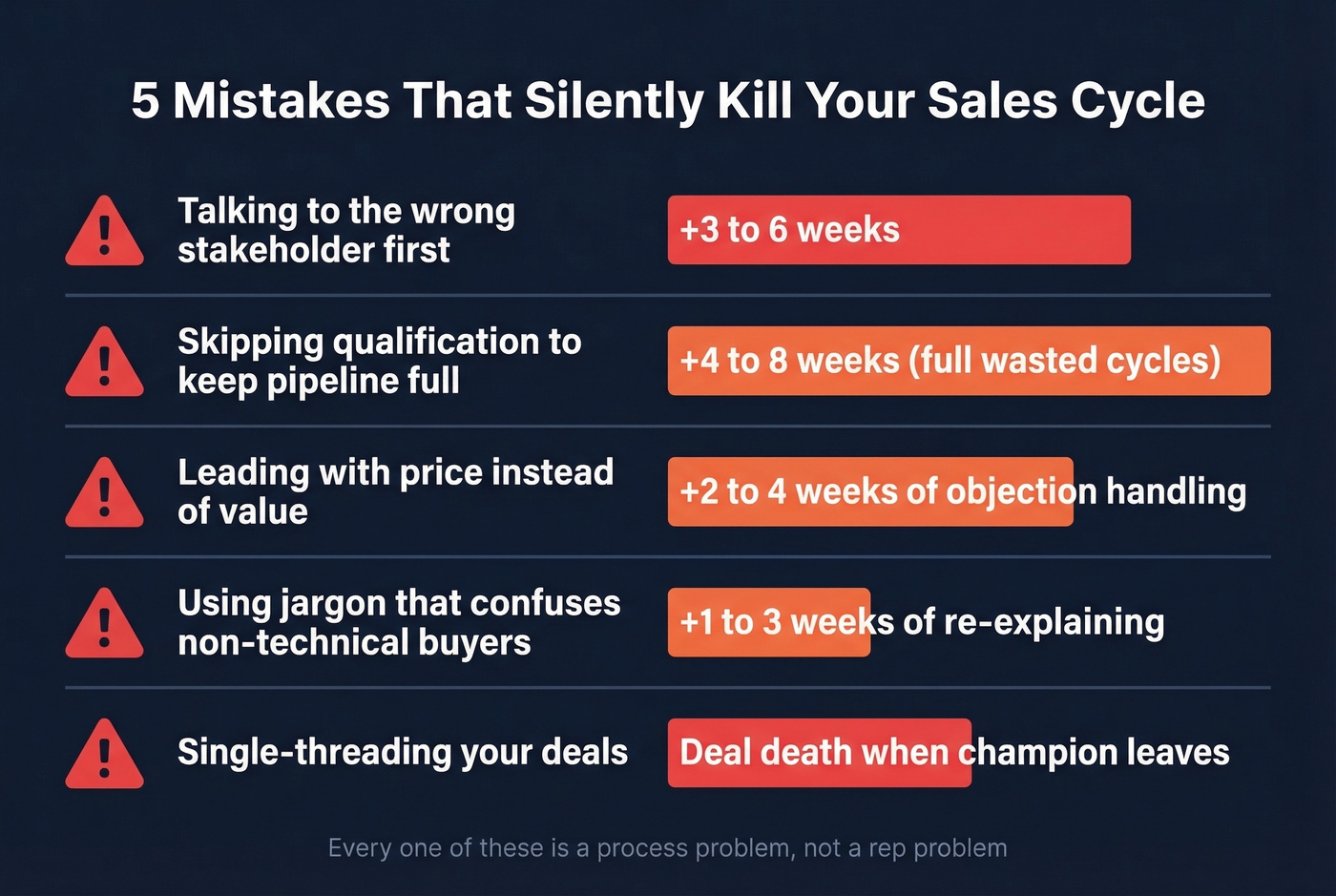
- Talking to the wrong stakeholder first (adds 3-6 weeks of redirection)
- Skipping qualification to "keep the pipeline full"
- Leading with price instead of value (use a clearer elevator pitch instead)
- Using jargon-heavy language that confuses non-technical buyers
- Failing to multi-thread - single-threaded deals are fragile and slow
AI and Sales Cycles in 2026
Let's be honest: AI won't fix a broken sales process. It'll just break it faster.
Bain's 2025 Technology Report found that AI drives 30%+ win-rate improvement - but only when paired with end-to-end process redesign, not bolted onto existing workflows. Gartner's Hype Cycle positions AI agents for sales squarely at the Peak of Inflated Expectations. If you’re shopping tools anyway, start with generative AI sales tools that support (not replace) process.
If your contact data bounce rate is above 10% or your reps can't articulate your ICP in one sentence, buying an AI tool is lighting money on fire. Fix the foundation first. Clean data, clear stage definitions, and consistent qualification make AI useful later instead of expensive now. For a broader framework, align this with sales process optimization.
Quick-Start Checklist
- Benchmark your cycle against the industry/ACV/company-size tables above
- Flag any deal past 50 days - review or kill it
- Audit your contact data bounce rate - if it's above 10%, fix data first
- Define entry/exit criteria for every pipeline stage
- Set time-in-stage alerts at 1.5x your median for deal velocity tracking
- Pick one qualification framework (MEDDICC or BANT) and enforce it (see MEDDIC sales qualification)
- Automate scheduling and follow-ups to eliminate dead time
Sales cycle optimization isn't about adding more tools or pressuring reps to close faster. It's about removing the friction that makes deals drag - bad data, weak qualification, and administrative dead time. Start with the benchmarks, enforce the 50-day rule, and fix your data layer. The cycle compresses itself.
Snyk's 50-person AE team cut bounce rates from 35-40% to under 5% and grew AE-sourced pipeline 180%. The fix wasn't a new process framework - it was replacing bad data with 300M+ verified profiles, 125M+ direct dials, and 30+ filters to find the actual decision-maker first.
Kill 3-6 weeks of redirection by reaching the right stakeholder immediately.
FAQ
What's a good cycle length for B2B SaaS?
For deals under $5K, target 40-55 days to close. Mid-market contracts ($50K-$100K) average 120 days, and enterprise deals above $250K typically run 220+ days. If you're 50%+ over your segment benchmark, audit qualification criteria and contact data quality before anything else.
How do you measure sales cycle length?
Measure from first meaningful contact to closed-won, not from lead creation date. Track median instead of average - outliers skew averages badly. Break it down by stage to pinpoint exactly where deals stall, then set time-in-stage alerts at 1.5x your median.
What's the fastest way to shorten a sales cycle?
Kill bad deals faster. Tighten qualification so you stop investing full cycles in deals that were never going to close. Then fix your contact data - bounced emails and wrong numbers waste days per deal. Prospeo's 98% email accuracy and 7-day refresh cycle eliminate most data-related delays.
Does AI actually shorten sales cycles?
Only if you redesign the process first. Bain's research found AI drives 30%+ win-rate improvement when paired with process redesign. Bolting AI onto a broken workflow just automates the dysfunction - clean data and clear stage definitions are prerequisites.