

How to Build a Sales Enablement Framework Reps Actually Use
Your VP just said "build out enablement" and gave you 90 days. You've got a Confluence page with 47 outdated battle cards, a content library nobody opens, and reps who spend 60% of their time on non-selling tasks](https://www.salesforce.com/sales/state-of-sales/sales-statistics/). Welcome to the starting line.
Most sales enablement framework efforts fail because they're built as content libraries, not operating systems. The teams that win treat enablement like infrastructure - something that runs underneath every deal, every sequence, every coaching conversation. 57% of sales professionals say the sales cycle is getting longer, and the answer isn't more content. It's better systems.
The Compressed Playbook
If you've been handed the enablement mandate and need to move fast:
- Start with a charter, not a content library. Define your mission, scope, and year-one success criteria before you touch a single asset.
- Diagnose your maturity stage before building. A team at the "Random" stage needs different interventions than one at "Scalable."
- Measure leading indicators, not just win rates. Content adoption and coaching frequency predict outcomes. Win rate tells you what already happened.
- Pilot with 5-10 reps for 4 weeks before scaling. Prove the model works small, then expand with data.
- Clean data is the foundation. Your framework fails if reps email bounced addresses or call dead numbers. Verify contact data before building anything on top of it.
What Is a Sales Enablement Framework?
A sales enablement framework is the operating system that connects strategy, content, tools, training, and measurement into a repeatable process for making reps more effective. It's not a content dump. It's not a tech stack. It's the connective tissue between all of those things.
At its core, enablement is behavior change management - translating strategy into specific rep behaviors, then reinforcing those behaviors until they stick.
The Sales Enablement Collective frames enablement as a continuous journey across five stages : strategy and planning, content, tech and tools, learning and development, and growth. We keep that structure here but make measurement a first-class pillar - because you can't scale what you don't measure.
Here's the thing: most teams confuse the framework with the platform. Buying Highspot or Seismic doesn't mean you have enablement. Those are tools. The framework is the logic that tells you what to put in them, who it's for, and how you'll know it worked.
Sales Enablement vs. Revenue Enablement
If your framework only covers the sales team, you're building for 2020.
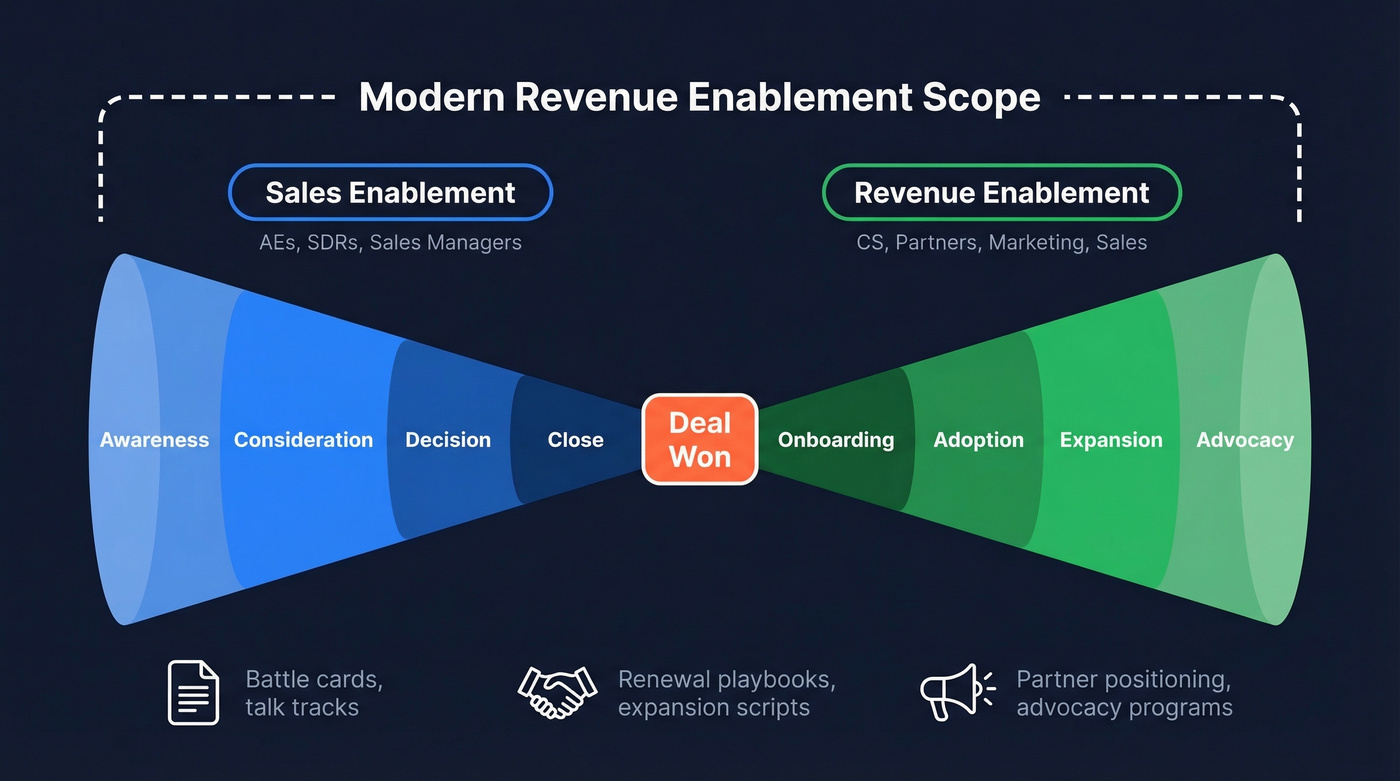
The shift happened because modern orgs don't work in silos - CS, marketing, and partners all touch revenue. Revenue enablement extends the same discipline to every customer-facing team across the full customer lifecycle.
The conceptual model is the bow-tie, popularized by Winning by Design. Instead of a linear funnel that ends at close, the bow-tie extends through onboarding, adoption, expansion, and advocacy. Your framework should account for how CS reps handle renewal objections, how partners position your product, and how marketing aligns content to actual deal stages - not just how AEs run discovery calls.
We'll build from a sales-first perspective, but design it so it scales into revenue enablement as your org matures.
Diagnose Before You Build: The Maturity Model
Before you start building, figure out where you are. We've seen teams waste months creating sophisticated coaching programs when they don't even have a documented sales process. Circle where you sit for each component below, and you'll know exactly what to prioritize.
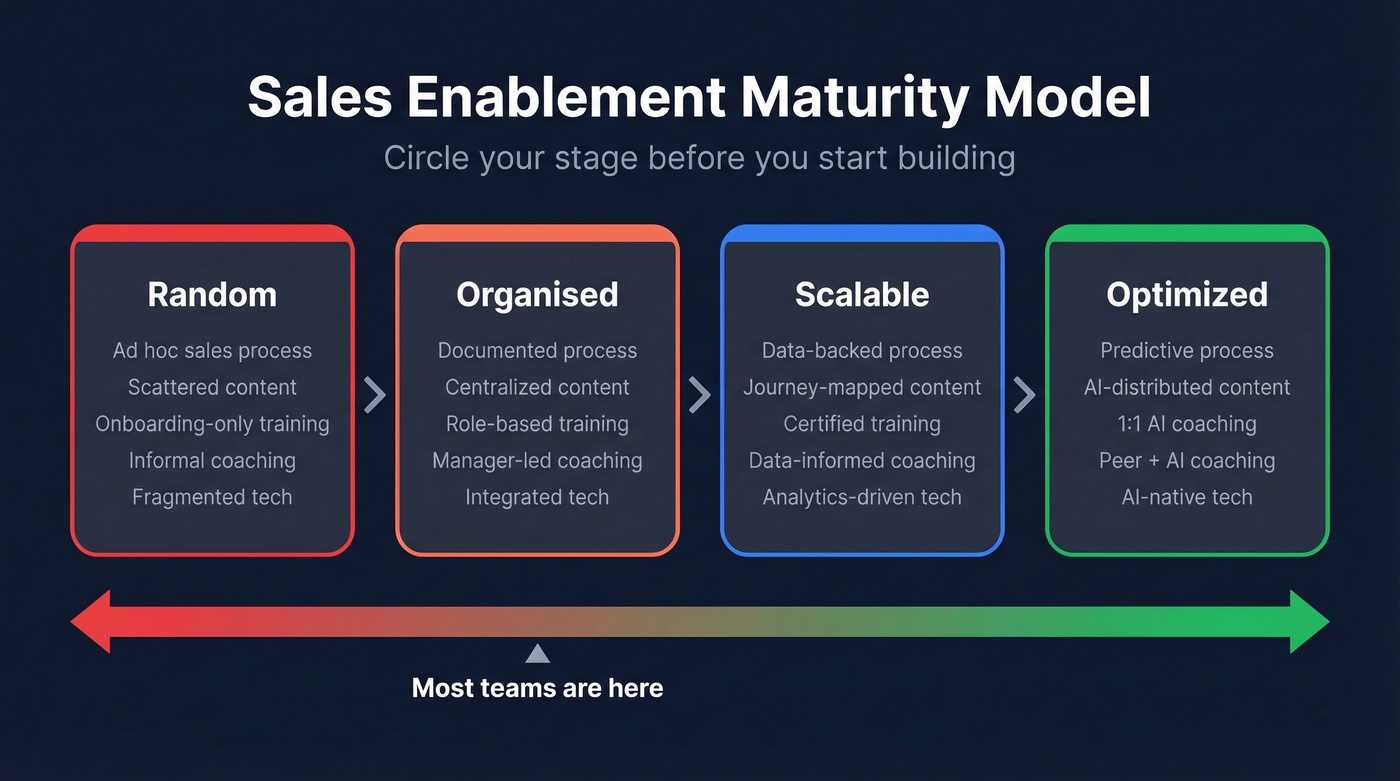
| Component | Random | Organised | Scalable | Optimized |
|---|---|---|---|---|
| Sales Process | Ad hoc | Documented | Data-backed | Predictive |
| Content | Scattered | Centralized | Mapped to journey | AI-distributed |
| Training | Onboarding only | Role-based | Certified | 1:1 AI coaching |
| Coaching | Informal | Manager-led | Data-informed | Peer + AI |
| Operations | Reactive | Repeatable | Automated | Self-optimizing |
| Technology | Fragmented | Integrated | Analytics-driven | AI-native |
| Cross-functional | Siloed | Aligned | Embedded | Orchestrated |
Most teams land somewhere between Random and Organised. That's fine - it means your first 90 days should focus on documentation, centralization, and basic measurement rather than AI-powered coaching workflows.
One structural factor that shapes everything: enablement reporting structures are shifting fast. Going into 2026, 39.4% of enablement teams report into RevOps, 25.4% into Sales, and 16.6% directly into the C-Suite. Where enablement sits in your org chart affects what you can build - a RevOps-aligned team has more cross-functional leverage than one buried under a regional sales director.
If you're at the Random stage, don't try to jump to Scalable in one quarter. Move one stage at a time, prove results, then expand scope.

You just read it: clean data is the foundation of every sales enablement framework. If reps are emailing bounced addresses, no amount of coaching or content fixes your pipeline. Prospeo delivers 98% email accuracy with a 7-day refresh cycle - so the data underneath your enablement stack is never stale.
Stop building enablement on top of broken contact data.
The 6-Step Framework Build Process
1. Write Your Enablement Charter
Every framework needs a charter - a one-page document defining your mission, scope, ownership, and what success looks like in year one. Without it, enablement becomes whatever the loudest stakeholder demands that week.
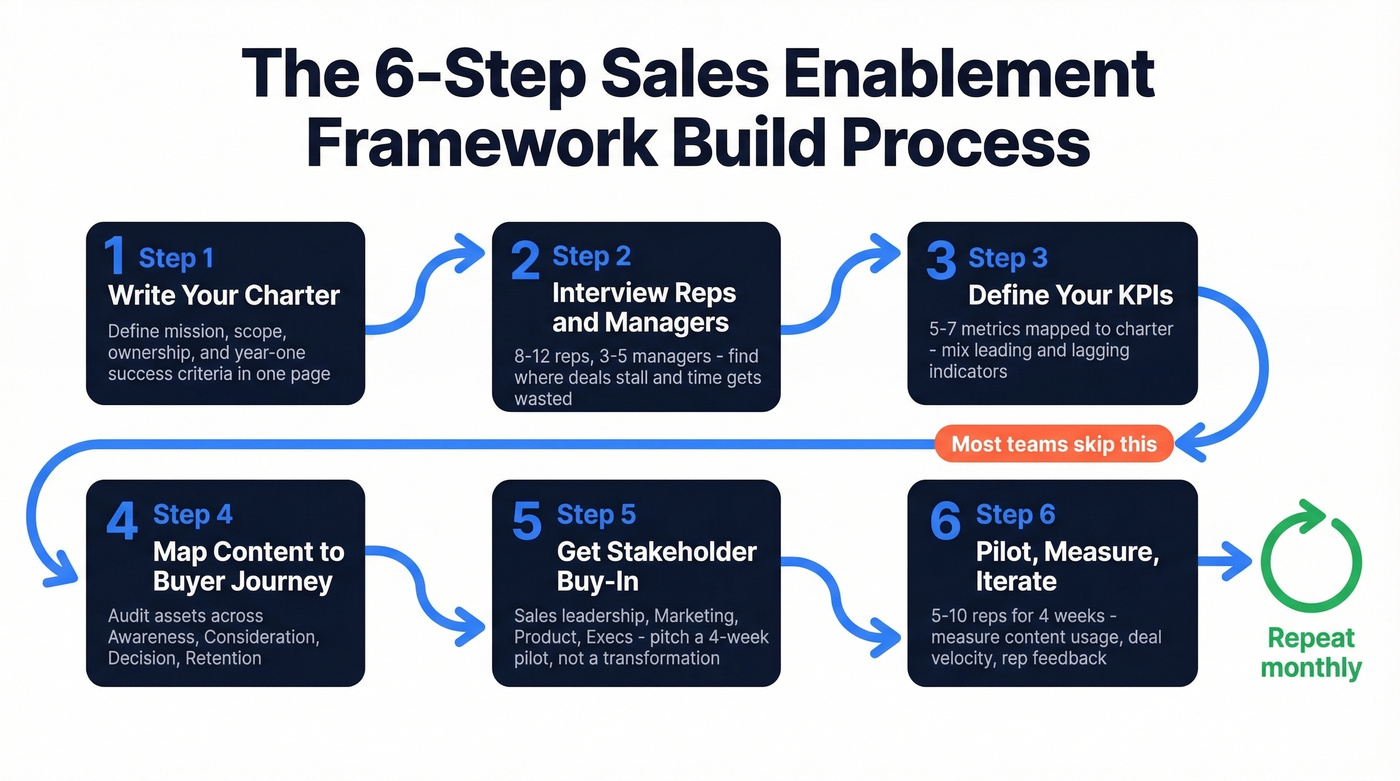
A strong charter mission is specific and measurable: "Reduce new rep ramp time from 6 months to 3 months while maintaining 85%+ quota attainment." That's a mission people can rally around. "Improve sales effectiveness" is not.
2. Interview Reps and Managers
Your charter gives you direction. Interviews give you reality.
Sit down with 8-12 reps and 3-5 frontline managers. Ask where deals stall, what objections they can't handle, what content they wish existed, what training actually changed how they sell, and what the biggest time waste in their day is. The patterns will surprise you. Usually it's not "we need more content" - it's "we can't find the content we have."
3. Define Your KPIs
Pick 5-7 metrics that map to your charter mission. If your charter targets ramp time, measure time-to-first-deal and time-to-quota. Targeting win rates? Set a concrete goal - moving from 22% to 28% over two quarters.
Content adoption and coaching frequency are leading indicators; they predict future outcomes. Win rate and revenue are lagging; they tell you what already happened. You need both, but leading indicators let you course-correct before the quarter's over.
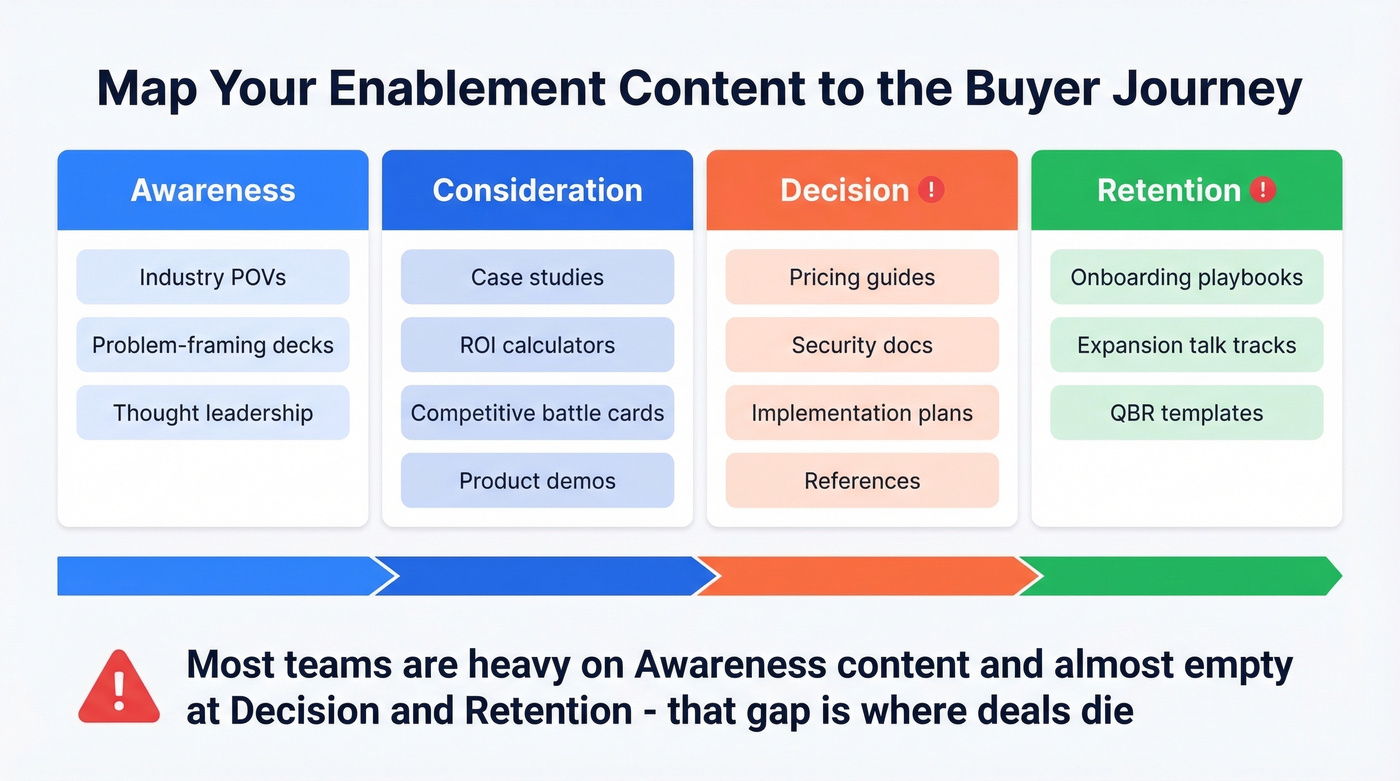
4. Map Content to the Buyer Journey
Every piece of enablement content should map to a stage. Audit what you have against this:
| Stage | Content Types |
|---|---|
| Awareness | Industry POVs, problem-framing decks |
| Consideration | Case studies, ROI calculators, competitive battle cards |
| Decision | Pricing guides, security docs, implementation plans |
| Retention | Onboarding playbooks, expansion talk tracks |
Most teams discover they're heavy on Awareness content and almost empty at Decision and Retention. That gap is where deals die.
5. Get Stakeholder Buy-In
You need four groups on board: Sales leadership (they control rep time), Marketing (they produce content), Product (they own roadmap context), and the Exec team (they fund headcount). Don't ask for permission to transform the org - ask for permission to run a 4-week pilot with 10 reps. Pilot results plus quantified ROI is the fastest path to buy-in.
6. Pilot, Measure, Iterate
Start with 5-10 willing reps. Run the pilot for 4 weeks. Measure content usage, deal velocity, rep feedback, and manager coaching frequency. Share results with stakeholders and iterate before scaling.
Once you're live, run monthly content audits and quarterly framework reviews. Enablement isn't a project with an end date. It's an operating cadence.
Measuring What Matters
Here's a stat that should bother every enablement leader: 49% of enablement professionals disagree with their leadership on which metrics they should be assessed on. Half the function is operating without aligned success criteria.
The fix is a structured KPI framework separating what you own (content quality, training completion), what you shape (rep behavior, coaching adoption), and what you support (win rate, revenue). This Own-Shape-Support model prevents enablement from taking credit for wins it didn't drive or getting blamed for losses it couldn't prevent.
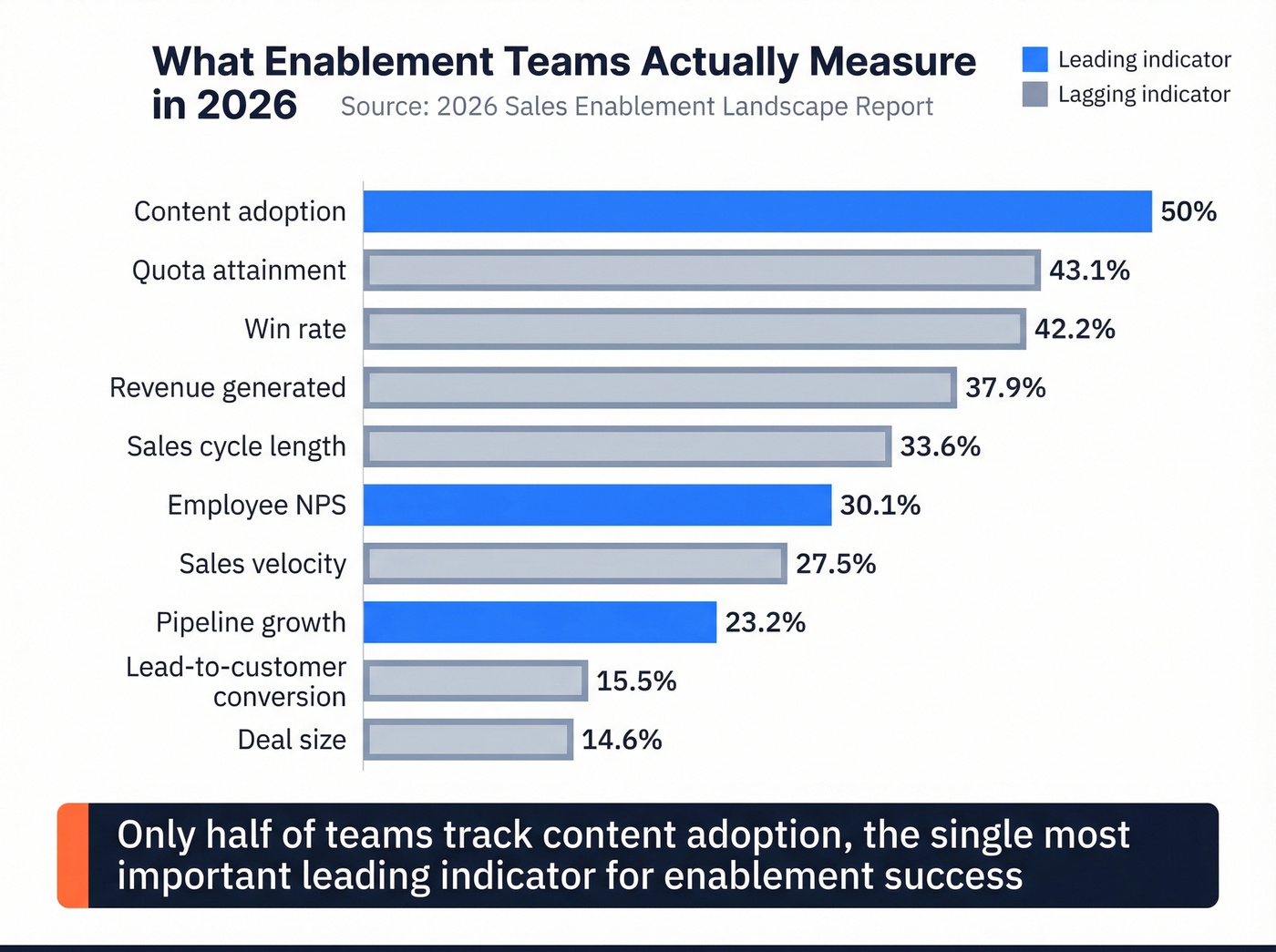
Here's what teams are actually measuring in 2026, per the 2026 Sales Enablement Landscape Report:
| Metric | Adoption % | Leading/Lagging | What It Tells You |
|---|---|---|---|
| Content adoption | 50% | Leading | Are reps using what you build? |
| Quota attainment | 43.1% | Lagging | Are reps hitting targets? |
| Win rate | 42.2% | Lagging | Are deals converting? |
| Revenue generated | 37.9% | Lagging | Top-line business impact |
| Sales cycle length | 33.6% | Lagging | Are deals moving faster? |
| Employee NPS | 30.1% | Leading | Do reps value enablement? |
| Sales velocity | 27.5% | Lagging | Pipeline speed x conversion |
| Pipeline growth % | 23.2% | Leading | Is top-of-funnel healthy? |
| Lead-to-customer conv. | 15.5% | Lagging | Full-funnel efficiency |
| Deal size | 14.6% | Lagging | Are reps selling bigger? |
Content adoption is the most-tracked metric, but only half of teams measure it. If you don't know whether reps are using your playbooks, you're flying blind.
The ZoomInfo internal enablement team learned this the hard way. Their enablement newsletters had a 10% readership rate. After they embedded guidance directly inside Salesforce - tooltips, in-app spotlights - over 1,100 demo calls were correctly dispositioned within a month, and the team recovered millions in pipeline they could directly attribute to enablement. The lesson: don't build content reps have to go find. Put it where they already work.
The Enablement Tech Stack
You don't need a $100K platform to start. But you do need to understand the layers and when each one earns its place.
CRM. Salesforce ($25-$330/user/month) or HubSpot (free tier available) is the backbone. Everything else plugs into this. If your CRM data is dirty, nothing downstream works. (If you’re still evaluating, here are examples of a CRM with real pricing.)
Enablement Platforms. Highspot, Seismic, and Showpad are common enterprise players - expect $30K-$100K+/year depending on seats and modules. Many platforms in this category are custom-priced; mid-market tools often land around $500-$3K/month. But if you're at the Random or Organised maturity stage, a well-organized Google Drive and a Notion wiki will get you further than a six-figure platform contract.
Conversation Intelligence. Gong and Chorus run $100-$150/user/month, typically $30K-$80K/year for a 20-50 seat team. These are powerful for coaching and deal inspection, but they're a "Scalable stage" investment - don't buy them before you have a documented sales process to measure against.
Sales Engagement. Outreach and SalesLoft cost $75-$150/user/month. This is the execution layer - where sequences, tasks, and cadences live. Most teams invest here early because it directly touches rep workflow. (If you’re implementing this layer, use a sales engagement platform rollout plan.)
Data Quality: The Layer Everyone Forgets
You can build the perfect playbook, train reps on MEDDPICC, and deploy an $80K enablement platform - and it all falls apart if reps are emailing bounced addresses and calling disconnected numbers.
Most enablement gains come from reducing drag - administrative friction, bad data, inaccessible content - rather than piling on more training. Data quality is the single highest-leverage drag reducer. In our experience, teams that fix their data foundation first see faster results from every other enablement investment they make afterward. (If you’re troubleshooting, start with email bounce rate benchmarks and fixes.)

Prospeo sits at this foundation layer. With 300M+ professional profiles, 143M+ verified emails at 98% accuracy, 125M+ verified mobile numbers delivering a 30% pickup rate, and a 7-day data refresh cycle, it keeps the contact data feeding your sequences actually current. GreyScout cut rep ramp time from 8-10 weeks to 4 weeks after switching - partly because new reps weren't wasting their first month learning that half their contact list was dead. The free tier gives you 75 verified emails/month plus 100 Chrome extension credits, and paid plans run about $0.01/email. No contracts, no sales calls required.

| Category | Example Tools | Typical Annual Cost | When to Invest |
|---|---|---|---|
| CRM | Salesforce, HubSpot | $300-$3,600/user | Random stage |
| Enablement Platform | Highspot, Seismic | $30K-$100K+ | Scalable stage |
| Conversation Intel | Gong, Chorus | $30K-$80K | Scalable stage |
| Sales Engagement | Outreach, SalesLoft | $900-$1,800/user | Organised stage |
| Data Quality | Prospeo | Free-$500/yr | Random stage |
Skip the enterprise enablement platform if you're under 20 reps and haven't documented your sales process yet. Seriously. A Notion workspace, a clean CRM, and verified contact data will outperform a $100K platform sitting on top of chaos.
Your reps already spend 60% of their time on non-selling tasks. Don't let bad phone numbers and dead emails eat into the other 40%. Prospeo gives your team 125M+ verified mobiles with a 30% pickup rate and emails at $0.01 each - so your enablement framework actually connects reps to real buyers.
Give reps data that converts instead of data that bounces.
Why Most Enablement Frameworks Fail
We've watched enough frameworks die to spot the patterns. Five keep showing up.
The content dump. Someone builds a SharePoint site with 200 assets, sends a Slack message saying "enablement library is live," and wonders why adoption is 4%. Reps don't need more content. They need the right content at the right moment. If you can't tell a rep exactly which asset to use for a specific objection at a specific deal stage, you've built a library, not a framework.
One-and-done training. Onboarding gets all the investment. Month two gets nothing. The consensus across r/sales and enablement communities is consistent: docs get used during ramp and then never touched again. Continuous reinforcement through coaching, micro-learning, and in-flow guidance is what separates frameworks that stick from ones that fade after Q1. (For reinforcement ideas, borrow from sales training tips that actually stick.)
No metrics. If you can't prove enablement's impact, you can't protect the budget. And yet nearly half of enablement teams aren't even aligned with leadership on what to measure. Pick your KPIs before you build anything. (A good starting point is a simple set of sales operations metrics.)
Content silos and bad data. Reps can't find the battle card because it's in a folder they don't have access to. Or worse - they find the prospect's email, send a perfectly crafted sequence, and it bounces because the data is six months old. Verified, regularly refreshed contact data isn't optional. It's infrastructure.
Ignoring rep feedback. 73% of B2B buyers avoid sellers who send irrelevant outreach. If your enablement content doesn't reflect what reps actually hear in the field, you're training them to be irrelevant. Build a feedback loop - monthly surveys, win/loss interviews, Slack channels where reps flag what's working and what's not. (If you need a system for relevance, use personalized outreach principles.)
Let's be honest about where most teams go wrong: they over-invest in "drive" - more training, more content, more motivation - and under-invest in removing "drag." Fixing a 35% email bounce rate will move the needle faster than any new battle card ever will. Start with the friction.
FAQ
What are the five pillars of sales enablement?
Strategy, content, tools, training, and measurement. Most frameworks fail by overweighting content creation and underweighting measurement. Balance all five from day one, and revisit them each quarter to make sure none has fallen behind.
Who should own the enablement function?
In 2026, 39.4% report into RevOps, 25.4% into Sales, 16.6% into the C-Suite. Early-stage teams benefit from Sales alignment; mature orgs get more cross-functional leverage under RevOps.
How long does it take to build a sales enablement framework?
A pilot can launch in 4-6 weeks with a focused charter and 5-10 rep participants. Full organizational rollout typically takes 2-3 quarters, with iteration cycles built into each one.
What's the difference between sales enablement and revenue enablement?
Sales enablement helps the sales team close new business. Revenue enablement extends that discipline to CS, marketing, partners, and SEs across the full customer lifecycle - from first touch through expansion and advocacy.
How do you make sure reps actually use enablement resources?
Embed guidance inside your CRM rather than expecting reps to visit a separate portal. Measure content adoption weekly. And start with verified prospect data so reps trust the system from day one - if the first three emails they send bounce, they'll never open your playbook again.