

Best Sales Enablement Software in 2026 (Honest Picks)
Your VP of Sales just told you to "fix enablement" after Q1 missed by 15%. You open a browser tab, and the first thing you learn is that several of the biggest sales enablement software vendors have merged or launched entirely new products in the last twelve months. The market in 2026 isn't just competitive - it's genuinely chaotic. The market is projected to hit $7.2 billion this year, and vendors are scrambling to consolidate before the music stops.
Most enablement purchases fail not because the software is bad, but because teams buy the wrong category of tool for their actual problem. A $100K content management platform doesn't help if your reps are emailing dead addresses. An AI coaching tool doesn't matter if nobody's loaded the right playbooks.
We've spent the last several months tracking mergers, testing products, and pulling pricing data from procurement benchmarks to build this list. Here's what actually matters.
Our Top 5 Picks
| Pick | Best For | Starting Price | Why It Wins |
|---|---|---|---|
| Prospeo | Data accuracy foundation | Free (75 emails/mo) | 98% email accuracy, 125M+ verified mobiles |
| Gong Enable | Conversation-led enablement | ~$30-50/seat/mo | Ties coaching directly to win rates |
| Seismic | Enterprise content mgmt | ~$20K-60K/yr | Deepest content platform at scale |
| Dock | Buyer-facing deal rooms | Free plan available | Mid-market sweet spot for deal rooms |
| Mindtickle | Rep readiness & onboarding | ~$92K/yr average | Best methodology enforcement |
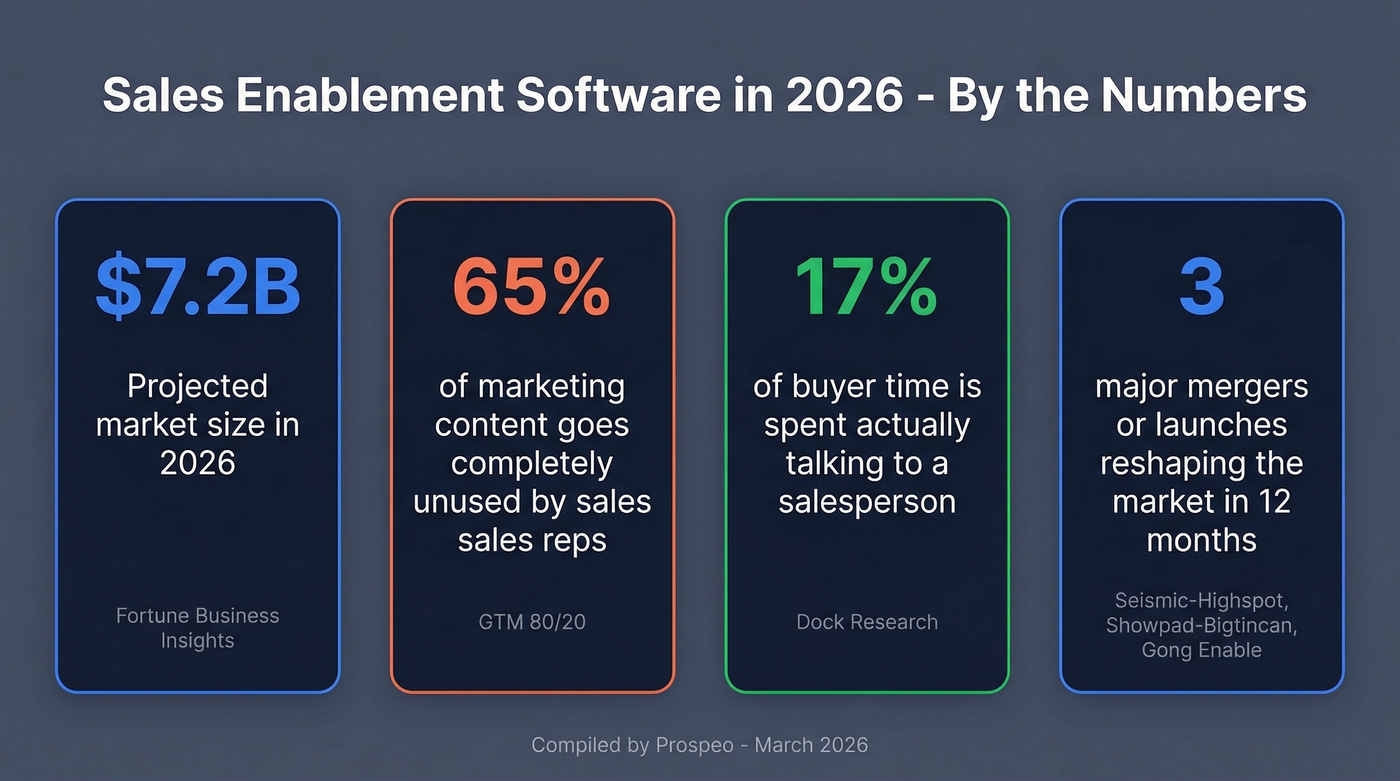
Gong Enable deserves special attention. Announced February 25, 2026, it prices in the "tens of dollars per seat per month" - compare that to legacy platforms running $90K+ annually. That pricing gap will force every incumbent to respond.
The 2026 Market Shakeup
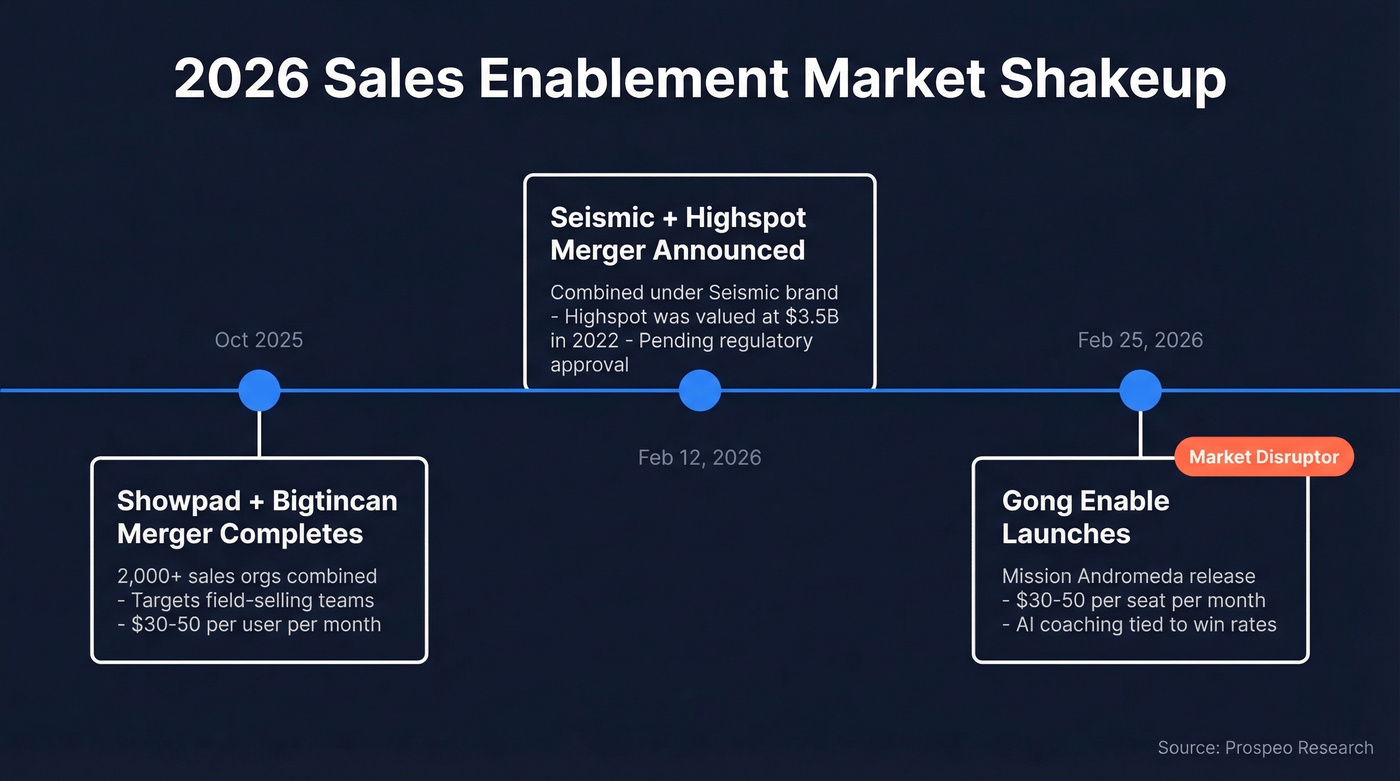
Three major shifts happened in under twelve months. If you're evaluating enablement platforms right now, understand all three before you sign anything.
Seismic + Highspot Merger
On February 12, 2026, Highspot and Seismic announced a definitive agreement to merge. The combined company will operate under the Seismic brand, led by Seismic CEO Rob Tarkoff, with Highspot CEO Robert Wahbe joining the board. Permira remains the controlling shareholder.
Highspot raised $650M and was valued at $3.5B in 2022, though the company went through two rounds of layoffs in 2023. Seismic serves roughly 2,000 customers worldwide. Both companies say their platforms "will continue to be supported" post-close.
Here's the thing: "will continue to be supported" is the bare minimum promise in any merger. If you're a Highspot customer, negotiate contract protections now - cap price increases for two years, get written platform-support commitments, and insist on termination-for-convenience clauses. The deal still needs regulatory approval, and until it closes, both companies operate independently.
Showpad + Bigtincan Merger
This one's already done. Showpad and Bigtincan completed their merger in October 2025, creating a combined platform serving 2,000+ sales organizations. The positioning targets field-selling teams - distributed revenue orgs that need content, readiness, and engagement unified in one place.
Pricing runs roughly $30-$50/user/month, with typical annual contracts landing in the $60K-$100K range. If you're a field-heavy org, it's worth evaluating. Inside sales teams will find better fits elsewhere.
Gong Enters Enablement
This is the move that should worry legacy vendors most. Gong launched Gong Enable on February 25, 2026, as part of its Mission Andromeda release. It's a brand-new product with its own pricing tier - Gong's CPO quoted "tens of dollars per seat per month."
Gong sits at roughly $300M ARR, with customers like Cisco running 20,000 users on the platform. Enable includes AI Call Reviewer for post-call behavior grading, AI Trainer for role-play simulations, and Initiative Tracking that ties enablement programs directly to win rates and pipeline impact. Gong also announced MCP interoperability, though their CPO acknowledged the protocol is "very immature when it comes to security" - worth watching but not a buying factor yet.
For teams already using Gong for conversation intelligence, adding Enable is a natural extension - and it's priced to undercut every legacy platform in the market.
Which Type Do You Actually Need?
Sales enablement software isn't one category. It's at least five, and most teams only need two or three. Gartner now defines the broader space as "Revenue Enablement Platforms" with mandatory capabilities including digital content management, guided selling, learning/coaching, buyer engagement analytics, and insights. Before you evaluate any tool, figure out which bucket your actual problem lives in.
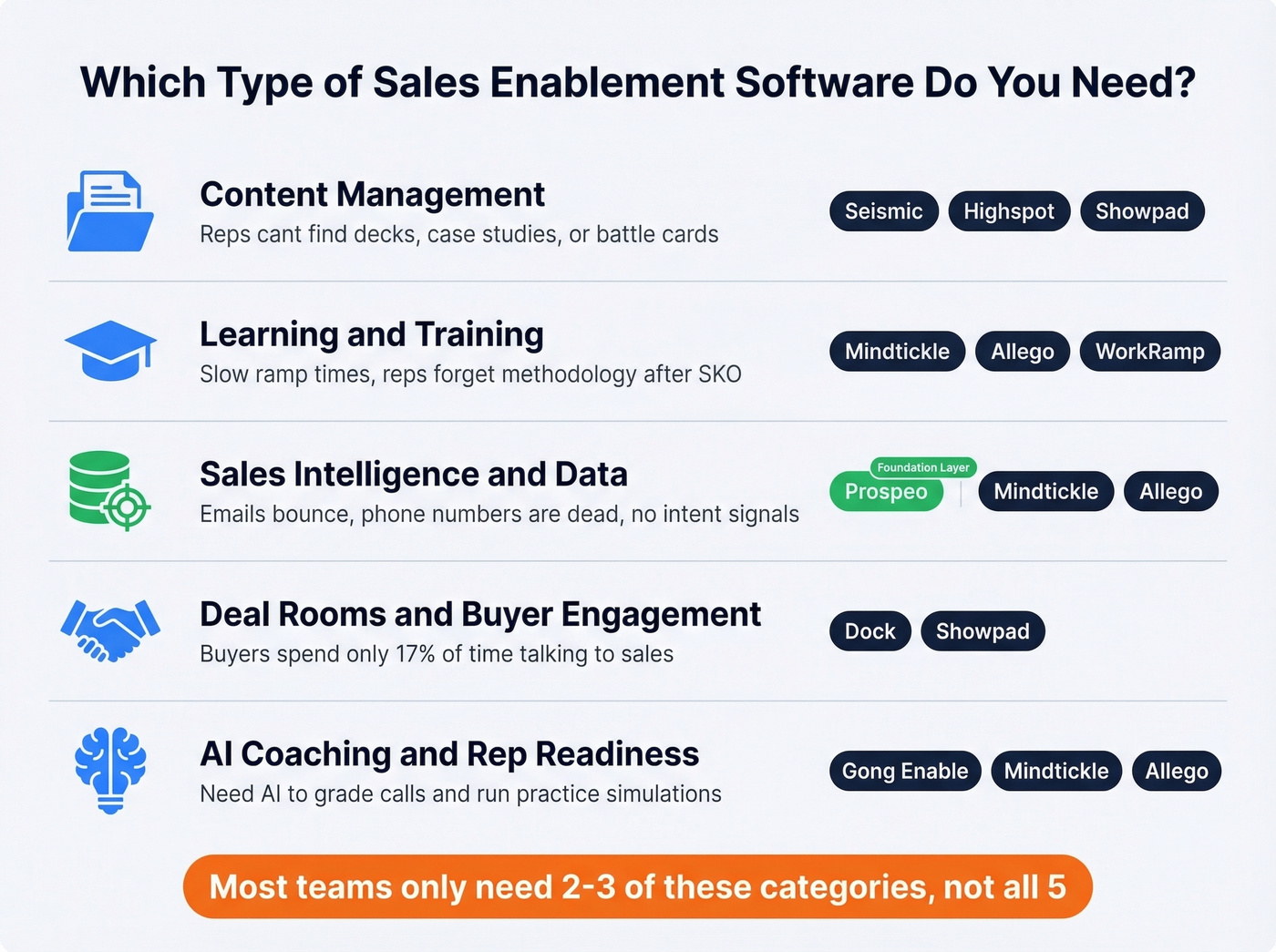
Content Management - Your marketing team creates decks, case studies, and battle cards. Your reps can't find any of it. When 65% of marketing content goes unused by sales, the problem isn't content creation - it's content discovery. Tools: Seismic, Highspot, Showpad. (If you need a repeatable way to ship and maintain battle cards, start with battle cards.)
Learning & Training - New reps take too long to ramp. Existing reps forget methodology after SKO. You need structured onboarding, certification paths, and ongoing reinforcement. Tools: Mindtickle, Allego, WorkRamp. If you're building onboarding from scratch, a 30-60-90 day plan helps standardize ramp.
Sales Intelligence & Data - Your reps are prospecting with bad data. Emails bounce, phone numbers are dead, and nobody knows which accounts are actually in-market. This is the foundation layer - everything else breaks without it. Prospeo sits here, delivering 300M+ verified professional profiles with 98% email accuracy and intent signals across 15,000 Bombora topics, all on a 7-day data refresh cycle. (If you're comparing providers, see our breakdown of data enrichment services.)

Deal Rooms & Buyer Engagement - Buyers spend just 17% of their time talking to Sales. The rest is spent researching independently. Deal rooms give buyers a single place to access proposals, timelines, and mutual action plans. Tools: Dock, Showpad. If you want the underlying framework, read our guide to a digital sales room.
AI Coaching & Rep Readiness - You want to know if reps are actually following methodology, and you want AI to grade calls and run practice simulations. Tools: Gong Enable, Mindtickle, Allego.
For teams under 50 reps, start with clean data and one execution tool like Gong or Dock. Teams of 50-200 should add a content layer. Only at 200+ reps does a full enterprise platform like Seismic start making economic sense.

Every enablement tool on this list breaks when reps prospect with dead emails and disconnected numbers. Prospeo delivers 300M+ profiles at 98% email accuracy on a 7-day refresh cycle - not the 6-week industry average. Layer in intent data across 15,000 Bombora topics so reps only work accounts that are actually in-market.
Build your enablement stack on data that doesn't bounce.
The 14 Best Enablement Tools
Content Management
Seismic
Deepest content management and analytics in the market, serving ~2,000 customers. Professional Edition lists at ~$52.50/user/month; Enterprise Premier at ~$41/user/month at scale. Aura Copilot AI ranges from a free pilot to $50+/user/month. Mid-market deals typically land at $20K-$60K/year with 32-68% discounts on 100+ seats (median 42%). At 500+ seats, discounts widen to 43-76% with a median of 57%.
The downsides are real, though. The merger with Highspot creates 12-24 months of roadmap uncertainty. Implementation runs 2-3 months minimum, longer for complex orgs. Salesforce Connector adds ~$69/user/year on top of base licensing, and enterprise deals can easily exceed $100K/year before add-ons. If you're running a Salesforce-heavy stack, it’s worth understanding Salesforce pricing before you commit to more add-ons.

If you're evaluating Seismic right now, negotiate hard. The merger gives you leverage - they don't want to lose customers during the transition. Push for price caps, platform-support guarantees in writing, and termination-for-convenience clauses. A 42% discount on list price is the median, not the floor.
Highspot
Highspot is merging into Seismic, so evaluate with caution. The average contract value across 62 procurement deals is $91,460/year. Learning-only licenses run ~$67/user/year, and Partner licenses sit around ~$183/user/year. But the real cost is in the fine print: implementation adds 15-25% to first-year costs ($15K-$45K), content migration runs $8K-$25K, custom integrations cost $5K-$15K each, and premium support tacks on $12K-$25K/year.
There's no free trial. Highspot has 40+ customers running 5,000+ reps each, so the platform handles scale. But signing a new multi-year Highspot deal in 2026 carries real risk. If you're already a customer, lock in protections. If you're evaluating fresh, lean toward Seismic's side of the combined entity.
Showpad
Post-merger with Bigtincan, Showpad positions itself as the enablement platform for field-selling teams. The combined entity serves 2,000+ sales organizations, with pricing running ~$30-$50/user/month and typical annual contracts in the $60K-$100K range. Salesforce and Outlook integrations are solid; HubSpot integration has gaps. No free trial. If your revenue team is primarily field-based and distributed, Showpad deserves a look. Inside sales teams will find better options elsewhere.
AI Coaching & Conversation Intelligence
Gong Enable
Gong Enable is the most interesting new entrant in enablement this year, and it's not close. Launched February 25, 2026, it extends Gong's conversation intelligence platform into full enablement territory with AI Call Reviewer, AI Trainer for role-play simulations, and Initiative Tracking that directly ties coaching programs to win rates and pipeline metrics.
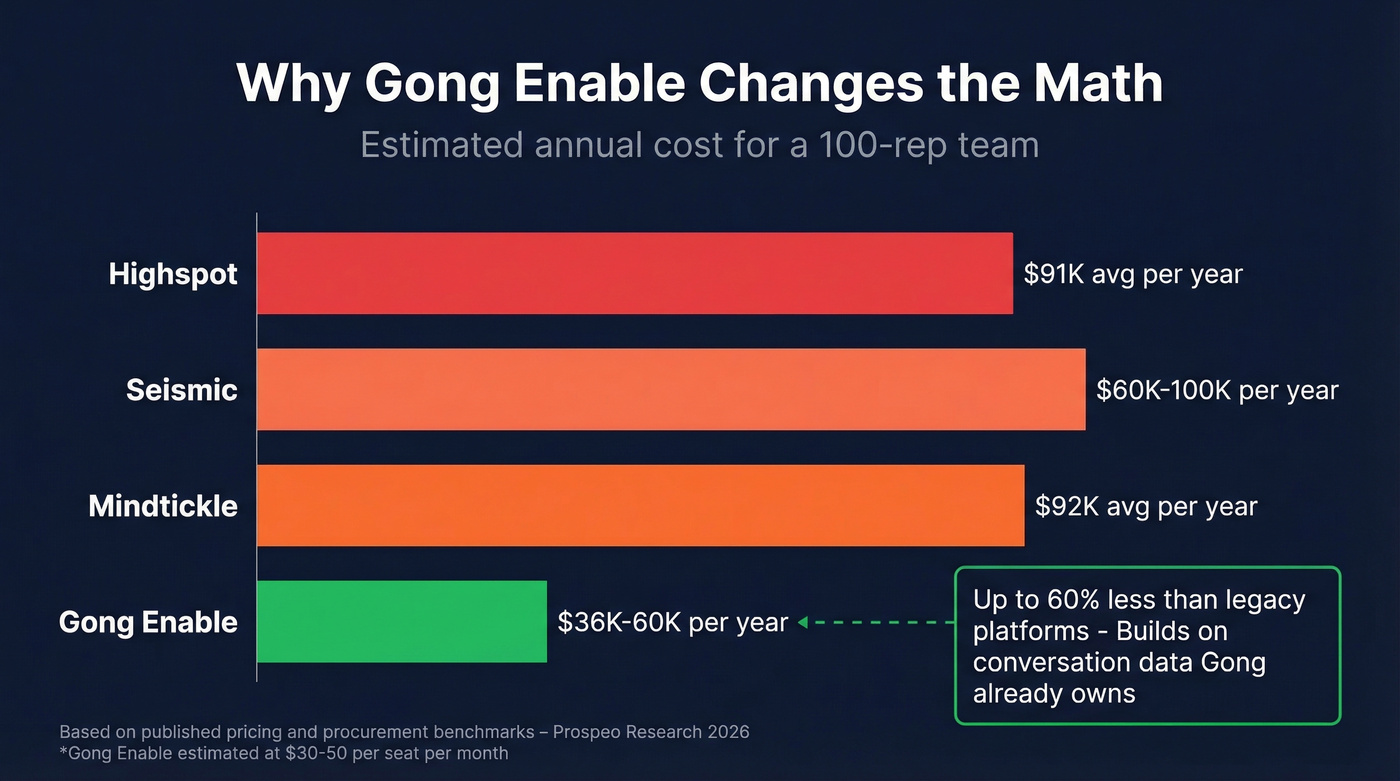
The pricing is what makes this disruptive. Working estimates land around $30-$50/seat/month. Compare that to Seismic or Mindtickle contracts running $60K-$100K+ annually. For teams already on Gong - and with Cisco running 20,000 users, plenty of teams are - adding Enable is a natural and relatively affordable extension. It's a separate pricing tier from core Gong, so expect to negotiate the bundle.
The biggest threat to legacy enablement vendors isn't another enablement vendor. It's Gong building enablement on top of the conversation data they already own.
Allego
Allego's strength is video-based coaching and asynchronous learning - particularly useful for distributed sales teams where live coaching sessions are logistically difficult. Reps record practice pitches, managers review and score them on their own schedule, and the platform tracks improvement over time. Custom enterprise pricing typically runs $40K-$100K/year for mid-market deployments.
Skip this if your team is co-located. Gong Enable covers similar ground with better analytics. But for remote-first orgs that need asynchronous coaching at scale, Allego is worth a demo.
Mindtickle
Mindtickle is the tool you buy when you're serious about methodology enforcement. If your CRO has mandated MEDDIC or Challenger and you need to actually verify reps are following it - not just hoping they are - Mindtickle is the strongest option. It carries a 4.8/5 rating across 125 reviews, and the platform covers AI copilot, conversation intelligence, digital sales rooms, coaching, and content management. If you're standardizing qualification, pair this with a clear MEDDIC sales qualification definition.
The price tag reflects that ambition. Average annual cost runs ~$92K, with enterprise deals reaching up to $430K. Pricing isn't public - expect a lengthy sales process. For 1,000+ users on the Enable Package, push for close to 60% discount. If you just need content management or basic coaching, Mindtickle is overkill. Don't let a vendor talk you into a platform that solves problems you don't have.
Deal Rooms & Buyer Engagement
Dock
Use this if: You're a mid-market team that wants buyer-facing deal rooms, mutual action plans, and a lightweight way to organize the buying process without a six-figure contract.
Skip this if: You need deep content management, LMS, or AI coaching - Dock is focused on the buyer experience, not internal enablement.
Dock offers a genuinely useful free plan, which is rare in this space. Standard pricing is $350/month for 5 seats, Premium is $1,000/month for 10 seats. The core value is simple: buyers spend the vast majority of their time researching independently, not talking to your reps. Dock gives them a single, organized space to access proposals, timelines, stakeholder maps, and mutual action plans. For mid-market teams running complex deals with multiple stakeholders, at least test the free tier.
CRM-Native Enablement
Salesforce Sales Programs
Your entire GTM motion already lives in Salesforce? Sales Programs eliminates the need for another vendor. At $100/user/month billed annually - on top of your existing Salesforce license - it's not cheap, but the native CRM integration means no data syncing, no middleware, no "why isn't this updating?" tickets. Partner Tracks are priced by quote. For Salesforce-heavy orgs, evaluate this before adding a standalone platform. For everyone else, the value evaporates outside the Salesforce ecosystem.
HubSpot Sales Hub
HubSpot is the right answer for SMBs that already live in the HubSpot ecosystem and need playbooks, sequences, and basic coaching without buying a separate enablement platform. The free CRM tier gets you started. Starter runs ~$20/user/month, scaling up to around $150/user/month for Enterprise. The playbooks and sequences features handle 80% of what a sub-50-rep team needs. Don't overthink it. If you're pressure-testing your CRM choice, see a few real examples of a CRM.
But if you need enterprise-grade content management, AI coaching, or deal rooms, HubSpot isn't a full enablement platform. It's a great CRM with enablement features bolted on.
Knowledge & Training Specialists
Guru
Free tier available, paid plans run ~$10-$15/user/month. Guru surfaces contextual knowledge inside the tools reps already use - a smart wiki that follows your reps around. Best for teams that just need "where's that battle card?" solved, not a full platform.
Spekit
Custom pricing, typically ~$20-$40/user/month. Spekit specializes in in-app training and contextual guidance, overlaying tips and walkthroughs inside your existing tools. Best for teams rolling out new software or processes where adoption is the bottleneck.
GTM Buddy
Per-seat pricing in the ~$20-$40/user/month range, with a free trial - refreshing in a market where most vendors hide behind "talk to sales." AI-powered content recommendations surface the right asset at the right moment. The just-in-time approach works well for teams drowning in content they can't find.
WorkRamp
LMS-first approach covering both employee and customer education. Custom pricing, typically in the $30-$60/user/month range for mid-market. Best for teams that prioritize structured onboarding programs and need to train customers alongside reps. If your primary need is content management or deal rooms, look elsewhere.
Notable exclusions: We left out pure sales engagement tools like Outreach and Salesloft. They're adjacent to enablement but focused on sequencing and execution, not content, coaching, or readiness. That's a different buying decision entirely. If you're shopping that category, start with our list of SDR tools.
Pricing Comparison
| Tool | Starting Price | Typical Annual | Free Tier? |
|---|---|---|---|
| Prospeo | ~$0.01/email | Varies by volume | Yes (75 emails/mo) |
| Gong Enable | ~$30-50/seat/mo | $15K-$50K+ | No |
| Dock | $350/mo (5 seats) | $4.2K-$12K | Yes |
| HubSpot Sales Hub | $20/user/mo | $2.4K-$18K+ | Yes |
| Guru | ~$10-15/user/mo | $1.2K-$18K | Yes |
| Spekit | ~$20-40/user/mo | $5K-$25K | No |
| GTM Buddy | ~$20-40/user/mo | $5K-$20K | Free trial |
| WorkRamp | ~$30-60/user/mo | $10K-$50K | No |
| Showpad | ~$30-50/user/mo | $60K-$100K | No |
| Allego | Custom | $40K-$100K | No |
| Seismic | ~$41-53/user/mo list | $20K-$120K+ | No |
| Highspot | ~$91K avg ACV | $75K-$150K | No |
| Mindtickle | Custom | ~$92K avg | No |
| Salesforce Programs | $100/user/mo | $12K-$60K+ | No |
When a vendor won't tell you what something costs upfront, expect a longer sales cycle and less negotiating leverage. These estimates come from procurement benchmarks, not vendor price pages - and that's exactly the problem.
Why Most Implementations Fail
The consensus on r/sales and r/salesoperations is frustratingly consistent: the most common regret about enablement purchases isn't picking the wrong vendor - it's buying a platform before defining the problem. Reps end up with a $90K content library nobody opens. Over two-thirds of companies investing in enablement aren't seeing expected results, and it almost always comes down to four failure modes.
No clear problem definition. "We need enablement" isn't a strategy. Is the problem rep ramp time? Win rates on competitive deals? Content findability? Each problem points to a different tool category. Interview your worst-performing reps before you evaluate any software. Their pain points are your requirements doc. (If you need a starting point, use these discovery questions.)
Scope mismatch. A 30-person sales team doesn't need a $100K enterprise platform. A 500-person org can't run on HubSpot playbooks alone. Match tool complexity to team size.
Nobody asked the reps. 65% of marketing content never gets used by sales. That's not a technology problem. Buying more software doesn't fix a content strategy gap. Audit what reps actually use before adding more tools.
Tool sprawl. Teams buy three overlapping platforms when they need one. The enablement stack becomes its own management burden - someone has to administer Seismic, someone else manages Gong, and a third person owns the LMS. Before adding a tool, ask: does this replace something, or does it add another login?
How to Build Your Stack
Let's be honest: most teams don't need a $100K platform. They need clean data, a CRM they actually use, and three good playbooks. If your average deal size is under $25K, you almost certainly don't need an enterprise enablement suite - you need reps who can actually reach prospects and a repeatable process. If you're rebuilding outbound from the ground up, start with proven sales prospecting techniques.
| Company Stage | Recommended Stack | Approx. Annual Cost |
|---|---|---|
| Startup/SMB (<50 reps) | Prospeo + HubSpot + Gong | $5K-$20K |
| Mid-Market (50-200 reps) | Prospeo + Dock + Gong Enable | $20K-$60K |
| Enterprise (200+ reps) | Prospeo + Seismic + Gong + Dock | $80K-$200K+ |
The data layer comes first in every stack. Here's why that ordering matters: your SDR team is burning through 200 dials a day, but half the numbers are disconnected. Your AEs are sending sequences to emails that bounce at 30%. No amount of content management or AI coaching fixes that. Clean the data first, then layer on execution tools. If you're seeing bounces spike, use this email bounce rate guide to diagnose the root cause.
For the startup stack, a free data tier plus HubSpot's free CRM gets you surprisingly far. Add Gong's core product when you can afford it. For mid-market, Dock's deal rooms and Gong Enable's coaching create a tight feedback loop - reps get coached on real calls, then use that coaching in buyer-facing deal rooms. At enterprise scale, Seismic handles content at volume while Gong and Dock handle the rep-facing and buyer-facing sides respectively.
I keep coming back to the same contrarian take in every enablement conversation we have internally: if you can only afford one tool beyond your CRM, make it a data platform, not an enablement platform. A rep with accurate contact data and a basic playbook will outperform a rep with a $100K enablement suite and a 35% bounce rate every single time. We've seen this play out with customers like Snyk, where fixing data accuracy alone - dropping bounce rates from 35-40% to under 5% - drove a 180% increase in AE-sourced pipeline.
You're comparing $60K-$100K enablement platforms, but your reps still can't reach buyers. Prospeo starts free and costs roughly $0.01 per verified email. Teams using Prospeo book 26% more meetings than ZoomInfo users and 35% more than Apollo - because 98% accuracy means reps spend time selling, not chasing dead leads.
Stop funding enablement tools that sit on top of broken data.
FAQ
How much does sales enablement software cost?
Anywhere from free to $430K/year. Prospeo, Dock, HubSpot, and Guru all offer free tiers, while enterprise Mindtickle deployments can reach the high six figures. Mid-market teams typically spend $20K-$60K/year on their primary enablement platform. Budget an extra 15-25% for implementation, migration, and training costs.
What does the Seismic-Highspot merger mean for customers?
Both platforms will be supported post-close, but expect 12-24 months of integration uncertainty as the combined company rationalizes two product lines. Negotiate price caps for at least two years, written platform-support commitments, and termination-for-convenience clauses before signing any multi-year deal.
Do small teams need a dedicated enablement platform?
Usually not. Teams under 50 reps get more value from verified contact data, a CRM they actually use, and a lightweight tool like Gong or Dock than from a six-figure enterprise platform. Start simple, measure what's broken, and add tools only when you've outgrown the basics.
What's the most important layer in an enablement stack?
Data quality. Every enablement tool assumes reps have accurate prospect data to work with. If emails bounce at 30% and phone numbers are dead, no amount of content management or AI coaching fixes the pipeline. Start with a verified data foundation, then build up.
What is sales enablement software?
Software that equips sales teams with content, training, coaching, and analytics to close deals more effectively. The category spans five functional areas: content management, learning and training, sales intelligence and data, deal rooms, and AI coaching. Most teams need two or three of these, not all five.