

How to Build a Sales Engagement Strategy That Actually Works
You bought the platform. You built the cadences. You trained the team. And your reps are still spending 60% of their time on non-selling tasks - logging activities, updating fields, prepping for calls they never make. Meanwhile, 70% of B2B sellers say they're overwhelmed by the number of tools they're expected to use.
The problem isn't your tools. It's the sales engagement strategy underneath them.
Here's the short version: your strategy has three layers - clean data, a multi-channel cadence, and a measurement system. Start with a 7-touch/10-day cadence across email, phone, and social. If deals aren't progressing within 50 days, your win rate drops from 47% to 20%. Measure speed, not activity volume.
What Sales Engagement Actually Is
Sales engagement is the planned execution of buyer interactions - every email, call, and social touch your reps make across the deal cycle. Your CRM is the system of record that stores data. Your sales engagement platform is the system of action that executes outreach. Sales enablement prepares reps with training, content, and playbooks. Engagement is what reps actually do with buyers.
Don't confuse the two.
The Winning Framework: Five Steps
Step 1: Start With Verified Data
Your cadence is only as good as the data feeding it. When emails bounce at scale, your domain reputation tanks and your sequences break before a single prospect reads your message. We've watched teams agonize over subject lines and call scripts while ignoring the fact that a huge chunk of their list was dead on arrival - bouncing into the void, torching sender reputation with every send. Bad data is one of the most common engagement killers, and it's the easiest to fix.
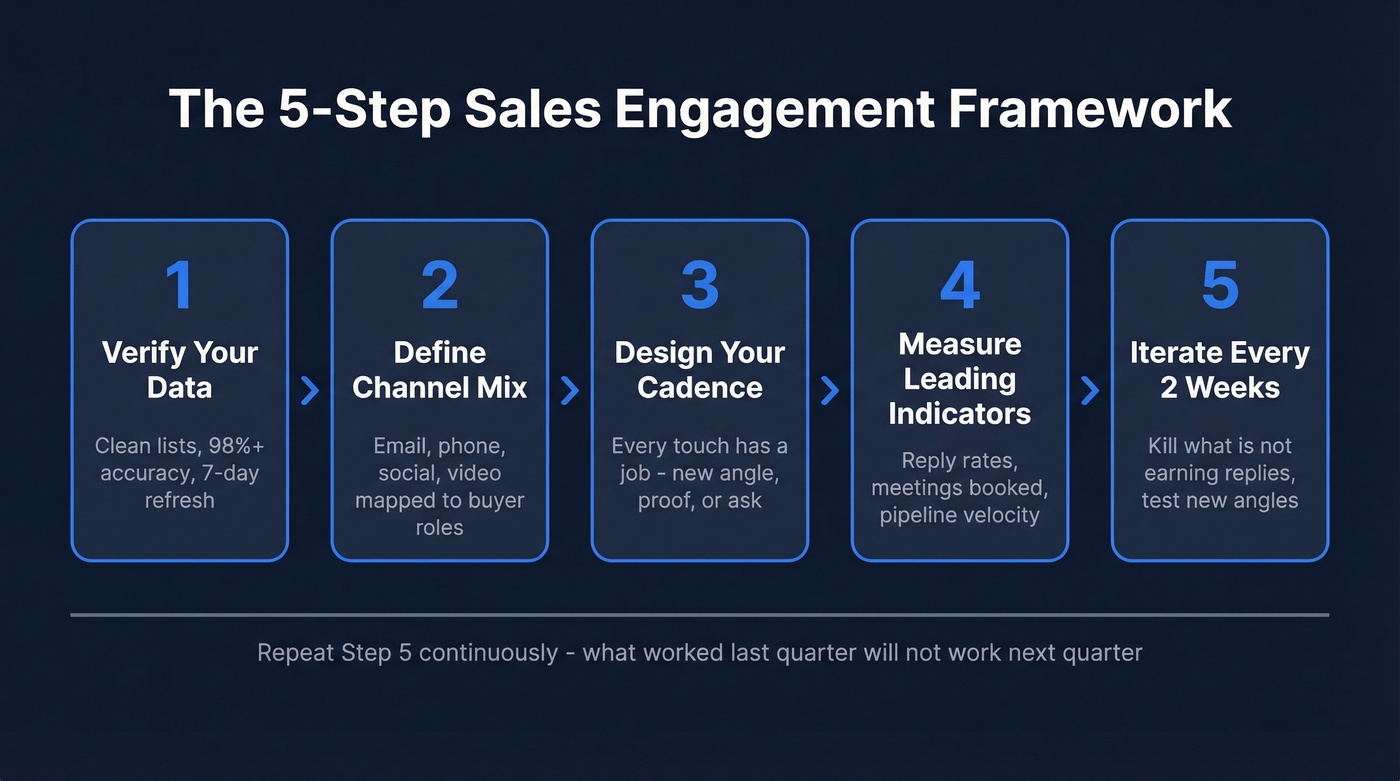
Use a verification-first platform like Prospeo - 98% email accuracy, data refreshed every 7 days - so your cadences reach real people. Teams like Snyk saw bounce rates drop from 35-40% to under 5%, generating 200+ new opportunities per month after switching. If you’re comparing options, start with these email verification tools.

Step 2: Define Your Channel Mix
Email alone won't cut it. 48% of reps give up after a single interaction, but most deals require 8+ touchpoints to close. Map your channels to your buyer's behavior:
- Email for async value delivery
- Phone for urgency and qualification
- Social for warming and multithreading
- Video for differentiation
Tailor content to the role. Your champion gets case studies. Your economic buyer gets ROI data. Your technical buyer gets integration specs. For executive outreach, keep messages shorter, lead with business outcomes, and reference board-level priorities rather than feature lists. If you need a tighter persona definition, use an ideal customer profile template.
Step 3: Design Your Cadence
Every touch needs a job - new angle, proof point, or specific ask. If a step is just "checking in," delete it. We cover the full cadence template below. For ready-to-send copy, pull from these sales follow-up templates.
Step 4: Measure Leading Indicators
Activity volume is a vanity metric. Track reply rates, meeting conversion, and pipeline velocity instead. The measurement framework is in the ROI section. If you want a broader KPI set, use these funnel metrics.
Step 5: Iterate Every Two Weeks
73% of B2B buyers actively avoid sellers who send irrelevant outreach. What worked last quarter won't work next quarter. Review cadence performance biweekly and kill anything that isn't earning replies.
As your team matures, graduate from static cadences to intent-triggered sequences - reaching buyers when they're actively researching, not when your calendar says it's time. That’s easiest when you have a process for identifying buying signals.
A Cadence You Can Copy
Top-performing BDRs average 21 attempts per contact - roughly 8 calls, 8 emails, and 5 social touches. Here's a baseline outbound cadence built on the "coverage, not harassment" principle:
| Day | Channel | Purpose |
|---|---|---|
| 1 | Personalized intro, specific pain | |
| 1 | Call | Warm intro referencing email |
| 2 | New angle or proof point | |
| 4 | Call + VM | Voicemail with value hook |
| 6 | Video | 60-90 sec personal video |
| 8 | Case study or social proof | |
| 10 | Permission close |
The forcing function: if you haven't created momentum by day 10, change something - persona, channel, angle, or offer. Don't repeat the same cadence to the same person. If you're running intent data, get your first touch out within 24 hours of a signal. That alone lifts response rates 2-3x. To keep sequences consistent across reps, tighten your sequence management.

Your 7-touch cadence means nothing if 30% of your list is dead. Prospeo delivers 98% email accuracy with a 7-day refresh cycle - so every touch in your sequence reaches a real inbox. Snyk's 50 AEs dropped bounce rates from 35% to under 5% and generated 200+ opportunities per month.
Fix your data layer before you tweak another subject line.
The 50-Day Cliff and Why Speed Wins
Here's the single most important number in your engagement playbook: opportunities closed within 50 days win at 47%. After 50 days, win rates collapse to 20% or lower.
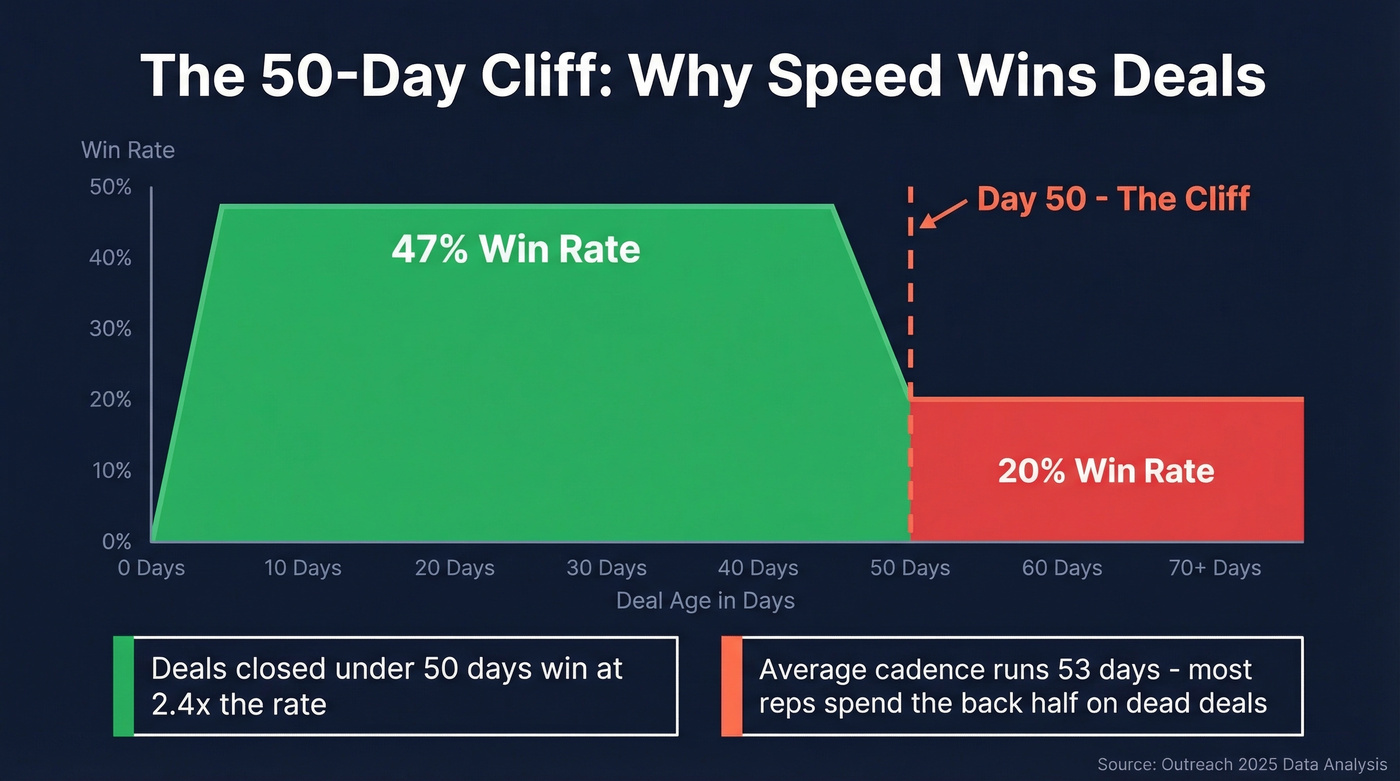
The average cadence runs 53 days before a rep gives up. That means most reps are spending the back half of their cadence on deals that have already statistically died. In our experience, the teams that internalize this number restructure everything - shorter cadences, faster escalation, more aggressive multithreading. And multithreading matters: 90% of BDRs multithread across roughly 9 people per account, but buying committees average 13 internal stakeholders. One champion isn't enough. Your engagement approach needs to account for the full committee. This is where account-based selling becomes a practical operating system, not a buzzword.
Choosing Your Stack
You don't need 10 tools. You need a CRM, a sequencing layer, and clean data.
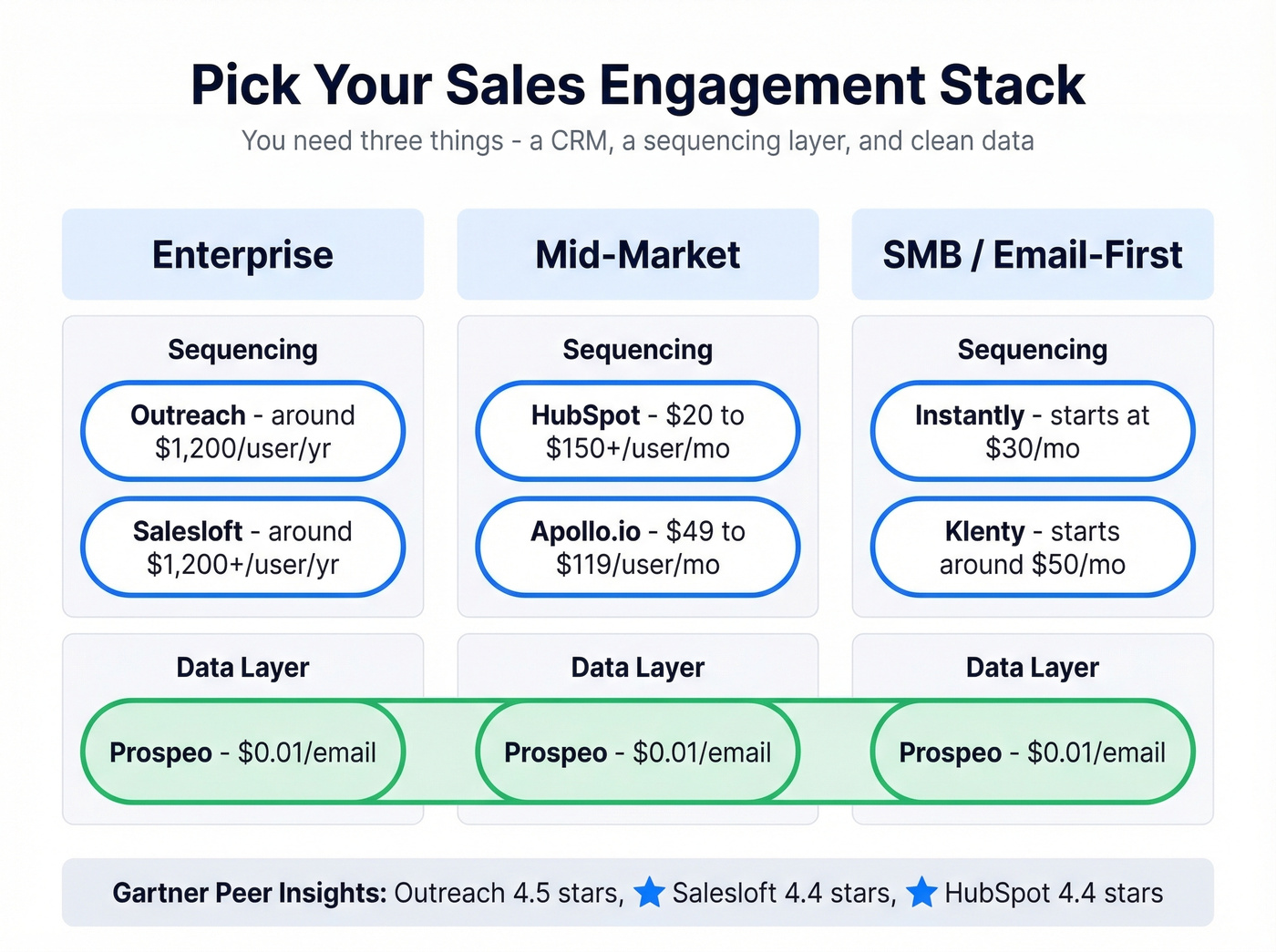
| Need | Enterprise | Mid-Market | SMB / Email-First |
|---|---|---|---|
| Sequencing | Outreach (~$1,200/user/yr) | HubSpot (~$20-$150+/user/mo) | Instantly (starts at $30/mo) |
| Sequencing alt | Salesloft (~$1,200+/user/yr) | Apollo.io (~$49-$119/user/mo) | Klenty (starts ~$50/mo) |
| Data layer | Prospeo ($0.01/email) | Prospeo | Prospeo |
On Gartner Peer Insights, Outreach leads at 4.5 stars, with Salesloft and HubSpot both at 4.4. The category is shifting from cadence-first to AI-first, but clean data still feeds every model. Regardless of which sequencing tool you pick, your data layer determines whether your cadences actually reach real inboxes. If you’re still evaluating, compare your SDR tools stack by workflow, not features.
Here's the thing: most teams don't need an enterprise SEP. If your average deal size is under six figures and your team is under 10 reps, HubSpot or Apollo paired with verified data will outperform a $1,200/seat platform that's half-configured and barely adopted.
Measuring ROI on Your Strategy
Stop measuring dials and emails sent. Establish a baseline, track leading indicators like adoption, reply rates, and meetings booked, then connect to lagging indicators like win rate, deal size, and time-to-close.
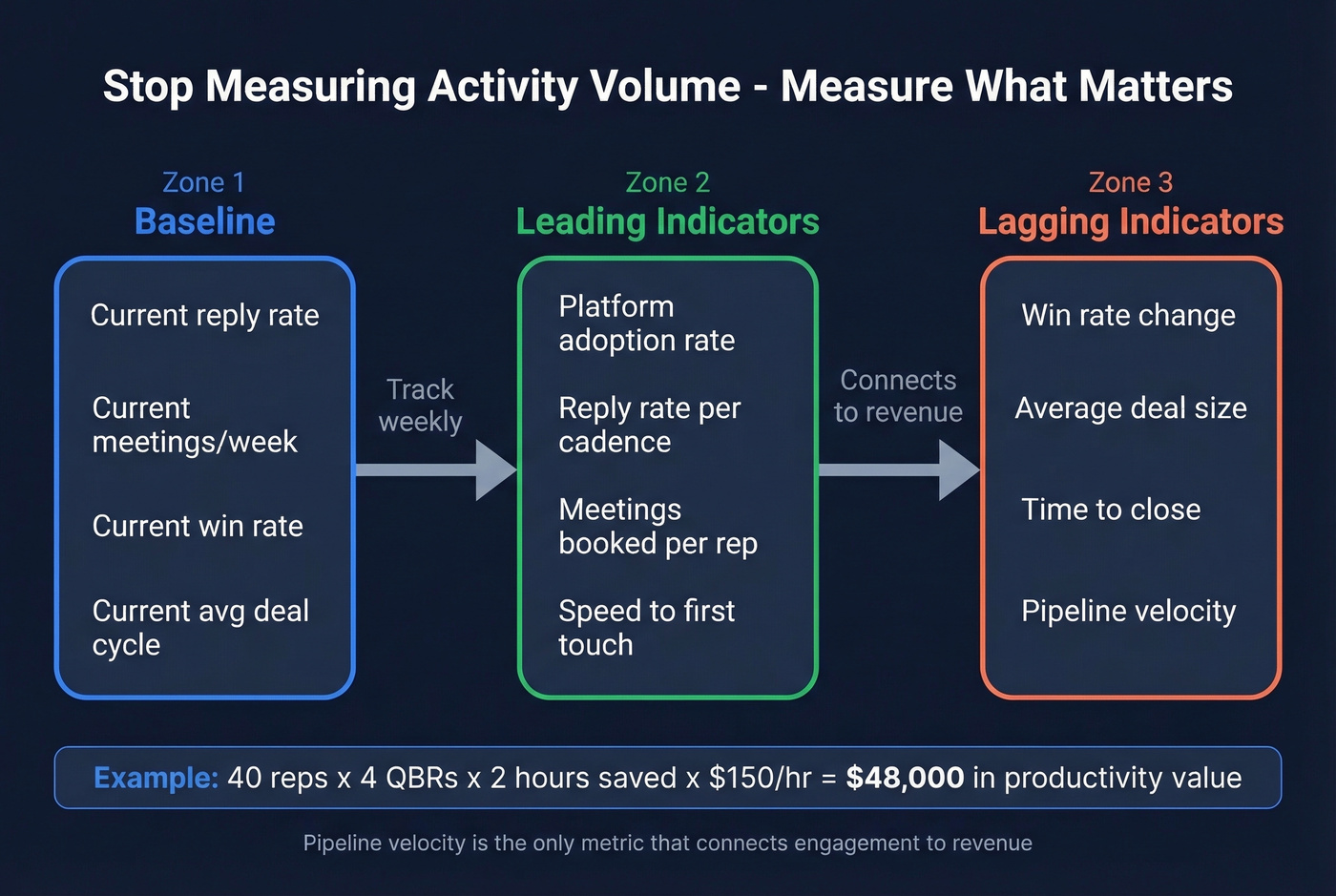
A worked example: say your SEP reduces QBR prep from 3 hours to 1 hour, and 40 reps do 4 QBRs/year with 90% adoption. That's 320 hours saved - $48,000 in productivity value at $150/hour fully loaded. Pipeline velocity - how fast deals move through stages - is the only metric that connects engagement to revenue. These improvements compound: faster cycles free reps to work more pipeline, which lifts total bookings without adding headcount. To pressure-test your numbers, use a pipeline health checklist.
Mistakes That Kill Your Strategy
Let's be honest - most engagement strategies don't fail because of bad tools. They fail because of bad habits.
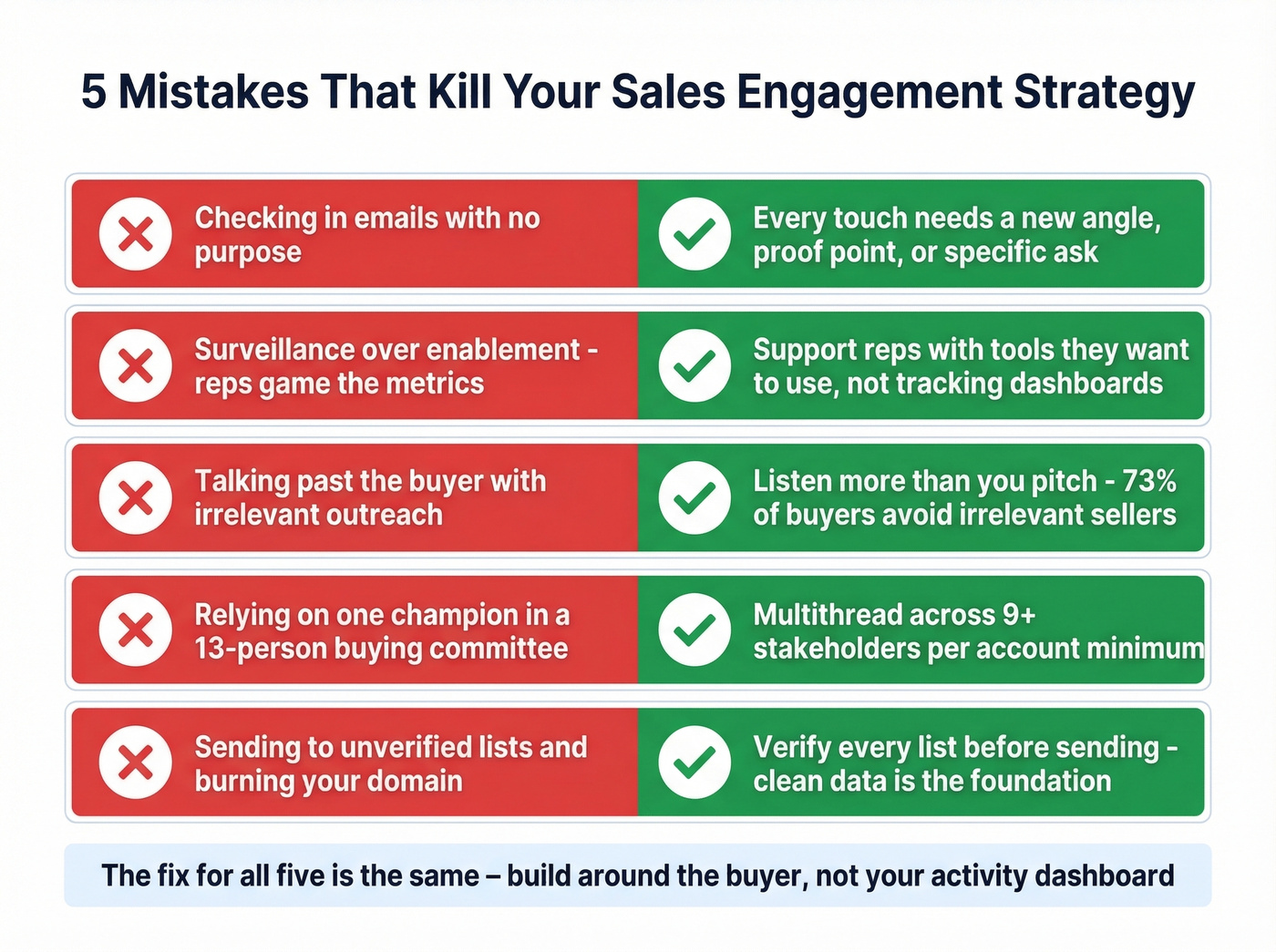
"Checking in" emails. Every touch needs a job. New angle, proof, or ask. Delete anything that's just a ping.
Surveillance over enablement. If reps feel tracked, not supported, they'll game the metrics instead of selling. The consensus on Reddit is clear: platforms that feel like surveillance tools get abandoned. Skip any tool where the primary value prop is "manager visibility."
Talking past the buyer. 73% of buyers avoid irrelevant outreach. Listen more than you pitch.
Wrong stakeholder. Buying committees average 13 people. One champion isn't enough.
Bad data. High bounce rates destroy your domain reputation faster than any bad subject line. We've seen teams burn through three domains in a quarter because they refused to verify before sending. If deliverability is slipping, start with an email deliverability guide.
The fix for all five is the same: build your sales engagement strategy around the buyer's reality, not your activity dashboard.
The 50-day cliff kills deals - you can't afford wasted touches on bad contacts. Prospeo gives you verified emails at $0.01 each and 125M+ direct dials with a 30% pickup rate, so your multi-channel cadence actually connects with buyers across every channel in your sequence.
Reach real buyers on every channel, starting today.
FAQ
What's a sales engagement strategy vs. sales enablement?
A sales engagement strategy is the execution plan for buyer interactions - emails, calls, and social touches across the deal cycle. Enablement is the training, content, and tools that prepare reps to engage. One is the playbook; the other is the practice.
How many touchpoints close a B2B deal?
Most B2B deals require 8+ touchpoints across multiple channels. Top-performing BDRs average 21 attempts per contact - roughly 8 calls, 8 emails, and 5 social touches - spread across about 9 stakeholders per account.
How do I fix high bounce rates in my cadences?
Run your list through a real-time verification tool before launching any sequence. A 98% accuracy rate with a 7-day refresh cycle keeps lists clean automatically. Verify weekly, not quarterly - stale data is the top domain killer.