

Best Sales Extensions for Chrome in 2026 - Tested and Ranked
Your last cold email campaign bounced at 18%. Your domain reputation took a hit, your sequences stalled, and now you're staring at a Chrome Web Store full of sales extension options that all promise "verified" data. You don't need 15 of them. You need three - a data layer, a CRM layer, and maybe a productivity add-on. The rest is bloat that slows your browser and muddies your pipeline.
Our Picks (TL;DR)
| Use Case | Pick | Why |
|---|---|---|
| Best for email accuracy | Prospeo | 98% email accuracy, 7-day refresh, free tier |
| Best all-in-one | Apollo.io | Database + sequences + dialer in one extension |
| Best CRM extension | HubSpot Sales | Free email tracking + CRM sidebar |
| Best for enterprise | Cognism | Diamond phone-verified mobiles, GDPR-first |
These four cover 90% of what sales teams actually need from Chrome extensions. The rest of this guide breaks down every option worth considering, plus the accuracy benchmarks and credit math that most listicles skip.
How to Choose the Right Tool
Before you install anything, run it through five criteria.
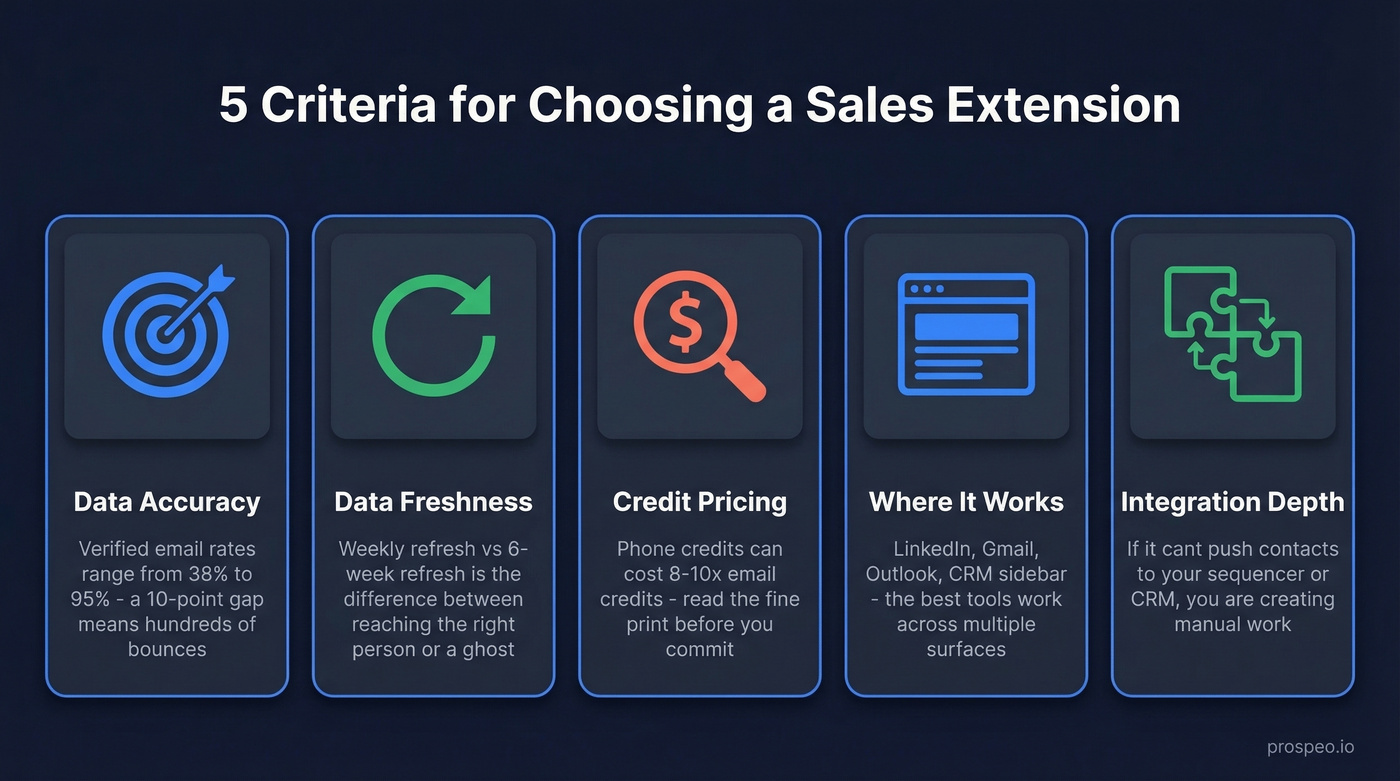
Data accuracy. This is the one that matters most. Across the tools we've benchmarked, verified email rates range from around 38% to 95% depending on the tool and dataset. A 10-point accuracy gap doesn't sound dramatic until you're sending 5,000 emails and 500 of them bounce. That's a deliverability crisis, not a rounding error. (If you want the benchmarks, start with our email bounce rate guide.)

Data freshness. People change jobs. Some tools refresh data every 6 weeks. Others do it weekly. The gap between those two cycles is the gap between reaching a VP of Sales and emailing someone who left three months ago.
Credit pricing transparency. Phone credits can cost 8-10x what email credits cost, and most vendors bury this in the fine print. Know what you're paying per data type before you commit.
Where it works. Some extensions only work on professional profiles. Others plug into Gmail, Outlook, or your CRM. The best ones work across multiple surfaces without forcing you to switch tabs.
Integration depth. An extension that can't push contacts into your sequencer or CRM creates manual work. Look for native integrations with your existing stack - Salesforce, HubSpot, Outreach, Lemlist, whatever you're running. (More on this in our connect outreach tool to CRM setup guide.)
Best Sales Extensions for Prospecting
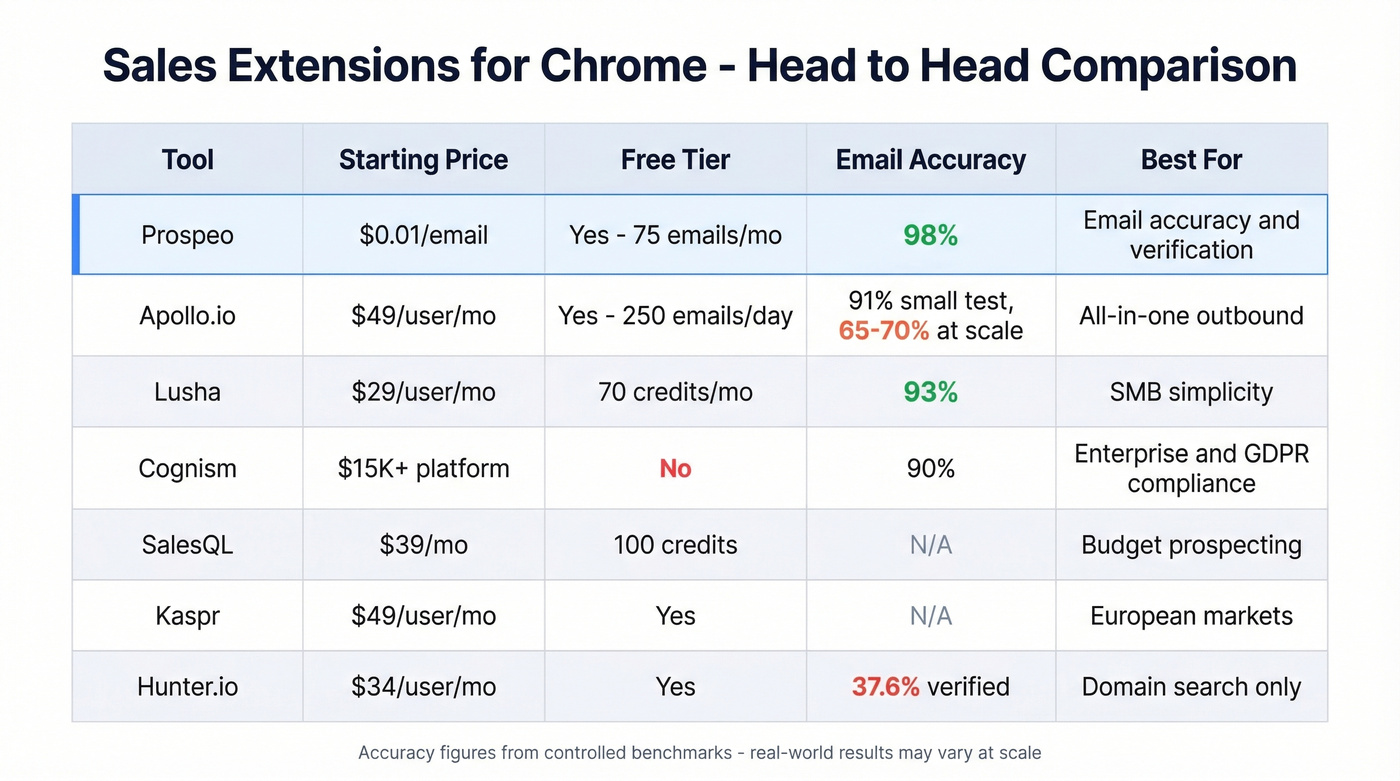
| Tool | Starting Price | Free Tier | Email Accuracy | Best For |
|---|---|---|---|---|
| Apollo.io | $49/user/mo | Yes | ~91% (small test) / 65-70% (at scale) | All-in-one outbound |
| Lusha | $29/user/mo | 70 credits/mo | 93% | SMB simplicity |
| HubSpot Sales | $20/user/mo | Yes | N/A | CRM + email tracking |
| Cognism | ~$15K+ platform | No | 90% | Enterprise/compliance |
| SalesQL | $39/mo | 100 credits | N/A | Budget prospecting |
| Kaspr | $49/user/mo | Yes | N/A | European markets |
| Hunter.io | $34/user/mo | Yes | 37.6% verified | Domain search |
Prospeo
Use this if you care about data accuracy above everything else. Prospeo's 98% email accuracy is the highest in this guide, backed by a proprietary 5-step verification process with catch-all handling, spam-trap removal, and honeypot filtering. The extension - used by 40,000+ Chrome users - covers 300M+ professional profiles, 143M+ verified emails, and 125M+ verified mobile numbers with a 30% pickup rate across all regions, meaning the phones you pull actually get answered.
A 7-day data refresh cycle runs roughly 6x faster than the industry average, which matters when you're prospecting into fast-moving companies where people change roles constantly. The free tier gives you 75 emails and 100 extension credits per month - enough to test properly. Paid plans run about $0.01 per email, and the extension pushes contacts directly into Salesforce, HubSpot, Lemlist, Instantly, Smartlead, or Clay. (If you're building lists in Clay, see our Clay list building workflow.)
Outbound agencies like Stack Optimize run client campaigns through Prospeo and have maintained 94%+ deliverability with bounce rates under 3% across all clients. One domain flag from bad data can cost you an entire client relationship, so that kind of consistency isn't a nice-to-have - it's the whole point.
Pairs best with a sequence tool like Apollo or Outreach for the full outbound workflow. Prospeo handles the data layer; let a dedicated tool handle the sending. (For more options, see our roundup of outbound lead generation tools.)
Apollo.io
Apollo bundles a database, email sequences, and a dialer into one extension. The free tier is genuinely usable, with ~250 emails/day and up to 2 active sequences.
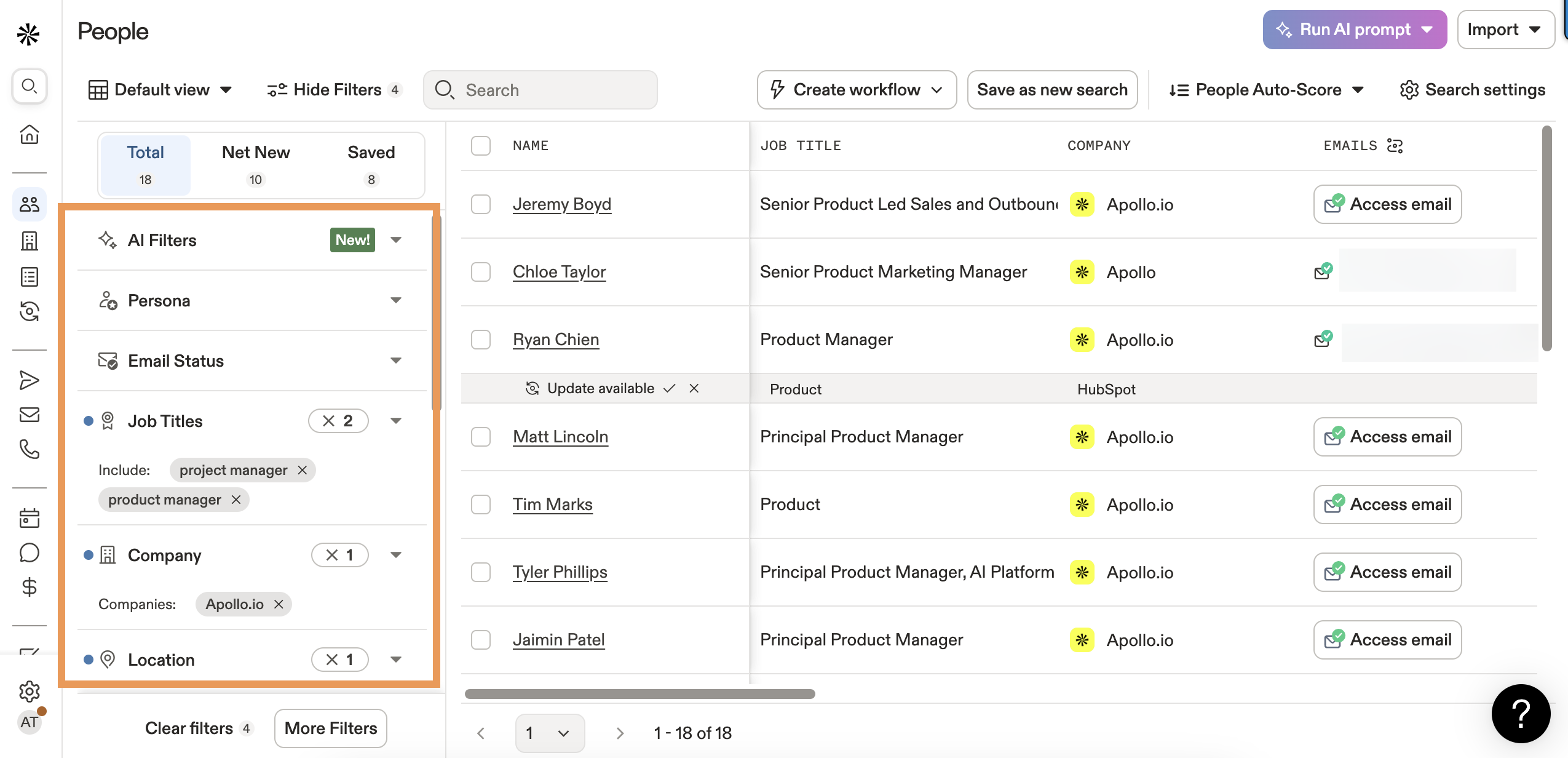
Here's the catch: accuracy depends heavily on volume. In a controlled 100-contact benchmark, Apollo scored 91%. But at production scale, the picture changes. Across G2 and Trustpilot reviews, users consistently report 65-70% real-world accuracy with 15-25% bounce rates. That gap between lab conditions and production is where your domain reputation lives.
Paid plans run $49-$119/user/month on annual billing, and phone credits cost 8x what email credits cost - a detail that catches teams off guard. The Organization plan at $119/user/month requires a minimum of 3 users, so you're looking at $4,284/year minimum for that tier. Apollo is the obvious starting point for most SMB teams, but plenty graduate to dedicated data tools once bounce rates start hurting.
Lusha - The Credit Math Problem
Lusha's extension is clean, the 70 free credits per month are generous, and it scores 93% accuracy in a 100-contact benchmark. Used by 280,000+ revenue teams, it's the fastest path from "I need this person's email" to having it. No learning curve.
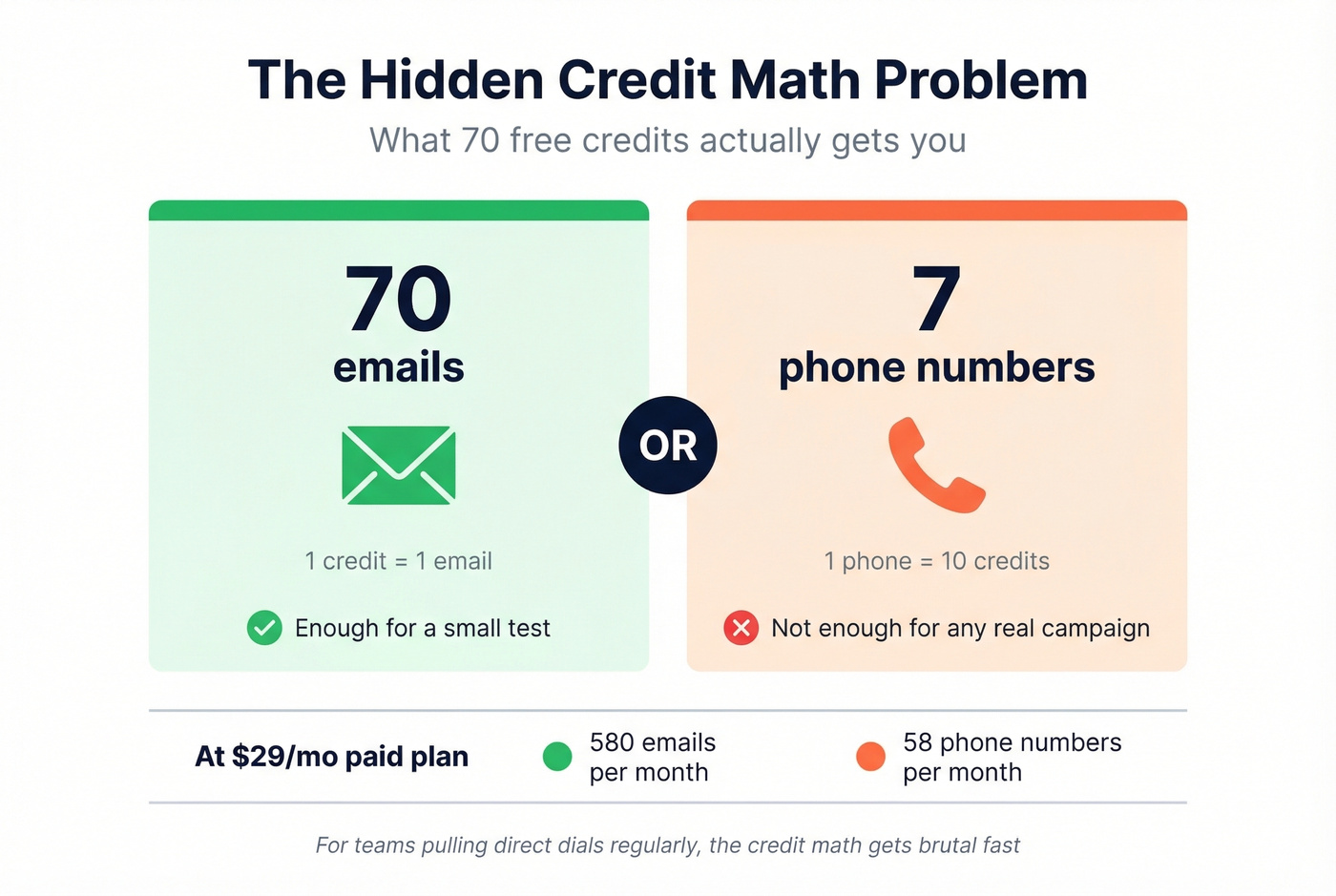
The problem is phone numbers. Lusha charges 1 credit per email but 10 credits per phone number - so those 70 free credits get you either 70 emails or 7 phone numbers, not both. Paid plans start at $29/user/month. For email-only prospecting at the SMB level, Lusha is excellent. The moment your team starts pulling direct dials regularly, the credit math gets brutal.
Cognism
Enterprise teams selling into Europe need Cognism on the shortlist. Diamond Data offers phone-verified mobile numbers, and the platform is GDPR-first with signals like job changes, funding, hiring, M&A, intent, technographics, and news. It carries a 4.6/5 on G2.
The pricing reflects the enterprise positioning. Platinum runs around a $15,000 platform fee plus $1,500 per user per year. Diamond access pushes to $25,000+ plus $2,500 per user per year. That's serious money - but for teams over 20 reps selling into EMEA, the compliance coverage and mobile verification justify it.
SalesQL
SalesQL wins on pricing transparency. Free (100 credits), $39/month (2,000 credits), $79/month (5,000 credits with 3 seats), or $119/month (12,000 credits with 15 seats). One credit gets you both emails and phone numbers for a single profile - no 10x phone multiplier. Annual billing saves 25%.
Kaspr
Kaspr is built for European prospecting. It checks data against 150 sources, offers GDPR/CCPA alignment, and starts at $49/user/month. The free tier includes unlimited B2B emails under a fair-use policy. If your ICP is heavily EMEA and you want a simpler, cheaper alternative to Cognism, Kaspr is the answer. Outside European markets, the coverage thins out quickly.
Hunter.io
Hunter's free tier and domain search are fine for one-off lookups. Paid plans start at $34/user/month. But in a 5,000-contact benchmark, Hunter's verified rate came in at just 37.6% - disappointing for production outreach at any volume. Use it for quick domain lookups, not as your primary data source. (If you're comparing options, see our Hunter alternatives list.)
Other tools worth mentioning: Datanyze, Crystal, and Scribe. They're either too niche or redundant with the tools above. Community threads on r/salesdevelopment also mention lemlist and LeadIQ frequently - both worth watching, but they overlap heavily with Apollo's feature set.
CRM and Inbox Extensions
HubSpot Sales
HubSpot Sales is the default CRM extension for a reason. The free version gives you email tracking, templates, a meeting scheduler, and a CRM sidebar - all inside Gmail or Outlook. You can see when a prospect opens your email, log it to a deal, and book a follow-up without leaving your inbox. Paid plans start at $20/user/month, but the free tier handles 80% of what most reps need. (If you're evaluating CRMs, see examples of a CRM.)
If you're already on HubSpot CRM, installing this is a no-brainer.
Streak
Streak turns Gmail into a lightweight CRM. Free tier available, paid from $49/user/month. Best for solo reps or teams under five who don't want to leave their inbox. It's not a replacement for HubSpot or Salesforce - it's a stopgap for teams that aren't ready for a full CRM yet. Skip this if you already have a CRM you're happy with.

You just read the accuracy benchmarks. Most sales extensions hover around 65-90% - Prospeo hits 98% with a 7-day refresh cycle that's 6x faster than the industry average. The free tier gives you 75 emails and 100 extension credits to test it yourself.
Install the extension 40,000+ reps already trust for verified data.
Productivity Add-Ons
Lavender
AI email coaching that scores your drafts and suggests improvements in real time. Free tier available, paid from $29/user/month. Worth testing if your team's reply rates are flat and you suspect the copy is the problem. (If you need copy ideas, pull from these email subject line examples.)
Vidyard
Video prospecting embedded directly in your outreach. Free tier for basic recording, paid from $19/user/month. A nice-to-have for mid-funnel follow-ups, not a must-have for cold outbound.
Accuracy Benchmarks - The Numbers Nobody Publishes
This is the section most guides skip, and it's the one that matters most. We've spent a frustrating amount of time chasing down real accuracy data because vendors love to publish "find rates" while burying verified rates.
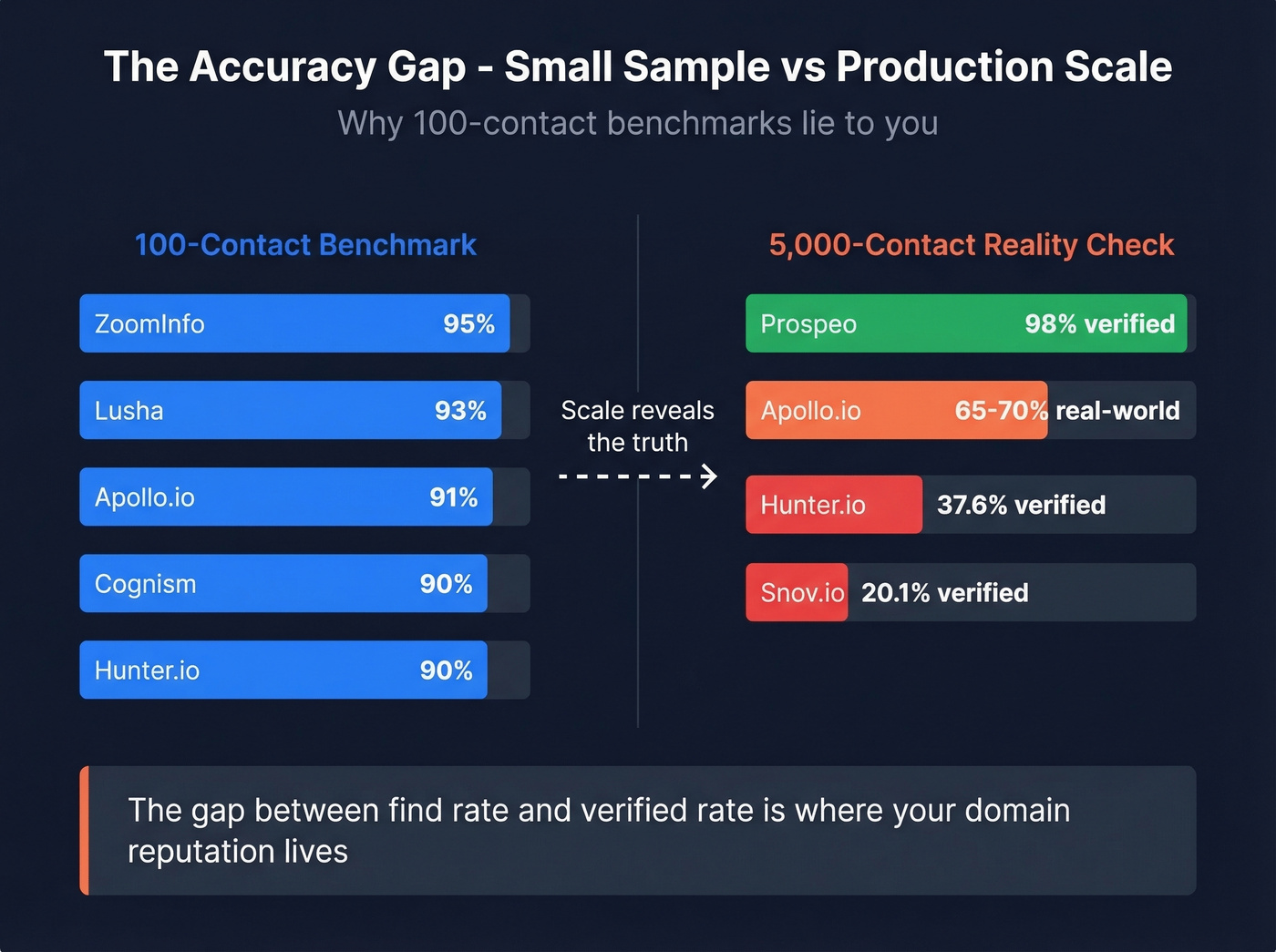
100-contact benchmark (same list tested across tools, per SalesHandy's email finder benchmark):
| Tool | Accuracy | Contacts Found |
|---|---|---|
| ZoomInfo | 95% | 92/100 |
| Lusha | 93% | 92/100 |
| Apollo.io | 91% | 91/100 |
| Cognism | 90% | 90/100 |
| Hunter.io | 90% | 90/100 |

These small-sample results look tight. At scale, the picture shifts dramatically. In a 5,000-contact test, Hunter's verified rate dropped to 37.6% and Snov.io fell to 20.1%. The gap between "find rate" and "verified rate" is where your domain reputation lives. A tool can find an email for 90% of contacts but only verify 40% of them - and the unverified portion is what gets you flagged as spam.
Let's be honest: most teams obsess over database size when they should obsess over verification methodology. A 300M-record database with 98% verification accuracy will outperform a 600M-record database with 70% accuracy every single time. The biggest database means nothing if a quarter of the emails bounce. (If you're building a sourcing layer, compare data enrichment services too.)
Common advice on r/salesdevelopment is simple: run your lists through at least two verifiers. At $0.01/email, adding a dedicated verification layer is essentially a rounding error in your budget.
Stack Optimize built a $1M agency on Prospeo data - 94%+ deliverability, under 3% bounce, zero domain flags. One bad sales extension can torch your sender reputation. 98% email accuracy and 125M+ verified mobiles mean your outbound actually connects.
Stop paying for bounced emails. Start with 75 free credits today.
How Credits Actually Work
Credit-based pricing is designed to confuse you. Here's how it breaks down.
| Tool | Email Cost | Phone Cost | Model |
|---|---|---|---|
| Apollo.io | 1 credit | 8 credits | Monthly expiry |
| Lusha | 1 credit | 10 credits | Rollover (2x cap) |
| SalesQL | 1 credit = full profile | Same credit | Bundled |
The biggest gotcha is phone numbers. On Lusha, your 70 free credits buy 70 emails or 7 phone numbers - not both. Apollo's phone credits cost 8x email credits, and they expire monthly. SalesQL's model is the simplest: one credit gets you everything on a profile, emails and phones included.
In our experience, the "pay for valid only" model saves teams 15-30% versus flat credit pools, because you're not burning credits on dead records. It's a small detail that compounds fast at volume.
Build Your 2026 Extension Stack
You need three layers: data, CRM, and optionally productivity. Here are three stacks by team size.
Solo SDR: Prospeo + HubSpot Sales (free). Total cost: $0 to start. You get 98% accurate emails, a CRM sidebar, and email tracking. That's enough to run real outbound. (If you want more tactics, use these sales prospecting techniques.)
SMB team (5-15 reps): Add Apollo.io for sequences and the dialer, keep HubSpot as the CRM layer, and use a dedicated data tool for the verification backbone. Budget: ~$50-150/user/month depending on Apollo tier. We've seen teams in this range get the best ROI by splitting data sourcing from sequencing rather than relying on one tool for both.
Mid-market (20+ reps): Layer in Cognism for EMEA compliance and Diamond phone-verified mobiles alongside your Salesforce extension. This stack runs heavier - expect $20-30K+ annually - but it lets you scale spend with actual usage rather than locking into flat-rate contracts.
FAQ
What is a sales extension?
A browser add-on that helps reps find contacts, track emails, manage CRM data, or automate outreach directly from Chrome. Most install in seconds and sit in your toolbar, surfacing prospect data as you browse professional profiles or company websites.
How many browser extensions should I install?
Two to three. A prospecting tool for data, a CRM extension for logging and tracking, and optionally a productivity add-on like Lavender or Vidyard. More than that slows your browser and creates data conflicts between tools.
Are free tiers worth using?
Yes - Prospeo (75 emails/mo), Apollo, HubSpot Sales, and Lusha all offer usable free plans with enough credits to test before committing budget. Start free, upgrade when you hit credit limits or need team features.
Do these tools work outside Chrome?
Most are Chrome-only. HubSpot Sales also works in Outlook. Always check browser compatibility before committing, especially if your org standardizes on Edge or Firefox.
Which tool has the most accurate contact data?
Prospeo leads at 98% verified email accuracy with a 7-day refresh cycle. In independent benchmarks, most tools range from 38% to 95% depending on dataset size and verification methodology. At production volume the gap widens significantly, which is why verification matters more than raw database size.