

Sales Follow-Up Email Subject Lines: What the Data Actually Says
Your sales follow-up email subject line gets about two seconds of attention before it's opened or ignored. A study of 5.5 million emails by Belkins found that personalized subject lines hit a 46% open rate versus 35% without - and the average B2B open rate hovers around 31-36%. Eighty percent of sales require five or more follow-ups. This isn't a one-shot problem. It compounds.
3 Subject Lines to Test First
If you're short on time, start here:
- "Next steps" - up to 70.5% open rate in a Yesware comparison cited by Mailshake. Two words. No cleverness needed.
- "Following our conversation" - a practitioner favorite on r/sales because it signals a real interaction happened. Not for cold outreach; perfect for warm follow-ups.
- "[First name] - quick question" - questions in subject lines hit 46% opens in the Belkins dataset. Adding the prospect's name pushes it further.
You don't need 90 ideas. You need these three and the discipline to A/B test them (and pull more options from our email subject line examples library when you need fresh variants).
What Works in Follow-Up Subject Lines for Sales
Ideal Length: 2-4 Words
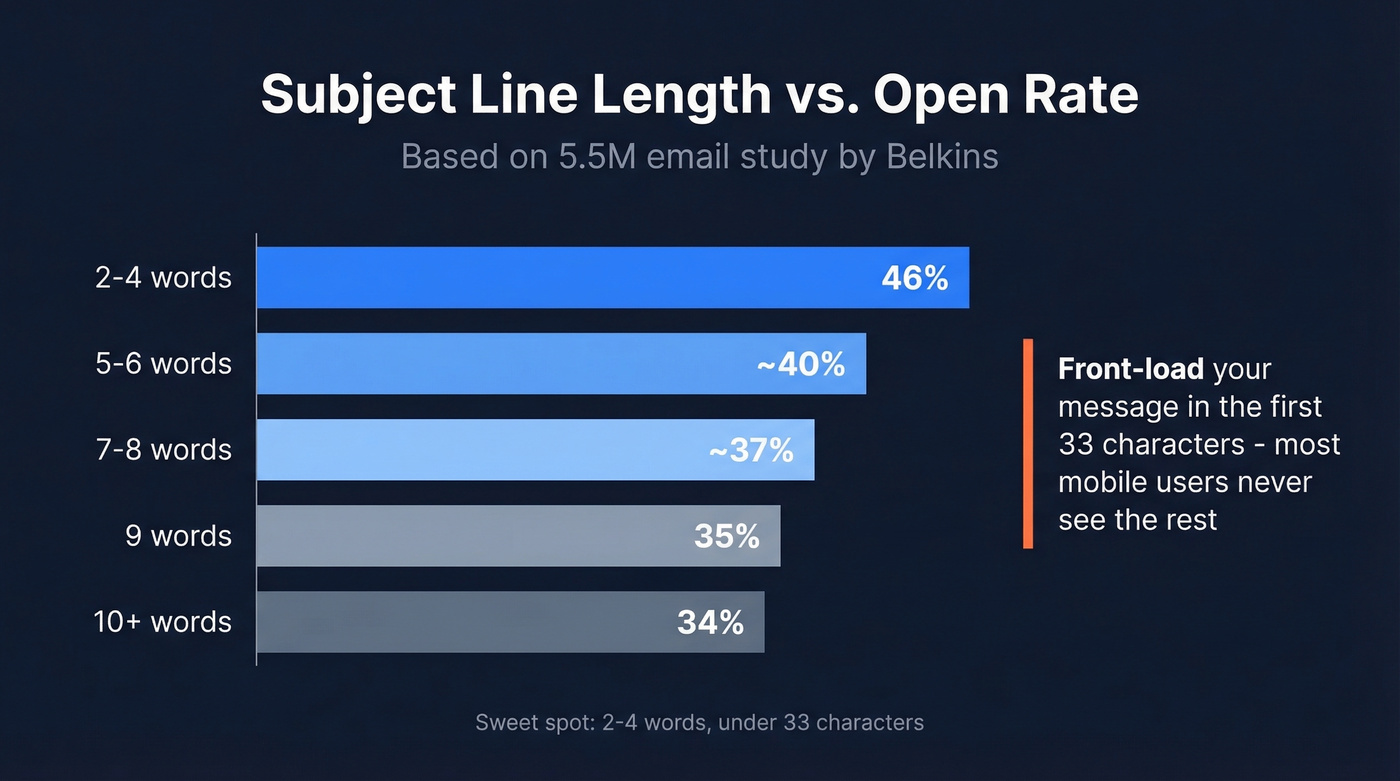
The Belkins study is clear: 2-4 word subject lines averaged 46% opens. Past 7 words, opens start declining. At 9 words, that drops to 35%. At 10, 34%.
Reply rates doubled too - personalized subject lines pulled 7% replies versus 3% without.
But word count isn't the whole story. EmailToolTester's device testing shows how many characters actually display before truncation, and the differences across clients are bigger than most reps realize:
| Device / Client | Max Visible Characters |
|---|---|
| Gmail Android (Pixel 7) | 33 |
| Gmail iPhone 14 | 37 |
| Apple Mail iPhone | 48 |
| Apple Mail iPad | 39 |
| Outlook Desktop | ~51 |
Front-load your message in the first 33 characters. Everything after that is bonus text most mobile readers won't see.
Numbers in subject lines? Skip them. The Belkins data shows 27% opens with numbers versus 28% without - a negligible or negative effect.
Which Personalization Type Wins
Let's be specific about what "personalize your subject line" actually means. Klenty's analysis of 100,000+ emails breaks it down:
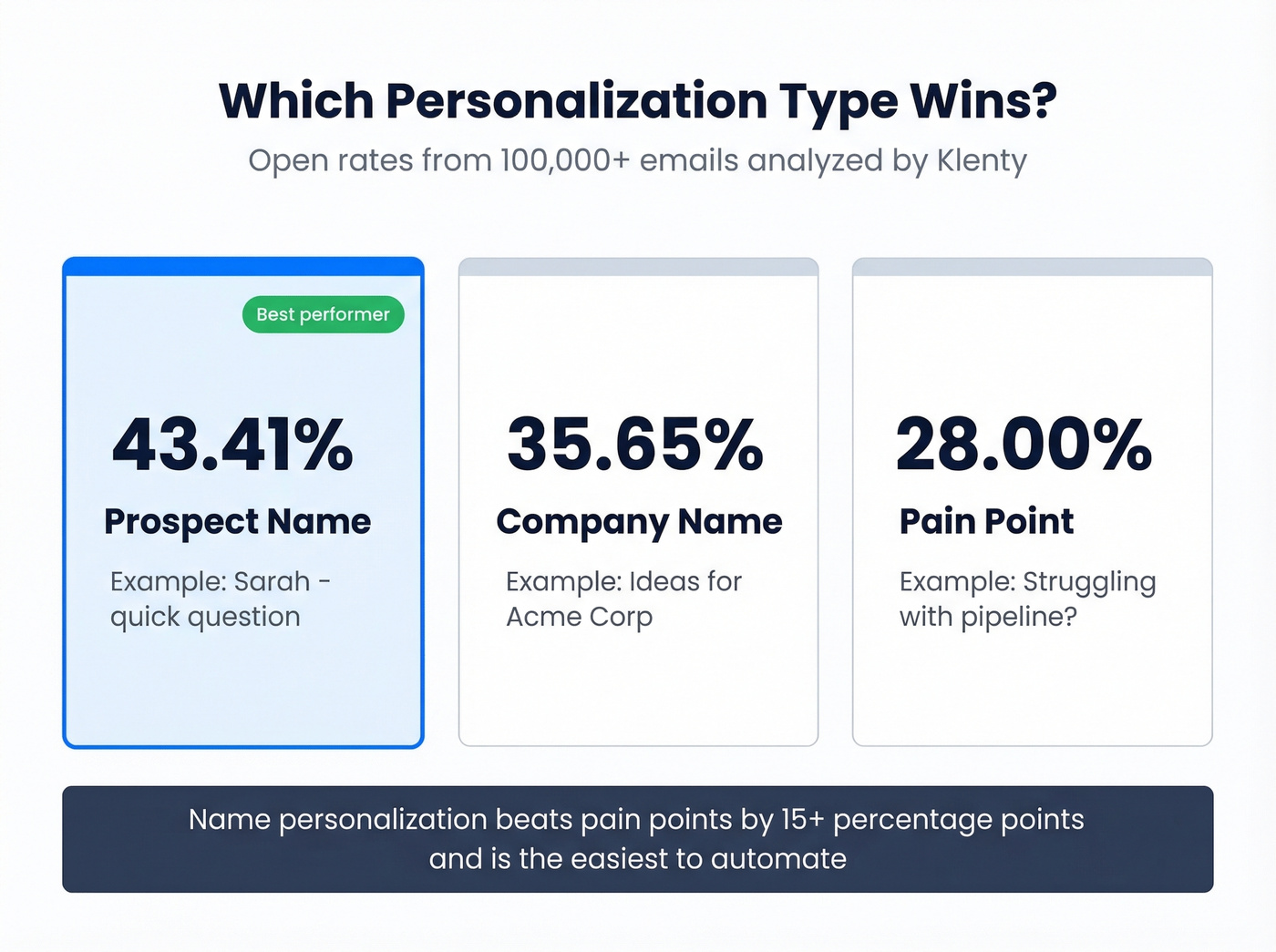
| Personalization Type | Open Rate |
|---|---|
| Prospect's name | 43.41% |
| Company name | 35.65% |
| Pain point | 28.00% |
Name personalization outperforms pain-point references by over 15 percentage points. It's the easiest variable to automate and the most effective. Use it. (If you need help operationalizing it across sequences, see personalized drip campaigns.)
Best Subject Lines by Scenario
After a Meeting or Call
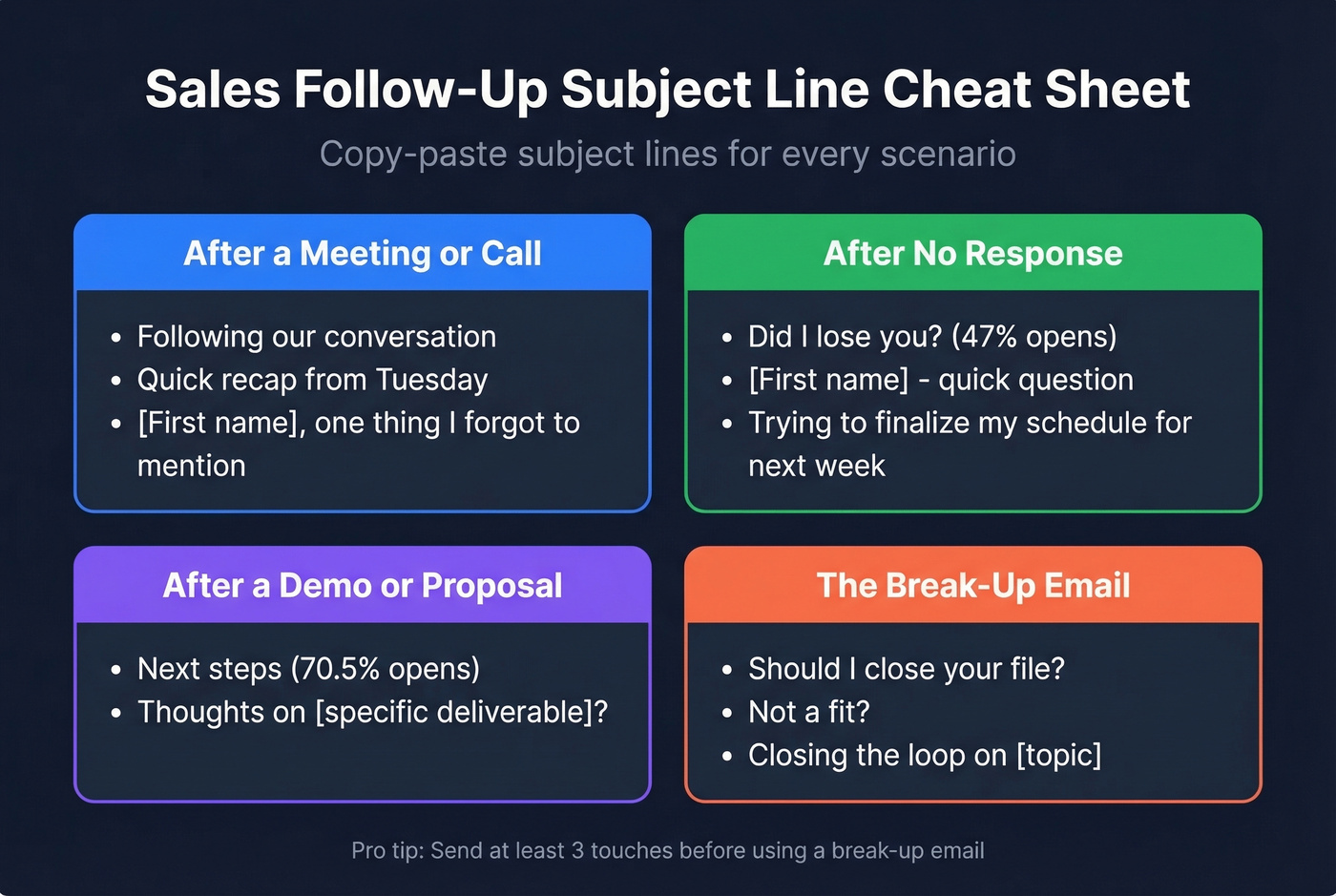
"Following our conversation" works because it's true - the prospect remembers talking to you. "Quick recap from [day]" anchors the follow-up to a specific moment. "[First name], one thing I forgot to mention" combines curiosity with implied value. Don't use any of these if a real interaction didn't happen. Prospects can smell a fake callback reference instantly, and it'll tank your credibility for every future touch.
After No Response
This is where most reps struggle, and honestly, where most sequences fall apart. You're competing against an inbox full of unread messages from people who all think their email is the important one.
- "Did I lose you?" - Salesforce's sales-engagement research reports this hit 47% opens in their testing. Direct without being aggressive.
- "[First name] - quick question" - questions drive 46% opens. Keep the actual question for the body.
- "Trying to finalize my schedule for next week" - a field rep on r/sales described this as their go-to for re-engaging quiet prospects. "Does Tuesday work?" gives them a low-friction way to respond.
If you want full sequences (not just subject lines), use these sales follow-up templates and swap in the best-performing subjects above.
After a Demo or Proposal
"Next steps" - up to 70.5% open rate. The simplicity is the point. "Thoughts on [specific deliverable]?" names the thing they're evaluating and makes the email feel relevant rather than generic. Pair this with a tight sales meeting follow-up email structure so the body matches the subject's clarity.
The Break-Up Email
Break-up emails often generate the highest reply rates in a sequence. We've tested dozens of variations across client campaigns, and the pattern is consistent: giving prospects an easy out gets more replies than another pitch.
"Should I close your file?" triggers loss aversion in five words. "Not a fit?" gives them permission to say no - and surprisingly often, they'll say "actually, let's talk." "Closing the loop on [topic]" is professional and final. Skip this approach if you haven't sent at least three prior touches; a break-up email on touch two just looks lazy.

Name personalization drives 43% open rates - but only if you have the right email behind it. Prospeo's 300M+ verified profiles give you accurate names, titles, and emails in one search. 98% accuracy means your perfectly crafted follow-up actually lands.
Stop writing subject lines for emails that bounce. Start with clean data.
Words to Avoid
Modern spam filters evaluate patterns and context, not single trigger words. Stacking urgency + money + guarantees in one subject line is what gets you filtered.
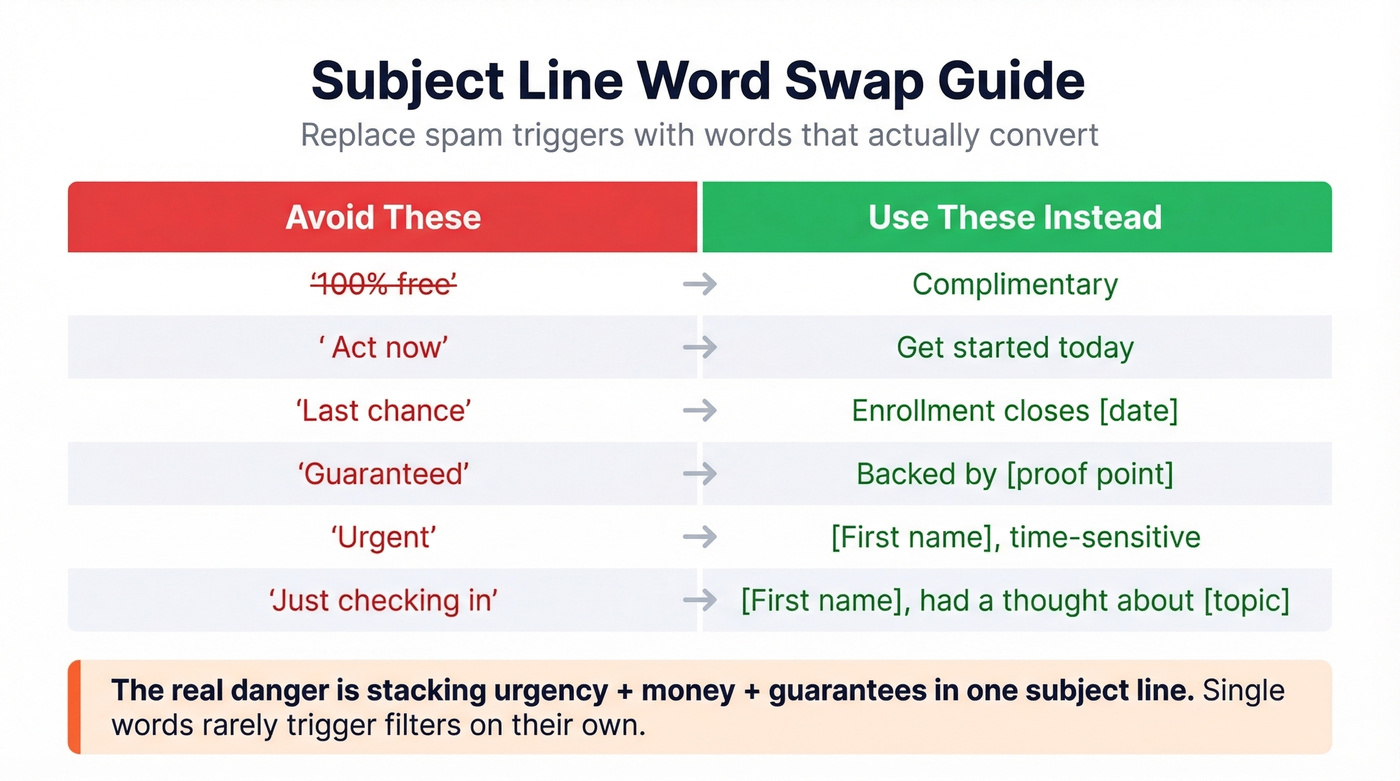
| Avoid | Use Instead |
|---|---|
| "100% free" | "Complimentary" |
| "Act now" | "Get started today" |
| "Last chance" | "Enrollment closes [date]" |
| "Guaranteed" | "Backed by [proof point]" |
| "Urgent" | "[First name], time-sensitive" |
Here's the thing: "just checking in" belongs on this list too. Not because it triggers spam filters, but because it signals you have nothing new to say. Every rep sends it. None of them should. If you catch yourself writing it, use these alternatives from how to say just checking in professionally. The Belkins data confirms that urgency words like "ASAP" and generic greetings like "Hello, friend" drag opens below 36%.
When to Send Your Follow-Up
Timing matters less than subject lines, but it's not zero. A role-based framework from Zeliq offers useful starting points:
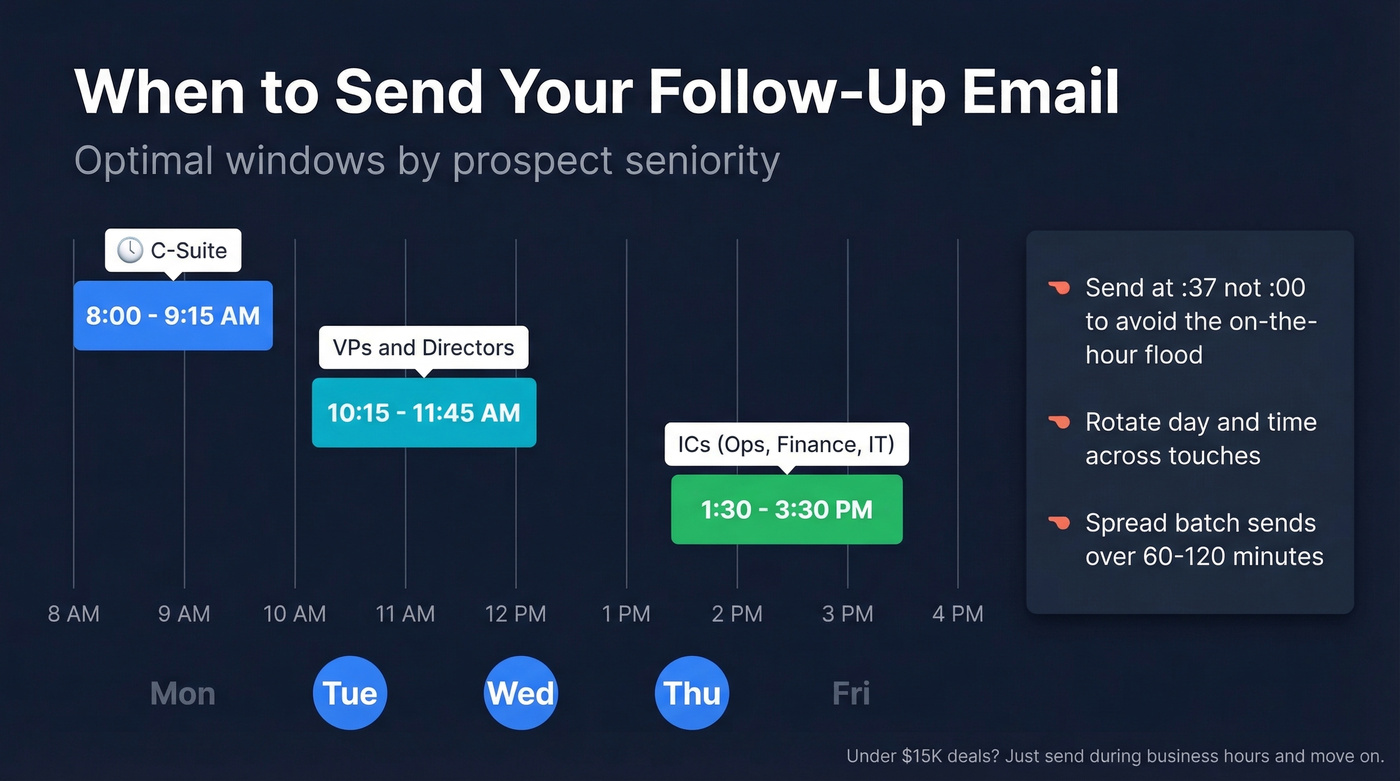
- C-suite: 8:00-9:15 AM
- VPs / Directors: 10:15-11:45 AM
- ICs (Ops, Finance, IT): 1:30-3:30 PM
Stick to Tuesday through Thursday. Send at :37, not :00 - you'll avoid the flood of emails scheduled on the hour. Rotate your day and time across touches; hitting the same slot every follow-up makes your emails predictable, and prospects start ignoring them unconsciously. Spread batch sends across 60-120 minutes to avoid throttling. (For a deeper breakdown, see best time to send cold emails.)
If your average deal is under $15K, timing optimization is a waste of your energy. Get the subject line right, send during business hours, and move on.
Verify Before You Send
The best sales follow-up email subject line can't save an email that bounces. High bounce rates damage your sender reputation over time and hurt deliverability across your entire domain - not just the campaign that caused the problem. Snyk cut their bounce rate from 35-40% to under 5% by switching to verified data, and their AE-sourced pipeline jumped 180%.
We run every email through a 5-step verification process at Prospeo, including spam-trap removal and honeypot filtering, delivering 98% email accuracy on a 7-day refresh cycle. The free tier gives you 75 verifications per month - enough to test whether your data is the bottleneck before you commit. If you're troubleshooting deliverability end-to-end, start with our email deliverability guide and then benchmark against email bounce rate norms.

Snyk's 50 AEs cut bounce rates from 35% to under 5% and grew pipeline 180% - because follow-ups only compound when they reach real inboxes. Prospeo's 5-step verification with 7-day refresh ensures every email in your sequence hits a valid address.
Five follow-ups need five deliveries. Verify your list at 98% accuracy.
FAQ
How long should a follow-up subject line be?
Two to four words hit a 46% open rate in a study of 5.5 million emails. Keep your subject line under 33 characters so it displays fully on Gmail Android - the most restrictive major mobile client in EmailToolTester's testing.
How many follow-up emails should I send?
At least five. Most sales require five or more touches, and the break-up email - something like "Should I close your file?" - often gets the highest reply rate in the entire sequence. Craft distinct subject lines for each touch so the sequence doesn't feel repetitive.
Why are my follow-up emails landing in spam?
Usually it's a combination of spam-trigger word clusters and bad data. High bounce rates from unverified emails damage your sender reputation over time. Run your list through a verification tool before sending, and avoid stacking urgency and money language in subject lines.
Do the same subject lines work across industries?
The principles - short length, name personalization, question-based framing - hold across verticals. But specific phrasing performs differently depending on your audience's sophistication. A/B test within your own segment rather than copying templates verbatim. A subject line that kills it in SaaS sales can fall flat in manufacturing.