

17 Sales Games That Motivate Your Whole Team, Not Just the Top 3 Reps
It's 2 PM on a Wednesday. Your team's energy flatlined after lunch. Half the floor is scrolling their phones, and the other half is "updating Salesforce." You announce a contest - highest revenue this month wins a $200 gift card - and the same three closers perk up while everyone else mentally checks out.
That's not gamification. That's a participation trophy for people who were already winning.
The right sales games fix this by rewarding effort and improvement across the entire roster. Most contests reward outcomes only top performers can hit. 70% of the Global 2000 have adopted some form of gamification, and the most common failure mode is that contests over-reward the top 10-20% instead of moving the middle 60% of the team. Here are 17 games that fix that - plus the psychology, the mistakes, and the software worth paying for.
Quick version: Zero budget? Run the poker card game. Have budget? Team houses. Remote team? Daily-reset bingo. Spending on software? Pointagram ($5/user) for small teams, Ambition ($45/user) for mid-market.
Why Sales Contests Actually Work
The instinct is to throw cash at reps and call it motivation. But a meta-analysis from Baylor's Keller Center - covering 77,560 salespeople across 127 studies - found that intrinsic motivation is more strongly linked to sales performance than extrinsic rewards like bonuses. Cash still works. It's just not the strongest lever.
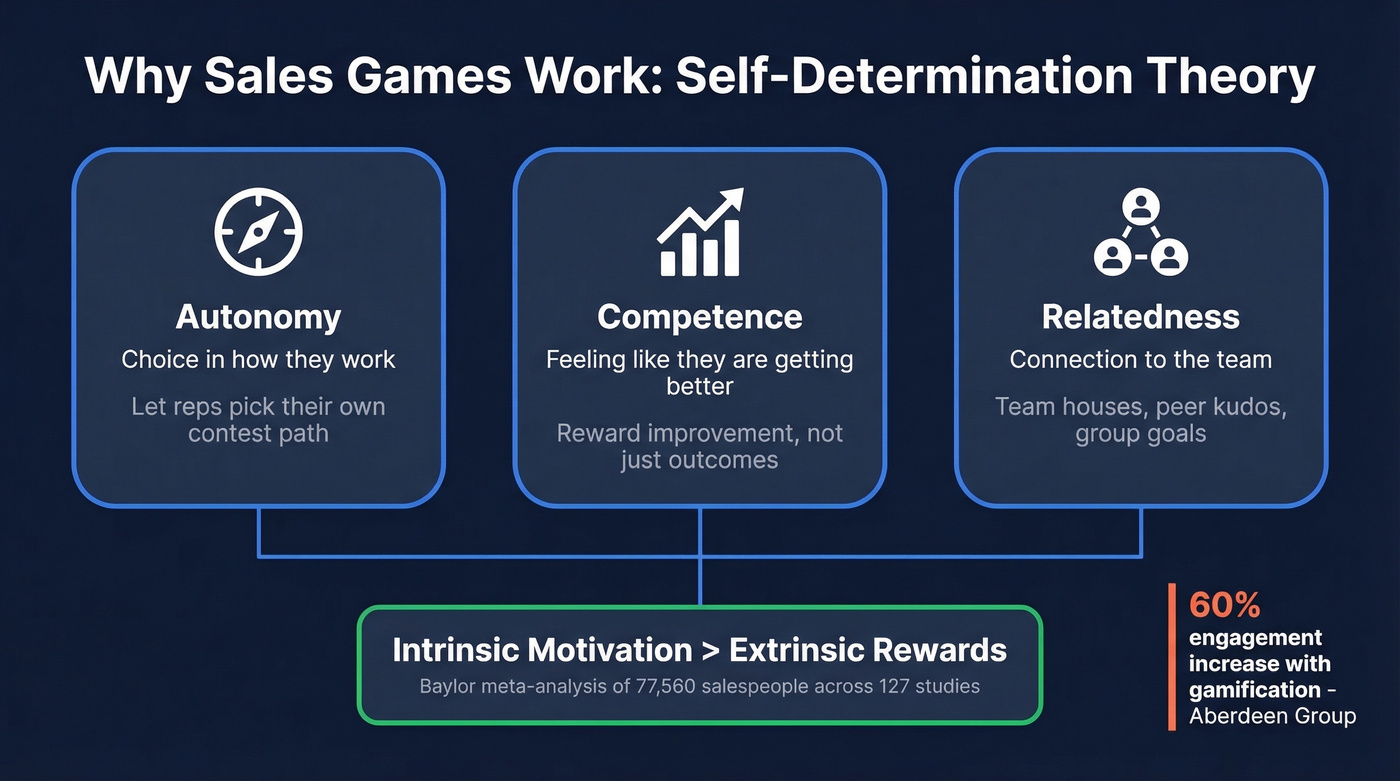
The framework behind this is Self-Determination Theory (SDT). People perform best when three needs are met: autonomy (choice in how they work), competence (feeling like they're getting better), and relatedness (connection to the team). Good sales games hit all three. Bad ones - "highest revenue wins" on repeat - only reward competence in people who already have it.
The numbers back this up at scale. The gamification market hit $19.42B in 2025 and is projected to reach $92.5B by 2030. HP saw a 30-42% revenue lift over two months after deploying sales gamification. Aberdeen Group research puts the engagement increase at 60% for organizations using gamification elements. A University of Colorado study found gamified learners scored 14% higher on skill-based knowledge tests. These aren't marginal gains.
Here's the thing: intrinsic motivation's advantage over extrinsic grows stronger as your reps get more experienced. Junior SDRs respond well to cash spiffs. Your senior AEs want status, autonomy, and mastery. If you're running the same "biggest deal wins a gift card" contest for a team with mixed tenure, you're actively demotivating your most valuable people. Design accordingly.
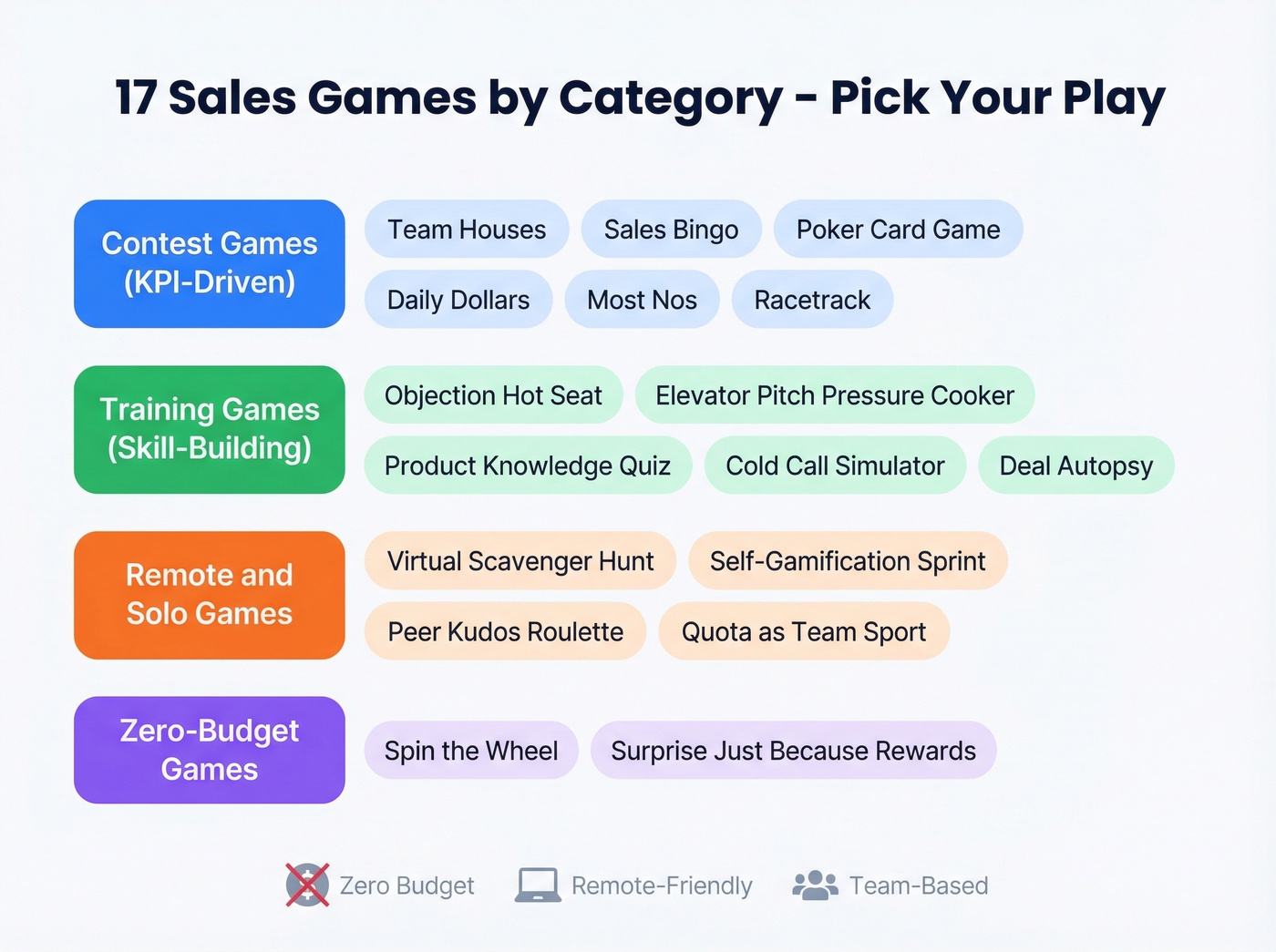
17 Games by Category
Contest Games (KPI-Driven)
Team Houses
Split your floor into houses of 5-8 people with mixed seniority and skill levels. A senior closer paired with two new SDRs creates mentorship pressure that no training program replicates. Scoring: $1 of revenue equals 1 point, or use opps booked and activities completed if your cycle is long (here are more sales activities you can score).
Use Hoopla to auto-tally and display scores on a monitor in real time. Pricing runs in tiers around $22/user/mo (Standard), $25/user/mo (Advanced), and $32/user/mo (Unlimited). One sales leader using this format reported upwards of a 90% SDR retention rate over 6+ months - which, if you've managed SDRs, you know is almost unheard of. Post the rules once, keep them simple, and get managers to hype participation daily.
Sales Bingo
Create custom bingo cards using Bingo Baker with squares like "booked a meeting from a cold call," "got a referral," "handled a pricing objection," or "sent a follow-up within 5 minutes" (pair it with proven sales follow-up templates). Multi-tier prizes keep it interesting: $50 for a line, $100 for four corners, $250 for blackout. Run it for one to two weeks. This format works especially well for remote teams because it doesn't require real-time leaderboards - reps just screenshot their cards.
Poker Card Game
This is the best zero-budget game we've seen. A sales manager on r/sales who couldn't get budget approval for cash rewards came up with this: reps earn playing cards each week based on metrics - most deals closed, highest close rate, most new contacts added, most outbound activity (use a consistent sales prospecting definition). At month's end, best poker hand wins.
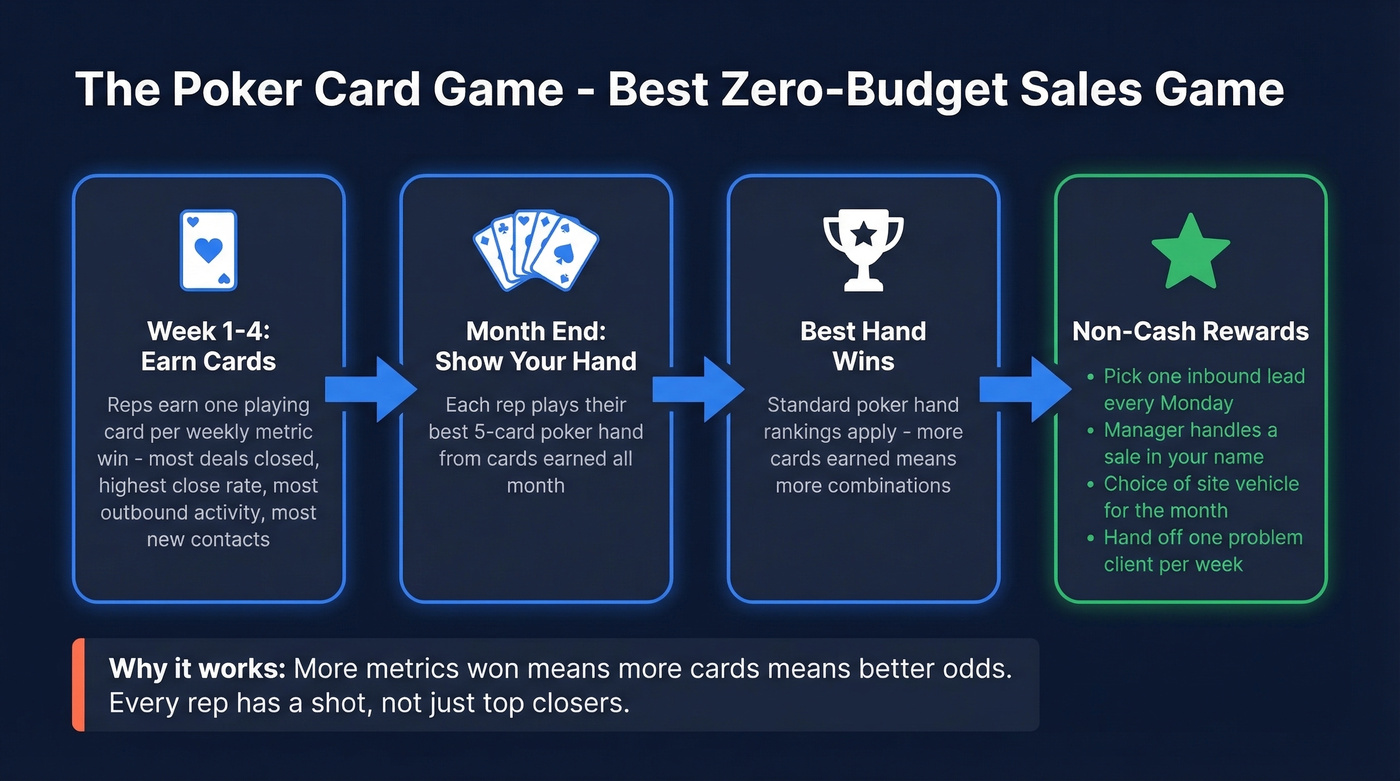
The genius is in the non-cash rewards: choice of one inbound lead each Monday, the sales manager handles a sale in your name, choice of site vehicle for the month, or hand off one problem client each week. These rewards cost nothing but carry real status. If you're looking for a practical way to gamify your sales floor without spending a dime, start here.
Daily Dollars
Leaderboard resets every 24 hours. The daily winner gets a $50-$100 gift card. This is the single best mechanic for preventing top-performer domination - your best closer can't coast on Monday's big deal all week because everyone starts at zero tomorrow morning. Run it for a week or two as a sprint.
Most Nos
Track rejections for 5-7 days. The rep who gets the most "no's" wins. Keep it short because the gap widens fast in longer contests. This game reframes failure as progress and rewards the activity volume that eventually produces results. It's particularly effective for new SDRs still building call reluctance tolerance (see more on cold call rejection).
Activity-based contests like this only work when your underlying data is clean. If 20% of your phone numbers are disconnected, you're not running a contest - you're running a frustration exercise. Verify your prospect list before launch with a tool like Prospeo so reps spend game time talking to real prospects, not listening to dial tones.

Racetrack / Progress Bar
A collaborative visual tracker toward a team goal - 500 meetings booked this quarter, $2M in pipeline, whatever matters. Put it on a shared screen or a team chat channel. This isn't competitive; it's about collective momentum. The racetrack works best as a background game running alongside individual contests (tie it to pipeline health so it doesn’t become a vanity board).
Training Games (Skill-Building)
Objection Hot Seat
One rep sits in the hot seat. A teammate throws an objection. The rep has 60 seconds to respond using the LAER framework - Listen, Acknowledge, Explore, Respond. The rest of the team scores the response 1-5. Record sessions with Gong or Chorus for later review. This builds muscle memory for the moments that actually close deals (and supports better sales communication).
Elevator Pitch Pressure Cooker
Each rep gets 30-60 seconds to pitch your product to the room. The audience votes on clarity, energy, and persuasiveness. It's brutal, it's fun, and it forces reps to cut the fluff. Run it monthly - you'll watch pitches tighten dramatically by round three (use these sample elevator pitches as a baseline).
Product Knowledge Quiz Show
Use Kahoot! to run a team-based quiz on product features, competitor positioning, pricing objections, and industry knowledge. Making it team-based means weaker product knowledge gets coached by peers in real time, which is the whole point.
Cold Call Simulator
AI roleplay tools like YesChat.ai let reps practice cold calls against an AI prospect that pushes back. Solo-friendly and remote-ready. Use it as a warm-up before daily dials (especially helpful for cold calling for beginners).
Deal Autopsy
A rep presents a lost deal - what happened, where it stalled, what they'd do differently. The team diagnoses the failure together. Run it biweekly with rotating presenters. This creates a culture where losing isn't shameful; it's educational.
Remote and Solo Games
Virtual Scavenger Hunt
Give reps a list of specific prospect details to find: tech stack, recent funding round, org chart for the VP of Sales, last earnings call mention of a specific initiative. First to find all items wins. Timed at 3-5 minutes. This builds the research skills that separate good prospectors from lazy ones.
Self-Gamification Sprint
For solo remote reps who need structure. Create a personal point system: 1 point per cold call, 3 points per meeting booked, 5 points per close. Track it in a spreadsheet. Beat your own weekly score.
A remote rep on r/sales put it perfectly: "I can grind in video games for hours but can't sustain focus at work without game mechanics." This gives that structure - it's the simplest way to gamify your sales routine when you don't have a team pushing the pace.
Peer Kudos Roulette
Start each team meeting by randomly calling on someone to recognize a teammate's effort from the past week. This is SDT's relatedness lever in action. 83% of businesses report remote work has been successful, but connection is the piece that erodes fastest without intentional effort. Costs nothing. Takes two minutes.
Quota as Team Sport
Split into groups of 3-4, track quarterly performance, meet weekly to strategize. Rotate groups each quarter so cliques don't form. This turns an individual grind into a collaborative challenge and gives mid-performers access to the thinking patterns of top performers.
Zero-Budget Games
Spin the Wheel
Use Wheel of Names with non-cash prizes: leave early Friday, pick your leads first on Monday, skip CRM updates for a day, choose your desk for the week. Reps earn a spin by hitting a daily activity threshold. The randomness adds a dopamine hit that a predictable reward can't match.
Surprise "Just Because" Rewards
The manager randomly rewards effort moments - a great discovery call, a creative objection handle, a rep who stayed late to help a teammate prep. No announcement, no schedule. Unpredictable reinforcement is more powerful than scheduled rewards. This is the easiest game on the list and the one most managers skip.

Activity-based sales games fall apart when your contact data is bad. Reps chasing "Most Nos" or Daily Dollars need to reach real humans, not dead numbers. Prospeo's 98% email accuracy and 125M+ verified mobiles mean every rep activity in your contest actually counts.
Stop gamifying frustration. Start gamifying real conversations.
Mistakes That Kill Sales Games
We've seen more contests die from fuzzy scoring than from bad prizes. Here are the six killers:
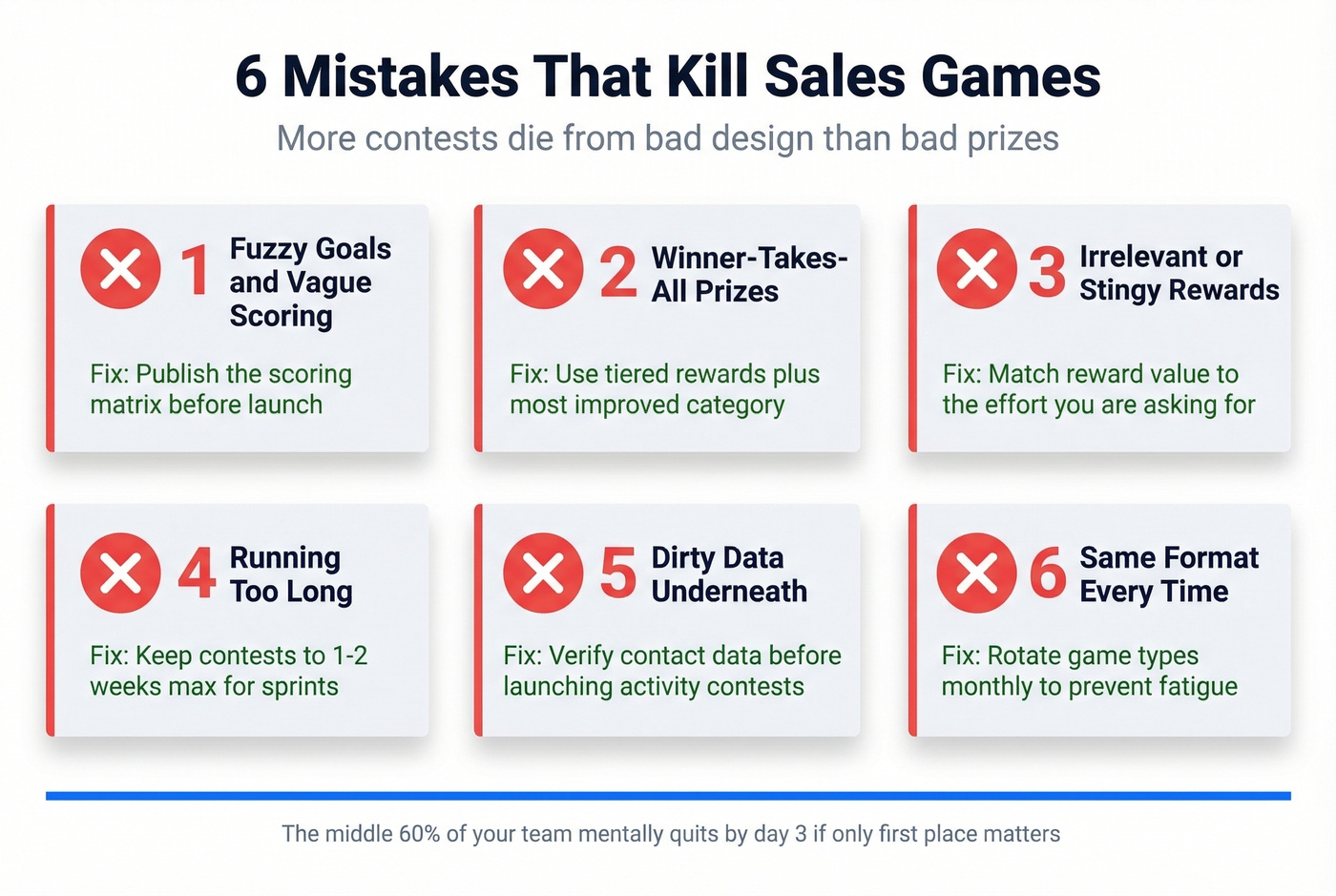
1. Fuzzy goals and vague scoring. If reps don't understand exactly how points are earned, you get distrust, bickering, and loophole hunting. Publish the scoring matrix before launch and freeze the rules. No mid-game changes.
2. Winner-takes-all prizes. When only first place matters, the middle 80% of your team mentally quits by day three. Use tiered rewards plus a "most improved" and "rookie of the week" category. Everyone should have a realistic path to winning something.
3. Irrelevant or stingy rewards. A $10 Starbucks card for a week of extra effort is insulting. Survey your team. Mix tangible rewards with status perks. Rotate what's available so it stays fresh.
4. Delayed or inaccurate feedback. If reps can't see their score in real time, the dopamine loop breaks. This compounds when your underlying data is bad - reps make 80 dials, half go to voicemail or disconnected numbers, and the leaderboard shows activity that didn't produce real conversations. Refresh your contact data weekly (and consider data enrichment services if you’re patching multiple sources).
5. Quest overload and rule creep. Running three simultaneous contests with overlapping metrics creates decision fatigue. One main sprint plus one side challenge, maximum. Keep it simple enough to explain in two sentences.
6. Negative scoring or public shaming. Deducting points for missed targets or posting "worst performer" lists creates fear and risk avoidance - the opposite of what you want. Additive scoring only. Coach underperformers privately.
How to Design a Game That Drives Results
Start with SMART goals. "Increase activity" isn't a goal. "Each rep books 3 additional meetings this week from outbound" is. Tie the contest metric directly to the behavior you want to change - and connect it back to SDT. For more outbound volume, design for autonomy (let reps choose their approach) and competence (make improvement visible). For better teamwork, design for relatedness.
Duration matters more than most managers realize. Five to seven days for competitive sprints - long enough to build momentum, short enough that mid-pack reps don't give up. In our experience, daily resets outperform weekly leaderboards for teams under 20 reps. For a longer arc, run weekly sprints with a monthly leaderboard that aggregates weekly wins.
Prize ranges that work: $50 daily prizes for sprint games, $100 for mid-tier weekly rewards, $250 for grand prizes. Non-cash rewards like lead selection priority, schedule flexibility, and status perks often outperform gift cards for experienced reps.
Fairness mechanics are non-negotiable. Use tiered rewards so multiple reps can win. Add a "most improved" category. Distribute leads evenly or randomly to prevent cherry-picking. For activity benchmarks, 60-80 dials per day and 12 decision-maker contacts is a reasonable baseline for inside sales teams - adjust for your team's reality.
Gamification Tools Worth Paying For
You don't need software to run sales games on a small team. A whiteboard, a shared Google Sheet, and a team chat channel will get you 80% of the way there. Skip the tools section entirely if your team is under 10 reps and you're just getting started.
Gamification tools become worth it when you need real-time CRM integration, automated scoring, and TV displays that keep energy visible. They fall into two camps: lightweight leaderboard tools and full performance management suites (often bundled into broader sales performance management stacks).
| Tool | Best For | Starting Price | G2 Rating |
|---|---|---|---|
| Pointagram | Budget teams | $5/user/mo | 4.3/5 |
| Spinify | SMB leaderboards | $16/user/mo | 4.6/5 |
| SalesScreen | Visual dashboards | $20/user/mo | 4.7/5 |
| Hoopla | Real-time TV displays | $22-32/user/mo | - |
| Ambition | Mid-market coaching | $45-75/user/mo | - |
| Plecto | Flat-rate teams | $200/mo (flat) | 4.6/5 |
Pointagram at $5/user is the obvious starting point for teams testing the waters. SalesScreen has some of the best visual dashboards we've used - if your office has TVs, it's worth the premium. Ambition is the mid-market play with real coaching features, but note the add-on pricing: AI Insights runs $5/user/mo and AI Actions $4/user/mo on top of the base. Contracts are annually structured with a two-year standard term, so negotiate hard.
The strongest case study in the space comes from Plecto: The Insurance Surgery reported a 50% increase in calls made and the equivalent of 8 extra hours of calls per month per sales advisor after implementation. That's real output, not a vanity metric.
Your sales games reward effort - but effort on bad data is wasted energy. Prospeo refreshes 300M+ profiles every 7 days, so your team's bingo cards and poker hands are built on contacts that pick up the phone. At $0.01/email, cleaning your list costs less than a single contest prize.
Give your reps a list worth competing over.
FAQ
Do sales games actually increase performance?
Yes. A meta-analysis of 77,560 salespeople found intrinsic motivation - which well-designed games build - is more strongly linked to performance than cash bonuses alone. HP saw 30-42% revenue gains after deploying gamification. The key is rewarding effort and improvement, not just outcomes only top performers can hit.
What are good sales contest prizes with no budget?
Non-cash rewards often outperform gift cards for experienced reps. Proven options: choice of inbound leads on Monday, manager handles a sale in your name, leave early Friday, skip CRM updates for a day, or pick your desk for the week. These tap into autonomy and status - the intrinsic drivers that research shows sustain long-term performance.
How long should a sales contest run?
Five to seven days for competitive sprints. Longer contests let the gap widen so mid-pack reps give up by week two. Daily resets keep energy high across the full roster. For sustained engagement, run weekly sprints that feed a monthly aggregate leaderboard - this gives everyone a fresh start while still rewarding consistency.
How do you keep activity contests fair when data quality varies?
Clean your contact list before launching any activity-based game. If 20% of phone numbers are disconnected, top dialers get penalized by luck, not effort. Even distribution of verified leads is the foundation of a fair contest - without it, you're measuring who got luckier with their list, not who worked harder.