

Sales Intelligence and Engagement Platforms: What They Are, What They Cost, and Which to Pick in 2026
Your VP of Sales just dropped "evaluate sales intelligence and engagement platform options" into your Q3 OKRs. You started researching. You found 27-tool listicles, vendor pages that all claim to be #1, and zero published pricing. One Reddit user nailed the frustration perfectly - their last platform "just added more boxes to check and felt like a surveillance system for management." That's the old model. The new model merges intelligence and engagement into a single workflow, and the gap between the best and worst options is enormous.
Most guides list 15-27 tools. That's a Wikipedia page, not a buying guide. You need to evaluate 3-4 platforms max, and the right 3 depend on your team size, budget, and whether you need data, engagement, or both.
Quick Picks
- Best enterprise all-in-one: Outreach - cadences, conversation intelligence, forecasting, AI recommendations.
- Best SMB all-in-one: Apollo - free tier, combined data + sequences, but watch the credit burn.
- Best for account-based intelligence: ZoomInfo - deepest company data, but $15K+/year minimum.
- Best CRM-native option: HubSpot Sales Hub - if you're already on HubSpot, don't add another tool.
What Is a Sales Intelligence and Engagement Platform?
Three years ago, these were two separate categories. Sales intelligence meant data - who to contact, what they care about, when they're in-market. Sales engagement meant the tools to actually reach them - email sequences, call tasks, social touches, and CRM logging.
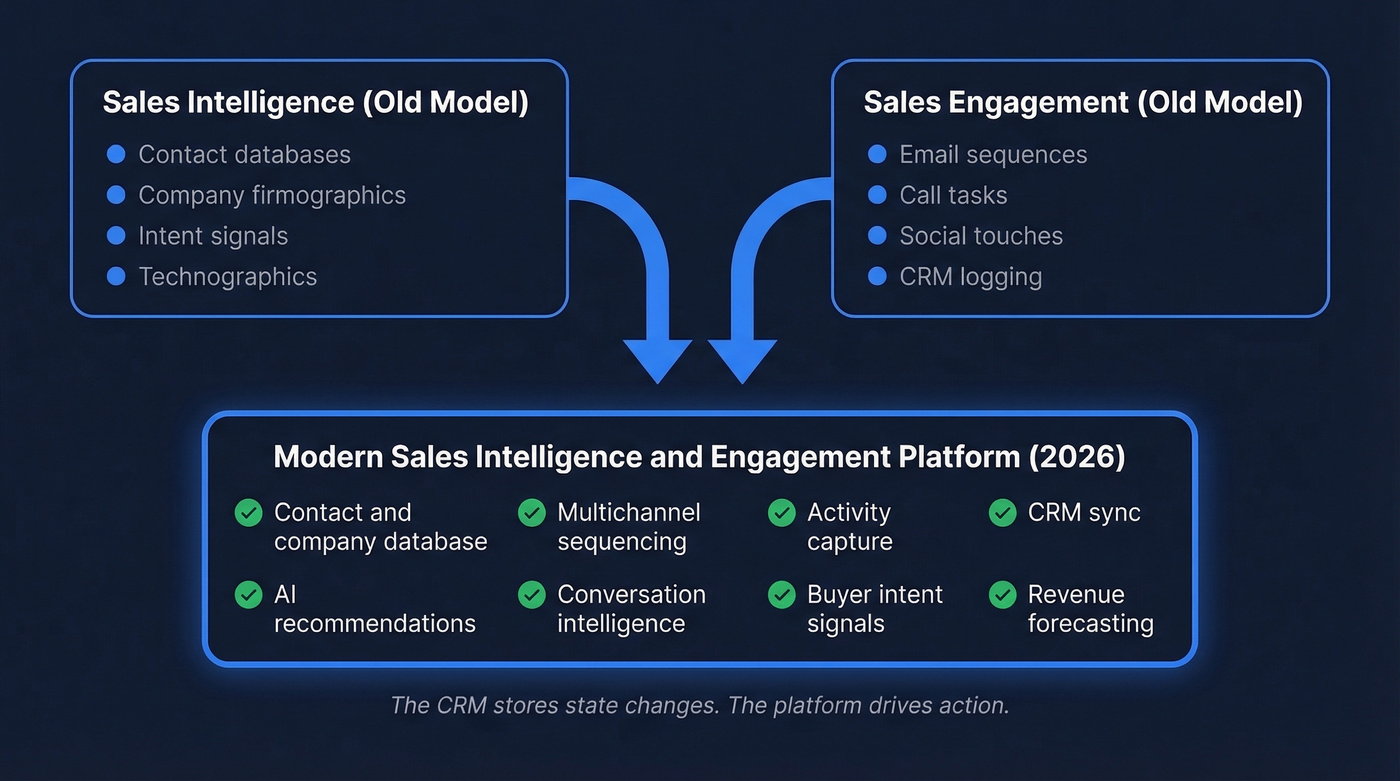
In 2026, that distinction is effectively dead.
ZoomInfo frames this convergence as "intelligence-driven orchestration" - platforms that don't just automate outreach but recommend who to contact, when, and with what message, all based on account context and behavioral signals. That's where every major vendor has already moved. Outreach added conversation intelligence and forecasting. Apollo bolted a database onto its sequencer. ZoomInfo built engagement workflows on top of its data layer.
The practical result: a modern sales intelligence and engagement platform combines a contact/company database, multichannel sequencing (email, phone, social), activity capture, CRM sync, analytics, and increasingly, AI-powered recommendations. It sits between your CRM - which records what happened - and your reps, who need to know what to do next. The CRM stores state changes. The platform drives action, surfacing prospect engagement data so reps act on signals rather than guesswork.
Here's the thing. Not every vendor does both halves equally well. Some are data-first with bolted-on engagement. Others are sequencing engines with a thin data layer. Knowing which type you're buying matters more than any feature checklist.
The 2026 Market Numbers
The sales engagement platform market was valued at $7.4 billion in 2022 and is projected to reach nearly $30 billion by 2032. Adoption is near-universal: 87% of sales development teams now run on some form of engagement platform.
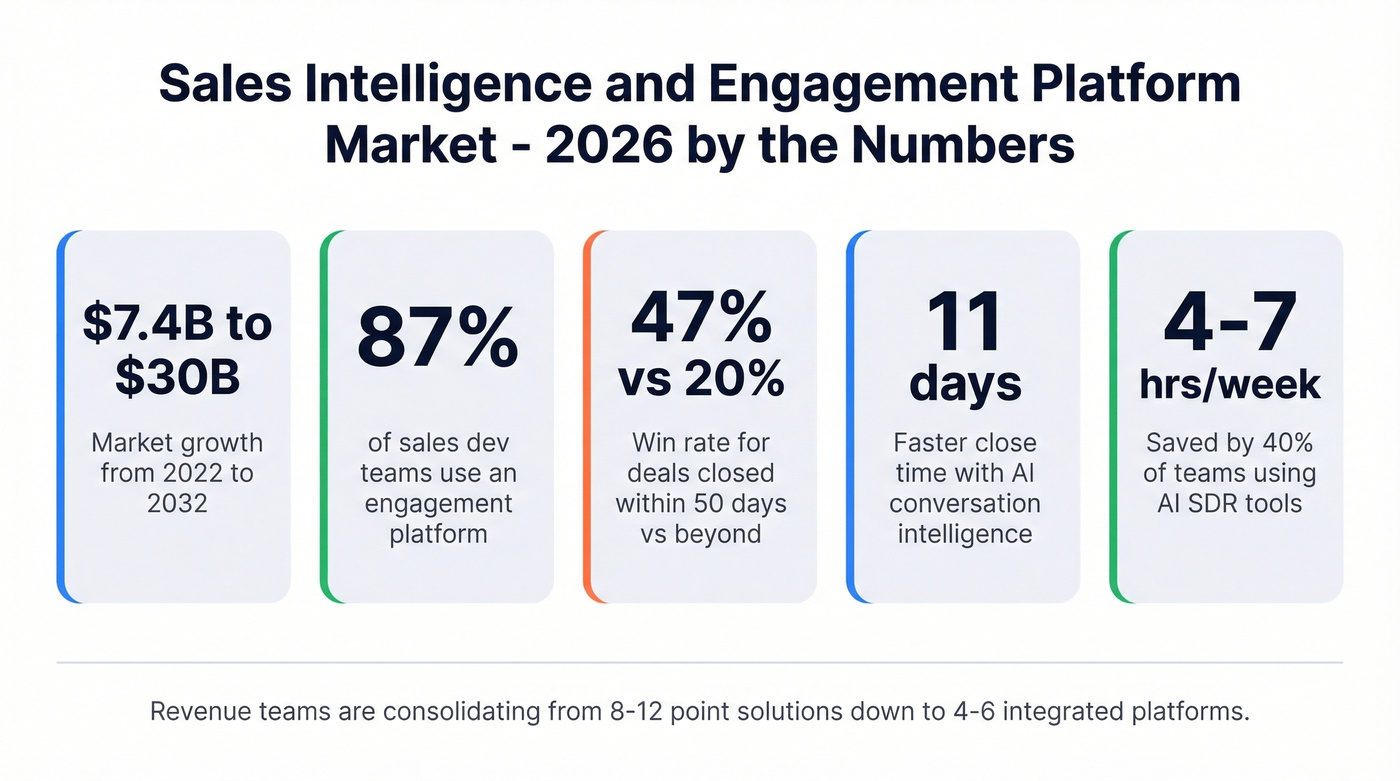
The performance data explains why. 34% of revenue teams report average sales cycles of 1-2 quarters, but speed matters enormously within that window. Outreach's analysis of their customer base found that opportunities closed within 50 days hit a 47% win rate versus roughly 20% or lower beyond that threshold. Their AI assistant Kaia shaves 11 days off the average close cycle. For deals over $50K, sellers using Kaia see a 10-point lift in win rate. Those aren't marginal gains - that's the difference between hitting quota and missing it.
The AI SDR trend is accelerating all of this. Among teams using AI SDR tools, 40% save 4-7 hours per week on prospecting. 45% of high-performing sales teams have adopted hybrid human-AI SDR models where AI handles research and initial outreach while humans handle conversations and closing. LivePerson cut research time from 20 minutes per prospect to 2 minutes and saw a 35% lift in engagement rates.
Revenue teams are consolidating from 8-12 point solutions down to 4-6 integrated platforms. That's not just a cost play - it's a data play. Every handoff between tools is a place where contacts get duplicated, fields get overwritten, and signals get lost.

You just read that the industry average data refresh is 6 weeks - and that stale data torches domain reputation. Prospeo refreshes every 7 days, delivers 98% email accuracy through 5-step verification, and tracks 15,000 intent topics so you reach buyers who are actually in-market. That's the intelligence layer most platforms charge $15K+/year to access.
Get enterprise-grade sales intelligence at $0.01 per verified email.
What to Look For Before You Buy
Before you shortlist platforms, you need evaluation criteria that actually predict success. Feature matrices don't tell you much. These seven factors do.
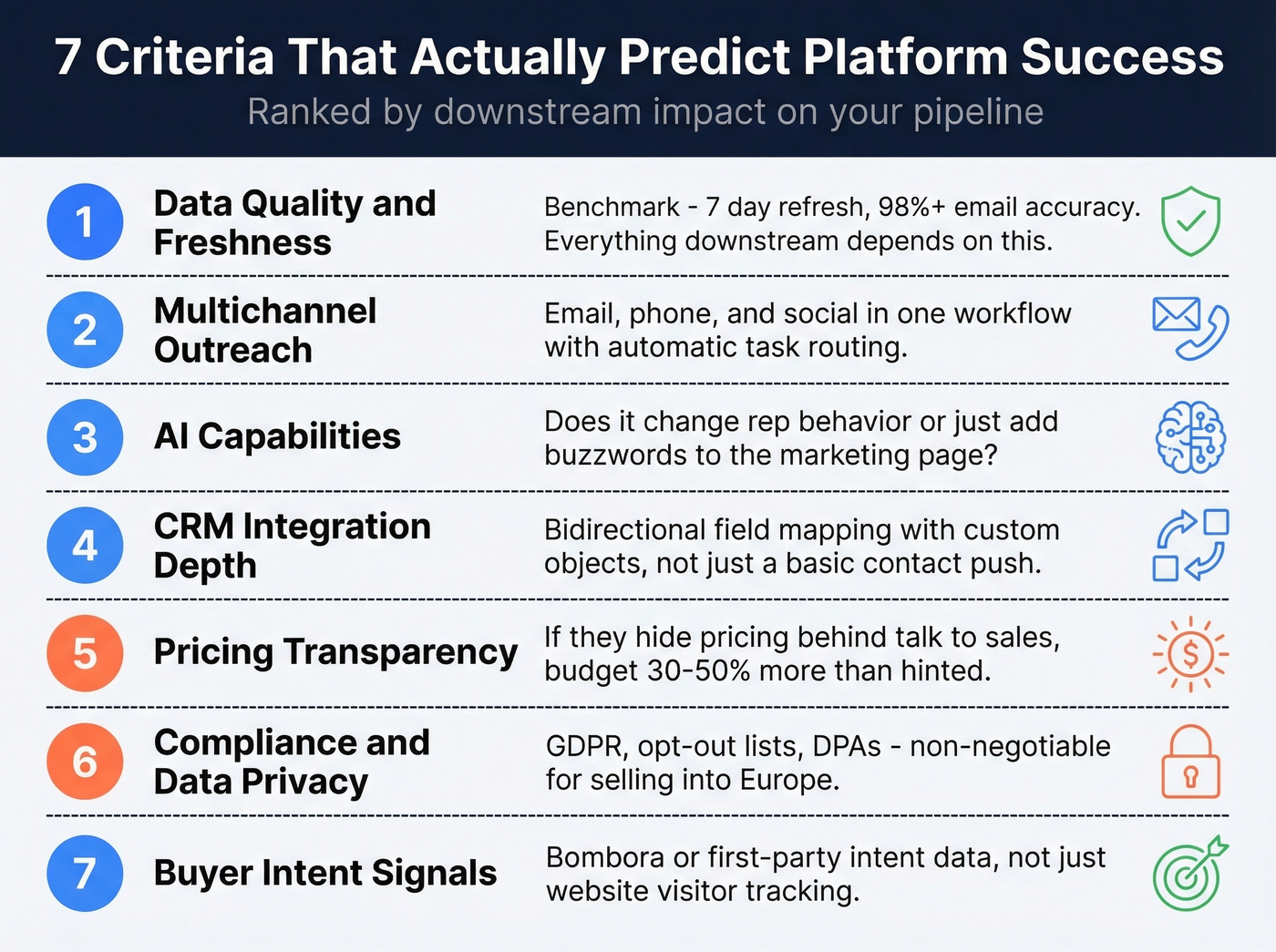
Data Quality and Freshness
This is criterion number one because everything downstream depends on it. A $150/user/month sequencing tool sending emails to a 25% bounce-rate list is burning money and domain reputation simultaneously. Your sender domain can get blacklisted in weeks.
The industry average for data refresh is roughly 6 weeks. That means the "verified" email you pulled in January might belong to someone who changed jobs in February. The benchmark to hold every platform against: a 7-day refresh cycle and 98%+ email accuracy on verified addresses. If a vendor can't tell you their refresh cadence, assume it's worse than 6 weeks.

Multichannel Outreach
Email-only sequencing is a relic. Your platform needs to orchestrate email, phone, and social touches in a single workflow with automatic task routing. Look for native dialer integration or built-in calling, not just "we integrate with Aircall." If you're building a calling motion, align it with a repeatable cold calling system.
AI Capabilities
Every vendor slaps "AI-powered" on their marketing page. What matters is whether the AI actually changes rep behavior. Does it recommend which accounts to prioritize? Does it draft personalized first lines from account context? Does it flag deals at risk before the rep notices? Ask for specifics, not buzzwords. If you're comparing vendors, it helps to benchmark against the broader landscape of generative AI sales tools.
CRM Integration Depth
"Integrates with Salesforce" can mean anything from a basic contact push to bidirectional field mapping with custom object support. The difference between those two is the difference between a useful tool and a data cleanup nightmare. We've seen teams spend more time fixing CRM sync issues than they save on prospecting. If you're implementing Outreach specifically, use a checklist like Connect Outreach Tool to CRM.
Pricing Transparency
The fact that ZoomInfo, Outreach, and Salesloft all hide pricing behind "talk to sales" in 2026 tells you everything about how they view the buyer relationship. Look for platforms that publish pricing. If they won't tell you what it costs before a demo, budget 30-50% more than whatever the SDR hints at.
Compliance and Data Privacy
If you're selling into Europe, GDPR compliance isn't optional - it's a deal-breaker. Ask whether the platform maintains opt-out lists, offers DPAs, and sources data through vetted channels. Cognism has built its entire positioning around this. Others treat it as an afterthought.
Buyer Intent Signals
Intent data tells you which accounts are actively researching solutions like yours. It's the difference between cold outreach and warm outreach. Not every team needs it, but if you're running ABM or targeting mid-market and above, intent signals compress your sales cycle significantly. Look for Bombora-powered or first-party intent, not just "website visitor tracking." For a practical framework, see Identifying Buying Signals.
A quick note on DIY alternatives: yes, you can stitch together Zapier, Gmail, and spreadsheets. It works for a solo founder. It breaks catastrophically past 5 reps.
Best Platforms for 2026
Prospeo - Best for Data Accuracy
Your engagement platform is only as good as the data feeding it. Prospeo is the data accuracy layer that makes every other tool in the stack work.
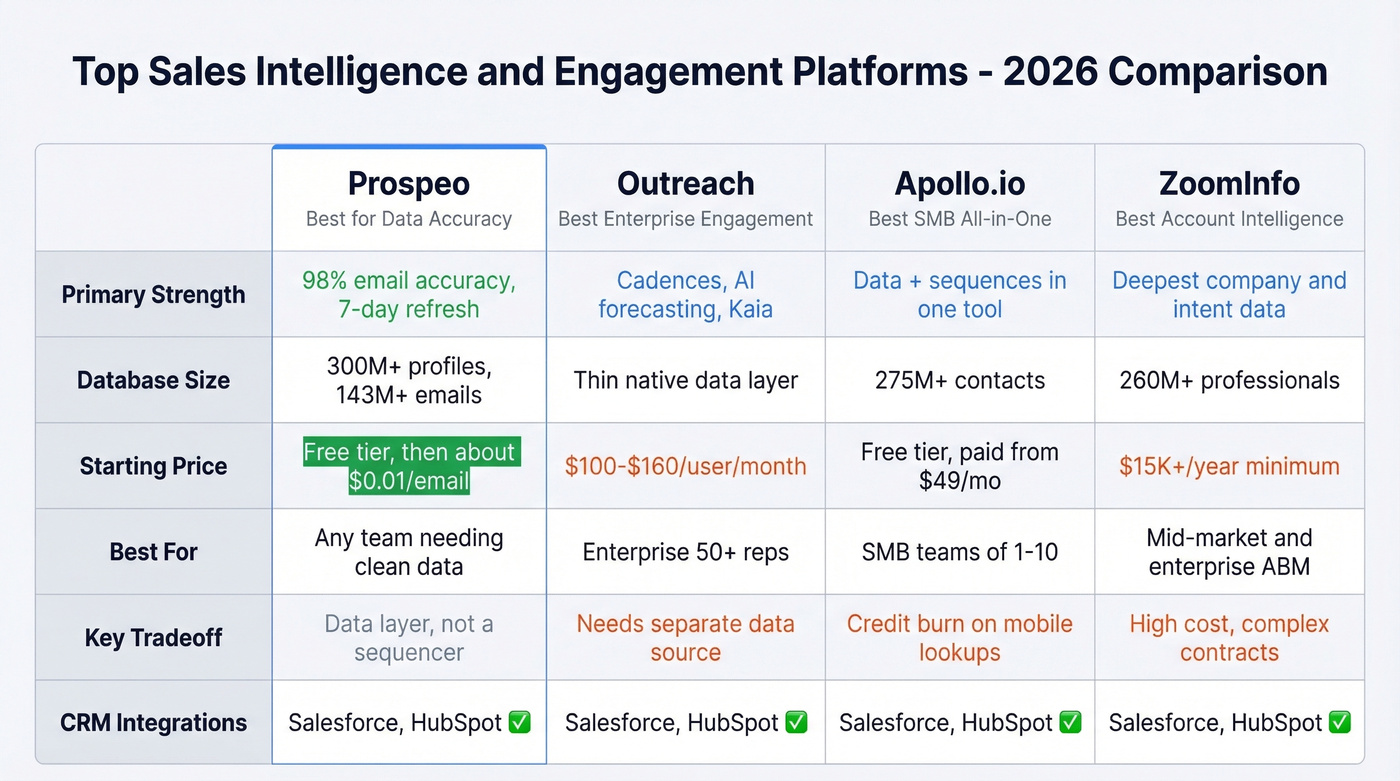
The numbers: 300M+ professional profiles, 143M+ verified emails at 98% accuracy, and 125M+ verified mobile numbers with a 30% pickup rate. The entire database refreshes every 7 days through a proprietary 5-step verification process - no third-party email providers, catch-all handling included, spam traps and honeypots filtered out.

The search layer includes 30+ filters - buyer intent across 15,000 Bombora topics, technographics, job changes, headcount growth, funding signals, and revenue ranges. Native integrations push directly into Salesforce, HubSpot, Outreach, Salesloft, Smartlead, Lemlist, Clay, Zapier, and Make. If you're comparing providers for the data layer specifically, start with data enrichment services and sales prospecting databases.
Two proof points stand out. Snyk's 50-person AE team went from a 35-40% bounce rate to under 5%, AE-sourced pipeline jumped 180%, and they generated 200+ new opportunities per month. Meritt tripled pipeline from $100K to $300K/week while dropping bounce rates below 4%.
Pricing starts free (75 emails + 100 Chrome extension credits/month), with paid plans running roughly $0.01 per email - no contracts, cancel anytime.
Outreach - Best Enterprise Engagement
Outreach is the enterprise sequencing engine that's grown into a full revenue execution platform. Cadences, conversation intelligence via Kaia, deal inspection, forecasting, and AI-generated action items - all in one UI. The benchmarks are hard to argue with: 11 days faster close times and a 10-point win-rate lift on $50K+ deals when using Kaia.

The tradeoff: Outreach is engagement-first. Its native data layer is thin compared to dedicated data platforms. You'll need a separate source for contact discovery and verification. Pair it with a strong data layer and you've got a stack that covers both halves well. If you want a rollout plan, follow Implementing a Sales Engagement Platform.
Pricing: ~$100-$160/user/month on annual contracts, plus $1,000-$8,000 in implementation fees for year one. A 10-seat deployment runs $12,000-$19,200/year before onboarding.
Apollo.io - Best All-in-One for SMBs
Apollo is the obvious starting point for most SMB teams. Free tier gets you in the door with 50 AI credits and 2 sequences. The database covers 275M+ contacts, and the built-in sequencer handles email, phone, and social touches without needing a separate tool.
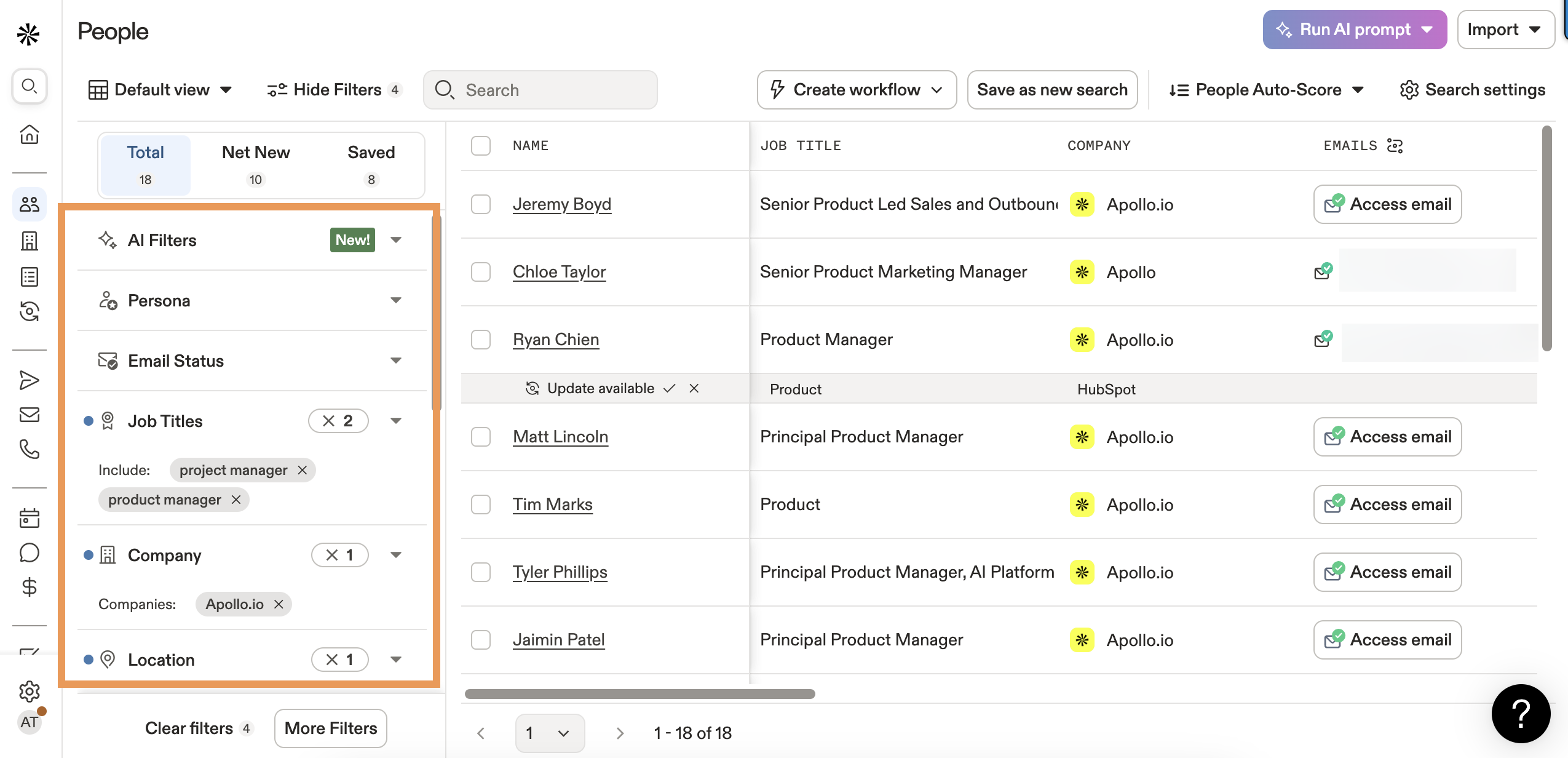
Use this if you're a team of 1-10 reps, budget-conscious, and want data + engagement in one login. Skip this if you need enterprise-grade deliverability controls or your team burns through mobile credits fast. The credit system is Apollo's Achilles heel - mobile lookups cost 8 credits each, credits expire monthly, and waterfall enrichment can spike your burn unpredictably. Basic starts at $49/mo, Professional at $79/mo, Organization at $119/mo with a 3-seat minimum. Budget for 20-30% more than the sticker price once credit overages hit.
ZoomInfo - Deepest Account Intelligence
ZoomInfo has the deepest company and contact database in the market - 500M+ contacts, 100M+ companies, real-time intent signals, technographics, org charts, and buying group indicators. If you're running enterprise ABM and need to map entire buying committees, nothing else comes close.
Where ZoomInfo loses: pricing and flexibility. Professional plans typically start at $15,000-$18,000/year for 1-3 seats. Advanced runs $22,000-$28,000. Elite hits $35,000-$45,000+. Annual contracts only. Renewals climb 10-20% - the #1 complaint on r/sales and in every sales ops community we follow. The Copilot Enterprise tier adds real-time deal activity data, advanced workflows, and a dedicated CSM, but you're deep into five-figure territory.
Hot take: If your average deal size is under $15K, you probably don't need ZoomInfo-level data. The depth is extraordinary, but most teams use maybe 30% of what they're paying for. A verified data source at $0.01/lead paired with a lighter engagement tool often delivers better ROI than a $35K/year platform your reps treat as a glorified email lookup.
SalesLoft - Enterprise Alternative to Outreach
Outreach and Salesloft are essentially the same product. Pick based on which CRM your team runs and which UI your reps already know. Salesloft leans into deal management and pipeline visibility, and its Rhythm feature uses buyer signals to prioritize rep actions - a genuine differentiator if your team struggles with task prioritization. Pricing runs ~$125-$165/user/month on annual contracts. If your org is on Salesforce and your reps prefer Salesloft's interface, it's a fine choice. Don't overthink this one.
Cognism - Best for European Compliance
Use this if you're selling into EMEA and GDPR compliance is non-negotiable. Cognism uses a five-step validation process, checks against 15+ Do-Not-Call lists, and offers intent data as an add-on powered by Bombora. Cognism wins over ZoomInfo on EMEA data quality and regulatory peace of mind. ZoomInfo still wins on US database depth and workflow breadth. Pricing is custom, typically ~$1,000-$3,000/month for small teams, scaling with seats and data access.
HubSpot Sales Hub - CRM-Native Option
If you're already on HubSpot CRM, Sales Hub is the path of least resistance. Sequences, email tracking, meeting scheduling, and basic prospecting tools - all native, no integration headaches. It won't match Outreach on sequencing depth or ZoomInfo on data, but for mid-market teams that want simplicity, it's hard to beat. Starts at $20/user/month for Starter. Professional and Enterprise tiers scale up from there. Skip this if you need advanced multichannel orchestration or deep intent data.
Demandbase - Best for ABM
Enterprise ABM platform that combines intent data, advertising, and sales intelligence into one account-based workflow. Demandbase One for Sales includes recommendations from a database of 160M+ professionals at 104M+ companies. If your GTM motion is purely account-based and you're spending $50K+ on the platform layer, Demandbase is worth evaluating. Pricing is enterprise-only - expect $30,000-$100,000+/year depending on modules and account volume. If you're formalizing your motion, use account-based selling best practices as your baseline.
Gong - Conversation Intelligence
Gong isn't a prospecting tool - it's what happens after the meeting starts. Call recording, deal intelligence, and coaching insights based on actual conversation patterns. Pairs well with any engagement platform on this list. Pricing runs ~$100-$150/user/month.
Salesforce Sales Engagement
If your entire org runs on Salesforce and you want to minimize tool sprawl, Salesforce Sales Engagement keeps prospecting inside the CRM. It unifies emails, phone calls, social touches, and tasks into a single to-do list, and Sales Cadences provide step-by-step prospecting instructions with automation and AI recommendations. Pricing is $50/user/month billed annually.
We excluded tools like Groove, Mixmax, and Reply.io - they're solid for specific use cases but don't combine intelligence and engagement deeply enough to qualify for this list.
Platform Comparison
| Tool | Best For | Database Size | Starting Price | Contract |
|---|---|---|---|---|
| Outreach | Enterprise engagement | Thin (pair w/ data tool) | ~$100/user/mo | Annual |
| Apollo | SMB all-in-one | 275M+ contacts | Free / $49/mo | Monthly available |
| ZoomInfo | Account intelligence | 500M+ contacts | ~$15K/year | Annual |
| Salesloft | Enterprise engagement | Thin (pair w/ data tool) | ~$125/user/mo | Annual |
| Cognism | EMEA compliance | Strong in EMEA | ~$1K-$3K/mo | Annual |
| HubSpot Sales Hub | CRM-native | Basic | $20/user/mo | Monthly available |
| Demandbase | ABM | 160M+ pros / 104M+ companies | ~$30K+/year | Annual |
| Gong | Conversation intel | N/A | ~$100/user/mo | Annual |
| Salesforce Sales Engagement | CRM-native engagement | N/A | $50/user/mo | Annual |
What These Platforms Actually Cost
| Tool | Starting Price | 10-Seat Annual Cost | Contract | Watch Out For |
|---|---|---|---|---|
| Outreach | ~$100/user/mo | $12K-$19.2K/yr | Annual | $1K-$8K implementation |
| Apollo | Free / $49/mo | $5,880-$14,280/yr | Monthly avail. | Credit expiration |
| ZoomInfo | ~$15K/yr (1-3 seats) | $35K-$55K+/yr | Annual | 10-20% renewal hikes |
| Salesloft | ~$125/user/mo | $15K-$19.8K/yr | Annual | $1K-$5K implementation |
| Cognism | ~$1K/mo | $15K-$36K/yr | Annual | EMEA-focused coverage |
| HubSpot Sales Hub | $20/user/mo | $2,400-$18K/yr | Monthly avail. | Feature gaps at Starter |
| Demandbase | ~$30K+/yr | $30K-$100K+/yr | Annual | Enterprise-only scope |
| Gong | ~$100/user/mo | $12K-$18K/yr | Annual | Not a prospecting tool |
| Salesforce Sales Engagement | $50/user/mo | $6K/yr | Annual | Add-on scope |
Let's break down what this looks like in practice. A 10-person SDR team running the enterprise stack - Outreach for engagement plus ZoomInfo for data - is looking at roughly $54,200/year ($19,200 for Outreach at $160/user/month + $35,000 for ZoomInfo Advanced at 10 seats). That's before implementation fees, credit overages, and the inevitable renewal bump.
The lean stack alternative: Apollo Professional for sequencing at $79/user/month ($9,480/year for 10 seats) plus a dedicated verified data source at roughly $1,200-$4,800/year. Total: ~$10,680-$14,280/year. That's 74-80% cheaper. And if your data layer runs 98% email accuracy versus the 85-90% range typical of bundled databases, you're not just saving money - you're protecting your domain reputation. If deliverability is a priority, start with an email deliverability guide.
Hidden Costs That Blow Your Budget
Implementation fees are the quiet budget killer. Outreach and Salesloft commonly charge $1,000-$8,000 for year-one setup - CRM mapping, workflow configuration, team training. That's on top of your per-seat costs.
Credit expiration catches Apollo users off guard. Credits don't roll over between billing cycles. If your team has a slow month, those unused credits vanish. Busy month? You're buying overages at premium rates. Budget 20-30% above the listed price for real-world Apollo spend.
Renewal inflation is ZoomInfo's signature move. Expect 10-20% annual increases. A $35K contract in year one becomes $42K in year two and $50K in year three. Over a 3-year period, you're paying significantly more than the initial quote suggested.
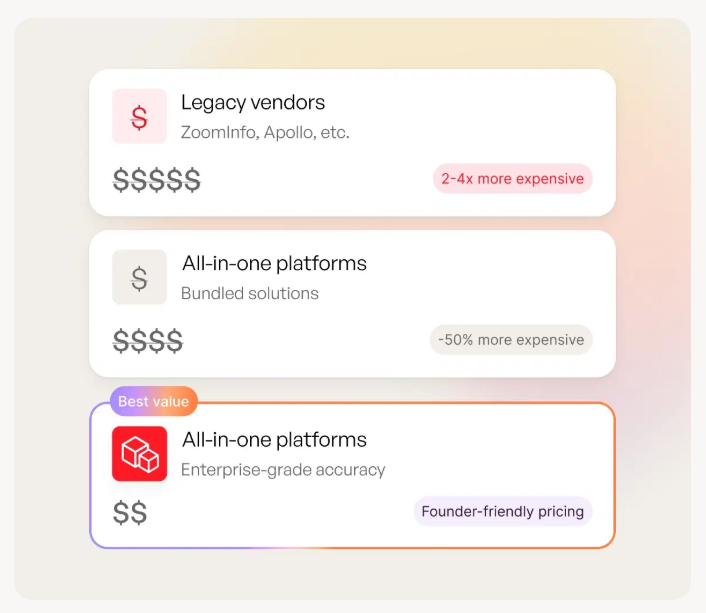
Consolidating from 8-12 point solutions? Prospeo combines 300M+ verified profiles, 125M+ mobile numbers with a 30% pickup rate, Bombora-powered intent data, and native integrations with Salesforce, HubSpot, Outreach, and Salesloft - all with published pricing and zero sales calls required.
Replace your data stack, not your engagement tools.
Which Platform Fits Your Team?
| Team Size | Budget | Data-First Pick | Engagement-First Pick | All-in-One Pick |
|---|---|---|---|---|
| 1-5 reps | < $5K/yr | Prospeo (free tier) | HubSpot Sales Hub | Apollo (free/Basic) |
| 5-20 reps | $5K-$25K/yr | Prospeo + Outreach | Outreach or Salesloft | Apollo Professional |
| 20-100 reps | $25K-$75K/yr | Prospeo + Outreach | Outreach or Salesloft | Apollo Organization |
| 100+ reps | $75K+/yr | ZoomInfo + Outreach | Outreach Enterprise | ZoomInfo Copilot |
Real talk: the "all-in-one" promise breaks down at scale. Once you're past 20 reps, the teams we've worked with consistently get better results from best-of-breed combinations than from a single vendor trying to do everything.
For teams under 10 reps with tight budgets, Apollo's all-in-one approach makes sense as a starting point. You'll outgrow it, but it gets you moving fast. For teams above 20 reps, invest in the engagement platform your reps will actually adopt - usually Outreach or Salesloft, whichever your org already knows - and pair it with a verified data layer underneath. A data-driven sales intelligence and engagement platform strategy means your reps spend time on accounts that are actually in-market, not blasting cold lists and hoping for replies. A $150/user/month sequencer sending to stale emails is just an expensive way to damage your domain. If you need a repeatable outbound motion, borrow from proven sales prospecting techniques.
If you're already on Salesforce or HubSpot and your outbound motion is light, the CRM-native engagement features might be enough. Don't add tools you won't use.
FAQ
What's the difference between sales intelligence and sales engagement?
Sales intelligence covers data and signals about who to contact - company information, verified emails, intent signals, technographics. Sales engagement covers the tools to reach them - email sequences, call tasks, social touches, CRM logging. In 2026, most platforms combine both into a single workflow, making the distinction increasingly academic.
How much does a sales engagement platform cost?
Expect $20-$165/user/month depending on the tier. Enterprise tools like Outreach and Salesloft run $100-$165/user/month on annual contracts. SMB options like Apollo start at $49/month. Add $1,000-$8,000 in implementation fees and credit overages for the true cost.
Why does data quality matter more than the sequencing tool?
Sequences sent to bad emails bounce, damage your domain reputation, and waste rep time. A 25% bounce rate can get your domain blacklisted within weeks. Verifying contacts before they enter sequences - targeting 98%+ accuracy and a weekly refresh cycle - is the difference between booking meetings and killing your sender domain.
Are AI SDR tools replacing human reps?
Not yet. 45% of high-performing teams use hybrid human-AI models. AI handles research, initial outreach, and data enrichment while humans handle conversations, objection handling, and closing. The best results come from AI making reps faster, not replacing them.
Do I need separate tools for intelligence and engagement?
All-in-one platforms like Apollo combine both, but dedicated data layers typically deliver higher accuracy than built-in databases. In our experience, the best stacks pair a strong engagement platform with a purpose-built data source rather than relying on one vendor for everything.